The Usage of Counter Revisited:
Second-Preimage Attack on New Russian
Standardized Hash Function
Jian Guo1, J´er´emy Jean1, Ga¨etan Leurent2, Thomas Peyrin1, and Lei Wang1
1 Division of Mathematical Sciences, School of Physical and Mathematical Sciences, Nanyang Technological University, Singapore
{GuoJian,JJean,Thomas.Peyrin,Wang.Lei}@ntu.edu.sg
2
INRIA, France
Abstract. Streebogis a new Russian hash function standard. It follows the HAIFA framework as domain extension algorithm and claims to resist recent generic second-preimage attacks with long messages. However, we demonstrate in this article that the specific instantiation of the HAIFA framework used inStreebogmakes it weak against such attacks. More precisely, we observe thatStreebog makes a rather poor usage of the HAIFA counter input in the compression function, which allows to con-struct second-preimages on the fullStreebog-512with a complexity as low asn×2n/2 (namely 2266) compression function evaluations for long messages. This complexity has to be compared with the expected 2512 computations bound that an ideal hash function should provide. Our work is a good example that one must be careful when using a design framework for which not all instances are secure. HAIFA helps designers to build a secure hash function, but one should pay attention to the way the counter is handled inside the compression function.
Key words:Streebog, cryptanalysis, second-preimage attack, diamond structure, expandable message, HAIFA.
1
Introduction
Hash functions are among the most fundamental primitives in modern cryptogra-phy. Informally, a cryptographic hash function maps an arbitrarily long message into a short random looking digest, which acts as the fingerprint of the original message. As for any cryptographic primitive, one expects some security properties to be fulfilled and in the case of hash functions we can point to three classical notions:
• Collision Resistance:it should be computationally infeasible for an adver-sary to find a pair of distinct messages that have the same hash digest. • Second-Preimage Resistance: for any given message M, it should be
computationally infeasible for an adversary to find a distinct messageM0
• Preimage Resistance:for any given hash digesth, it should be computa-tionally infeasible for an adversary to find a messageM that leads to the hash digesth.
By “computationally infeasible”, we mean that an attacker should not be able to break that property with less than a certain number of computations that depends onn, the bit length of the hash digest. More precisely, we expect that the best attacks on a cryptographic hash function are generic attacks. In the case of an ideal hash function, one expects to find a (second)-preimage only after trying about 2n distinct messages, and to find a collision only after trying about
2n/2distinct messages (due to the birthday paradox).
A cryptographic hash function is commonly built by iterating a fixed input-length function calledcompression function in order to handle arbitrarily long messages, and the iteration algorithm is referred to asdomain extension. In this article, we mainly discuss the domain extension schemes for cryptographic hash functions, and consider the compression function as an ideal component.
Generic attacks. The well-known Merkle-Damg˚ard scheme [13,26] has been the most popular domain extension scheme in order to build a hash function, e.g.,
MD5,SHA-1andSHA-2are built upon such design strategy. However, since 2004,
several weaknesses of Merkle-Damg˚ard scheme have been discovered. In particular, Kelsey and Schneier published a generic second-preimage attack for long messages against the Merkle-Damg˚ard scheme [23] in 2005. The attack complexity is roughly 2n−k compression function calls if the original given message is 2k-block long,
withk≤n/2. Later, Andreeva et al. gave an alternative attack using a diamond structure [3]. Their attack also require 2n−k compression function calls if the original given message is 2k-block long, but only fork
≤n/3. On the other hand, it is applicable to a wider range of designs; in particular it can accommodate a small dithering input in the compression function. It also gives some more freedom to the adversary: as mentioned in [3], this variant allows “the attacker to leave most of the target message intact in the second preimage, or to arbitrarily choose the contents of roughly the first half of the second preimage, while leaving the remainder identical to the target message.”
Therefore, regardless of how the compression function is designed, a Merkle-Damg˚ard hash function can simply not achieve the security of 2nwith respect to
proved under strong randomness assumptions for the compression function [10]. On the other hand, this means the compression function must accept an extra input, which must be processed securely to avoid security issues. In particular, compression function attacks can take advantage of this input [4,9,16,19], even though the effect on the iterated function is not obvious. Recently, many new dedicated hash functions have been designed following the HAIFA framework, including someSHA-3candidates (BLAKE[5],ECHO[6],Shavite-3[8],Shabal[12],
Skein[14]), as well asStreebog, which has been standardized by the Russian
government as GOST R 34.11-2012 [27] and by IETF as RFC 6896 [20].
Our contributions. In this article, we focus on the security of Streebog
hash function with respect to the second-preimage resistance. According to the designers,Streebogis based on the HAIFA framework, and is explicitly claimed to resist second-preimage attacks with long message [17,30]3.
While we are not aware of any generic second-preimage attack on the HAIFA framework, we emphasize that HAIFA acts as a generic framework, without explicitly specifying how the counter should be involved in the compression function computation. On the other hand,Streebog, as an instantiation of the
HAIFA framework, has fully specified the way how the counter is used inside the compression function. This instantiation is quite provocative as the counter is simply XORed to the internal state variable of the compression function. Thus, it is necessary to evaluate whether this simple approach is sound or not (at least with respect to the second-preimage resistance). This analysis will also shed some light on the statement of Kelsey and Schneier that “XORing in a monotomic counter” is sufficient to avoid those attacks.
Unfortunately, we show in this article thatStreebog’s method to incorporate the counter does not strengthen its security with respect to second-preimage
resistance. More precisely, we observe that during the sequential iteration of the
compression function, the counter injection at blockiinteracts with the counter injection at next blocki+1. The iteration of the compression function inStreebog
can then be transformed into an equivalent form, for which a counter-independent function is used multiple times during the hashing process. This behavior reduces to almost zero the extra security brought by the HAIFA framework over the regular Merkle-Damg˚ard construction. Thanks to our findings, we describe two second-preimage attacks on the full Streebog-512. In Section 4, we give an attack using a diamond structure, similar to the attack of [3]. It requires about 2342 compression function evaluations for long messages with at least 2179blocks. In Section5, we give attack using an expandable message, similar to the attack of [23]. It requires only 2266 compression function evaluations for long messages with at least 2259blocks. For short messages of 2x blocks, the first attack gives a
complexity of about 2x·2512−xwhenx <179, while the second attack gives a
complexity of about 2523−x whenx <259. Note that this increaseslinearly with
the decrease of the message block length (ignoring the logarithmic factor). The rest of the article is organized as follows. In Section 2, we provide a description of theStreeboghash function, and then discuss our main observation on the usage of the counter value in Section3. We detail how this observation can be used in order to mount second-preimage attacks of the fullStreebog-512
hash function in Section4(using a diamond structure), and in Section 5(using an expandable message). Finally, we draw conclusions in Section6.
2
Specifications of
Streebog
2.1 Domain extension of Streebog
Streebogis a family of two hash functions,Streebog-256 and Streebog-512
that has hash output sizes 256 and 512 bits respectively [20,27]. In this article, we only consider the large versionStreebog-512 and we simply refer to it as
Streebog.
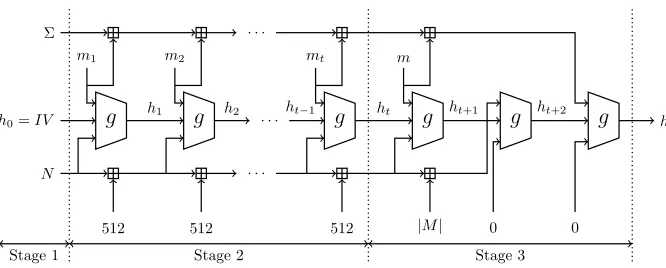
During the computation process,Streebogupdates the internal state has well as two other internal variables:Σ that denotes the checksum of the message blocks already processed, and the counterN that refers to the number of already hashed bits. Both the message block size and the intermediate hash variable size are 512 bits. The dedicated domain extension consists of three stages that we describe below (see also Figure 1). Let M be the input message, and we denote|M|its bit length. In the rest of the article, we also denotehi the internal
state variablehafter thei-th application of the compression functiong, which is defined in more details in Section 2.2.
Stage 1. This phase initializes the hash state. The three variablesΣ,N and hare assigned to 0, 0 andIV respectively, whereIV refers to the initialization vector ofStreebog, and has been publicly defined by the designers.
Stage 2. The input messageM is divided into 512-bit blocksm1||m2|| · · · ||mt,
wheret=l|512M|m. The blockmi, 1≤i≤t, is processed according to the following
operations:
hi←−g(N, hi−1, mi); N←−N+ 512; Σ←−Σ+mi.
Stage 3. Pad the last block with10· · ·0so that it becomes full, and we denote this padded blockm. Then, process this padded last block with:
ht+1←−g(N, ht, m); N←−N+ (|M| mod 512); Σ←−Σ+m.
After all the message blocks have been processed, two extra compression function calls are applied:
g
m1h0=IV
512
N
Σ
h1
g
m2
512
. . . . . .
h2 . . .
g
mt
ht−1
512
g
mht
|M|
g
ht+10
g
ht+20
h
Stage 1 Stage 2 Stage 3
Figure 1:The domain extension algorithm ofStreebog.
Finally,ht+3is the hash digest forStreebog-512. In the case ofStreebog-256, the 256 MSBs ofht+3 are outputted as hash digest.
2.2 The compression function of Streebog
As described in the introduction, the designers ofStreeboghave chosen to adopt
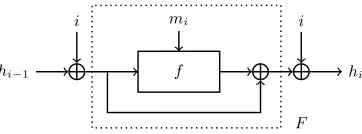
the HAIFA model in the design of the compression functiong. This framework has been initially introduced to differentiate the successive applications of the compression function calls by adding a counter as additional input parameter. Here, we mainly focus on how the counterN is used in the compression function g(N, hi−1, mi), which is described in Figure2. Particularly, we emphasize that
f is a deterministic function independent of the counter N. Since the detailed algorithm of f is not related to our attack, we omit its description in this paper, and refer the interested reader to the original document [20,27]. Yet we would like to point out thatf shares high similarity with the compression function of Whirlpool hash function [28], which leads to the analysis results on
Streebog[1,2,31] that share similarity with the attacks on Whirlpool [25,29].
For the sake of simplicity, we consider that the counter value equals the number of compression calls rather than the number of processed bits. Practically, this only consists in performing a right-shift operations of 9 bit positions on the counter value. This simplification does not change any of the results described in this article, while easing the reading of the technical contents.
3
Our observation
In this section, we propose an equivalent representation of the domain extension algorithm of Streebog, which we use in the next section to launch a second-preimage attack on the full hash function.
i
hi−1
mi
hi f
Figure 2: The compression function g(N, hi−1, mi) of Streebog produces the new chaining variablehi.
design is simply XORed to the internal statehi−1 prior to the application of the functionf (but after the feed-forward branching, see Figure2), which makes it possible to linearly shift the addition before and after the feed-forward in the original compression function. Formally, we have the following equivalence:
hi=hi−1⊕f(hi−1⊕i, mi) ⇐⇒
(
hi=F(hi−1⊕i, mi)⊕i,
F(x, mi) =f(x, mi)⊕x.
Note that the counter valueiis now XORed to both the input hash variable and the output hash variable ofF (see Figure3), whileF itself is a deterministic function which is independent of the counter parameteri.
i i
hi−1
mi
hi
f
F
Figure 3:An equivalent representation ofStreebog’s compression function: the internal functionF has been made independent of the counter value.
We now pay attention to the sequential iteration of the above equivalent compression function in Stage 2 of the domain extension. For the sake of simplicity, we detail here the case of two consecutive blocks (see Figure4).
i i
hi−1
mi
f
F
i+ 1 mi+1 i+ 1
hi+1 f
F
As we can see, during the end of thei-th message block computation until the beginning of the (i+ 1)-th message block computation, the output ofF is updated twice by XORing consecutively the counter valuesiandi+ 1. We define
∆(i)def= i⊕(i+ 1),
F∆(i)(X, Y) def
= F(X, Y)⊕∆(i).
From this observation, we get yet another equivalent representation of the consecutive compression function iterations during Stage 2 of Streebog, as shown in Figure5.
i⊕(i+1) F
i i i+ 1
hi
F∆(i)
(i+1)⊕(i+2) F
i+ 1 i+ 2
hi+2
F∆(i+1)
Figure 5:Two consecutive compression function blocks in the equivalent representation.
Next, we investigate the relation between the functionsF∆(i), 1≤i≤t. In the most simple case, we can easily see that∆(i) =i⊕(i+ 1) = 1 always holds as long asiis an even integer. Consequently, the very same functionF1 is used every even integer index during the iterations in Figure5. We list the first values of ∆(i) in Table 1, and one can see that there is a lot of structure: sequences of length 2s
−1 seem to repeat every 2ssteps. More formally, we compare the
functionsF∆(i)andF∆(i+2s)for any 0≤i <2s−1, wherescan be any positive
integer smaller than 512. Lethiidenote thes-bit binary representation of that integer i. We have:
∆(i) =hii ⊕ hi+1i
∆(i+ 2s) = (1||hii)⊕(1||hi+1i) =hii ⊕ hi+1i.
Thus, we conclude thatF∆(i)andF∆(i+2s)are the same function for any 0≤i <
2s
−1. By extending this simple reasoning, we can generalize and demonstrate thatF∆(i)andF∆(i+j×2s) are the same function for any 0≤i <2s−1 and any
integer j. This is illustrated in Figure6.
Table 1:First values of∆(i).
i: 0 1 2 3 4 5 6 7 8 9 10 11 12 13 14 15 16 17 18 19 20 21 22 23
512−sbits sbits 0 <i>
0 <i+1>
= 0 <i⊕(i+1)> ∆(i)
512−sbits sbits
j <i>
j <i+1>
= 0 <i⊕(i+1)> ∆(i+j·2s)
Figure 6:FunctionsF∆(i)andF∆(j×2s+i) are the same
Finally, we present an equivalent representation of the sequential iteration in Stage 2 of the domain extension of Streebogin Figure7, whereFi denotes
the function for F∆(j×2s+i) with 0≤i≤2s−2, andGj denotes the functions
F∆(j×2s−1), where j is any integer. Let l be t
2s
and p be the reminder of tmod 2s.
F0 F1 . . . F2s−2 G1
IV
0
. .
. ... ...
. . .
F0 F1 . . . F2s−2 Gl
F0 F1 . . . Fp ht
t+ 1
F2s−2◦ · · ·F1◦F0
Figure 7: The equivalent representation of Stage 2
4
Second-preimage attack on full
Streebog
with a
diamond
Based on the equivalent description of the Stage 2 computation of Streebog
presented in the previous section, we now describe a second-preimage attack on the full Streebog-512hash function with time complexity equivalent to 2342 compression function evaluations for an original message of at least 2179 blocks. Our main observation provides a way to remove the security benefits brought by the counter of the HAIFA design in theStreeboghash function. This is due to
technique allows to construct a large multicollision set of 2dd-block messages, all
hashing to a single chaining variableh. This is similar to the second-preimage attack on dithered hash functions by Andreeva et al. [3].
We first give in Section4.1a detailed explanation concerning the construction of this structure with 2(n+d)/2 computations, and we later describe in Section4.2 how to use it inside a second-preimage attack for the fullStreebog-512.
4.1 The diamond structure
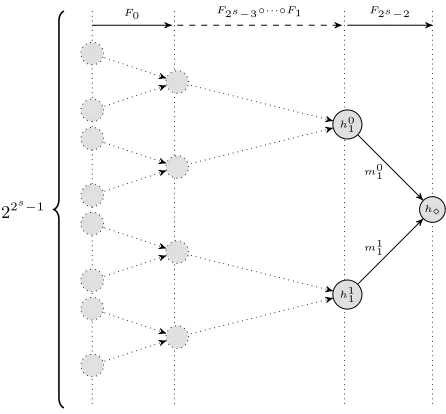
As depicted in Figure8, a 2d-diamond construction refers to a complete binary
tree of depth d, i.e., the distance from the leaves to the root is d. There are exactly 2d−l nodes at levell, for 0≤l≤d, where l= 0 refers to the leaf level and l=dto the root level. All nodes except the leaves have two children from lower level. In [22], Kelsey and Kohno introduced this structure to launch herding attacks. In this diamond, a node refers to a chaining value, and an edge represents a message connecting one chaining value to another.
h h01
m01
h11 m11
22s−1
F2s−2 F2s−3◦···◦F1
F0
Figure 8: The diamond structure of depth 2s−1 used in our second-preimage attack.
Given the leaves, i.e., 2d chaining values at level 0, one can construct the
diamond in 2(n+d)/2compression function evaluations. The construction algorithm was initially proposed by Kelsey and Kohno [22] and later refined by Kortelainen and Kortelainen [24] and verified in [18]. The algorithm works level by level recursively and independently. Below in Algorithm1, we show how the next level of 2d−1 chaining values are computed given the current level of 2d nodes and
then fed into the algorithm as inputLinfor next level, until root is reached. The
overall complexity has been estimated as 2(n+d)/2 in [24].
Algorithm 1 Construction of one level of a diamond
Input: input chaining value listLinof size 2d Input: compression functionf
Output: next layer chaining values listLout of size 2d−1 1: initialize an empty hash tableT, a message listLM. 2: whileLinis not emptydo
3: pick random message blockM, add toLM. 4: for allhin∈Lindo
5: evaluatehout=f(hin, M) 6: if T[hout] is not emptythen
7: fetch the pair (h0in, M0) in entryT[hout] 8: addhout toLout, along with (hin, M), (h0in, M
0
) as the connecting edges. 9: removef(hin, m) andf(h0in, m) fromT for allm∈LM.
10: removehinandh0in fromLin.
11: else
12: add (hin, M) toT[hout].
4.2 Details of the attack
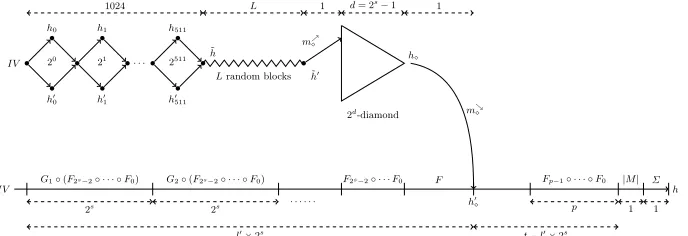
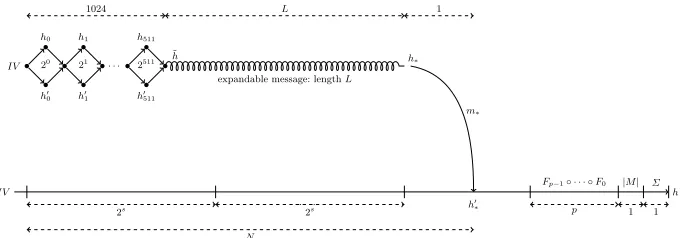
At this point, we are able to build a diamond structure, and we would like to use it for a second-preimage attack. An overview of our attack is given in Figure9, where one can see that we used= 2s
−1 in order to fully control the effect of the counter. The diamond structure is constructed with the function F2s−1◦ · · ·F1◦F0. Then, as in the original second-preimage attack using the
diamond structure, we use a single message blockm& to connect the root chaining
valuehto the known message we are attacking. The connection is done after the
nextF function, but before the addition of the counter, i.e. we match of set of values{F(h, m)|m←$}, and{hi⊕i|i≡0 mod 2s}. If the original message
mconsists oft2s-bit blocks, we havel= t
2s
possible connecting points, meaning that we expect to pick about 2n/lrandom message blocksm&
before hitting a
known pointh0.
This point of connection gives the valuel0×2s−1 of the counterN used in
Streebogat that position. Once we have found the 1-block connecting message
m& at the end of the diamond structure, we need to connect one of the 2d leaves
of the diamond structure to theIV of the hash function.
IV h G1◦(F2s−2◦ · · · ◦F0) G2◦(F2s−2◦ · · · ◦F0) F2s−2◦ · · ·F0 F Fp−1◦ · · · ◦F0 |M| Σ
2s
2s . . . p 1 1
l0×2s t−l0×2s
d= 2s−1 1
1024 L 1
h
2d -diamond
h0
m&
Lrandom blocks . . .
˜ h0
m%
IV h0
h0 0
h1
h0 1
h511
h0 511
˜ h
20 21 2511
Figure 9:Overview of the second-preimage attack.
In order to overcome both of these two points, we first construct a 2512 -multicollision (with a technique similar to the one from Joux [21]) over the first 2×512 = 1024 message blocks so as to handle the checksum issue. This step can be performed efficiently with 512×2n/2computations using the technique described in [15]. The idea is that, at each stepiof the multicollision search, we compute two sets of 2-block messages:{(Ai)||(−Ai)}, for 2n/2 random choices
ofAi, and {(Bi+ 2i)||(−Bi)}, for 2n/2 random choices ofBi, in order to find a
collision between the two sets.
Then, starting from theIV, we reach a chaining value ˜h, such that we can find a 1024-block message that verifies any given additive checksum value σ. Indeed, the binary decomposition of σgives precisely the path to follow (and incidentally the message blocks to use) in the multicollision graph we just built in order to reachσ.
We would like now to match the correct message length|M|. For that task, we first evaluate the number of blocks already fixed by the attack. The diamond usesd= 2s
−1 blocks, the multicollision uses 1024 blocks, and we use one block for m% to connect to h0 in the original message chain. After the collision on
h0, we use the same values as in the original message, such that we want to use exactly l0×2s blocks between theIV andh0
. We use an additional message
block m% to connect to one leaf of the diamond, so that in total there are
L=l0×2s
−1024−1−2s
−1 blocks left between ˜hand ˜h0. We pick random
values for all those blocks, obtain the value of ˜h0, and then pick about 2n−d
random blocksm% to hit one of the 2d leaves of the diamond.
Finally, we compute the reduced checksum valueσof all the message blocks except the 1024 first ones, and we choose the correct 1024 message blocks in the graph so as to match the local checksumΣ−σ. At this point, the attack is over: all the message blocks are fixed, and the second-preimage is constructed.
Overall, the total complexity of this attack requires 2(n+d)/2 computations to construct the diamond, 2n/lcomputations to connect the root of the diamond
multicollision. The time complexity
512×2n/2+ 2n−d+ 2(n+d)/2+ 2n−log2(l)
can be minimized by fixing d = n/3 and l ≥ 2n/3, which reaches an overall time complexity of about 22n/3 computations for the second-preimage attack. With the parameters of Streebog-512, n= 512 gives the integer value s = 8 andd=n/3, and a total time complexity equivalent to about 2342 compression function evaluations. We note that our attack imposes a certain length on the original message asn−log2(l)≤341 imposes l≥2171, which constraintsM to have at least 2171+8= 2179 message blocks.
For shorter messages with 2xblocks and x <179, the complexity is mainly
dominated by the complexity of linking IV to one leaf node of the diamond structure, which is 2n−d, and the complexity of linking h
to h0, which is
2n−x+dlog2(d)e. Let x = d, and we get the complexity is upper bounded by
2x·2n−x. Thus the complexity increaseslinearly with the decrease of the message
block length (ignoring logarithmic factors).
5
Second-preimage attack on full
Streebog
with an
expandable message
The equivalent description ofStreeboggiven in the previous sections can also be used to mount a variant of the attack of Kelsey and Schneier using anexpandable
message[23]. This gives a second-preimage attack on the fullStreebog-512hash
function with time complexity equivalent to 2266compression function calls for an original message of at least 2259 blocks.
We first give in Section5.1a detailed explanation concerning the construction of this structure withn/2×2n/2computations, and we later describe in Section5.2 how to use it inside a second-preimage attack for the fullStreebog-512.
5.1 The expandable message
In order to build an expandable message, we use the technique of [23], i.e. we build a multicollision where the messages in each colliding pair have a different length, as shown by Algorithm2. If we have colliding pairs with length (1,2k+ 1),
for 0≤k < t, this implicitly defines a set of 2tmessages with length in the range
[t,2t+t−1], that all reach the same final chaining valuex
∗. More precisely, one
can build a message of lengtht+Lusing the binary expression ofLto select a message in each pair.
IV
1bl.
27+ 1bl. m7/m07
1bl.
26+ 1bl. m6/m06
1bl.
25+ 1bl. m5/m05
1bl.
24+ 1bl. m4/m04
1bl.
23+ 1bl. m3/m03
1bl.
22+ 1bl. m2/m02
1bl.
In a second-preimage attack, we hash random blocks starting fromx∗ until we find a link to one of the intermediate values reached when hashing the challenge message. This gives the required length for the expandable message, and we build the second preimage using the expandable message, the linking block, and the end of the challenge message.
Algorithm 2 Construction of an expandable message (Merkle-Damg˚ard) Input: Initial chaining valuex
Input: Compression functionf
Output: Message pairs (mi, m0i), final chaining valuex
1: for0≤i < n/2do
2: Initialize an empty hash tableT
3: for0≤r <2n/2 do 4: T[f(x, r)]←r
5: y←x
6: for0≤j <2i do
7: y←f(y,0) 8: repeatr←$
9: untilT[f(y, r)] not empty 10: mi←[0]2ikr
11: m0i←T[f(y, r)]
12: x←f(y, r)
However, this does not work for a HAIFA compression function: depending on which message is selected in the pairk(mk orm0k), the message length before
the following block will be different, and the counter will have a different value. Therefore, the collision (mk−1, m0k−1) will only be valid in one case.
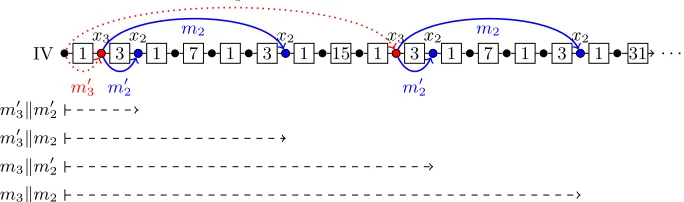
In the case, ofStreebog, the weak use of the counter makes this attack still possible thanks to the equivalent representation of Section3. Indeed, the sequence ∆(i) has a lot of regularity and repetitions (as seen in Table 1), and with a careful construction, we can ensure that the message pairs (mi, m0i) are only used
at positions with same sequences of∆(i). More precisely, we must build pairs with large difference first, and use differences that are powers of two, while more general constructions can be used for plain Merkle-Damg˚ard. We must also stop the construction a few steps before reaching a difference of 1 (as explained later, the smallest difference isO(n)). This means that we can only use a fraction of the intermediate states reached by the challenge message.
In the following, we call an expandable message that can reach lengths between aandbby increment ofcan (a, b, c)-expandable message. Let us assume we have built an (l, l+L,2i)-expandable message for
Streebog, withl <2i−1−1. Since
l <2i
−1, we have∆(l+x) =∆(l+x+j·2i), for all 0
≤x <2i
−l−1 andj ≥0. In particular, if we append a new message pair (m, m0) with|m|= 2i−1+ 1,
|m0|= 1
the (l, l+L,2i)-expandable message into a (l+1, l+L+1+2i−1,2i−1)-expandable message. If we iterate this construction, starting from a single message of lengthl and a maximal increment of 2t, we can build a (l+t
−s, l+t−s+ 2t+1
−2s,2s
)-expandable message forStreebog, assuming thatl+t−s <2s
−1.
IV 1 3 1 7 1 3 1 15 1 3 1 7 1 3 1 31 . . .
m03
m3
m02
m2
m02
m2
x3 x2 x2 x3 x2 x2
m03km02
m03km2
m3km02
m3km2
Figure 10: Construction of a (2,14,4)-expandable message forStreebog. Note that
m2 andm02have the same∆indices in both positions, and the∆for the block after
m03km02,m03km2,m3km02, orm3km2 is the same (here,∆= 1).
5.2 Details of the attack
The second preimage attack on fullStreebog-512uses an initial multicollision with 1024 blocks in order to adjust the checksum, like the attack of Section4. Then, we build the expandable message starting for the final value of the multicollision. With the parameters of Streebog-512, we use l = 1024, s = 11, t = 258, i.e. we build a (1271,2259
−777,2048)-expandable message. After building the expandable message, the attack mostly follows the procedure given by Kelsey and Schenier. An overview of our attack is given in Figure11.
We first use a message blockm∗ to connect the final chaining valueh∗ to
the known message we are attacking. More precisely, if the original messagem consists oft 2s-bit blocks, we havel=t
2s
possible connecting points, meaning that we expect to pick about 2n/l random message blocksm
∗ before hitting a
known pointh0∗. With the parameters used forStreebog-512, we use connecting points4 withi≡1272 mod 2048. This point of connection gives the value of the
counter N used in Streebogat that position, and the lengthL=N−1024−1 required for the expandable message. In order to build the second preimage, we select the message with the correct lengthLin the expandable message, and we select a message in the initial multicollision to adjust the checksum.
Overall, the attack requires about 512×2n/2 computations for the Joux’s multicollision, 256×2n/2for the expandable message, and 2n/lcomputations to
4
IV h Fp−1◦ · · · ◦F0 |M| Σ
2s
2s . . . .
p 1 1
N
1
1024 L
h∗
h0 ∗
m∗
expandable message: lengthL . . .
IV h0
h0 0
h1
h0 1
h511
h0 511
˜ h
20 21 2511
Figure 11:Overview of the second-preimage attack.
connect the end of the expandable message to the original message chain. The time complexity
768×2n/2+ 2n/l
can be minimized with l >2n/2/n, and reaches an overall time complexity in the order of n·2n/2 computations for the second-preimage attack. With the parameters of Streebog-512, we have n = 512 and s= 11, and a total time complexity equivalent to about 2266 compression function evaluations, if the message has more than 2259 blocks (so that 2n/l≤256×2n/2).
6
Open discussion and conclusion
In this article, we have studied the security of the Russian hash function standard
Streebog. We showed that an attacker can find second-preimages much faster
than what is expected from an ideal hash function, even thoughStreeboguses HAIFA as the domain extension algorithm. Our main observation is that the counter is not very well handled inStreebogand this enables the attacker to apply a more complex variation of the now classical generic second-preimage attacks. As a result,Streebogis only marginally stronger than a plain Merkle-Damg˚ad iteration.
This analysis also contradicts the remark by Kelsey and Schneier that “XOR-ing in a monotomic counter” would be sufficient to avoid the second-preimage attacks with long messages: there is at least one way to XOR the counter that do not provide any extra security.
a differenceδin both the counter and the chaining variable input, one always get δon the output). It would be interesting to study what is exactly the minimal security assumption that is required on the counter input for HAIFA in order to ensure only secure instances.
7
Acknowledgment
We would like to thank the anonymous reviewers for their detailed feedback and comments. Jian Guo, J´er´emy Jean, Thomas Peyrin and Lei Wang were supported by the Singapore National Research Foundation Fellowship 2012 (NRF-NRFF2012-06).
References
1. AlTawy, R., Kircanski, A., Youssef, A.M.: Rebound attacks on Stribog. IACR Cryptology ePrint Archive2013(2013) 539
2. AlTawy, R., Youssef, A.M.: Preimage Attacks on Reduced-Round Stribog. In Pointcheval, D., Vergnaud, D., eds.: Progress in Cryptology - AFRICACRYPT 2014 - 7th International Conference on Cryptology in Africa, Marrakesh, Morocco, May 28-30, 2014. Proceedings. Volume 8469 of Lecture Notes in Computer Science., Springer (2014) 109–125
3. Andreeva, E., Bouillaguet, C., Fouque, P.A., Hoch, J.J., Kelsey, J., Shamir, A., Zimmer, S.: Second Preimage Attacks on Dithered Hash Functions. In Smart, N.P., ed.: EUROCRYPT 2008. Volume 4965 of LNCS., Springer (April 2008) 270–288 4. Aumasson, J.P., Guo, J., Knellwolf, S., Matusiewicz, K., Meier, W.: Differential
and Invertibility Properties of BLAKE. In Hong, S., Iwata, T., eds.: FSE. Volume 6147 of LNCS., Springer (2010) 318–332
5. Aumasson, J.P., Henzen, L., Meier, W., Phan, R.C.W.: SHA-3 proposal BLAKE. Submission to NIST (Round 3) (2010)
6. Benadjila, R., Billet, O., Gilbert, H., Macario-Rat, G., Peyrin, T., Robshaw, M., Seurin, Y.: SHA-3 Proposal: ECHO. Submission to NIST (updated) (2009) 7. Biham, E., Dunkelman, O.: A Framework for Iterative Hash Functions - HAIFA.
Cryptology ePrint Archive, Report 2007/278 (2007)
8. Biham, E., Dunkelman, O.: The SHAvite-3 Hash Function. Submission to NIST (Round 2) (2009)
9. Biryukov, A., Gauravaram, P., Guo, J., Khovratovich, D., Ling, S., Matusiewicz, K., Nikolic, I., Pieprzyk, J., Wang, H.: Cryptanalysis of the LAKE Hash Family. In Dunkelman, O., ed.: FSE. Volume 5665 of LNCS., Springer (2009) 156–179 10. Bouillaguet, C., Fouque, P.A.: Practical Hash Functions Constructions Resistant
to Generic Second Preimage Attacks Beyond the Birthday Bound. Submitted to Information Processing Letters (2010)
11. Brassard, G., ed.: CRYPTO’89. In Brassard, G., ed.: CRYPTO’89. Volume 435 of LNCS., Springer (August 1989)
13. Damg˚ard, I.: A Design Principle for Hash Functions. [11] 416–427
14. Ferguson, N., Lucks, S., Schneier, B., Whiting, D., Bellare, M., Kohno, T., Callas, J., Walker, J.: The Skein Hash Function Family. Submission to NIST (Round 3) (2010)
15. Gauravaram, P., Kelsey, J.: Linear-XOR and Additive Checksums Don’t Protect Damg˚ard-Merkle Hashes from Generic Attacks. In Malkin, T., ed.: CT-RSA 2008. Volume 4964 of LNCS., Springer (April 2008) 36–51
16. Gauravaram, P., Leurent, G., Mendel, F., Naya-Plasencia, M., Peyrin, T., Rech-berger, C., Schl¨affer, M.: Cryptanalysis of the 10-Round Hash and Full Compression Function of SHAvite-3-512. In Bernstein, D.J., Lange, T., eds.: AFRICACRYPT. Volume 6055 of Lecture Notes in Computer Science., Springer (2010) 419–436 17. Grebnev, S., Dmukh, A., Dygin, D., Matyukhin, D., Rudskoy, V., Shishkin, V.:
Asymmetrical Reply to SHA-3: Russian Hash Function Draft Standard. CTCrypt 2012, abstract available fromhttp://agora.guru.ru/csr2012/files/6.pdf
18. Guo, J.: A program confirmation of the diamond construction by Kortelainen and Kortelainen. Available online:http://guo.crypto.sg/diamond.zip(Feburary 2014)
19. Guo, J., Karpman, P., Nikolic, I., Wang, L., Wu, S.: Analysis of BLAKE2. In Benaloh, J., ed.: CT-RSA. Volume 8366 of LNCS., Springer (2014) 402–423 20. IETF: GOST R 34.11-2012: Hash Function. RFC6896 (2013)
21. Joux, A.: Multicollisions in Iterated Hash Functions. Application to Cascaded Constructions. In Franklin, M., ed.: CRYPTO 2004. Volume 3152 of LNCS., Springer (August 2004) 306–316
22. Kelsey, J., Kohno, T.: Herding Hash Functions and the Nostradamus Attack. In Vaudenay, S., ed.: EUROCRYPT 2006. Volume 4004 of LNCS., Springer (May / June 2006) 183–200
23. Kelsey, J., Schneier, B.: Second Preimages onn-Bit Hash Functions for Much Less than 2nWork. In Cramer, R., ed.: EUROCRYPT 2005. Volume 3494 of LNCS., Springer (May 2005) 474–490
24. Kortelainen, T., Kortelainen, J.: On Diamond Structures and Trojan Message Attacks. In Sako, K., Sarkar, P., eds.: ASIACRYPT (2). Volume 8270 of Lecture Notes in Computer Science., Springer (2013) 524–539
25. Lamberger, M., Mendel, F., Rechberger, C., Rijmen, V., Schl¨affer, M.: Rebound Distinguishers: Results on the Full Whirlpool Compression Function. In Matsui, M., ed.: ASIACRYPT 2009. Volume 5912 of LNCS., Springer (December 2009) 126–143
26. Merkle, R.C.: One Way Hash Functions and DES. [11] 428–446
27. REGULATION, F.A.O.T., METROLOGY: Information technology - CRYPTO-GRAPHIC DATA SECURITY - Hash-function. GOST R 34.11-2012 (2012) 28. Rijmen, V., Barreto, P.S.L.M.: The WHIRLPOOL Hashing Function. Submitted
to NISSIE (September 2000)
29. Sasaki, Y., Wang, L., Wu, S., Wu, W.: Investigating Fundamental Security Re-quirements on Whirlpool: Improved Preimage and Collision Attacks. In Wang, X., Sako, K., eds.: ASIACRYPT 2012. Volume 7658 of LNCS., Springer (December 2012) 562–579
30. https://www.streebog.net/: GOST R 34.11-2012: Streebog Hash Function