The Locality of Searchable Symmetric Encryption
David Cash1 Stefano Tessaro2
April 30, 2014
Abstract
This paper proves a lower bound on the trade-off between server storage size and the locality of memory accesses in searchable symmetric encryption (SSE). Namely, when encrypting an index of
N identifier/keyword pairs, the encrypted index must have size ω(N)or the scheme must perform searching withω(1) non-contiguous reads to memoryor the scheme must read many more bits than is necessary to compute the results. Recent implementations have shown that non-locality of server memory accesses create a throughput-bottleneck on very large databases. Our lower bound shows that this is due to the security notion and not a defect of the constructions. An upper bound is also given in the form of a new SSE construction with anO(NlogN) size encrypted index that performs
O(logN) reads during a search.
1Department of Computer Science, Rutgers University, 110 Frelinghuysen Road, Piscataway, New Jersey 08854-8019.
Email: [email protected]. URL:http://www.cs.rutgers.edu/∼dc789.
2 Department of Computer Science, University of California, Santa Barbara, Santa Barbara, USA. Email: tessaro
1
Introduction
Searchable symmetric encryption (SSE) [24, 15, 13] enables a client to encrypt an index of record/keyword pairs and later issue tokens allowing an untrusted server to retrieve the (identifiers of) all records matching a keyword. SSE aims to hide statistics about the index to the greatest extent possible while maintaining practical efficiency for large indexes like email repositories or personal document stores. These schemes employ only fast symmetric primitives and recent implementations [10] have shown that, in contrast to most applications of advanced cryptography, cryptographic processing like encryption is not the bottleneck for scaling. Instead, lower-level issues dealing with memory layouts required by the schemes are the limiting factor for large indexes.
This work studies how the security definitions for SSE inherently hamper scaling for large indexes. It proves an unconditional lower bound on the trade-off between server storage space and the spatial locality of its accesses to the encrypted index during a search. At a high level, the bound says that, for an index with N pairs, any secure SSE must either pad the encrypted index to an impractical (super-linear, ω(N)) size or perform searching in a very non-local way (with ω(1) contiguous accesses or by reading far more bits than is necessary). Either of these options is likely to incur a large slow-down over a properly designed plaintext searching system with anO(N)-size index that can search withO(1) contiguous accesses.
The issue of locality in SSE surfaced in recent works [13, 10] where implementations showed that the non-local use of external storage was a bottleneck preventing scaling to large indexes. The only works with a highly local access pattern generated very large (roughlyO(N2)) encrypted databases that also prevented scaling. This paper explains this dichotomy of padding versus spatial locality by proving it is an unavoidable consequence of the SSE security definition. As more cryptographic applications are developed for securely outsourcing large amounts of data (while maintaining either authenticity or secrecy), lower-level issues like locality may become more relevant. While in some contexts (like secure multiparty computation) it is clear that the entire input must be touched during computation, this work appears to be the first to study of the effect of security on locality in detail.
The lower bound suggests the question of a matching upper bound. We give a new scheme with an O(NlogN) size encrypted index andO(logN) locality via a different padding strategy, which compares to a scheme with aO(N2) size encrypted index andO(1) locality.1 This scheme may not be competitive with prior highly-optimized implementations, but it serves as intermediate point in the trade-off curve implied by the lower bound. The interesting question of closing the gap is left open.
SSE and locality. Let us describe the issue in more detail, starting with SSE and its security goals. An input to an SSE scheme, denoted DB, is an index (usually called an inverted index in information retrieval literature) associating with each keywordwa set of identifiers (bit strings)DB(w) =
{id1,· · · ,idtw}, where the number tw can vary. “Searching” means retrieving those identifiers, given
w. An SSE scheme is a system for storing the index in encrypted form and delegating the ability to retrieving these sets while hiding statistics about the identifier sets matching un-searched keywords such as their number, size, the size of their intersections, and so on. Security is formally parameterized with a leakage function L that describes an upper bound on what a server learns. One example of good leakage is N = P
w|DB(w)|, along with the identifier sets DB(w) for each keyword that is searched
for. Other statistics like maxw|DB(w)|and the number of unique keywords are also usually considered
acceptable leakage. In any case, the defined leakage isallthe server should learn, so plaintext keywords, identifiers, and anything else other than the output ofL must be hidden.
A scheme of Curtmola et al. [13] forms the basis for most subsequent SSE schemes. This scheme leaks only N and the number of unique keywords by placing all N of the identifier/keyword pairs in random order into a large array (along with some auxiliary tables) and enabling retrieval with encrypted linked lists that could be opened for the server. Performing an encrypted search forwrequires walking
1There are various ways to achieve a smaller index (see Figure 1), but these will achieve a slightly different notion of
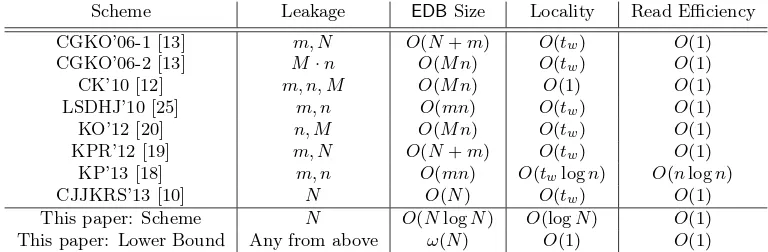
Scheme Leakage EDBSize Locality Read Efficiency
CGKO’06-1 [13] m, N O(N+m) O(tw) O(1)
CGKO’06-2 [13] M·n O(M n) O(tw) O(1)
CK’10 [12] m, n, M O(M n) O(1) O(1) LSDHJ’10 [25] m, n O(mn) O(tw) O(1)
KO’12 [20] n, M O(M n) O(tw) O(1)
KPR’12 [19] m, N O(N+m) O(tw) O(1)
KP’13 [18] m, n O(mn) O(twlogn) O(nlogn)
CJJKRS’13 [10] N O(N) O(tw) O(1)
This paper: Scheme N O(NlogN) O(logN) O(1) This paper: Lower Bound Any from above ω(N) O(1) O(1)
Figure 1: Comparison of some SSE schemes. Legend: Leakage is leakage from EDBonly, and all schemes also leak search results and access pattern. n= total # of unique identifiers,N =P
w|DB(w)|,m= total # of unique
keywords,M = maxw|DB(w)|,tw=|DB(w)|for the queryw. For [12] we mean the scheme in Section 5.2 of the
full version there. The lower bound is achieved withα= 0 in Theorem 4.1. If a scheme support updates or more advanced searches then we consider a simplified static version for keyword searching as formalized in Section 2. Differences in security (simulation versus indistinguishability, adaptivity) are ignored here but explain why some schemes appear to be strictly worse than others.
through|DB(w)|pseudorandom locations in this large array. When the array is stored on disk, it means that each retrieved pair requires a disk read at a random location. Since each identifier is on the order of several bytes but the disk block size is now often 4KB, this searching will sacrifice throughput and latency compared to a plaintext search system which can store the identifiers together in sectors, and moreover in contiguous sectors which can be read together more efficiently without additional seeking. Naive modifications, like packing several identifiers from a singleDB(w) set into one sector, render the scheme insecure for the leakage function they consider.
One work [12] addressed locality by enlarging the index to ω(N) size. This scheme pads every set
DB(w) to size maxw|DB(w)| and then store these padded sets in the own contiguous rows. For very
large indexes (with billions of pairs as in [10]), even doubling the plaintext size may be unreasonable, so these works do not appear to scale for realistic datasets where the padding will be large.
Results. In the sections that follow a precise model is given for measuring and comparing the memory usage of SSE schemes. The parameters of locality, read-efficiency, and read overlaps are defined and discussed in relation to lower bounds. Briefly,locality is the number of non-contiguous memory accesses made by the server andread-efficiency is the number of bits read beyond the minimum necessary. In Figure 1 we compare the leakage, locality, and read efficiency of prior SSE constructions. (For read efficiency, the number listed is a multiplicative factor over the binary encoding of the identifiers matching the query.)
This paper’s primary results are summarized below. For the following two theorems, letLbe any of the leakage functions in Figure 1 (or any function efficiently computable from them). Below we write
BinEnc(DB) to mean an encoding onDBas a binary string formed by concatening the lists of identifiers matching each keyword. Moreover, we say that a scheme has α-overlapping reads if reads for a new search overlaps in at mostα bits with all previous reads. See Sections 2 and 3 for definitions.
Theorem 1.1 IfΠ is an L-IND-secure SSE scheme with localityr as well asα-overlapping reads, then
Π has ω|BinEncr·(α+1)(DB)|server storage.
Theorem 1.2 Assuming one-way functions exist, there exists an L-IND-secure SSE scheme with lo-calityO(logN), O(1)read efficiency and O(NlogN) storage.
reads. We conjecture that information-theoretic techniques can be used to obtain a quantitatively similar lower bound when allowing arbitrary overlaps, but were unable to prove such a strong result. We leave this as an open question.
The bulk of the paper is spent proving the first theorem. We now start with an intuitive sketch of how one might prove a weak lower bound. See Section 4 for a detailed sketch of the actual proof, which is more complicated.
Lower bound approach. Intuitively, if a scheme is very local, then after some searching the server can look at what isnot read after several searches and infer statistics about what has not been opened. In particular, if one of the setsDB(w) is very large, then good locality means there is a very large region of the encrypted index that will not be touched by other searches, and the server will notice that this happens after several searches with small number of results.
The lower bound develops this intuition, but requires further ideas to achieve a lower bound ofω(N) on the server storage. For now let us sketch how one shows the server must approximately double the size of a plaintext index if it is to beperfectly local and read-efficient, meaning it processes a search by reading exactly the required number of bits from a single contiguous section ofEDB, and moreover that the reads for all searches are disjoint. This seems highly restrictive, but later will we be able to weaken all of these assumptions to realistic versions.
Now suppose we have a perfectly local SSE scheme. Consider two index inputs, DB0 and DB1, where DB0 consists of N keywords each matching a single unique document and DB1 consists of 2 keywords matching a single unique document and a third keyword matchingN −2 documents. If two random keywords matching single documents are searched for then the server learns which locations of the encrypted index are read in order to respond. If DB0 was encrypted, then pigeon-hole argument shows that with constant probability, there is no remaining contiguous interval large enough to contain the bits that would be read for the third keyword (it is here that we use an assumed bound on the server storage). This is diagrammed in the top part of Figure 2, where when the red regions are read there is no longer space between them for a larger interval. This is in contrast to the case whenDB1 is encrypted, because after observing the two small reads, a perfectly local scheme there will always be a contiguous unread region large enough to hold theN −2 identifiers for the third keyword.
The full lower bound is an extension of this idea to consider a family of indexes with result sets of several sizes. Later it is argued that the technique above is limited to showing a factor 2 overhead in server storage, and that the complexity of the main attack seems necessary. We also address several extensions, such as when the server does not perform a single contiguous read but up to O(1) reads, the leakage function parameter varies, and the reads are allowed to partially overlap.
Related work on secure searching. Following the initial work of [24] that suggested searchable en-cryption, Curtmola et al. [13] formalized the version of SSE that we consider in this paper. Subsequently SSE schemes were given with different efficiency properties [15, 11, 12], support for data updates [19, 18], authenticity [20] and support more advanced searches [10]. These improvements are rthogonal to the lower bound, which applies to these schemes when used for basic (non-dynamic, non-authenticated) SSE.
The problem of searching on encrypted data can be addressed in several ways using generic multi-party computation protocols, oblivious RAM schemes [16] or fully homomorphic encryption [14]. These approaches achieve slightly levels of functionality and different notions of security, meaning that the lower bound does not seem to apply. Order-preserving encryption [6, 7] takes a different approach to searching that achieves high efficiency for rich queries but is less secure than SSE. Implementations that use order-preserving encryption, notably CryptDB [22], inherit these properties. Our lower bound does not apply to them.
too small too small too small
large enough
Figure 2: Intuition for a basic lower bound.
the lower bound. The line of work on deterministic public-key encryption [4, 8, 5] enables fast searching but achieves different, weaker security meaning our lower bound does not apply.
Related work on locality. Algorithmic performance with data stored on disk has been studied extensively in external memory models (c.f. [26, 23, 3]). These models usually consider block-oriented devices with varying degrees of precision (e.g., including modeling parallelism, drive geometry, memory hierarchies, caching, locality of blocks, etc.). Typically one measures the external memory efficiency of an algorithm by counting the number of blocks it accesses, and a wide array of techniques have been developed to optimize disk utilization at the algorithmic level.
Interestingly, matching lower and upper bounds are known for many natural problems like, e.g., dictionary retrieval, sorting, range searching – see, e.g., Chapter 6 of [26]. Our lower bound is fun-damentally different from these results. There, one can give an information theoretic argument that a certain number of disk accesses are necessary in the worst case, with a flavor similar to the classic O(nlogn) comparison-based sorting lower bound. Our lower bound, however, will proceed by showing that any SSE scheme that meets a certain level of efficiency will beinsecure (rather thanincorrect as in traditional external memory lower bounds). That is, our lower bound comes in the form of an attack. Due to the nature of our lower bound we opt for an extremely simplified version of locality and leave its adaptation to fine-grained external memory models to future work.
We are not aware of any prior similar lower bounds on cryptographic primitives, other than the folk-lore observation that security forces many primitives to touch every bit their inputs (e.g., homomorphic encryption [14], multiparty computation).
Organization. Preliminaries and definitions are recalled in Section 2. Definitions relating to locality are given and discussed in Section 3. The lower bound is stated and proved in Section 4, and the upper bound is in Section 5.
2
Preliminaries
Throughout this paper the security parameter is denoted λ and all algorithms (and adversaries) are assumed to run in time polynomial inλ. We write [n] for the set {1, . . . , n}. For a vector v we write
|v|for the dimension (length) of v and for i ∈ [|v|] we write v[i] for the i-th component of v. For a bitstring s, we write s[a, b] for the substring starting with the bit in positiona and ending in position b. For integers a≤b we write [a, b] for{a, a+ 1, . . . , b} and (a, b) for {a+ 1, a+ 2, . . . , b−1}.
Databases and SSE schemes. An index (or database)DB= (idi,Wi)ni=1is a list of identifier/keyword-set pairs, where each idi ∈ {0,1}λ and eachWi is a set of bitstrings. When the DBunder consideration
is clear, we will write W = Sn
i=1Wi. For a keyword w ∈ W, we write DB(w) for {idi : w ∈ Wi}.
We will always use N =P
w∈W|DB(w)| =
Pn
i=1|Wi|to mean the total number of keyword/identifier
pairs in DB,n to mean the number of unique identifiers, andm =|W| to mean the number of unique keywords. We will also denote asBinEnc(DB(w)) the binaryrepresentationof DB(w), i.e., the concate-nation of all identifiers represented as bit strings, and BinEnc(DB) to be the concatenation of all the
BinEnc(DB(w)) for each win the database. Under our assumption that all identifiers are in {0,1}λ, we
have |BinEnc(DB(w))|=λ|DB(w)|and |BinEnc(DB)|=λN.
TokGen,Search) that satisfy the following syntax. The key generation algorithmKeyGentakes as input the security parameter and outputs a key K. The algorithm EDBSetuptakes as input a key K and a database DB and outputs an encrypted database EDB. The token generation protocol takes as input a stringw and key K and outputs a token τ. Finally, the searching algorithm Search takes as inputτ and EDB and outputs as setL of results.
We note that formalization of an SSE scheme does not model the storage of actual document payloads, but only of metadata encoded in a keyword index. This simplifies the definition and makes it modular, but some care must be taken when combining an SSE scheme with a document storage scheme (see e.g. [13] for an example of how to store the payloads).
An SSE scheme is correct if the natural usage returns the correct results for the keyword being searched (i.e., DB(w)), except with negligible probability. Formally, for every database DB, consider an experiment where K ←$ KeyGen(1λ) and EDB $
← EDBSetup(K,DB) are initially sampled. Then, an attacker learns EDB and can issue adaptive queries wi, which are answered by first generating a
token τi ← TokGen(K, wi) and then returning it together with Si ← Search(τi,EDB) to the attacker.
The scheme is correct if for all polynomial-time attackers, Si =DB(wi) for alli, except with negligible
probability.
Finally, we say that the scheme Π has server storage s = s(N, λ, ℓ, m) if on input a key K ←$ KeyGen(1λ) and a database DB with N keyword/identifier pairs, bit length ℓ = |BinEnc(DB)|, and
m=|W|keywords, EDBSetupoutputsEDB with bit length |EDB|at mosts(N, λ, ℓ, m). (Note that by the above discussion we typically have ℓ =N λ, and ℓ is hence somewhat redundant, and only serves the purpose of better readability.)
Security. We recall the non-adaptive indistinguishability-based version of security from [13] which will be considered in the lower bound.
Definition 2.1 Let Π = (KeyGen,EDBSetup,TokGen,Search) be an SSE scheme and let L be a leakage function and A be an adversary. For b ∈ {0,1} we define the game IND-SSEbΠ,L,A(λ) as follows: The adversary chooses DB0,DB1,w. The game runs K ←$ KeyGen(1λ), EDB ←$ EDBSetup(K,DBb) and t[i] ← TokGen(K,w[i]) for each i ∈ [|w|]. It gives (EDB,t) to A, which outputs a bit ˆb. Finally, if
L(DB0,w)6=L(DB1,w), the game outputs⊥ and otherwise it outputsˆb.
We define the L-IND advantage of A to be
AdvindΠ,L-,sseA(λ) =|Pr[IND-SSE0Π,L,A(λ) = 1]−Pr[IND-SSEΠ1,L,A(λ) = 1]|,
and we say thatΠ is L-IND-secure if AdvΠind,L-,sseA(λ) is negligible for every A.
Our construction will achieve the stronger (adaptive, simulation-based) definition from [13], which we recall here. (A non-adaptive version is such that in both games A must choose all of its queries beforehand.)
Definition 2.2 Let Π = (KeyGen,EDBSetup,TokGen,Search) be an SSE scheme and let L be a leakage function. For algorithmsAandS, we define the two gamesSIM-SSE0
Π,L,A(λ)andSIM-SSE1Π,L,A,S(λ)
as follows:
SIM-SSE0Π,L,A(λ): A(1λ) choosesDB,w. The game then runs(K,EDB)←EDBSetup(DB) andt[i]← TokGen(K,w[i]) for each i∈ [|w|]. It gives EDB,t to A, which eventually returns a bit that the game
uses as its own output.
SIM-SSE1Π,L,A,S(λ): A(1λ) chooses DB,w. The game then runs (EDB,t) ← S(L(DB,w)) and gives EDB,t to A, which eventually returns a bit that the game uses as its own output.
We define theL-SIM-advantage ofA and S to be
AdvsimΠ,L-,sseA,S(λ) =|Pr[SIM-SSE0Π,L,A(λ) = 1]−Pr[SIM-SSE1Π,L,A,S(λ) = 1]|,
and we say that Π is L-SIM-secure if for all adversaries A there exists an algorithm S such that
Leakage functions. Below we will consider two leakage functions Lmin and Lmax. The first is called the size minimal leakage function,2 which is defined as follows: Lmin(DB,w) outputs N = P
w∈W|DB(w)| and the sets (DB(w[1]), . . . ,DB(w[|w|])). The second is called the maximal leakage
function which outputs (N, n, m, M) as well as (DB(w[1]), . . . ,DB(w[|w|])), where N is defined as be-fore, n is the number of unique identifiers in DB, m = |W| (the number of unique keywords), and M = maxw|DB(w)|. It is of course possible to consider “more” leakage, but this is more than any
existing scheme leaks, meaning out lower bound will apply to all of them.
3
Read Efficiency and Locality Metrics for SSE Schemes
This section introduces the notions of locality and read efficiency of SSE schemes.
Read patterns. First, we observe that the searching procedure of any SSE scheme can be decomposed into a sequence of contiguous reads from the encrypted database. To formalize this point of view, fix an SSE scheme Π, an EDB output by EDBSetup and a token τ output by TokGen. Viewing EDB
as a bitstring of length M, we may express the computation of Search(τ,EDB) as follows: It starts by computing an interval [a1, b1] that depends only on τ. It then computes another interval [a2, b2] that depends only onτ and EDB[a1, b1], and continues computing intervals to read based onτ and all previously read intervals fromEDB. We write RdPat(τ,EDB) for these intervals.
Locality of an SSE scheme. We put forward the notion of locality of an SSE scheme, capturing the fact that every read pattern consists of at most a bounded number of intervals.
Definition 3.1 (Locality) An SSE scheme Π is r-local (or has locality r) if for any λ, DB, and
w∈W, we have that RdPat(τ,EDB) consists of at most r intervals with probability 1 when EDB, τ are computed as K ←$ KeyGen(1λ), EDB←$ EDBSetup(K,DB), τ ←TokGen(K, w). If r= 1, we say Π has
perfect locality.
In particular, the valuer can depend both on the security parameter λandthe index size|DB|.
Read efficiency. The notion of locality alone is not very meaningful. Of course, we can just make every scheme perfectly local by reading the whole EDB. This is why the notion of locality is directly tied to the notion of read efficiency, which measures the overall size of the portion read by a search operation.
Definition 3.2 (Read Efficiency) An SSE scheme Π is c-read efficient (or has read efficiency c) if for any λ, DB and w ∈ W, we have that RdPat(τ,EDB) consists of intervals of total length at most
c· |BinEnc(DB(w))| bits.
We allowc to depend on the security parameter here.
Read disjointness. The above definition of read efficiency is very general. In particular, for sufficiently largec, it allows multiple queries to read exactly the same bits. Our lower bound below will apply to a more restricted class of r-local schemes which read sufficiently many new bits. We feel this class is natural, and moreover it contains all prior constructions.
Definition 3.3 (Overlapping reads) An SSE scheme Π has α-overlapping readsif for allλ and all
DB, the read pattern induced by the search of each keyword inDBhas an overlap of at mostα bits with the read patterns induced by the searches of all other (previous or future) keywords (with probability
1 over the computation of K ← KeyGen(1λ), EDB ← EDBSetup(K,DB), and the computation of the
tokens). When α= 0 we say Π has disjoint reads.
2It appears to be impossible to define a true “minimal” amount of leakage, as we could consider a leakage function that
In general, the value α is independent of N, but may additionally depend on λor possibly on the number of words |W|in order for example to take into account a common portion of EDB which can be read at every search operation. Typically, a scheme will read some metadata like hash table entries and then perform reads to retrieve the actual results. (Of course we make no assumption on what computation the scheme actually does, beyond being of the form above.)
4
Lower Bounds
4.1 Theorem Statement and Proof Overview
In this section we sketch our proof that a secure SSE scheme cannot simultaneously achieveO(1) locality and O(|BinEnc(DB)|) server storage. Concretely, we are going to prove the following theorem, where
Lmax was defined at the end of Section 2 and the locality metrics were defined in the previous section.
Theorem 4.1 If Π is an Lmax-IND-secure SSE scheme with locality r as well asα-overlapping reads,
thenΠ has ω|BinEncr·(α+1)(DB)| server storage.
We note that we considerLmaxfor the lower bound as this strengthens the result by considering schemes that are “very leaky.” In the theorem statement, we assume that α does not depend on N, but may additionally depend onλor possibly on the number of words|W|.
Proof approach. We will first sketch our lower bound with a few simplifications. First, we assume the SSE scheme is has perfect locality and read efficiency, meaning the server always performs exactly one contiguous read for exactly|BinEnc(DB(w))|=λ· |DB(w)|bits fromEDBwhen searching for a word w, the minimum required for the response. Second, we assume all reads are perfectly disjoint. Third, we consider the lower bound against SSE schemes achieving security with leakage functionLmin instead of Lmax (thus making the result easier). It turns out that this case encompasses most of the technical difficulties for the general result, which we derive afterwards.
The principle behind the attack extends the idea sketched in Section 1: When an SSE scheme fits the above assumptions, a curious server can observe the sizes ofunread intervals after several searches and (as we will prove) infer some information about the parts of the index that have not been searched for.
We will formalize this by giving an adversary that distinguishes the two games in Definition 2.1 for any Π meets the restrictions. The adversary will choose two indexes DB0,DB1 of the same size in a careful way so that DB1 has keywords that match a large number of documents while DB0 does not. Then it will query for tokens for several keywords matching relatively small numbers of documents. Using the tokens, it will compute the read pattern of the server when searching for those keywords, and then look at theunread portions ofEDB. Since we are assuming perfect locality, ifDB1 was encrypted, there must be large regions that go untouched by any query. On the other hand, we will show that this is often not the case if DB0 is encrypted, allowing the adversary to distinguish.
To describe the proof it will be useful to introduce a compact notation for theshape of aDBinput.
Definition 4.2 We write
DB←(n1×s1; n2×s2; . . . ; nt×st)
when DB = (idi,Wi) has shape (n1 ×s1; n2 ×s2; . . . ; nt×st), which means that it satisfies the
following:
• DB has a keyword setW of size Pt
j=1nj comprised ofλ-bit strings.
• For each j∈[t], there are nj keywords w∈W such that|DB(w)|=sj.
Our attack sketched in the introduction corresponded to picking indexes DB0,DB1 with shapes
DB0←(N×1) andDB1←(2×1 ; 1×(N−2)), meaning thatDB0 consists ofN “singletons” andDB1 consists of two singletons and one large set of results. It is possible to formalize that attack and show that a secure perfectly local SSE scheme must produce anEDB that is at least twice as large as the bit representation of DB, but as we observe at the end of this section, any attack that uses indexes with such simple shapes will not be able to prove a better lower bound.
We now proceed to extend that attack. Let Π be perfectly local scheme with server storagekλN for some constant k≥1. Our attack against the security Π will select two random inputs DB0,DB1 with shapes
DB0←(n1×ε1N; n2×ε2N; . . . ; nk−1×εk−1N; ˆnk×εkN) (1)
DB1←(n1×ε1N; n2×ε2N; . . . ; nk−1×εk−1N; nk×εkN; ˆnk+1×εk+1N) (2)
wheren1 > n2 >· · · > nk >1 and ε1 < ε2 < . . . < εk < εk+1 <1 are appropriately chosen constants. Intuitively,DB0 consists only of many small result setsDB0(w) whileDB1 consists of many small result sets and some relatively large sets of εk+1N keywords.
The attack will query for tokens for all Pk
i=1ni keywords matching εiN documents withi∈[k] (in
order to note lose the game, the attack ensures that DB0 and DB1 are consistent on these queries). It then calculates the read patterns of the server. Since Π is perfectly local, the reads are for εiλN bit
intervals respectively, and moreover they are all disjoint. Thus if DB1 is encrypted, then the perfect locality of Π means there must exist an interval of εk+1λN bits in EDB that was not touched by the observed reads (actually, there will be at least ˆnk+1 such intervals) – These are where the large result sets are stored (note that the adversary does not query for the keyword corresponding to any of large sets, but only notices the presence of a suspiciously large untouched interval). However, as we will show, ifDB0 was encrypted then the security of Π will mean there is a noticeable probability that there is no such interval remaining untouched. We stress that this will be due to the (forced) distribution of the reads, and not simply because there is no room, as the same number of bits is read when eitherDB0 or
DB1 in encrypted.
Proving the latter claim onDB0 is the main technical part of the proof. Intuitively, it holds because security forces the small intervals (say of size εiλN) to be located in random-looking locations which
do not leave large gaps (say of sizeεi+1λN) between them too often, which implies that large intervals cannot fit between them while remaining disjoint, effectively “killing” that space for large intervals.
We will show that, for a specific choice of the constants, that for each i= 1, . . . , k, the queried sets of size εiλN will each kill at least λN bits of the EDB from storing any larger intervals (in particular,
intervals of size εjλN for j > i) with constant probability. Since we have k different read pattern
sets each killing λN bits from storing anything larger with constant probability, we get that kλN bits are killed with constant probability. But this means the entire EDB has been killed with constant probability (here we use thatkis a constant), and when that happens the adversary can conclude that
DB0 was encrypted – IfDB1 had been encrypted this would happen with probability 0.
We now sketch how to show that queries for a constant number of sets of sizeεiN will kill λN bits
(which is much larger than the actual number of bits –εiλN – read by the server during its
perfectly-local searching). To prove this we use hybrid argument, which can be understood as a sequence of adversaries A1,A2, . . . ,Ak - the purpose of Ai is to show that the sets of size εiN kill enough space
with constant probability, assuming that the smaller sets each do so. The first adversary A1 is the simplest to describe, and resembles our original attack from the Introduction. Adversary A1 draws
DB0,DB1 of size N with shapes
DB0←(ˆn1×ε1N) (3)
where n1 <nˆ1 =ε1−1 and ε1 < ε2 are constants. It populates the two databases with a consistent set of keywords, meaning that the n1 keywords matching ε1N documents DB1 are a random subset of the ˆ
n1 such keywords in DB0. Intuitively, DB0 has a large number of keywords matching ε1N documents each, and searching for each keyword induces a read by the server for a disjoint interval ofλε1N bits. Thus searching for a random subset of n1 <nˆ1 of those keywords will reveal the location of a random subset of the disjoint intervals. InDB1, however, there are only n1 of these keywords, but we can show that security forces their distributions to be as they are in DB0.
Specifically, we have A1 query for the n1 keywords matching ε1N documents in either database, and then it computes their read patterns. If DB0 was encrypted, then the intervals read by the server are chosen randomly from amongst ˆn1 intervals of that size. We show (unconditionally) with good probability there is a lot of space (aboutλN bits) inEDB where intervals of size ε2N or larger cannot fit after then1 intervals have been read. This happens because, for randomly chosen intervals, the gap between them cannot be larger than ε2N too often. Thus the larger intervals must go elsewhere in
EDB. And since the scheme is secure, DB1 must also exhibit this behavior (despite the read intervals not being chosen from a larger set of intervals). In fact, this shows that when any database containsn1 keywords with εN results each, then the resulting reads for those keywords must be laid out in a way that eliminates a large amount of space for larger intervals even though the actual bits read for them is very small, namelyn1ε1λN ≪ˆn1ε1λN.
We then iterate this approach; The next adversaryA2 queriesDB0,DB1 with shapes
DB0←(n1×ε1N; ˆn2×ε2N) (5)
DB1←(n1×ε1N; n2×ε2N; ˆn3×ε3N). (6)
(SoDB0 now has the shape that A1 chose for DB1.) The adversary A2 then queries for tokens for all n1 keywords matching ε1N documents, and then a random subset of the ˆn2 keywords matching ε2N documents in DB1. (As before these databases are made with consistent keywords and identifiers.) We show that whenDB0 is encrypted, conditioned on the read intervals of size ε1λN disallowing λN bits for larger intervals, a random subset of intervals of sizeε2λN will disallow about another λN bits for larger intervals. Security again forces this is to be true when DB1 is encrypted despite not being forced statistically. The result is that with constant probability about 2λN bits of EDB can no longer accommodate larger intervals.
By considering the sequence of A1, . . . ,Ak of adversaries and applying this reasoning k times, we
have that the entire database has been disallowed by a relatively small number of small reads intervals with good probability, and then we can finish the proof as sketched above.
Extensions to more general locality. The argument above worked forperfect locality, meaning the server search algorithm for keywordw worked with a single, contiguous read fromEDB for exactly λ· |DB(w)|bits that is disjoint from the read for any other search. It is easy to extend the lower bound to when the server works with r = O(1) contiguous reads that total exactly λ· |DB(w)| bits and are disjoint from all other reads by observing that one of ther reads must have size at leastλ· |DB(w)|/r contiguous bits, and then adjusting the parameters of the above argument to ensure that intervals of that size can be be disallowed with good probability by the final adversary.
Other relaxations will be given. For instance, to adaptive the attack to work with leakage function
Lmax, we need to additionally arrange for the submitted databases to always have the same number of documents, keywords, maximum size result setDB(w). This only introduces minor technicalities.
Would a simpler attack work? It is fair to ask if the complexity of this attack is necessary, and specifically if an attack likeA1, which only queries for keyword with|DB(w)|equal to two possible sizes (either ε1N orε2N) could give the lower bound and avoid the iterative argument.
have EDB reserve λN bits for the first size, and another λN bits for the second size. Then it could simply store sets DB(w) of the first size in random order first half of EDB with padding, then the sets
DB(w) with the second size in the second half.
This reasoning generalizes to show that any attack proving M ≥ kλN must query keywords with
|DB(w)|having at leastk+ 1 different sizes, as our attack does.
4.2 Tools for the Proof of Theorem 4.1
The proof will use technical, but elementary, facts about how intervals of integers can be packed together. The intervals in the proof will be the read patterns of the searches, and whether or not they can be arranged in certain ways will allow the attack to work. We start with some tools to formalize the meaning of intervals “killing” space for larger intervals. This is captured in the definition of closure below. At first reading, it may be helpful to proceed without worrying about the details of the definitions and lemmas below because it is possible to understand the proof structure without them.
Recall that we write [a, b] for{a, a+ 1, . . . , b}and (a, b) for{a+ 1, . . . , b−1}.
Definition 4.3 LetS ⊆I ⊆[M]be a subset of an intervalI = [α, β], and writeSuniquely as a disjoint union of increasing intervals, S =St
i=1[ai, bi] (with bi < ai+1), and let d >0. We define the d-closure ofS inI to be the set
cld,I(S) =S∪ [
{(bi, ai+1) : 0≤i≤t, ai+1−bi≤d}
where we define b0 =α−1 and at+1 =β+ 1.
More generally, if S ⊆F ⊆[M]where F =Ss
i=1Ii is the union of non-adjacent disjoint intervals,
then we define the d-closure of S inF to be
cld,F(S) = s [
i=1
cld,Ii(S∩Ii).
In words, the d-closure of S in F consists of S along with all of the intervals between its members or endpoints of intervalsF that are strictly smaller thand. (The conditionai+1−bi ≤dimplies there are
at mostd−1 positions between x and y.) We also observe that |cld,F(S)| ≥ |S| always. To give some
further intuition, in our attack below, [M] are the indices of the bits of the given encrypted database, whereas F is the set of live indices which can still be used, and S ⊆F is the read pattern associated with a set of search operation.
It is easy to check that the notion of closure is well-defined over S in the sense that any choice of an interval-decomposition ofS will result in the same d-closure. This isnot true for the decomposition of F, which is why we write it to be decomposed uniquely as the union of non-empty, non-adjacent
intervals.
The motivation for the prior definition is that intervals of size d or larger that are disjoint from a set must also be disjoint from its d-closure, as summarized by the following lemma.
Lemma 4.4 Let S ⊆F ⊆[M]and J ⊆F be an interval. If an interval J is disjoint from S then it is also disjoint from cld,F(S) for anyd≥ |J|.
Proof:Suppose thatJ is disjoint fromS but intersects cld,F(S). SinceJ ⊆F, we haveJ ⊆IkwhereIk
is some interval in the unique decomposition ofF. SinceJ is disjoint fromS, it must becontained one of the extra intervals added when forming cld,F(S). But these intervals all contain at most d−1<|J|
elements, a contradiction.
It says that for any set S =St
i=1Ji expressed as a union of intervals, we can always pick relatively
few of the intervals the union of which will have the same d-closure.
Lemma 4.5 If S =St
i=1Ji ⊆F ⊆[M] is written as a union of (possibly adjacent) intervals, then we
can select a set T ⊆[t]of size at most3M/d such that cld,F(S) = cld,F(Si∈TJi).
Proof: Now, we are going to choose a subset T ⊆[t] such that cld,F(Si∈T Ji) = cld,F(S).
From now on, we can assume without loss of generality thatF = [M]. To see that this is true, assume that it is not the case and let F =Ss
i=1Ii, where Ii are disjoint intervals in increasing order. We now
defineF := [M] and letS:=S∪S∆, whereS∆is the union of disjoint intervals chosen as follows: For any two consecutive intervalsIi = [ai, bi] andIi+1 = [ai+1, bi+1], we add the intervalJi,i+1 = (ai, bi+1) toS∆, together with [1, a1) (ifa1 >1) and (bs, M] (ifbs< M). It is easy to verify that cld,F(S)∩F = cld,F(S).
Now, if we can find a subset S′ ⊆ S consisting of at most 3M
d of the intervals of S and such that
cld,F(S) = cld,F(S′), we also note that by removing the intervals in S∆ from S′, obtainingS′′ ⊆F, we have
cld,F(S′′) = cld,F(S′)∩F = cld,F(S)∩F = cld,F(S).
Write now cld,F(S) = Su
i=1Ci as the union of disjoint non-adjacent intervals. We will choose the
indices for T by showing how to choose the elements from each partition S∩Ci. For each Ci, we let
[a1, b1]≤[a2, b2]≤ · · · ≤[aℓ, bℓ] be the subset of the (possibly adjacent) intervals amongJ1, . . . , Jtwhich
are in S∩Ci, and we will take a subset of these, denoted [a′1, b′1]<· · · <[a′ℓ′, b′ℓ′]. We start by taking
[a′
1, b′1] = [a1, b1]. Then we take [a′2, b′2] to be the interval with largest aj such that aj −b′1 ≤d. Then we pick the next interval [a′3, b′3] to have the largestaj such thataj−b′2 ≤d, and continue in this way until we have taken [a′ℓ′, b′ℓ′] = [aℓ, bℓ]. We can always pick another element because there is no interval
of sizedbetween [ai, bi] and [ai+1, bi+1] by Lemma 4.4.
We define T to be the indices of intervals chosen in this way. To bound the size of T, we first observe that the number u of intervals composing cld,F(S) is at most|F|/d < M/dbecause the space between
those intervals is at leastd. Next, we have that all the [a′j, b′j] are strictly increasing, and moreover that forj∈[ℓ′−2],
a′j+2> a′j+d,
because otherwisea′j+2 > a′j+1 would have been chosen asa′j+1. LetTi be the set of indicesj∈T such
thatJj ⊆Ci. Then,
|Ti| ≤ ⌈2|Ci|/d⌉,
and we have
|T|=
u X
i=1
|Ti| ≤ u X
i=1
2|Ci|
d
≤u+
u X
i=1 2|Ci|
d ≤ M
d +
2|cld,Fd(S)|
d ≤
3M d .
Finally, it is easy to check that the selected intervals have same d-closure inF asS.
4.3 The Basic Attack
We are now ready to state our attack for the case of perfect locality and read efficiency with disjoint reads. We will ignore round-off errors computing values that not necessarily integers. To address these formally we can simply choose constants that divide N and satisfy other divisibility conditions. We discuss how to extend the result to the more general case in the next section.
Theorem 4.6 (Basic Attack) If Π is an Lmin-IND-secure SSE scheme with perfect locality, perfect
AdversaryAj: ComputingDB0,DB1,w:
01 Select randomV ⊂[ˆnj] such that|V|=|nj|
02 InitializeDB0,DB1 to empty lists 03 fori∈[j−1] andℓ∈[ni]do:
04 wi,ℓ
$
← {0,1}λ; S i,ℓ
$
←({0,1}λ)εiN; Addw
i,ℓ7→Si,ℓ toDB0andDB1 05 forℓ∈[ˆnj]do:
06 wj,ℓ
$
← {0,1}λ; S j,ℓ
$
←({0,1}λ)εjN; Add w
j,ℓ 7→Sj,ℓ toDB0 07 if ℓ∈V then: Addwj,ℓ7→Sj,ℓ to DB1
08 forℓ∈[ˆnj+1]do: 09 wj+1,ℓ
$
← {0,1}λ; S j+1,ℓ
$
←({0,1}λ)εj+1N ; Addw
j+1,ℓ7→Sj+1,ℓtoDB1 10 w={wi,ℓ : i∈[j−1], ℓ∈[ni]} ∪ {wj,ℓ : ℓ∈V}
11 OutputDB0,DB1,w
AdversaryAj: Computing output bit:
12 InputEDB,t={τi,ℓ:i∈[j−1], ℓ∈[ni]} ∪ {τj,ℓ:ℓ∈V} 13 L1←[|EDB|]
14 fori∈[j−1]do:
15 Compute read patterns induced by τi,1, . . . , τi,ni; LetRi be their union
16 if |clεi+1λN,Li(Ri)|<nˆiεiλN thenOutput 0
17 elseLi+1←Li\clεi+1λN,Li(Ri)
18 Compute read patterns induced by {τj,ℓ:ℓ∈V}; LetRj be their union
19 if |clεj+1λN,Lj(Rj)|<nˆjεjλN thenOutput 0
20 elseOutput 1
Figure 3: AdversaryAj for the proof of Theorem 4.6.
Proof: Suppose for contradiction that Π has perfect locality and perfect read efficiency and server storage M =k· |BinEnc(DB)| for some constant kand all sufficiently large DB. We are going to show that the scheme cannot beLmin-IND-secure. Without loss of generality, we will assume thatk >2; this obviously implies impossibility for all k, as schemes with smaller storage can be padded to havek >2. Our attack will fix some sufficiently large N as well as constants D, n1 > n2 > · · · > nD > 1,
ˆ
n1>ˆn2 > . . . >nˆD+1 and ε1< ε2 <· · ·< εD+1 <1. Looking ahead, we will set these constants
D=k, εj =
1 3k3
D−j+2
, nj =
3k εj+1
, and ˆnj =
1−Pj−1 i=1 niεi
εj
, (7)
whereN = poly(λ) is sufficiently large.
For each j ∈ [D] we define an adversary Aj using the code in Figure 3. Our plan is to show,
unconditionally, that at least one of these adversaries has non-negligible advantage in attacking Π. Each Aj plays the game IND-SSEbΠ,Lmin,Aj(λ), which starts by having the adversary supply indices
DB0,DB1 and a list of keywords wsuch thatLmin(DB0,w) =Lmin(DB1,w).
Let us give some intuition for how the adversaries are design. Aj generates generatesDB0 andDB1, which will have shapes
DB0←(n1×ε1N; . . . ; nj−1×εj−1N; ˆnj×εjN)
DB1←(n1×ε1N; . . . ; nj−1×εj−1N; nj×εjN; ˆnj+1×εj+1N).
These shapes are chosen so thatDB0 has a large (ˆnj, but still constant) number of keywords matching
εjN random (i.e., unique w.h.p.) documents each, whileDB1 has only a few,nj <ˆnj and instead has
some keywords matchingεj+1N documents each.
Formally, for eachi= 1, . . . , j−1,Aj picksni random keywordswi,1, . . . , wi,ni, and then it associates
each of these withεiN random identifiers (we ignore the case where the identifiers repeat, which happens
with negligible probability), which in the code are the sets Si,1, . . . , Si,ni. It adds these keywords and
Next it generates ˆnj random keywords wj,1, . . . , wj,ˆnj and associated identifier sets Sj,1, . . . , Sj,njˆ (each of sizeεjN), and adds them to DB0. Now it uses the randomly chosen subsetV ⊂[ˆnj] to select
nj <nˆj of those keywords and sets to add toDB1.
At this point DB0 is complete, but DB1 is smaller because not all of the keywords wj,1, . . . , wj,njˆ were added (only those determined byV were added to DB1). The next “for” loop adds ˆnj+1 random keywords, each matchingεj+1N random identifiers, toDB1. By our choice of parameters, this will bring
DB1 to have the same size of DB0.
This completes the computation ofDB0 andDB1. The adversary sets its query vectorw to be
w={wi,ℓ : i∈[j−1], ℓ∈[ni]} ∪ {wˆj,ℓ : ℓ∈V}.
This means Aj queries for tokens for all keywords w with |DB(w)|= εiN with i ∈ [j−1], and then
for thenj keywords w∈V that have |DB(w)|=εjN and are common to both DB0 and DB1. In DB1, these areall of the keywords matching εjN documents, but inDB0 this will be astrict subset of the ˆnj
such keywords. This will be crucial in our analysis because it means in DB0 we will observe statistical patterns when choosing a subset of keywords to search, and security will force the searching to exhibit the same patterns when searching DB1. We will reason along these lines to conclude that DB1 must read regions of memory in an inefficient way in order to “look like”DB0.
The adversary Aj gives (DB0,DB1,w) to its game, and receives EDB with M := |EDB| = k ·
|BinEnc(DB)|=kλN and the tokens corresponding to the queries.
Finally Aj determines its output bit by performing a series of checks which ensure that the read
patterns of the searched keywords “kill” large regions of the memory, meaning they prevent those regions from storing intervals of a given size. It starts by settingL1 = [M]. During i-th round of checking, Li
will be the set of “live” regions of EDB where intervals of size εiλN may fit without overlapping with
any of the previously read regions.
There is one detail to verify in Aj. For the checks involving closures to make sense, we need that
Ri ⊆Li for each i∈ [j] so that the closures are defined. Perfect locality says that the intervals in Ri
must avoid R1, R2, . . . , Ri−1, and so by Lemma 4.4 the intervals comprising Ri (which are of sizeεiN)
must avoid clε2λN,L1(R1), . . . ,clεiλN,Li−1(Ri−1). This impliesRi ⊆Li.
Fori=j we can prove something slightly stronger that will be used below. If we letTj be the union
of read patterns of {wj,ℓ : ℓ∈[ˆnj]}, then obviously Rj ⊆Tj. We also have Tj ⊆Lj by an argument
nearly identitcal to the one in the previous paragraph.
Analysis. Theorem 4.6 will follow by combining the the next two Lemmas. After stating them we show how to derive the theorem, and then we prove them in turn.
Lemma 4.7 Let Π be an SSE scheme with perfect locality, perfect read efficiency andk· |BinEnc(DB)|
server storage, andAD the adversary defined in Figure 3 with parameter settings in (7). Then
Pr[IND-SSE1Π,Lmin,AD+1(λ)⇒1] = 0.
Lemma 4.8 Let Πbe an Lmin-IND-secure SSE scheme with perfect locality, perfect read efficiency and k· |BinEnc(DB)|server storage, andAj the adversary defined in Figure 3 with parameter settings in (7).
Then for eachj ∈[D]and b∈ {0,1},
Pr[IND-SSEbΠ,Lmin,Aj(λ)⇒1]≥ 1
Πji=1 ˆnjnj −negl(λ).
Moreover, for our setting of parameters in (7), this probability is at least some positive constant inde-pendent of λof N and dependent on k.
By Lemma 4.7,
Pr[IND-SSE1Π,Lmin,AD(λ)⇒1] = 0. (8)
However, since Π is Lmin-IND-secure, by Lemma 4.8 withj=D and b= 0, we have
Pr[IND-SSE0Π,Lmin,AD(λ)⇒1]≥ 1
ΠD i=1 ˆnDnD
−negl(λ), (9)
where the right hand side is at least an absolute constant for sufficiently largeλ. Subtracting (8) and (9), we get thatAdvind-sseΠ,Lmin,AD(λ) is a positive constant. Since AD is efficient this contradicts the assumed
security of Π and finishes the proof.
Proof of Lemma 4.7: If the AD outputs 1, then for all i = 1, . . . , D, we have |clεi+1λN,Li(Ri)| ≥
ˆ
niεiλN for alli= 1, . . . , D, whereL1 := [kλN] andLi+1 :=Li\clεi+1λN,Li(Ri). We will show that this
condition cannot hold when Π has perfect locality and read efficiency.
The key observation is that, for theDB1 chosen byAD, it must be that|LD+1|>nˆD+1·ǫD+1·λN. This is because perfect locality and perfect read efficiency mean the remaining ˆnD+1 keywords, if searched for, would result in reading overall a set I consisting of ˆnD+1·ǫD+1·λN bits within LD+1.
We assume that AD outputs 1 and get a contradiciton by showing that I is larger than LD+1. Using
(7), |I|is
|I|= ˆnD+1εD+1λN =
1−Pk j=1niεi
εk+1
·εk+1λN =
1− k X
j=1 3k εj+1
εj
·λN
=
1−3k k X
j=1 1 3k3
·λN =
1−3k·k· 1
3k3
·λN =
1−1
k
·λN.
The first equality uses the definition ˆnD+1, the second uses the definition of ni, and the third uses
εj/εj+1= 1/3k3.
Next we bound |LD+1|when AD outputs 1. In this case, AD must have calculated |clεi+1λN,Li(Ri)| ≥
ˆ
niεiλN for each i∈[D]. This means, since the clεi+1λN,Li(Ri)’s are disjoint,
|LD+1|=kλN− D [ i=1
clεi+1λN,Li(Ri)
≤kλN −
D X
i=1
|clεi+1λN,Li(Ri)| ≤kλN − D X
i=1 ˆ niεiλN.
For our setting of parameters (see (7)), we can simplify this as
kλN−
k X
i=1 ˆ
niεiλN =kλN− k X
i=1
1−3k
i−1 X
l=1 εl
εl+1 !
λN =kλN−kλN+ 3kλN
k X
i=1
(k−i) εi εi+1
= 3kλN
k X
i=1
(k−i) 1 3k3 =
λN k2 ·
k X
i=1
(k−i)≤ λN
2
Recall that we assumed WLOG thatk >2, from which we get that|I|>|LD+1|.
Proof of Lemma 4.8: We use induction on j. We first observe that the game will never output ⊥
becauseLmin(DB0,w) =Lmin(DB1,w) by our construction ofAj.
keywords and has some additional keywords added. The adversaryA1queries for tokens for the keywords inV, computes the read pattern R1 induced by them, and tests if clε2λN,[M](R1)<nˆ1λε1N =λN.
Since Π is perfectly local, each of the ˆn1 keywords induces a disjoint read of ε1λN bits out of the M =kλN total bits in theEDB server memory. LetT1 be the set of read patterns forall nˆ1 keywords, queried or not. We have that|T1|= ˆn1ε1λN =λN.
Now considerR1, which is the union of the read patterns for keywords inV. This is a uniformly random set ofn1 intervals chosen from the ˆn1 intervals making up T1. We will show that
|clε2λN,[M](R1)| ≥ |clε2λN,[M](S1)| ≥ |T1|=λN
for at least one choice of the set V. Since the total number of choices for V is nˆ1 n1
this will give the bound for the base case. This follows because using Lemma 4.5 we can choose a set of at most n1= 3k/ε2 of the intervals making up T1 that will have the sameε2λN-closure in [M]. The adversary
A1 will output 1 when it selects V that contains this set. Thus we have
Pr[IND-SSE0Π,Lmin,A1(λ)⇒1]≥ n1ˆ1
n1 ,
proving the base case.
We now let j >1 be arbitrary. It enough to prove the statement for b= 0 because, by the security of Π, we have that
Pr[IND-SSE1Π,Lmin,Aj(λ)⇒1] = Pr[IND-SSEΠ0,Lmin,Aj(λ)⇒1]±negl(λ)
We claim that
Pr[IND-SSE0Π,Lmin,Aj(λ)⇒1]≥ njˆ1
nj
·Pr[IND-SSE 1
Π,Lmin,Aj−1(λ)⇒1].
We will prove this first by showing that Aj selects DB0 from the same distribution that Aj−1 selects
DB1 from, and then showing Aj outputs 1 exactly when Aj−1 would have output 1 and an additional condition holds.
For the first part, by construction we have thatAj picks DB0 with the same shape that Aj−1 uses for
DB1, and all that remains to check is that the identifiers and keywords are all uniform and independent in both cases. ForAj this is obviously true when generatingDB0, and for Aj−1 it only complicated by the fact that the adversary first generates its own DB0 and then picks a subset of its identifiers along with some fresh ones to use inDB1. But it is easy to check that this process also gives random identifiers and keywords, establishing the first part.
We now examine the extra conditionAj checks before outputting 1. By construction we have that Aj
runs the same code asAj−1 to determine if it outputs 1, except for two differences. First,Aj−1 will run its final test that |clεjλN,Lj−1(Rj−1)|<nˆj−1εj−1λN with the read pattern Rj−1 for keywords indexed
by the set V of size nj while Aj will run the same test with the read pattern Rj−1 calculated from all nj keywords matching εjN documents. But in either case, the adversaries are checking the condition
of the read pattern for the same keywords.
The second difference is that Aj performs the additional check on the read pattern of nj keywords
that each match εjN documents chosen at random from the ˆnj such keywords. We will show that,
conditioned on the event thatAj has not output 0 before this point, the probability that it outputs 1
is at least 1/ njnjˆ
, which proves the claim.
This check selects nj keywords {wˆj,ℓ : ℓ ∈ V} where each has |DB( ˆwj,ℓ)| = εjN, and computes the
(namely, {wˆj,ℓ : ℓ ∈ [ˆnj]}). Let Tj be the read pattern induced by all ˆnj such keywords, queries
and unqueried. By the claim after the description of Aj, we know that Tj ⊆Lj. And by Lemma 4.5,
there exists a subset of nj = 3k/εj+1 intervals out of the total ˆnj comprising Tj that have the same
εj+1λN-closure in Lj as Tj. If the set of intervals corresponding to the keywords chosen in V contain
this set, then the test will pass because then
|clεj+1λN,Lj(Rj)| ≥ |clεj+1λN,Lj(Tj)| ≥ |Tj|= ˆnjεjλN.
Thus this happens with probability at least 1/ ˆnjnj
. Moreover, this bound is also true conditioned on the prior checks passing, which gives the inductive step and completes the proof of Lemma 4.8.
4.4 Extending the Basic Attack
The above theorem considers prefect locality (r = 1), perfect read efficiencyγ, as well as disjoint reads. In other words, every search operations reads exactly γ · |DB(w)|bits, and all of these have not been read before. We now extend our result to prove Theorem 4.1. Below, we also discuss extensions to other leakage metrics.
To this end, we present a generalization of the attack of the previous section which allows us to extend the result to more complex read patterns. To this end, let us denote the read pattern induced by querying a keyword w in some arbitrary execution as Rw. For the theorem below, we assume that
for an SSE scheme Π there exists a value ρ (independent ofN, but possibly dependent on λand |W|) such that for every queried keyword w ∈ W with |DB(w)|= cw·N for some constant cw, there must
a subset R′
w ⊆Rw consisting of exactly ρ· |DB(w)| contiguous bits which are not part ofRw′ for any
w′ 6=w. Then, a lower bound of ω(ρ·N) can be computed using the same proof technique as above, as stated in the next lemma, for which we only sketch a proof. We stress that we are not asking for efficient computability ofR′
w, only for its existence.
Lemma 4.9 Assume that Π is an Lmin-IND-secure SSE scheme with the above property on its read
patterns. Then, its server storage isω(ρ·N).
Proof:The proof is very similar to the one of Theorem 4.6, and we only sketch the main modifications. In particular, the attackers use the same databases DB0 and DB1 used in the proof of Theorem 4.6. The main difference is that we cannot guarantee any more in the attacker Aj that Ri ⊆ Li. For this
reason, the attackerAj is now going to do the following: It setsL1 = [M] (Li will be the set of “live”
indices, where intervals of size εiN ρ may fit). Then it does the following for i= 1, . . . , j−1:
• Compute the read pattern of the server for keywords {wi,ℓ : ℓ∈[nj]}. Call the union of their read
patterns Ri ⊆[M].
• If |clεi+1N ρ,Li(Ri∩Li)|<nˆiεiN ρ then output 0. Else set Li+1 =Li\clεi+1N ρ,Li(Ri∩Li).
Finally, Aj computes the read patterns for the keywords {wj,ℓ : ℓ∈ V} and calls their union Rj. It
tests if|clεj+1N ρ,Lj(Rj∩Lj)|<nˆjεjN ρ and outputs 0 if so. Otherwise, it outputs 1.
In order to show that the proof still applies, we need to make the following observations:
1. For all words wi,ℓ (i∈ [j]), we have that the associated subset of the read pattern R′wi,ℓ ⊆ Rw,ℓ
must be contained inLiby construction, as it consist ofρ·|DB(wi,ℓ)|contiguous bits, which cannot
be made to fit into [M]\Li.
2. We also need to modify the proof of Claim 4.8: We are going to replaceRj withRj′ consisting of
nj of the R′w’s corresponding associated with the ˆnj keywords with closure as large as ˆnjǫjN ρ,
and that therefore
|clǫj+1N ρ,Lj(R′j)| ≥nˆjǫjN ρ
with probability at least 1/ njnjˆ
. The attacker does not necessarily knowR′
j, but sinceR′j ⊆Rj∩Lj,
we have also have|clǫj+1N ρ,Lj(Rj∩Lj)| ≥ˆnjǫjN ρ, as the closure can only become larger by taking
supersets.
Proof of Theorem 4.1 with Lmin. We now use Lemma 4.9 to derive Theorem 4.1 with Lmin in place ofLmax. In contrast to the setting of Theorem 4.6, we make no a-priori assumption on the size of the read pattern when searching of a keywordw. A simple compression argument shows that every search operation for wshould read at least B0(w) bits, where for some universal constant C0,
B0(w)≥λ· |DB(w)| −O(λ)≥λ·(|DB(w)| −C0),
where the O(λ) term takes into account the secret-key length (assumed wlog to have length smaller thanC0·λ) and some possible slackness. If the above were not true, then correctness of the SSE scheme Π implies that we could compress the random indices in DB(w) to less than λ· |DB(w)| bits using the secret key and the portion of EDB read upon searching for w on that key. (We dispense with the standard proof of this simple fact.) Moreover, since the scheme has localityr, we can guarantee that when query of a keywordw, the read pattern must contain a set of contiguous locations of size at least B1(w), where
B1(w)≥ B0(w)
r ≥
λ·(|DB(w)| −C0)
r .
Still, we cannot guarantee that these bits have not been read by previous queries or will be read by later queries. However, by the α-overlapping assumption, we know that among these B1(w) bits, at most α can ever be contained in the read patterns associated with other search queries. By an elementary counting argument, this means that there must still exist an interval of B2(w) contiguous locations which are read solely when searching w, where
B2(w)≥
B1(w)−α α+ 1 ≥
λ· |DB(w)|
r(α+ 1) −
C0·λ+α r(α+ 1) ≥
λ· |DB(w)|
2r(α+ 1) ,
for sufficiently largeN. The right-most inequality holds because for the databases used by the attacker in Lemma 4.9, we have |DB(w)| = ǫ·N for some constant ǫ, and moreover α does not grow with N (when keeping all other parameters constant). Hence, for sufficiently largeN,
C0·λ+α r(α+ 1) =
C0·λ r(α+ 1)+
α r(α+ 1) ≤
λ· |DB(w)|
2r(α+ 1) .
To conclude the proof of Theorem 4.1, we invoke Lemma 4.9 withρ= λ
2r(α+1).
Extension to Lmax. The proof of Theorem 4.6 constructs adversaries Aj that always produce
(DB0,w0),(DB1,w1) with Lmin(DB0,w0) = Lmin(DB1,w1). We cannot immediately use these ad-versaries to prove Theorem 4.1 because they will immediately lose the game with leakageLmaxbecause we will haveLmax(DB0,w0)6=Lmax(DB1,w1). In particular, DB0,DB1 will have a different number of unique keywords, and they will also have different values for maxw∈W|DBb(w)|. (They will contain the
same number of unique identifiers,N, however.)
to modifyingAj so thatDB0 and DB1 have the contain the same number of unique keywords, and have the same maximum size set maxw∈W|DBb(w)|.
We sketch the modifications to Aj. We start by modifying the number of unique keywords.
Orig-inally, Aj submits DB0 containing
Pj−1 i=1ni
+ ˆnj keywords while DB0 contains Pji=1ni keywords.
To address this issue we change Aj to always submit both DB0 and DB1 with PDi=1ni keywords by
padding with additional random keywords that match some previously used identifier (so that n will not change). We then adjust the parameters so that these additional keyword/identifier pairs will not affect the main argument. This is not difficult as m=PD
i=1ni is still a constant independent of N.
Finally we modify Aj to construct DB0 and DB1 so that maxw|DB0(w)| = maxw|DB1(w)|. In
Aj these are εjN and εj+1N respectively. Now instead Aj will insert into both DB0 and DB1 a set of identifiers of size ε′N that match a single new keyword, for a constant (say) ε′ = 2ε
D+1. It then carries proceeds as in basic the attack with N replaced by (1−ε′)N everywhere. With these adjusted parameters, each step in the induction will “disallow” about (1−ε′)λN bits for the next step (instead of aboveλN). Finally, when computing its output bit,Aj will test if the remaining allowed area contain
intervals large enough forboth the set ofε′N identifiers andεj+1N identifiers, instead of only the latter.
5
A Positive Result: SSE with Logarithmic Locality
In the previous section, we have seen that any scheme withconstantlocality produces encrypted index of sizeω(N). To complement this result, we provide a new scheme with logarithmic locality, at the cost of an asymptotically larger encrypted index of size roughly NlogN. At the same time, our scheme is going to only leak the database size N, i.e., it is going to be Lmin-secure. None of the previous SSE schemes achieved such locality level without additional leakage or a larger worst-case blow-up of the encrypted database.
Hash tables. The scheme below relies on hash tables. Concretely, a hash table implementation
consists of a pair of algorithms (HTCreate,HTGet). The function HTCreate takes as input a list L =
{(li, di)}1≤i≤k of pairs (li, di) of strings, where li ∈ {0,1}ℓ is thelabel and di ∈ {0,1}r is thedata, and
outputs the hash tableHT. After running HT← HTCreate(L), we have that HTGet(HT, l) returnsd if and only if (l, d)∈L, and returns ⊥otherwise.
There exist hash-table implementations (for example, via variants of cuckoo hashing [21]) with the following properties: The overall size ofHT isO(k(r+ℓ) + log2k), and the algorithmHTGet needs to read from the hash tableHTa constant number (e.g. two) of blocks ofℓcontiguous bits, as well as one r-bit block, when searching for a labell=li. Moreover,HTdoes not depend on the ordering of the list
L.
Description of the scheme. We now proceed to specify our new SSE scheme Π = (KeyGen,
EDBSetup,TokGen,Search) with logarithmic locality. It relies on two keyed functionsF and F′, where
F : K × {0,1}∗ → K × K′ and F′ : K ×N → {0,1}ℓ (both later to be assumed as pseudorandom).
Moreover, it uses a symmetric encryption scheme (E,D) with key space K′ and m-bit ciphertexts. In particular, we are going to use the latter scheme to encrypt document identifiers and we are going to assume that all identifiers are in the message space of the scheme (E,D) and their encryption results in ciphertext ofexactlylengths.
The four algorithms of Π now operate as follows:
Key Generation. AlgorithmKeyGen simply generates a keyK ← K$ forF.
Setup. Assume that we are givenDBwith size N = 2t for somet≥1, and for every wordw∈W, we use the notationDB(w) ={id1, . . . ,idnw}to denote itsnw associated identifiers. We also need to
consider the binary expansionnw = Pt−1
i=0nw,i·2i. (If N is not a power of two, we need to pad
Algorithm EDBSetup, on input DB and K, proceeds as follows: It initially sets up t empty lists L0, L1, . . . , Lt−1. For every wordw∈W, it then computes two derived keysFK(w) = (Kw,0, Kw,1)
and sets c = 0. Subsequently, for all i = 0, . . . , t−1, if nw,i = 1, we define the ℓ-bit label
l=F′
Kw,0(i) and the (2i·s)-bit data
d=E(Kw,1,idc)k . . . k E(Kw,1,idc+2i),
increasecby 2i, and add (l, d) toL
i. Once done with the iteration, for alli= 0, . . . , t−1, we first
add pairs (l, d) to Li until it contains exactly2t−i elements, where lis a random label and dis a
random (2i·s)-bit string, and then compute HT
i ←HTCreate(Li). The final output is
EDB=HT0kHT1k . . . kHTt−1.
Token Generation. Algorithm TokGen, on inputs K and w, computes and outputs the two derived keys (Kw,0, Kw,1)←FK(w).
Search. The search algorithm Search, on inputEDB=HT0kHT1k. . . kHTt−1 and (K0, K1), initially defines an empty response set R =∅. Then, for all i= 0, . . . , t−1, it computesl ←F′
K0(i) and
d← HTGet(HTi, l). If d=C1k . . .kC2i =6 ⊥, it adds D(K1, C1), . . . ,D(K1, C2i) to the response
setR. At the end, it outputsR.
Correctness, complexity and locality. Correctness of the SSE scheme Π holds with high prob-ability assuming pseudorandomness ofF and F′ – we dispense with a formal analysis.
Assume now that we use the space- and lookup-efficient hash-table implementation mentioned above. Note first that every Li is going to always contain 2t−i elements consisting of a pair (l, d) where|l|=ℓ
and|d|= 2i·s. Indeed, we cannot add more than 2t−i pairs (before possibly filling upL
i) because each
such pair is associated with 2i keyword-identifier pairs, and overall there are N = 2t such pairs. For
this reason, the size ofHTi is going to be O(N(ℓ+s) + log(N)2), and thus the overall size ofEDB is
|EDB|=O(NlogN ·(ℓ+s) + log(N)3).
As for locality, by the property of the hash tables, we are going to readO(1) blocks of consecutive values for everyi= 0, . . . , t−1, thus obtaining locality O(logN). Also, read efficiency is constant.
Security. We turn to the security of the SSE scheme Π. We start with non-adaptive security, and below discuss the changes necessary in order to prove adaptive security in the random-oracle model. Here, we are going to prove that the scheme achieves the strong notion Lmin-SIM-security. Recall that we say that (E,D) haspseudorandom ciphertexts if no polynomial-time attacker can decide whether a given oracle is behaving as EK(·) for random secret key K or whether it is returning a fresh random
string upon each invocation, except with negligible advantage.
Theorem 5.1 (Non-adaptive Security of Π.) The above SSE-schemeΠisLmin-SIM-secure against
non-adaptive attacks ifF andF′ are pseudorandom functions and(E,D)has pseudorandom ciphertexts.
Proof: Recall that in a non-adaptive attack, the attackerAfirst commits to key-word queries wand a databaseDB. We also recall that in the real experiment SIM-SSE0Π,Lmin,A(λ), KeyGenis run, resulting
in a keyK, and thenEDBSetupis run, producing the encrypted databaseEDB. The attackerAis then givenEDB, together with the search tokens (Kw[i],0, Kw[i],1) =FK(w[i]) fori∈[|w|]. In contrast, in the
ideal experiment SIM-SSE1Π,Lmin,A,S(λ), the simulatorS initially only obtains N =|DB|andDB(w[i])
fori∈[|w|], and needs to output EDB′ as well as search tokens (Kw′ [i],0, K ′
w[i],1) such that
Pr[SIM-SSE0Π,Lmin,A(λ)⇒1]−Pr[SIM-SSE
1