R E S E A R C H
Open Access
Second-order differential operators with
interior singularity
Kadriye Aydemir
1*and Oktay S Mukhtarov
1,2*Correspondence:
1Department of Mathematics,
Faculty of Arts and Science, Gaziosmanpa¸sa University, Tokat, 60250, Turkey
Full list of author information is available at the end of the article
Abstract
The purpose of this study is to investigate a new class of boundary value transmission problems (BVTPs) for a Sturm-Liouville equation on two separate intervals. We introduce a modified inner product in the direct sum spaceL2[a,c)⊕L2(c,b]⊕C2and
define a symmetric linear operator in it in such a way that the considered problem can be interpreted as an eigenvalue problem of this operator. Then, by suggesting own approaches, we construct the Green’s function for the BVTP under consideration and find the resolvent function for the corresponding inhomogeneous problem.
Keywords: Sturm-Liouville problems; Green’s function; transmission conditions; resolvent operator
1 Introduction
Many interesting applications of Sturm-Liouville theory arise in quantum mechanics. For instance, for a single quantum-mechanical particle of massmmoving in one space dimen-sion in a potentialV(x), the time-dependent Schrödinger equation is
iψt= –
mψxx+V(x)ψ.
Looking for separable solutionsψ(x,t) =ϕ(x)e–iEt/, we find thatϕ(x) satisfies the differ-ential equation
–
mϕ
+V(x)ϕ=Eϕ.
That is a Sturm-Liouville equation of the form
–y+qy=λy.
The coefficientqis proportional to the potentialV, and the eigenvalue parameterλis pro-portional to the energyE. Physical problems such as this and those involving sound, sur-face waves, heat conduction, electromagnetic waves, and gravitational waves, for example, can be solved using the mathematical theory of boundary value problems. Boundary value problems can be investigated also through the methods of Green’s function and eigenfunc-tion expansion. The main tool for solvability analysis of such problems is the concept of
Green’s function. The concept of Green’s function is very close to physical intuition (see []). If one knows the Green’s function of a problem, one can write down its solution in a closed form as linear combinations of integrals involving the Green’s function and the functions appearing in the inhomogeneities. Green’s functions can often be found in an explicit way, and in these cases it is very efficient to solve the problem in this way. Deter-mination of Green’s functions is also possible using Sturm-Liouville theory. This leads to a series representation of Green’s functions (see []).
2 Statement of the problem
In this study we shall investigate a new class of BVPs which consist of the Sturm-Liouville equation
(y) := –p(x)y(x) +q(x)y(x) =λy(x) ()
to hold in a finite interval [a,b] except at one inner pointc∈(a,b), where discontinuities inyandyare prescribed by the transmission conditions at the interior pointx=c,
Vj(y) :=βj–y(c–) +βj–y(c–) +βj+y(c+) +βj+y(c+) = , j= , , () together with eigenparameter-dependent boundary conditions at end pointsx=a,b,
U(y) :=αy(a) –αy(a) –λ
α y(a) –α y(a)= , ()
U(y) :=αy(b) –αy(b) +λ
αy(b) –α y(b)= , ()
wherep(x) =p–> forx∈[a,c),p(x) =p+> forx∈(c,b], the potentialq(x) is a
real-valued function continuous in each of the intervals [a,c) and (c,b], and it has a finite limit
q(c∓);λis a complex spectral parameter,αij,βij±,αij (i= , andj= , ) are real
(thermal conduction problems for a thin laminated plate) were studied in []. Boundary value problems with transmission conditions were investigated extensively in the recent years (see, for example, [, –, –]).
3 The ‘basic’ solutions and a characteristic function
With a view to constructing the characteristic function ω(λ), we shall define two basic solutionsϕ–(x,λ) andψ–(x,λ) on the left interval [a,c) and two basic solutionsϕ+(x,λ) and
respectively. In terms of these solutions, we shall define the other solutionsϕ+(x,λ) and
ψ–(x,λ) by the initial conditions
It is convenient to define the characteristic functionω(λ) as
ω(λ) :=ω–(λ) =ω+(λ).
Obviously,ω(λ) is an entire function. By applying the technique of [], we can prove that there are infinitely many eigenvaluesλn, n= , , . . . , of problem ()-() which coincide
with zeros of the characteristic functionω(λ).
4 Operator treatment in a modified Hilbert space
To analyze the spectrum of BVTP ()-(), we shall construct an adequate Hilbert space and define a symmetric linear operator in it in such a way that the considered problem can be interpreted as the eigenvalue problem of this operator. For this we assume that
> , > ,
θ=
α α
α α
> , θ=
α α
α α
>
and introduce modified inner products on the direct sum spacesH=L[a,c)⊕L(c,b]
andH=H⊕Cby
[f,g]H:=
p–
c–
a
f(x)g(x)dx+
p+
b
c+
f(x)g(x)dx ()
and
[F,G]H:= [f,g]H+
θ
fg+
θ
fg ()
forF= (f(x),f,f),G= (g(x),g,g)∈H, respectively. Obviously, each of these inner
prod-ucts is equivalent to the standard inner prodprod-ucts of the Hilbert spacesL[a,c)⊕L(c,b]
andL[a,c)⊕L(c,b]⊕C, respectively, so (H, [·,·]H) and (H, [·,·]H) are also Hilbert spaces. Let us now define the boundary functionals
Ba[f] :=αf(a) –αf(a), Ba[f] :=αf(a) –αf(a),
Bb[f] :=αf(b) –αf(b), Bb[f] :=αf(b) –α f(b)
and construct the operatorL:H→Hwith the domain
dom(L) := F=f(x),f,f
:f(x),f(x)∈ACloc(a,c)∩ACloc(c,b),
and has a finite limitsf(c∓) andf(c∓),(f)∈L[a,b],
V(f) =V(f) = ,f=Ba[f],f= –Bb[f]
and action low
Then problem ()-() can be written in the operator equation form as follows:
LF=λF, F=f(x),Ba[f], –Bb[f]∈dom(L)
in the Hilbert spaceH.
Theorem The linear operatorLis symmetric.
Proof By applying the method of [] it is not difficult to show thatdom(L) is dense in the Hilbert spaceH. Now, letF= (f(x),Ba[f], –Bb[f]),G= (g(x),Ba[g], –Bb[g])∈dom(L). By partial integration we have
[LF,G]H– [F,LG]H=W(f,g;c–) –W(f,g;a)
+W(f,g;b) –W(f,g;c+)
+ θ
Ba[f]Ba[g] –Ba[f]Ba[g]
+ θ
Bb[f]Bb[g] –Bb[f]Bb[g]
, ()
where, as usual,W(f,g;x) denotes the Wronskians of the functions f andg. From the definitions of the boundary functionalsBaandBbwe get that
Ba[f]Ba[g] –Ba[f]Ba[g] =θW(f,g;a), ()
Bb[f]Bb[g] –Bb[f]Bb[g] = –θW(f,g;b). ()
Further, taking in view the definition ofLand applying the initial conditions ()-(), we derive that
W(f,g;c–) =
W(f,g;c+). ()
Finally, substituting (), () and () in (), we have
[LF,G]H= [F,LG]H for everyF,G∈dom(L),
so the operatorLis symmetric inH. The proof is complete.
Corollary
(i) All the eigenvalues of problem()-()are real.
(ii) Iff(x)andg(x)are eigenfunctions corresponding to distinct eigenvalues,then they are
‘orthogonal’in the sense of the equality
[f,g]H+
θ
Ba[f]Ba[g] + θ
Bb[f]Bb[g] = , ()
5 Solvability of the corresponding inhomogeneous problem Now, letλ∈Cnot be an eigenvalue ofL. Consider the operator equation
(λI–L)Y=U ()
for arbitraryU= (u(x),u,u)∈H. This operator equation is equivalent to the following
inhomogeneous BVTP:
(λ–)y(x) =u(x), x∈[a,c)∪(c,b], ()
V(y) =V(y) = , λBa[y] –Ba[y] =u, –λBb[y] –Bb[y] =u. ()
We shall search the resolvent function of this BVTP in the form
By differentiating we have
By using equalities (), () and boundary conditions (), we can derive that
h(λ) =
Let us introduce the Green’s function as
G(x,y;λ) =
Then from () and () it follows that the considered problem (), () has a unique solution given by
Theorem The resolvent operator can be represented as
(λI–L)–U(x) =
⎛ ⎜ ⎝
b
a G(x,y;λ)u(y)dy+u
ψ(x,λ)
ω(λ) +u
ϕ(x,λ)
ω(λ)
Ba[u] –Bb[u]
⎞ ⎟ ⎠,
where
G(x,y;λ) =
p– G(x,y;λ) if a<y<c,
p+G(x,y;λ) if c<y<b.
()
Remark Although the Green’s function looks as simple as that of standard Sturm-Liouville problems, it is rather complicated because of the transmission conditions. To illustrate this situation, let us give the following example.
Example Consider the following simple case of BVTP’s ()-() on [–, ] withc= :
–y(x) =λy(x), ()
y(–) +λy(–) = , ()
λy() +y() = , ()
y(–) =y(+),
y(–) = y(+),
()
whereλis a complex spectral parameter. Puttingλ=μwe find easily that
ϕ–(x,μ) =μcosμ(x+ )– μsin
μ(x+ ),
ϕ+(x,μ) =
μcosμ– μsinμ
cos(μx)
–
μsinμ+ μcosμ
sin(μx),
ψ–(x,μ) = (cosμ–μsinμ)cos(μx) + (sinμ+μcosμ)sin(μx),
ψ+(x,μ) =cosμ( –x)–μsinμ( –x). Using these formulas, we have
w(μ) =μ+ cosμ–μ+ sinμ + μ–μsinμcosμ.
Consequently, the Green’s function has the following form:
×
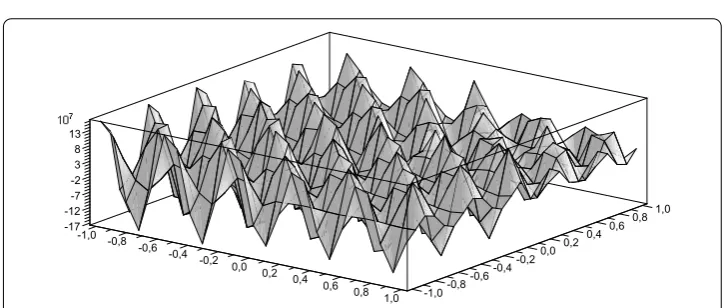
The graph of the Green’s function is displayed in Figure and Figure for two different values of the spectral parameter.
Figure 1 The graph of the Green’s functionG(x,t,μ) forμ= 3.
Competing interests
The authors declare that they have no competing interests.
Authors’ contributions
The authors contributed equally to this work. The authors read and approved the final manuscript.
Author details
1Department of Mathematics, Faculty of Arts and Science, Gaziosmanpa¸sa University, Tokat, 60250, Turkey.2Institute of
Mathematics and Mechanics, Azerbaijan National Academy of Sciences, Baku, Azerbaijan.
Acknowledgements
The authors would like to thank the referees for their valuable comments. This work was supported by the research fund of Gaziosmanpa¸sa University under Grant No. 2012/126.
Received: 18 September 2014 Accepted: 6 January 2015 References
1. Duffy, DG: Green’s Functions with Applications. Chapman & Hall/CRC, Boca Raton (2001) 2. Levitan, BM, Sargsyan, IS: Sturm-Liouville and Dirac Operators. Springer, New York (1991)
3. Ao, J, Sun, J: Matrix representations of Sturm-Liouville problems with coupled eigenparameter-dependent boundary conditions. Appl. Math. Comput.244, 142-148 (2014)
4. Likov, AV, Mikhailov, YA: The Theory of Heat and Mass Transfer. Qosenergaizdat, Moscow (1963) (Russian) 5. Tikhonov, AN, Samarskii, AA: Equations of Mathematical Physics. Pergamon, Oxford (1963)
6. Voitovich, NN, Katsenelbaum, BZ, Sivov, AN: Generalized Method of Eigen-Vibration in the Theory of Diffraction. Nauka, Moscow (1997) (Russian)
7. Mukhtarov, OS, Demir, H: Coerciveness of the discontinuous initial- boundary value problem for parabolic equations. Isr. J. Math.114, 239-252 (1999)
8. Mukhtarov, OS, Aydemir, K: New type Sturm-Liouville problems in associated Hilbert spaces. J. Funct. Spaces Appl.
2014, Article ID 606815 (2014)
9. Mukhtarov, OS, Yakubov, S: Problems for ordinary differential equations with transmission conditions. Appl. Anal.81, 1033-1064 (2002)
10. Rasulov, ML: Methods of Contour Integration. North-Holland, Amsterdam (1967)
11. Titeux, I, Yakubov, Y: Completeness of root functions for thermal conduction in a strip with piecewise continuous coefficients. Math. Models Methods Appl. Sci.7, 1035-1050 (1997)
12. Altını¸sık, N: Asymptotic formulas for eigenfunctions of the Sturm-Liouville problems with eigenvalue parameter in the boundary conditions. Kuwait J. Sci. Eng.39, 1-19 (2012)
13. Aydemir, K: Boundary value problems with eigenvalue depending boundary and transmission conditions. Bound. Value Probl.2014, 131 (2014)
14. Aydemir, K, Muhtarov, FS: Modified Parseval and Carleman equalities for Sturm-Liouville problems with interior singularities. Contemp. Anal. Appl. Math.2(1), 78-87 (2014)
15. Bairamov, E, Ugurlu, E: On the characteristic values of the real component of a dissipative boundary value transmission problem. Appl. Math. Comput.218, 9657-9663 (2012)
16. Chanane, B: Sturm-Liouville problems with impulse effects. Appl. Math. Comput.190(1), 610-626 (2007) 17. Ao, J, Sun, J, Zhang, M: The finite spectrum of Sturm-Liouville problems with transmission conditions and
eigenparameter-dependent boundary conditions. Results Math.63, 1057-1070 (2013)
18. Tharwat, MM, Bhrawy, AH, Alofi, AS: Approximation of eigenvalues of discontinuous Sturm-Liouville problems with eigenparameter in all boundary conditions. Bound. Value Probl.2013, 132 (2013)
19. U ˇgurlu, E, Bairamov, E: Dissipative operators with impulsive conditions. J. Math. Chem.51, 1670-1680 (2013) 20. Kong, Q, Wang, QR: Using time scales to study multi-interval Sturm-Liouville problems with interface conditions.
Results Math.63, 451-465 (2013)