R E S E A R C H
Open Access
Improved energy-balanced algorithm
for underwater wireless sensor network
based on depth threshold and energy level
partition
Pan Feng
1†, Danyang Qin
1*†, Ping Ji
1, Min Zhao
1, Ruolin Guo
1and Teklu Merhawit Berhane
2Abstract
Considering the insufficient global energy consumption optimization of the existing routing algorithms for Underwater Wireless Sensor Network (UWSN), a new algorithm, named improved energy-balanced routing (IEBR), is designed in this paper for UWSN. The algorithm includes two stages: routing establishment and data transmission. During the first stage, a mathematical model is constructed for transmission distance to find the neighbors at the optimal distances and the underwater network links are established. In addition, IEBR will select relays based on the depth of the neighbors, minimize the hops in a link based on the depth threshold, and solve the problem of data transmission loop. During the second stage, the links built in the first stage are dynamically changed based on the energy level (EL) differences between the neighboring nodes in the links, so as to achieve energy balance of the entire network and extend the network lifetime significantly. Simulation results show that compared with other typical energy-balanced routing algorithms, IEBR presents superior performance in network lifetime, transmission loss, and data throughput.
Keywords: UWSN, Energy-balanced routing, Network lifetime, Depth threshold, EL partition
1 Introduction
Wireless communication and information technology have been developed to the fifth generation (5G) [1–5], which enabled the realization of various appli-cations based on radio signals [6–10], including satel-lite systems [11–13], however, they could not be used in an underwater environment. Wireless sensor network (WSN) is wildly used in an underwater environment to collect and transmit data. Underwater WSN (UWSN) can realize wide-area information transmission by underwater sensors, which has certain application value in under-water target detection, underunder-water Internet of Things construction, marine data collection, disaster prevention, and underwater sonar communication [14]. However, the energy cost by data transmission and the difficulty
*Correspondence:[email protected]
†Pan Feng and Danyang Qin contributed equally to this work.
1Heilongjiang University, Harbin, China
Full list of author information is available at the end of the article
in battery-replacement in an underwater environment require an efficient and energy-balanced routing protocol to extend the underwater network lifetime. Many existing protocols for UWSN [15–18] might reduce energy con-sumption, but most of them only consider the problem of local energy consumption.
At present, the energy routing research of UWSN mainly considers consuming energy efficiently. Wahid and Kim [19] proposed a depth-based routing protocol (DBR) by selecting a transponder node based on depth and residual energy, named energy-efficient DBR (EEDBR). Cao et al. [20] studied the balanced transmission mech-anism (BTM) for UWSN in the view of energy pattern, in which each node selects a transmission pattern based on its energy level (EL). Li et al. [21] proposed a relative distance-based forwarding (RDBF) protocol. In another work [22], a routing algorithm with efficient energy con-sumption was proposed based on the sensors’ distance and the residual energy. Mahmood et al. [23] extended DBR and EEDBR, improving the network lifetime. Shen
et al. [24] proposed a new energy-efficient centroid-based routing protocol (EECRP) to improve the energy perfor-mance of the network, which requires a long lifetime round and base stations located in the network. Azam et al. [25] proposed a balanced load distribution (BLOAD) in order to avoid energy holes caused by energy consumption imbalance, prolonging the stability period and lifetime of UWSN. Javaid et al. [26] proposed two UWSN rout-ing protocols. The first protocol used adaptive hop-by-hop vector-based forwarding (AVN-AHH-VBF) to avoid a void node. The second protocol was cooperation-based AVN-AHH-VBF (CoAVN-AHH-VBF). Ali et al. [27] pro-posed two protocols: forward layered multipath power control-one (FLMPC-One), and FLMPC Two, reducing the energy consumption and achieving reliability by elud-ing energy holes. Bengheni et al. [28] proposed an energy management scheme which enhanced energy harvesting. Yousaf et al. [29] proposed a joint rate and power allo-cation policy (JRPAP), which balanced fairness, through-put, and energy consumption. Yang et al. [30] proposed a hybrid TDMA/CSMA protocol in the MAC layer to improve network energy efficiency and throughput.
For any energy-balanced routing algorithm, the trans-mitting power of the sensors is the greatest of all working states, which is about 100 times higher than the receiv-ing power [31,32]. So improving the transmitting energy efficiency is important to improve the data throughput and lifetime of the network. Improved energy-balanced routing (IEBR) adopts the frames of two classical UWSN protocols, BTM and data-aggregating ring (DAR) [33], which will be descripted in Section 2, and it modifies their routing and data transmission mechanisms based on the actual needs of UWSN. IEBR will focus on the global optimaization which can hardly be achieved by the exist-ing energy balance algorithms. Simulation results show that compared with other typical energy-balanced rout-ing algorithms, IEBR processes superior performances in network lifetime, transmission loss, and data throughput.
2 UWSN energy-balanced routing analysis
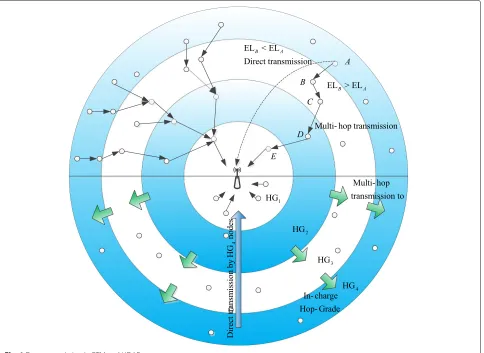
2.1 BTM and UDAR routing models
The energy balance problem is always an important research field of UWSN. In the routing algorithms for UWSN energy balance, BTM and DAR have good energy balance performance, and their frames are widely adopted to construct the routing models. Figure 1 illustrates the data transmission mechanisms in the models, where the above is BTM and the following is underwater DAR (UDAR).
BTM is a routing protocol based on hybrid data trans-mission, which includes two algorithms. Firstly, a tree, whose nodes are sensors and directed edges are links between sensors, is established through efficient routing algorithm (ERA) to determine the transmission route of
the data packets, e.g. the multi-hop routes in Fig.1. Then, the data packets will be transmitted according to the data balanced transmission (DBT) algorithm. BTM divides the initial energy of each node into m ELs. During multi-hop transmission (MT), the closer a sensor to the sink, the more energy it takes to convey the increasing traf-fic. When the EL of a node decreases frommtom−1, it will broadcast notice packets to all its predecessors. If the EL of the predecessor is higher than that of its suc-cessor, the direct transmission (DT) will be adopted to deliver the packets to the sink. For example, in Fig. 1, when ELB is lower than ELA, the node A will transmit
data to the sink directly. Otherwise, MT will be used, as the multi-hop transmission link from the nodeAto the sink in Fig. 1. By the way, the transmission pattern can be constantly changed, achieving continuous transmission with balanced energy consumption. However, such mode conversion makes BTM only suitable for small-scale net-works, because there are too many direct transmission links in BTM.
UDAR is the derivative model of DAR in underwater environments and it divides all nodes in UWSN into dif-ferent sets based on the hops to the sink, which is called as hop grade (HG). HGiis a set of the nodes with hop grade i. HGi is a circular area in space, which is called as ring
sector. As shown in Fig.1, the nodes in UWSN are divided into HG1, HG2, HG3, and HG4. The nodes in some HG will collect the data from the nodes in other HGs by MT in a different period and then directly transmit the data to the sink so as to avoid the rapid energy exhaustion of the nodes lying close to the sink. In Fig.1, the nodes in HG4are responsible for collecting data of nodes in other HGs by MT (the green arrows), and then the nodes in HG4 transmit them to the sink by DT (the blue arrows) along with their own data. It should be noted that the nodes in HG1directly transmit data to the sink. UDAR achieves energy balance among different nodes, but it may cause the problem of data transmission loop.
2.2 UWSN energy consumption model
Since the coverage area of the sensor is a circle, given the network radiusR, the node densityρ, the maximum num-ber of hopsH, and the width of each ring sector w, the total number of nodes can be defined as Eq. (1):
N=ρπR2=ρπ(Hw)2 (1)
Then, the number of the nodes in HG1 is shown in Eq. (2). The area of HG1is a circle, and the other ring sec-tors are ring, so they are called as ring secsec-tors. sensors in HG1, HGH or other ring sectors have given the network
radiusR, so they are discussed separately.
Fig. 1Data transmission in BTM and UDAR
Assuming that every node in the UWSN send a data packet at first, according to the different ring sectors, all nodes can be divided into three groups to calculate their energy consumption respectively as follows:
(1) The whole energy consumed by nodes in HG1is shown as follows:
E1 = Erx(ρπH2w2−ρπw2)+EtxρπH2w2
= ρπw2(Erx(H2−1)+EtxH2) (3)
whereErxandEtxis energy consumption of receiving and
transmitting a data packet respectively. The first term in Eq. (3) is the energy consumption of receiving data from nodes in other HGs, and the second term represents the energy consumption of transmitting data to the sink.
(2) The nodes in HGk(1<k<H) need to receive data
from the neighbors in HGk+1and send the data along with their own data to the neighbors in HGk−1. The energy
consumption is shown in Eq. (4).
Ek = Erx(ρπH2w2−ρπ(kw)2) (4)
+ Etx(ρπH2w2−ρπ((k−1)w)2)
= ρπw2(Erx(H2−k2)+Etx(H2−(k−1)2))
(3) The nodes in HGHonly need to send their own data
to the nodes in HGH−1, without accepting data from other
nodes. Their energy consumption is shown in Eq. (5).
EH =ρπw2Etx(H2−(H−1)2) (5)
The practical conditions, including the propagation delay and the working frequency range, should also be consid-ered in setting up the underwater energy model [34] to calculate specific energy consumption. The attenuation of the signal with transmission distancedand the frequency
f in underwater acoustic channel is defined in Eq. (6).
A(d,f)=A0dkvd (6)
whereA0is the normalized coefficient,kis the spreading factor, andvis the absorption coefficient, which is based on the signal frequency expressed in kilohertz. The value ofkrelies on the geometrical shape of the propagation.kis 2 in spherical spreading and is 1 in cylindrical spreading. In addition,vis defined by Eq. (7), where the parameterα is related to the signal frequencyf [35].αcan be calculated by Eq. (8) withf exceeding 100 Hz and by Eq. (9) withf
(kHz) andd(km) , the transmitting power consumption
It can be seen from Eq. (10) that factual transmitting power is PtA(d,f) if the transmitting power is Pt. The
transmitting and receiving energy consumption are shown in Eq. (11) and Eq. (12) respectively, wherexis the size of transmitted data.ris a constant depending on the receiver.
Etx(x,d)=PtA(d,f)xt (11)
Erx(x)=rxt (12)
3 Improved energy-balanced routing algorithm
Since existing UWSN energy-balanced routing models such as BTM and UDAR have the problem of insufficient global energy balance and transmission loop, IEBR selects the relay nodes according to the distance and depth at the same time, so as to minimize the hops and eliminate the transmission loop in every link. Then, the EL model in BTM will be adopted to establish dynamic links, achieving balanced energy consumption in the same ring sectors and prolonging the network lifetime. In addition, IEBR will also use cross-sector data transmission to achieve energy balance in different ring sectors.
3.1 Network node deployment
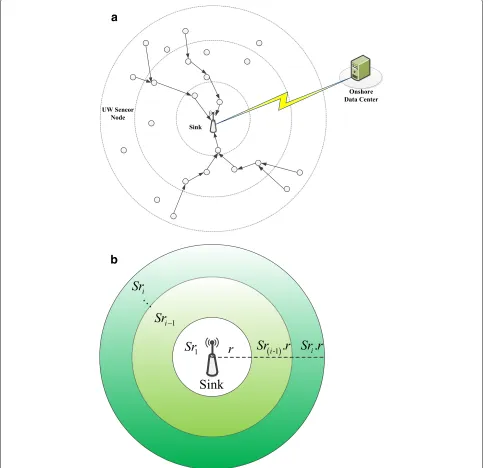
Considering the complexity of underwater environments and the inconsistency of the propagating energy con-sumption, the UWSN topology with ring sector structure in UDAR has been constructed as shown in Fig. 2. The coverage of UWSN is divided into spaced ring sectorsSr1, Sr2,. . . ,Srnfrom the inside to the out. GivenR, which is
the network radius, and Ot, which is the optimal
com-munication distance threshold of sensors, the maximum number of ring sectors isR/Ot . If the transmitting
dis-tance exceeds the given Ot, the signal quality will drop
sharply to be regarded as unavailable. This threshold has a close corresponding relation with the radiusRas shown in Fig.3. The whole area of UWSN is a concentric circle, where the sink is in the center and other sensors are in the target area randomly and uniformly. Assuming UWSN satisfy the following conditions:
• All sensor nodes have limited battery power
• The sensor nodes use the positioning methods
(received signal strength indication (RSSI) [36] and
MoteTrack position recognition scheme [37]) for
position sensing in a given underwater environment to make the location known to every sensor
• There are enough data to send for the sensors
• The data reporting mechanism is periodic
• The sink is static and above the water
3.2 Energy-balanced routing (EBR) construction
3.2.1 Relay selection based on optimal distance threshold
After all sensors are deployed as above, if nodeinot inSr1 has data to send, it will select the neighbor at the optimal distance as the relay. Node iwill broadcast the location of both itself and the sinksto the neighbors, and every neighbor receiving the data will calculate the parameter
Njaccording to Eq. (13):
Nj=α|d(i,j)−Ot| +(1−α)d(j,s) (13)
whered(i,j)is the distance betweeniandj,αis a system parameter and there isα = 0.5.αgives the same weight to the two distances (distance from nodeito relayjand distance from relayjto sink), so the system will consider the effect of two distances on data transmission equally and choose the most appropriate relay based on distance.
The node with the smallestNj will be the relay, which
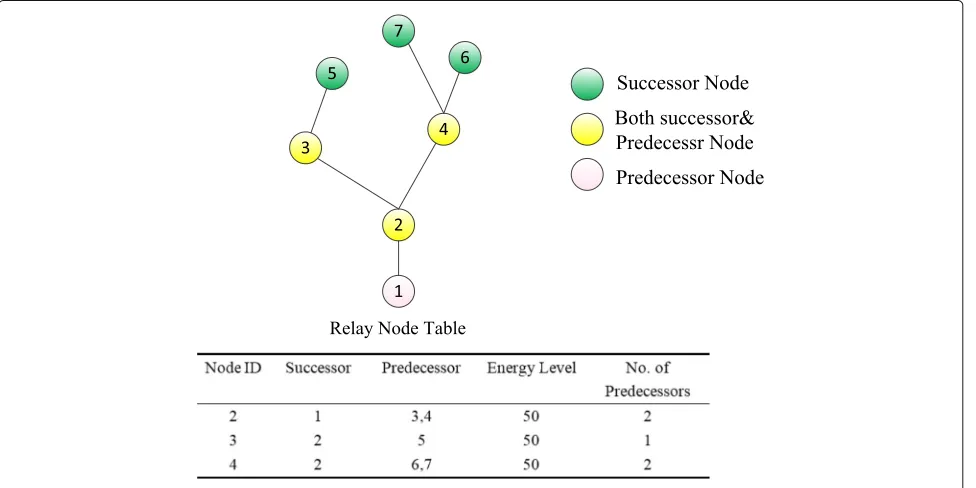
ensures that the relay node is located at the optimal dis-tance from node i to sink. Figure 4 shows tree typical structures and a list of relays, through which the routing information can be obtained.
When a relay j is obtained, the parameter Nj will be
stored in the routing table of its predecessori. Thenjwill inform its successor the fact ofj’s being selected as the relay and the node number in the routing table along with
Nj. To reduce the node power consumption, the algorithm
will allow each node forwarding packets from at most two neighbors.
The process of selecting a relay node withNjis shown in
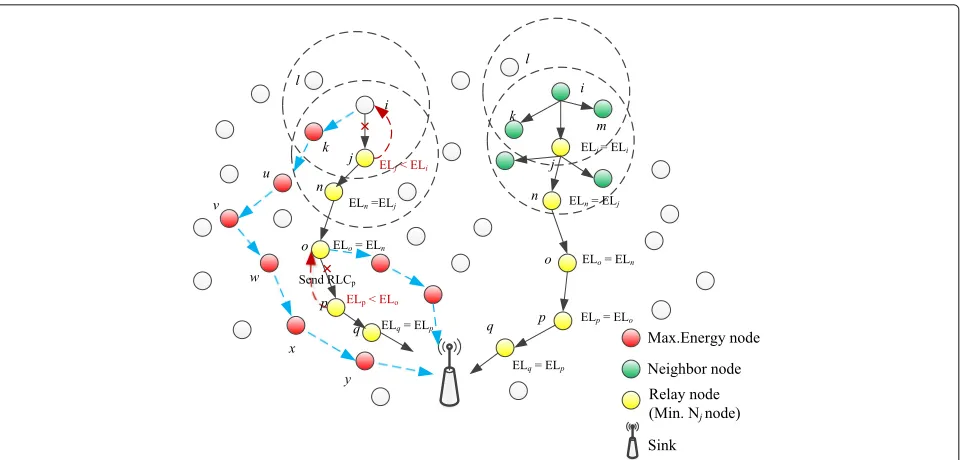
Fig.5. Firstly, nodeiidentifies all its neighbors by sending query packets, such as the neighborsq,k, andmin Fig.5. Then nodei will select a relay from its neighbors based onNj. The algorithm will calculate the distance between
node i and its neighbor (black arrow) and the distance between the neighbor and the sink (blue arrow) . In Fig.5, nodeiselects neighborjas the relay. After that, the node
jwill select its relayx. This process will continue until a complete link fromito the sink has been established. The specific routing algorithm can be seen in Table1.
3.2.2 Data transmission mode based on EL consumption
EBR may get a set of nodes based on the value of Nj
a
b
Fig. 2The structure of UWSN.aNetwork topology.bRing sector. Sink is on the center to gather data from other nodes and transmits them to data center. All nodes are located in ring sections (Sr) randomly and the radius of each section isr
nodes to transmit data. The initial energyE0of each node is divided into L ELs, the Unit EL (UEL) is defined as Eq. (14).
UEL= E0
L (14)
The energy consumption of nodes i andj is calculated by Eq. (15), including the energy consumption of sensing, receiving, and transmitting.xis the data size anddis the transmitting distance.
Eti,j(x,d)=Eseni (x)+Ejrx(x)+Eitx(x,d) (15)
During the data transmission, all the sensors in different ring sectors have the same initial ELs. If there is UEL=β, EL of node j in Sri and node k in Sri−1 are shown in
Eqs. (16) and (17), respectively.
EjEL= E0
β (16)
EkEL= E0
Fig. 3Optimal threshold at different network radiuses. The abscissa is the network radius (km) and the ordinate is the optimal threshold (km)
As shown in Fig.6, two conditions may occur during data transmission. In the right link, the EL of each node is equal to that of the successor, so the entire link topol-ogy remains the same. In the left link, the transmission load of i and jare different for they are located in dif-ferent ring sections resulting in ELj < ELi. Then, node j will send a control packet to node i, and the link
between them is cut off. Now, node j will only trans-mit its own data along the original link, and node iwill have to build a new one. Each relay in the new link is the node with maximum EL in the neighbors. This oper-ation can balance the energy consumption of all sensors in the same ring sectors. Related algorithms are shown in Table2.
Fig. 5Selection of relay nodes withNj. Source node calculates the distance between and the neighbor; obtains the distance between the neighbor node and sink from the neighbor node, calculatingNjof all neighbors; and selects the relay node
3.3 Realization of improved EBR (IEBR)
3.3.1 Relay node selection model based on depth
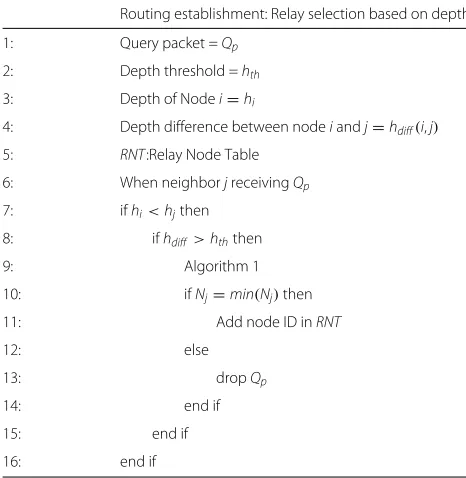
To solve the problem of transmission loop, IEBR will take the depth threshold to limit the neighbor number, and the depth of a node depends on the ring sector where the node is located. The nodes in the same ring sector have the same depth. The closer a node lies to the sink, the smaller depth a node will have. A node will get the depth of its neighbors by broadcasting control packets when it has data to transmit. The sensor node will select the neighbors with smaller depth as the relay candidates. After that, the algorithm will select only one node with smallestNjfrom
all candidates as the relay. The data transmission of IEBR is also based on EL. A sensor will not reselect the relay until the EL of its successor falls below that of itself.
The sensor with greater depth will not be selected as the relay according to IEBR; however, traditional BTM and EBR leave the depth of the node out of account, resulting in the transmission loop, asA→B→Ain Fig.7, so the data packets cannot be transmitted to the sink or addi-tional hops are required, asA→B→ Cin Fig.7, which will increase the energy consumption and cause lifetime reduction. For the special condition with no neighbor or only one neighborBexisting, the sensorAwill expand the communication range to contain more neighbors [38] so as to establish IEBR loop-free transmission. The routing establishment process of IEBR is shown in Table3.
3.3.2 Cross-sector data transmission
To reduce the hops and the transmission loads, IEBR will search for the relays in every other ring sectors instead of in adjacent ring sectors, i.e., a node inSriwill look for the
relay node inSri−2instead ofSri−1.
Suppose that there are four nodesA ∈ Sr1, B ∈ Sr2, C ∈Sr3, andD ∈ Sr4. Aand Bsend data to C andD, respectively. The same volume of data being transmitted at the same distance will have the same energy consump-tion.Creceives the data fromAand will send the data as well as its own data, the UEL ofCwill drop faster thanA, which will makeAreselect the relay node. Then nodeC
will head to send its own data, nodeAwill begin to send
Table 1Routing establishment of EBR
Routing establishment: Relay Selection based Distance
1: Initialization:
2: TotalELs =m
3: UEL =E0/m
4: α= 0.5
5: SelectRelayNode:
6: SourceID =i
7: NeighborID =j
8: Mis the number of neighbors
9: forj=1 :Mdo
10: d(i,j)=di,j
11: d(j,s)=dj,s
12: Nj=α|di,j−Ot|+αdj,s
13: ifNj=<Nj−1then
14: min(Nj)=Nj
15: RelayID=j
16: end if
Fig. 6Data transmission based on EL difference. The link between nodes are dynamic, if EL of successor is lower, the node will find a new relay, and a link become two links by this way
data to another node with a higher EL and the data load is shared by different nodes in this way. Finally, the energy consumption of all ring sectors can achieve balance.
Moreover, the node number in every ring sector is assumed to be the same fixed value in the mathemati-cal mode for simplifying the mathemati-calculation. In IEBR, it will vary according to the data load as well as the distance to the sink, and the nodes in a ring sector with higher energy consumption will be more, prolonging the lifetime of UWSN for longer lifetimes of these ring sectors.
Table 2Data transmission of EBR
Data transmission: Relay Selection based on Energy Level
1: if ELj>=ELithen
2: continue
3: else
4: ELNoticePacketSend(j,i)
5: NeighborFinding (i)
6: LinkBuild.sourceID =j
7: for neighborIDk=1 :mdo
8: if ELk>=ELithen
9: nodekbe new relay node
10: LinkBuild.soureID =k
11: end if
12: end for
13: end if
3.3.3 Packet loss rate constraint of IEBR algorithm
The energy balance algorithm in UWSN will always cause packets lost increasingly so as to limit the practi-cal application. Thus, a maximum throughput model is established in IEBR to reduce the packet loss rate along while achieving global energy balance. Linear program-ming is used in the paper to design the objective function Maximizetmax
t=1Tp(r), and it should satisfy the following
constraints:
(i)Eu ≤E0, ∀u∈N; (ii)du,v≤dopt, ∀u,v∈N; (iii)fu,v≤fmax, ∀u,v∈N; (iv)dmin≤du≤dmax; (v)Pl≥Pg, ∀u∈N;
(vi)nu=1E(u)∼=vm=1E(v), ∀u,v∈N;
The objective function will maximize the number of effective packets received by the sink during timetmax. (i) is the energy constraint, and each sensoru’s energy isE0 at first. All sensors’ energy should be consumed efficiently to extend the network lifetime and increase throughput. (ii) requires that the distance between two communica-tion nodesuandvnot exceed the optimal transmission distance dopt to keep the packet loss rate from increas-ing. (iii) describes the constraint of data flow in physical link. fmax is the upper limit of data flow, and it can be defined as the maximum number of packets that can be transmitted per unit time when the size of each packet is fixed. The data flow from any nodeuto another nodev
Fig. 7Routing problems during data transmissions. Formation of loops during data transmissions without using depth of the neighbors
of the transmission distance,dmaxanddmin. Transmitting data over a long distance by expanding the transmission range will result in a large amount of packets loss while reducing the transmission range will cause higher energy consumption, shorter network lifetime, and higher packet loss rate. IEBR is a reasonable trade-off in the view of the global performance. (v) indicates that the probabilityPl
of the current link state should be no less thanPg, which
Table 3Routing establishment of IEBR
Routing establishment: Relay selection based on depth
1: Query packet =Qp
2: Depth threshold =hth
3: Depth of Nodei=hi
4: Depth difference between nodeiandj=hdiff(i,j)
5: RNT:Relay Node Table
6: When neighborjreceivingQp
7: ifhi<hjthen
8: ifhdiff >hththen
9: Algorithm 1
10: ifNj=min(Nj)then
11: Add node ID inRNT
12: else
13: dropQp
14: end if
15: end if
16: end if
is the minimum probability required for successful data transmission [39]. (vi) indicates that the energy consump-tion of every ring sector should be approximately equal. If the energy consumption is balanced, the network can achieve high throughput so as to prolong the effective lifetime.
4 Performance evaluation
The performance of the proposed IEBR will be verified by cross comparison with BTM and UDAR. In addition, EBR will be adopted as an independent algorithm to evaluate the impact of various elements and stages of the algorithm model.
For EBR, BTM, and UDAR, there are the same num-ber of sensors lying in each ring sector of UWSN in the simulation. The initial energy of each sensor node is 300 J, and the transmission data packet size is 200 bits: 50 bits in the control field, 150 bits in the data field. Carrier sense multiple access with collision avoidance (CSMA/CA) is adopted under IEEE 802.15.4. IEBR model uses Linprog
Table 4Simulation parameters
Parameters Value
Network radius (R) 1–5 km,= 0.5 km
Number of nodes (N) 80
Initial energy (E0) 300 J
Frequency (f) 20 kHz
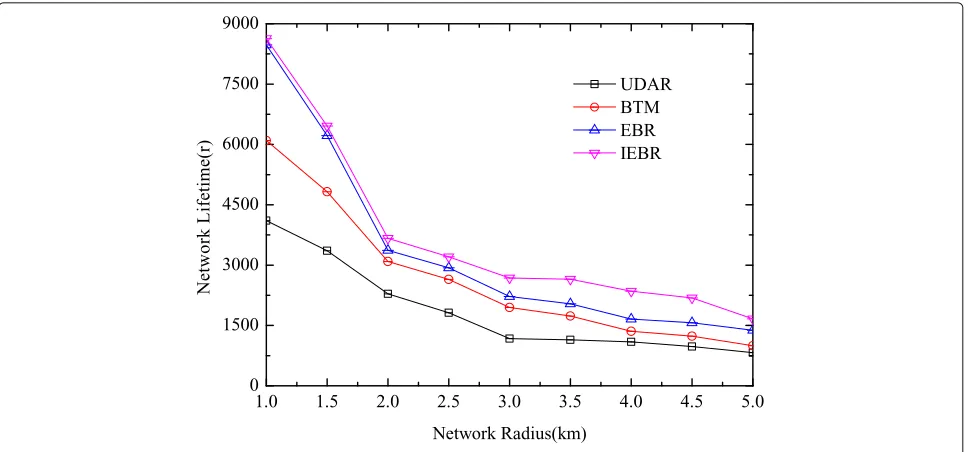
Fig. 8The network lifetimes with different network radiuses
linear programming to achieve the throughput optimiza-tion. Network lifetime, effective throughput and transmis-sion loss are used to evaluate the network performance. Network lifetime defined by BTM is evaluated by the maximum transmission rounds (r) that can be achieved. Effective throughput is the number of valid packets (p) received by the sink successfully. Some parameters are shown in Table4.
4.1 Network lifetime with different network radiuses The network lifetime comparison of the algorithms on dif-ferent network scales is shown in Fig.8. The curves show that the network lifetime of all algorithms will decrease with the increase of the network radius. When the radius is less than 2 km, the network lifetime falls obviously, but the decline curves of IEBR and EBR are an obvious flat to achieve better lifetime performance. Specifically, the
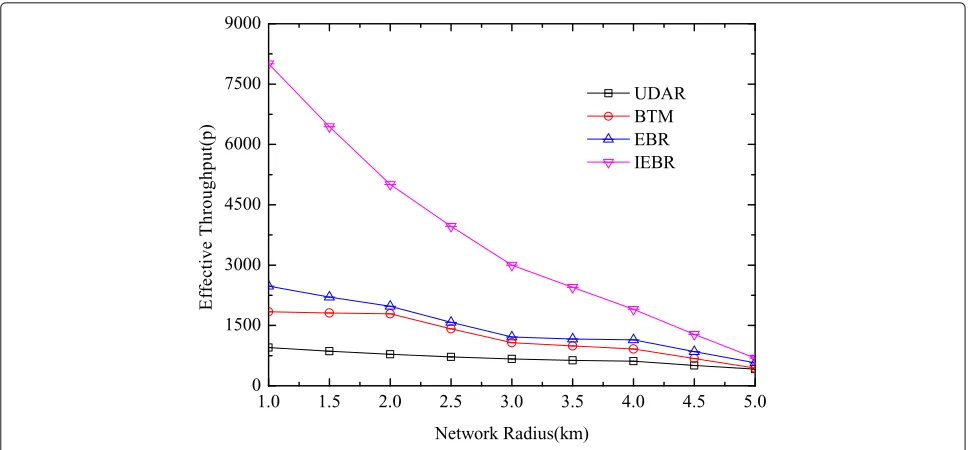
Fig. 10The effective throughput with different network radiuses
network lifetime of IEBR is about 1.5 times and twice more than that of BTM and UDAR, respectively. When the radius of the network exceeds 3 km, the falling trend of the network lifetime tends to be flat. The network life-time of IEBR is still higher than the other algorithms, about 1.5 times higher than EBR, and about twice higher than UDAR and BTM. Overall, IEBR performs better in the network lifetime on different network scales, which is mainly because IEBR is able to reduce the hops as well as the data load of the sensors near the sink.
4.2 Transmission loss with different network radiuses The transmission loss caused by the balanced algorithms with different network sizes is shown in Fig. 9, which indicates that the transmission loss will increase with the network radius for all algorithms. The increasing trend of IEBR, however, is relatively flat. The transmission loss curves are roughly the same when the network radius is 1km. With the network radius increasing by every 1km, the transmission loss of IEBR and EBR will increase by about 5 dB and 7 dB, respectively, while that of BTM and UDAR will exceed 10 dB and 12 dB, respectively. The advantage of the IEBR algorithm is relatively obvious. When the network radius reaches 5 km, the transmission loss of UDAR is about 30 dB higher than IEBR, the incre-ment is 20 dB for BTM, and is about 10 dB for EBR. It can be seen that IEBR will cause low transmission loss while processing a long network lifetime.
4.3 Effective throughput with different network radiuses Considering the multi-hop forwarding characteristics of UWSN, the number of effective data packets received is
used as the measure of throughput. The effective through-put comparison with different network radiuses is shown in Fig.10. The effective throughput will decline with the network radius increasing. That is because the increase in the network radius will cause the decrease in node density with constant node number. And the increase in distance between two neighbors will cause the packet loss rate to increase. Specifically, when the radius is 1 km, the effec-tive throughput of IEBR is approximately 8 times more than that of UDAR. After that, the effective throughput will drop sharply with the radius increasing, but it is still higher than that of the other algorithms. That means IEBR has an advantage in effective throughput, especially in the network with the limited radius, which is similar with the simulation results in network lifetime.
4.4 Network lifetime with different network radiuses and node numbers
a
b
c
d
e
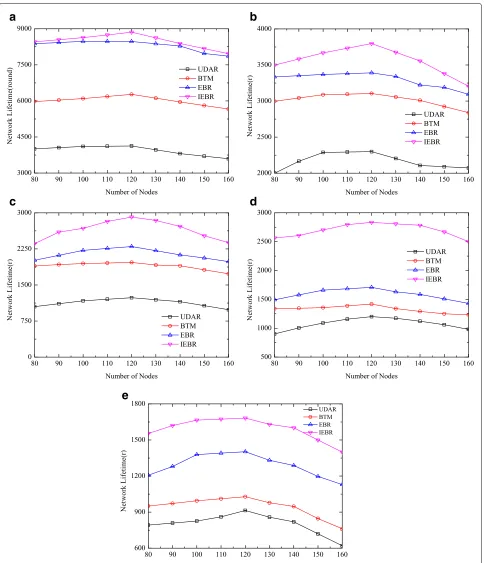
Fig. 11The network lifetimes with different network radiuses and numbers of nodes.aNetwork radius = 1 km.bNetwork radius = 2 km.cNetwork radius = 3 km.dNetwork radius = 4 km.eNetwork radius = 5 km
network lifetime by about 25%. The comparisons show that IEBR has an advantage in network lifetime over other algorithms with different network radiuses and numbers of nodes.
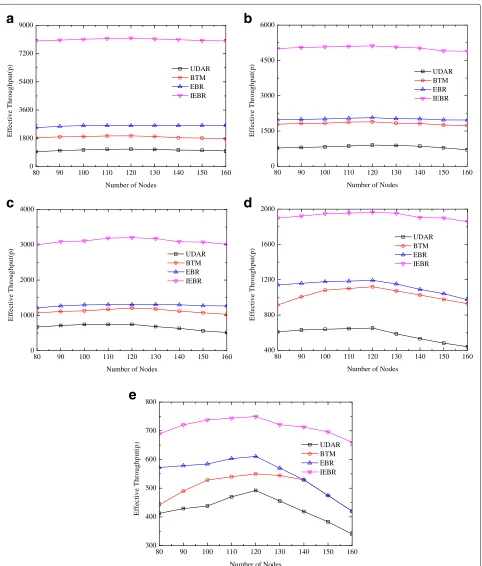
4.5 Effective throughput with different network radiuses and node numbers
80 90 100 110 120 130 140 150 160
in Fig. 12. The effective throughput is less sensitive to the node density when the network radius is small. With the radius increasing, the effective throughput of the net-work will rise first and then gradually decline, which is similar to the lifetime curves. When the node num-ber is about 120, the values of effective throughput are the largest with different network radiuses. The larger lifetime means more data transmission and reception, and the effective throughput could be larger, which is similar to the results in Fig. 11. Under different node density conditions, IEBR will have high effective through-put and relatively stable performance in a small-scale network.
5 Conclusion
To solve the problem of limited energy and short lifetime in UWSN, an improved energy balance routing (IEBR) algorithm is presented in this paper. A ring sector model is constructed, and the optimal relay node is selected by transmission distance and depth threshold to avoid the transmission loop. IEBR will select the optimal relay node among different ring sectors alternately, and the link structure will be adjusted dynamically according to the energy level difference. Simulation results show that IEBR has a longer network lifetime, larger effective through-put, and lower transmission loss than the existing typi-cal algorithms in UWSN with different sizes and stypi-cales. Moreover, the research indicates that IEBR achieves global energy balance rather than the local balance as the existing algorithms do. Futural research will consider the spatial expansion of the energy ring sectors and the model of dynamic depth thresholds.
Abbreviations
BTM: Balanced transmission mechanism; DT: Direct transmission; EBR: Energy balance; EL: Energy level; HG: Hop grade; IEBR: Improved energy-balanced routing; MT: Multi-hop transmission; RSSI: Received signal strength indication; UDAR: Underwater data-aggregating ring; UEL: Union energy level; UWSN: Underwater Wireless sensor network
Authors’ contributions
PF and DyQ conceptualized the idea and designed the experiments. PF contributed in writing and draft preparation and DyQ supervised the research. All authors read and approved the final manuscript.
Funding
The funding was supported by the National High Technology Research and Development Program of China (2012AA120802),National Natural Science Foundation of China (61771186), Postdoctoral Research of Heilongjiang Province (LBH-Q15121), and Undergraduate University Project of Young Scientist Creative Talent of Heilongjiang Province (UNPYSCT-2017125).
Availability of data and materials
Not applicable
Competing interests
The authors declare that they have no competing interests.
Author details
1Heilongjiang University, Harbin, China.2Dire-dawa Institute of Technology,
Dire Dawa, Ethiopia.
Received: 2 March 2019 Accepted: 7 August 2019
References
1. L. Xin, J. Min, Z. Xueyan, et al., A novel multi-channel Internet of Things based on dynamic spectrum sharing in 5G communication[J]. IEEE Internet of Things J.6, 1–1 (2018)
2. X. Liu, F. Li, Z. Na, Optimal resource allocation in simultaneous cooperative spectrum sensing and energy harvesting for multichannel cognitive radio[J]. IEEE Access.5, 1–1 (2017)
3. X. Liu, M. Jia, Z. Na, et al., Multi-modal cooperative spectrum sensing based on Dempster-Shafer fusion in 5G-based cognitive radio[J]. IEEE Access.6(99), 199–208 (2018)
4. Z. Na, Y. Wang, X. Li, et al., Subcarrier allocation based simultaneous wireless information and power transfer algorithm in 5G cooperative OFDM communication systems[J]. Phys. Commun.29, 164–170 (2018) 5. Z. Na, J. Lv, M. Zhang, et al., GFDM based wireless powered
communication for cooperative relay system[J]. IEEE Access.7, 50971–50979 (2019)
6. M.A. Shaolin, Y. Wang, Design and implementation of an ultra-wideband high-accuracy ranging system[J]. J. Tianjin Norm. Univ.(Nat. Sci. Ed.)37(6), 55–57 (2017)
7. X. Zhang, Z. Zhang, Near-field plate applied in wireless power transmission system[J]. J. Tianjin Norm. Univ. (Nat. Sci. Ed.)37(6), 58–61 (2017) 8. J. Wu, C. Zeng, J. Sun, Research and application of wireless intelligent
network monitoring smog system based on STM32F407[J]. J. Tianjin Norm. Univ. (Nat. Sci. Ed.)37(6), 62–66 (2017)
9. Z. Liu, J. Chen, Y. Tong, F. Duan, J.I. Maolin, Research and implementation of digital baseband signal transmission[J]. J. Tianjin Norm. Univ. (Nat. Sci. Ed.)38(1), 51–55 (2018)
10. B. Liang, J. Xie, J. Shi, W. Wang, Design and implementation of three-phase inverter for microgrid research[J]. J. Tianjin Norm. Univ. (Nat. Sci. Ed.)38(1), 59–63 (2018)
11. M. Jia, X. Gu, Q. Guo, W. Xiang, N. Zhang, Broadband hybrid satellite-terrestrial communication systems based on cognitive radio toward 5G. IEEE Wirel. Commun.23(6), 96–106 (2016)
12. M. Jia, X. Liu, X. Gu, Q. Guo, Joint cooperative spectrum sensing and channel selection optimization for satellite communication systems based on cognitive radio. Int. J. Satell. Commun. Netw.35(2), 139–150 (2017) 13. M. Jia, X. Liu, Z. Yin, Q. Guo, X. Gu, Joint cooperative spectrum sensing and
spectrum opportunity for satellite cluster communication networks. Ad Hoc Netw.58(C), 231–238 (2016)
14. I.F. Akyildiz, D. Pompili, T. Melodia, Underwater acoustic sensor networks: research challenges[J]. Ad Hoc Netw.3(3), 257–279 (2005)
15. N.Z. Zenia, M.S. Kaiser, M.R. Ahmed, et al., inElectrical Engineering and Information Communication Technology (ICEEICT), 2015 International Conference on. An energy efficient and reliable cluster-based adaptive mac protocol for uwsn[C] (IEEE, Dhaka, 2015), pp. 1–7
16. A. Solayappan, M.BH. Frej, S.N. Rajan, inSystems, Applications and Technology Conference (LISAT), 2017 IEEE Long Island. Energy efficient routing protocols and efficient bandwidth techniques in Underwater Wireless Sensor Networks-a survey[C] (IEEE, Farmingdale, 2017), pp. 1–7 17. Z. Wan, S. Liu, W. Ni, et al., An energy-efficient multi-level adaptive
clustering routing algorithm for underwater wireless sensor networks[J]. Clust Comput, 1–10 (2018)
18. S. Souiki, M. Hadjila, M. Feham, inProgramming and Systems (ISPS), 2015 12th International Symposium on. Energy efficient routing for ,obile underwater wireless sensor networks[C] (IEEE, Algiers, 2015), pp. 1–6 19. A. Wahid, D. Kim, An energy efficient localization-free routing protocol for
underwater wireless sensor networks[J]. Int. J. Distrib. Sensor Netw.8(4), 307246 (2012)
20. J. Cao, J. Dou, S. Dong, Balance transmission mechanism in underwater acoustic sensor networks[J]. Int. J. Distrib. Sensor Netw.11(3), 429340 (2015)
21. Z.L. Li, N.M. Yao, Q. Gao, Relative distance-based forwarding protocol for underwater wireless sensor networks[C]. Trans. Tech. Publ. Appl. Mech. Mater.437, 655–658 (2013)
DBR (CDBR) and EEDBR (CEEDBR) in underwater WSNs[J]. Procedia Comput. Sci.34, 228–235 (2014)
24. J. Shen, A. Wang, C. Wang, et al., An efficient centroid-based routing protocol for energy management in WSN-assisted IoT[J]. IEEE Access.5, 9–18479 (1846)
25. I. Azam, N. Javaid, A. Ahmad, et al., Balanced load distribution with energy hole avoidance in underwater WSNs[J]. IEEE Access.5, 15206–15221 (2017)
26. N. Javaid, T. Hafeez, Z. Wadud, et al., Establishing a cooperation-based and void node avoiding energy-efficient underwater WSN for a Cloud[J]. IEEE Access.5, 11582–11593 (2017)
27. B. Ali, N. Javaid, A.R. Hameed, et al., inWireless Communications and Mobile Computing Conference (IWCMC), 2017 13th International. Energy hole avoidance based routing for underwater WSNs[C] (IEEE, Valencia, 2017), pp. 1654–1659
28. A. Bengheni, F. Didi, I. Bambrik, EEM-EHWSN: Enhanced energy management scheme in energy harvesting wireless sensor networks[J]. Wirel. Netw.25(6), 3029–3046 (2019)
29. R. Yousaf, R. Ahmad, W. Ahmed, et al., A unified approach of energy and data cooperation in energy harvesting WSNs[J]. Sci. China Inf. Sci.61(8), 082303 (2018)
30. X. Yang, L. Wang, J. Xie, et al., Energy efficiency TDMA/CSMA hybrid protocol with power control for WSN[J]. Wirel. Commun. Mob. Comput.
2018(2018)
31. I. Harris AF, M. Stojanovic, M. Zorzi, inProceedings of the 1st ACM international workshop on Underwater networks. When underwater acoustic nodes should sleep with one eye open: idle-time power management in underwater sensor networks[C] (ACM, Los Angeles, 2006), pp. 105–108
32. A.A. Syed, W. Ye, J. Heidemann, inThe 27th Conference on Computer Communications. IEEE. INFOCOM 2008. T-Lohi: A new class of MAC protocols for underwater acoustic sensor networks[C] (IEEE, Phoenix, 2008), pp. 231–235
33. Y. Bi, N. Li, L. Sun, DAR: An energy-balanced data-gathering scheme for wireless sensor networks[J]. Comput. Commun.30(14-15), 2812–2825 (2007)
34. J. Poncela, M.C. Aguayo, P. Otero, Wireless underwater communications[J]. Wirel. Pers. Commun.64(3), 547–560 (2012) 35. M. Stojanovic, On the relationship between capacity and distance in an
underwater acoustic communication channel[J]. ACM SIGMOBILE Mob. Comput. Commun. Rev.11(4), 34–43 (2007)
36. K.M. Kwak, J. Kim, Development of 3-dimensional sensor nodes using electro-magnetic waves for underwater localization[J]. J. Inst. Control Robot. Syst.19(2), 107–112 (2013)
37. K. Lorincz, M. Welsh, inInternational Symposium on Location-and Context-Awareness. Motetrack: A robust, decentralized approach to rf-based location tracking[C] (Springer, Berlin, 2005), pp. 63–82 38. M. Zorzi, P. Casari, N. Baldo, et al., Energy-efficient routing schemes for
underwater acoustic networks[J]. IEEE J. Sel. Areas Commun.26(9), 1754–1766 (2008)
39. A. Ahmad, N. Javaid, Z.A. Khan, et al.,(ACH)2: Routing Scheme to
Maximize Lifetime and Throughput of Wireless Sensor Networks[J]. IEEE Sensors J.14(10), 3516–3532 (2014)
Publisher’s Note