Polynomial-Time, Semantically-Secure Encryption
Achieving the Secrecy Capacity
Mihir Bellare1 Stefano Tessaro2
September 2011
Abstract
In the wiretap channel setting, one aims to get information-theoretic privacy of communicated data based only on the assumption that the channel from sender to adversary is noisier than the one from sender to receiver. The secrecy capacity is the optimal (highest possible) rate of a secure scheme, and the existence of schemes achieving it has been shown. For thirty years the ultimate and unreached goal has been to achieve this optimal rate with a scheme that is polynomial-time. (This means both encryption and decryption are proven polynomial time algorithms.) This paper finally delivers such a scheme. In fact it does more. Our scheme not only meets the classical notion of security from the wiretap literature, called MIS-R (mutual information security for random messages) but achieves the strictly stronger notion of semantic security, thus delivering more in terms of security without loss of rate.
1 Department of Computer Science & Engineering, University of California San Diego, 9500 Gilman Drive, La Jolla, California 92093, USA. Email: [email protected]. URL:http://www.cs.ucsd.edu/users/mihir. Supported in part by NSF grants CNS-0904380 and CCF-0915675.
Contents
1 Introduction 3
2 Preliminaries 5
3 Encryption and Semantic Security 6
4 Seeded Encryption 7
5 A DS-Secure Scheme Achieving Secrecy Capacity 10
5.1 TheItE Construction . . . 10
5.2 Random-Message Security ofItE . . . 12
5.3 DS-Security ofItE . . . 14
5.4 InstantiatingItE . . . 16
5.5 Extensions . . . 17
A Related Work 19
1
Introduction
Introduced by Wyner, Csisz´ar and K¨orner in the late seventies [34, 11], the wiretap channel is a setting where one aims to obtain information-theoretic security (privacy) of communicated data under the sole assumption that the channel from sender to adversary is “noisier” than the channel from sender to receiver. Researchers have shown that there is a maximum possible rate (ratio of message length to ciphertext length) for a secure scheme, called the optimal rate, and they have shown, through the probabilistic method, that there exist secure schemes with this rate. But these results are non-constructive. A question of great interest in this area is whether there is an explicit, secure scheme that is polynomial-time. (Meaning, there are polynomial-time algorithms for both encryption and decryption.) But this has remained open for 30 years. In this paper we finally resolve this question by providing such a scheme.
However, we do even more. Our scheme achieves not only the classical notion of security from the wiretap literature but the stronger notion of semantic (equivalently, distinguishing) security of [3]. Furthermore our scheme is simple, efficient and modular. Unlike schemes from the I&C approaches, it makes only blackbox (meaning non-intrusive) use of error-correcting codes. Our scheme is obtained by combining methods from cryptography and coding theory. Let us now look at all this in some more detail.
The wiretap model. The setting is depicted in Figure 1. The sender applies to her message M a
ran-domized encryption function E: {0,1}m → {0,1}c to get what we call the sender-ciphertext X←$E(M).1 This is transmitted to the receiver over the receiver channel ChRso that the latter gets areceiver cipher-text Y←$ChR(X) which it decrypts via algorithm D to recover the message. The adversary’s wiretap is modeled as another channel ChA and it accordingly gets an adversary ciphertext Z←$ChA(X) from which it tries to glean whatever it can about the message.
A channel is a randomized function specified by a transition probability matrix W where W[x, y] is the probability that input x results in output y. Here x, y are strings. Thus, for example, we regard the Binary Symmetric Channel BSCp with crossover probability p≤ 1/2 as taking a binary string x of
any length and returning the string y of the same length formed by flipping each bit ofx independently with probability p. For concreteness and simplicity of exposition we will often phrase discussions in the setting where ChR,ChAare BSCs with crossover probabilities pR, pA≤1/2 respectively, but our results
apply in much greater generality. In this case the assumption thatChAis “noisier” thanChRcorresponds
to the assumption that pR < pA. This is the only assumption made: the adversary is computationally unbounded, and the scheme is keyless, meaning sender and receiver are not assumed to a priori share any information not known to the adversary.
Requirements. The two requirements aredecryptability, also calleddecodability, andsecurity. The first asks that the scheme provide error-correction over the receiver channel, namely limm→∞Pr[D(ChR(E(M)))
6
= M] = 0. Security may be measured in various ways. A security metric xs associates to encryption
function E: {0,1}m → {0,1}c and adversary channel ChA a number Advxs(E;ChA) that measures the maximum “advantage” of an adversary in breaking the scheme under metric xs, and we say that E provides XS-security relative to ChA if limk→∞Advxs(E;ChA) = 0. The central metric of the wiretap
literature is mis-r (mutual-information security for random messages), defined via Advmis-r(E;ChA) = I(M;ChA(E(M))) where M is uniformly distributed over {0,1}m andI is the mutual information. It was
introduced by [26, 27] and strengthens the original metric of [34]. The name is from [3].
Taking a cryptographic perspective, the latter point out that mis-r is weak because messages are assumed to be random. They introduce a semantic security (ss) metric following [15] that, roughly, asks that given the adversary ciphertext, the adversary cannot compute any function of the message with probability better than she could have without the adversary ciphertext. They show that this is equivalent to a strengthening of mis-r that they call mis security and also to a simpler and more convenient metric called distinguishing security (ds), also adapted from [15], where the advantage is defined via
Advds(E;ChA) = max
A,M0,M1
2 Pr[A(M0, M1,ChA(E(Mb))) =b]−1
ChR
ChA M
M
D
Y
Z A
E X
Figure 1: Wiretap channel model. See text for explanations.
where challenge bit b is uniformly distributed over {0,1} and the maximum is over all m-bit messages
M0, M1 and all adversariesA. Since MIS, SS and DS are shown equivalent in [3] one can work with any of them, and our choice is DS.
Practical interest in the wiretap setting is escalating [35, 4], and applications need DS-security rather than MIS-R security. Thus DS-security is the most desirable target.
Previous work. In the Information and Coding (I&C) community, the wiretap setting has a literature encompassing hundreds of papers. (See the survey [23] or the book [4].) The focus has been to show the existence of MIS-R-secure schemes with optimal rate. (The schemes are not required to be explicit, let alone polynomial time.) This optimal rate is called the secrecy capacity. In the case of BSCs, it equals the difference (1−h2(pR))−(1−h2(pA)) =h2(pA)−h2(pR) in capacities of the receiver and adversary channels, where h2(p) = −plg(p)−(1−p) lg(1−p) is the binary entropy. Non-constructive proofs of the existence of MIS-R-secure schemes with this optimal rate were given in [34, 11, 5]. A lot of work has followed aiming to establish similar results for other channels.
Mahdavifar and Vardy [24, 25] provide an explicit MIS-R-secure scheme with optimal rate, but they give no proof that decoding is possible for their scheme, even in principle let alone in polynomial time. The central open question in the wiretap channel community was whether there is a polynomial time (this means both encryption and decryption are polynomial time) MIS-R secure scheme with optimal rate.
DS-security has upped the ante. The first question here is to determine this optimal rate. Since DS-security is stronger than MIS-R security, the optimal rate could in principle be smaller but (perhaps surprisingly), for a broad class of channels, it isn’t. That is, the optimal rate is the same for DS and MIS-R security for a broad class of channels including symmetric channels. This follows by applying a result of [3], which shows that MIS-R implies MIS for certain types of schemes and channels, to the scheme of [24, 25].
Polynomial-time DS-secure schemes were presented in [3] but their rate is not optimal. In summary, the most desirable goal here is to not only solve the long-standing open question from the wiretap community by giving a polynomial-time MIS-R-secure scheme with optimal rate but go further and give a polynomial-time DS-secure scheme with optimal rate.
Our scheme. This paper resolves the above open problem, providing the first polynomial-time scheme that achieves DS (and hence MIS-R) security with optimal rate, meaning rate equal to the secrecy capacity.
The scheme of [24, 25] is based on polar codes [2]. Our approach is modular and is able to use any ECC, so that we do not rely on the structure of specific ECCs.
One might hope to build a scheme for the case where the receiver channel is noiseless and then add error-correction to meet the decoding condition with a noisy receiver channel. This does not work because the error-correction helps the adversary by reducing the noise over the adversary channel. The need to to couple security and decoding considerations in the design is one source of challenges.
Our scheme is based on three main ideas: the use ofinvertible extractors; analysis via smooth min-entropy; and an adaption of the result of [3] saying that for certain types of schemes, DS-security on random messages implies DS-security on all messages. Section 5 overviews the technical approach, de-scribes the components and scheme in detail and proves DS security.
simple and efficient. Finally the claims (proven DS-security and decoding with optimal rate) hold not only for BSCs but for a wide range of receiver and adversary channels.
A concrete instantiation. As a consequence of our general paradigm, we prove, for example, that the following simple scheme achieves secrecy capacity for the setting whereChRand ChAare BSC’s with
respective crossover probabilities pR < pA ≤ 1/2. Let E: {0,1}k → {0,1}n be an error-correcting code which is efficiently decodable for the BSC with crossover probabilitypR, and such thatk≈(1−h2(pR))·n (such ECCs can be built e.g. from polar codes [2] or from concatenated codes [14]). Our encryption function E takes as input an m-bit message M, where m =b·t, b ≈ (h2(pA)−h2(pR))·n, and t is a parameter of the scheme. It first chooses uniformly at random ak-bit stringA6= 0k as well ast(k−b)-bit strings R[1], . . . , R[t]. It then splits M intot b-bit blocks M[1], . . . , M[t], and outputs
E(M) =E(A)kE(A⊙(M[1]kR[1]))k · · · kE(A⊙(M[t]kR[t])),
where ⊙is multiplication ofk-bit strings interpreted as elements of the extension field GF(2k).
Related work. Appendix A surveys related to wiretap security.
2
Preliminaries
Basic notation and definitions. Ifs is a binary string then s[i] denotes its i-th bit and|s|denotes its length. IfS is a set then |S|denotes its size. Ifx is a real number then|x|denotes its absolute value. If s1, . . . , sl are strings then s1k · · · ksl denotes their concatenation. If sis a string and na non-negative integer then sndenotes the concatenation of ncopies of s.
A probability distribution is a functionP that associates to each x a probability P(x)∈[0,1]. The support supp(P) is the set of all x such that P(x) > 0. All probability distributions in this paper are discrete. Associate to random variableXand eventE the probability distributions PX,PX|E defined for
all x by PX(x) = Pr [X=x] and PX|E(x) = Pr [X=x | E]. We denote by lg(·) the logarithm in base
two, and by ln(·) the natural logarithm. We adopt standard conventions such as 0 lg 0 = 0 lg∞= 0 and Pr[E1|E2] = 0 when Pr[E2] = 0. The functionh: [0,1]→[0,1] is defined byh(x) =−xlgx. The (Shan-non) entropy of probability distributionP is defined byH(P) =Pxh(P(x)) and the statistical difference between probability distributionsP, Qis defined bySD(P;Q) = 0.5·Px|P(x)−Q(x)|. IfX,Yare random
variables the (Shannon) entropy is defined byH(X) =H(PX) =P
xh(PX(x)). The conditional entropy is defined via H(X|Y=y) =P
xh(PX|Y=y(x)) andH(X|Y) =PyPY(y)·H(X|Y=y). The statistical or variational distance between random variables X1,X2 isSD(X1;X2) =SD(PX
1;PX2) = 0.5·
P
x|Pr[X1 =
x]−Pr[X2 =x]|. The min-entropy of random variable X is H∞(X) = maxxPr[X=x] and if Z is also a random variable the conditional min-entropy is H∞(X|Z) =PzPr[Z=z] maxxPr[X=x|Z=z].
Transforms, channels and algorithms. We say that T is a transform with domain D and range
R, written T: D→R, if T(x) is a random variable over R for every x∈D. Thus,T is fully specified by a sequence P ={Px}x∈D of probability distributions over R, where Px(y) = Pr[T(x) =y] for all x ∈D and y ∈ R. We call P the distribution associated to T. This distribution can be specified by a |D|by
|R| transition probability matrix W defined by W[x, y] = Px(y). A (randomized) algorithm is also a transform. Finally, an adversary too is a transform.
Channels. A channel is, again, just a transform. In more conventional communications terminology, a channel Ch: D→R has input alphabet Dand output alphabetR.
IfB: D→Z is a channel andc≥1 is an integer we define the channelBc: {0,1}c →Zc by Bc(X) = B(X[1])k · · · kB(X[c]) for all X = X[1]. . . X[c] ∈ {0,1}c. The applications of B are all independent,
meaning that if W is the transition probability matrix of B then the transition probability matrix Wc
of Bc is defined by W[X, Y] = W[X[1], Y[1]]·. . .·W[X[c], Y[c]] for all X = X[1]. . . X[c]∈ {0,1}c and
Y =Y[1]. . . Y[c]∈Zc. We say that a channelCh is binary if it equalsBc for some channel Band some
c, in which case we refer to Bas the base (binary) channel and Chas the channel induced byB.
By BSCp: {0,1} → {0,1} we denote the binary symmetric channel with crossover probability p
x, y∈ {0,1}. The induced channelBSCc
p flips each input bit independently with probabilityp.
The receiver and adversary channels of the wiretap setting will have domain {0,1}c, where c is the length of the sender ciphertext, and range{0,1}d, where the output lengthdmay differ between the two channels. Such channels may be binary, which is the most natural example, but our equivalences between security notions hold for all channels, even ones that are not binary.
If Ch1: {0,1}c1 → {0,1}d1 and Ch2: {0,1}c2 → {0,1}d2 are channels then Ch1kCh2 denotes the channel Ch: {0,1}c1+c2 → {0,1}d1+d2 defined byCh(x1kx2) =Ch1(x1)kCh2(x2) for all x1 ∈ {0,1}c1 and
x2∈ {0,1}c2.
Finally, we say that a channelCh: D→R with transition matrix W issymmetric if the there exists
a partition of the range as R = R1 ∪ · · · ∪Rn such that for all i the sub-matrix W[·, Ri] induced by the rows in Ri is strongly symmetric, i.e., all rows are permutations of each other, and all columns are permutations of each other.
3
Encryption and Semantic Security
Our formalization of encryption functions and schemes, as well as their security, follows the approach of [3]. We briefly review the main tools, and refer the reader to [3] for further details.
Encryption functions and schemes. An encryption function is a transform E: {0,1}m → {0,1}c where m is the message length and c is the sender ciphertext length. The rate of E is Rate(E) =m/c. If ChR: {0,1}c → {0,1}d is a receiver channel then adecryption function forE over ChR is a transform
D: {0,1}d → {0,1}m whose decryption error DE(E;D;ChR) is defined as the maximum, over all M ∈
{0,1}m, of Pr[D(ChR(E(M)))6=M].
An encryption scheme E = {Ek}k∈N is a family of encryption functions where Ek: {0,1}m(k) →
{0,1}c(k) for functions m, c: N → N called the message length and sender ciphertext lengths of the
scheme. Suppose ChR={ChRk}k∈N is a family of receiver channels whereChRk: {0,1}c(k) → {0,1}d(k). Then adecryption scheme forEover ChRis a familyD={Dk}k∈NwhereDk: {0,1}d(k)→ {0,1}m(k) is a decryption function for Ek over ChRk. Thedecoding requirement, also called thedecryption requirement, is that limk→∞DE(Ek;Dk;ChRk) = 0. Therate of E is Rate(E) = limk→∞Rate(Ek).
We say that a family{Sk}k∈N(eg. an encryption or decryption scheme) is polynomial-time computable if there is a polynomial time computable function which on input 1k (the unary representation ofk) and
x returns Sk(x). Our constructs will provide polynomial-time computable encryption and decryption schemes.
Semantic security. LetE: {0,1}m → {0,1}c be an encryption function and letChA: {0,1}c → {0,1}d
be an adversary channel. Security depends only on these, not on the receiver channel. Following [3], in this paper we will target semantic security (ss) and distinguishing security (ds). We refer the reader to [3] for an in depth study of these notions, and their relation to entropy-based security metrics.
Concretely, the ss advantage is defined as
Advss(E;ChA) = max
f,M
max
A Pr[A(
ChA(E(M))) =f(M)]−max
S Pr[S(m) =f(
M)]
, (1)
where f is a transform with domain {0,1}m that represents partial information about the message. Moreover, the distinguishing advantage is
Advds(E;ChA) = max
A,M0,M1
2 Pr[A(M0, M1,ChA(E(Mb))) =b]−1 (2)
= max M0,M1
SD(ChA(E(M0));ChA(E(M1))), (3)
where Pr[A(M0, M1,ChA(E(Mb))) =b] is the probability that adversaryA, givenm-bit messagesM0, M1 and an adversary ciphertext emanating fromMb, correctly identifies the random challenge bitb. We note
We say that the encryption scheme E = {Ek}k∈N is SS-secure relative to ChA = {ChAk}k∈N if limk→∞Advss(Ek;ChAk) = 0. This does not mandate any particular rate at which the advantage should vanish, but in our constructions this rate is exponentially vanishing with k. Similarly, the scheme is DS-secure if limk→∞Advds(Ek;ChAk) = 0. The following theorem, proved in [3], establishes the equivalence of SS- and DS-security.
Theorem 3.1 [DS ↔SS] Let E: {0,1}m → {0,1}c be an encryption algorithm and ChA an adversary channel. Then Advss(E;ChA)≤Advds(E;ChA)≤2·Advss(E;ChA).
4
Seeded Encryption
We introduce an extension of the standard wiretap setting where Alice, Bob, and Eve have access to a common random string S, called the seed, chosen honestly and randomly. This setting is interesting in its own right: One can think of the seed as being chosen once and for all when deploying an encryption scheme. More importantly, however, seeded encryption can be seen as an intermediate step towards building a regular (unseeded) encryption scheme, as we explain below.
Seeded encryption. Aseeded encryption functionis a transformSE: Sds×{0,1}b → {0,1}nthat takes a seed S∈Sdsand messageM ∈ {0,1}b to return a sender ciphertext denoted SE(S, M) orSES(M), so that each seedSdefines an encryption functionSES: {0,1}b → {0,1}n. Given a channelChR:{0,1}n→
{0,1}ℓ, a seeded decryption function SD for SE over ChR is a a transform SD:Sds× {0,1}ℓ → {0,1}b.
The decryption error DE(SE;SD;ChR) of SE,SD, and ChR is defined as
DE(SE;SD;ChR) =E
max
M∈{0,1}bPr [SD(S,
ChR(SE(S, M)))6=M]
,
where the expectation is taken over the random choice of S. A seeded encryption scheme is a family
SE ={SEk}k∈N. The rate Rate(SE) of a seeded encryption function SE is defined as b/c, meaning the seed is ignored, and, accordingly, we let Rate(SE) = limk→∞Rate(SEk).
Distinguishing security for seeded encryption. We extend distinguishing security to the setting of seeded encryption. It is defined via a game where the adversary is first given the seed S←$Sds. It then outputs two messages M0, M1, and is subsequently given the encryption ChA(SES(Mb)) for a random bit b. Finally, it outputs a bit b′, and wins the game if b = b′. As the adversary can choose
the best pair of message M0, M1 for each choice of the seed, the optimal strategy guesses the bitb with probability (1 +Advds(SES;ChA))/2 conditioned on a particular choice of the seed S. Therefore, the optimal adversary guesses b with probability
E
"
1 +Advds(SES;ChA)) 2
# = 1
2 +
EAdvds(SES;ChA)
2 ,
where the expectations are over S drawn at random from Sds, and equality follows from linearity of expectations. Consequently, we define the ds advantage as
Advds(SE;ChA) =EhAdvds(SES;ChA)i.
Similarly, one can extend the definition of semantic security to the setting of seeded encryption.
Note that in the special case of one individual seed value, we obtain the special case of unseeded encryption given above.
From seeded to unseeded encryption. We discuss how to generically transform any seeded encryp-tion funcencryp-tion into a convenencryp-tional (seedless) encrypencryp-tion funcencryp-tion. This transformaencryp-tion is rate preserving, i.e., the rate of the resulting scheme is (asymptotically) the same as the one of the original seeded encryption scheme.
TransformE(M): //M ∈ {0,1}m
S←$Sds
M[1], . . . , M[t]←b M
Fori= 1 to t do
C[i]←$SE(S, M[i]) RetE(S)kC[1]k · · · kC[t] .
Transform D(C0kC1): //C0 ∈ {0,1}ℓ0, C1 ∈ {0,1}tℓ1
C1[1], . . . , C1[t]←ℓ1 C1
S ←D(C0)
For i= 1 to tdo
M[i]← SD(S, C[i]) Ret M[1]k · · · kM[t] .
Figure 2: Encryption from a seeded encryption. Encryption functionE=SR[SE,E], and associated
decryption function D for the channel ChR =ChR0kChRt
1, where ChR0 :{0,1}e → {0,1}ℓ0 and ChR1 :
{0,1}n→ {0,1}ℓ1. By X[1], . . . , X[c]←b X we mean thatbc-bit string X is split intob-bit blocks.
cost of including the seed is asymptotically vanishing, hence preserving the rate of the underlying seeded encryption. Moreover, no privacy must be guaranteed for the seed, as it can be made public, provided the underlying seeded encryption is DS-secure.
More concretely, letSE :Sds× {0,1}b → {0,1}n be a seeded encryption function and let E:Sds→
{0,1}e be an efficiently computable injective function. For a parameter t ≥1, the encryption function
E =SRt[SE,E] takes as input a message M ∈ {0,1}m, wherem =t·b, and splits it into t b-bit blocks
M[1], . . . , M[t]. It selects a random seedS←$Sds, and then encrypts the individual message blocks as
C[i] = SE(S, M[i]). The final (e+t·n)-bit ciphertext consists of the concatenation of C[0] =E(S) and
C[1], . . . , C[t]. The encryption function E is described in Figure 2 for completeness.
Decryption for SR. First, recall that a code is an injective function E : {0,1}k → {0,1}e for
k ≤ e. Given a channel ChR : {0,1}e → {0,1}ℓ, a decoder for E over ChR is a an algorithm D :
{0,1}ℓ → {0,1}k. As in the case of decryption, its decoding error is defined as DE(E;D;ChR) =
maxM∈{0,1}kPr [D(ChR(E(M)))6=M].
We assume that E is used over a channel ChR = ChR0kChRt1 which operates by independently
processing the first n ciphertext bits through a channel ChR0 : {0,1}e → {0,1}ℓ0 and each subsequent
n-bit block is sent (independently) through a channel ChR1 :{0,1}n → {0,1}ℓ1. The goal of the function
E is to operate as a code ensuring recovery of the seed. Therefore, for any function D:{0,1}ℓ0 →Sds, and decryption function SD:Sds× {0,1}ℓ1 → {0,1}n for SE over ChR1, we specify the corresponding
decryption function D for E over ChR as in Figure 2. The following lemma summarizes the relation
between its decryption error and the ones of Dand SE, and its proof follows by a simple union bound.
Lemma 4.1 [Correct decryption of SR] Let t≥1, and let ChR =ChR0kChRt1 be such that ChR0 :
{0,1}e → {0,1}ℓ0 and ChR1 : {0,1}n → {0,1}ℓ1. Moreover, let SE : Sds× {0,1}b → {0,1}n, SD :
Sds× {0,1}ℓ1 → {0,1}b, E:Sds→ {0,1}e, and D:{0,1}ℓ0 → Sds. Then, for E =SR
t[SE,E] and the
associated decryption function D as above using D,
DE(E;D;ChR)≤DE(E;D;ChR0) +t·DE(SE;SD;ChR1).
We note that Lemma 4.1 can be extended to the case where the channels ChR0, as well as the t
usage of ChR1, are not necessarily independent, provided they do behave individually asChR0 and ChR1,
respectively.
Security of SR. We now turn to proving that DS security of E = SRt[SE,E] can be reduced to DS-security of SE, at the cost of only a factor t loss in the security reduction.
Lemma 4.2 [Security of SR] Let t ≥ 1, and let ChA = ChA0kChAt
1 be such that ChA0 : {0,1}e →
{0,1}ℓ′0 and ChA1 :{0,1}n → {0,1}ℓ′1. Moreover, let SE :Sds× {0,1}b → {0,1}n, E :Sds → {0,1}e, and E =SRt[SE,E]. Then,
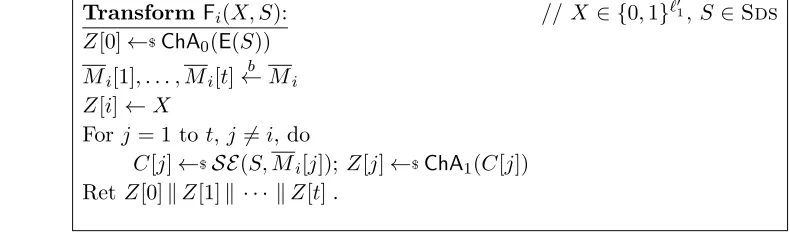
Transform Fi(X, S): // X ∈ {0,1}ℓ′1,S ∈Sds
Z[0]←$ChA0(E(S))
Mi[1], . . . , Mi[t]←b Mi
Z[i]←X
For j= 1 to t,j6=i, do
C[j]←$SE(S, Mi[j]); Z[j]←$ChA1(C[j]) RetZ[0]kZ[1]k · · · kZ[t] .
Figure 3: Proof of Lemma 4.2. Description of the transformFi.
Proof: The proof proceeds by a hybrid argument. To start with, let us fix two arbitrarym-bit messages
M0, M1. Recall thatm =t·b. For alli∈[0. . . t], let Mi ∈ {0,1}m be such that for all j ∈[1. . . t], the
j-thb-bit blockMi[j] equalsM1[j] ifj ≤i, and M0[j] otherwise. In particular,M0 =M0 andMt=M1. We let Xi =ChA(E(Mi)), and by the triangle inequality,
SD(ChA(E(M0));ChA(E(M1))) =SD(X0;Xt)≤
t X
i=1
SD(Xi−1;Xi).
For convenience, let us introduce the shorthand Z(S, M) = ChA1(SE(S, M)). For all i ∈ [1. . . t], we
introduce the transformFi :{0,1}ℓ′1×Sds→ {0,1}ℓ′0+t·ℓ′1 described in Figure 3. Then, it is easy to verify that the outputs of Fi(Z(S, M0[i]),S) and Fi(Z(S, M1[i]),S) are distributed as Xi−1 and Xi, respectively.
Hence:
SD(Xi−1;Xi) =SD(Fi(Z(S, M0[i]),S);Fi(Z(S, M1[i]),S))
≤SD((Z(S, M0[i]),S); (Z(S, M1[i]),S))
≤ max M′
0,M1′∈{0,1}b
SD((Z(S, M′
0),S); (Z(S, M1′),S))
= max
M′
0,M1′∈{0,1}b
ES←$SdsSD(Z(S, M0′);Z(S, M1′))
≤ES←$Sds
"
max M′
0,M1′∈{0,1}b
SD(Z(S, M0′);Z(S, M1′))
#
=Advds(SE;ChA1),
where the first inequality follows from the fact thatSD(g(X);g(Y))≤SD(X;Y) for all random variables X,Y, and all functionsg. The final bound follows by maximizing over all M0, M1∈ {0,1}m.
An encryption scheme and its rate. In the asymptotic setting, we construct an encryption scheme
E ={Ek}k∈N using theSRconstruction as follows: We start from an arbitrary seeded encryption scheme
SE = {SEk}k∈N such that SEk : Sdsk × {0,1}b(k) → {0,1}n(k), as well as from family of injective functions E = {Ek}k∈N with Ek : Sdsk → {0,1}e(k). Also let t : N → N be a function such that
e(k) = o(n(k) ·t(k)). Often, letting t(k) = O(log(n)) will be sufficient. Then, for all k ∈ N, the encryption algorithm Ek:{0,1}t(k)·b(k) → {0,1}e(k)+t(k)·n(k) is defined as Ek=SRt[SEk,Ek].
We conclude by verifying that the rates of E and SE are indeed equal:
Rate(E) = lim k→∞
t(k)·b(k)
e(k) +t(k)·n(k)
= lim k→∞
b(k)
e(k)/t(k) +n(k)
= lim k→∞
b(k)
n(k) ·klim→∞
1
1 +e(k)/(t(k)·n(k))
=Rate(SE)· 1
1 + lim
k→∞e(k)/(t(k)·n(k))
| {z }
=0
5
A DS-Secure Scheme Achieving Secrecy Capacity
In this section, we turn to our main technical result, a seeded encryption scheme achieving DS-security. Its rate, for a large set of adversary channels, is optimal, meaning it equals the secrecy capacity. Using the SR construction from the previous section, our scheme yields an unseeded encryption scheme with optimal rate.
5.1 The ItE Construction
In the following, we present our generic construction of an encryption function, which we callItE (Invert-then-Encode). Before giving any details, however, let us start with the high-level idea underlying our approach. For simplicity, let us focus on the case whereChRandChAare BSC’s with respective crossover
probabilities pR < pA ≤1/2. Let us also assume the goal is the simpler one of Alice and Bob agreeing on an n-bit key rather than transmitting a message. If we let the seed S ∈ Sds be the seed for an extractor Ext: Sds× {0,1}k → {0,1}m and given an error-correcting code E: {0,1}k → {0,1}n for
reliable communication over BSCp
R, a natural approach consists of Alice sending E(R), for a random
k-bit R, to Bob, via ChR, and both parties now derive the key asK =Ext(S, R).
Proving that this approach works requires estimatingH∞(R|Z) =−lg(PzmaxrPr [R=r, Z =z]), where Z = BSCn
pA(E(R)) is the information received by Eve. Yet, it is not hard to see that that the
most likely outcome, when Z = z, is that R equals the unique r such that E(r) = z, and that hence H∞(R|Z) =n·lg (1/(1−pA)), which is smaller thanh2(pA)−h2(pR), and which also upper bounds the length of the derived key K. To overcome this, we will observe the following: We can think of BSCp
A as
adding an n-bit vector E to its input E(R), where each bitE[i] of the noise vector takes value one with
probability pA. With overwhelming probability, E is (roughly) uniformly distributed on the set ofn-bit vectors with hamming weight (approximately) pA·nand there are (approximately) 2n·h2(pA)such vectors. Therefore, choosing the noise uniformly from such vectors does not change the experiment much, and moreover, in this new experiment, one can show that roughly H∞(R|Z)≥k−n·(1−h2(pA)). We will make this precise for a general class of symmetric channels via the notion of smooth min-entropy [29].
While bothExtandEcan be instantiated so that the secret-key rate satisfies|K|/n≈h2(pA)−h2(pR),
which is the secrecy capacity, recall that our goal is way more ambitious: Alice wants to send anarbitrary message of her choice. The obvious way to do this is obtain a key K as above and then send K⊕M. But this at least halves the rate, which becomes far from optimal. Our approach instead is to use an extractor Ext that is invertible in the sense that given M and S, we can sample a random R such that Ext(S, R) = M. We then encrypt a message M as E(R), where R is a random preimage of M under Ext(S,·). However, the above argument only yields, at best, security for a randomly chosen input. In
contrast, showing DS-security accounts to proving, for any two messagesM0 andM1, thatBSCnpA(E(R0))
and BSCn
pA(E(R1)) are statistically close, where Ri is uniform such thatExt(S, Ri) =Mi. To make things
even worse, the messages M0 andM1 are allowed to depend on the seed. The main challenge is that such proof appears to require detailed knowledge of the combinatorial structure of E and Ext. In particular,
we remark that it is not possible to provide a direct proof that the encryption of an arbitrary message is uniformly distributed, even in the simpler case where the message is seed-independent. In fact, for most codes, ciphertexts turn out not to be uniform at all.
Instead, we will take a completely different approach: We prove a general result, of independent interest, which shows that any seeded encryption function with appropriate linearity properties is DS-secure whenever it is DS-secure for randomly chosen inputs. This result is surprising, as random-input security does not, in general, imply chosen-input security. A careful choice of the extractor to satisfy these requirements, combined with the above idea, will hence yield a scheme achieving DS-security.
(Invertible) Extractors. A functionExt: Sds× {0,1}k → {0,1}b is called a (h, α)-extractor(strong,
average case extractor in the terminology of [12]) if SD((Ext(S,X),Z,S); (U,Z,S)) ≤ α for all pairs of
TransformSE(S, M): //S∈Sds,M ∈ {0,1}b
R←${0,1}r
X←Inv(S, R, M)
RetE(X) .
Transform SD(S, C): //C ∈ {0,1}ℓ
X ←D(C)
M ←Ext(S, X)
RetM .
Figure 4: Seeded Encryption function SE=ItE[Inv,E]and associated decryption functionSD.
functionExt(S,·) is regular, meaning every point in the range has the same number of preimages.
Recall that a functionH: Sds× {0,1}k → {0,1}b istwo-universalif Pr[H(S, X) =H(S, X′)]≤2−m for all distinct X, X′ ∈ {0,1}k when S←$Sds. The following average-case version of the Leftover Hash Lemma (LHL) of [16], due to [12], implies that a two-universal function is an essentially-optimal extractor:
Lemma 5.1 Let H: Sds×{0,1}k→ {0,1}b be a two-universal function. LetSbe uniform overSds. Let X,Zbe random variables over{0,1}k and{0,1}∗ respectively, and letUbe uniform on{0,1}b, independent of X,Z and S. Then,
SD((H(S,X),Z,S); (U,Z,S))≤ 1
2 p
2b−H∞(X|Z).
Specifically, this says that H is a (h, α)-extractor with h=b−2−2 lgα.
Our approach will rely on extractors which can efficiently be inverted. We say that a function
Inv:Sds× {0,1}r× {0,1}b → {0,1}k is aninverterfor an extractor Ext:Sds× {0,1}k → {0,1}b if for all
S ∈Sds and Y ∈ {0,1}b, and forR uniform over {0,1}k, the random variable Inv(S,R, Y) is uniformly
distributed on {X∈ {0,1}k : Ext(S, X) =Y }, the set of preimages ofY under Ext(S,·).
To make this concrete we give an example of an extractor with an efficiently computable inverter. Recall that k-bit strings can be interpreted as elements of the finite field GF(2k), allowing us to define a multiplication operator ⊙ on k-bit strings. Then, for Sds = {0,1}k \0k, we consider the function
Ext :{0,1}k× {0,1}k → {0,1}b which, on inputs S ∈ Sds and X ∈ {0,1}k, outputs the first b bits of
X⊙S. It is easy to see that Ext is regular if 0k is removed from the set of seeds. In Appendix B we
prove the following using the LHL:
Lemma 5.2 For all α∈(0,1] and all b≤k−2 lg(1/α)−2, the function Ext is a (b+ 2 lg(1/α) + 2, α) -extractor.
An efficient inverter Inv : Sds× {0,1}k−b × {0,1}b → {0,1}k is obtained by letting Inv(S, R, M) =
S−1⊙(MkR) whereS−1is the inverse ofSwith respect to multiplication in GF(2k). Invertible extractors were used in [7] but their setting was much simpler than ours and they achieve only security for random inputs.
Encryption. We now describe the seeded encryption function of ItE. In the following, let Ext : Sds× {0,1}k → {0,1}b be a regular extractor with inverter Inv : Sds× {0,1}r × {0,1}b → {0,1}k. Also let E : {0,1}k → {0,1}n be a function with k ≤ n, later to be instantiated via an appropriate
error-correcting code. The encryption function SE =ItE[Inv,E] is described in Figure 4: It applies the
extractor inverter (with fresh randomnessR) to the messageM and the seed S to obtain an intermediate value X=Inv(S, R, M), which is then encoded usingEto obtain the ciphertext.
Decryption. Given a channel ChR : {0,1}n → {0,1}ℓ, the goal of the function E in SE above is to
operate as an error-correcting code ensuring decryptability of the generated ciphertexts. Therefore, for any function D:{0,1}ℓ → {0,1}b, we can define the corresponding decryption function SD forSE over ChR as in Figure 4. The following lemma summarizes the relation between its decryption error and the
one of D.
Security. Below, we discuss the security ofItE. Our approach consists of two steps: We first introduce a metric based on statistical distance capturing the random-message security of a seeded encryption function, and prove random-message security of ItE. Subsequently, we prove a general result showing that random-message security implies DS security in many scenarios, and apply it to ItE.
5.2 Random-Message Security of ItE
Random distinguishing-security. We now address the problem of proving security of ItE under
random messages. To this end, we introduce a new security metric rds based on the statistical distance. Specifically, for a seeded encryption function SE :Sds× {0,1}b → {0,1}n and a channelChA:{0,1}n→
{0,1}∗, we define the rds advantage as
Advrds(SE;ChA) =ESD((ChA(SE(S,U)),U); (ChA(SE(S,U′)),U)),
where Uand U′ are independentb-bit inputs, and the expectation is taken over the choice of the seed S.
Below, we will prove that, surprisingly, RDS-security is often sufficient in order to infer DS-security of a seeded encryption function.
RDS-Security for ItE. We now want to prove an upper bound on rds advantage forSE =ItE[Inv,E],
where Invis the inverter of a regular extractor Ext.
It is crucial to remark that the joint distribution of (X,U) is identical if we (i) sample a uniform
random b-bit message U, a random r-bit string R, and compute X ← Inv(S,R,U), or if instead (ii) we
pick X uniformly at random, and then compute U← Ext(S,X). But then, intuitively, we expect that X,
when E(X) is sent through ChA, has sufficiently high min-entropy h in the eyes of the adversary, hence
implying that if Extis an (h, α)-extractor,
Advrds(SE;ChA) =ESD((ChA(SE(S,U)),U); (ChA(SE(S,U′)),U))≤α ,
since for any two transforms T1, T2,SD((T1(S),S); (T2(S),S)) =E[SD(T1(S);T2(S))], where the expec-tation is over the choice of S according to PS. In order to lower bound the entropyH∞(X|ChA(E(X)))
we will use the following observation: For a symmetric channel ChA, let H(ChA) =H(ChA(X)) for any
input X. (The entropy H(ChA(X)) is the same, regardless of the input, since the rowsof the transition
probability matrix of ChA are all permutations of each other.) Then, we are going to prove that if we
use the channel n times, each time to transmit a bit, then we can always seeChA as adding some noise
whose distribution isstatistically close to a noise distribution where all values are taken with probability at most 2−nH(ChA)
. This is formalized via the notion of ǫ-smooth min-entropy [29] of a distribution P, defined as
Hǫ∞(P) = max
Q:SD(P;Q)≤ǫH∞(Q).
Analogously, we define Hǫ∞(X) = Hǫ∞(PX) for every random variable X with distribution PX. The
following lemma, first shown by Holenstein and Renner [18] in a more general setting, states that the smooth min-entropy of multiple independent samples is, on average, nearly as large as the Shannon entropy of an individual sample.
Lemma 5.4 [18] Let X1, . . . ,Xn be independent samples from a distributionP on a finite set X, and let
δ >0. Then, Hǫ
∞(X1. . .Xn)≥n·H(P)−n·δ, where
ǫ=ǫ(δ, n,|X|) = 2− nδ 2 2 lg2(|X|+3) .
The RDS-security of SE is then summarized by the following lemma. Interestingly, the lemma does not need any assumption on E, other than the fact that it is injective.
Lemma 5.5 [RDS-security of ItE]Let δ >0andOutA⊆ {0,1}∗. Also, letChA:{0,1} →OutAbe a symmetric channel and letSE =ItE[Inv,E], whereInvis the inverter of a regular (k−n·(lg(|OutA|)− H(ChA) +δ), α)-extractor, and Eis injective. Then,
Advrds(SE;ChAn)≤2·2− nδ2
Process Π1:
M←${0,1}b;
S←$Sds;R←${0,1}r
X←Inv(S, R, M);
C←E(X)
Z←$ChAn(C) Ret (Z, M, S).
Process Π2:
M←${0,1}b;
S←$Sds;R←${0,1}r
X ←Inv(S, R, M);
C ←E(X)
Y ←$ChAn(0n);Z ←πC(Y) Ret (Z, M, S).
Process Π3:
S←$Sds;X←${0,1}k
M ←Ext(S, X);
C←E(X)
Y ←$ChAn(0n); Z ←πC(Y) Ret (Z, M, S).
Process Π4:
S←$Sds;X←${0,1}k
M ←Ext(S, X);
C←E(X)
Y ←$P′;Z ←πC(Y) Ret (Z, M, S).
Process Π5:
S←$Sds;X←${0,1}k
M ←Ext(S, X);
C ←E(X)
M′←${0,1}b
Y ←$P′; Z←πC(Y) Ret (Z, M, S).
Process Π6:
M←${0,1}b;M′←${0,1}b
S←$Sds;R←${0,1}r
X←Inv(S, R, M′);
C←E(X)
Z←$ChAn(C) Ret (Z, M′, S).
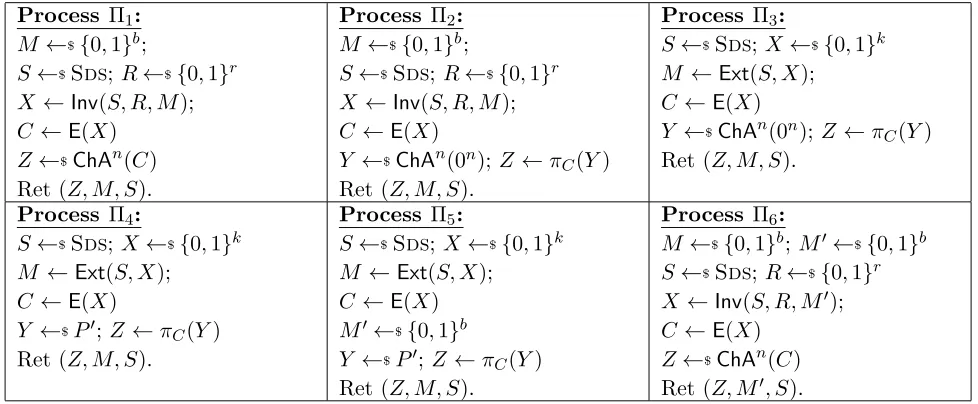
Figure 5: Proof of Lemma 5.5. Pseudocode description of the sequence of processes Π1 to Π6.
Proof: Recall that for two independent and uniformb-bit strings U and U′,
Advrds(SE;ChAn) =ES←$SdsSD((ChAn(SE(S,U)),U); (ChAn(SE(S,U′)),U))
=SD((ChAn(SE(S,U)),U,S); (ChAn(SE(S,U′)),U,S),
whereSis chosen uniformly at random onSds. The proof proceeds by giving a sequence of intermediate
random processes, described in pseudo-code in Figure 5, which will be used to transition from the random variable (ChAn(SE(S,U)),U,S) to the random variable (ChAn(SE(S,U′)),U,S). For any two processes Πi
and Πj, we let SD(Πi; Πj) denote the statistical distance between their output distributions.
The first three processes Π1,Π2, and Π3 are described on top of Figure 5. Process Π1 samples a triple (Z, M, S) according to the probability distribution of (ChAn(SE(S,U)),U,S). The second process Π2
modifies the way in whichZis sampled: As the channelChAis symmetric, there must exist a permutation
π1 : OutA → OutA such that Pr [ChA(B) =πB(Y) ] = Pr [ChA(0) =Y ], where π0 is the identity. Consequently, for all X∈ {0,1}n, we defineπX(Y) = (πX[1](Y[1]), . . . , πX[n](Y[n])), and
Pr [ChAn(X) =πX(Y) ] = Pr [ChAn(0n) =Y ]
for all Y ∈ OutAn. Accordingly, to implement the channel ChAn on input X in Π2, we first sample
Y ←$ChAn(0n), and then output Z = πX(Y). For the third process Π3, assume that we invert the role of X and M: that is, we first sample X uniformly at random in {0,1}k, and then set M to equal
Ext(S, X). By the regularity of Ext, the output distributions of Π2 and Π3 are identical. Therefore, SD(Π1,Π2) =SD(Π2,Π3) =SD(Π1,Π3) = 0.
In Process Π4, we want to simplify the probability distribution of ChAn(0n) by computing its smooth min-entropy: Invoking Lemma 5.4 withChAn(0n) lets us conclude that (forδas in the lemma statement)
Hǫ∞(ChAn(0n))≥n·(H(ChA)−δ)
for ǫ= 2−
nδ2
2 lg2(|OutA|+3). Recall that this means that there exists a probability distribution P′ on OutAn such that SD(PChAn(0n);P′)≤ǫand H∞(P′)≥n·(H(ChA)−δ), or, equivalently,
P′(Y)≤2−n·(H(ChA)−δ) (4)
Let now X,Y,Z be random variables representing the respective choices ofX, Y and Z in Π4. Then,
H∞(X|Z) =−lg
X
Z∈OutAn
max X∈{0,1}kPr [
X=X ∧ Z=Z]
!
=−lg X
Z∈OutAn
max X∈{0,1}kPr [
X=X]·Pr [Z=Z | X=X]
!
=−lg X
Z∈OutAn
max X∈{0,1}kPr [
X=X]·PrhY=π−1
E(X)(Z) i!
=−lg X
Z∈OutAn
2−k· max X∈{0,1}kP
′(π−1 E(T)(Z))
!
(4)
≥ −lg X Z∈OutAn
2−k·2−n(H(ChA)−δ) !
=−lg2lg(|OutA|)·2−k·2−n(H(ChA)−δ)=k−n·(lg(|OutA|)−H(ChA) +δ).
In Process Π5, instead ofM, we then output an independent random valueM′. Using the fact thatExt is a (k−n·(lg(|OutA|)−H(ChA) +δ), α)-extractor, we directly obtainSD(Π4; Π5)≤α. We conclude
by undoing the changes we had from Process Π1, coming back to the original choice of X, C, and Z, while still outputting M′ instead ofM. It is easy to see that SD(Π5; Π6)≤ǫ.
The final bound in the lemma statement follows via the triangle inequality, by adding all distances between consecutive processes.
5.3 DS-Security of ItE
As proven above, using invertible extractors with appropriate parameters is amenable to proving RDS-security. However, proving DS-security seems to require a better grasp of the combinatorial structure of
Ext and Inv, as well as of the channel ChA. Interestingly, we now show that such requirement is quite
minimal as a corollary of a more general result relating RDS- and DS-security, which we now explain.
From RDS- to DS-securityWe first recall the following notions from [3], adapted to the more general setting of seeded encryption: Think of a randomized seeded encryption function SE : Sds× {0,1}b →
{0,1}n as a deterministic map {0,1}r×Sds× {0,1}b → {0,1}n, where the first argument takes the role of the random coins. We call SE separable if
SE(R, S, M) =SE(R, S,0b)⊕ SE(0r, S, M)
for allR ∈ {0,1}r,S ∈Sds, andM ∈ {0,1}b. Also,SE ismessage linearifSE(0r, S,·) :{0,1}b → {0,1}n is linear for all S ∈Sds.
We now state and prove the following lemma, which related RDS and DS security for seeded encryption functions when transmitting each ciphertext bit over a symmetric channel.
Lemma 5.6 [RDS ⇒ DS] Let OutA⊆ {0,1}∗. For any symmetric channel ChA:{0,1} →OutA, if
SE :Sds× {0,1}b → {0,1}n is separable and message linear, then Advds(SE;ChAn)≤2·Advrds(SE;ChAn).
An analogous version of this lemma for the simpler case of mutual-information security and unseeded encryption is given in [3]. Here, we extend their result to the setting of unseeded encryption and of DS-security. The proof of Lemma 5.6 will make use of the following technical statement from [3].
Lemma 5.7 [3] Let SE : Sds× {0,1}b → {0,1}n be separable and message linear, let ChA :{0,1} →
The proof of Lemma 5.6 centrally relies on the following fact: It states that for a symmetric channel
Ch, the statistical distance betweenCh(U) for a uniform random inputUandCh(M) is the same regardless
of the choice of the inputM.
Lemma 5.8 Let Ch : {0,1}b → Out be a symmetric channel. Let U be a uniformly distributed b-bit string. Then, there exists ∆(Ch) such that ∆(Ch) =SD(Ch(U);Ch(M)) for allM ∈ {0,1}b.
Proof: We partition the output setOut=Sri=1Outi so that the sub-matrices W[·,Outi] are strongly symmetric. By the definition of statistical distance,
SD(Ch(U);Ch(M)) = 1
2 X
Y∈Out
|Pr [Ch(U) =Y ]−Pr [Ch(M) =Y ]|
=1 2 r X i=1 X
Y∈Outi
|Pr [Ch(U) =Y ]−Pr [Ch(M) =Y ]|.
Fix some i∈[1. . . r]. Then, for allY, Y′∈Outi, Pr [Ch(U) =Y ] = 1
2b X
M∈{0,1}b
W[M, Y] = 1 2b
X
M∈{0,1}b
W[M, Y′] = PrCh(U) =Y′,
using the fact that the columns W[·, Y] and W[·, Y′] are a permutation of each other.
Then, in particular, with pi = Pr [Ch(U) =Y ] for any Y ∈Outi, we can rewrite the above as
SD(Ch(U);Ch(M)) = 1
2 r X
i=1 X
Y∈Outi
|pi−W[M, Y]|.
However, since the rows W[M,Outi] andW[M′,Outi] are permutations of each other for any two mes-sages M, M′ ∈ {0,1}b and for all i∈[1. . . r], it follows that SD(Ch(U);Ch(M)) = SD(Ch(U);Ch(M′)).
With both lemmas at hand, we can now turn to the proof of Lemma 5.6.
Proof of of Lemma 5.6: We first observe that withChSE,S defined as in Lemma 5.7, Advrds(SE;ChAn) =ES←$SdsSD((ChAn(SE(S,U)),U); (ChAn(SE(S,U′)),U))
=ES←$Sds
1 2m
X
M∈{0,1}m
SD(ChSE,S(U′);ChSE,S(M))
=ES←$Sds[∆(ChSE,S)],
where the last equality follows from Lemma 5.8. On the other hand, by the triangle inequality,
Advds(SE;ChAn) =ES←$Sds
max M0,M1∈{0,1}b
SD(ChAn(SE(S, M0));ChAn(SE(S, M1)))
=ES←$Sds
max M0,M1∈{0,1}b
SD(ChSE,S(M0);ChSE,S(M1))
≤ES←$Sds
max M0,M1∈{0,1}b
(SD(ChSE,S(M0);ChSE,S(U)) +SD(ChSE,S(U);ChSE,S(M1)))
= 2·ES←$Sds[∆(ChSE,S)] = 2·Advrds(SE;ChAn),
which concludes the proof.
DS-Security of ItE. Coming back to the concrete case of ItE, we say that an extractor-inverter
Inv:Sds× {0,1}r× {0,1}b → {0,1}k is output linear if Inv(S,0r,·) is linear for all S ∈Sds. Moreover,
it is separable if
Inv(S, R, Y) =Inv(S, R,0b)⊕Inv(S,0r, Y) (5)

![Figure 2: Encryption from a seeded encryption. Encryption function E = SR[SE, E], and associateddecryption function D for the channel ChR = ChR0 ∥ ChRt1, where ChR0 : {0, 1}e → {0, 1}ℓ0 and ChR1 :{0, 1}n → {0, 1}ℓ1](https://thumb-us.123doks.com/thumbv2/123dok_us/7895039.1310389/8.612.73.544.44.146/figure-encryption-encryption-encryption-function-associateddecryption-function-channel.webp)
![Figure 4: Seeded Encryption function SE = ItE[Inv, E] and associated decryption function SD.](https://thumb-us.123doks.com/thumbv2/123dok_us/7895039.1310389/11.612.72.547.43.113/figure-seeded-encryption-function-ite-associated-decryption-function.webp)