What do students in higher education do and what do they value? Undergraduate students: Values and Activities
Lorna Sibbett
Abstract
A survey of undergraduate biology students at the University of St Andrews provides evidence that both formal and informal learning are valued by students, but there are differences in the extent to which such value is manifest in student activities. Comparisons between students with different entry qualifications, indicated that those with "A" Levels spent more hours in attending classes; private study and social engagement via volunteer groups; sports societies and creative arts. Those with Scottish Highers spent longer hours on online social networks. As we are a Scottish university, these outcomes might be expected due to the nature of students electing to study at greater distance from their home. Such data do not provide evidence of weakness in the Scottish Education System.
Our survey highlighted one point for concern: level of study is positively correlated with the number of hours spent in earning. Whilst earning can be essential (Taylor, 1998), and is itself an opportunity for learning (Billett, 2001), authors such as Callender (2008) provide evidence that employment has a negative impact on achievement. When class hours are reduced in favour of individual pursuit of literature and opportunities for project collaboration, students use the hours gained to increase hours in private study and use the schedule flexibility to increase hours in employment.
Introduction
Optimal HE provision requires understanding of students’ circumstances, concerns, values and priorities. Students must be empowered as learners and such empowerment requires close collaboration between learners and teachers.
“… our country will need different kinds of student experiences to enable its graduates to contribute to the world of the future. We must extend our students, whether they study in traditional or less traditional ways, enabling them to find resources of courage, resilience and empathy that traverse national boundaries….We will not be able to take the student experience forward unless we see it as a joint venture between students and those who provide higher education.”
Ramsden (2008)
Student circumstances have changed much in the last two decades and thus potentially have student priorities. In lieu of maintenance grants, today’s HE student has access to Student Loans. There is a choice between debt and/ or juggling academic work with paid employment. For some students term-time
employment is essential (Taylor, 1998). Although it provides opportunities for learning (Billett, 2001) there is accruing evidence that employment has a negative impact on achievement (e.g. Callender, 2008). A student under financial pressure may find themselves in an academic department for which financial pressures have led to reductions in laboratory classes or a poorer a staff : student ratio. As complements to direct
interaction with academics, Virtual Learning Environments (VLEs) effectively support and enhance
information access, but electronic communication and “E-learning” have brought new expenses for students and may contribute:
“another shiny new learning aid to divert attention from actual learning”
Communications with family and friends have become frequent, brief and publicly conducted via online social networks (OSNs) and text messages. Whilst minimising any sense of isolation in entrant students, the demarcation of university as the commencement of independent life has perhaps been lost.Entrant students are professional examinees with clear focus on assessment criteria, have high expectations of the quality of education to be provided for them and the confidence to seek such support as is personally required (Ramsden, 2008). For these qualities we respect them and yet academic staff face a challenge to refocus minds on learning for the sake of learning and for the development of higher order thinking skills. In the era of mass HE, large entrant classes and a crowded campus cause difficulties in finding like-minded people with whom to debate and learn. Informal collaborative learning, once inherent in HE, must now be engineered by academic staff via peer learning and project groups.
If it was once assumed that students could integrate their learning across the formal and informal curriculum and be able to demonstrate maturity of thinking at employment interviews, it is now recognized that structured Personal Development Planning (PDP) must be facilitated by HE institutions. PDP initiatives structured for specific professions such as medicine can be successful (e.g. Cotterill et al, 2008) in engaging individuals, as the current experiences of the student cohort and career aspirations are narrow. However, meaningful provision in a traditional academic school, in which students are engaged in flexible curricula and have varied career aspirations, is problematic. A PDP solution should be sought with advice from students; understanding of their activities, priorities and values. This report represents an early phase in such a consultation and development; it especially focuses upon evolution of priorities and activities across the years of student experience. As such it considers an area in which there has been little research.
Methods
The survey was conducted at the University of St Andrews, which is based within the coastal holiday and retirement town of St Andrews. Without nightclubs, but with many public houses, student social lives centre upon societies, halls of residence, cinema and sport. The university offers traditionally academic courses and no professional qualifications; medical students complete their training in other HE institutions. Term-time employment opportunities are poor, but students who stay over the summer months have opportunities to work in research laboratories and tourism. Few students live in their family home during term-time.
An email, inviting participation in an online survey, was sent to students studying undergraduate modules in the School of Biology; First Year students were not invited. Most students completed the questionnaire retrospectively, such that Second Year students commented on their First Year; Third Year students on their Second Year etc. However, some students commented upon their current year. Of the 89 respondents, seven supplied incomplete information and were thus excluded from analyses. 35 had studied “A” Levels; 36 studied Scottish Highers and the others possessed various European and American qualifications. Similar ratios of entry qualifications occurred across the four years of study. One of the Scottish students lived at home during term-time and had child-care responsibilities. All respondents were full time students. The questionnaire primarily employed closed questions with Likhert-type response scales, grading one to five. Descriptive statistics were obtained using SPSS.
Results
Activities as time investment
All
n = 82 A Levelsn = 35 Scottish Highers n = 36
First
n = 18 Secondn = 31 Thirdn = 22 Fourthn = 11 Class
attendance** 17 (14 – 20) 17 (12 – 22) 17 (15 – 21) 22 (20 – 24) 18 (16 – 22) 15 (11 – 17) 12 (6 – 15)
Private
study** 10 (7 – 20) 15 (10 – 24)
10 (6 – 16)
10 (5 – 16)
10 (6 – 15)
16 (10 – 21)
25 (15 – 35)
Total study 30
(25 – 35) 32 (27 – 40) 27 (24 – 32) 31.5 (26– 36) 28 (25 – 35) 31 (24 – 36) 31 (27 – 43)
Earning** 0
(0 – 4) 0 (0 – 2) 0 (0 – 7) 0 (0 – 0) 0 (0 – 9) 0 (0 – 6) 0 (0 – 15)
Sport 4
(2 – 6) 4 (2 – 6) 3.5 (2 – 6) 2.5 (2 – 4) 4 (3 – 6) 4 (2 – 6) 4 (2 – 8)
Creative 2
(0 – 3) 2 (0 – 4) 1 (0 – 3) 1.5 (1 – 4) 1 (0 – 3) 2 (0 – 3) 2 (0 – 5)
Community* 0
(0 – 1) 0 (0 – 1) 0 (0 – 0) 0 (0 – 0) 0 (0 – 1) 0 (0 – 1) 1 (0 – 2)
Total: organizations and cultural
6
(4 – 11) 7 (4 – 12) 5 (4 – 8) 5 (4 – 9) 7 (5 – 10) 7 (4 – 12) 9.5 (3 – 13)
Family 0
(0 – 2) 0 (0 – 0) 1 (0 – 4) 0 (0 – 0) 0 (0 – 2) 1 (0 – 4) 0 (0 – 1)
Online social
network* 3 (2 – 5) 3 (2 – 5) 3.5 (2 – 6) 5 (3 – 5) 3 (2 – 7) 2 (1 – 4) 2 (1 – 5)
Friends 10
(7 – 15) 12 (8 – 16) 10 (6 – 15) 14.5 (7 – 16) 12 (10 -15) 10 (6 – 15) 8 (2 – 15) Total: social
– informal* 17 (13 – 22) 17 (13 – 22) 16 (12 – 26) 19.5 (14 – 26) 18.5 (13 – 23) 15.5 (12 – 22) 15 (3 – 20) House 4 (3 – 7) 4 (3 – 6) 4 (3 – 8) 3 (1 – 6) 5 (3 – 9) 4 (3 – 8) 3 (2 – 5)
Sleep 54
Significant (Spearman Rank, p < 0.05) negative correlation was observed between year of study and: class attendance (r = -.626), online social network (r = -.241) and total informal social contact (r = -.222). Between First and Fourth year there is a tendency for students to spend less time with friends, on and off line, and to increase time within community activities. Significant (Spearman Rank, p < 0.05) positive correlation was observed between year of study and: private study (r = .407), earning (r = .289), community (r = .221). Level of study was positively correlated with the number of hours spent earning. No First Year students in the sample obtain term-time paid employment, but from Second Year onwards approximately 40% students are engaged in term-time employment, with Fourth Year students working longer paid hours than the other years (Table 2).
Compared with their Scottish peers, “A” Level students spent significantly more time in private study (“A” Levels median, 15 hours; Scottish Higher median, 10 hours), causing the total study time to also vary significantly (Mann Whitney, p <0.01) between the two groups: “A” Levels median, 32 hours; Highers median, 27 hours. Thus, students from “A” Level backgrounds spent 19% more time in study than their Highers-qualified counterparts. Contact time with family was higher amongst the Scottish students at a median of 1 hour compared to that of 0 hours amongst “A” Level students. Scottish students spent marginally more time on online social networks (3.5 hours versus 3 hours) and slightly less time with: sport (median 3.5 hours versus 4 hours), creative activities (1 hour versus 2 hours), friends (10 hours versus 12 hours) and sleep (50 hours versus 56 hours).
Employment
Overall 32% students were in paid term-time employment. In comparisons of students with “A” Levels and Scottish Highers: at 31% a smaller proportion of “A” Level students were working in term time compared with 39% for Scottish Highers students. However, those from “A” Level backgrounds who were earning in term-time did so for longer hours (median 15 hours compared with 9.5 hours) than their Scottish Highers peers (Table 2).
In their vacations, compared with their Scottish peers, more “A” Level students were involved in research and charity work; fewer appear to be engaged in paid employment. However this may be an underestimate due to questionnaire ambiguity: some students engaged in paid research may not have declared such work as paid.
Table 2: Employment, research and charity work. Median hours are shown with
interquartile range in brackets. Vacation refers to the summer vacation between the stated
year and that following. The proportion engaged in vacation employment may be under
estimated as several students engaged in research did not clearly respond as to whether
this was paid.
All A Levels Scottish
Highers First SecondYear of studyThird Fourth Term-time
Earning % 32 31 39 0 42 36 46
Median hours 10
(5 – 15) 15 (2 – 17) 9.5 (5 – 12) 10 (9 – 15) 9 (5 – 16) 15 (7 – 20) Vacation
Proportion
earning *% 69 53 83 67 72 67
Proportion
research % 27 34 14 13 31 40
Proportion
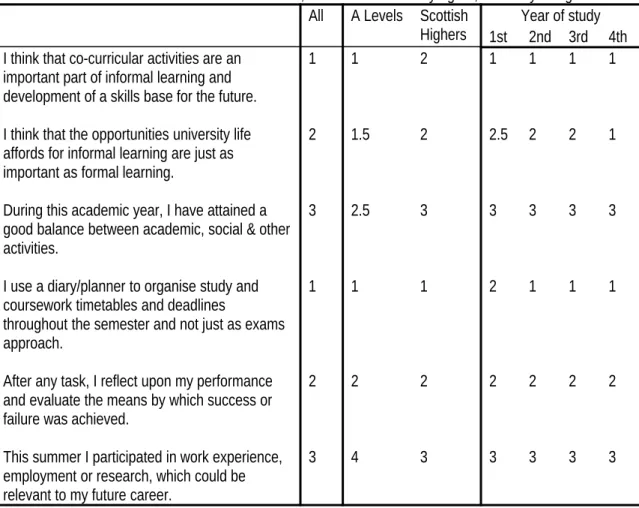
Table 3: Student values measured on scale 1 to 5, wherein: 1 - definitely agree; 5 - totally disagree. All A Levels Scottish
Highers 1st Year of study2nd 3rd 4th I think that co-curricular activities are an
important part of informal learning and development of a skills base for the future.
1 1 2 1 1 1 1
I think that the opportunities university life affords for informal learning are just as important as formal learning.
2 1.5 2 2.5 2 2 1
During this academic year, I have attained a good balance between academic, social & other activities.
3 2.5 3 3 3 3 3
I use a diary/planner to organise study and coursework timetables and deadlines
throughout the semester and not just as exams approach.
1 1 1 2 1 1 1
After any task, I reflect upon my performance and evaluate the means by which success or failure was achieved.
2 2 2 2 2 2 2
This summer I participated in work experience, employment or research, which could be relevant to my future career.
3 4 3 3 3 3 3
Student values and priorities
Students valued co-curricular activities (Table 3) (median 1 for all but the Scottish Highers group). They regarded informal learning during university life as almost as important as formal learning (median 2 overall) and appreciation of the value of informal learning increases from First to Fourth Year (median changes from 2.5 to 1.). Scottish Highers students valued the informal curriculum slightly less than “A” level students. Students attempted to self-organise using diaries or planners, with First Year students being less organized than older students. These students were reflective and the propensity to reflect did not change with increasing maturity (median 2 throughout). Students were not confident that they achieved a balance (median 3 overall); nor did they believe that their work experience was relevant to their future career (median 3 overall). “A” level students (median 4) were less likely to have relevant, or regard as relevant, their work experience.
Discussion
Student development across study years
Within the formal curriculum, students developed as increasingly independent learners. Via organised societies, they increasingly invested in the informal curriculum.
Between First and Fourth Year, total study time remained at approximately 30 hours. The shift from pre-honours (First and Second Year) high class contact hours, to pre-honours (Third and Fourth year) freedom to engage in individual pursuit of literature, was accompanied by increased hours spent in private study. Thus students were fulfilling the expectation of transition to independent study. Concomitant increase in schedule flexibility, particularly in Fourth Year, may partially explain the increase in paid term-time employment. This trend may also reflect a developing awareness of the importance of non-academic learning.
From First to Fourth Year, there was evidence of a developing social conscience and affirmative action in seeking out opportunities to engage with peers in e.g. sport and creative ventures. This increase in formal social contact was matched by a decrease in informal contact with friends, as priorities shifted towards collaborative ventures and away from just “hanging out”. The decreasing time spent on OSN reflected a shift from First Year use of OSN for informal contact with friends to later use in co-ordinating study groups and maintaining effective news distribution for clubs and societies. Students thus demonstrated increasing maturity in learning, priority setting and development of effective communication strategies using newer technologies. Their time was being used more productively.
The impact of studying away from home
Being a Scottish university, “A” Level qualified students were those living at a greater distance from home than their Scottish counterparts. They may thus be a self-selected group of more confident and independent individuals with comparatively mature priorities. Only six months older than Scottish peers, they spent longer in private study; social contact within community, creative and sport clubs; and less time on OSN. In study patterns and community-centred activities they were comparable to Third year students. Whether they arrive at university with greater maturity, or more rapidly attain maturity upon taking such a large step into
independence, is a matter for further study. Should the latter be true, the financial pressures holding students near to their family home may have a large negative impact on the development of young people within HE.
Earning
At 32%, fewer St Andrews undergraduate biologists were in paid term-time employment than 59% at Manchester Metropolitan University (Curtis, 2007); 50% at University of Glasgow (Carney et al, 2005) and 49% at Northumbria University (Hunt et al, 2004). This may reflect a lack of job opportunities in St Andrews, which, as a small holiday town, offers seasonal employment opportunities. That First Year student were not in paid term-time employment may reflect their difficulty in obtaining such employment as older students retain positions from vacation work into term-time. For those students in term-time employment, the median hours worked, at 10hrs overall and 15hrs for “A “ Level students, is comparable to that, at 15:45hrs, observed at Manchester Metropolitan University (Curtis, 2007). Fourth Year students, despite working longer hours were able to maintain good study patterns and social activities. It is of concern that many engaged in employment could not see its relevance to their future careers. Given that available jobs are in service industries, where teamwork and positive customer relations are important, employees were undoubtedly learning from their experiences. PDP would provide a vehicle by which to facilitate such realizations.
Conclusion
route. The priorities, activities and values of students reflected a desire for: personal learning; maintaining a healthy body and mind; contribution to society; and sharing with family and friends. They recognized a need for balance, and, upon prompting, could suggest how such balance may be achieved. They demonstrated critical awareness of the enticingly interesting (e.g. OSNs) versus the productively rewarding (e.g. personal collaboration with others on a community project), but testified to such realizations crystallizing slowly. Based upon the student perspective, a meaningful PDP strategy is thus one which: addresses wider life skills and not purely career matters; facilitates reflection and self-awareness, which would occur but only slowly; facilitates goal-setting and prioritizing; helps students of lower self-esteem to recognize their strengths; facilitates matching of student skills and experiences to those of value in the world-of-work. PDP across study years must reflect evolving priorities and be flexible, as individuals’ intellectual, emotional and social development occurs at differing rates.
References
Billett, Stephen. 2001. "Learning through work: workplace affordances and individual engagement". Journal of Workplace Learning. Vol 13, Issue 5, pp209-214.
Callender, Claire. 2008. "The Impact of Term-Time Employment on Higher Education Students' Academic Attainment and Achievement". Journal of Education Policy, Vol 23, Issue 4, pp359-377.
Carney, C., McNeish, S. and McColl, J. 2005. “The impact of part time employment on students’ health and academic performance: a Scottish perspective”. Journal of Further and Higher Education, Vol. 29, No. 4, pp307-19.
Cotterill, S.J., Bradley, P.M. and Stacy, R. 2008. “Using ePortfolios to support annual appraisal in undergraduate medicine. HEA conference proceedings: ePortfolios, identity and personalized learning in healthcare education. Newcastle upon Tyne.
Hunt, A., Lincoln, I. and Walker, A. (2004), “Term-time employment and academic attainment: evidence from a large-scale survey of undergraduates at Northumbria University”. Journal of Further and Higher Education. Vol 28, No. 1, pp3-18.