A Blocking Gibbs Sampling Method to Detect Major
Genes with Phenotypic Data from A Diallel Mating
Wen Zeng1, Sujit Ghosh1 and Bailian Li2
1
Department of Statistics, 2Department of Forestry, Box 8002, North Carolina State
University, Raleigh, NC 27695-8002, USA.
Institute of Statistics Mimeo Series# 2560
S
UMMARY: Diallel mating is a frequently used design for estimating the additive anddominance genetic (polygenic) effects involved in quantitative traits observed in the half- and
full-sib progenies generated in plant breeding programs. Gibbs sampling has been used for
making statistical inferences for a mixed inheritance model (MIM) that includes both major
genes and polygenes. However, using this approach, it has not been possible to incorporate
the genetic properties of major genes with the additive and dominance polygenic effects in a
diallel mating population. A parent block Gibbs sampling method was developed in this study
to make statistical inferences about the major gene and polygenic effects on quantitative traits
for progenies derived from a half-diallel mating design. Using simulated data sets with
different major and polygenic effects, the proposed method accurately estimated the major
and polygenic effects of quantitative traits, and possible genotypes of parents and progenies.
The impact of specifying different prior distributions was examined and was found to have
little effect on inference on the posterior distribution. This approach was applied to one
experimental data of Loblolly pine (Pinus taeda L.) derived from a 6-parent half-diallel
mating. The result suggested that there might be a recessive major gene affecting height
growth in this diallel population.
Key words: Bayesian method; Polygenic effects, Diallel mating design; Markov Chain
1. Introduction
Quantitative genetics has contributed significantly to the improvement of productivity and
quality in animal and plant breeding programs. In the classic quantitative method, traits are
assumed to be controlled by polygenes, i.e., many genes, with each gene having a small effect
on a quantitative trait. With advances in molecular technology and computational statistics,
there is strong evidence that some quantitative traits may be controlled by a number of genes
that have relatively large effects on phenotype. For example, major genes or quantitative trait
loci (QTL) have been found in Drosophilae (Long et al., 1995), domestic animals (Piper and
Shrimpton, 1989), rice (Jiang et al., 1994) and tree species (Wilcox et al., 1996; Kaya et al.,
1999, Remington and O’Malley, 2000). A mixed-inheritance model (MIM) that includes a
major gene together with polygenes, instead of strictly polygenes, has been developed
recently for analyzing some quantitative traits (Elston and Stewart, 1971; Kinghorn et al.,
1994; Janss et al., 1997; Zeng and Li, 2003).
Several statistical approaches have been developed for the detection of major genes
for quantitative traits, based on phenotypic data. Methods based on analysis of variance have
been used to infer the number of major loci contributing to growth variation of interspecific
aspen hybrids (Li and Wu, 1996; Wu and Li, 1999; Wu and Li, 2000). Several statistical
methods using simple non-parametric tests for departure from normality have been used for
detecting major gene segregation, but not for estimating major gene effects (Mérat, 1968;
Fain, 1978; Karlin and Williams, 1981; Lynch and Walsh, 1998; Zeng and Li, 2003). Other
approaches based on maximum likelihood and Bayesian inference have been developed for
the MIM to detect major genes affecting quantitative traits in animal (Hoeschele, 1988; Knott
species (Wu et al., 2001). Most of these methods are based on either a multiple-generation
pedigree, or else a progeny population derived from either a nested mating design (in the case
of animal breeding) or a factorial mating design (in the case of tree hybrids). To our
knowledge, however, no statistical methods have been developed for a progeny population
derived from a diallel mating design.
Diallel mating is one of the most commonly used designs in plant and tree breeding
programs (Hallauer and Miranda, 1981; Zobel and Talbert, 1984). Unlike factorial mating,
where male parents from one group are crossed with females from a second group, parents in
a diallel design are crossed either as male or female with other parents in a single group
(Griffing, 1956). A half-diallel mating is the diallel mating without self and reciprocal
crosses where both half-sib and full-sib progenies are produced for each of six parents. Diallel
mating yields two levels of polygenic effects, i.e., the general combining ability (GCA) of
parents due to additive polygenic effects, and the specific combining ability (SCA) of crosses
due to dominant polygenic effects. The unique feature of diallel mating, the model for an
observation having two main effects, has made it difficult to analyze with standard statistical
programs for even polygenetic effects (Xiang and Li, 2001). Thus, it has been difficult to
incorporate genetic properties of major genes with the two levels of polygenic effects in a
MIM model for analyzing diallel data. Because of high-dimensional marginalization of the
joint density over the unknown single genotype and polygenic effects, it is practically
impossible to maximize the likelihood function associated with such a model using analytical
and/or numerical techniques (Le Roy et al., 1989; Knott et al., 1991). For animal breeding,
the Gibbs sampling algorithm has been found to be reasonably effective in making inference
or female, but not both (Janss et al., 1997). Such analyses were primarily based on the
half-sib relationships of parents (male or female) and their progenies. In the case of tree-breeding
programs, diallel progenies are usually planted at several locations or site types to determine
their growth potential under different environments. The potentially large environmental
variation, as well as genotype by environmental interaction, relative to animal breeding, may
affect the statistical power for major gene detection (McKeand et al., 1997). Although the
Bayesian approach may have potential for major gene detection, its usefulness for MIM
analysis of diallel data is unknown, because of the two types of polygenic effects and the
heterogeneous environmental variance. It is important to evaluate the ability of the Bayesian
approach for detecting the segregation of major genes with a diallel progeny population
across environments.
In this study, we developed a Bayesian approach, using a parent blocking Gibbs
sampling, to make inferences about major genes and polygenic effects (GCA and SCA) that
control quantitative traits for a progeny population derived from a half-diallel mating design
without self and reciprocal crossings. Computer simulations were done to examine the effects
of different prior distributions and design matrix, either full-ranked or non-full-ranked, on the
proposed statistical method. A case study with one half-diallel progeny population of Loblolly
pine (Pinus taeda L.) was used to detect a major gene for height growth and to illustrate the
application of themethod.
2.
The Mixed Inheritance Model
A mixed inheritance model (MIM) is adopted in this study for the diallel analysis, in which
half-diallel mating design, with parents selected from a base population under
Hardy-Weinberg and linkage equilibrium (Falconer and Mackay, 1996), and
full-sib families, is used to study the MIM. Each full-full-sib family is tested at several sites,
following a randomized complete block design with several trees per full-sib family within
each block, and several blocks within each site. The statistical model for a MIM can be
written as a mixed linear model: p
n
s p
p n n
n ( −1)/2=
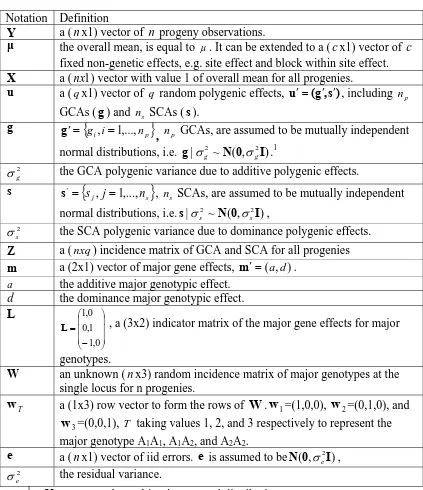
Y=Xµ+Zu+WLm+e (1) The notation definitions are listed in Table 1. Unlike MIM for an animal population,
there is no incidence matrix in the major gene effect term, because data are only the
phenotypic observations of progenies in a tree population, rather than progenies plus parents
(sires and dams) as in an animal population. By assuming for e and giving
location and scale parameters, the vector of data is also normally distributed as:
Z Y
) , (0 2I
N σe
Y
) , ~
, 2 N(Xµ Zu WLm 2I
m W, u, µ, |
Y σe + + σe
The single major gene under the traditional genetic model of one gene with two alleles
(Falconer and Mackay, 1996) is assumed to be a bi-allelic ( and ), autosomal locus with
Mendelian transmission probabilities, such that each progeny has one of the three possible
genotypes: , and with genetic effects and
1
A A2
1 1A
A A A1 2 A2A2 a,d, −a respectively. For progeny
, the genotype is represented as a random vector , with values (1,0,0), (0,1,0),
or (0,0,1) corresponding to the three possible genotypes of , , and
respectively. Given the two parent genotypes and , the genotype distribution of
progeny is denoted as . This distribution describes the probability of )
,..., 1
(k n
k = wk
1 1A
A A1A2 A2A2
) ( 1k p
w wp2(k)
k p(wk |wp1(k),wp2(k))
alleles constituting genotype being transmitted from parents with genotypes and
when segregation of allele follows Mendelian transmission probabilities. Because of
the conditionally independent structure of the genotypes, the joint genotype distribution of
progenies can be written as: k
w wp1(k)
) ( 2 k p
w
( ) p( | 1( ), 2( )) (2)
1 k p k p k n k p
p W|w
∏
w w w=
=
where are the genotypes of parents. The parent genotypes are sampled from a base
population with genotypes in Hardy-Weinberg equilibrium (Falconer and Mackay, 1996).
This is a reasonable assumption for tree breeding populations because individual trees serving
as parents are usually selected randomly from natural populations. Given the favorable allele
frequency in the base population p
w np
) (A1 p
f = , the probability distribution of the genotype of
parent i is assumed to be which follows Hardy-Weinberg proportions. Because of
the independence among parents, the joint genotype distribution of parents can be written as: )
|
( f
p wpi
( | ) ( | ) (3)
1 f p f p pi n i p p w w
∏
= =In order to fully specify the Bayesian model, normal priors are assigned to the overall
meanµ=µ, and major gene effects m′=(a,d), i.e. , and , where , =1, 2 and 3 are the hyper-parameters of the prior distribution. In
the simulation and real data analysis we used k
), , 0 ( ~ N µ 2 1 k 3 v ) , 0 ( ~ N k22 a
) , 0 ( ~N k32
d ki2 i
i =4, i=1,2,3. Variance components, , and
are assumed to arise independently from conjugate inverted gamma distributions (IG), i.e.
and where
2 g σ 2 s σ 2 e σ ), , (
~ 1 1
2
v IG
g γ
σ 2 ~ ( 2, 2)
v IG
s γ
σ 2 ~ ( 3, ),
IG
e γ
σ γi and are hyper-parameters.
For our application, we used
i
v
and σˆ3 =σˆe, where σˆ are obtained from a preliminary study using frequency distribution i method. The conjugate Beta prior is used for the allele frequency, i.e.,p(f)~ Beta(αf,βf),
whereαfand βfare prior distribution parameters. We have chosen αf = βf =1 to express prior ignorance.
The joint posterior density of all unknowns, given the data , is proportional to the
product of the likelihood function and the prior densities:
Y ) ( ) | ( ) | ( ) ( ) ( ) ( ) ( ) ( ) | ( ) | ( ) ( ) , ( ) | , , , , ( 2 2 2 2 2 2 2 2 2 f p f p p d p a p p p p p p p p f p p p s g s g e e e s g p w w W µ s g W u, m, µ, | Y Y w W, u, m, µ, σ σ σ σ σ σ σ σ σ ∝
∏
∏
∑
∑
= − − = + − = − + − = − + − − − = = × ⎭ ⎬ ⎫ ⎩ ⎨ ⎧ − ⎭ ⎬ ⎫ ⎩ ⎨ ⎧ − ⎭ ⎬ ⎫ ⎩ ⎨ ⎧ − × ⎭ ⎬ ⎫ ⎩ ⎨ ⎧ − ⎭ ⎬ ⎫ ⎩ ⎨ ⎧ − × ⎪⎭ ⎪ ⎬ ⎫ ⎪⎩ ⎪ ⎨ ⎧ − ⎪⎭ ⎪ ⎬ ⎫ ⎪⎩ ⎪ ⎨ ⎧ − ⎭ ⎬ ⎫ ⎩ ⎨ ⎧ − × ⎭ ⎬ ⎫ ⎩ ⎨ ⎧ − − − ′ − − − − ∝ g f f s s g g n i g pi n k k p k p g k s s n j j s n s g g n i i g n g e e e n e f f f p p d k a k k v s v g v 1 1 1 1 ) ( 2 ) ( 1 2 2 3 2 2 2 2 2 1 2 2 ) 1 ( 2 1 2 2 2 2 2 1 ) 1 ( 2 1 2 2 2 2 2 3 ) 1 ( 2 2 2 2 ) 1 ( ) | ( ) , | ( 2 1 exp 2 1 exp 2 1 exp exp ) ( 2 1 exp ) ( exp ) ( 2 1 exp ) ( exp ) ( ) ( ) ( 2 1 exp ) ( 2 1 3 β α γ γ γ µ σ σ σ σ σ σ σ σ σ σ σ σ w w w w w w WLm Zu Xµ y WLm Zu Xµ y (4)In order to study the effects of the prior on the method’s behavior with this data
structure, improper flat priors are used for the overall meanµ, and major gene effect a
andd, i.e., p(µ)∝constant, p(a)∝ constant, and p(d)∝constant, besides normal priors.
The prior for any σ2 is always inverted Gamma.
3. Gibbs sampling
In order to make statistical inferences about unknowns, the marginal posterior distributions
for the model parameters are of interest. However, it appears to be almost impossible to
obtain such marginals for our model. In analytical approaches, the study of marginal
densities would require integration and/or summation. Often such marginalizations are not
feasible to compute or even express in closed form for a high-dimensional model like MIM,
as presented in equation (4). But this difficulty can be circumvented by means of
simulation-based methods. The Gibbs sampler is simulation-based on sampling random varieties from a Markov
chain (MC) with its stationary distribution as the posterior distribution, and the sampling from
the MC used to perform the high dimensional Monte Carlo integration (Gelfand and Smith,
1990; Brooks, 1998). Samples are obtained from the full conditional distributions, which form
the transition probabilities of the Markov chain. Each time a full conditional distribution is
visited, it is used to sample the corresponding parameter, while other parameters are
considered to be fixed, and then the realized value is substituted into the full conditional
distribution of all other parameters.
To improve the mixing and hence the speed of convergence, it is possible to sample
several parameters simultaneously, called a ‘block,’ from their joint conditional distribution
instead of updating all parameters univariately. As long as all parameters are updated, the new
Markov chain will still have equation (4) as the density of stationary distribution. Unlike an
animal population where data include parents and their offspring, and usually span several
generations, in a tree population we consider only the progeny observations in the data Ywith
just two generations. The sire block strategy (Janss et al., 1997) has worked well for animal
populations. Since in a diallel mating design, one tree served as a male as well as a female, we
modified ‘a sire blocking’ into ‘a parent blocking’. In a parent blocking, the genotypes of a
parent and its half-sib offspring are treated as a block and updated simultaneously.
Consequently, in each cycle, the genotype of every offspring is updated twice instead of once
a cycle as each offspring has two parents. Given the work of Liu et al. (1994), and Robert and
Sahu (1997), it seemed to us that the block Gibbs sampler would mix faster than the ordinary
one-at-a-time version that updates each component sequentially. Blocking is generally
effective when the elements within the block are highly correlated compared to the correlation
between blocks.
3.2 Full conditional distributions
Full conditional distributions are derived from the joint posterior distribution (4). For
notational convenience, the MIM can be rewritten as: Y=Hθ+e, where
is a ( ) matrix, and is a (
Z] : WL : [X H=
nxp θ'=(µ',m',u')=(µ,a,d,g',s')=(θ1,θ2,...,θp) px1) parameter
vector.
In order to implement the ‘parent blocking,’ an exact calculation of the joint conditional
distribution of a parent and its all offspring is required. The joint conditional distribution for
parent is: , where denotes the
number of offspring of parent i, and the offspring are indexed by , or simply
, where . By definition, this distribution is proportional to
.
i p(wpi,wi(1),...,wi(n) |W i(l),w pi,θ,f, g2, s2, e2,Y)
i − − σ σ σ ni
) ( ),..., 2 ( ), 1
( i i ni
i
) (l
i l =1,...,ni
) , , , , , , , | ,..., (
* ) , ,
2
s , , , , , |
(wpi Wi(l) w pi θ f 2g e2 Y p wi(1) wi(n) Wi(l) wp θ f g2 s2 e2 Y p
i σ σ σ
σ σ
σ −
− −
The first term is the genotypic distribution of the parent i, marginalized with respect to the
genotypes of its offspring. The second term is the joint distribution of offspring genotypes
conditional on the parents’ genotypes. To calculate the genotype distribution of parent , the
three possible genotypes of all offspring must be summed after weighting each genotype by
its relative probability. The final marginalized full conditional distribution for the major
genotype of the parent is: i
∏∑
∈ = − − = = = = ∝ = ) ( 3 1 2 1 2 2 2 ) ( ) | ~ ( ) , | ( * ) | ( ) , , , , , , , | ( l i k b b k k p T p b k T pi e s g pi l i T pi y p p f p f p w w w w w w w w w Y θ w W ww σ σ σ
(5-1)
where ~yk = yk −µ−Zku is called the adjusted record, Zk are the kth rows of the matrices , and has the same notation as . The penetrance function (or weight) is:
Z wb wT
⎭ ⎬ ⎫ ⎩ ⎨ ⎧ − − ∝ ) = 2 2 ) ~ ( 2 1 exp
|w w k wkLm
e b k y p σ ~
(yk . The probabilities here are given up to a
constant of proportionality and st be normalized to ensure that
∑
. = = = 3 1 1 ) ( T T pip w w
For the genotypes of offspring, the marginalized full conditional distributions are the
same as the usual full conditional distributions found by extracting from equation (4) the term
in which wk,k∈i(l), is present. i.e.
) | ~ ( * ) , | ( ) , , , , , , , |
( k T k p f 2g s2 e2 p k T p1(k) p2(k) p yk k T
p w =w W− w− θ σ σ σ Y ∝ w =w w w w =w (5-2)
The full conditionals for allele frequency, location parameters and variance components
are obtained by just extracting the relevant terms from the joint posterior density in equation
(4) (for details see Zeng, 2000).
3.3 Updating scheme
The algorithm based on parent block updating is summarized as the following:
I. initiate W,wp,θ, , and with some reasonable starting values;
II. sample major genotypes wpi,i=1,...,np,wk,k =1,...,n from full conditional distributions,
(5-1) and (5-2), by parent blocking. The updating scheme is to
1) update parent 1 and its offspring, wp1 plus wp1(l), in one block, with [ ]pt [ ]pnt
p
w w 2,...,
known;
2) update parent 2 and its offspring, plus , in one block, with
known;
2
p
w wp2(l)
[ ] [ ] [ ]t pn t
p t
p w w p
w , 3,...,
1 1
+
… …
) update parent and its offspring, plus , in one block with
known; each offspring updates twice in each cycle; p
n np wpnp wpnp(l)
[ ] [ ]1
) 1 ( 1
1 ,...,
+ −
+ t
n p t
p w p
w
The parents may be updated in any order. In fact, it is possible to update in random order in
each iteration.
III. sample allele frequency f , location parameters θ, and variance components σg2, and
2
s
σ
2
e
σ from the full conditional distribution;
IV. repeat II-III, these steps constituting one iteration.
4. Simulation
4.1 Data generation process
To evaluate the procedure with this data structure, simulated data with both major gene and
polygenic components were generated for this study. A 6-parent half-diallel mating design
with 4 test sites and 6 blocks per site is used to simulate phenotypic observations, although
the site effects and block within site effects are both set to zero. Six parents are chosen
defined. There are 15 full-sib families, 6 progenies per family per block per test site, and a
total of 2160 progenies across 4 test sites.
For all progenies, phenotypic observations are simulated according to the model (1). The
polygenic effect (Zu) include G1+G2 +S, where G1 and are GCA effects for 2 parents
with prior distribution , and is SCA effects with prior distribution . Two
genetic parameters, the narrow sense heritability of polygenic inheritance
(where is the total phenotypic variance), and the ratio of dominance to additive genetic
variance of polygenic inheritance, , are used to calibrate these polygenic
quantities (Huber et al., 1992).
2
G
) , 0 ( 2g
N σ S N(0,σs2)
2 2 2
/ 4 g p
h = σ σ
2
p
σ
2 2
/ g s
r =σ σ
The major genotypes of parents and progenies are simulated according to equation (3)
and (2). The major gene variance component is calculated as following:
[
] [
2]
22 2 2
) 1 ( 2 )
2 1 ( ) 1 (
2f f f d a f f d
d a
m =σ +σ = − − + + −
σ . The total phenotypic variance is
. The relationship between polygenic effects and major gene
effects is assumed to be additive. For our simulation, the parameters are set to =0.2, 0
. 1
2 2 2 2
2
2 = + + + =
e s g m
p σ σ σ σ
σ
2
h
r
=0.5,=1.0, =0.0, and =0.2. The realized favorable allele frequency ( ) is 0.167. The major
genotypes of six parents are , , , , and . The effect of the
single gene in this case is to be detected and estimated.
a
d
f f2 2A
A A2A2 A2A2 A1A2 A1A2 A2A2
4.2 Effects of prior distribution, initial value, and design matrix
For the overall mean (µ), the additive major gene effect (
a
) and the dominance major geneproportional to a constant, or chosen as a normal distribution, i.e. p(µ),p(a) and , and
have , where
)
(
d
p
) , 0 ( K2
N K =4 is used in the analysis. Both uniform and normal priors are used
in the model, respectively, to see the effect of priors on posterior inference.
The design matrix for the random polygenic effects (GCAs and SCAs) can be either full
rank by putting constraints , or singular. Both design matrices are used to
test its effect on the MCMC method, especially on the convergence of MCMC.
∑
∑
= =
=
= s
g n
j j n
i
i s
g
1 1
0 ,
0
Initial values of GCA, SCA and variance components, are obtained from the
traditional genetic model analysis (without major gene effect). These estimates are used as
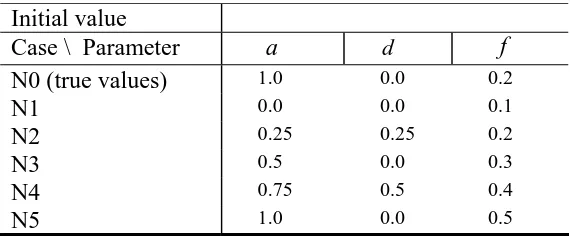
initial values for the Markov chain. For the major gene, the ranges for , and are [0.0,
1.0], [0.0, 0.5], and [0.1, 0.5] respectively (Table 2). The genotypes of parents are generated
by , assuming that parents are all from a base population with Hardy-Weinberg and linkage
equilibrium. Given the parents’ genotypes, major genotypes of progenies are generated by
following the Mendelian transmission probabilities of allele segregation. These multiple
independent parallel runs of Gibbs sampler can be used as a diagnostic tool to examine the
mixing property of MCMC. For each case, two independent chains, with 40,000 iterations
each, are run.
, , , 2 2
2
e s g σ σ
σ
d
a, f
f
4.3 Convergence diagnostics
Bayesian Output Analysis (BOA version 0.5.0) (Smith, 2000) is used to analyze these
outputs. The Gelman and Rubin Shrink Factors (Gelman and Rubin, 1992) plot is used to
determine the burn-in time as well as the convergence. The autocorrelation plot is then used
final analysis. Brooks, Gelman and Rubin’s corrected scale reduction factors (for multiple
chains) and Raftery and Lewis’s dependence factors (for a single chain) are also used to
diagnose the convergence of MCMC chains (Brooks and Roberts, 1998). As a rule of thumb,
if the 0.975 quantile of Corrected Scale Reduction Factors is less than 1.2, the sample may be
considered to have arisen from the stationary distribution. For a single chain, Dependence
Factors greater than 5.0 often indicates convergence failure and a need to reparameterize the
model. Trace plots are used as indicators of mixing and convergence of chains.
In the Gibbs chain, the additive major gene effect (a) may be positive as well as negative.
The sign of is relevant, i.e. the favorable allele is when a is positive, and when is
negative. From the Gibbs samples, we are interested in the absolute value of . For
consistency, we change the frequency of the favorable allele ( ) to 1- when is changed
from a negative value to a positive value.
a A1 A2 a
a
f f a
4.4 Results
When the design matrix was singular, both uniform prior and normal prior provided good
frequentist coverage estimates, except for the fact that estimates were lower than expected
from simulations (Table 3). The Gelman and Rubin plot for a set of initial values (as in N1)
indicated that the burn-in iteration was about 25,000 iterations (see Figure 1). The corrected
scale reduction factors were approximately 1.0, and Raftery dependence factors were found to
be much less than 5.0. Posterior densities of six genetic parameters, and ,
for a different set of initial values (as in N2) are listed in Figure 2. These numerical
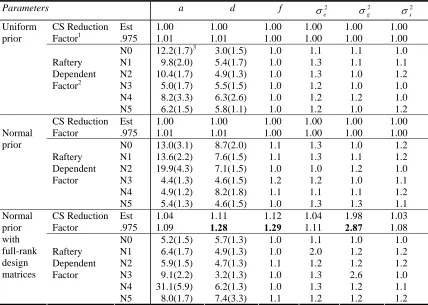
diagnostic summaries (Table 4 and Figure 1) indicated that the chains mix well and there was
2
g
σ
2 2
, , ,
,d f e g
no severe problem with MCMC convergence. We also found that the prior and initial values
did not have any effects on the Gibbs sampler under the singular design matrix.
When the design matrix was chosen to be of full rank, each individual chain converged
with the Raftery dependence factors less than 5.0. The parameter estimates from the five
different initial value sets N0, N1, N2, N4, and N5 were very good in term of precision. For
the set of initial values N3, however, the estimates of major gene genotype for the 6th parent,
as well as the corresponding genetic parameters, were not correct (see Table 3). As a result,
the 0.975 quantile of corrected scale reduction factors for parameter and were 1.28,
1.29, and 2.87 respectively (see Table 4). This may indicate a possible mixing problem for the
N3 set due to the combination of full-rank design matrix with this data structure. To avoid this
possibility, a normal prior with a singular design matrix was chosen as a model for the further
analysis of our case study.
, , f
d σ2g
5.
A case study
The blocking Gibbs sampling method was applied to a progeny data set derived from a 6
parents, half-diallel mating of loblolly pine by the North Carolina State University Tree
Improvement program (Li et al., 1999). Similar to the simulated data, 15 full-sib families
from the diallel mating were planted at 4 different sites with 6 blocks each. Tree heights of
progenies at age 6 were measured as the quantitative trait for this analysis. First, a mixed
linear model was fitted to adjust the site effect t, and block within site effect
. The residuals were used as the phenotypic observation vector . Initial values for GCA,
SCA and variance components were all taken from the estimates from a traditional polygenic
model without the major gene. The prior distribution for
b(t) t+ =
Y
b(t) Y
a
,
withK =4. The hyper-parameters for allele frequency f were αf=1 and βf=1. Asingular design matrix was chosen for the analysis.
The results for two independent chains, with different sets of initial values for
and , were very close to each other using 240,000 iterations (Table 5). The 0.975 quantile
of corrected scale reduction factors for parameters was less than 1.2. The percentage of major
gene effects was estimated as 17% of the total phenotypic variance. The estimated major
genotype of parent 2 was , while that of the others was . The additive effect of the
major gene was 2.3 and the dominance effect was
d a,
f
2 1A
A A2A2
≈
a d ≈-2.3. That is, A1A1 had a≈2.3,
had -2.3 and had
2 1A
A d ≈ A2A2 a ≈-2.3. The results indicated that there might be a
detectable recessive major gene controlling the height growth of loblolly pine in this diallel
population, although the effect of the major gene is small compared with the polygenic
effects, which explains about 17% of total phenotypic variance. High estimated GCA values
also indicated that the polygenic component was more important for height growth of loblolly
pine at age 6. Given the limitations of the experimental design and relatively small effect of
the major gene, the major genotypes may not be accurate in this case study. Furthermore, the
validity of the model assumptions and possible interaction of polygenic and major gene
effects may make this genotype interpretation difficult.
6. Discussion
The Bayesian approach with parent-blocking Gibbs sampling has been shown to be effective
in this study for analyzing data from a half-diallel mating design using a mixed inheritance
gene effects and putative genotypes of a major gene for parents and progenies, as well as
polygenic parameters of a quantitative trait. To our knowledge, this is the first statistical
approach that incorporates the polygenic effects of GCA and SCA with a major gene in the
MIM for a diallel mating design. The results from this model have provided a better
understanding of mixed inheritance of quantitative traits in diallel populations, particularly for
tree-breeding.
Although major-gene genotypes detected are putative, based on the statistical
inference, this information of segregation could be valuable for identifying parents with major
genes affecting quantitative traits. The proposed method is based on the existing half-diallel
mating design, and hence it can be used to analyze actual progeny test data for breeding
purposes. By systematically screening progeny test data with this method, putative major
genes, genotypes of parents and progenies, and their probabilities can be estimated. This is in
addition to the polygenic effects of GCA and SCA, and other variance component estimates
from the traditional analysis. The detectable major gene and putative genotypes would be
valuable for selecting materials in an active breeding program. By combining the GCA and
SCA estimates and possible major genotypes, suitable combinations of parents or progenies
can be chosen to provide maximum genetic gains for a breeding program.
The putative genotypes of major genes identified with this method could also be
valuable for molecular mapping experiments by providing a mapping population with a high
probability of segregation for the quantitative traits. This should improve the effectiveness of
searches for QTL in the laboratory and reduce the experimental costs of such a search. Often
no QTLs can be detected due to inadequate segregation in the experimental population. Our
segregating for a quantitative trait before further molecular mapping and linkage analysis are
pursued. The detection of major genes using statistical approaches and confirmation of the
presence of a major gene using genetic markers are very important for designing more
effective breeding strategies and would make breeding for quantitative traits much more
efficient.
One problem with the traditional ML approach is that it is not feasible to obtain
maximum likelihood estimators either by maximizing the likelihood of incomplete data
directly or by using an iterative algorithm such as EM. By adopting a Bayesian framework for
the segregation analysis, we avoided the necessity of performing such an optimization. In
addition, estimates of the parameters are based on finite sample posterior distribution and thus
avoid the use of asymptotic approximation using Fisher information. The marginal Bayesian
estimators take into account the uncertainty of a single parameter that is due to the uncertainty
in all other parameters in the model. Thus, it can take into account all model uncertainty
based on finite samples. Model selection methods based on theoretic criteria such as AIC and
BIC can be used to choose models with different number of major genes.
Usually, a full-rank design matrix makes the Markov chain converge quicker (Gilks and
Roberts, 1996). In this study, the combination of the method, data structure and full-rank
setting may limit the movement of chains by chance. Consequently, the wrong parent
genotypes may be identified even though the chain may mix well and converge for other
genetic parameters. Smooth posterior density is not always an indicator of convergence as
studied by Wang et al. (1994), especially when dealing with the discrete genotypes in the
unknown parameter space. Gelfand and Sahu (1998) have shown that mixing improved as
Efficiency of Gibbs sampling depends on the mixing property of the Markov chain,
which in turn is determined by the parameterization used in the model and the sampling
scheme applied. From the consistent results of multiple chains and convergence tests, we
conclude that the chains have mixed well for parent block sampling of genotypes. However, if
the size of progeny population is small and/or the major gene effect is small, mixing may
become a problem even with the parent block sampling. If additional molecular marker
information is included in the model or the overall mean µ in the model is extended to a
vector by including other non-genetic parameters, such as site effects and block within site
effects, the mixing problem may be worse. One possible way to avoid this is to use the hybrid
Markov chain embedding a Hasting or Metropolis updating step in the basic Gibbs sampling
scheme, as used in pedigree analysis (Tierney, 1994). Another way would be to use
Metropolis jumping kernel to make transition between communicating classes (Lin, 1995). A
Bayesian network is also an alternative solution (Lund and Jensen, 1999).
Although only one major gene with two alleles was considered in this study, this
method can be extended to more general situations by considering 2 alleles and/or two or
more major genes. When multiple alleles and genes are involved in the model, many
important issues such as Hardy-Weinberg disequilibrium (among alleles for one gene),
linkage disequilibrium (association among genes), and epistasis (non-allelic interaction)
should be examined. In these cases, model selection can be adopted by means of the Bayes
Factor (Kass and Raftery, 1998), or by means of a predictive loss approach (Gelfand and
Ghosh, 1998).
p
n
This research was supported by a grant from the Department of Energy and several industry
members of the North Carolina State University-Industry Cooperative Tree Improvement
Program. The support of the Department of Forestry at the North Carolina State University is
gratefully acknowledged. We thank the North Carolina Supercomputer Center for allowing us
to use its facilities for some computations. We appreciate Drs. Zhao-Bang Zeng, Trudy
Mackay, Rongling Wu, Ben-Hui Liu, and Arthur Johnson for their inputs and helpful
discussions at various stages of this work. We thank the editor and two anonymous reviewers
for their useful comments on this manuscript.
R
EFERENCESBrooks, S.P. (1998). Markov chain Monte Carlo method and its application. The Statistician 47, 69-100.
Brooks, S.P. and Roberts, G.O. (1998). Convergence assessment techniques for Markov chain Monte Carlo. Statistics and Computing8, 319-335.
Elston, R.C. and Stewart, J. (1971). A general model for the genetic analysis of pedigree data.
Human Heredity21,523-542.
Fain, P.R. (1978). Characteristics of simple sib-ship variance tests for the detection of major loci and application to height, weight and spatial performance. Annuals of Human Genetics 42,109-120.
Falconer, D.S. and Mackay, T.F.C. (1996). Introduction to Quantitative Genetics. Ed.4, New York: Longman.
Gelfand, A.E. and Ghosh, S.K. (1998). Model choice: A minimum posterior predictive loss approach. Biometrika85(1), 1-11.
Gelfand, A.E. and Sahu, S.K. (1998). Identifiability, improper priors and Gibbs sampling for generalized linear models. Journal of the American Statistical Association94, 247-253. Gelman, A. and Rubin, D.B. (1992). Inference from iterative simulation using multiple sequences. Statistical Science7, 457-511.
Gilks, W.R. and Roberts, G.O. (1996). Strategies for improving MCMC. In Markov Chain
Monte Carlo in Practice (eds. W.R. Gilks, S. Richardson, and D.J. Spiegelhalter), pp.
89-114. London: Chapman & Hall.
Griffing, G. (1956). Concept of general and specific combining ability in relation to diallel crossing systems. Australian Journal of Biological Science9, 463-493.
Hallauer, A.R. and Miranda, J.B. (1981). Quantitative genetics in maize breeding. Iowa State Universitypress, Ames, Iowa. P468.
Hoeschele, I. (1988). Genetic evaluation with data presenting evidence of mixed major gene and polygenic inheritance. Theoretical and Applied Genetics76, 81-92.
Huber, D.A., White, T.L. and Hodge, G.R. (1992). The efficiency of half-sib, half-diallel and circular mating designs in the estimation of genetic parameters in forestry: a simulation. Forest Science38, 757-776.
Janss, L.L.G., Van Arendonk, J.A.M. and Brascamp, E.W. (1997). Bayesian statistical analysis for presence of single gene affecting meat quality traits in a crossed pig population.Genetics145, 395-408.
Jiang, C.J., Pan, X.B. and Gu, M.H. (1994). The use of mixture models to detect effects of major genes on quantitative characters in a plant breeding experiment. Genetics136,383- 394.
Karlin, S. and Williams, P.T. (1981). Structured exploratory data analysis (SEDA) for
determining mode of inheritance of quantitative traits. II. Simulation studies on the effect of ascertaining families through high-valued probands. The American Journal of Human Genetics, 33, 282-292.
Kass, R.E., and Raftery, A.E. (1995). Bayes Factors. Journal of the American Statistical Association 90(430), 773-795.
Kaya, Z., Sewell, M.M. and Neale, D.B. (1999). Identification of quantitative trait loci influencing annual height- and diameter increment growth in loblolly pine (Pinus taeda L.). Theoretical and Applied Genetics 98,586-592.
Knott, S.A., Haley, C.S., and Thompson, R. (1991). Methods of segregation analysis for animal breeding data: a comparison of power. Heredity68, 299-311.
Le Roy, P., Elsen, J.M. and Knott, S.A. (1989). Comparison of four statistical methods for detection of a major gene in a progeny test design. Genetics, Selection, Evolution 21, 341-357.
Li, B. and Wu, R. (1996). Genetic causes of heterosis in juvenile aspen: a quantitative comparison across intra-and interspecific hybrids. Theoretical and Applied Genetics 93,
380-391
Li, B., McKeand, S.E. and Weir, R.J. (1999). Tree improvement and sustainable forestry – impact of two cycles of loblolly pine breeding in the U.S.A.. Forest Genetics, 6(4), 229- 234.
Lin, S., (1995). A scheme for constructing an irreducible Markov Chain for pedigree data. Biometrics51, 318-322.
Liu, J.S., Wong, W.H. and Kong, A. (1994).Covariance structure of the Gibbs sampler with applications to the comparisons of estimators and augmentation schemes. Biometrika81
(1), 27-40.
Long, A.D., Mullaney, S.L., Reid, L.A., Fry, J.D., Langley, CH., and Mackay, T.F.C. (1995). High resolution mapping of genetic factors affecting abdominal bristle number in
Drosophilae melanogaster. Genetics139:1273-1291.
Lund, M.S. and Jensen, C.S. (1999). Blocking Gibbs sampling in the mixed inheritance model using graph theory. Genetics, Selection, Evolution31, 3-24.
Lynch, M. and Walsh, B. (1998). Genetics and analysis of quantitative traits. Sinauer Association Inc. 321-378.
McKeand, S.E., Eriksson, G. and Roberds, J.H. (1997). Genotype by environment interaction for index traits that combine growth and wood density in Loblolly pine. Theoretical and
Applied Genetics 94, 1015-1022.
Mérat, P. (1968). Distributions de fréquences, interprétration du déterminisme génétique des caracteres quantitatifs et recherche de “géens majeurs.” Biometrics24, 277-293.
Remington, D.L. and O’Malley, D.M. (2000) “Evaluation of major genetic loci contributing to inbreeding depression for survival and early growth in a selfed family of Pinus taeda”, Evolution54,1580-1589
Roberts, G.O., and Sahu, S.K. (1997). Updating schemes, correlation structure, blocking and parameterization for the Gibbs sampler. Journal of Royal Statistical Society Series B 59, 291-317.
Smith, B. (2000). Bayesian output analysis program (BOA) Version 0.5.0 Programmer Manual.
Tierney, L. (1994). Markov chains for exploring posterior distributions (with discussion). Annual Statistics.22, 1701-1762.
Wang, C.S, Rutledge, J.J., and Gianola, D. (1994). Bayesian analysis of mixed linear models
via Gibbs sampling with an application to litter size in Iberian pigs. Genetics, Selection,
Evolution26, 91-115.
Wang, J., Podlich, D.W., Cooper, M. and Delacy, I.H. (2001). Power of the joint segregation analysis method for testing mixed major-gene and polygene inheritance models of quantitative traits. Theoretical and Applied Genetics 103, 804-816.
Wilcox, P.L., Amerson, H.V., Kulman, E.G., Liu, B.H., O’Malley, D.M. and Sederoff, R.R. (1996). Detection of a major gene for resistance to fusiform rust disease in loblolly pine by genomic mapping. Proceedings of National Academy of Science of the United States
of America 93, 3859-3864.
Wu, R. and Li, B. (1999). A multiplicative epistatic model for analyzing interspecific differences in outcrossing species. Biometrics55, 355-365.
Wu, R. and Li, B. (2000). A quantitative genetic model for analyzing species differences in outcrossing species. Biometrics56, 1098-1104.
Wu, R., Li, B., Wu, S.S. and Casella, G. (2001). A maximum likelihood-based method for mining major genes affecting a quantitative character. Biometrics57, 764-768.
Xiang, B. and B. Li. (2001). A new mixed analytical method for genetic analysis of diallel data. Canadian Journal of Forest Research31, 1-8.
Zeng, W. (2000). Statistical methods for detecting major genes of quantitative traits using phenotypic data of a diallel mating. Ph.D. dissertation, North Carolina State University, Raleigh, USA. 145p.
Table 1: The definitions of the notations used in the mixed inheritance model.
Notation Definition
Y a ( x1) vector of progeny observations.n n
µ the overall mean, is equal to µ. It can be extended to a ( x1) vector of
fixed non-genetic effects, e.g. site effect and block within site effect.
c c
X a (nx1) vector with value 1 of overall mean for all progenies.
u a ( x1) vector of random polygenic effects, q q u′=(g′,s′), including GCAs (g) and SCAs (s).
p
n
s
n
g
{
}
p
i i n
g , =1,..., =
′
g , GCAs,are assumed to be mutually independent normal distributions, i.e. .
p n ) , ( ~
| 2 N 0 2I
g σg σg
1 2
g
σ the GCA polygenic variance due to additive polygenic effects.
s
{
}
s
j j n
s , 1,...,
' = =
s , SCAs, are assumed to be mutually independent normal distributions, i.e. ,
s n ) , ( ~
| 2 N 0 2I
s σs σs
2
s
σ the SCA polygenic variance due to dominance polygenic effects.
Z a (nxq) incidence matrix of GCA and SCA for all progenies
m a (2x1) vector of major gene effects, m′=(a,d). a the additive major genotypic effect.
d the dominance major genotypic effect.
L ⎟ ⎟ ⎟ ⎠ ⎞ ⎜ ⎜ ⎜ ⎝ ⎛ − = 0 , 1 1 , 0 0 , 1
L , a (3x2) indicator matrix of the major gene effects for major
genotypes.
W an unknown ( x3) random incidence matrix of major genotypes at the single locus for n progenies.
n
T
w a (1x3) row vector to form the rows of . =(1,0,0), =(0,1,0),and =(0,0,1),
W
w1 w23
w T taking values 1, 2, and 3 respectively to represent the major genotype A1A1, A1A2, and A2A2.
e a ( x1) vector of iid errors. n e is assumed to beN(0, 2I),
e
σ
2
e
σ the residual variance.
1. N
a d
Table 2: The six combinations of initial values (N0-N5) for each of three combinations
of prior and design matrix: Uniform priors for , and µ with singular design matrix,
normal priors for a, , and d µ with singular design matrix, and normal priors for , ,
and
a d
µ with full-rank design matrix to test the effect of prior, initial value, and design
matrix on the mixed inheritance model (MIM) using a blocking Gibbs sampling. In the
MIM model, the polygene background setup was narrow sense heritability of polygenic
inheritance =0.2, the ratio of dominance to additive genetic variance of polygenic
inheritance
2 h
r
=0.5, and the major gene effect was simulated by 2 , , and .
a d f
Initial value
Case \ Parameter a d f
N0 (true values) 1.0 0.0 0.2
N1 0.0 0.0 0.1
N2 0.25 0.25 0.2
N3 0.5 0.0 0.3
N4 0.75 0.5 0.4
Parameters a d f 2
e
σ 2
g
σ σs2 P1 P2 P3 P4 P5 P6
True values 1.0 0.0 0.167 0.595 0.034 0.017 A2A2 A2A2 A2A2 A1A2 A1A2 A2A2
N0 1.03±0.121 -0.07±0.12 0.212±0.102 0.613±0.027 0.017±0.012 0.013±0.008 A2A2 A2A2 A2A2 A1A2 A1A2 A2A2
N1 1.04±0.12 -.008±0.12 0.215±0.103 0.613±0.027 0.017±0.011 0.013±0.007 A2A2 A2A2 A2A2 A1A2 A1A2 A2A2
N2 1.03±0.12 -0.07±0.13 0.215±0.106 0.612±0.028 0.018±0.014 0.013±0.007 A2A2 A2A2 A2A2 A1A2 A1A2 A2A2
N3 1.02±0.13 -0.06±0.13 0.212±0.104 0.614±0.028 0.017±0.010 0.013±0.008 A2A2 A2A2 A2A2 A1A2 A1A2 A2A2
N4 1.03±0.11 -0.07±0.12 0.215±0.107 0.612±0.027 0.016±0.011 0.013±0.008 A2A2 A2A2 A2A2 A1A2 A1A2 A2A2
Uniform prior
N5 1.02±0.12 -0.07±0.12 0.212±0.106 0.614±0.028 0.017±0.011 0.013±0.008 A2A2 A2A2 A2A2 A1A2 A1A2 A2A2
N0 1.04±0.12 -0.08±0.12 0.217±0.108 0.613±0.028 0.017±0.011 0.013±0.007 A2A2 A2A2 A2A2 A1A2 A1A2 A2A2
N1 1.03±0.13 -0.07±0.13 0.215±0.105 0.613±0.028 0.017±0.012 0.013±0.007 A2A2 A2A2 A2A2 A1A2 A1A2 A2A2
N2 1.04±0.12 -0.08±0.13 0.212±0.104 0.612±0.028 0.017±0.010 0.013±0.008 A2A2 A2A2 A2A2 A1A2 A1A2 A2A2
N3 1.01±0.13 -0.05±0.13 0.216±0.107 0.614±0.027 0.017±0.011 0.013±0.007 A2A2 A2A2 A2A2 A1A2 A1A2 A2A2
N4 1.03±0.12 -0.07±0.12 0.215±0.105 0.613±0.026 0.017±0.011 0.013±0.008 A2A2 A2A2 A2A2 A1A2 A1A2 A2A2
Normal prior
N5 1.04±0.11 -0.08±0.11 0.214±0.107 0.611±0.028 0.017±0.028 0.013±0.008 A2A2 A2A2 A2A2 A1A2 A1A2 A2A2
N0 1.02±0.11 -0.07±0.12 0.212±0.106 0.615±0.028 0.015±0.010 0.012±0.006 A2A2 A2A2 A2A2 A1A2 A1A2 A2A2
N1 1.02±0.13 -0.07±0.13 0.215±0.106 0.616±0.027 0.016±0.011 0.012±0.007 A2A2 A2A2 A2A2 A1A2 A1A2 A2A2
N2 1.03±0.11 -0.08±0.12 0.214±0.108 0.614±0.028 0.015±0.010 0.012±0.007 A2A2 A2A2 A2A2 A1A2 A1A2 A2A2
N3 0.95±0.10 -0.20±0.07 0.354±0.123 0.634±0.033 0.100±0.067 0.009±0.006 A2A2 A2A2 A2A2 A1A2 A1A2 A1A1 N4 1.02±0.14 -0.06±0.14 0.216±0.141 0.615±0.105 0.015±0.010 0.012±0.007 A2A2 A2A2 A2A2 A1A2 A1A2 A2A2
Normal prior with full-rank design
matrices N5 1.01±0.12 -0.05±0.13 0.216±0.106 0.614±0.106 0.015±0.009 0.012±0.006 A2A2 A2A2 A2A2 A1A2 A1A2 A2A2
MC error 2 0.006 0.006 0.002 0.0006 0.0003 0.0002
Table 3: Estimated means, and standard deviations of posterior densities for six genetic parameters (a, d, f, , , ), and genotype
estimates of six parents (P
2
e
σ 2
g σ 2
s
σ
1-P6) for testing the effects of prior distribution, initial value, and design matrix on the mixed inheritance
model. In the MIM model, the polygene background setup was 2=0.2,
h
r
=0.5, and the major gene effect was simulated by 2 =2.0,=0.0 and =0.2 (actual value is 0.167). There were six runs, N0 to N5, for each of three cases.
a
d f
1: mean ± standard deviation of the parameter estimate from the Gibbs sample with lag=5; 2
: There is one MC error for each Chain. Because the values for each parameter are so close, only an average value is listed here.
2 e
σ 2
g
σ 2
s σ
2
Table 4: Convergence diagnostics of the six parameters, a, d, f, , , , for testing
the effects of prior distribution, initial value, and design matrix on the mixed inheritance
model. In the MIM model, the polygene background setup was h =0.2,
r
=0.5, and themajor gene effect was simulated by 2 =2.0, =0.0 and =0.2 (actual value is 0.167).
There were six runs, N0 to N5, for each of three cases.
a d f
2 e
σ 2
g
σ 2
s σ Parameters a d f
Est 1.00 1.00 1.00 1.00 1.00 1.00
CS Reduction
Factor1 .975 1.01 1.01 1.00 1.00 1.00 1.00
N0 12.2(1.7)3 3.0(1.5) 1.0 1.1 1.1 1.0 N1 9.8(2.0) 5.4(1.7) 1.0 1.3 1.1 1.1 N2 10.4(1.7) 4.9(1.3) 1.0 1.3 1.0 1.2 N3 5.0(1.7) 5.5(1.5) 1.0 1.2 1.0 1.0 N4 8.2(3.3) 6.3(2.6) 1.0 1.2 1.2 1.0 Uniform
prior
Raftery Dependent Factor2
N5 6.2(1.5) 5.8(1.1) 1.0 1.2 1.0 1.2
Est 1.00 1.00 1.00 1.00 1.00 1.00
CS Reduction
Factor .975 1.01 1.01 1.00 1.00 1.00 1.00
N0 13.0(3.1) 8.7(2.0) 1.1 1.3 1.0 1.2 N1 13.6(2.2) 7.6(1.5) 1.1 1.3 1.1 1.2 N2 19.9(4.3) 7.1(1.5) 1.0 1.0 1.2 1.0 N3 4.4(1.3) 4.6(1.5) 1.2 1.2 1.0 1.1 N4 4.9(1.2) 8.2(1.8) 1.1 1.1 1.1 1.2 Normal
prior
Raftery Dependent Factor
N5 5.4(1.3) 4.6(1.5) 1.0 1.3 1.3 1.1
Est 1.04 1.11 1.12 1.04 1.98 1.03
CS Reduction
Factor .975 1.09 1.28 1.29 1.11 2.87 1.08
N0 5.2(1.5) 5.7(1.3) 1.0 1.1 1.0 1.0 N1 6.4(1.7) 4.9(1.3) 1.0 2.0 1.2 1.2 N2 5.9(1.5) 4.7(1.3) 1.1 1.2 1.2 1.2 N3 9.1(2.2) 3.2(1.3) 1.0 1.3 2.6 1.0 N4 31.1(5.9) 6.2(1.3) 1.0 1.3 1.2 1.1 Normal
prior with full-rank design matrices
Raftery Dependent Factor
N5 8.0(1.7) 7.4(3.3) 1.1 1.2 1.2 1.2
lag=5 in the regular base because of strong autocorrelation; and Probability = 0.9.
3
: The dependent factor in the parenthesis was calculated by using lag=30, instead of
2
: Raftery Dependent Factor is calculated under Quantile = 0.025, Accuracy = ± 0.05,
1
Table 5: Estimated means and standard deviations of posterior densities for seven genetic parameters ( , , , , , , ), and
general combining ability (GCA) (
a d f 2
e
σ 2
g σ 2
s
σ 2
m
σ
6
1 g
g − ) and major gene genotypes of six parents (P1−P6) for the diallel from Bayesian based
segregation analysis. There were two independent runs, chain 1 and chain 2.
Genotype P1 P2 P3 P4 P5 P6
Chain 1 A2A2(.95)1 A1A2 (.90) A2A2 (.86) A2A2 (.84) A2A2 (.97) A2A2 (.91) Chain 2 A2A2 (.97) A1A2 (.86) A2A2 (.82) A2A2 (.80) A2A2(1.0) A2A2(.93)
GCA g1 g2 g3 g4 g5 g6
Chain 1 1.30±0.812 -0.88±0.64 0.03±0.69 -0.45±0.67 0.66±0.67 -0.27±0.75
Chain 2 1.53±0.92 -0.91±0.62 -0.05±0.71 -0.48±0.68 0.84±0.76 -0.26±0.76
Parameter a d f 2
e
σ 2
g
σ 2
s
σ 2
m
σ 2
p
σ 2 2
/ p
m σ
σ
Chain 1 2.29±0.65 -2.31±1.05 0.33±0.16 6.96±0.25 0.96±0.92 1.41±0.90 2.18±1.50 12.47 0.175
Chain 2 2.17±0.65 -2.25±0.78 0.37±0.17 6.91±0.27 1.12±1.09 1.29±092 2.16±1.41 12.60 0.171
1
: Probability of this genotype
2
: the estimated mean ± standard deviation from the Gibbs samples with lag=5
Shri nk fa ct or Shri nk fa ct or
Figure 1: Gelman and Rubin shrink factor plots of six genetic parameters a d f 2
e
2
g
2
s) of the initial value set N1 for norma
prior for a d, and f with singular design matrix for testing the effects of prior distribution, initial values, and design matrix on
mixed inheritance model.
( , , , , , l
,
σ σ σ
20000 25000 30000 35000 40000
20000 25000 30000 35000 40000 20000 25000 30000 35000 40000
1.3 2 1. 1.1 1.0 1.4 1.3 1.2 1.1 1.0
f 0.975 … . Wealan ----
2 e
σ 0.975 … . Wealan ---- 1.12
1.08
1.04
1.00
20000 25000 30000 35000 40000 20000 25000 30000 35000 40000
2 s
σ 0.975 … . Wealan ----
2 g
σ 0.975 … . Wealan ----
1.6
1.4
1.2
1.0
20000 25000 30000 35000 40000
a 0.975 … .
Wealan ----
0.975 … . Wealan ----
d Sh ri n k fac to r 4.0 3.0 2.0 1.0 5.0 4.0 3.0 2.0 1.0
Figure 1: Gelman and Rubin shrink factor plots of six genetic parameters ( , , , , , ) of the initial value set N1 for normal prior for , , and with singular design matrix for testing the effects of prior distribution, initial values, and design matrix on mixed inheritance model.
a d
a d f
f
Figure 2: Posterior densities of six genetic parameters ( , , , , , ) of the initial value set N1 for normal prior for ,
, and
a d f 2
e
σ 2
g σ 2
s
σ a
d µ with singular design matrix were used for the mixed inheritance model. The horizontal dots are the Gibbs sample
values for the parameter.
3
2
1
0
0.4 0.6 0.8 1.0 1.2 1.4 - 0.6 - 0.4 -0.2 0.0 0.2 0.4 0.6
0.0 0.2 0.4 0.6
Parameter value
0.00 0.05 0.10 0.15 0.20
Parameter value
0.00 0.02 0.04 0.06 0.08 0.10 0.12 0.14 3
2
1
0
60
40
20
0 12
8
4
0
f
0.50 0.55 0.60 0.65 0.70 0.75
2 g
σ 2
s σ
a d
2 e σ
D
en
si
ty
4
3
2
1
0
D
ty
en
si
50
30
10 0
D
e
ty
n