Ahmednagar, Maharastra, India
Comprehensive Cross Layer Analysis
Framework for Delay Distribution in WSN
Bharat R Pawar , Jintendra Kumar SinghAtul Srivastava
Asst. Professor, Dept of ETC, PDVVP, Pune University, Ahmednagar, Maharashtra, India.
Asst. Professor, Dept of ETC, VACOE, Pune University, Ahmednagar, Maharashtra, India.
Asst. Professor, Dept of ETC, VACOE, Pune University, Ahmednagar, Maharashtra, India.
Abstract: — As technology advances in society the need for networks has become essential. In network study we found many advantage as well as disadvantage related to wired and wireless scenario. So, while considering design issue of network QoS i.e. Quality of Service is the main consideration of network. In wireless networks QoS deals with the many system sensitive parameters they are average delay, End to end delay, Throughput, Packet loss, energy consumption, latency, etc. Due to nondeterministic behaviour of the wireless channel and queuing mechanisms of nodes also the probabilistic that means where there is multiple possibility of outcomes each with different certainty analysis of QoS is essential. so compared with other delay parameter such as mean delay, delay variance, and worst-case delay etc .end to end delay parameter is having great influence on WSN to meet a strict deadline. In this paper, a cross-layer protocol (XLP) introduced, which gives us congestion control means overcrowded signals and medium access control MAC in a cross-layer fashion, ultimately for performance evaluations. Usually timely delivery of a certain number of packets is required to improve delay detection capabiity.The previous delay analysis papers fail to give the single hop delay distribution, also the congestion traffic is not considered so this paper gives you brief idea about, a comprehensive cross-layer(XLP) analysis framework is develop . This framework is generic and can be parameterized for a wide variety of MAC protocols and routing protocols. Our work gives the exact solution for the average delay and End to End delay characteristics and models each node as a discrete time instant. Throughput and the packet loss in WSNs gives by simulation and experiments. Our work shows , the result for comparison of the CSMA/CA Mac protocol and cross layer protocol for average delay and End to end dealy,Throuhput and Packet loss is done for WSNs at different packet rate. Our work gives benefits of cross layer over the CSMA/CA Mac protocol. Extensive simulation results underline the validity of the method and its applicability.
Keywords: Cross-layer protocol (XLP), Average Delay distribution, End to end delay, routing, medium access control,
Packet Loss, Throughput, wireless sensor networks.
I. INTRODUCTION
Ahmednagar, Maharastra, India
Copyright to IJIRSET www.ijirset.com 392 deterministic and random deployments a accurate and reliable cross layer framework is developed to characterize the average delay and end to end delay distribution of nodes. Second, Throughput and the Packet loss of the CSMA/CA Mac protocol and Cross layer protocol is calculated by the graphical analysis[4] [2]..The end-to-end delay distribution depends on the deterministic deployment and random deployment. For both deployments, focus on the steady-state behaviour of the routing protocol. In original OSI model we found strict boundaries between protocols. We are going to develop virtual strict boundary cross layer protocol for both deterministic and random deployment for removing such strict boundaries between protocols by permitting one layer to access the data of another layer to exchange information and enable interaction for reliability of network. The basic theme of our work is to maintain the functionalities associated to the original layers but to allow coordination between layers, interaction and joint optimization of protocols crossing different layers[11]..
In proposed system, present comprehensive cross-layer analysis framework, which employs a stochastic queuing model in realistic channel environments, is developed for throughput, packet loss, average delay and end to end delay in WSN.
ІІ. RELATED WORK
Omesh Tickoo and Biplab Sikdar proposed that Traditional system fail to evaluate the queuing delays and channel access times at nodes in wireless networks paper presents an analytic model for evaluating the queuing delays and channel access times at nodes in wireless networks using the IEEE 802.11 Distributed Coordination Function (DCF) as the MAC protocol in network. The model of XLP can account for arbitrary arrival patterns, packet size distributions and Number of nodes. Fail to give end to end delay analysis for deterministic and random deployment of nodes in WSN.
Mehmet C. Vuran, Member, IEEE, and Ian F. Akyildiz, Fellow, proposed that Severe energy constraints of battery-powered sensor nodes necessitate energy- efficient communication in Wireless Sensor Networks (WSNs). the vast majority of the existing solutions are based on the classical layered protocol approach, which leads to significant overhead a cross-layer protocol (XLP) introduced, which having congestion control routing or overcrowding of signal , and medium access control MAC in a cross-layer fashion.
Yunbo Wang Mehmet C.Vuran Steve Goddard have proposed to improve the event detection reliability of nodes, usually for WSN timely delivery of a number of packets required. We have traditional or convention timing analysis of WSNs are, also focused on individual packets or traffic flows from individual nodes a spatio-temporal fluid model is developed to capture the delay characteristics of event detection in large-scale WSNs. Mean delay and soft delay bounds are analysed for different network parameters. The resulting framework can be utilized to analyze the effects of network and protocol parameters on event detection delay to realize real-time operation in WSNs. but fail to give single hop delay distribution. The design principle of XLP is based on the cross-layer concept of initiative determination, which gives receiver-based contention, initiative based forwarding, local congestion control that is overcrowding of signals, and distributed duty cycle operation to realize efficient and reliable communication in WSN .Fail to investigate of various networking functionalities such as adaptive modulation, error control, and topology control in a cross-layer fashion to develop a unified cross-layer communication module.
Yunbo Wang, Mehmet C.Vuran and Steve Goddard have proposed that Limited energy resources in increasingly sophisticated wireless sensor networks (WSNs) call for a comprehensive cross layer analysis of energy consumption in a multi-hop network. Reliability analysis in of such networks, the statistical information for energy consumption and lifetime is required Traditional energy analysis approaches only focus on the average energy consumed. a stochastic analysis of the energy consumption in a random network environment. the distribution of energy consumption for nodes in WSNs during a given time period is found. Fail to analyse the energy consumption for more MAC protocols, such as BMAC, XMAC, using our model.
ІІІ. SYSTEM OVERVIEW
Ahmednagar, Maharastra, India
two main parameters while considering QoS. Furthermore, the random effects of the wireless channel prohibit the development of deterministic QoS guarantees in this multihop network.
Overview of complete process is as bellow-
Consequently, a probabilistic analysis of QoS metrics is essential to address both timing and reliability requirements. In our analysis, we consider a network composed of sensor nodes that are distributed in a 2-D field. Sensor nodes report their readings to a sink through a multihop route in the network. Two different types of network deployments techniques are used [8] [9].
1. Deterministic deployment:-The deterministic deployment has the position of sensor nodes is fixed with deterministic locations which is useful to calculate the single hop delay distribution with queuing model.
2. Random Deployment:-Random deployment uses Poisson point process with log normal fading channel. queuing model deals with inter arrival distribution and discrete time Markov Process.
We start our work with parameter initialization of WSN. We model our own user defined sensor network model. Communication model for cross layer protocol XLP is then developed by using Markov process. The simulation is carried out using the Network simulator (version 2.35), which simulates the events such as sending i.e. transmitting, receiving, dropping i.e. packet loss, forwarding, etc. The wireless channel is used as the sensor nodes deployed communicate wirelessly with each other. The propagation models are used to compute the received power. When a packet is received in netwok, the propagation model determines the attenuation between transmitter and receiver and computes the received signal strength. Wireless sensor networks are modeled such that a bidirectional link is established between neighboring sensor nodes if they are within communication radius [10] [5].
Ahmednagar, Maharastra, India
Copyright to IJIRSET www.ijirset.com 394
Fig 2. Activity Diagram
Ahmednagar, Maharastra, India
Constructing Markov chain process
The discrete time Markov chain {Xn} is made up of M+1 layers, where each layer m (0<m<M) represents the state there are m packets in the queue and M is the queue capacity. idle layer {In}and the communication layers{Cn}m ,each of which consists of one or more states each of which consists of one or more states. The states and the transitions among the states in each layer are determined by the protocols used by each node and represent the operations conducted by the nodes according to the protocols. The idle layer {In}(m=0),represents the idle process, during which the node does not have any packet to send and waits for new packets. The communication layers {Cn}m, (m>0) represent the communicationprocess in which packets are transmitted [4]
According to the MAC protocol employed, and are respectively parameterized by the following notations:
•PI and PC: Transition probability matrix among the states in {In} and {Cn} ;
•αIand αC : the initial probability vector for {In}and {Cn};
• tIS and tcs : the probability vector from each state in{In} and {Cn} to complete the idle process and the transmission process successfully;
•tcf : the probability vector from each state in to complete the transmission process unsuccessfully;
•ג 1 and ג 2: the packet arrival probability vector for each state in{In}and {Cn} . Each element in the vector is the probability of a new packet arrival in a time unit when the process is in the corresponding state.
Each communication layer {Cn }consists of Markov chain blocks for each transmission attempt {Zn}, which is further characterized by the transition probability matrix Pz, the initial probability vector αz, the success probability vector tzs, the failure probability vector tzf , and packet arrival probability vector גz.
Accordingly, the transition probability matrix among the states in a single layer {Cn} in {Xn} can be organized as rows and columns of blocks
⋯ 0
∝
0 ⋯
Where the number of PZ blocks in PC is equal to x , i.e., the maximum number of attempts for each packet transmission. Similarly, initial probability vector αc and the probability vectors tc
s and tc
f
to complete a layer in success and failure are respectively organized as
αC = [ αZ 0 …. 0 ] (1) tcs = [tzs tzs ……… tzs ]T (2) tc
f
= [0 0 ……tz f
]T (3)
Note that since the idle layer does not have multiple attempts like the communication layer does, there is no similar organized internal pattern in the corresponding matrices and vectors for {In}. The states and the transitions related to {In} and {Zn}
Depend on the MAC protocol employed. The transition probability matrix Qx of the entire Markov chain {Xn} can then be found according to transitions between different states at each layer as explained next.[1]
For layer m ,1<m<M-1 , the queue is not full. Whenever a packet arrives, the process switches to a higher or next layer since the queue length increases. The probabilities of such transitions are governed by the probability matrix
Au=(1 גc ) T
* Pc (4)
where is a properly dimensioned matrix containing all 1’s, and * is the entrywise product operator.גc and Pc are parameterized according to the MAC protocol. Note that element (v,v’) in Au represents the transition probability from the v th state in previous layer to the v’ th state in the upper layer, and other transition probability matrices in the following are defined the similar way. The transition probability matrix at the same level m ,1<m<M-1, is
Ahmednagar, Maharastra, India
Copyright to IJIRSET www.ijirset.com 396 Where tc = tcs + tcf is the probability vector from each layer to complete the current communication process regardless of success or failure. The first term in (5) captures the case where a locally generated packet arrives at the same time unit in which a packet service is completed. The second term in (5) is for the case where neither service completion nor new packet arrival occurs during the time unit.
At layer m=M, the queue is full. Hence, new arriving packets are directly dropped. Therefore, the transition probability matrix in this layer is Au + As .When there is no packet arrival and the current packet service is completed, the Markov chain transistor switches to one layer below. The transition probability matrix from level m+1 to level m ,1<m<M-1 is
Ad = (1-1גc)T * tcαc (6)
The transition probabilities for given network are similar when the idle layer is involved as follows: Au0= גIT * αC ( 7)
Ad0=( 1-1גc) T
*tcαI (8) As0 = ( 1-1גI)
T * (PI + tI
S
αI (9)
When a new packet arrives while there is no packet in the system, the chain transits from the idle layer to layer 1 according TO Au0 to in (8). When the service is completed for the only packet in the system and no new packet arrives, chain transits from given layer 1 to the idle layer according to Ad0 in(8).
And finally, the transition probabilities with which the node stays in the idle layer are given in As0 in (9). Using (4)–(9), the transition probability matrix Qxfor
the entire recurrent Markov chain {Xn} can be constructed as follows:
Qx=
⋯ 0
⋱ ⋮
0 ⋯ +
IV. DISCUSSION AND RESULTS
IV. Discussion and Simulation results
Ahmednagar, Maharastra, India
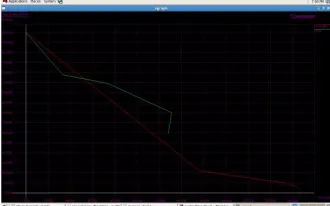
Figure (b): Average and end to end delay for CSMA/CA Mac protocol.
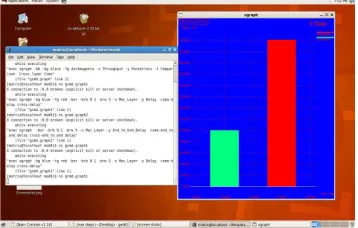
Figure (c): Graph of Throughput Vs Packet loss Cross layer
Figure (d): Graph of Throughput Vs Packet loss For CSMA/CA Mac protocol.
Ahmednagar, Maharastra, India
Copyright to IJIRSET www.ijirset.com 398 Fig (f). Average and end to end delay for Cross layer protocol.
Figure (g): Cross layer protocol
Ahmednagar, Maharastra, India
The real time scheduler (one of the two types of NS event schedulers) is used for emulation. Emulation allows the simulator to interact with a real live network NS is an OTcl script interpreter with network simulation object libraries. But NS in not only wrote in OTcl but also in C++language. For better efficiency cause, NS exploits a split-programming model. Because the developers of NS have found that separating the data path implementation from the control path implementation will reduce packet and event processing time. Task such as low-level event processing and packet forwarding requires high performance and are modified infrequently, so due to the event scheduler and the basic network component objects in the data path are implemented in a compiled language that is C++[5].
NS2 is a free simulation tool or openGL or open source. It runs on various platforms including UNIX (or Linux), Windows, and Mac systems. Being developed in the UNIX environment, with no surprise, NS2 has the ease of work experince, and so does its installation. The discussion in this book is based on a Cygwin (UNIX emulator) activated Windows system. NS2 source codes are distributed in two forms: the all-in-one suite and the component-wise for various environments. With the(NS) all-in-one package, users get all the required components along with some optional components. [5]
The all-in-one suite consists of the following main components:
• NS release 2.30,
• Tcl/Tk release 8.4.13,
• OTcl release 1.12, and
• TclCL release 1.18.
and the following optional features are available:
• NAM release 1.12: NAM is an animation tool for viewing network simulation traces and packet traces.
• Zlib version 1.2.3: This is the required library for NAM (Network Animator)
The average delay for the CSMA/CA protocol is 0.421msec considering transfer of 50 packets. The End to end delay for CSMA/CA Mac protocol is 0.111 msec. The average delay for Cross layer protocol is 0.342 m sec considering transfer of 30 packets. The end to end delay for Cross layer protocol is 0.083 msec. Following Table I show the analytical results.
Table І Sr. No. Parameter In msec No. of Packets
Cross layer CSMA
1 Average
Delay
50 0.342 0.421
2
End-to-End Delay
50 0.083 0.111
3 Average
Delay
80 0.512 0.984
4
End-to-End Delay
80 0.324 0.344
V. CONCLUSION
Ahmednagar, Maharastra, India
Copyright to IJIRSET www.ijirset.com 400
REFERENCES
[1] Heping Wang, Xiaobo Zhang, Farid Naït-Abdesselam,” Cross-Layer Optimized MAC to Support Multihop QoS Routing for Wireless Sensor Networks”, Member, IEEE, and Ashfaq Khokhar, Fellow, IEEE. VOL. 59, NO. 5, JUNE 2010
[2] N. Bisnik and A. Abouzeid, “Queuing network models for delay analysis of multihop wireless ad hoc networks,” Ad Hoc Netw., vol. 7, no.1, pp. 79–97, Jan. 2009.
[3] John A. Stankovic ,Wireless Sensor Networks Department of Computer Science University of Virginia Charlottesville, Virginia 22904 E-mail: [email protected] June 19, 2006
[4] Yunbo Wang, Mehmet C. Vuran and Steve Goddard, “Cross-Layer Analysis of the End-to-End Delay Distribution in Wireless Sensor Networks.” Member, IEEE, and Steve Goddard, Member, IEEE, VOL. 20, NO. 1, FEBRUARY 2012
[5] Teerawat Issariyakul & EkramHossain”Introduction to Network Simulator 2.”2009 Springer Science, Business Media
[6] Omesh Tickoo and Biplab Sikdar, Member, IEEE “Modeling Queueing and Channel Access Delay in Unsaturated IEEE 802.11 Random Access MAC Based Wireless Networks.” IEEE/ACM transactions on networking, vol. 16, no. 4, august 2008
[7] I. F. Akyildiz, T. Melodia, and K. R. Chowdhury, “A survey on wireless multimedia sensor networks,” Comput. Netw. J., vol. 51, no. 4, pp. 921–960, Mar. 2007.
[8] G. Bianchi, “Performance analysis of the IEEE 802.11 distributed coordination function,” IEEE J. Sel. Areas Commun., vol. 18, no. 3, pp.535–547, Mar. 2000.
[9] I. F. Akyildiz,W. Su, Y. Sankarasubramaniam, and E. Cayirci, “Wireless sensor networks: A survey,” Comput. Netw. J., vol. 38, no. 4, pp. 393–422, Mar. 2002.
[10] A. Burchard, J. Liebeherr, and S. Patek, “A min-plus calculus for end-to-end statistical service guarantees,” IEEE Trans. Inf. Theory, vol. 52, no. 9, pp. 4105–4114, Sep. 2006
[11] Ramon Serna Oliver and Gerhard Fohler, “ Probabilistic Estimation of End-to-End Path Latency in Wireless Sensor Networks” Chair for Real Time Systems Technische Universt¨at Kaiserslautern Kaiserslautern, Germany {serna oliver, fohler}@eit.uni-kl.de
BIOGRAPHY
Bharat R Pawar1BE in Electronics from Pune University ,pursuing ME in VLSI and embedded
fromVACOE,Ahmednagar,Pune University, working as an assistant professor at PDVVP COE ,Ahmednagar,Maharashtra ,India. He has teaching experience of 5 years. His field of interest isWireless networks.
Jintendra Kumar Singh2 BE in ECE from Anna University. He completed MTech in Digital