Volume 3, No. 3, May-June 2012
International Journal of Advanced Research in Computer Science
REVIEW ARTICLE
Available Online at www.ijarcs.info
ISSN No. 0976-5697
A Comprehensive Study on Cross Layer Design and its Future
Prabhat Singh*
Vinay Kumar
M.Tech Student of Dept. of CSE, KNIT, Sultanpur, UP, India
M.Tech Student of Dept. of CSE, KNIT, Sultanpur, UP, India
Akhilesh Kumar
M.Tech Student of Dept. of CSE, KNIT, Sultanpur, UP, India
Awadhesh Kumar
Dept. of CSE, KNIT, Sultanpur, UP, India
Abstract: Rapid adaptation of wireless technology when coupled with the explosive growth of the internet results in the increasing demand of wireless data services. Over the last decade, , there are large numbers of cross layer design proposals in the literature of wireless networks. Researchers have proposed that cross layer design proposal obtained the optimized performance gains in the wireless network. Cross layer design proposal focus on both cellular communication as well as mobile ad-hoc network and involves various layers of the protocol stack. After a very long time, various efforts of cross layer design are put in to single comprehensive effort. Cross layer design definition, coordination model and its management entities are also discussed in order to show the interactions between the layers. In this paper, we have presented a survey of various cross layer design proposals. In this paper, we also focus on various open technical challenges and new opportunities faced by the cross layer design in the nearby future.
Keywords: cross layer design, wireless networks
I
I
NTRODAUCTIONOver the last decade, wireless communications has become a centre of attraction from the research point of view for various researchers. Wireless communications and networking has provide us one of the beneficiary in the form of layered protocol architecture(OSI Model), on which research community keeps the close look for future researches. Several times, it has been said that if layered protocol architecture(OSI Model) works well for wired networks then, it is not necessary that it also suitable for wireless networks. In order to justify this point, Researchers put forward there proposal of cross layer design. In the literature there is large number of cross layer design proposals. Cross layer design is defined as the protocol design done by exploiting the inter-dependence between the protocol layers to obtain various performance gains. This is different from layered model, where the protocols at different layers operate independently.
A protocol layer may use more than one service access point (SAP), on the basis of its function and information it required to exchange with its adjacent protocol layers. A Service access point (SAP) in a protocol stack may support the exchange of control and information between the adjacent layers. An attempt to violate an OSI reference model and interdependence among the layers of this model is considered as the cross layer design. In various cases, cross layer design combines a number of physical layers parameters to the parameters of network and transport layer. Various observations in the literature of cross layer design have been made. Firstly, cross layer design is based on various assumptions, as it has been developed independently by various researchers from different background who work on different layers in the OSI model. Secondly, there are various cross design proposals in the literature whose fundamental issues are not addressed directly. Thirdly, weak coordination occurs on the basis of the performance view point and implementation concerns. Hence, cross layer design proposals focus on the performance gains. There have been various ideas through
which cross layer interactions are implemented. Finally, wireless medium require better modality of communication than wired network. In this paper we have to focus on two basic aims: first we have to make a survey from all cross layer design proposals and understand all the ongoing work as well as experimental results. Second aim is to identify the future of cross layer. This can be done by raising those queries which according to us are not getting appropriate attention in the literature. Nowadays, one of the prime aspects of cross layer design is to improve the performance of wireless networks and its ability to support cross layer interaction patterns throughout the layered protocol stack in mobile communications systems. The network performance is increased by maximizing the amount of users per service area and adapting the various multimedia applications. Cross layer design can improve the performance of the wireless network by adapting various features such as low cost, ease of development and deployment, increased coverage and enhanced capacity. We start our survey by giving the definition of cross layer design in section 2. In section 3, we will discuss the various cross layer architecture, models and entities. After this in section 4, we focus on some basic types of cross layer design proposals and their implementations with the help of suitable examples. Then in section 5, we have discussed various cross layer design solutions in wireless network. Further in section VI, we point out various technical challenges in cross layer design as well as new ideas that will provide new opportunities for the cross layer design. At last, we conclude our paper.
II
C
ONCEPTUAL DEFINITION OF CROSS LAYER DESIGNcommunication between non adjacent layers by adding external entities in systems architecture.
Designer basically has two choices while designing the cross layer design protocol. One on the basis of respecting the rules of reference architecture and other on the basis of violating the rules of reference architecture. According to the first choice, protocol is designed in such a way that high layer protocol makes use of the services at the lower layers and does not deal with how the services are being provided. According to second choice, here the protocols are designed by ignoring the architecture, for example, allowing direct communication between protocols at non-adjacent layers. Such ignorance and violation of layered protocol architecture is called cross layer design.Generally speaking, cross layer design refers to the protocol design done by exploiting the interdependence among the layers of the protocol to obtain various performance gains such as low cost, increased coverage etc. Cross layer design is the protocol design obtained by the violation of reference layer architecture with respect to the particular layered architecture.
Postulates 1: various key features used during the violation of layered protocol architecture are: new interfaces between the layers are created, the layer boundaries are again redefined, and protocol at a particular layer is designed by obtaining the details of how the protocols at other layer are designed, better tuning of parameters across the different layers.
Postulates2: Cross layer design provide the comfort to design protocols at different layers independently. Cross layer design is also defined as the methodology used for designing protocols at different layers.
From explanation point of view, let us consider a three layer model in which layers are denoted as M 1, M2 and M3.The bottom layer is M1 and top layer is M3.As we know that in layered protocol architecture there is no interface between layer M3 and layer M1.Thus, we design a layer M3 protocol in such a way that needs layer M1 to pass parameters to layer M3. As a result, we require the new interface between the layers and hence, violate the layered protocol architecture. Alternatively, the layers M1 and M2 are assumed to be a single layer and design a joint protocol in order to provide better tuning services for this single layer. Or, as we have been given the luxury of designing the protocols at different layers independently by designing protocol at layer M3 and keeping in mind the processing is being done at M1
Violations of layered protocol architecture introduced by cross layer design, clearly determine the importance of the architecture since the architecture no longer represents the actual system. If many architecture violations accumulate over time, the original architecture can completely lose its meaning. Architecture violations can have a detrimental impact on system longevity, as has been argued for the case of cross-layer design in [1].
. This is basic explanation how the cross layer design is different from layered protocol architecture.
III
C
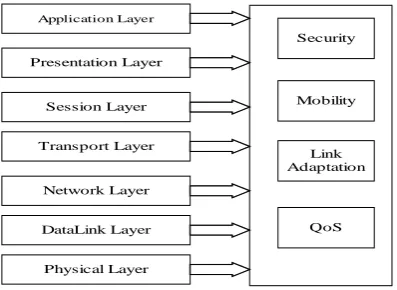
ROSS LAYER MODELS AND ITS ENTITIES As we know that cross layer design model facilitates the decomposition of system functions in to the modular components. It makes the communication possible between non adjacent layers by introducing new entities in to system architecture. No reference model has been described so far that specifies the functionality of each new entity in a cross layer design. To overcome this, [2] has proposed a model through which each of the cross layer design entity must provide some additional functionality. Four different coordination planes are introduced by this model that can work across the layers of the OSI reference model. Various problems in wireless networks include mobility, security, quality of services (QoS) and wireless link adaptation, thus resulting to the four coordination planes.•
Mobility Coordination Plane
Mobility basically means the movement of wireless devices from one area to other area with the help of handoffs and handovers. There are exactly two types of handover: one is horizontal and other is vertical handover. In horizontal handover, mobile devices moves between the access point of the same technology whereas in vertical handover, mobile devices moves between the access point of different technologies. Hence, upper layers would mitigate the effect of both the handovers with the help of mobility coordination planes.
•
Security Coordination Plane
Various encryption protocols and technologies are introduced in this plane across various different layers. Various encryption protocols at different layers are: Secure socket layer (SSL) provide encryption between the transport and application layer, IPSec (internet protocol security encapsulates)provide encryption at the network layer, WEP and Wi-Fi are used for encryption at the MAC layer. If each layer of the OSI model carries out encryption of its own, this results in unnecessary encryption duplication, thus consuming more energy, wasting useful resources and decreasing the network performance. Hence, cross layer design provide the Solution of these problems and determine which protocol layer will perform the encryption.
•
QoS Coordination Plane
various quality of service (QoS) solutions are provided at different layers such as RTP receiving quality of service information at the application layer, various services architecture such as integrated services(IntServ) and differentiated services(DiffServ) may provide support for IP QoS. These solutions are developed according to OSI reference model but do not provide support to cross layer design and QoS requirements are not provided to the different layers in the protocol stack. The information about the protocol is being transferred from the physical layer to the application layer and to use the protocol with improved QoS. Thus, the exchange of QoS information between the non adjacent layers needs a cross layer design. Hence, QoS coordination plane must provide efficient and effective communication across the different layers.
•
Link Adaptation Coordination Plane
In this plane, we basically focuses on various effects to the wireless link that is channel fading, limited bandwidth, signal to noise ratio(SNR),bit error rate(BER) and various transmission delays..
Application Layer
Network Layer Transport Layer
Session Layer Presentation Layer
Physical Layer DataLink Layer
Security
Mobility
Link Adaptation
[image:2.595.310.509.501.646.2]QoS
Fig. 1 Coordination Model between the Layers
These functionalities usually affect the performance of upper layers such as application layer and network layer where the packet loss occurs. Hence, cross layer design solutions are provided in order to know the actual cause of packet losses Hence, cross layer design is basically the management of “how the interaction is being carried out at various layers of OSI model in order to achieve better performance gains. Now, further various management entities are introduced in order to maximize the performance gains.
A. Internal Entities
Cross layer design classify the internal entities in to two basic forms interlayer as well as interlayer. On the basis of internal interlayer management entities, work has been carried out by the cross layer manager and optimize.
a) Interlayer management entities carried out by manager: The main aim of interlayer management entities carried out by the cross layer manager is to manage the whole protocol stack.
Drawbacks: It causes the negligible overhead which can be ignored.
b) Interlayer management entities carried out by optimizer: the main aim of the cross layer optimizer is to optimize the N layers of a given OSI model in comparison to application oriented function.
Drawbacks: It results in an external overhead when information of cross layer is passed from one terminal to other terminal in a network.
c) Intra-layer management entities carried out by optimizer: Each and every layer in a cross layer design has there protocol optimizer which can use flowchart to optimize the performance parameters at different layers.
Drawbacks: It results in an internal overhead which is caused by the extensive calling of each layer optimizer.
d) Intra-layer management entities carried out by scheduler: The main aim of the scheduler is to improve the throughput performance of a given system which further enhances the QoS.
B. External entities
Cross layer design classify the external entities in to three basic types: external radio scheduler, external centralized cross layer optimizer and external distributed cross layer optimizer.
a) Cross layer scheduler: various scheduling algorithms are used to identify the priority of radio transmission on the basis of channel state and its changes or variation in the channel
Drawbacks: Due to signaling external overhead occurs, which can be avoided by providing fast power information in the base stations.
b) Centralized optimizer: The main aim of the external centralized cross layer optimizer is that the mobile station can send to the base station the maximum delay which can be tolerated, size of the batch as well as the batch class.
Drawbacks: In this, overhead that occurs due to the exchange of information between the various terminals is very low and can be easily neglected. Hence, mobile station state is the important issue and can be obtained very carefully.
c) Decentralized optimizer: the main aim of decentralized optimizer is to first schedule the M links in the layered model which can satisfy various interference constraints proposed by the network distributed model.
Drawbacks: As in distributed network model, the size of the network and topology used is not defined which results in providing various signaling overhead.
IV
V
ARIOUS CROSS LAYER DESIGN PROPOSALS As we know that there are various cross layer designs proposals defined in the literature. The authors in [3] have presented the survey on various cross layer design proposals in the literature based on the layers that are coupled. Hence, we are very much interested in howthe layers are coupled in cross layer design proposals. Violation of layered protocol architecture can be done in following ways:
• By creating new interfaces in which the information flow take place in upward direction, downward direction and back and forth direction.
• How the non adjacent and adjacent layers are merge together in order to provide efficient communication. • How coupling can be designed without creating new
interfaces.
• How vertical calibration across the layers is carried out.
Creation of new interfaces in Cross Layer design:
Basically, new interfaces are created in a cross layer design in order to exchange information between the layers at the execution time. Hence, the violation of layered protocol architecture is done by creating new interfaces. This category is further been classified in to various subcategories of information flow:
A. Interface creation along upward direction:
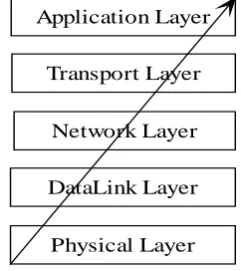
A new interface is created in an upward direction (that is from lower layer to the upper layer) when higher layer protocol requires some information from the lower layer protocol at the execution time. For example, the explicit congestion notification (ECN) from the router to the transport layer at the TCP sender can explicitly tell the TCP sender if there is congestion in the network to enable it to differentiate between errors on the wireless link and network congestion [4].The similar example is in the form of the MAC layer in which the channel adaptation and link adaptation schemes are used.
B. Interface Creation along downward direction: A new interface is created in a downward direction (that is from higher layer to the lower layer) when lower layer protocol requires some information from the higher layer protocol at the execution time. Some of the cross layer design proposals focus on setting the parameters at the lower layer by using the direct interface with the upper layer. As an example, applications can inform the link layer about their delay requirements, and the link layer can then treat packets from delay-sensitive applications with priority [5].
Application Layer
Physical Layer DataLink Layer Network Layer Transport Layer
Upward Information Flow Downward
Information Flow
Fig 2 Downward and Upward information flow
A good way to look at the upward and downward information flow is to treat them as notifications and hints, respectively, as proposed in [6].hence, upward information flow is used to send the information from the lower layer to the upper layer and downward information flow is used to send the information from upper layer to the lower layer.
C. Merging of adjacent layers in cross layer design:
super layer but only the collaborative study regarding the PHY and MAC layer is considered while merging of the adjacent layers.
Applic ation Layer
[image:4.595.363.484.62.198.2]Physic al Layer DataLink Layer Netw ork Layer Transport Layer
Fig 4 Addition of Adjacent layers
D. Coupling design without the creation of new interfaces in a cross layer design:
Another way of cross layer design is to couple two or more layers at the run time without creating new interfaces in order to exchange the information. As, the new interfaces are not created it is not possible to replace one layer without making possible changes in another layer.
Application Layer
Physical Layer
DataLink Layer
Network Layer
Transport Layer
Designed
Layer
Fixed
Layer
Fig 5 Coupling Design without creating new Interface
For instance, [8] considers the design of a MAC layer for the uplink of a wireless LAN when the PHY is capable of providing multi-packet reception capability. Multi-packet reception capability implies that the PHY is capable of receiving more than one packet at the same time. Hence, the capability of physical layer changes the role of the MAC layer.
E. Vertical calibration in cross layer design:
With the help of vertical calibration, we can use different parameters across different layers. Moreover, performance seen at the upper layer is due to the calibrative effect of various parameters at the lower layers. Therefore, we come to know that the joint working of various parameters at the cross layer have better performance than the individual working of parameters. As an example, [9] presents an example of vertical calibration where the delay requirement dictates the persistence of link-layer automatic repeat request (ARQ), which in turn becomes an input for deciding the rate selection through a channel-adaptive modulation scheme.
Application Layer
Physical Layer
DataLink Layer
Network Layer
Transport Layer
Fig 6 Vertical Collaboration of Layers
Vertical calibration can be done in a static as well as dynamic manner. Static vertical calibration can be done by setting parameters across the layers at the design time by keeping some optimization methods in reserve. It basically works at the design time. Whereas, Dynamic vertical calibration is done at the run time and works with the entire protocol stack to provide variations in the network, channel and the traffic conditions. The parameters of the static vertical calibration are adjusted once at the design time and then these parameters are left untouched. Whereas, parameters of dynamic vertical calibration can be optimized from different layers.
V
I
MPLEMENTATIONS OF CROSS LAYER DESIGN PROPOSALSThe cross layer design proposals which have been discussed earlier are implemented in the following ways:
A. Communication between the layers is direct in cross layer design: In this, the layers can exchange the information in a straightforward manner in order to provide effective communication between the layers. This is done and application only during the run time. It is very much suitable for the dynamic vertical calibration as well as it also depend on creating new interfaces and design coupling. As the name suggests the direct communication between the layers means that parameters of one layer is visible to the parameters of other layer.
Applic ation Layer
Phys ical Layer DataLink Layer Network Layer T ransport Layer
Fig 7 Communication is Direct between the layers There are various scenarios in which the layers can communicate with each other i.e. protocol headers are used to perform information exchange between different layers. Extra information at inter layer can be treated as internal packets. The work in [10] presents a comparative study of several such proposals and goes on to present another such proposal, cross-layer signaling shortcuts (CLASS) which allow direct communication between the layers.
the various other layers. It is very much suited for the static vertical calibration as well as dynamic vertical calibration across the layers. As well as, new interfaces are also provided between the layers in a shared database. The main challenge of the cross layer design is to design coupling without creatingnew interfaces and to provide the merging of the adjacent layers.
Applic a tion La ye r
P hys ic al L ayer DataL ink La yer Netw ork La yer T ra ns port La yer
Sha red Inform ation
Fig 8 Shared Information Design between the Layers
C. New abstractions in across layer design: Another way to implement the cross layer design proposals is to develop new abstractions. Consider, for example, the proposal in [11], which presents a new way to organize the protocols: in heaps, not in stacks as done by layering. Whenever, the rich interactions between the layers occurs it results in developing of new abstractions.
VI
C
ROSS LAYER DESIGN SOLUTIONS OVER WIRELESS NETWORKSThe various cross layer design solution over wireless network are as follows:
A. Improving the performance of TCP over wireless networks: In this, the interactions are being carried out between the data link layer, network layer and transport layer. Here, new interfaces and merging of adjacent layers is done. It involves various notification mechanisms. This provides the indication about the congestion and errors in the channel of the wireless networks. The exploitation of various parameters such as network congestion, channel errors, channel conditions and channel size from the PHY and MAC layer is useful for improving the performance of the TCP.
B. Increased working capacity of the served users: It basically provides interactions between the PHY and MAC Layer. In a cross layer design, the use of multi-user diversity and the power control mechanism increases the ratio of the number of served users. Capacity of the users is increased by the coupling design of AMC at the physical layer and HARQ at the data link layer. It can also be increased by the coupling of SNR at physical layer to that of CNR at the data link layer.
C. Adaptation and optimizations at the application layer:
In this. The interactions are being carried out between the application and physical layer. Better synchronization of the message is done at both the layers. Involvement of data link layer and network layer is also possible. Parametric signal to noise ratio (PSNR) calculates the application oriented approach which further can be used to provide the cross layer optimization. Here, PSNR is used for the application layer. A lower layer provides the various functionality of multi-user diversity, power control mechanisms and the channel size, errors etc. For optimizing the performance of the cross layer design, statistical based estimations technique at the data link layer are used.
Open technical challenges faced by the users in the future of cross layer design:
A. Interface standardizations: As we know that the cross layer design solutions must provide functionality to its layers only. In order to provide functionality between the different non adjacent layers it requires an interface. Standardizations of interfaces have provided various cross layer design solutions for the further developed wireless networks. One of the technical challenge is the standardization of various cross layer entities in order to achieve optimal performance in a wireless networks.
B. Cross layer design co-existence: It is necessary to answer a question how and why various cross layer design proposals can co-exist with one another. For example, data Link layer in the protocol stack make adjustment in their data rate by seeing various fluctuations in the channel. Co-existence of different layers in cross layer design proposals needs further innovation. Let us say in a cross layer design, physical and data link layer are used to improve the performance metrics of a particular scheme. If it is developed first, then the other cross layer scheme which uses physical and data link layer focus on the coupling mechanisms and are deployed later.
C. Coupling of the cross layer: As we know that there are large number of cross layer design proposals in the literature and we are not clear about which one is beneficial and which one is not. For this, we have to make various analyses on the basis of complexity and performance improvement. Cross layer design is needed between the network and MAC layer for the mobile ad-hoc network as the functionalities of two layers interact with each other [12], by creating new interfaces at the transport layer to improve end to end performance [4], making uses of the channel resources and improve various MAC layer parameters such as energy, delay, bandwidth and security issues [12].
D. Physical layer role in the cross layer design: Physical layer plays an important role in wireless network by sending and receiving packets from lower layer to the upper layer. Signal processing advancement in the physical layer play an important role at wireless network. Processing of the signal may include various functions such as channel scheduling and carrier allocation. Now the question arises how much role the physical layer play. Firstly, OSI model does not provide too much role for the physical layer and then, physical layer make changes with the changes of the other layers. For the future researches, advanced signal processing at the physical layer is the inte13resting topic.
E. Cross layer design invocation: As we know that the network conditions in a wireless network is spatial and time variant. In such case, cross Layer design is used to make the network equivalent to impedance matching [13]. This is done to make the protocol stack enable to adapt to the network conditions easily. Two challenges are to be faced for achieving the optimal performance: firstly, users have to establish those network conditions under which the cross layer design provide the optimal performance. Timely and accurate mechanisms are built to identify the state of the network in protocol stack as well as the various overhead are taken in to the consideration.
networks. The answer to this is that the lots of work have been carried for inherently broadcasting of wireless medium. For example, exploiting the broadcast nature of the wireless medium can allow transmission schemes that rely on cooperation between the communication nodes (e.g., [13]).
VII
CONCLUSION
In this paper, we have discussed all the activities which are provided by various researchers in the literature of cross layer design. After discussing the definition of a cross layer design, we have discussed the models and various entities of cross layer design. Then, we have discussed various cross layer design proposals and methods used to implement these cross layer design proposals. After that we have discussed various cross layer design solutions in a wireless network. Next, we point out various open technical challenges that will be faced by the cross layer design in the future of research. Various modalities of communication are also being discussed in wireless network in which the designers can easily be trapped. Nowadays, the several researches are being made which provide efforts for the cross layer design solution in wireless network to provide resources to mobile devices, scheduling of resources is done in such a way it require high throughput and low delay as well as achieve better quality of services for multimedia applications. All in all, we have gathered all the results and ideas about the cross layer design in to particular structure as well as the platform is provided for various researchers who can make future researches in wireless network.
VIII
R
EFERENCES[1] V. Kawadia and P. R. Kumar, “A Cautionary Perspective on Cross Layer Design,” IEEE Wireless Commun., vol. 12, no. 1, Feb. 2005, pp. 3–11.
[2] G. Carneiro, J. Ruela, and M. Ricardo, “Cross-Layer Design in 4G Wireless Terminals,” IEEE Wireless Commun., vol. 11, no. 2, Apr. 2004, pp. 7–13.
[3] V. T. Raisinghani and S. Iyer, “Cross-Layer Design Optimizations in Wireless Protocol Stacks,” Comp. Commun., vol. 27, 2004, pp. 720–24.
[4] S. Shakkottai, T. S. Rappaport, and P. C. Karlsson, “Cross-Layer Design for Wireless Networks,” IEEE Commun. Mag., vol. 41, no. 10, Oct. 2003, pp. 74–80.
[5] G. Xylomenos and G. C. Polyzos, “Quality of Service Support over Multi-service Wireless Internet Links,” Comp. Net., vol. 37, no. 5, 2001, pp. 601–15.
[6] L. Larzon, U. Bodin, and O. Schelen, “Hints and Notifications,”
Proc. IEEE Wireless Commun. and Net. Conf., Orlando, FL, Mar. 2002.
[7] G. Dimic, N. D. Sidiropoulos, and R. Zhang, “Medium Access Control — Physical Cross-Layer Design,” IEEE Sig. Proc., vol. 21, no. 5, Sept. 2004, pp. 40–50.
[8] L. Tong, V. Naware, and P. Venkitasubramaniam, “Signal Processing in Random Access,” IEEE Sig. Proc., vol. 21, no. 5, Sept. 2004, pp. 29–39.
[9] Q. Liu, S. Zhou, and G. B. Giannakis, “Cross-Layer Combining of Adaptive Modulation and Coding with Truncated ARQ Over Wireless Links,” IEEE Trans. WirelessCommun., vol. 3, no. 5, Sept. 2004, pp. 1746–55.
[10] Q. Wang and M. A. Abu-Rgheff, “Cross-Layer Signalling for
Next-Generation Wireless Systems,” Proc. IEEE Wireless Commun. and Net. Conf., New Orleans, LA, Mar. 2003.
[11] R. Braden, T. Faber, and M. Handley, “From Protocol Stack to
Protocol Heap — Role-Based Architecture,” Proc. Hot Topics in Net., Princeton, NJ, Mar. 2002.
[12] C. Barrett et al., “Characterizing the Interaction Between
Routing and MAC Protocols in Ad-Hoc Networks,” Proc. ACM Annual Int’l. Symp. Mobile Ad HocNet. and Comp., Lausanne, Switzerland, June 2002.
[13] B. Zhao and M. C. Valenti, “Practical Relay Networks: A
Generalization of Hybrid-ARQ,” IEEE JSAC, vol. 23, no. 1, Jan. 2005, pp. 7–18.
About the Authors
Prabaht Singh graduated from Priyadarshini College of Computer Sciences, greater noida, Uttar Pradesh in Computer Science & Engineering in 2010. He is pursuing M.Tech in the department of Computer Science & Engineering, Kamla Nehru Institute of Technology, Sultanpur (Uttar Pradesh).
Email:[email protected]
Vinay Kumar graduated from Shree Ganpati Institute of Technology, Ghaziabad, Uttar Pradesh in Computer Science & Engineering in 2010. He is pursuing M.Tech in the department of Computer Science & Engineering, Kamla Nehru Institute of Technology, Sultanpur (Uttar Pradesh).
Email:[email protected]
Akhilesh Kumar graduated from Mahatma Ghandhi Mission’s college of Engg. and technology, Noida, Uttar Pradesh in Computer Science & Engineering in 2010. He is pursuing M.Tech in the department of Computer Science & Engineering, Kamla Nehru Institute of Technology, Sultanpur (Uttar Pradesh).
Email:[email protected]
Awadhesh Kumar graduated from Govind Ballabh Pant Engineering college, Pauri (Garhwal) in Computer Science & Engineering in 1999. He obtained his Master degree (M.Tech.) in Computer Science from Uttar Pradesh Technical University, Lucknow in 2006. He joined the department of Computer Science & Engineering at Kamla Nehru Institute of Technology, Sultanpur (Uttar Pradesh) as Lecturer in 2000 and Assistant Professor in 2007. His teaching and research interests include Computer Networks, Wireless Networks and Mobile Ad-Hoc Networks. He is pursuing PhD in the department of Computer Science & Engineering, MNNIT, Allahabad (Uttar Pradesh) in the area of Mobile Ad-hoc Networks.