University of Windsor University of Windsor
Scholarship at UWindsor
Scholarship at UWindsor
Electronic Theses and Dissertations Theses, Dissertations, and Major Papers
1-1-2006
Efficient combinator parsing for natural-language.
Efficient combinator parsing for natural-language.
Rahmatullah Hafiz University of Windsor
Follow this and additional works at: https://scholar.uwindsor.ca/etd
Recommended Citation Recommended Citation
Hafiz, Rahmatullah, "Efficient combinator parsing for natural-language." (2006). Electronic Theses and Dissertations. 7137.
https://scholar.uwindsor.ca/etd/7137
Efficient Combinator Parsing for Natural-Language
by
Rahmatullah Hafiz
A Thesis
Submitted to the Faculty o f Graduate Studies and Research through Computer Science
in Partial Fulfillment o f the Requirements for the Degree of Master o f Computer Science at the
University o f Windsor
Windsor, Ontario, Canada
2006
1*1
Library and
Archives Canada
Published Heritage
Branch
3 9 5 W ellingt on S tr e e t Ottaw a ON K 1 A 0 N 4 C a n a d a
Bibliotheque et
Archives Canada
Direction du
Patrimoine de I'edition
3 9 5 , rue Wellington O ttaw a ON K 1 A 0 N 4 C a n a d a
Your file Votre reference ISBN: 978-0-494-42328-8 Our file Notre reference ISBN: 978-0-494-42328-8
NOTICE:
The author has granted a non
exclusive license allowing Library
and Archives Canada to reproduce,
publish, archive, preserve, conserve,
communicate to the public by
telecommunication or on the Internet,
loan, distribute and sell theses
worldwide, for commercial or non
commercial purposes, in microform,
paper, electronic and/or any other
formats.
AVIS:
L'auteur a accorde une licence non exclusive
permettant a la Bibliotheque et Archives
Canada de reproduire, publier, archiver,
sauvegarder, conserver, transmettre au public
par telecommunication ou par Nntemet, preter,
distribuer et vendre des theses partout dans
le monde, a des fins commerciales ou autres,
sur support microforme, papier, electronique
et/ou autres formats.
The author retains copyright
ownership and moral rights in
this thesis. Neither the thesis
nor substantial extracts from it
may be printed or otherwise
reproduced without the author's
permission.
L'auteur conserve la propriete du droit d'auteur
et des droits moraux qui protege cette these.
Ni la these ni des extraits substantiels de
celle-ci ne doivent etre imprimes ou autrement
reproduits sans son autorisation.
In compliance with the Canadian
Privacy Act some supporting
forms may have been removed
from this thesis.
While these forms may be included
in the document page count,
Conformement a la loi canadienne
sur la protection de la vie privee,
quelques formulaires secondaires
ont ete enleves de cette these.
ABSTRACT
ACKNOWLEDGEMENT
I would like to express my gratefulness to my advisor Dr. Richard Alan Frost for his motivational and insightful suggestions, and patience. Dr. Frost’s enthusiasm as a mentor and dedication as a researcher vastly inspired me to keep myself focused during my graduate studies.
I would like to thank Dr. Paul Callaghan of the University of Durham for his important remarks. I also wish to show my appreciation to my thesis committee members Dr. Jianguo Lu, Dr. Richard J. Caron and Dr. Scott Goodwin for their valuable comments regarding my thesis report and defense.
TABLE OF CONTENTS
ABSTRACT
ACKNOWLEDGEMENT LIST OF FIGURES LIST OF TABLES
CHAPTER 1. PREFACE
1.1 Introduction
1.2 Structure of the Thesis Report 1.3 Contribution by the Candidate
2. INTRODUCTION
2.1 Grammars and top-down Parsing 2.2 Natural-language Parsing
2.2.1 Ambiguity 2.2.2 Left-Recursion 2.3 The Problem
2.4 Thesis Statement 2.4.1 The Statement
2.4.2 Why This Thesis is Important 2.4.3 Why it is Not Obvious
2.4.4 How the Thesis will be Proven 2.5 Brief Description o f the Solution
3. LAZY FUNCTIONAL PROGRAMMING
3.1 Introduction to Lazy Functional Languages 3.2 Elements o f Lazy Functional-Programming 3.3 Haskell -A Purely-functional Language
4. COMBINATORY PARSING
4.1 General Concept
4.1.1 Example o f a Simple Parser-Combinator 4.2 Use o f Monads for Combinatory-Parsing
4.2.1 Monads to Structure Program 4.2.1.1 Definition o f Monad
4.2.1.2 Example o f Monadic Computation 4.2.1.3 Monads in Haskell
4.2.2 Monadic Parser-Combinators 4.3 Shortcomings o f Combinatory-Parsing 4.3.1 Exponential Time-complexity 4.3.2 Non-Termination for Left-Recursion
5. RELATED PREVIOUS WORKS 32
5.1 Use o f memoization and monads to
accommodate ambiguity in polynomial time 32 5.1.1 Basic Concept of Memoization 32 5.1.2 Frost and Szydlowski
-Memoized Language-processors 34 5.1.3 Frost- State-Monadic Language-processors 3 7 5.2 Approaches to Accommodate Left-recursion 39
6. THE NEW ALGORITHM -FOR RECOGNITION 40
6.1 Basic Definitions 40
6.2 Overview o f Basic Recognition 42
6.3 Accommodating Direct Left-Recursion 45 6.3.1 Condition for Curtailment 45 6.3.2 Modified Memoization for Direct Left-recursion 48 6.4 Accommodating Indirect Left-Recursion 50
6.4.1 The Problem 50
6.4.2 Context-Based Re-use, Modified Combinators
and Memoization 52
6.4.2.1 Generating and Passing ‘Reason for Curtailment’
and ‘Current-context’ 52
6.4.2.2 Storing the Result with
‘Left-rec-context’ During ‘Update’ 54 6.4.2.3. Condition for Re-using the
Saved Result During ‘Lookup’ 5 5
6.4.3 Results in Memo-table 56
7. THE NEW ALGORITHM -FOR PARSING 58
7.1 Overview 58
7.2 Concepts o f Compact-representation 59
7.3 The Modified Algorithm 62
7.3.1 Type o f Result and Memo-table 62
7.3.2. Modified Combinators 62
7.3.3. Modified Memoization 64
7.4 Memo-table as a Forest of n-ary Branches 66
8. IMPLEMENTATION IN HASKELL 68
8.1 Data-types and State-monadic Combinators 68 8.2 Forming ‘name-less’ n-ary branches for Parsers in Sequence 70 8.3 Lookup, Update and Computing New-result using Memoization 71
8.3.1 Lookup Operation 72
8.3.2 Update Operation 74
9. TERMINATION ANALYSIS 77
9.1 Basic Concept 77
9.2 Cases for Combinatory-Parsers’ Termination 78
9.3 Proof o f Termination 79
10. COMPLEXITY ANALYSIS 84
10.1 Time Complexity o f Recognition - w.r.t the length o f input 84 10.2 Time Complexity o f Parsing - w.r.t the length o f input 88 10.3 Space Complexity - w.r.t the length o f input 91
11. EXPERIMENTAL RESULTS 93
12. CONCLUSION 96
APPENDIX: EXPERIMENTAL OUTPUT OF
COMPACT REPRESENTATION 97
REFERENCES 102
VITA AUCTORIS 104
LIST OF FIGURES
Figure 2.1: An ambiguous grammar and some possible parses 7 Figure 2.2: Elimination of left-recursion and possible problem 8 Figure 4.1: A combinatory-parser representation o f a CFG for NL 23
Figure 4.2: Simple monadic-combinators 29
F igure 5.1: Memoized computation o f F ibonacci 3 3 Figure 6.1: ‘Condition for curtailment’ for left-recursive recognition 49 Figure 6.2: Faulty ‘out-of-context’ lookup 50 Figure 6.3 : Restricted re-use o f result when recognizer is ‘out-of-context’ 56 Figure 6.4: Memo-table represents results o f recognition using G_2 57 Figure 7.1: Basic idea of constructing a parse-tree 59 Figure 7.2: Example o f a densely-compact representation 61 Figure 7.3: Memo-table represents results o f parsing as a packed-forest 67 Figure 11.1: Time vs. length-of-input plot for memoized parsers 95
LIST OF TABLES
Table 2.1: Four types o f grammars, where type 0 idtype 1 idtype 2 idtype 3 3
CHAPTER 1: PREFACE
1.1 Introduction
Although the elegant top-down parsing method closely resembles a Natural Language Processing strategy, it has some short comings which make it less appealing for various NLP-related tasks. A naive implementation may require exponential time and space and do not provide any support for ambiguous left-recursion (note that converting left- recursive grammar to non-left recursive form may cause missing parses). Modularity of implementation is required so that individual components o f a language-processor can be tested separately and semantic-rules can be integrated naturally. As natural-language is ambiguous, it is important to ensure that the language-processor is able to process ambiguous left-recursive grammars in order to have the proper right-most and left-most derivations, which is essential to retrieve all possible semantic meanings. Also the computation-time needs to be reasonable, and the exponential number o f parse-trees should be represented within polynomial space. Many attempts have been made to accomplish the above requirements but none has been able to accommodate all o f them within one algorithm.
In this thesis we develop a general top-down combinator-parsing algorithm that accommodates ambiguous and left-recursive grammars, whilst maintaining polynomial time-complexity, compact (polynomial) representation o f exponential number o f parse trees and modularity o f the implementation. We implement the algorithm in a lazy functional language, Haskell, have analyzed it theoretically and have tested it with highly ambiguous grammars to support the theoretical claims.
1.2 Structure of the Thesis Report
complexity of the algorithm respectively. Chapter 11 presents some experimental results, which support the analytic results o f chapter 10. Chapter 12 concludes the report and the appendix contains some example-output (densely packed parse-forests).
1.3 Contribution by the Candidate
In conducting the work described in this thesis-report, the candidate worked closely with Dr. Frost, his supervisor, and he also collaborated with Dr. Callaghan o f the University of Durham.
CHAPTER 2: INTRODUCTION
2.1 Grammars and Top-Down Parsing
A ‘language’ is a set o f finite-length sequences or strings, constructed over a finite-set o f entities known as alphabet. Any formal or natural-language can be specified or defined with a finite-size specification (or generator) - formally known as ‘grammar’. A formal grammar G is a 4-tuple (N, Z, P, S) where:
■ N is a finite-set o f non-terminals
■ Z is a finite-set o f terminals (or alphabet - over which a language is defined)
■ P is a finite-set o f production-rules
■ S is a distinguished symbol (known as startsymbol) ■ N n Z = 0, S e N and
(Vpi eP) ( p i e (N u Z) * N (N u Z) * x (N u Z)*)
The language L (G), which is defined by G, is a set o f ‘strings’ that consist only o f the terminals from Z and that can be derived starting from S and applying 3 p i until no non terminal is present. This formal-grammar framework is the most expressive way to specify a language. According to Chomsky (1956, [4]), this general framework o f formal orphrase-structure grammar can be divided into four ‘types’:
G ram m ar Properties
Types
Type 0- ■ Rules don’t have restrictions (in terms o f number of symbols) on left Unrestricted and right side o f the productions.
■ Its most ‘unrestricted’ nature makes it less useful to linguists. Type 1 - ■ Rules are o f form aA p ->• a%P where A e N,
Context- a & p e (N u Z) * and % e (N u Z ) +.
Sensitive ■ The derivation A —> % is determined by the “context” o f a & p. Type 2 - ■ Rules are o f form A -»■ a where A e N , a e (N u Z)*. Context-Free ■ Simple and ‘powerful’ enough to define most of the languages. Type 3 - ■ Rules are o f form A - > a B orA -> a where A & B e N and Regular a, e Z .
Out o f the four types, the Context-Free Grammar (CFG)1, typically expressed in Backus-Naur Form (BNF), is the most important type in terms o f application to various languages. The languages that can be specified by CFGs are known as Context-Free Languages. CFGs are considered as ‘standard sets o f rules’ for syntax-analysis or
parsing, which is a technique to determine whether a given input sequence’s
grammatical structure can be recognized and identified by the given CFG. The most natural form of parsing is Top-Down Parsing, which is a method o f attempting to find the ‘left-most derivation’ o f a given input sequence. The ‘attempt’ starts from the root- symbol S and keeps expanding from the left-most position o f S ’s definition. The recursive-decent fully backtracking parsing is the most general form o f top-down parsing, where rules are implemented as ‘mutually-recursive’ procedures and if an alternative o f a rule ‘fails’ or ‘ends’, the parser backtracks to try another rule. Top-down parsers are easy to construct and understand, compared to their bottom-up counter-parts.
An Example
In order to specify or generate a language L (G_1) = {0, 1 , 0 0 , 0 1 , 1 0 , 1 1 , 0 0 0 , 0 0 1 , 0 1 0 , 100}, w e may use the following CFG G_l :
G _ 1 =
( N = { B_ E, D} , 2 = { 0 , 1 },
P =
j B_E : : = D | D B_E | s [ D : : = 0 | 1
S = B_E ) (B_E = Binary Expression, D = Digit)
While determining the syntax-structure o f an input “00 1 ” using top-down parsing technique with G _ l, a parser executes the start-symbol or the root rule B_E, which has
three alternatives. Each o f the alternatives is individually (in a sequence from left)
applied on the original-input. I f the alternatives have non-terminals, then they are
1 In this report, we represent a production-rule o f a CFG as
Non-terminal ::= ... Non-terminal' .... t e r m in a l... I.. Non-terminal'' . . . . t e r m i n a l ' . . . Where means the starting of a rule-definition, '|' separates
expanded again recursively and their definitions (which may consist o f different
alternatives) are applied to the remaining input-sequence (if some left-most tokens were previously consumed). The process ends if there are no more input-tokens left for processing. For example:
1. B E is expanded to its first alternative B E : : = D and then D is expanded to its two alternatives D: : = 0 and D: : = 1. The second alternative o f D is a ‘failure’ as it derives to ‘1 ’ whereas the input sequence starts with ‘O’.
other non-terminals left for expanding, it is a valid parse.
2. When the previous phase is done, B_E ‘backtracks’ to try its second alternative B_E : : = D B_E, then D’s two alternatives are applied on “0 0 1 ” (as we know, only the first one succeeds and recognizes “0”) and the rest o f the input “0 1 ” is processed by the non-terminal B E (which is a part o f root B E’s recursive definition). In a similar way, B_E is expanded again to its three alternatives and eventually returns a successful parse- tree and also reports all failed attempts:
B E B E
Success Failure
The first alternative finds a match for the leftmost position o f “ 001” and as there are no
B E B E B E
1
Success
8
Failure
0
Failure
3. When the above phase is done, the first application o f B E ‘backtracks’ to try its third alternative B _ E: : = s , which always succeeds:
B E
£
Success
In terms o f functional-programming, combinators or higher-order functions are ideally-suited for constructing top-down recursive-descent (with backtracking) parsers. The combinators are ‘operators’ which are used to construct basic parsers from terminals, and compound parsers from simpler parsers. Before examining any input-token, a combinator-parser tries to execute a ‘rule’ - an executable-specification, to identify the token. If this attempt fails, the parser recursively tries another rule and so on. Language- processors, constructed using this parsing-technique, are able to provide many advantages such as:
1. They are easy to implement in most o f the programming languages that support ‘recursion’.
2. Associating semantic rules for recursive syntax-rules is straightforward (Frost [8]). 3. They are highly modular (Koskomies [22]), re-useable and each components can be
tested individually.
4. The structure o f the code is closely related to the structure of the grammar of the language to be processed and can be implemented as executable-specifications of grammars, as shown by Frost and Launchbury (1989, [13]). Definite Clause Grammars (DCGs) o f logic-programming can also be used to achieve this.
2.2 Natural-Language Parsing
2.2.1 Ambiguity
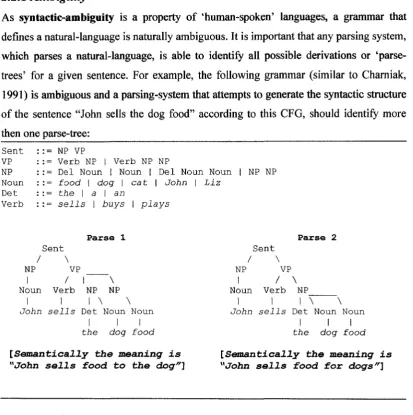
As syntactic-ambiguity is a property o f ‘human-spoken’ languages, a grammar that defines a natural-language is naturally ambiguous. It is important that any parsing system, which parses a natural-language, is able to identify all possible derivations or ‘parse- trees’ for a given sentence. For example, the following grammar (similar to Chamiak, 1991) is ambiguous and a parsing-system that attempts to generate the syntactic structure o f the sentence “John sells the dog food” according to this CFG, should identify more then one parse-tree:
Sent ::= NP VP
VP ::= Verb NP | Verb NP NP
NP ::= Del Noun I Noun | Del Noun Noun | NP NP Noun ::= f o o d | d o g I c a t \ J o h n \ L i z
Det ::= t h e | a I a n
Verb ::= s e l l s | b u y s |p l a y s
Parse 1
Sent / \
NP VP
I / I \
Noun Verb NP NP
I I I \ \
J o h n s e l l s Det Noun Noun
I I I
t h e d o g f o o d
[Semantically the meaning is "John sells food to the dog"}
Parse 2
Sent / \
NP VP
I / \
Noun Verb NP_____
] I I \ \
J o h n s e l l s Det Noun Noun
I I I
t h e d o g f o o d
[Semantically the meeming is "John sells food for dogs"}
Figure 2.1: An ambiguous gram m ar and some possible parses
2.2.2 Left-Recursion
There are several reasons why it is important for an NL-parsing system to accommodate left-recursive CFGs:
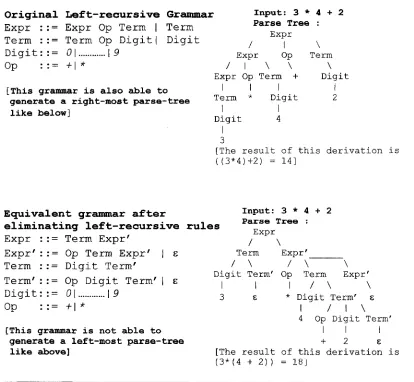
the left-recursion problem o f top-town recursive-descent parsing is ‘eliminating a left- recursive production-rule by converting it into a non-left-recursive one’. The following example demonstrates missing valid-parses and semantic misinterpretations because o f this elimination technique:
Original Left-recursive Grammar Expr
Term Digit Op
= Expr Op Term | Term
= Term Op Digit| Digit
= 0 | ...19
= +1 *
[This grammar is also able to generate a right-most parse-tree like below]
Input: 3 * 4 + 2 Parse Tree :
Expr
/ I \
Expr Op Term
/ I \ \ \
Expr Op Term + Digit
I I I I
Term * Digit 2
I I
Digit 4
[The result of this derivation is ((3*4)+2) = 14]
Equivalent grammar after
eliminating left-recursive rules Expr :
Expr': Term : Term': Digit:
Op :
= Term Expr' = Op Term Expr' = Digit Term' = Op Digit Term'
= 01 I 9 = + \ *
[This grammar is not able to generate a left-most parse-tree like above]
Input: 3 * 4 + 2 Parse Tree :
Expr / \
Term Expr'_____
/ \ / \ Digit Term' Op Term
I I
\ Expr' I / \ \ 3 E * Digit Term' e
I / I \ 4 Op Digit Term'
I I I
+ 2 E
[The result of this derivation is (3*(4 + 2)) = 18]
Figure 2.2: Elimination of left-recursion and possible problem
Left-recursive attrihute-grammar
number ::= digit digit ::= '0'
number.VAL = digit.VAL digit.VAL = 0 ^
| number' digit _ I '1'
number.VAL = (10 * number'.VAL + digit.VAL) digit.VAL = 1
Equivalent non-left recursive attribute-qrammar
number ::= digit
number.VAL = digit.VAL
I digit number'
number.VAL = ?????
3. As mentioned in [11], if left-recursive grammars could be used with top-down parsing, they would provide a better framework for investigating NL theories in order to achieve more efficient natural-language interfaces. For example, to test and investigate compositional Montague-like theories (for processing verb adjuncts such as “When and with what did Hall discover Phobos?”) the parsing-system needs to achieve all possible ambiguous leftmost and rightmost derivations.
2.3 The Problem
To utilize the advantages of a ‘recursive-descent backtracking’ top-down combinatory parser for natural-language parsing (and for other applications involving ambiguity), we require a new algorithm to accommodate ambiguity and left-recursive production rules in polynomial time. Many researchers have tried to address this problem with different approaches, but none o f them completely satisfies the requirements.
It is widely believed 1) that top-down parsers require exponential computational time, 2) that they fall into infinite-loop while processing left-recursive grammars, and 3) that it is not practical to implement a modular top-down parser. However, the following list o f researchers’ work demonstrates that the above problem can be partially addressed:
1. Norvig (1991, [32]) showed that it is possible to achieve polynomial complexity for top-down recognizers by use o f the memoization technique.
3. Leermakers’ [24] claim to solve the problem using a “recursive ascent” functional approach appears to be achieved compromising modularity and clarity o f the code, and is not really a top-down approach.
4. Frost’s [7] “guarded-attribute” approach solves the left-recursive problem, but exhibits exponential time at worst case.
5. Nederhof and Koster’s approach o f “cancellation parsing” [30] to process left- recursive rules is exponential at the worst-case and the resulting code is less clear as it contains additional production rules and code to insert the special tokens.
6. Lickman’s use o f purely functional set-monadic fix-point parser-combinator approach to accommodate left-recursion for recognition is exponential [27].
7. Johnson integrated memoization with continuous-passing style-programming [20] to resolve the problem. It appears that this approach is too complicated for practical use. Also, as pointed by the Johnson, this approach might be too difficult to modify for compact-representation o f resulting parse-trees.
8. Camarao, Figueiredo, and Oliveiro’s [3] monadic compiler-generator may accommodate left-recursion but fails to accommodate ambiguity.
Even though the above approaches partially solve the well-known drawbacks o f top- down parsing, for last 40 years no one has been able to provide full support for all o f the following requirements within a single parsing-system:
1. Complete support for direct and indirect left-recursive grammar. 2. Accommodating ambiguity.
3. Accommodating any form o f CFG (including empty, cyclic, ‘densely’ rules etc). 4. Maintaining at least polynomial time and space complexity at the worst case. 5. Clarity and modularity o f the implementation for efficient practical use.
6. Not only recognition but also working as a complete parser - that is able to represents the resulting parse-trees using least possible space.
2.4 Thesis Statement
2.4.1 The Statement
“Top-down parsing can accommodate ambiguity and left-recursion and can create a compact (polynomial-size) representation o f parse trees in polynomial time at worst case.”
2.4.2 Why This Thesis is Important
Much work has been done and many theories have been proposed to analyze, investigate and compute different aspects and problems related to natural-language semantics. But all o f the existing syntax-analysis systems share some common shortcomings (as mentioned in section 2.3); it is not completely possible to accommodate and easily investigate all semantic-analysis theories within current platforms. The algorithm described in this thesis will allow combinator-parsing to be used with any form of ambiguous left- recursive CFGs whilst maintaining polynomial time and space complexity. Hence, this work will enable the full potential o f existing work on natural-language semantics to be integrated with and investigated within syntactic-analysis, thereby providing a useful environment for natural-language investigation. This work also allows constructing natural-language processors as executable specifications by being highly modular, structured and easily alterable. According to the proposed algorithm, the result of parsing is represented as a densely-compact form, which will help the potential users to retrieve a particular parse-tree by spending less time. Overall, investigating and implementing different theories and aspects o f computational-linguistics will benefit significantly.
2.4.3 Why it is Not Obvious
any left-recursive production rules, top-down parsing is generally considered to exhibit exponential time-complexity in the worst-case - mainly because o f its ‘backtracking’ characteristic. Reviews from literature suggest that it’s been universally assumed in the functional-programming community that combinator-parsing cannot accommodate left- recursion at all - because the left-most ‘parser’ would always keep executing its own definition again and again. Therefore, despite fulfilling some partial requirements (as mentioned in section 2.3), for last 40 years no one has been able to accommodate ambiguity and left-recursion within a complete top-down parsing system in polynomial time.
2.4.4 How the Thesis will be Proven
The following steps have been taken to justify that the proposed algorithm satisfies the thesis-statement:
■ Studying related-works thoroughly to identify whether they have addressed the following all requirements or not:
1. Complete support for direct and indirect left-recursive grammar. 2. Accommodating ambiguity.
3. Accommodating any form o f CFG (including empty, cyclic, ‘densely’ rules etc).
4. Maintaining at least polynomial time and complexity at the worst case.
5. Not only recognition but also working as a complete parser - that is able to represent the resulting parse-trees using least possible space.
6. Maintaining modularity, clarity and flexibility to accommodate different theories and applications for NLP including integrating semantic-rules with syntax-structure correctly.
■ Proposing a new algorithm to fulfill the above requirements.
■ Implementing the algorithm in a lazy-functional language - Haskell. ■ Termination-analysis o f the algorithm.
2.5 Brief Description of the Solution
Frost and Szydlowski [14] proposed a framework to the utilize memoization technique for improving the complexity o f purely-functional parser-combinators. Later, in 2003 [9], Frost showed how recognition o f natural-languages can be achieved in polynomial-time by memoizing parser-combinators in a systematic way using ‘state- monads’. But the basic drawback o f this approach is that it doesn’t ‘terminate’ while processing left- recursive grammars. The proposed algorithm o f this thesis uses memoization in such a way that it can accommodate indirect and direct left-recursive grammars. In order to do so, the new algorithm keeps track o f the depth o f a particular parse and the length o f the input which is currently being processed. Each time a particular parser is being called during recursive-descent while processing a particular input, a ‘counter’ (we call it ‘left- rec-counter’) is incremented by one - indicating the depth of the parser. This parser is ‘curtailed’ when its left-rec-counter exceeds the length o f the remaining input and the process backtracks up the parse-tree to apply another alternative parse, if exists any. When the parser computes a result, it saves it to a ‘memo-table’ along with a reference to the position in current input.
The new algorithm stores the resulting parse-trees in the memo-table as a forest of one-level depth, n-ary branches. Each branch has implicit pointers to determine ‘where to go next’ in its nodes and is shared between ambiguous parses. This densely-compact representation o f resulting parse-trees ensures the cubic space-complexity, even though the total number of parses could be exponential.
CHAPTER 3: LAZY FUNCTIONAL
PROGRAMMING
3.1 Introduction to Lazy Functional Languages
3.2 Elements of Lazy Functional-Programming
Important components and attributes o f LFP are described below briefly:
1. Lambda Calculus
Church invented lambda-calculus in 1930 to demonstrate that it is impossible to find a general algorithm which, for some given first-order statements, decides whether they are universally valid or not. Since then, it has been used for investigating function-definition, function-application, recursion and has influenced the basic implementation-mechanism o f LFP languages. The basic building block o f lambda calculus is computable-function formation (which is obtained by abstracting an expression), and variable substitution. A simple lambda-expression or term is, for example X x. (x 3 + 1) , where Xx abstracts the name-less expression (x 3 + 1) w.r.t. x. We evaluate this L-term by substituting the variable x with a given constant. For example, in (Xx. (x 3 + 1) ) 2 = 2 3 + 1 = 9 the variable x is replaced by the constant 2. A variable x is ‘bound’ if its occurrence in the L-term is preceded by Xx, otherwise x is ‘free’. For example, in the expression
Xx. (x + y) , x is bound and y if free, ^.-calculus is considered as the ‘universal programming language’. As any computable function can be expressed and evaluated using L-calculus, it is the central issue o f the LFP paradigm.
2. Higher-Order Function
A ‘higher-order function’ (FIOF) is a function which can take other function(s) as its input-argument and also can produce some other function(s) as its output. For example, most LFP languages provide a HOF map that receives a function and a list as its input parameter and returns a list by applying the input function to each element o f the input list, for example, map (* 2) [1,2,3] => [2,4,6]. HOFs are ‘first-class object’ o f LFP language. Use o f higher-order functions as infix-operators is the basic for constructing parser-combinators as such use o f functions can mimic the BNF notation of a CFG. For example, a CFG rule 's: := a s | empty' can be interpreted in English as
Using higher-order functions ( 'o r ' and 't h e n ') , parser-combinators1 can be written as:
empty input = [input]
a (x:xs) = if x =='a' then [xs] else []
(p 'or' q ) input = p input ++ q input
(p 'then' q) input = if r == [] then []
else map q r
where r = p input
and used, as for example:
s input = (a 'then' s 'or' empty) input
3. Pattern-matching
Pattern-matching enriches function-definitions’ readability and the structure o f the program a great deal. Standard patterns (such as variables, constants, wildcard-pattem, patterns for tuples, lists, algebraic constructors etc) match against the syntactic-structure o f an argument while maintaining the iazy-evaluation’ attribute. LFP supports another type o f pattern - known as ‘application pattern’ or ‘n+k-pattem’, which matches the semantic-structure o f the arguments instead o f syntactic-structure. As described in [33], a pattern n+k, where k is a constant, matches against an actual function-argument - a, if a
can be considered as the result o f an expression (A,n. n+k) b. If so, then n is bound to b. Clearly, b can be calculated by evaluating the inverse expression (A,n. n - k ) a.
4. Polymorphic Types
LFP languages are ‘strongly-typed’ - which prevents users to use ill-typed values in function application, equipped with ‘statically type-checking’ system - that tries to detect types automatically, checks for type-mismatch and identifies type-errors during compilation. Also, in LFP, functions’ input and output arguments may have ‘polymorphic-type’ - that means these function-definitions are common for any type o f values. This facility makes function-definitions more general and reusable. For example, a simple function ‘tail’ - which is defined to pick the last element o f a list - works on lists of integers, strings etc:
tail [1,2,3] => 3,
tail ["aa","bb","cc"] =3 "cc".
5. Currying
Frege, in 1893, observed that it is sufficient to define any function with a single argument. “Currying” (named after Haskell B. Curry) is a way that converts an n- argument function to a 1-argument function and returns another function (if more arguments are needed). Modem LFP languages use “currying” (and “uncurrying”) as a default method of evaluation (by treating all functions as higher-order functions) and provide abstraction to user through ‘syntactic-sugar’. For example, the function add (of type add :: Int -> Int -» Int) adds two integers. When ‘add 2 3’is executed, first ‘add 2 ’ is evaluated and returns a function (of type Int -» Int). Then this function is applied to 3 and returns 5 as the final result.
6. Lazy-evaluation
Lazy-evaluation delays the computation o f a function until the result is required. This unique feature allows LFP languages to process ‘infinite data-structure’. For example, assume already defined pick_5th function selects 5th element of a list. When this function is applied on an infinite list o f integers, it doesn’t go into non-terminating state but retunes the fifth element from the list. For example, pick_5th [1..] => 5
7. Monads
Monadic-computation is another unique feature o f LFP languages. The underlying idea is derived from categorical-theory. Using monads, a computation could be constructed as sequential block o f computations and the ‘block o f computations’ may be constructed using other sequential block o f computations too. Monads make programs much structural and modular by ensuring sequential execution o f computations. A detailed description of monadic-computation is described in section 4.2.
3.3 Haskell - A Purely-functional Language
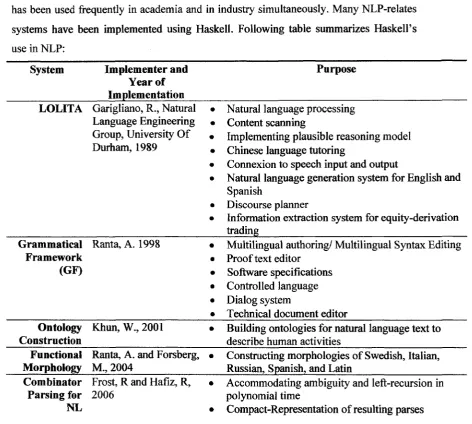
(Peyton-Jones, 2002). In addition to supporting all o f the features mentioned in previous section, it also provides a novel type-system that supports a systematic form of ‘overloading’. Different variations o f Haskell are also introduce such as: GPH, pH (both are parallelizable version o f Haskell), Haskell++, O’Haskell (‘object-oriented’ Haskell), Mondrian (a ‘mixture’ o f Haskell and Java - can be used in .NET platform) etc. Haskell has been used frequently in academia and in industry simultaneously. Many NLP-relates systems have been implemented using Haskell. Following table summarizes Haskell’s use in NLP:
System Implementer and Purpose
Y ear of Implementation
LOLITA Garigliano, R., Natural Natural language processing Language Engineering Content scanning
Group, University O f Implementing plausible reasoning model Durham, 1989 Chinese language tutoring
Connexion to speech input and output
Natural language generation system for English and Spanish
Discourse planner
Information extraction system for equity-derivation trading_____________________________________ G ram matical
Fram ework
Ranta, A. 1998 Multilingual authoring/ Multilingual Syntax Editing Proof text editor
(GF) Software specifications
Controlled language Dialog system
Technical document editor Ontology
Construction
Khun, W., 2001 Building ontologies for natural language text to describe human activities
Functional Morphology
Ranta, A. and Forsberg, M„ 2004
Constructing morphologies o f Swedish, Italian, Russian, Spanish, and Latin
Combinator Parsing for NL
Frost, R and Hafiz, R, 2006
Accommodating ambiguity and left-recursion in polynomial time
Compact-Representation of resulting parses Table 3.1: Use of Haskell for constructing NLP-related systems
CHAPTER 4: COMBINATORY PARSING
4.1 General Concept
Use o f a higher-order function as an infix operator in a function-definition is known as a ‘combinator’. A parsing method, which is constructed using these combinators, is called ‘combinatory-parsing’ (as higher-order functions ‘combine’ different parsers together). A complete language-processor can be constructed by combining small processors with combinators. Though the concept o f combinatory-parsing was introduced by Burge in 1975 [2], it was Wadler (1985, [37]) who first popularized this form o f parsing. Wadler showed that results (success or failure) o f a recognizer can be returned as a list. Multiple entries o f this list represent ambiguous results, whereas an empty list represents a ‘failure’. Most o f time, parsers are generated automatically using tools like Lex and Yacc (for imperative languages) or Happy (for functional language Haskell). One drawback of this approach is the user needs to learn a new language (Lex, Yacc or Happy) to generate a parser. Combinatory parsers are written and used within the same programming language as the rest o f the program. As function application in LFP is juxtaposition, a language-processor written using combinators can represent BNF representation o f any CFG. By nature, a combinatory-parsing system is a top-down, recursive-descent (with full backtracking), which is able to accommodate ambiguity. These parser-combinators are straightforward to construct, ‘readable’, modular, well-structured and easily maintainable and alterable. Semantic-meaning and extra functionalities can be added to the respective production-rules effortlessly. Frost and Launchbury (1989, [13]) showed how to construct Natural-Language Interpreters in Miranda1 using higher-order functions. Based on this work, Frost later constructed an attribute grammar-programming environment - W/AGE (Windsor attribute grammar-programming environment) (2002, [10]). Huttton (1992, [19]) also used parser-combinators to demonstrate a complete parser construction - that addresses parsing problems caused by white-space, special characters etc. Koopman and Plasmeijer (1999, [21]) used continuation to improve the efficiency and performance o f parser-combinators.
The following step-by-step example demonstrates how a CFG can be represented as a language-processor using parser-combinators.
4.1.1 Example o f a Simple Parser-Combinator
A production-rule o f a CFG may have one or more ‘alternatives’ and each alternative may consist of a sequence o f non-terminal(s) and/or terminal(s), or the alternative may consist o f a single non-terminal or terminal or ‘empty’. In order to build a recognizer for a CFG using parser-combinators, we need to construct some basic combinators and use them to ‘glue’ different terminals and non-terminals to form a complete rule. These combinators work as infix operators and non-terminals (and terminal) work as operands to these operators. (Note that in this example we just work with ‘recognizers’ instead of ‘parsers’) Consider a CGF that generates a limited subset of natural-language:
Sentence ::= Noun_Phrase Verb_Phrase
Noun_Phrase ::= Del Noun | Adjective Noun | Del
Noun Verb
= Verb PP NP | Verb I empty
= the | a | an
= universe I planets Isolar-system = earth-like \ finite
= the | a I an
= exist | finds | expands
= in I on
Verb_Phrase Det
Noun Adjective Det
Verb PP
This grammar recognizes a given sentence (or parts o f it) if the sentence’s syntactic- structures match some rules o f the grammar. We denote the ‘sentence’ as a list of strings (or tokens). If some parts o f the sentence (starting from the beginning) have been recognized, then the result o f recognition is the ‘rest of the sentence’. That implies if the whole sentence is recognized successfully, the result is just a list o f an empty string. If the recognition fails, the result is an empty list. If the same input can be recognized in more then one ways, then the result contains multiple entries.
For example, application o f Noun Phrase to ["the", "universe"] and
["the", "milky-way"] results [ [ ] ] (indicating‘success’) and [] (indicating
‘failure’) respectively.
So, the type o f the basic recognizer is:
We define four basic-combinators to construct the complete recognizer-set. 1. The empty recognizer always succeeds and simply returns the input.
empty input = [input]
2. Any terminal is constructed in terms o f combinator - term, which matchers the first token o f the input-sequence with its own token. If a match is found, it returns the rest o f the input-sequence, otherwise returns an empty list.
term :: String -> Recognizer term w [] = L
term w (t:ts) w == t = [ts]
otherwise = []
3. We call the ‘alternative’ combinator orelse, which is used as an infix operator between two recognizers. The orelse applies both o f the recognizers on the same input-sequence and sums up the results returned by o f both o f the recognizers, which is eventually returned as the final result. It can be defined as:
orelse:: Recognizer -> Recognizer -> Recognizer (p 'orelse' q) inp = unite (p inp) (q inp)
We assume the function 'un i t e' combines the results returned by the two recognizers and removes the duplicate values.
4. The sequencing o f recognizers is done with the then combinator. Like ‘orelse’, it is also used as an infix operator between two recognizers. But it applies the first recognizer to the input-tokens and if there is any successful result o f this application, then the second recognizer is applied to the result - returned by the first recognizer, otherwise the final result is an empty list - indicating a failure. One way of defining it is:
then:: Recognizer -> Recognizer -> Recognizer (p 'then' q) inp = apply_to_all q (p inp)
where
apply_to_all q [] = []
apply_to_all q (r:rs) = unite (q r)
(apply_to_all q rs)
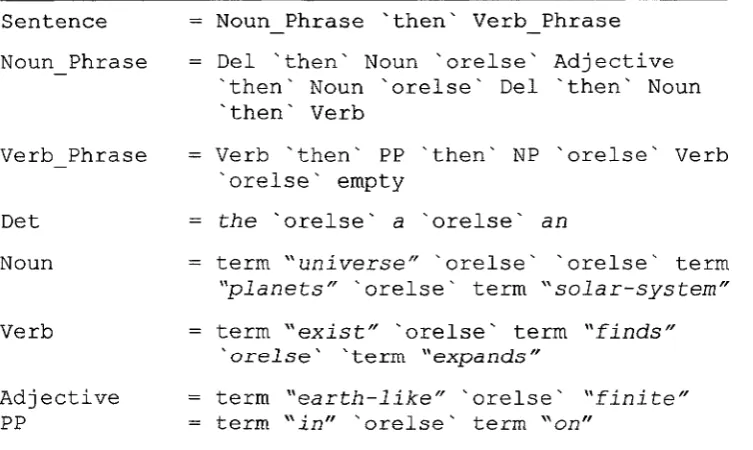
Using these four basic combinators, we now represent the previously mentioned CFG as a combinatory-parser for simple subset o f English. Basically the sequencing terminal and/or non-terminals are glued together by then combinators, alternatives are represented with orelse combinators, terminals and empty recognizers are created by
term and empty combinators. Each non-terminal definition works as an executable-
function, which is simple enough to construct, understand and modify.
Sentence = Noun Phrase 'then' Verb Phrase
Noun Phrase = Del 'then' Noun 'orelse' Adjective
'then' Noun 'orelse' Del 'then' Noun 'then' Verb
Verb Phrase = Verb 'then' PP 'then' NP 'orelse' Verb
'orelse' empty
Det = the 'orelse' a 'orelse' an
Noun = term "universe" 'orelse' 'orelse' term
"planets" 'orelse' term "solar-system"
Verb = term "exist" 'orelse' term "finds"
'orelse' 'term "expands"
Adjective PP
= term "earth-like" 'orelse' "finite"
= term "in" 'orelse' term "on"
Figure 4.1: A combinatory-parser representation of a CFG for NL
Below is a list o f sample applications o f these recognizers to some natural-language inputs:
1. Sentence ["earth-like", "planets", "exist", "in",
"the", "universe"] => [[""]]
(A completely successful recognition)
2. Sentence ["earth-like", "planets", "may", "exist"] => [["may", "exists"]]
(A partially successful recognition)
3. Noun_Phrase ["the","universe", "expands", "uniformly"] => [["expands", "uniformly"], ["uniformly"]]
(Two different ways o f recognitions for the same input - shows ambiguity)
4. Sentence ["andromeda", "is", "next", "to", "milky- way"] => []
4.2 Use of Monads for Combinatory-Parsing
4.2.1 Monads to Structure Program
As non-strict functional-programming languages do not permit ‘side-effects’ (such as: assignments, exceptions, continuation etc), it is relatively complex to perform operations like IO, maintaining states, raising exceptions, error handling etc. The monads appear as an easy solution o f these kinds o f problems. The concept o f ‘monad’ in computing is derived from Category-Theory - a branch o f mathematics, which abstractly describes mathematical-structures (categories) and relations between them. Moggi [8, 9] showed how monads can be used efficiently to structure semantic-computations. Moggi (1989) and Spivey (1990) demonstrated that maintaining states, raising exceptions, error handling, continuations etc can be performed structurally using monads. Inspired by their works, Wadler established monads as a convenient tool for structuring functional programs [ 38, 39].
4.2.1.1 Definition o f Monad
Our discussion about monads is restricted within its use in functional programming as a software-engineering tool. A monad consists o f a triple (M, unit, bind).
M is a polymorphic type constructor.
Function unit (of type a -» M a) takes a value and returns the computation o f the value. Function bind (of type M a -> (a -» M b) - » M b) applies the computation (a -» M b) to the computation 'M a' and returns a computation 'M b'.
The bind ensures sequential building blocks o f computations. To be considered as a
valid monad, the triple has to obey following three laws:
Left Unit :: unit a 'bind' k = k a
Right Unit :: a 'bind' unit = a
Associative:: a 'bind' (\b -> (k b) 'bind' (\c —> h c) )
= (a 'bind' (\b —»• (kb)) 'bind' (\c -» h c)
purely-functional language. Monad helps programmers to construct a ‘bigger’ computation combining sequential alterable blocks o f ‘smaller’ computations. It abstracts the smaller computations and the combination-strategies from the main computation. As monad separates the type o f computation from the type o f resulting value, it’s easier to add new changes to an existing monad to fulfill different computational requirements.
Two most commonly used monads are the identity-monad and the state-monad.
We are particularly interested in the ‘state-monad’ as this form o f monad has been employed in this thesis to construct the combinatory parsers.
Identity-Monad:
This simplest monad just returns the value without attaching any information to it.
type Id x = x
unit :: a -> Id a unit x = x
bind:: Id a -> (a -> Id b) -> Id b x 'bind' f = f x
State-Monad:
As maintaining updateable variables (in other words - ‘different states’) are not permitted in LFP languages, eveiy function-definition, which requires latest state-value, must have a ‘state’ as input-parameter. For complex functions, maintaining this explicit ‘state’ is complicated, error-prone and results unstructured and cluttered code. By using state- monads, function-definitions can ‘abstract away’ the updated ‘state’ as a function- parameter implicitly. A continuously-changing state-variable can float around within a monadic function-definition without forcing the function explicitly operates on it. One way to define a state-monad is:
type State a = S -> (a, S)
unit :: a -> State a
unit x = \s -> (x, s)
bind :: State a -> (a -> State b)-> State b
m 'bind' k = \x -> let (p, y) = m x in let (q, z) = k p y in
The u n i t takes a value o f any type (along with an initial state o f type S, which is abstracted within the definition) and returns a pair that consists o f the input-value and the initial state. In other words, the type o f the output o f u n i t is 'State a'. The b i n d takes two parameters - the first one, m, is o f type 'State a' and the second one, k,
which is a computation that takes a value o f type a and returns a value o f 'State a'.
The output of b i n d is of type 'State a'. According to the type-definition of
'State a', when x o f type S is supplied to m, it returns a pair (p , y) where p is the
value that ‘container’ m was holding and state y is o f type S. Then b i n d takes p and y from the output o f 'm x ' , applies k on p, which returns something o f type ' S t a t e a'
(which contains a value inside). When output o f k is applied to the previously calculated state y, it returns (q, z ) - by following the definition o f 'State a'. Here q is the new value that the output of ' k p ' was holding and z is the new state (of type S).
4 .2 .1 .2 E x a m p l e o f M o n a d ic C o m p u ta tio n
The following simple-but-illustrative example shows how adding some changes to the existing monadic-definition can perform different computational tasks.
With the non-monadic definition for reversing a list, it’s quite tedious to retrieve other information about the list. But by converting the naive definition o f ‘reverse list’ to a monadic definition, we can perform additional tasks in a structured manner.
The original definition for reversing a list:
revList [] = []
revList (e:es) = revList (es) ++ [e]
Example 1:
This basic monadic-definition (using identity-monad) o f reversing a list and the original definition do not have any difference w.r.t. their functionalities. This monadic-definition can be considered as the basic building block for the other monadic-definitions. The type- constructor 'Ml a' has one data constructor - a. The unitl and bindl are defined according to the previous identity-monad definition.
revListl [] = unitl []
revListl (e:es) = revListl (es) 'bindl' f
Sample output:
*Main> revListl [3,7,9,0] [0,9,7,3]
Example 2:
This version of ‘monadic reverse-list’ uses ‘state-monad’ and is changed in such a way that along with reversing a list, it is also able to return the length o f the input list. It was done by changing the type constructor 'M2 a' so that it can maintain a state o f integer type. The definition o f bind was also changed to ensure that the recursive calls can have the latest state.
type M2 a = Int -> (a, Int)
unit2 :: t -> M2 t
unit2 x = f where f t = (x,t)
bind2 :: M2 tl -> (tl -> M2 t2) -> M2 t2
m 'bind2 ' k = f ’
where f' x = (b,z)
where (b,z) = k a y
where (a,y) = m x
revList2 [] c = unit2 [] c
revList2 (e:es) count = (revList2 es 'bind2' f)
(count+1)
where f a
= unit2 (a ++ [e])
Sample output:
*Main> revList2 [3,7,9,0] 0 ( [0,9, 7,3] ,4)
Example 3:
type S = [Char]
t y p e M3 a = S - > (a, S)
revList3 [] = unit3 []
revList3 (e:es) = (drevList3 es 'bind2' f)
where f a = unit2 (a ++ [e])
drevList3 lis str = findDup revList3 lis str findDup revList3 lis str
= (out, chkForDup out) where (out, none)
= revList3 lis str
chkForDup resList = if (resList == nub resList) then "Has No Repetition" else "Has Repetition"
Sample output:
*Main> drevList3 [3, 7, 4, 9] "" ([9,4,7,3],"Has No Repetition") *Main> drevList3 [3,7,9,4,9] ""
([9,4,9,7,3],"Has Repetition")
4 .2 .1 .3 M o n a d s i n H a s k e l l
Haskell is equipped with many built-in monads (such as: list, maybe, IO etc) and the Prelude1 contains some monadic classes (such as: Monad, MonadPlus, Functor etc). The standard monad class in Haskell is defined as
class Monad m where return :: a -> m a
(»=) : : m a -> (a -> m b) -> m b
(where 'return' and ' ( » = ) ’ are equivalent to 'unit' and 'bind' of previous discussion)
A basic monad can be constructed by creating an instance o f this class. Haskell also provides a special syntax for monad (the ‘do’ notation - an expressive short-hand notation), which gives programmers a touch o f imperative-style-programming in Haskell. Instead o f using the built-in monads, we shall use hand-written monads to maintain the clarity o f the function-definitions.
4.2.2 Monadic Parser-Combinators
Wadler (1990, [38]) first noticed that using monads, combinatory-parsers can be represented in an organized manner. Hutton (1996, [19]) described a step-by-step procedure to form functional-combinators using monads. In 2003, Frost demonstrated how monadic parser-combinators can be used to maintain updatable ‘state’ efficiently during ‘memoization’. The main purpose o f transforming regular combinators to monadic combinators is to abstract out the underlying computation mechanism in order to add new functionalities in a structured and modular way. In our case, however, the primary requirement is maintaining a changing ‘state’ securely. We begin by transforming the non-monadic combinators of section 4.1.1 to monadic combinators using identity-monad. Though these definitions don’t serve any useful purpose except modularity for now, we show in following sections, how we can systematically replace the identity-monad with a state-monad to provide systematic method for memoization.
Identity-monad definition type Recognizer x = x unit :: a -> Recognizer a unit x = x
bind:: Recognizer a -> (a -> Recognizer b) ->
Recognizer b
x 'bind' f = f x
Basic (identity) Monadic-combinators
term c [] = unit [""]
term c (r:rs)I r == c = unit [rs]
I otherwise = unit []
empty x = unit [ x ]
(p 'orelse' q) inp = p inp 'bind' f
where f m = q inp 'bind' g where g k = unit(union m k)
(p 'then' q) inp = p inp 'bind' f
where f m = q m 'bind' g
where g k = unit k
In orelse, recognizers p and q are applied to the given input inp and their results are bound to the variables m and k using bind. The union o f m and k is added to a ‘container’ of computation through unit and returned as the result o f o r e l s e . In
then, recognizer p is applied to the given input and its result is bounded to m with
bind. Then recognizer q is applied to m and its result is bounded to k, which ultimately
is returned as a computation using unit. The term and empty combinators’ results are added to a ‘container’ o f computation using unit and returned afterwards. Using these combinators, we can form identical recognizers o f figure 4.1.
4.3 Shortcomings of Combinatory-Parsing
Combinators are very effective for constructing modular top-down recursive-descent backtracking language-processors and to accommodate ambiguity. But they exhibit exponential time-complexity in worst-case and they don’t terminate when used to represent a left-recursive production rule.
4.3.1 Exponential Time-complexity
If no precaution is taken, a top-down parser normally exhibits exponential time-complexity while processing an ambiguous grammar. As combinator-parsing follows recursive-descent with backtracking top-down parsing technique, it is inherently exponential. The simple ambiguous grammar - G_1 from section 2.1 that can generate binary numbers - can be expressed using combinators as:
B_E = D 'orelse' (D 'then' B_E) 'orelse' empty
D = term 0 'orelse' term 1
And when executed on input " 0 0 0 " , the execution tree with repeated computations
would look like: B E
/
T
\
D (D B E) empty
/ \ /\ I \ \
0 1 0 1 D (D B E) empty
/\ /\ / I \
0 1 0 1 D (D B_E) empty
A A I
0 1 0 1 failed
When a non-terminal e.g. B E (or D) is applied on the input, according to the definition
of 'orelse' combinator, all the alternatives o f B E (or D) are being applied on the
current input without knowing whether the same operation for same input was performed previously or not. For a highly ambiguous grammar, the rate o f backtracked alternative re-computations grows exponentially with respect to the length o f the input.
4.3.2 Non-Termination fo r Left-Recursion
If we express the above grammar in a left-recursive form, then the combinator-parser would be:
B_E = D 'orelse' (B_E 'then' D) 'orelse' empty
D = term 0 'orelse' term 1
The second alternative o f the non-terminal B_E (B_E = B_E ' then' D) is a left-recursive rule. When this particular rule is applied on an input " 0 0 0 " the following parse will be ever-growing:
When the non-terminal B E is executed on any input, according
1 ^ to the definition o f the combinator 'then', its left-most
B_E D
/ \ operand (which is the B E function itself) is being applied on the input first. When this second B_E executes its definition, the same scenario occurs again. As B E rewrites itself at the
left-B_E ~
CHAPTER 5: RELATED PREVIOUS WORKS
5.1 Use of memoization and monads to accommodate
ambiguity in polynomial time
The technique o f re-using ‘previously-stored results’ has been used to improve parsing and recognition efficiency by many. Earley’s well-known chart-parsing algorithm [6], which uses ‘dynamic-programming’, requires 0 (n 3) time in the worst case. Leermakers and Augusteijn [25] used ‘memoization’ to improve their parsing-algorithm though their explanations are slightly abstract in terms o f modularity. It was Norvig [32] who first demonstrated how to construct modular and efficient parser-combinators using a strict functional language (Lisp) with the help o f ‘memoization’. Inspired by his work, Frost and Szydlowski (1995) constructed a purely-functional versions o f memoized language- processors. In 2003, Frost extended the previous work by changing the general-parser combinators to state-monadic parser-combinators to ensure correct systematic memoization. By using memoization, this approach also ensures cubic time-complexity at worst case for recognition. In this section, we discuss Frost and Szydlowski [14] and F rost’s [9] work briefly.
5.1.1 Basic Concept o f Memoization
Many recursive programs can be “memoized” to improve efficiency. Memoization (also known as ‘top-down dynamic-programming’) computes a ‘sub-problem’ once, saves the result in a storage (we shall refer this storage as ‘memo-table’) and reuses this result (instead o f re-computing it) when the identical sub-problem is required to be solved again. Time-complexity of most of the recursive computations can be reduced from exponential to linear or polynomial using memoization. The whole process is based on two operations:
Update: whenever a result is computed for a sub-problem, it is saved in the memo-table (with a unique identifier (id)) during recursive-ascent - only once.
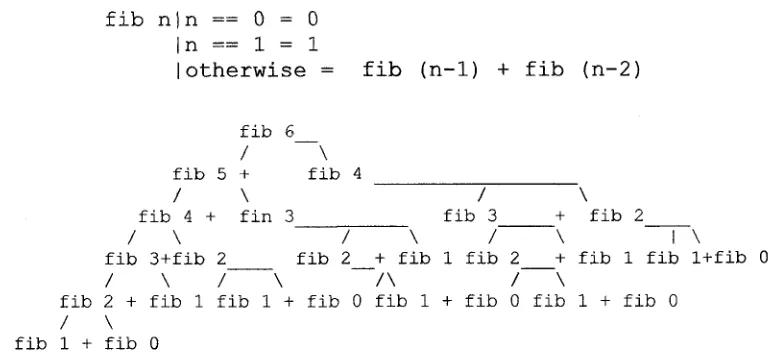
computed. Different variant o f ‘update’ and ‘lookup’ can be used - according to the needs. For example, consider the recursive definition ‘fib’ (for computing Fibonacci number) and the execution-tree for input 6:
fib n|n == 0 = 0
In == 1 = 1
I otherwise = fib (n-1) + fib (n-2 )
fib 6__
I \
fib 5 + fib 4_____ _
/ \
fib 4 + fin 3
/ \ / \
fib 3+fib 2 fib 2 + fib 1 fib 2 / / fib 3
r
\ fib 2\ I \
+ fib 1 fib 1+fib 0 \
\ / \ / \ /
fib 2 + fib 1 fib 1 + fib 0 fib 1 + fib 0 fib 1 + fib 0
/ \
fib 1 + fib 0
Clearly, the time requires to compute ‘fib 6’ is exponential (0 (2n) ). But, if the results of sub-problems were saved in a memo-table for future use, then the required time would be reduced to linear:
fib 6
t[update]
/ \
fib 5 + fib 4 4 [lookup] T[update]
/ \
fib 4 +
t[update]
/ \ fib 3 + fib T[update]
/ \ fib 2 + fib 1
T[update]
/ \ fib 1 + fib 0
Memo-table for ‘fib 6’
fin 3 4 [lookup]
2 4 [lookup]
n result 0 0 1 1 2 1 3 2 4 3 5 5 6 8
Figure 5.1: Memoized Computation of Fibonacci
5.1.2 Frost and Szydlowski
-Memoized Language-processors
Frost and Szydlowski constructed memoized versions o f basic combinators (as described in section 4.1.1) for building polynomial-time language-recognizers. Their method differs from Norvig’s approach by being implemented in a purely-fiinctional programming language - Miranda. As Norvig used Lisp (a strict functional language), he was able to maintain a globally accessible memo-table within the program-scope, which could be updated or looked up by any function independently. But, as updatable dats-structure is not permitted in LFP languages, Frost and Szydlowski implemented language- recognizers in such a way that they can receive the recent memo-table as input-argument and can also return it as a part o f the output. Basically the whole memo-table is threaded through the all recursive calls o f the recognizers as an input-argument.
To illustrate their approach, we step-by-step construct memoized parser-combinators that represents the CFG rule “S : : = a S S I e”. In their original paper, Frost and Szydlowski described the recognition-procedure by identifying inputs as integer indices for improved efficiency. For simplicity and better readability o f the function-definitions, in this section we assume that
- input-tokens are represented as characters.
- unique-identifier o f a recognizer is a string (i.e. recognizer’s name) and - ‘result’ o f recognition is a list o f ‘remaining inputs’ (or a string). So, the memo-table can be defined as:
type memo-table = [(String,[( String,[String])])]
which represents “memo-table = {(recognizer id,{(recognized input-token, {different results o f recognition})})}”.
lookup name inp table Ires_in_table == [] = []
lotherwise = res|(i, res) <- (res_in_table !! 0 ),i == inp]
where
res_in_table = [pairs|(n,pairs) <- table,n == name]
update [] name inp res = [(name,[(inp,res)])] update ((key, pairs):rest) name inp res
I key == name =(key, (inp,res):pairs) :rest
lotherwise = ( (key,pairs): update rest name inp res)
The 'lookup' function scans through the memo-table with given recognizer 'name'
and current input 'inp'. If there exists a result in memo-table, 'l o o k u p ' returns that, otherwise it returns an empty list - indicating a lookup-failure. The 'update' function adds a newly computed result 'res' to the end o f the result-set for a particular recognizer 'name' and specific input 'inp'.
memoize rec-name recognizer (inp, table)
Itable_res == [] =(res, update newtable rec-name inp res)
lotherwise = (table_res!!0, table)
where
table_res = lookup rec-name inp table (res, newtable) = recognizer inp table
The 'memoize' function takes a recognizer-name (unique id), recognizer function-
definition, input-string and a memo-table as its input-parameters. From the definition, it is obvious that 'memoize' first performs a 'lookup', if 'lookup' returns an empty list, it permits the 'recognizer' to compute new results. When a result is found, it is updated to the memo-table for later use. To pass-around the memo-table as an input-argument (or as the part o f the output) o f a recognizer, the definitions o f basic combinators can be modified as follows:
(p 'orelse' q) (inp, memo_tab) = (merge_result1 p_r q_r,n_tab)
where
(p_r, n_tab)= p (inp, memo_tab) (q_r, n_tab)= q (inp, n_tab)