University of South Carolina
Scholar Commons
Theses and Dissertations
6-30-2016
Decorative Turkey Callmakers: Artists or
Craftsmen
Lauren E. Virgo University of South Carolina
Follow this and additional works at:https://scholarcommons.sc.edu/etd Part of theHistory of Art, Architecture, and Archaeology Commons
This Open Access Dissertation is brought to you by Scholar Commons. It has been accepted for inclusion in Theses and Dissertations by an authorized administrator of Scholar Commons. For more information, please [email protected].
Recommended Citation
Virgo, L. E.(2016).Decorative Turkey Callmakers: Artists or Craftsmen.(Doctoral dissertation). Retrieved from
D
ECORATIVET
URKEYC
ALLMAKERS:
A
RTISTS ORC
RAFTSMENby
Lauren E. Virgo
Bachelors of Arts Clemson University, 2003
Certificate of Museum Management University of South Carolina, 2005
Submitted in Partial Fulfillment of the Requirements
For the Degree of Master of Arts in
Art History
College of Arts and Sciences
University of South Carolina
2016
Accepted by:
Peter Chametzky, Director of Thesis
Lydia Brandt, Reader
Lana Burgess, Reader
D
EDICATIONA
CKNOWLEDGEMENTSI would like to thank the staff of the National Wild Turkey Federation’s
Winchester Museum for the opportunity to work with them on this project. In addition to
the NWTF’s museum staff, there are many NWTF employees, callmakers and call
collectors who shared their knowledge and passion for turkey calling with me. Without
their enthusiasm for turkey calls I would not have the appreciation that I have today for
this wonderful and uniquely American craft.
A big thank you is needed for my family and friends who always encouraged me
to complete my degree. Of course, this thesis would not have been possible without the
professors and staff of the School of Visual Art and Design. They gave me a second
A
BSTRACTThis thesis explores the history of the wild turkey call and the role of decorative
callmakers in the world of art and craft. Is a turkey callmaker an artist or a craftsman?
Are their decorative turkey calls works of art or works of craft? This debate is explored
via the decorative turkey calls that have won the Decorative Turkey Call Best of Show
portion of the National Wild Turkey Federation’s Grand National Callmaking
Competition. These winning turkey calls are currently on display at the NWTF’s
Winchester Museum in Edgefield, South Carolina.
The National Wild Turkey Federation (NWTF) is a non-profit organization
incorporated in 1973. The organization is dedicated to the conservation of the wild
turkey and the preservation of the hunting tradition. The headquarters for the NWTF is
located in Edgefield, South Carolina. The headquarters has a 7,200 sq.ft. museum that
supports the mission of the National Wild Turkey Federation with the exhibition of
hunting- and preservation-related items, including a large collection of over 500 turkey
calls. In 1994, the NWTF hosted the first national competition for decorated turkey calls.
The competition continues to this day and has become the epicenter for turkey call
P
REFACEMy first professional museum job after college was working as the Collections
Manager for the National Wild Turkey Federation’s Winchester Museum. I spent many
years learning about the wild turkey, its preservation, and its hunting tradition. This
thesis seeks to convey the responsibility felt by the staff of the NWTF towards preserving
the heritage of the American wild turkey hunting tradition. This thesis traces the
evolution of turkey call design and explores the role of decorative turkey callmakers as
seen in the holdings of the NWTF’s Winchester Museum. From the depths of historic
T
ABLE OFC
ONTENTSDEDICATION ... iii
ACKNOWLEDGEMENTS ... iv
ABSTRACT ...v
PREFACE ... vi
LIST OF FIGURES ... viii
LIST OF ABBREVIATIONS ...x
CHAPTER 1: INTRODUCTION ...1
CHAPTER 2: HISTORY OF THE TURKEY CALL ...10
CHAPTER 3: ARTIST OR CRAFTSMAN ...26
REFERENCES ...69
APPENDIX A – GLOSSARY ...72
L
IST OFF
IGURESFigure 1.1 John Parker’s 2008 Decorative Turkey Call Best of Show winner ...6
Figure 1.2 Strutting male wild turkeys ...6
Figure 1.3 M.L. Lynch Box Call...7
Figure 1.4 Replica of a BGI Yelper by Irving Whitt ...7
Figure 1.5 Tube Call by Knight & Hale Company ...8
Figure 1.6 Slate Call with Striker by Clint Corder ...8
Figure 1.7 Henry C. Gibson’s Box Call Patent ...9
Figure 2.1 4,000 year old Wingbone Call ...21
Figure 2.2 Neil Cost’s Prototype Box Call ...21
Figure 2.3 Henry Gibson Turkey Box Call (replica) ...22
Figure 2.4 Henry Gibson Turkey Box Call (replica) ...22
Figure 2.5 M.L. Lynch Model No. 102...23
Figure 2.6 Neil Cost’s Signature Box Call Design ...23
Figure 2.7 Scott Basehore’s 1994 DTCBS Winning Call...24
Figure 2.8 Richard L. Steward’s 2014 DTCBS Winning Call ...24
Figure 2.9 Dave Constantine’s 2007 DTCBS Winning Call ...25
Figure 3.1 NWTF’s Winchester Museum’s Turkey Call Exhibit ...62
Figure 3.2 Tim Oldham Jr.’s 2016 DTCBS Winning Call ...63
Figure 3.3 Boat Paddle by Neil Cost for Gary Berry ...64
Figure 3.5 John Parker’s 2009 DTCBS Winning Call - Interior ...65
Figure 3.6 Dave Constantine’s 2012 DTCBS Winning Call ...66
Figure 3.7 Don Bald’s 2000 DTCBS Winning Call ...66
Figure 3.8 Dave Constantine’s 2010 DTCBS Winning Call ...67
Figure 3.9 Henry C. Gibson’s 1908 Box Call ...67
Figure 3.10 Kent Freeman’s 1997 DTCBS Winning Call ...68
L
IST OFA
BBREVIATIONSCCAA ... Callmakers & Collectors Association of America
DTCBS ... Decorative Turkey Call Best of Show
GNCC ... Grand National Callmaking Competition
CHAPTER
1
I
NTRODUCTIONWhen Henry C. Gibson burned images of hunting dogs, log cabins, and nostalgic
phrases onto the side panels of a turkey box call in the late 1890s, he couldn’t have
realized the impact of this minor decoration. Prior to Gibson’s decorative additions,
turkey calls were simple, handmade hunting tools that had been used by hunters for
thousands of years. Just over one hundred years after Gibson’s wood-burned decorations,
the National Wild Turkey Federation created a national competition for decorative turkey
calls as part of their Grand National Callmaking Competition (GNCC). Callmakers from
across the United States compete annually in the Decorative Turkey Call Best of Show
(DTCBS) of the GNCC where they showcase their stunning, carefully carved decorative
turkey calls (Fig. 1.1). The winning DTCBS calls are eventually displayed as part of a
permanent exhibit at the National Wild Turkey Federation’s Winchester Museum in
Edgefield, South Carolina. It is this transformation of turkey calls from a simple hunting
tool to incredible works of beauty that begs the question – are decorative callmakers
craftsmen or artists?
Turkey calls are a uniquely American hunting tool created to hunt a uniquely
American game bird. Wild turkeys (Meleagris gallopavo) only existed on the North
American continent until a segment of the population was taken to Europe for widespread
in Central America. While some American Indian cultures were able to domesticate the
wild turkey, most native persons hunted the cunning game bird with a combination of
camouflage, traps, blowguns and calling techniques.1 Turkeys were not hunted using
guns until the European settlers arrived in America. After centuries of over-hunting and
hunting practices that are considered illegal today, the wild turkey was on the brink of
extinction by the late 1800s. Author Thomas Bangs Thorpe noted in 1854 that “every
passing year lessens its numbers; and as their disappearance always denotes their death
their extermination is progressive and certain.”2
However, through efforts of wildlife
conservation and hunting regulations, the population was restored to sustainable levels.
Through restoration efforts the national population of wild turkeys has risen from an
estimated 500,000 in 1954 to over 7 million wild turkeys today.3 The story of the wild
turkey from near extinction to thriving populations is one the most successful wildlife
restoration achievements in America.
In forests, mountains and prairies across the United States, the distant gobbling of
male wild turkeys can be heard during the spring time. Ideal turkey habitat is a large
expanse of wooded land with open fields nearby. This habitat is typically full of mast
producing trees, insects, and berry laden bushes. The male turkeys are performing their
strutting and calling ritual to catch the attention of female turkeys (Fig. 1.2). When a
wild turkey hunter walks into the forest to harvest a bird, he brings with him a little bit of
trickery. To catch the attention of a lovelorn male turkey, the hunter must replicate the
romantic vocalizations of a female turkey or the territorial gobbles of a male turkey to
1
James G. Dickson. The Wild Turkey: Biology & Management (Mechanicsburg, PA: Stackpole Books, 1992), 8.
2
Thomas Bangs Thorpe. The Hive of the ‘Bee-Hunter’ (New York: D. Appleton and Company, 1854), 9.
3
attract attention. The need to create these alluring vocalizations is the basis for a hunting
tool known as a turkey call. Turkey calls can come in a variety of shapes, sizes and
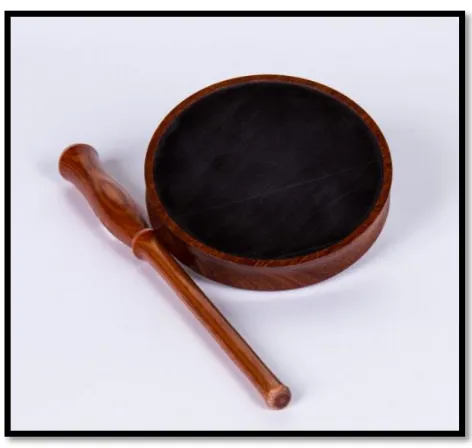
materials. Some of the more common turkey calls are the box call, the slate call, the
yelper and the tube call. These calls will be discussed in Chapter 2 (Figs. 1.3, 1.4, 1.5,
1.6).
While the earliest known turkey calls were wingbone calls created by American
Indian hunters thousands of years ago, turkey calls were not widespread as a hunting tool
until the late 1800s.4 At the same time that turkey calls were becoming a more popular
hunting tool, the Industrial Age ushered in the new capability to mass manufacture turkey
calls. By 1897, an Arkansan named Henry Clay Gibson applied for the first patent for a
turkey box call (Fig. 1.7). Turkey box calls have been documented to be in use since the
1700s, but Gibson was the first callmaker to have a patent issued for his design. In
addition to being the first person to patent a turkey box call, Gibson is also recognized as
the first person to sell turkey calls that were wood-burned with elaborate decorations. As
a result, he is recognized as being the first callmaker to create a decorative turkey call – a
call that told a story in addition to its function of calling in wild turkeys. From this
beginning, a number of callmakers have opted to add sculptural elements to their
functional turkey calls, such as a painting of a gobbler or a carving of a leaf. A small
percentage of callmakers have taken decoration to another level where the entire surface
of the call is decorated, sometimes, to the point of being barely functional. The
comparison of these elaborately decorated turkey calls has led to the creation of a
national competition.
4
When the National Wild Turkey Federation hosted its first national convention in
1977, the main purpose of the convention was for biologists to share scientific research
and focus on the restoration of the wild turkey population. However, the NWTF also
recognized the need to have hunters involved in the convention. So, the Grand National
Turkey Calling was created for callers from across the United States to compete. 5 By the
1980s, the NWTF’s national conventions expanded the offerings of the national gathering
to include a competition for handmade turkey calls – the Grand National Callmaking
Competition (GNCC). In 1994, this competition was enlarged to include a specific
category for decorative handmade turkey calls. Thus the Decorative Turkey Call Best of
Show (DTCBS) competition was established as part of the GNCC.
By analyzing the backgrounds of the DTCBS winners along with other decorative
callmakers and the range of functionality in their winning calls, this thesis interprets the
placement of decorative callmakers in the world of art or craft. Key questions to be
answered are: Is a turkey callmaker an artist, folk artist, craftsman, or studio craftsman?
Turkey calls have been interpreted by previous scholars as being an American folk art.
While several of the decorative callmakers refer to their works as folk art, I believe that
the majority of the DTCBS winning calls fall more into the category of studio craft which
is a combination of craftsman skill and artistic expression.
This thesis is aided greatly by the works of two turkey call historians – Earl
Mickel and Howard Harlan6. Mickel interviewed hundreds of turkey callmakers across
the United States in the 1990s for his books Turkey Callmakers Past and Present: Mick’s
Picks and Turkey Callmakers Past and Present: The Rest of the Best. Harlan is a game
5
Wayne Bailey and Neal Weakly,“A History of the Early Years,” Turkey Call, Mar/Apr 1994, 34.
6
call historian and collector who has thoroughly researched the history of turkey calls in
his work Turkey Calls: An Enduring American Folk Art. My knowledge for this paper
has also been gleaned from conversations with callmakers and collectors during my
four-year tenure as the Museum Coordinator for the National Wild Turkey Federation’s
Winchester Museum. Special recognition goes to Charles Burke and Chris Karinja for
Figure 1.1 John Parker’s 2008 DTCBS winning box call, “Circle of Life.” NWTF’s Winchester Museum. Image by author.
Figure 1.2 Two wild male turkeys strutting in a field. Image from National Wild Turkey Federation online,
Figure 1.4 Hunting Class call – Replica of a BGI yelper by Irving Whitt. NWTF’s Winchester Museum. Image by author.
Figure 1.5 Hunting Class call – Tube call by Knight & Hale. Image courtesy of Knight & Hale.
CHAPTER 2
H
ISTORY OF THET
URKEYC
ALLAs mentioned in the previous chapter, the wild turkey is a uniquely American
game bird. From the point of near extinction in America to its impressive return to
self-sustaining levels, the American wild turkey has made an incredible recovery with help
from wild life professionals, conservation organizations, and wild turkey hunters. At the
current population levels, wild turkey hunting has been able to resume its balance with
nature as part of the prey-predator cycle. Wild turkey hunters have used turkey calls as
part of their hunting technique for thousands of years. It is only within the last one
hundred years, though, that these turkey calls have been altered to resemble sculpture
more than a hunting tool. This chapter traces the history of turkey calls from their
earliest, purely functional versions to their recent sculptural enhancements.
The earliest records of turkey hunting by American Indian cultures came from
accounts by European settlers. They recorded many types of turkey hunting from
trapping turkeys in pens to Indian turkey hunters camouflaging themselves in moss, like
modern day gillie suits, and hunting wild turkeys with blow guns. Often in the accounts,
American Indians were shown to call in turkeys with either their voices, using a leaf or
large blade of grass, or a calling device made from the wing bone of the turkey.
The wingbone call is the first known type of handmade turkey call. American
Indian hunters discovered that by sucking on the narrow diameter of the bird’s wing
Winchester Museum has in its collection one of the oldest known wingbone
turkey calls. This 4,000 year old turkey wingbone call was discovered during an
archaeological dig in Indiana along the Ohio River (Fig. 2.1). The call is constructed
using the ulna and radius bones from the wing of the wild turkey. By lightly sucking on
the radius bone, a hunter can produce the sounds of a female hen, which is key to
convincing a male turkey (gobbler) to come close to the hunter’s blind.
Wild turkeys are incredibly wary creatures and much skill is required of the
hunter to get close enough to the bird for a good shot with either a shotgun or a bow and
arrow. As suggested in the book The Hive of the Bee-Hunter on the hunting traditions of
early Americans in 1854, the cautiousness of the wild turkey is extraordinary. The author
rates the intelligence and wariness of the wild turkey above that of deer and any other
wild game.7
Turkeys can vocalize more than 28 different calls. These calls have different
meanings from vocalizations of satisfaction (the purr) to warning signals (the putt) to the
courting sounds of a female turkey (the yelp). Wild turkey hunters focus primarily on
replicating a handful of turkey vocalizations that might cause a gobbler to come near their
camouflaged hunting blind. There are at least four call vocalizations that every turkey
hunter needs to know: the yelp, the cluck, the gobble and the purr. Clucks, purrs and
yelps are typically made by hen turkeys when they are content and/or looking for a male
turkey. A gobble is a male turkey vocalization and can be used by a turkey hunter to
challenge a nearby gobbler into a confrontation. A skilled hunter can produce most of
these vocalizations using just one or two turkey calls. However, a hunter who has been
7
hunting for decades will tell you that a wise hunter brings four or five different kinds of
turkey calls on a hunt because you cannot predict what type of call will entice a gobbler.
Early hunting techniques that included baiting, trapping and night hunting were
eventually outlawed with the over-hunting of the species and the need for population
restoration. As a result of outlawing those forms of hunting and the enforcement of
hunting seasons, the majority of hunters resorted to the usage of turkey calls. Whether
they were purchased or hand-carved by the hunter, turkey calls are offered in a variety of
shapes, sizes, and function.
Turkey calls are divided into two main types – 1. friction-operated calls and 2.
air-operated calls. Friction calls include but are not limited to box calls, trough calls, slate
calls, chamber and striker calls, and push button calls. Box calls and slate calls are some
of the most popular forms of friction calls. Calls within the air operated category include
wingbone calls, trumpet calls, yelpers, tube calls, shaker calls and mouth calls. Air-
operated turkey calls work by forcing air across a vibrational surface or through a narrow
diameter channel. Versions of these turkey call types were handmade for generations by
hunters until the Industrial era offered another way to purchase calls that were mass
Timeline of noteworthy, consumer-purchased turkey calls:
1867 – Patent is issued to Samuel McClain for an in-mouth bird call
1881 – Charles Jordan’s Combination Yelper was marketed nationally
1882 – The BGI Yelper was mass marketed
1897 – Henry C. Gibson patented his box call design (Fig. 1.7)
1900 – Droughan applied for a patent for a scratch box call
1912 – First known fencepost style box call appeared and Saunders
patented a striker & slate call
1917 – Tom Turpin’s No. 2 Style yelper
1919 – Tom Turpin’s No. 3 Style yelper
1921 – H. P. Bridges patented a diaphragm call & J.E. Jackson patented a push pin friction call
1926 – Tom Turpin began making box calls in addition to his yelpers
Late 1920s – E.G. Chalkley obtained the rights to John E. Jackson push-pin call (patented March 27, 1923)
1930 – W. Fox’s Tru-tone single slate call was developed
1931 – P.S. Olt created a scratch box to work in conjunction with a hunter’s gun stock
1939 – The most successful mass producer of box calls, M.L. Lynch
began producing his first model of box call (Fig. 1.3)
1950 – Herring produced a collapsible trumpet yelper, Bowles created a double-sided scratch box, and Megginson created a piston-powered call
1952 – Walker patented an ink well call
1958 – Johenning & Leon patented their Turkey Caller
1960 – Neil Cost began making box calls (Fig. 2.2) and Raymond
Chisholm developed his popular version of a trough call which reinvented the trough style call
1965 – E.L. Wisor developed a cylindrical peg-n-slate friction call
1968 – Winterbottom reenergizes the fencepost box call
1973 – Morgan patented a tube call
1974 – The Pulley crank box call was patented
1976 – E.O. Mitchell’s Big “Turk” worked by placing a piece of slate in a turtle’s shell; the concave body of the shell amplified the slate’s noise
1978 – D.D. Adams patented a double slate call
1980 – Cassette created a two-button push pin call
1981 – Whedon & Hearn patented an interchangeable mouthpiece yelper
Some of the more innovative callmakers who produced consumer-purchased calls
were Michael Leroy Lynch, Neil Cost, and the aforementioned Henry C. Gibson. Gibson
turkey call type. Lynch was significant because he was the first callmaker to successfully
mass produce and mass market a turkey call. And last, but not least, Neil Cost was the
callmaker to perfectly tune a friction call to replicate the vocalizations of a wild turkey.
These men produced turkey calls that were revolutionary in the turkey call world.
Henry Clay Gibson
Born in 1848 near Dardanelle, Arkansas, Henry Clay Gibson worked as a farmer
and as a manager of a fencing company. He also helped to organize Mt. Nebo Summer
Normal which was the first normal school in Arkansas. Little else is known about
Gibson other than he applied for a patent along with a man named John Boddie. Turkey
call scholars believe that Boddie helped Gibson market his box calls to regional hardware
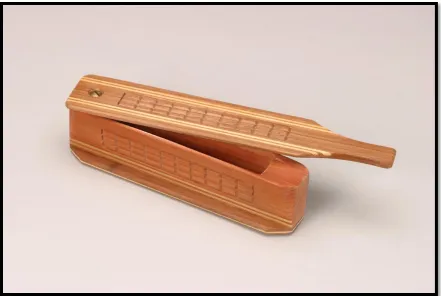
companies.8 The patented design is composed of three components: a rectangular block
of wood with a deep chamber carved into its body, a thin piece of wood in the shape of an
elongated paddle, and an attachment point to join the two pieces of wood together. The
call works by the hunter abrading the underside of the paddle with chalk and then gently
scraping the chalked side of the paddle against the top walls of the open chamber. This
chalked friction of wood against wood produces the vibrations necessary to imitate
several calls of the wild turkey. Gibson’s design was so simple, but so effective, that it is
still used by callmakers today.
While the patent alone is significant, the major contribution by Gibson was his
decorated turkey box call. Although only a few examples of Gibson’s decorated calls
exist today, no other decorated turkey calls have been recorded before his version. His
8
wood-burned turkey calls ushered in a new wave of turkey calls that looked beyond
function to include expression and personalization.
An exact replica of his most well-known box call design shows imagery that
would be attractive to turkey hunters (Fig. 2.3). On one side of the box’s chamber,
Gibson burned the design of a strutting male turkey while on the other side is the
depiction of a hunter holding a gun and walking with his hunting dog. The rest of the
burned designs were simple dashes and flourishes with the final touch being the
callmaker’s own name brandished on the top of the paddle (Fig. 2.4). The designs are
very rustic with no signs of shadowing or three-dimensional skill. Although rudimentary,
these simplistic wood-burned drawings were the beginning of the decorative turkey call.
Michael Leroy Lynch
Born in 1896, a Mississippi gentleman named Michael Leroy Lynch began
making turkey box calls in 1939 after working as a home builder and custom
cabinetmaker for years. M.L. Lynch, as he is commonly known, was a man who liked to
experiment with the basic designs of turkey calls. Lynch’s first calls were made from
cedar in his shop in Birmingham, Alabama. Later, Lynch changed the materials to
walnut paddles and mahogany chambers. These call chambers were glued together rather
than carved from a single block of wood to make the design easier for mass production.
Lynch’s most revolutionary contribution to the turkey calling world was the idea
of mass production. Before Lynch, most turkey callers made their own turkey calls or
purchased them from a small scale operation. Lynch was the first person to successfully
eastern portion of the United States with turkey calls in his trunk, selling them in bulk to
any hunter or hunting store he came across.9 Eventually, Lynch’s company would grow
to include more than 20 different models of turkey calls – all primarily friction calls.
He began by making box calls with very simple designs that were very close in
scale to the Gibson patented design. In 1940, he added grooves to the side panels of the
box calls and forever changed how future turkey call makers chose to design the box call
chamber (Fig. 2.5). Many call makers today still use the grooved-sides design for their
call chambers. From the late 1950s until he sold the company in 1970, Lynch would
continue experimenting with the design of the chamber walls, the internal shape of the
chamber, the ways of bracing the chamber walls, and the design of the paddle.
Neil Cost
A few years after the Lynch World Champion Turkey Caller was unveiled in
1958, a callmaker in Greenwood, South Carolina named Neil Cost began selling hand-
carved turkey calls. Cost’s revolutionary contribution to the world of turkey calls was his
tonal perfection. Called the “Stradivarius of Turkey Calls,” Neil Cost was a perfectionist
who carved, sanded, and constructed turkey calls that flawlessly replicated the tonal
vocalizations of a wild turkey (Fig. 2.6). 10 In fact, his turkey calls were tested in a sound
laboratory and compared to actual turkey vocalizations. The difference between Cost’s
turkey call and the real turkey vocalization was nearly imperceptible to the human ear. In
his interview with author Earl Mickel for his book Turkey Callmakers Past and Present:
The Rest of the Best, Cost said “Turkey calls are a piece of wood that when properly
9
Harlan, Turkey Calls, 80-83.
10
selected, precisely cured and expertly fashioned, become an instrument to duplicate
turkey language.”11
Cost often said that for every single turkey call that made it out of his work shop,
two more went in the trash. He would never allow an imperfect turkey call to leave his
shop. As a result of this high degree of perfection, his turkey calls became recognized as
some of the best turkey calls in the nation. After nearly fifty years of turkey callmaking,
his dedication to the promotion of turkey callmaking and his skill in tonal perfection
earned him South Carolina’s Jean Laney Harris Folk Heritage Award in 2002.12
While Gibson, Lynch and Cost considerably altered the landscape of field grade
turkey calls, there was also a growing movement to take turkey calls beyond the singular
function of being a hunting tool. Ornate turkey calls have emerged slowly from the
world of field grade turkey calls and into a category of their own. Very few examples of
decorated turkey calls exist between Henry Gibson’s early 1900s wood-burned turkey
calls and the Decorative Turkey Call Best of Show winners of the 1990s. Their slow
emergence is very likely a result of declining wild turkey populations.
Gibson created decorative turkey calls during the late 1890s and early 1910s when
turkeys were populous and hunting limits for the wild game bird did not exist. Thus, a
decline of wild turkey populations due to overhunting was inevitable. With this decline
came less demand for turkey calls. It makes sense that a callmaker would only build
fully functional field grade turkey calls for hunters who might be desperate to call in a
food source.
11
Mickel, The Rest of the Best, 150.
12
It was only after decades of hunting regulation, wildlife conservation, and habitat
restoration that wild turkey populations began to obtain balanced levels in the 1960s and
1970s. With this resurgence in wild turkey populations, a large number of hunters once
again sought turkey calls for the field. It is at this time that decorative turkey calls also
reappear. With a new demand for turkey calls, callmakers once again began to
experiment with shape and form.
One particular enclave of callmakers that reemerged in the 1960s was the
Eminence callmakers. In 1968, the town of Eminence, Missouri, held a centennial
celebration. The Eminence area’s turkey season had recently reopened in 1960 after
being closed for twenty-three years while the populations were conserved. There was a
turkey calling contest at the town’s centennial celebration. The contest was won by Dan
Searcy who used one of his father’s fence post style calls that had been made in 1912.
These fence post calls are unusually long-bodied box calls that were carved from a single
block of old fence post wood before and during the Great Depression. 13 Many of the
early fence post calls are covered with wood-burned images and the shape of the paddle
is very close to that of the Gibson design with its almost diamond shape. At any one
time, there were probably only ten fence post style callmakers in Eminence in the 1960s,
but they have become well recognized in the callmaking community for their particular
decorative call style. 14
This resurgence of decorated turkey calls in the late 1960s and 1970s eventually
led to competitions for the decorative category at turkey callmaking events. The National
13
Typical box calls are less than 8 inches long. Eminence fence post style box calls are 12 to 17 inches long.
14
Wild Turkey Federation created the national Decorative Turkey Call Best of Show
(DTCBS) competition for only decorative turkey calls in 1994 as part of their Grand
National Callmaking Contest. This contest has pushed the creativity of callmakers to a
new level as can be seen in a comparison of the first DTCBS winner with the 2014
winner (Figs. 2.7, 2.8).
The impact of the NWTF’s Decorative Turkey Call Best of Show cannot be
underestimated in the growth of decorative turkey callmakers. In an interview with
callmaker Kent L. Bowers, he noted that he was a dedicated duck callmaker since 1983.
However, he noticed the growing market for custom made turkey calls in the early 1990s.
So he began making turkey wingbone calls with decorated aspects in 1994.15 It is
interesting that he noted the growing market for custom turkey calls around the same time
that the NWTF created a new category for the Decorative Turkey Call Best of Show.
Another callmaker that was inspired by the NWTF’s national decorative call
competition was Jack Burrus of Eminence, Missouri. Although Burrus does not carve in
the traditional fence post style of other Eminence callmakers, he is well versed in the
carving tradition. His typical carvings feature Western themes of cowboys and American
Indians. In Earl Mickel’s book, Burras states “The N.W.T.F. decorative call competition
got me interested in carved turkey calls in 1994.”16
So, in a way, the creation of the
decorative turkey callmaking competition was a motivation within the callmaking world
to then create more elaborate, decorative turkey calls. The cycle is self-perpetuating.
15
Mickel, The Rest of the Best, 21.
16
As can be observed in the evolution of calls in the Decorative Turkey Call Best of
Show competition, decorative turkey calls have become more and more elaborate within
the past two decades. This extensive decoration has led many to consider these calls as
collectors’ items that should not be used as a hunting tool. Modern decorative callmakers
tend to place emphasis on the materials that will best yield a certain aesthetic rather than
only using materials that create a perfect tonal vocalization of the wild turkey. For
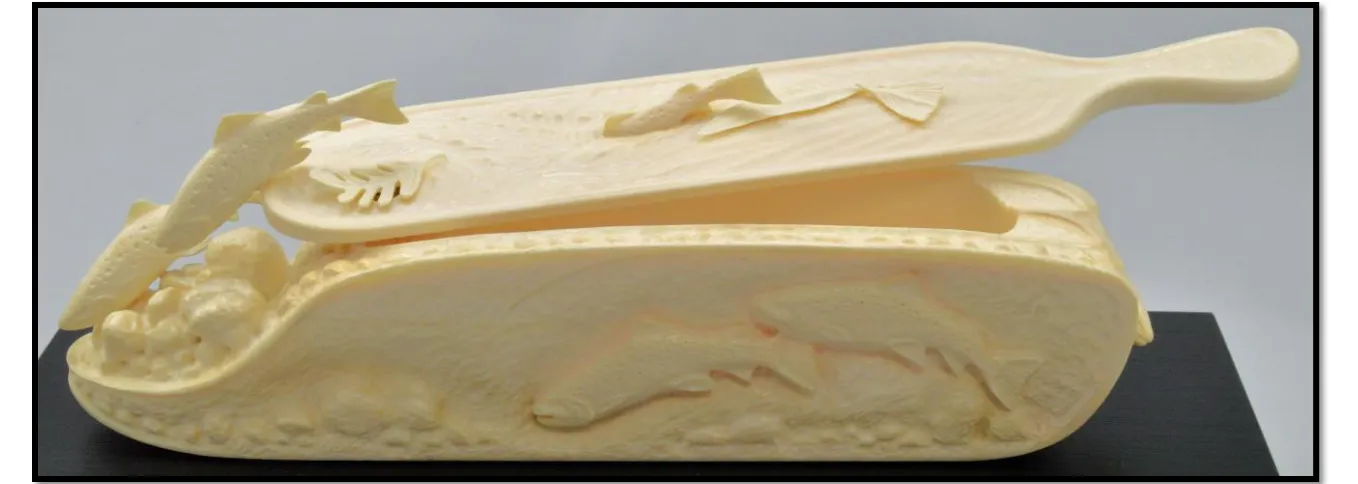
instance, Dave Constantine’s 2007 DTCBS winning call replicates the same shape of a
traditional box call (Fig. 2.9). However, the callmaker chose ivory, a very dense
material, over a piece of wood like poplar or cedar which would have resulted in making
realistic turkey vocalizations. This ivory box call can technically function as a turkey call
because its paddle does swing across the top panels of the chamber, but the sound the call
creates would never fool a wild turkey.
It is this preferential placement of a call’s aesthetic value over its hunting function
that is the basis of my argument in Chapter Three. Does this decrease of functional value
relegate a decorative callmaker to the realm of an artist? Or does the fact that the
callmaker retains the functional form of a call keep him in the realm of craftsman? The
answer lies somewhere between the two worlds where a decorative call can be both art
Figure 2.1 4,000 year old wingbone call made by an American Indian. Discovered in an archaeological dig along the Ohio River in Indiana. NWTF’s
Winchester Museum. Image by author.
Figure 2.3 Gibson turkey box call, historic reproduction. NWTF’s Winchester Museum. Image by author.
Figure 2.5 M.L. Lynch Model No. 102 box call with grooved side panels. One side of the box was worked to make the sounds of a hen while the other side was used to make the sounds of a gobbler. NWTF’s Winchester Museum.Image by author.
Figure 2.7 Scott Basehore’s 1994 Decorative Turkey Call Best of Show winning box call. NWTF’s Winchester Museum.Image by author.
Figure 2.8 Richard L. Steward’s 2014 DTCBS winning box call titled “In the Timber.”
25
CHAPTER 3
A
RTIST ORC
RAFTSMANIn the world of handmade turkey calls, there is a wide variety of calls available.
Most calls have a very pure form and stick strictly to the functional designs that have
worked for centuries. These Hunting Class calls have smooth surfaces, purposeful
design, and no decorative elements. There are some Hunting Class calls that are
bedecked with simple line drawings or a few flourishes of natural elements, but these
decorations in no way alter the functional form of a field grade turkey call. Finally, there
are the exceptional turkey calls that are elaborately decorated to the point that most
purchasers display the calls in their homes instead of taking them into the woods on a
hunt. Although the level of craftsmanship required for Hunting Class calls is equivalent
to the level of skill needed to craft Decorative Class calls, the focus of my thesis work is
with the callmakers of the Decorative Class.
It is difficult to place callmakers into one category. Earl Mickel conducted
interviews with over 500 callmakers across the United States for his two books, Turkey
Callmakers Past and Present: Mick’s Picks (1994) and Turkey Callmakers Past and
Present: The Rest of the Best (1999). Most of the callmakers he interviewed produced
field grade turkey calls, but a few dozen produced decorative turkey calls. During his
interviews, some of these decorative turkey callmakers would self-identify as artists
used the words artist and craftsman interchangeably. Thus enters the confusion of this
issue. Are callmakers craftsmen, artists, folk artists, or do they fall more into the
category of studio craft? This chapter will explore this conundrum by primarily
analyzing the works of the NWTF’s Decorative Turkey Call Best of Show winning
callmakers.
A Note about Female Callmakers
The world of turkey callmakers is predominately male and predominately
Caucasian. Female callmakers who produced consumer-purchased calls are small in
number. In some cases, women who make turkey calls do so in partnership with their
callmaking husbands. An example of this interlocked relationship is GNCC entrant
Sarah Clarke and her husband Don. After working for the Union Pacific Railroad for
forty-one years, Don retired and began making turkey calls under the name Clark-It
Custom Turkey Calls in Sheridan, Arkansas. Don builds the calls and Sarah decorates
them with wood-burned and painted designs. They have been making turkey calls
together for more than a decade.17
Another husband and wife team is the Gaskins of Rapid City, South Dakota.
Tricia Gaskins was a professional jewelry and scrimshaw artist when she met Randy
Gaskins at a Mountain Man retreat. Randy has built wingbone and horn mouth calls
17
since the early 1990s. With their cooperative partnership, Randy builds the calls while
Tricia decorates them with her scrimshaw skills.18
One example of an independent female callmaker is Goldie Goodman of Evening
Shade, Arkansas. She attended Arkansas State University to study in the fine arts
program and worked for several decades as a mold assembler in a plant. When she began
hunting wild turkeys in 1989, she noticed a scratch box call that her brother-in-law was
using and she knew that she could make her own. Goodman also carves walking sticks,
statues, and other wooden artworks.19
The lack of female turkey callmakers could be attributed to the tradition of men
being the hunters in most cultures.20 As the primary hunters, men would also be the ones
to create any necessary hunting tools. While the majority of current wild turkey hunters
are men, this tradition is slowly changing. Programs like the NWTF’s Women in the
Outdoors promote outdoor sports and hunting to women. By more women entering the
hunting fields, I expect to see an increase in female callmakers.
In the field of decorative turkey calls, there have been only five female callmakers
to enter the NWTF’s Decorative Turkey Call competition within the past three years:
Bobbie Jean Boyd, Sarah Clarke, Dana Cornette, Jennifer Demay, and Patty Harness.21
Although a woman has yet to win the DTCBS competition, I believe it is only a matter of
time before a woman does win the top award.
18
Mickel, The Rest of the Best, 81.
19
Mickel, The Rest of the Best, 82.
20
The 2011 US Fish & Wildlife Survey reports that 89% of hunters are male. U.S. Fish and Wildlife Service, “National Survey of Fishing, Hunting, and Wildlife-Associated Recreation, FHW/11-NAT,” 29, http://www.census.gov/prod/2012pubs/fhw11-nat.pdf (accessed March 27, 2016).
21
Artist / Folk Artist
During my research for this thesis, Matt Lindler and I had a conversation about
how decorative turkey callmakers define themselves. “If you were to ask them
[decorative callmakers], they would say that they’re artists.” 22
Several of the callmakers
self-identify as artists and they refer to their calls as works of folk art. What is interesting
to me is that they consider themselves artists and do not further define themselves as folk
artists.
In the turkey callmaking world, turkey calls are commonly referred to as folk art
by callmakers, collectors, museum curators and authors. In fact, the most comprehensive
history written about turkey call development designated turkey callmakers as folk artists.
In Howard Harlan’s book, Turkey Calls: An Enduring American Folk Art, Harlan argued
that callmakers were masters of their craft who understood the ingenuity and skill
required to lure in the cunning wild turkey.23
When the NWTF built a permanent exhibit about modern turkey callmakers in
2005, the exhibit was titled “American Folk Art: Featuring the Wild Turkey.” The
exhibit displayed the DTCBS winners alongside other modern turkey calls. All of the
calls were placed in either glass topped pedestals or inside large caseworks with exhibit
labels (Fig. 3.1). This way of displaying the calls gives the museum visitor the
impression that they are viewing a work of folk art because the call is removed from its
function of being a hunting tool and instead takes on the role of educational device.
22
As the NWTF’s Director of Photography and Editor of Turkey Country and JAKES magazines, Matt Lindler has been photographing and working with decorative callmakers for nearly twenty years. Author’s conversation with Matt Lindler, March 18, 2016.
23
Another institute that displays turkey calls in a museum environment is the
McKissick Museum in Columbia, South Carolina. The University of South Carolina’s
McKissick Museum curates their Neil Cost call collection as part of their Folklife
Resource Center. Cost was awarded the Jean Laney Harris Folk Heritage Award for
South Carolina residents in 2002.24 The award recognizes “traditional artists …who
practice art forms that have been transmitted through their families and communities.”25
Turkey callmaking is certainly a community unto itself. Callmakers are typically
encouraged in their craft by more experienced mentor-like callmakers, they have an
online community where they share tips and their creations, and they have a way of
talking about their calls that is special to callmakers.
The Merriam-Webster Dictionary defines folk art as “the traditional, typically
anonymous, art of usually untrained people.”26 Folk art is furthered explained by the
American Folk Art Museum as the work of self-taught artists whose art reflects our
shared culture.27 Although outside of the realm in which most people think of folk art;
i.e., Grandma Moses or Howard Finster, turkey calls could be considered a form of folk
art. Given the untrained background of most of the DTCBS callmakers, turkey calls are
handcrafted with experience based skill. Much like their folk art counterparts, the
DTCBS callmakers often give titles to their works. A title signals to a viewer that the
work is to be interpreted much like a work of art. For instance, the most recent winner of
the DTCBS Tim Oldham, Jr., named his work “Close Call” (Fig. 3.2). The title for his
24
Five weeks after receiving the award, Cost died at the age of 78 from emphysema.
25
“Jean Laney Harris Folk Heritage Awards,” South Carolina Arts Commission, accessed March 18, 2016, http://www.southcarolinaarts.com/folkheritage/.
26
Merriam-Webster Dictionary, accessed January 30, 2016, http://www.merriam-webster.com/dictionary/folk%20art.
27
box call is certainly well chosen given the subject matter of a hawk nearing a young
turkey poult.
When looking at the educational backgrounds and professional lives of the eleven
decorative turkey callmakers who have won the DTCBS, only three callmakers attended
college and earned a degree in an art field. The other eight callmakers cite a mentor or
natural ability as their guiding force in their callmaking skills. It is this tendency of a
callmaker to train oneself or study with another, more experienced callmaker that pushes
the argument towards the definition of folk artist for decorative callmakers.
The argument against viewing turkey calls, in general, as being folk art is that the
Hunting Class calls maintain their functionality. The Decorative Class calls bend more
towards folk art due to their sculptural qualities and the fact they would not fare well if
taken on a hunt. Their exotic materials, extraneous carvings, and colorful appearance
would make for a poor hunting tool. However, if one looks closely at even the most
elaborate decorative turkey call, the basic form of a working turkey call is visible
underneath all of the carving. Without this basic turkey call form, these pieces of wood
would simply be a three-dimensional wood sculpture and not a turkey call. A craft
person ensures that the basic form of function exists even if, as in the case of these
decorative turkey calls, it doesn’t function well.
While describing the creation of historic non-utilitarian baskets in Choosing
Craft, Ed Rossbach states: “Both kinds of baskets [utilitarian and non-utilitarion] carried
spiritual meaning. … They show handles, supports, legs, closures, eccentric forms
These features appear in contemporary baskets … to strengthen ‘by a tradition that lies
concealed behind them.’”28 This is a great way of viewing the more quickly evolved
aesthetic of turkey calls from their utilitarian design to the more non-utilitarian,
decorative design. The callmakers have retained the aspects of functioning calls, such as
handles, chambers, paddles, and hinged joints, but without the ability to function fully.
These utilitarian aspects of turkey calls have been retained as elements of the design to
maintain the visual identification as a turkey call.
If callmakers ever began designing decorative turkey calls whose hinges didn’t
swing, whose trumpet wasn’t drilled with a chirping diameter, or whose striker didn’t
abrade the slate surface, then you would have a work of art and not of craftsmanship.
Because at that point, the calling aspect of the turkey call would not exist. It would
simply be a sculptural work with no inherent function and no right to be called a turkey
call. Since decorative turkey calls maintain the ability to function as calling devices,
however poorly, I believe that they cannot be deemed as art or folk art. Decorative
turkey calls keep their functional form and, as such, can be placed firmly in the argument
of being categorized as a craft made object.
Craftsman
Craft is often defined by specific materials, such as wood, glass, textile, or
ceramic, while fine art is usually defined by the media of paint, photography and film.
Cross-over mediums of clay, metal, stone and wood can have makers on both sides of the
craftsman-artist line. For instance, a piece of ceramic can be both craft and art by
28
traditional meaning. A ceramic pot can be skillfully crafted to hold water while another
piece of clay can be transformed into a Modernist sculpture that replicates the shape of a
pot. Thus, media cannot draw the line between art and craft.
Instead of basing the idea of craft on a particular medium, craft can be thought of
as a mindset or intent and workmanship within a chosen medium. If the maker has
studied his medium and intends to make an item that is both beautiful and functional,
then he is a craftsperson. In Choosing Craft, Bruce Metcalf observes that “[i]t’s my
contention that the primary cause in craft practice is the labor, not the idea.”29
He also
goes on to argue that a craftsman dedicates his life to one medium and mastering its
qualities while an artist is encouraged to float between mediums in the search of
expression. Even if the crafted object is placed on a pedestal or in a display cabinet
instead of being used, the non-usage of that item by the purchaser should have no effect
on the definition of its maker. In other words, a callmaker shouldn’t be defined as an
artist simply because the call’s purchaser treats it like a work of art.
Another way in which a definition of craft can be sought is in the way a viewer is
invited to interact with the creation. In Howard Risatti’s A Theory of Craft: Function and
Aesthetic Expression, he defines differences between craft objects and Minimalist/art
objects by stating that they are different in the way they “communicate their physical
existence.”30 Minimalist objects communicate solely based on their visual appearance
whereas craft works communicate both visually and in a tactile way. Risatti states that
craft objects “encourage active physical engagement” which decorative turkey calls
29
Douglas and Harper, Choosing Craft, 63.
30
definitely do. They encourage the viewer to pick them up and observe them from every
angle.
Decorative turkey calls are truly sculpted in the round. Whereas sculptural art
pieces normally have a base that is not worked by the artist, turkey calls are hand-sized
and are picked up to be experienced from every surface. All surfaces of a turkey call are
given a treatment, even if it’s only a minor texturing or a beautifully polished piece of
wood. Turkey calls are meant to be experienced from every angle and every side.
In Choosing Craft, textile artist Sonya Y.S. Clark states that “the sensuality of
their pieces recreates moments and celebrates shared experiences.”31
While callmakers
may not view their works as being “sensual,” turkey calls do represent shared experiences
and it recreates moments spent in the woods by the turkey hunters. Most turkey hunters
will relate that hunting is not about the meat from the wild turkey. If they needed meat, a
hunter could just visit a grocery store or a butcher. Being a hunter is about celebrating
nature. It’s experiencing the woods and reveling in the primitive nature of our human
behavior. Hunting returns a person to his most basic behavior of gathering food for
survival. It’s about communing with nature and celebrating its bounty.
Turkey callmakers share a love of nature with wild turkey hunters and they
celebrate their shared love of the wild through the calls. In honor of this shared love,
callmakers often sculpt imagery that celebrates the world of turkey hunters, such as morel
mushrooms, fall or spring foliage, and wild turkeys themselves. Other common themes
for the sculptural elements are fish, antlers, foxes, acorns, and feathers.
31
What is fascinating about craft is the object’s ability to communicate with and
convey meaning to the viewer. The handmade object can tell stories about its maker, its
owner, and its creation. In Richard Sennett’s book, The Craftsman, he stated that “people
can learn about themselves through the things they make, that material culture matters.
…we can achieve a more humane material life, if only we better understand the making
of things.”32
A viewer isn’t going to learn as much about the material culture imagery of
a hunter from searching websites. However, a person who views a collection of
decorated turkey calls can grasp the important experiences of a hunter. Even if the
viewer is not a hunter or wildlife biologist, the common themes of turkeys, flora, and
rural landscapes represented on the calls echo the important shared experiences of wild
turkey hunters.
In a quote from Choosing Craft, jeweler, sculptor and teacher Bruce Metcalf
identified craft as being “against the anonymity of mass-production and for the
personalized object. … Craft stands against big-money capitalism and for small-scale
entrepreneurship. … Craft continues to be a social movement, often intuitive and without
leadership.”33
Metcalf’s sentiments resonate strongly in the turkey callmaking
community. Callmakers typically operate as small-scale entrepreneurs who refuse the
avenue of mass production. In a slight contradiction to the last part of Metcalf’s
statement, turkey callmakers do have a national organization to promote their works. The
Callmakers & Collectors Association of America (CCAA) offers an almost guild-like
brotherhood via an online community.
32
Richard Sennett, The Craftsman, (New Haven and London: Yale University Press, 2008), 8.
33
Guild System
Author Howard Harlan is not just a collector, callmaker and historian of turkey
calls. He is also a co-founder of the Callmakers & Collectors Association of America.
This association is “dedicated to promoting interest in and knowledge of the history of
callmaking in America and to create a fellowship between all those who are involved in
making and/or collecting game calls.”34 In Sennett’s The Craftsman, he explored the
history and function of the medieval guild in relation to the education and skill levels
attained by the guild’s master craftsmen and their apprentices. It is interesting that
members of the callmakers’ community refer to themselves as a guild. They truly
embody both the structure and spirit of medieval guilds in the way they support one
another, even if the majority of their interactions take place online. Their website
provides a forum for sharing their latest works, encouraging competition between one
another for the best crafted call, and for patrons (collectors) to view and purchase calls.
When not conversing online by sharing skill tips, designs, and end products,
members of the callmakers association attend group gatherings, support one another at
competitions, and occasionally hunt together. They share a competitive, and yet bonding,
environment where new makers are encouraged and skilled makers are critiqued and
praised. The turkey callmakers also have a sense of honor and trustworthiness. They
often will point out a callmaker who “cheats” by not hand-carving a piece of their turkey
call. Cast plastics are a frowned upon aspect of decorative turkey calls because they are
viewed as a short-cut in the eyes of many callmakers.
34
Members of the CCAA also bond in a way that is beyond the normal craftsman in
his workshop. They share personal stories and hardships. This relationship greatly
mimics the surrogate father-son bond mentioned by Sennett as being a key component
between a master craftsman and his apprentices. In some instances, the callmaking
father-son bond is literal. One such pair is the father and son team of James and Len
Yule. They are the only relatives who have won the Decorative Turkey Call Best of
Show award. James Yule learned the craft of carving from his father who operated a
duck hunting lodge and he passed down his knowledge to his son Len. While their styles
are somewhat similar due to this relationship, Len added his own independently acquired
knowledge of braiding leather to enhance his turkey calls.
However, most craftsman-apprentice relationships are formed between two
like-minded individuals who favor one medium over another. In many instances, a
well-experience callmaker will select one or two men to study under him. This parental
surrogacy is widely recognized in the relationships of South Carolina Folk Artist Neil
Cost with his apprentices. Throughout his lifetime of crafting tone-perfect turkey calls,
he offered advice to dozens of callmakers, but he extensively mentored only two men.
Steve Mann and Lamar Williams are recognized by the callmaking world as Cost’s
approved protégés.
Steve Mann was formally taken on as an apprentice by Neil Cost in the late
1990s. Mann spent an average of 30 hours a week with Cost over a period of five years
to learn his craft.35 He continued to study with Cost until Neil’s death in 2002 and he
produces a call very similar to Cost’s style. Lamar Williams started making turkey calls
35
in 1977, but it wasn’t until 1985 that he began studying with Neil Cost. He currently
produces the checkered box call and boat paddle call styles that Cost made famous.
While originality is highly praised in the turkey callmaking world, the only exception
would be the ability to create a turkey call on the level of a grand master turkey
callmaker, such as Neil Cost.
Neil Cost was nicknamed as the “Stradivarius of Turkey Calls” due to his ability
to carve/tune a turkey call in such a way as to exactly replicate the vocalizations of a wild
turkey. His skill level and auditory ability was such that it could not be replicated, even
by his apprentices.36 It was an innate part of his being and genetic hearing ability. This
level of tacit knowledge can only be understood as a certain genius quality within the
craft.
Although techniques can be passed along from mentor to apprentice with enough
time, the passing down of tacit knowledge is more difficult. Sennett explains explicit
knowledge as knowledge that can be instructed via book or person as in instructing a
callmaker to angle his chisel at a certain angle to make the best cut. In comparison, tacit
knowledge is knowledge of a skill that is inherently learned, such as knowing when a
section of the sculpture can survive more carving and when it cannot. Tacit knowledge is
more of a “feeling” knowledge that is hard to instruct others in and is gained after years
of working with the craftsman’s medium.
The Eminence, Missouri, callmakers are an interesting study of a localized
guild-like system in the history of decorative turkey callmaking in which an enclave of
36
decorative turkey callmakers that stretched across generations. The original Eminence
callmakers produced calls from around the 1910s to 1930s. They all created unusually
long-bodied box calls with wood-burned designs and paddle designs similar to Henry
Gibson’s. These callmakers are most well-known for their usage of found wood, such as
fence posts, and carved a unique style of box call. The legend is that wood was such a
scarce resource by the time of the Great Depression in Missouri that hunters resorted to
recycling old fence posts into turkey calls. The Eminence fence post style is easily
recognized today by its long chamber body and handle, narrow sounding chamber,
pointed lid grip area, one-piece construction, and wood-burned decorative designs. The
abnormal body length of these calls has led to their nickname of boat-paddle calls.
In 1968, the city of Eminence held a centennial celebration. As part of this
celebration, the city held a turkey calling contest. A man named Dan Searcy won the
calling contest using a 1912 fence post box call that his father had made for hunting.
Thus, the fence post style of Eminence callmakers was reinvigorated. Three callmakers
emerged as traditional fence post callmakers after being inspired at the 1968 centennial
calling contest. Their names were Walter Winterbottom, Swiney Rayfield, and D. Dan
Searcy.
Walter Winterbottom was a lifelong outdoorsman who never sold any of his
turkey calls, but instead gave them away to friends and family. Winterbottom
wood-burned nature theme designs into his long fence post box calls.37 Winterbottom was
visited one day by in 1978 by a callmaker named Neil Cost. Cost purchased an
37
Eminence style call from Winterbottom for $25. Years later in 1989, he created his own
version of the boat paddle call (Fig. 3.3).38
Swiney Rayfield started making turkey calls in the 1960s when he saw that “all
the good old boys around Eminence were talking calls.”39
He began making turkey calls
by patterning his calls after an old turkey call supplied by his father-in-law.
After winning the calling contest, Dan Searcy patterned his turkey calls after his
father’s 1912 model. 40
Searcy made only about ten turkey calls a year while following
the long body, one-piece construction method of the traditional fence post style. As of
2015, Searcy was 93 years old and still encouraging the next generation of Eminence
callmakers to carry on the tradition.41
This tradition of callmaking instruction from mentor to mentee, the focus on the
production of a quality turkey call, and the support system between callmakers creates a
modern guild structure for their field. With their guild system, the argument for
decorative turkey callmakers being defined as craftsmen is strong. However, the
tendency for decorative turkey calls to suffer from a lessened functional aspect pushes me
in another direction - the direction of Studio Craft.
Craft + Artist = Studio Craft
Craft has been thought of as a lesser form of creation. If something wasn’t art,
then it was crafted. Art was for the refined viewer while craft was a simplistic, common
38
Mickel, Mick’s Picks, 59.
39
Mickel, Mick’s Picks, 185.
40
Mickel, Mick’s Picks, 203.
41
object. In Howard Risatti’s A Theory of Craft, he argued that “craft” objects have been
lessened in the minds of people because of the ability for modern machines to execute an
object’s creation.42
Although a turkey call could be designed by a callmaker and
independently produced by machines, decorative callmakers hold themselves to a higher
standard. A lathe or a Dremel tool might be used to aid in carving, but the machine is
still wielded by a skilled hand and most of the finishing touches are done without the aid
of a machine.
In the 1960s, a new movement began that has since been referred to as Studio
Craft. It is a movement that combines the works of craft media with art-educated makers.
Studio Craft evolved from the Arts and Crafts movement which, in turn, evolved from the
Gothic Revival writings of the mid-1800s in England. Men like John Ruskin, A.W.N.
Pugin, and William Morris were proponents of the revival of the crafted objects
movement in England. Their writings and productions influenced the development of the
Arts and Crafts movement at the turn of the century. The supporters of Arts and Crafts
also sought to offer an alternative to the Industrial Revolution’s mass-produced objects
that left the maker out of the equation. They wanted to return to the days of individual
craft and elevate craft production to the same level as art in the minds of the consumer.
The expansion of the Arts and Crafts movement into America had some major
advocates, including British architect-designers Charles Robert Ashebee and Charles
Francis Annesley Voysey. Alongside American architect Frank Lloyd Wright and
designer Louis Comfort Tiffany, the aesthetics of the Arts and Craft movement spread
quickly in the United States. The Arts and Crafts emphasis on handmade items over
42
completely machined objects spread from home design to jewelry to furniture. This
gradual push by makers, authors, and designers to place craft above mass-produced,
machine-made items eventually brought craft into the refined world of art. 43
After World War II, a return to economic prosperity and the advent of new
technologies like television, dishwashers, and electric appliances were the focus of a
factory-made consumerism. Craft once again was forced to reexamine its place in a
consumer-driven society that placed value in quickly made, easily purchased,
technologically advanced products. In the face of this technology laden society, craft
became radicalized. New methods, techniques and assemblage technologies were used
and craft organizations began organizing “designer-craftsmen” exhibitions. After the
WWII, more colleges and universities added visual arts programs to their curriculum.
Craft found a new home in the realm of higher education. Art teachers were being
required to become engaged in the field of their medium, i.e. participating in national
exhibitions. The theoretical now had to become the practical. In a way, the dividing line
between the worlds of art and craft began to blur.44
Turkey callmakers have benefited from this revised view of craft in the world of
art. While the majority of callmakers do not have any formal education in the arts, their
works are no longer a lesser creation and they can be potentially viewed as a work of art
with the skill of a craftsman behind its creation. This blend of craft skill and art quality is
the argument for decorative turkey callmakers to be categorized as a studio craft.
43
Janet Koplos and Bruce Metcalf, Makers: A History of American Studio Craft, (Chapel Hill: University of North Carolina Press, 2010), 1-38.
44
However, the designation of decorative turkey callmakers as studio craftsmen is not a
clear-cut categorization either.
One of the major wood artisans in the Studio Craft movement was Wharton
Esherick. In a Craft Horizons interview titled “The New American Craftsman: First
Generation” in 1966, Esherick discussed the changing atmosphere of craft with fellow
wood artists Sam Maloof and Donald McKinley.45 The men were very open about the
challenges of balancing professional woodworking with the economics of the studio.
Most of them worked under the apprentice-mentor relationship and most of their pieces
were custom ordered by patrons. They called themselves “craftsmen” and bemoaned the
term “handcraft” since it gives the impression that tools were not used by the artist. They
definitely viewed themselves as outside the art world even as other woodworkers
self-identified as artists. The difference was the economics of calling something art which
usually indicated that the piece would be more expensive and individually made across a
period of months. Whereas, for these furniture craftsmen, a craft piece usually involved
the supervised creation of multiple objects at once.
In the East Coast potters segment of the article, four potters interviewed one
another. These potters were Daniel Rhodes, Val Cushing, Robert Turner and James
McKinnell. Potter Daniel Rhodes perceived that the fine arts felt cut off from society
while James McKinnell observed that “the sense of control over one’s own destiny that
can be felt all through the crafts.”46 The potters talked about how ceramic work became
so popular in the pre-WWII era because it was a way to make an income after the Great
45
“The New American Craftsman: The First Generation,” Craft Horizons, June 1966, 16-19.
46