Citation:
Bell, M (2005) Learning to Tango: Sustainable development and the multidisciplinary dream. In: The 2005 World Sustainable Building Conference (SB05), 27-29 September 2005, Tokyo Japan.
Link to Leeds Beckett Repository record:
http://eprints.leedsbeckett.ac.uk/735/
Document Version:
Conference or Workshop Item
The aim of the Leeds Beckett Repository is to provide open access to our research, as required by funder policies and permitted by publishers and copyright law.
The Leeds Beckett repository holds a wide range of publications, each of which has been checked for copyright and the relevant embargo period has been applied by the Research Services team.
We operate on a standard take-down policy. If you are the author or publisher of an output and you would like it removed from the repository, please contact us and we will investigate on a case-by-case basis.
LEARNING TO TANGO: SUSTAINABLE DEVELOPMENT AND THE
MULTIDISCIPLINARY DREAM
Malcolm Bell.
Centre for the Built Environment, Leeds Metropolitan University, UK
Paper given at the 2005 World Sustainable Building Conference, Tokyo, 27-29 September 2005.
Citation:
LEARNING TO TANGO: SUSTAINABLE DEVELOPMENT AND THE MULTIDISCIPLINARY DREAM
Malcolm BELL MSc.1
1
Buildings Energy and Sustainability Group, School of the Built Environment, Leeds Metropolitan University, Civic Quarter, Leeds, LS1 3HE, UK, [email protected]
Keywords: sustainability, multidisciplinary, interprofessional, team, teamwork, music making, choirs,
Summary
It is widely accepted that the creation of a sustainable future will require considerable collaboration between a range of academic and professional disciplines. This need is usually expressed in calls for the formation of multidisciplinary teams that are designed to explore the issues and develop our understanding of the problem space. However, there would appear to be few attempts to understand how such teams operate and how they should be managed. This paper explores collective music making as a useful metaphor for understanding the role of specialist skills, of generalist, management and support skills and the way they could be harnessed so that each is able to provide the right contribution at the right time ensuring that all contributions intertwine to create a powerful song. In unpacking the multidisciplinary bag, the paper draws on the author’s experience and observations in both collective music making and the development of regulatory structures and technologies for sustainable housing. It provides a reflective reassessment of the nature of multidisciplinary working and how, with a much deeper understanding of the difficulties involved, multidisciplinary approaches can be enabled so as to deliver the solutions required for a more sustainable world.
1. Introduction
This paper represents a work in progress and is somewhat tentative in nature. It is tentative because in seeking to draw parallels between two unlikely bedfellows, multidisciplinary approaches to sustainability research & policy and collective music making, it is something of a leap in the dark. However, given the complexities in seeking to achieve a sustainable world, we must be prepared to look at the problem from all angles and derive insight from wherever it can be found. The paper is an attempt to stand, for a while, outside the castles and citadels of sustainability research and policy making to see what the power of music can do. To this end, the paper reflects on the author’s experience of working in the field of sustainable housing as a member of a multidisciplinary team and his experience, over many years, as a member of a number of chamber choirs.
2. Multidisciplinary teams
Although there is clear recognition of the multifaceted nature of the problems and the need to tackle them in a multidisciplinary way, there is little clarity or depth of understanding about what constitutes a multidisciplinary approach or how it is to be managed. In the last 20 years there have been numerous attempts to develop multidisciplinary projects, encouraged, at least in part, by Government and other bodies who fund research and policy development. It is one thing, however, to identify the need and to support the formation of groups in which different domains are represented but quite another to enable them to generate a genuine multidisciplinary understanding. Very often the teams, meta-teams, colleague collectives and the like are little more than a loose association of discipline focused specialists each with different agendas, mores and norms. In such groups there is considerable scope for misunderstanding, red-herring trails and political manoeuvring, all of which tend to obscure rather than illuminate. The suggestion that teams may not deliver the benefits that are claimed for them is well recognised, at least in the literature on teams in non academic settings. In their review of teams and the attractions they appear to hold for many managers Allen and Hecht (2004) point to a considerable body of evidence, drawn from laboratory and field study literature that throws doubt on the effectiveness of teams and teamwork, concluding that “typical gains are small and that, overall, the evidence regarding the effectiveness of teams must be described as modest, at best.” (Allen and Hecht, 2004, p 444)
A brief foray into the organisational and management literature suggests that there are teams and, then again, there are teams, a position that may explain the lack of clear evidence for the contribution of teams to improved effectiveness. Evidence is emerging from studies of interprofessional working in the health sector that groups of health professionals working together in a patient centred way do not necessarily operate as a team, even if they all buy into the teamworking concept. Very often “team” members have different philosophies and understanding of teamwork or, in some cases, that they are members of a team at all and, it is argued, this mismatch in understanding creates barriers to genuine team operation (Freeman et. al., 2000; Cott, 1998; Lowe and O’Hara, 2000,). Conflicts arise with the blurring of boundaries and responsibilities that can be very difficult to resolve and new ways of working are required to address the problems that arise (Rogers 2004). Others have pointed out that the blurring of boundaries may carry the seeds of retrenchment, as in an uncertain world, professionals seek refuge in their initial professional identities, which they strengthen. Interprofessional structures, it seems, can lead to stronger not weaker professional boundaries (Brown et. al., 2000).
The problem seems to lie in the tendency for any group of people who interact to be referred to as a team and, if that group includes more than one discipline, it tends to be called a multidisciplinary team. Most construction professionals will have worked on construction projects in which all those involved were referred to as the project team but, in fact, the so called team was little more than a set of, often opposing, individuals and sub groups. Katzenbach and Smith (1993), based on work with over 50 teams in 30 organisations, make a clear distinguish between groups and teams, declaring that: “Groups do not become teams simply because that is what someone calls them.” In their view the crucial distinction is based on the results and how they are produced. Groups where outputs are, in essence, a product of what people do as individuals, even though they may come together to share and discuss the information, are not operating as teams. Even where a coordinator pulls individual contributions together in a compilation and adds some form of integrative commentary (perhaps as a document editor) the process may remain focused on the individuals involved and the total group output is equal to no more than the sum of the parts. For a team to exist there must be, what Katzenbach and Smith call, “collective work products” in addition to individual outputs. For such collective work products to exist there must be two or more people who work together on a particular issue or problem and produce a joint output that reflects the integrated contribution of those members who worked on it. Put another way, teams display synergy, groups do not. Differences can be observed also in the approach taken to accountability, in that groups who simply work together as individuals, tend to focus on individual accountability whereas teams exhibit both individual and mutual accountability.
traditional working arrangements. The problem is that fashion often dictates the style and cut of what is done and many projects want to be perceived as being carried out by a multidisciplinary team even when they are not. This leads us to a consideration of what such “teams” often look like.
2.1 Models of operation in multidisciplinary groups and teams
In reflecting on attempts to develop multidisciplinary approaches to problems in general, it is possible to discern three broad models of group operation.
• Controlled channel model. • Negotiated overlap model. • Holistic model.
Based, as they are, on experiential reflection, the models described are offered primarily to provide a theoretical starting point for debate and one which would need to be tested against empirical longitudinal studies of the constitution, management and effectiveness of multidisciplinary research and policy groups, a research area which, as far as can be ascertained, has received very little attention. In, perhaps, the only explicit attempt to analyse the management of multidisciplinary (interdisciplinary) research teams in an academic setting, O’Connor et. al. (2003), point out, in the context of grounded theory-building methodologies, that despite a recognition of the distorting impact of individual “thought worlds”1 on the understanding of complex phenomena, there is no discussion of the processes by which research groups do and should operate as multidisciplinary teams.
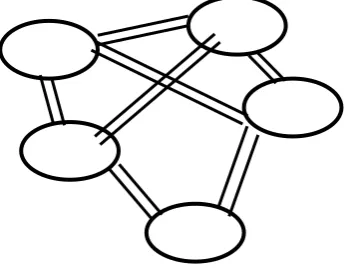
[image:5.595.86.499.382.534.2]The controlled channel model illustrated in figure 1 depicts an arrangement in which territories of expertise and knowledge are preserved and information is tightly controlled across boundaries. This results in little sharing of issues and problems outside each domain as the control of information ensures that only complete and consistent packages of understanding are transmitted in the “official” language. The effect is a strengthening and reinforcing of domain models, languages, methods and discipline cultures. Although this may produce useful results within each domain, they are protected from meaningful contact with each other and are unlikely to produce any significant insights across the problem area as a whole.
Figure 1 A controlled channel model of multidisciplinary groups
Figure 2 A negotiated overlap model of multidisciplinary groups 2
In recognising and seeking to break down the barriers erected by the controlled channel model there is room for negotiation so that there is more overlap and greater passage of information. In one form or another such a desire is likely to result in negotiation designed to blur the boundaries especially between domains that are, in any event, related. Such an arrangement is illustrated in figure 2. However, as negotiation implies each domain seeks recognition of its worth and status with territorial behaviour designed to guard and preserve the contribution from the discipline. Overlaps are likely to be negotiated but with markers laid down as to how far the overlap goes and who has the authority and status in the overlap area. In such a scenario, information transfer will remain partial and controlled but to a lesser degree than the controlled channel model.
To some extent and despite apparent funding incentives to the contrary, the maintenance of the first two approaches are supported and, indeed, encouraged by existing academic organisational and funding structures. As O’Connor et. al. (2003) remark:
“The product of the academic team is ideas. There is a disincentive to cooperate because the attribution of ideas is critical to an individual’s professional success. The ownership of ideas can become a contentions issue if not explicitly addressed.” (O’Connor et. al., 2003, p. 359).
1 [image:5.595.89.269.387.522.2]
The maintenance of distinct territories within a multidisciplinary framework (whether by individuals or discipline sub-groups) enables the ownership of ideas and their expression to be maintained clearly and is more likely to be recognised when it comes to the quality rating of individuals and institutions2. In contrast, any model of multidisciplinary working that seeks to operate as a fully integrated team where much more of the output consists of “collective work products” (Katzenbach and Smith 1993), runs the risk of diffusing the impact of the individuals and institutions involved.
There are other risks in teamwork that discourage a more integrated approach. These relate to the shear practical difficulties involved in sharing territory and seeking a less discipline focused approach to the problem area. A discipline is defined by, among other things, its knowledge base, academic standards and methods of enquiry. To embrace other traditions and to move away from the established way of doing things, carries a risk of “failure” and ignominious failure at that. Also, the risks have project management implications. Despite policy analysis advocating more multidisciplinary research and the launch of large funding regimes to support the policies adopted, the mechanisms of funding control are risk averse. The need to see that the money is well spent often dominates and since nothing upsets project management like uncertainty, it is easier to play safe and parcel out the economics to the economists, the sociology to the sociologists and the technology to the scientists and engineers3. The “you do your bit, I’ll do my bit” approach to project management militates against a team approach. Of course, the effort will be coordinated and every individual (although more likely institution) will be called to account. Individual reports will be produced as will an edited compilation but, in the end, the whole will be little more than the sum of the parts and the pools of light will have got a bit brighter but not much wider.
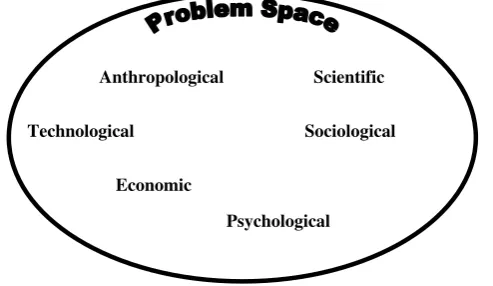
Anthropological
Economic
Sociological Technological
[image:6.595.176.423.297.440.2]Psychological Scientific
Figure 3 A Holistic model of multidisciplinary groups
In contrast, the holistic model (figure 3) seeks to operate as a team bent on producing collective understandings that are informed by but not controlled by the different disciplines involved. Clearly, any project requiring a multidisciplinary approach needs to be clear about what skills and expertise are required but the trick lies in breaking down barriers, learning each other’s language and being prepared to have others tread on one’s own turf and to do the same to them. In such a model the potential for each team member to develop expertise outside their home territory and to learn how to work in a real team is as important as the expertise they bring to the team in the first place.
If, for a significant part of the search for understanding, the holistic approach suggested by the model in figure 3 is required, the sort of questions that need to be asked are; what does it mean to break down the barriers? What does it mean to be truly multidisciplinary? What does it mean to work as a team? In addressing these and other questions we now turn to the art of collective music making to see what insights it has to offer.
3. Insights from collective music making
At first glance collective music making may seem to provide few parallels for the operation of multidisciplinary teams and teamworking. After all, is it not a routine exercise? Like dance, is it not choreographed, rehearsed, predefined, a matter of following the notes, a formula that has only one answer? In contrast, is not any multidisciplinary work (whatever the model) nonroutine, explorative and subject to change as a project progresses? At one level this may be true but to describe music in this way, as a routine activity, is to misunderstand the nature of music and music making. To sing the notes is one thing but to communicate the music is quite another. Interpretation and communication is key. In his memoirs Gerald
2
In the UK this is done through a national peer review process (the Research Assessment Exercise) applied at the level of the individual and the institution and has a marked impact on core research funding.
3
Moore4 (1962) clearly relegates the mechanical side of music making to a subservient role in the artistic endeavour.
“I am not one of those people who believe that the mechanical ability to read [music] at sight is the chief requirement of an accompanist. One can easily read at sight most of the songs of Die Winterreise but it would be monstrous to suppose one could grasp all that is in Schubert’s mind on first glance at his score. At least I, personally, am not so patronizing and I know I have not sufficient genius to be ‘at one’ with Schubert thus easily. You may read music as fluently as you read a newspaper but it does not make an artist of you and I count it just as clever to be a good stenographer.” (Moore 1962 p. 197.)
As with teams, there are choirs and then again there are choirs. There are those who follow the formula, hopping from one correct well tuned note to the next, then there are those who, in getting the notes right, do it in such a way as to communicating the music, both to themselves and to the audience. The former are like the multidisciplinary teams that apply quasi-formulaic approaches to multidisciplinary research – the academic research equivalent of note hopping. They get a result, and may even provide additional information but do not advance understanding, they merely sing the notes. The output of a choir is essentially collective, in Katzenbach and Smith’s terms (1993) a ‘collective work product’. In the best choirs there is a clear sense of teamwork with each part searching for their place in the endeavour and the choir, as a whole, searching for the music in the piece, seeking to understand what the music has to say and communicating their understanding. And this is where parallels seem appropriate.
Above all else collective music making requires shared understanding, a feature that is often referred to in the literature on multidisciplinary and interprofessional working (Lowe and O’Hara, 2000). This shared understanding may appear to originate with a musical director or conductor and there is no doubt that when a conductor is involved the leadership influence is considerable but the responsibility for the sharing lies with the individual parts and the way they interact both with each other as well as the director. The singing of madrigals, as they were designed to be sung, is a particular case where, given the lack of a conductor, the need for sharing is crucial. Originating in Italy in the 13th. century, although not fully developed until the late 16th. century, they were sung usually with one voice to a part often with the singers in a circle singing to each other. Figure 4 illustrates a typical arrangement.
Figure 4 A madrigal table (from Ledger, 1978) Figure 5 Bars 142 to 149 Beatus vir (Monteverdi
1641)
Developing the necessary shared understanding is achieved through communication, coordination and proximity. Communication is achieved through listening and eye contact (with each other around the madrigal table but more usually via a conductor) on a second by second basis and through constant rehearsal over a period of working together. Listening and eye contact provide the channels, rehearsal provides the ability to recognise what is being communicated, to act upon it and recommunicate the result. Coordination starts with the music, is developed by a leader, who may be the conductor or singer taking a similar role, and maintained through the established communication mechanisms, all of which are constantly rehearsed. Proximity, in a physical sense, is of obvious importance but, in addition, a different sort of proximity is required, a proximity of purpose, a vocal proximity in terms of the blending of tone and vowel sounds so as to develop a sound characteristic of a particular choral ensemble.
The similarities with genuine teamwork are obvious. The literature is full of exhortation to improve communication but this is often expressed in mechanical terms. What is often missing is an understanding of
4 [image:7.595.79.258.380.540.2]
the what and how of communication and the subtleties involved, together with the sort of channels that are represented, metaphorically, by listening and eye contact. Such things receive scant attention. Although multidisciplinary teams do not necessarily require the sort of physical proximity required by choral groups, they certainly need to develop their intellectual proximity, for even when contributions are different, as in the case of different vocal parts, proximity of purpose, tone and blend are more likely to lead to a more effective performance.
Like multidisciplinary teams, choirs are made up of different parts. At their most typical they consist of soprano, alto, tenor and bass parts. In some pieces, parts will subdivide and multiply, the most extreme being Tallis’s 40 part motet ‘Spem in alium’, which consists of 8 sub-choirs of 5 parts each. However, as a piece unfolds different parts assume different levels of importance. One or two parts may have the main theme or are responsible for a particularly important figure or decoration. Sometimes this may be only one note in a chord which if it does not have the required prominence reduces the effectiveness of the chord itself and the role it plays in the piece overall. Figure 5 illustrates a section from Monteverdi’s Beatus vir in which the upper parts hold a repeated ‘A’ providing a context for the lower parts to introduce a new line of the text, which they do in sequence and as each part enters the fray the other parts (helped in part by the writing itself) attempt to ‘let them in’ by ensuring that their part does not overpower the new entry, thus creating space for the repeated sequence to emerge from the texture. Even when the three lower parts have entered and seek to interact, they are conscious that in bars 147 and 148 (6 and 7 of the extract) the second tenor line has a moving figure that needs to come through. The responsibility for this lies not only with the second tenors but also with the rest of the choir.
The simple message for those who seek to work in multidisciplinary teams or, indeed, teams in general is the importance of knowing when one discipline requires more prominence than another. In music this is a matter of interpretation, usually stemming from the conductor or director. Since I am not a musicologist (a mere amateur choral singer), my interpretation of the quotation in figure 5 may have some Monteverdi experts throwing their hands up in horror. However the point remains that there is a sense of what the purpose of the piece is and a measure of agreement, within the team, about the purpose itself and who’s interpretation is to be followed. Of course, within choirs and teams who work together over a long period some of these matters are tacit as they become part of the fabric of shared understandings.
[image:8.595.59.533.382.575.2]Figure 6 Bars 188 to 192 Beatus vir (Monteverdi 1641)
Figure 7 Bars 220 to 224 Beatus vir (Monteverdi 1641)
Closely related to the idea of support and shifting prominence is that of passing the baton from one discipline to the next. This is the notion that those working in one area develop an idea or line of enquiry as far as they can before it is then taken up by other team members, shaped, remoulded and passed back for further modification, embellishment and thought. In music this is easy to see as a theme is passed around the different parts of the choir or orchestra, adding different voices, colour and tone. Figure 6, again taken from
Beatus vir, provides an example. The figure in the two soprano lines was introduced some 6 bars earlier (bar
182) by the bass line, picked up by a duet of first tenor and second soprano before being handed onto the two soprano parts, singing in thirds (bar 188 - bar 1 in figure 6) followed by the two tenor lines. Not only is the baton passed but the parts have reshaped it in subtle ways that change the effect and provide a sense of progression.
Balance, blend and tone, as well as tuning, are crucial, for it is here that the whole choir bring the psalm section to a resolution before moving into the Gloria. Of course all teams, at various points need to seek a resolution of the different strands they are pursing. They need to review their collective outputs and reflect on how far their joint deliberations and investigations have increased their collective understanding of the problem. These points may be the precursor to a shift in direction or mood, as is often the case in a piece of music, or may signal the end of a particular project (or movement), with many of the ideas and approaches being carried into the next stage.
The potential for insights from the sort of comparative analysis undertaken briefly in this paper would seem to be large. Space does not permit a full analysis even of the areas discussed above and there are other areas that could be explored, some of which are touched upon below. However, the analysis is presented in an attempt to try out the ideas and elicit debate, in the spirit of conference. In the meantime, the following list is indicative of the potential for further exploration:
• What is the role of discord? In music, discords are very important in the development of a piece and have considerable emotional power. They enable a deeper exploration than would be possible otherwise. Rather than discourage discord, music harnesses it to good effect. To what extent are teams able to see discord as a valuable tool rather than a destructive force?
• Counterpoint5 is an important musical form. It weaves an emotional spell with the different parts intertwining, each singing its own song to the enhancement of the whole. How do the contributions from the different disciplines involved in sustainability research achieve coherence within their own domains yet enhance the area as a whole?
• What is the role of individuals within the parts? We have seen already the importance of the different parts but in many team situations each part is, itself, a collection of individuals that need to blend. In choirs, particularly when they are small, blend within parts is a crucial precursor to blend between parts. It is here where conflict and discord become destructive for it becomes difficult to control.
• How are prima donnas to be harnessed? In any team it is tempting to seek to remove individualists. But in the greater scheme of things they have an important role. In collective music making the team interact with and support the individuals who have a solo part. In some groups members can be both soloist and team player depending on the role allotted in a particular piece.
• What is the leadership role? Leadership in teams can be a woolly concept. For choirs, the director or conductor provides leadership in a general way and minute by minute or second by second during rehearsal and in performance. The conductor tends to set the task and general direction of the musical programme but this can only be done, in the long term, by consent and there are subtle levels of negotiating going on all the time as both choir and conductor explore a repertoire together. For it to be otherwise would result in choir members voting with their feet or destructive conflict emerging. The conductor also provides leadership through the provision of feedback on what is achieved and what still needs to be worked on. These notions of leadership raise some interesting questions which could be usefully addressed with reference to the management and leadership literature as well as material on conducting. However leadership is more complex than this simple definition would suggest for at different times and in different ways the leadership role shifts.
4. Concluding remarks
From the outset, this paper sought a tentative exploration of what it means to tackle the issues of sustainability in a multidisciplinary way and to undertake a comparative analysis of two apparently unconnected areas (multidisciplinary teams and collective music making). Having taken the first steps, conclusions must remain tentative. As an amateur singer I have trodden on the toes of the musicologists and, probably, incurred the wrath of the conductor and musical director’s union. As a professional technologist I have trodden on the toes of management scientists and psychologists. I hope I have not upset them too much but there is no apology to be made for doing so. Singing is about being inside the sound and the song in such a way as to interact intimately with those who, although performing a different part need to twist about your sound and you theirs. This means that you tread on toes from time to time, singing (as a baritone) at the extremes of your upper range while others (usually tenors, who could sing your notes with ease) sing notes that you would be more comfortable with. And all because the composer wanted a particular sound and effect. Seeking to understand multifaceted phenomena as part of a multidisciplinary team seems to be a bit like that. To understand where technology fits into the picture requires an understanding of the cultural, economic social (and so on) aspects of the world it inhabits. This means
5
knowing enough about all the relevant domains so as to be in a position to ask appropriate questions both within and outside ones area of expertise. It is a way of learning but learning that results not only in brighter spot lights but brighter and wider flood lights.
It seems that an exploration of team work in other domains, such as collective music making, can give us something to think about. What is needed is a fuller exploration of the insights available both in theory and through empirical research, focused on how multidisciplinary academic and policy teams actually interact, frame the questions they ask, the objectives they pursue and arrive at “collective work products”. One of the highest goals of choral singing is to sing such as to suggest a single “voice”. Perhaps one of the goals of multidisciplinary teams is to think, at least at one level, as if to suggest a single, super-knowledgeable, and integrated mind.
References
Allen, N. J. & Hecht, T. D. 2004, The ‘romance of teams’: Toward an understanding of its psychological underpinnings and implications. Journal of Occupational and Organizational Psychology, 77, pp. 439–461
Bell, M., Lowe, R. J. and Roberts, P. 1996, Energy Efficiency in Housing. Aldershot, UK, Avebury,
Blackwell Science, Ltd
Brown, B. Crawford P. & Darongkamas, J. 2000, Blurred roles and permeable boundaries: the experience of multidisciplinary working in community mental health Health and Social Care in the Community. 8 (6), pp. 425–435
Cott, C. 1998, Structure and meaning in multidisciplinary teamwork. Sociology of Health and Illness, 20 (6), pp. 848-873.
Dougherty, D., 1992, Interpretive barriers to successful product innovation in large firms. Organisation Science, 3 (2) pp. 179–202.
Freeman, M. Miller, C. & Ross, N. 2000, The impact of individual philosophies of teamwork on multi-professional practice and the implications for education. Journal of Interprofessional Care, 14, (3) pp.237-247.
Katz, R., 1997, The Human Side of Managing Technological Innovation: A collection of readings. New York, Oxford, Oxford University Press.
Katzenbach, J. R. & Smith, D. K., 1993, The Discipline of Teams, Harvard Business Review, 17, pp. 111 – 120. Reprinted in Katz, 1997.
Ledger, 1978, The Oxford Book of English Madrigals, London, Oxford University Press.
Lowe, F. & O’Hara, S. 2000, Multi-disciplinary team working in practice: managing the transition. Journal of
Interprofessional Care, 14 (3), pp.269 – 279.
Lutzenhiser, L. 1992, A Cultural Model of Household Energy Consumption. Energy, 17 (1), pp 47-60.
Monteverdi, C., 1641 Beatus vir, Edited from the Selva Morale et Spirituale, Venic (1641) by J Steel, 1965, Sevenoaks, UK, Novello.
More, G. ,1962 Am I Too Loud?: Memoirs of an accompanist. London, Hamish Hamilton.
O'Connor, GC, Rice, M.P. Peters, L. & Veryzer, R.W. 2003, Managing interdisciplinary, longitudinal research teams: Extending grounded theory-building methodologies. Organization Science, 14 (4), pp.353-373
Rogers, T., 2004, Managing in the interprofessional environment: a theory of action perspective. Journal of
Interprofessional Care, 18 (3), pp. 239 – 249.
Scholes, P. A. & Ward, J. O., 1964, Concise Oxford Dictionary of Music. [2nd Ed]. London, Oxford University Press.
Stern, P.C. 1986, Blind Spots in Energy Analysis: What Economics Doesn't Say About Energy Use. Journal