d iff e r e n t a p p r o a c h e s t o n e w
p r o d u c t d e v elo p m e n t a n d t h e
v a ri a bl e s a s s o ci a t e d wi t h
m o d e lli n g t h e p r o c e s s
O w e n s , JD a n d At h e r t o n , AM
h t t p :// dx. d oi.o r g / 1 0 . 4 0 1 8 / 9 7 8-1-5 2 2 5-3 4 0 1-3
T i t l e A c o n c e p t u a l a n a ly si s o n t h e d iff e r e n t a p p r o a c h e s t o n e w p r o d u c t d e v elo p m e n t a n d t h e v a ri a bl e s a s s o ci a t e d wi t h m o d e lli n g t h e p r o c e s s
A u t h o r s O w e n s , JD a n d At h e r t o n , AM
Typ e Bo o k S e c ti o n
U RL T hi s v e r si o n is a v ail a bl e a t :
h t t p :// u sir. s alfo r d . a c . u k /i d/ e p ri n t/ 4 5 1 7 1 /
P u b l i s h e d D a t e 2 0 1 8
U S IR is a d i gi t al c oll e c ti o n of t h e r e s e a r c h o u t p u t of t h e U n iv e r si ty of S alfo r d . W h e r e c o p y ri g h t p e r m i t s , f ull t e x t m a t e r i al h el d i n t h e r e p o si t o r y is m a d e f r e ely a v ail a bl e o nli n e a n d c a n b e r e a d , d o w nl o a d e d a n d c o pi e d fo r n o
n-c o m m e r n-ci al p r iv a t e s t u d y o r r e s e a r n-c h p u r p o s e s . Pl e a s e n-c h e n-c k t h e m a n u s n-c ri p t fo r a n y f u r t h e r c o p y ri g h t r e s t r i c ti o n s .
1
A Conceptual Analysis on the different approaches to New product
Development and the Variables Associated with modelling the process.
Jonathan D Owens PhD* and Andrew M Atherton PhD **
*University of Salford, UK. **Lancaster University, UK.
Abstract
Globally, new products are launched almost every day. They are developed to provide solutions to common or specialised problems; to enrich our lifestyle; to release us from mundane and monotonous jobs; to give reliable alternatives to old solutions; to amuse us; to provide items that are more pleasing to the eye; to be more ecologically aware etc. What the companies that develop, design, manufacture, market and sell these products are seeking is commercial compensation in the short, medium or long term “success” however you measure it. Subsequently, New Product Development is a major issue for most companies as they seek to reduce time to market, reduce the development cycle, access new technologies and develop more and better products and services. As the development of such new products that can successfully compete in local, national and global markets has thus become a key concern for the majority of companies, so successful NPD is now being seen as a fundamental to both stimulating and supporting economic growth. It is therefore a subject, which has received and continues to receive much attention, particularly in seeking to improve its effectiveness and efficiency. Therefore, paper reviews the New Product Development (NPD) process and considers the variables associated with the different approaches, which may be needed when developing a new product.
Keywords
New Products, New Product Development, New Product Development Processes, New Product Development Modelling, New Product Introduction.
Introduction
In the hotly competitive global environment of the twenty-first century New Product
Development (NPD) is being seen as a major consideration for most organisations (Cooper,
2011, 2008; Dillon et al, 2005; Song and Benedetto, 2008; Smith, 2011; Schmidt et al, 2009). Across the global business arena, it is seen as one of the key areas for focus, as companies
seek to reduce time-to-market, access new technologies in order to develop more and better
new products and services. As the development of such new products and services which can
compete in local, national and global markets has thus become a key concern for most
companies, so successful NPD is now more than ever being seen as a fundamental business
tool to stimulating and supporting economic growth (Owens and Atherton, 2015). It is
therefore a subject that has received and continues to receive much attention, particularly in
2 Product Development (NPD) process and considers the variables associated with the different
approaches that could be considered when developing a new product.
Developmental and Importance of New Products
Various researchers (Beard and Easingwood, 1996; Cooper and Edgett, 2003; Akgun et al, 2005; MacCormack et al, 2012) have identified NPD as a critical element of business strategy for most companies. Even companies that do not wish to grow will still be at risk
from competitors, new technologies and the changing needs of customers if NPD is not
undertaken (Cooper, 2011). The industrial revolution changed the social-economic structure
of Britain and the world. Prior to this, products were usually made and sold within a region,
customer needs were easily communicated between the parties involved (as everything was
virtually hand-made and made-to-order) and flexibility and uniqueness were almost certain.
Investment in machinery and large factories prompted the development of new towns and
cities. No area in Britain reflects this more than Lancashire with its cotton mills, where the
customer and vendor operated geographically and relied upon brief descriptions and third
parties to produce a marketable product. Mass production reduced the standard cost of
products and opened the market to more customers. Henry Ford was the first great global
exponent of this in 1913 with the production of the Ford Model T. Other automotive
manufacturers adopted mass production techniques and although the motorcar was still a
luxury item then, it became more accessible to a wider market. Technological advances,
customer preferences and economic developments have changed the automotive industry into
a highly competitive market. Research and development departments are constantly looking
for variants, modifications and improvements that will attract a larger portion of the market
(Li, 1999; Petrie, 2008). As a result, companies that do not adapt to and satisfy customers’
needs generally fail (Cooper and Kleinschmidt, 2007; Gerwin and Ferris, 2004). The
automotive industry is not unique in having to constantly change; indeed, most industry
sectors are under increasing pressure to modify and improve their product ranges (Van
Echtelt et al, 2008). Competition dictates that a larger share of, or the maintenance of a current position in the market place, will only be achieved by offering a more attractive
3 The Sourcing of New Product Ideas.
The idea for a new product can originate from many sources (Cooper, 2011); for example,
customers, employees, current products, competitors etc. The problem occurs in determining
which products to develop and which to avoid. The risk of failure should not discourage the
introduction of new products, however, though careful product screening should be utilised
throughout when instigating development (Balasubramanian and Baumgardner, 2004;
Holstrom et al, 2006; Johnsen, 2011). Cooper (2008) suggests the first stage of screening should avoid two types of error, these being:
1 NO-GO error – Dismissal of a good idea.
2 GO error – The development of a poor idea.
For example, research by Havener and Thorpe (1994) indicates that an assessment of a
product should be thorough and must take into account much more than just the financial
gain. They discuss the cases of both the fax machine and Post-it® notes, which would have
been rejected if only the cost analysis had been undertaken.
The New Product Development Process
Theory on the introduction of new products concentrates on the development process from
innovation to introduction to market (Hutlink and Hart, 1998; Goffin and Micheli, 2010).
Concurrent engineering, design methods, technology applications and a range of other
techniques that ensure the new product meets the customer requirement. However, new
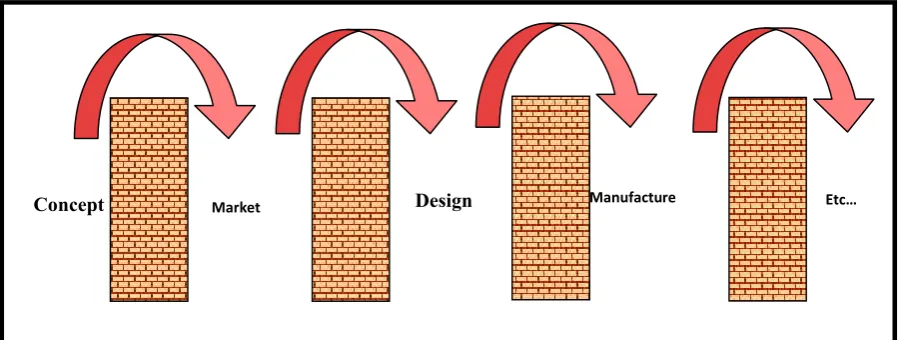
products can still fail in manufacturing terms as they are pushed ‘over the wall’ (Owens and
Davies, 2000) with all the correct documentation, but little or no explanation of what it is
intended to be used for. Subsequently, a reoccurring theme within in the literature supports
the development of a structured and clear road map of the NPD process can help reduce this
failure and the understanding of product newness categories. Figure 1presents a product
typology of ‘newness’ categories. Specifically, product design and development is the
4 New to the World Products.
These new products are the first of their kind and create and entirely new market. Examples of products in this category are the Sony Walkman and 3M’s Post-It notes. This category represents up to ten percent of all new products.
New to the Company.
These are products new to a company, but not to the marketplace, enabling a company to enter an established market for the first time. For example, IBM was not the first to launch an office version laser printer, Hewlett Packard (HP) were, therefore it was not an innovation, but it did however represent a new product line for IBM. Approximately twenty percent of all new products correspond with this category.
Additions to existing Product Lines.
These are new items to a company and fit within an existing product line the company manufactures. They may also represent a fairly new product to the market place. For example, the introduction of HP smaller and considerably less expensive version of its laser printer, that was suitable for home computers. The printer was a new item to the LaserJet line. This product type represents approximately twenty-six percent of all new product launches.
Improvements in revisions to existing products.
These are essentially replacements of existing products. They offer improved performance or greater perceived value over the previous product. Similarly, this product type can represent up to twenty six percent of all new product launches.
Repositioning.
These are essentially new applications for existing products, and involve retargeting an old product to a new market segment for a different application. For example aspirin was considered a standard reliever for headache and fever symptoms, but due to safer, more effective and cheaper products it (aspirin) was superseded. However, new research demonstrated this product had other benefits, and resulted with the aspirin being marketed as prevention against blood clots, strokes and heart attacks. This product type can account for up to seven percent of all new product launches.
Cost Reductions.
These are new products designed to replace existing products in the line, and can yield similar benefits and performance. From a marketing perspective they are not new products but from a design and production perspective, they could represent significant change to the company. This product type can account for up to eleven percent of all new product launches.
Figure 1 The Classification of New Products (Cooper, 2005).
‘Good design’ can be achieved when the product not only looks good, but it also does the job
well (Kalyanaram and Krishnan, 1997; Jang et al, 2009; Hsu, 2006). Therefore, “designing” is differentiated, because it is a tool which can be applied during NPD to help turn an
invention into a successful product, or to extend the usefulness of an existing innovation
(Goffin and Micheli, 2010; Holstrom et al, 2006; Osterlund, 1997). Subsequently, NPD is a most appropriate term for this research, because it relies upon “design” activities carried out
5 In order to undertake NPD, it would be prudent to have “a formal blueprint, roadmap, template or thought process for driving a new product project team from the idea stage through to market launch and beyond” - a formal NPD process (Cooper, 2005, 2011; Kleinschmit et al, 2007). However, as with many other things in the business world, a definitive process that provides continual success has not been forthcoming. This section
reviews some of the different models that have been put forward to describe the process and
further examines activities, methods and techniques, which have direct relevance to the area
of developing quality products.
Modelling the New Product Development Process
There are numerous examples of previous research (Bhaskaran and Krishnan, 2009; Hsu,
2006; Ogama and Pillar, 2006; Perks et al, 2005) where they have attempted to monitor the progress of the new product both prescriptively and descriptively. In addition, some
researchers (Danese and Filippini; 2010; Schmidt et al, 2009) who are focussing on NPD process models often form dissimilar opinions as to their structure. That said there is
agreement amongst researchers in that a generic NPD model cannot be created. However, an
agreed commonality is from established research by Saren (1984) are the following five
categories:
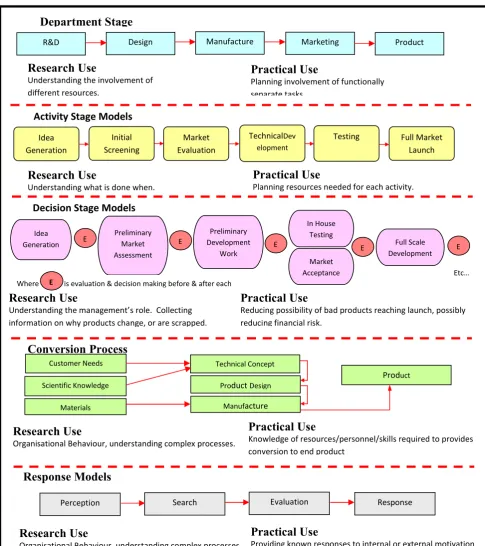
1. Departmental-stage models. 2. Activity-stage models. 3. Decision-stage models. 4. Conversion process models 5. Response models.
Figure 2 provides a summary of these different models by type. Discussion points on the
usefulness of each model for research work and their practical use in the management of
NPD are also illustrated.
Saren (1984) suggests that dividing methods into groups provides a useful point for an
examination of how each model might purposefully be used in research; for example, who is
involved in the innovation; at what point and in what order specified tasks are undertaken;
upon what basis decisions are made; how inputs to a process become outputs; or the reactions
to specified stimuli. However, he concluded that although each individual model is valid, in
6 Figure 2 A summary of some NPD process models (Saren, 1984).
on the holistic process of innovation in companies; this is something that is reiterated in more
research carried out by Cooper and Kleinschmidt (2007).
Etc…
R&D Design Manufacture Marketing Product
Department Stage
Research Use
Understanding the involvement of different resources.
Practical Use
Planning involvement of functionally separate tasks
Research Use
Understanding what is done when.
Practical Use
Planning resources needed for each activity.
Decision Stage Models
Idea Generation
Preliminary Development
Work E Preliminary
Market Assessment
E E
In House Testing
Market Acceptance
E E Full Scale
Development Activity Stage Models
Research Use
Understanding the management’s role. Collecting information on why products change, or are scrapped.
Practical Use
Reducing possibility of bad products reaching launch, possibly reducing financial risk.
Conversion Process
Scientific Knowledge Customer Needs
Materials
Technical Concept
Product Design
Manufacture
Product
Research Use
Organisational Behaviour, understanding complex processes.
Practical Use
Knowledge of resources/personnel/skills required to provides conversion to end product
Full Market Launch Idea Generation Testing Initial Screening Market Evaluation TechnicalDev elopment Response Models
Perception Search Evaluation Response
Research Use
Organisational Behaviour, understanding complex processes
Practical Use
7 More recent research by Noke and Hughes (2010) uses the nineteen sixties phased
development model as a starting point for a comparison with some of the NPD process model
ideas, which have been progressing from the late nineteen eighties in to the twenty first
century. They (Noke and Hughes, 2010) also claim that modern stage gate methodologies,
product and cycle-time excellence; and total design as the main examples of advancement in
processes aimed at improving product success. Since there is a number of different ways to
model the NPD process, and each way has associated with it its own specific strengths and
weaknesses, this paper will discuss those that are recurrent in the most recent literature.
Subsequently, the remainder of this paper will consider the origins, uses and limitations of
five NPD modelling techniques, which are common and progressive:
1. Stage gate models.
2. Multiple convergent process. 3. Product and cycle-time excellence. 4. Total design.
5. Third generation NPD process.
The Stage Gate Model
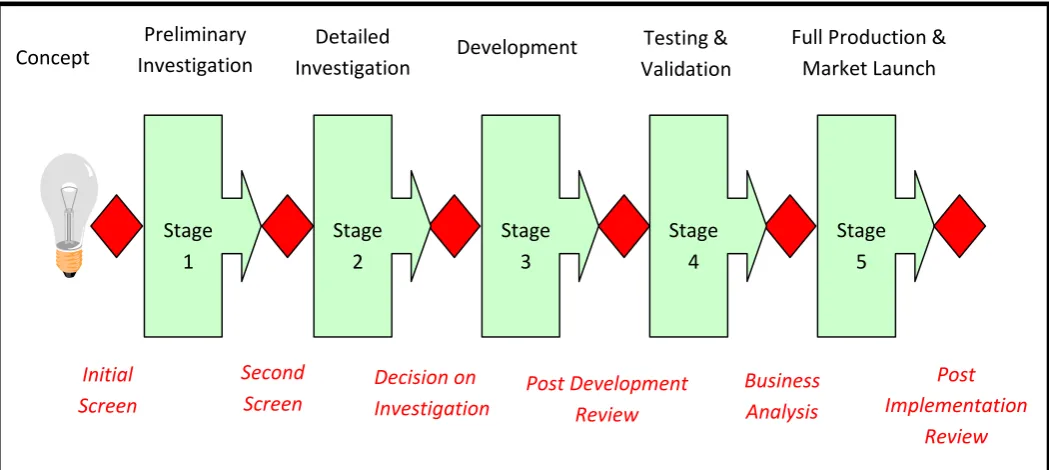
The stage gate model breaks the NPD process into discrete identifiable stages, with each
stage being followed by decision gates as illustrated in figure 3. The number of stages can be
increased to harmonise with both company and product development requirements. Each
stage is designed to gather information required in order to progress the new product onto the
next stage of development. In addition, each stage consists of a set of parallel activities
undertaken by personnel from different fictional area within the business, but working
together as a team. Subsequently, to manage risk via a stage-gate process, the parallel
activities within a stage should be designed to gather important information as to drive both
technical and businesses uncertainties associated with the new product, thereby facilitating
built in feedback loops (Zhao et al, 1999; Atilgan-Inan et al, 2010). In recent years some researchers (Dayan and Basarir, 2010; Smith, 2011; Troy et al, 2008; Fu; 2010) have suggested that successful product development is aided by following a stage gate decision
process because it encourages activities to be undertaken by a core team of representatives
from all functional departments. The stage gate models may help the reader to understand the
management of the process and may also help prevent losses being made by revealing most
errors early on, and before market launch, the products which will fail in an industrial
situation by reducing failure risk in the comprehensive review implemented at the gate of
8 Figure 3 Overview of a Stage-Gate NPD process (Cooper, 2008, 2011).
However, the model does not lead us to a means of ensuring that the product will meet the
need of the user(s), or indeed the final customer. This type of system does have the potential
to include “go/no-go” decisions, based on whether the product is being designed to a high
enough quality and one that will satisfy the user(s) and ultimate customer. On the other hand,
without elucidation from someone providing a customer needs compliance emphasis, there is
not necessarily any strong incentive to use this as a basis for what the product “must meet”
or “should meet” when product management decision are being made at each of the gates.
Although, this model can be seen widely in practical use today in some industrial
organisations (Cooper, 2008; Owens, 2007, 2009; Smith, 2011) there are some general
problems which occur when following a stage gate model which are indicated by Cooper
(1999; 2005; 2008). He adds later (Cooper, 2011) that even though the idea has been taken
up in the last two decades with positive effect, stage gate process models are still not really
usable because they are too time consuming, often have too many ways of waiting time, are
too bureaucratic and have no provision for focus. Also, one author (Himmelfarb, 1992, p.10)
provides a fairly severe and emotive set of comments by claiming that it “creates products that are hard to make, that cost too much, that require too many expensive design changes, and that may or may not meet marketplace needs. It encourages isolation of functional areas and, worst of all, it’ very slow.” It should be noted that these observations do not bode well
Preliminary Investigation
Detailed
Investigation Development
Testing & Validation
Full Production & Market Launch Concept
Initial Screen
Second Screen
Decision on Investigation
Post Development Review
Business Analysis
Post Implementation
Review
Stage 1
Stage 2
Stage 3
Stage 4
9 for the extra and important inclusion of both usability and customer needs compliance in this
particular process model.
The Multiple Convergent Model
A key limitation of the stage-gate model and linear NPD process in general is the interaction
between the people involved within the process (Griffin, 1997; Shenhar, 2001; Hart et al,
2003; Petrie, 2008). One such method that helps address this interaction difficulty is the
Multiple Convergent Model. It looks at differing approach to integrate people, both directly
and explicitly, into the NPD process, thereby taking into consideration the documented
limitations in other NPD process models (Brown, 2008).
The model takes into account the lessons learned that suggest that success comes from having
quality inputs which are valid from multidisciplinary areas (Troy et al, 2008). There is much importance placed on the use of networks and the production of a model that breaks down
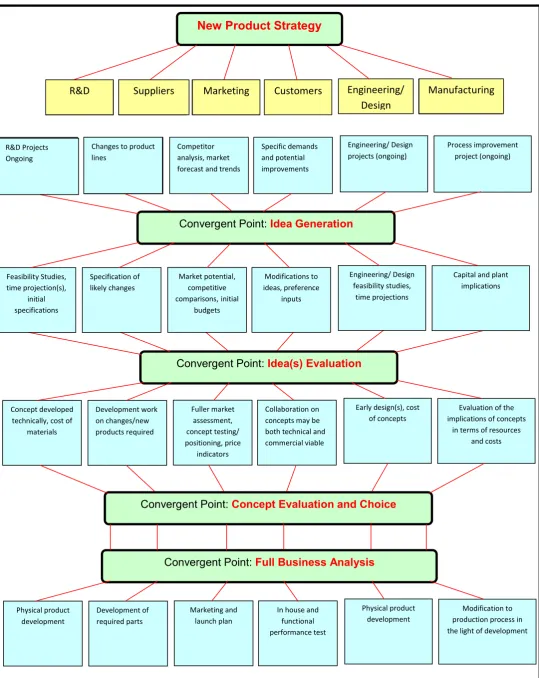
multidisciplinary boundaries (Newey and Verreynne, 2011). The models views NPD as tasks
with areas moving towards a common conclusion, but are required to come together at a
number of different natural and integrative points for evaluation, as illustrated in figure 4. In
this way the multiple convergent model is similar to the stage gate models. However, where
it differs is that the convergent model has multiple points, which it recognises as important to
an iterative process. According to Hart (1995) the advantages of taking the process as a
series of converging points for evaluation, followed by diversion into functional activities
are:
It accommodates iteration.
It allows for iterative communication and evaluation within the functional groups.
The framework can accommodate third parties easily.
Methods for real integration of work from functional groups can be provided in the convergent points.
Despite the model being driven by converging points, the main disadvantage in practical use
appears to be, ironically, that it may be too divergent. It converges for cross-functional
decisions, but then separates out into each of the different functions to carry out the tasks.
Hart et al (2003) describes a key element as the amount of information sharing that is modelled, however, horizontal communications between functional areas, are only modelled
as happening during the evaluation or collation points and not during other activities. With
10 Figure 4 The early stage of the multiple convergent model (Hart and Baker, 1996).
R&D Suppliers Marketing Manufacturing
R&D projects (ongoing)
Changes to product lines
Convergent Point: Idea(s) Evaluation
Concept developed technically, cost of
materials
Development work on changes/new products required
Evaluation of the implications of concepts
in terms of resources and costs Fuller market assessment, concept testing/ positioning, price indicators Collaboration on concepts may be both technical and commercial viable
Early design(s), cost of concepts
Convergent Point: Concept Evaluation and Choice
Convergent Point: Full Business Analysis
Physical product development
Development of required parts
Modification to production process in the light of development Marketing and
launch plan
In house and functional performance test
Physical product development New Product Strategy
Customers Engineering/ Design
R&D Suppliers Marketing Manufacturing
Process improvement project (ongoing) Competitor
analysis, market forecast and trends
Specific demands and potential improvements
Engineering/ Design projects (ongoing)
Convergent Point: Idea Generation
Feasibility Studies, time projection(s), initial specifications Specification of likely changes
Capital and plant implications Market potential, competitive comparisons,initial budgets Modifications to ideas, preference inputs Engineering/ Design feasibility studies, time projections Changes to product
lines R&D Projects
11 to be conducive with efficiency and it seems to require a large amount of management effort
to keep the process on track.
The Product and Cycle-Time Excellence Model
As a supplementary to the multiple convergent model there are alternative modelling
approaches whereby the prime focus is to reduce the time-to-market, subsequently,
concentrating on how to influence the economic outcome of the design process. The product
and cycle-time excellence model McGrath et al (1992) is an example of this. It is similar to the stage-gate approach (Petrie, 2008), except that during the phase reviews the decisions are
not made by a NPD team involved with developing the new product, but by a small number
of senior managers who are the ‘Product Approval Committee’ (Brown, 2008). Under
product and cycle time excellence, the process is seen as a funnel taking in lots of ideas,
following the completion of five phases, producing new products, as illustrated in figure 5.
In an attempt to reduce the time it takes to develop a new product, the productivity model
breaks down each of the five phases in the process into fifteen or twenty steps and then each
of these steps into ten to thirty tasks. Database records can be kept on the timing for each of
the tasks and thus the total development time can be judged for each new product (Suomala
and Jokioinen, 2003).
The productivity and cycle time concepts also pay attention to the management of the process
in more holistic ways. Of the seven major elements for this model, four (Jenkins et al, 1997) are directly overseeing the whole of the product development process in the company:
1. The provision of core teams during development 2. The use of a product strategy
3. The review and correct implementation of technology management 4. The endorsement of cross project management
The authors of the product and cycle time excellence model also advocate the use of design
techniques and automatic development tools that will help focus and streamline the
development of the product (McGrath et al, 1992).
The product and cycle time excellence model is more than just a definition of the
development process. It is aimed at efficiently managing the development of new products
such that the product is produced on time and within budget, whilst using the optimum
12 Figure 5 The phase review process within the product and cycle time excellence model (Jenkins et al, 1997).
2005; Troy et al, 2008). However, these types of models, which are driven by productivity and cycle time reduction, rely upon putting senior management in an overriding position of
authority and also upon splitting down the design process to a level so low that it can be
timed. As well as the obvious philosophical discussions about specifying exactly the creative
nature of design that these issues incite, both of these ideas seem regressive and are Pilot production,
customer field trials, test marketing
Inexpensive and fast qualitative
Build business case detailed market analysis, financial analysis
Phase 4 Go/Redirect/Kill
Product Release:
Phase 2 Go/Redirect/Kill
Design and Development:
Phase 0 Go/Redirect/Kill
Concept Evaluation:
Phase 1 Go/Redirect/Kill
Specification and Planning:
Phase 3 Go/Redirect/Kill
Testing and Evaluation:
Product is developed, prototype(s) produced
Tooling and full production launch, develop market IDEAS
13 reminiscent of the work-study principles, based on Taylorism, which had its ‘glory days’ at
the beginning of the twentieth century.
Total Design
“Total design is seen as a broadly based business activity in which specialists collaborate in the investigation of a market, the selection of a projects, the conception and manufacture of a product, and in the provision of various kind of user support.”
(Pugh and Moreley, 1988, p1)
The models discussed previously in this paper revolve around breaking down the process into
manageable portions by seeing the development process as a series of problems to be solved
(Brown, 2008; Kleinschmidt et al, 2007; MacCormack, 2012). Various authors (Hart et al, 2003; Baldwin and Clark, 2000; Griffin, 1997; Moultrie et al, 2006; O’Dwyer and Ledwith, 2009; Nicholas et al, 2011) have criticised the way of focussing on parts of the problem and solving them one-by-one because they have found that they are often used without paying
sufficient attention to the aspects of assimilating all of the problems together. A slightly
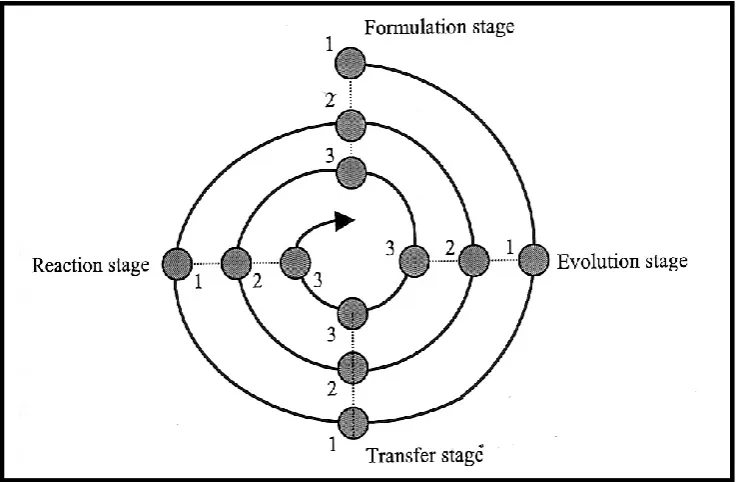
different outlook to view design and development as a converging spiral, the spiral from of
the design process attempts to emulate real-life, in that the design process is evolving
(Oakley, 1990). The spiral moves from a formulation stage, to an evolution stage, through to
a stage where transfer takes place and is followed by a reaction stage that returns the
development to the formulation stage, as illustrated in figure 6. This is different to other
series or stage gate models as it relies upon interactive and overlapping stages that evolve.
The spiral form was a depiction used for Acar’s (1966) triple-helix model of the product
development process, which can be cross-sectioned at any point to reveal the interaction
between specification, conceptual design and embodiment design. In the total design model
championed by Pugh and his colleagues, the spiral is taken into more depth (Pugh, 1991;
Pugh and Moreley, 1988; Hollins and Pugh, 1990).
The development of the total design model and subsequent publishing of Pugh have
stimulated much discussion within engineering design circles (Brown, 2008; Goffin and
14 Figure 6 A spiral model of the design process (Oakley, 1990)
engineering courses, especially because it emphasises the use of many different discipline
independent tools and methods (Goffin and Micheli, 2010).
The total design model outlines six nominal spirals, which attempt to capture the main
undertakings during the design process, all within an iterative environment. These ‘design
cores’ are presented by Pugh (1991) as:
Investigation of market/user needs and demands
The development of the product design specification
Conceptual design
Detailed (technical) design
Manufacture
Selling (marketing)
Figure 7 illustrates how Pugh visualises the whole package of design activities, within a
“…framework of planning and organisation…and how they fit into a business structure”
(Pugh, 1991, p8).
The total design and its embellishment with detailed information on how to approach each of
the “design cores” goes a long way to assist engineering designers practically undertake
product design systemically. Pugh and his colleagues have devoted much literature (Pugh
[image:15.595.92.464.82.323.2]15
Figure 7 The Total Design Activity Model (Pugh, 1991, p11)
that can be used in conjunction with the total design philosophy. The model does
acknowledge and capture many of the complexities of NPD and attempts to attract a cross
disciplinary audience. It also explicitly acknowledges the place of design within the
16 explaining business requirements to a technical audience, rather than explaining technical
issues to a business audience.
The market and user needs “design core” does not clarify well enough for an inexperienced
company or researcher to fully comprehend the importance of meeting customer needs to the
success of the product (Carbonell and Rodriguez, 2006). However, having said that, there are
numerous issues that have arisen from studying this approach, such as the strong emphasis on
the Product Design Specification (PDS) and the recognition of informal paths of
communication within the design team (Brown, 2008).
Requirements Capture Process Model
The requirement capture model developed by Cooper et al (1999) captures the understanding of both the individual and the team who are involved in the development of the new product,
and how these understandings relate to the customer requirements. This process is illustrated
in figure 8. It considers the internal and external variables of the new product comprehension
by the parties involved in the NPD process, and how these may influence the data
interpretation. Subsequently, the parties involved review the outputs from three levels:
1. Acquisition of data 2. Transformation of data 3. Generation of requirements
It focuses on where there is a collaborative comprehension of customer requirements and
needs, in order to produce an agreed outcome and set of requirements. Although established,
Cooper et al (1998) research is still a useful benchmark in that it provides a focus on dealing with information provided by the customer, in order to establish clear definition by the NPD
team as to what the customer requires. Some key issues that are addressed in the model are:
Different views and understandings (perceptions) of the same data are included
Activities and events change the understating (perception) of a customer requirement(s)
Data acquisition and transformation events are required to gain an agreement on the
17 Figure 8 Theoretical requirements capture process model (Cooper et al, 1998, p 510).
Third Generation New Product Processes
The phase development models of the nineteen-sixties are referred to as the first generation of
defined product processes (Dillon et al, 2005). The phase review process advocates sequential development stages, each carried out by different functional groups that complete
18 (illustrated in figure 9) processes because development is handed onto the next group, when
[image:19.595.71.521.144.314.2]the last is finished.
Figure 9 “Over the wall” Concept (Owens and Davies, 2000).
The second generation of product development processes are the processes of today – which
are mainly based upon stage gate type models involving a cross discipline structure of one
type or another (Troy et al, 2008). According to Cooper (2008) the third generation are the future way in which products should be produced. He suggests these third generation
processes are relatively ill defined because they are still in development and should be
developed and grown around the specific company. They are driven by the need to
efficiently create new products and get them to market as quickly as possible, but with a
much greater tolerance for calculating risk taking, which is a conflicting view to that of the
previously discussed models driven by cycle time (Carbonell and Rodriguez, 2006; Chan,
2010).
Cooper et al (2002) suggests there is a distinct need to redress the balance from a restrictive linear process that only moves the product development forward when a decision is made on
the outcome of a preceding activity, as illustrated in figure 10. The ideas put forward by
these third generation models tie in with the management practices of concurrent and
simultaneous engineering.
This model would, inevitably require integration through software, hardware and ‘human
ware’ or team facilitation (Ogama and Pillar, 2006; Reid and Brentani, 2004). It will
allegedly work from a premise that attempts to maintain discipline, but allows a balance of Manufacture
Design
19 Figure 10 Third Generation Process (Cooper, 2011).
action thoroughness and the need to move quickly (Cooper and Edgett, 2003). To answer
problems that may arise from this basis of reasoning, four fundamental ‘F’s’ have been
defined (Cooper, 2011):
1. Fluidity. The model is fluid and adaptable, with overlapping and fluid stages for greater speed.
2. Fuzzy Gates. The model features conditional go decisions (rather than absolute ones), which are dependent on the situation.
3. Focused. The model builds in prioritisation methods that look at the entire portfolio of projects (rather than one at a time) and focuses resources on the “best bets”.
4. Flexible. The model is not a rigid stage gate process; each project is unique and has its own routing through the process.
The implications from the use of such a model is that everything becomes so much more
difficult to define in absolute terms, making devising and understanding the product
development process a more daunting task (Zollo et al, 2002). As a project progresses, the decisions made will be more complex and sophisticated and may be hard to place in context
if the stages overlap too readily (Gerwin and Ferris, 2004). Thus, falling into an ad-hoc
free-for-all system of product development seems a distinct possibility. Later Cooper (2005) also
made some of these observations and suggests that this model will only work within a
framework based on the second-generation stage gate models. He does not advocate a
withdrawal from stages and gates, instead he realises that to make these systems really work
product development should allow much more flexibility. A potential way of achieving this
could be a move towards reducing the authoritative role of senior management and pushing
the decision-making role of the NPD project team members and leaders (Jorgensen and
Messner, 2009; Rodriguez et al, 2008).
Validate Test & Development
Business Case Investigation
Preliminary
Stage 4 Stage 3
Stage 2 Stage 1
Gate 2
Gate 1 Gate 3 Gate 4 Gate 5
etc.
20 Summary: The usefulness of a NPD process modelling approach
The previous commentaries show the immense profusion and disparity as to the different
approached to modelling the NPD process. This is by no means a definitive discussion, but
rather a reflection to direct the reader to the vast multiplicity that exists in this field. The
need to observe and comprehend the differing modelling approaches, and how one might
portray the NPD process is that of practicality. For example, if one can somehow capture
what a business does, and can realise the path the product development process takes, then
perhaps it may be possible to have an improved and useful comprehension of how to enhance
and improve the NPD process, then it may be possible to secure tangible benefits. Past
research has suggested that positive consequences result from the existence of formal NPD
processes. Also, research (Cooper, 2011; Moultrie et al, 2006; Petrie, 2008; Sethi, 2000) has suggested that the lack of understanding and implementation of product development
processes in industry can account for poor product development performance.
Since many product development authors and practitioners have reported these positive
results, it is no wonder that they are driven to try and capture the essence of good product
development practices and processes. Therefore, in an effort to make the task of modelling
the process more manageable, different authors have tried to summarise their complexities by
generalising and minimising differences between companies and products (Noke and Radnor,
2004; Johnsen, 2011). However, because of this, the models are often only a representation
of the process and are regularly produced by individual researchers as tools to investigate
specific phenomena that occur during product development. Also, the reality of producing
working models is the consideration of differences, which occur between what the literature
describes and/or prescribes and what is actually done in reality because the nuances within
each company are so difficult to encapsulate (Cooper et al, 1998; Jorgensen and Messner, 2009).
Given the plethora of product development models available and reviewed here, it would be
reasonable to assume that there would be one, which specifically follows a customer’s need
through product development. However, although many pay more than just ‘lip-service’ to
customer needs. None have been found that depict the whole of the process for NPD, with
explicit emphasis on customer needs compliance. The closest is a descriptive list suggested
21 addressed is illustrated in table 1. This is a useful list, and does highlight different periods of
need recognition, assessment and appraisal. Yet, it does not get to grips with the essence of
product development interaction, process, iteration and communications required. These are
issues that are being investigated in this research to be able to understand at least some of the
facets of customer needs compliance during the product development process.
Need Identification A problem or a user need is perceived, often in a vague form. This is usually the initiation of the product innovation process.
Need Evaluation Based on available information, the perceived need is analysed and evaluated; for example in connection with preparation of the proposal.
Need Clarification This involves a systematic study of the user needs involved. It may be undertaken in connection with a feasibility study in the last part of the idea generation stage.
Need Specification Based on assessed needs and their relative strength, relevant need requirements are specified.
Need Up-Dating As the project moves ahead, the needs specified are up-dated at intervals in connection with development of the technology and planning of the marketing and manufacturing operations.
Table 1 Model of the need assessment process (Holt et al, 1984).
Considerations for Further Research
In summary, it is perhaps apparent various researchers have provided a lot of different
methods for depicting the NPD process. Although, one important finding is so far none of
the methods have been specifically developed for the following customers’ needs through the
NPD process from concept to launch. However, the representation of the linkages within
NPD practice that these models demonstrate is perhaps a useful starting point for further
examination, as long as they are taken within their context and understanding of their
limitations. Therefore, in order to advance this research, a review of the literature
incorporating management and information provision for customer needs compliance issues,
22 References
Acar, B S (1966). “A new model for the design process.” Proceedings of the Institute of Mechanical Engineers, Series E, no. 210, pp 135-138.
Ahmed, P X (1998). “Culture and climate for innovation.” European Journal of Innovation
Management, vol. 1, no. 1, pp 30-43.
Akgun, A E, Byrne, J; Keskin, H and Lynn, G S (2005). “Knowledge networks in NPD
projects: a transactive memory perspective.” Information and Management, vol. 42, pp.1105-1120.
Atilgan-Inan, E; Buyukkupcu, A and Akinci, S (2010). “A content analysis of factors
affecting NPD process.” Business and Economics Research Journal, vol. 1, no. 2, pp. 87-100.
Baldwin, C Y and Clark, K B (2000). Design Rules: The Power of Modularity. MIT Press,
Cambridge, MA, USA.
Barczak, G; Griffin, A and Khan, K B (2009). “Trends and drivers of success in NPD
practices: results of the 2003 PDMA best practice study.” Journal of Product Innovation Management, vol. 26, no. 1, pp. 3-23.
Beard, C and Easingwood, C (1996). “New Product Launch: Marketing Action and launch
tactics for high technology products.” Journal of Industrial marketing Management, 25, pp 87-103.
Bhaskaran, S R and Krishnan, V (2009). “Effort, Revenue and Cost Sharing Mechanisms for
Collaborative NPD.” Management Science, vol. 55, no. 7, pp. 1152-1169.
Booz, Allen and Hamilton (1991). New Product Management. Booz, Allen and Hamilton
Inc., New York, USA.
Brown, T (2008). “Design Thinking.” Harvard Business Review, vol. 86, no. 6, pp. 84-92.
Carbonell, P and Rodriguez, A I (2006). “The impact of market characteristics and
innovation speed on perceptions of positional advantage and new product performance.” International Journal of Research in Marketing, vol. 23, pp. 1-12.
Chan, H C (2010). “Linkage community based innovation and speed to market: The
mediating role of the NPD process.” The International Journal of Organisational Innovation, vol. 2, no. 4, pp.49-60.
Cooper, R G (1999). “From Experience: the invisible success factors in product innovation.”
Journal of Product innovation Management, vol. 16, no. 4, pp. 333-351.
Cooper, R G (2005). Product Leadership: Pathways to Profitable Innovation. NY, Basic
Books.
Cooper, R G (2008). “The Stage-Gate® idea-to-launch process update, what’s new and
NexGen systems.” Journal of Product Innovation Management, vol. 25, no. 3, pp. 213-232.
Cooper, R G (2011). Winning at New Products: Creating Value through Innovation, 4th
Edition. Basic Books.
Cooper, R G and Edgett, S J (2003). “Overcoming the crunch in resources for new product
development.” Research Technology Management, May/Jun, vol. 46, no. 3, pp. 48-59.
Cooper, R G and Kleinschmidt, E J (2007). “Winning businesses in product development:
Critical Success Factors. Research Technology Management, vol. 50, no. 3, pp. 52-66.
Cooper, R G; Edgett, S J and Kleinschmidt, E J (2002). “Optimising the stage-gate process:
What best practice companies do – II.” Research Technology Management, Nov/Dec, vol. 45, no. 6, pp. 43-51.
Cooper, R; Wooton, B and Bruce, M (1998). “Requirements Capture: Theory and Practice.”
Technovation, vol. 18, no. 8/9, pp. 497-511.
Danese, P and Filippini, R (2010). “Modularity and the impact on new product development
time performance: Investigating the moderating effects of supplier involvement and interfunctional integration.” International Journal of Operations and Production Management, vol. 30, no. 11, pp. 1191-1209.
Dayan, M and Basarir, A (2010). “Antecedents and consequences of team reflexivity in NPD
23
Dillon, T A; Lee, R K and Matheson, D (2005). “Value Innovation: Passport to wealth
creation.” Research Technology Management, Mar/Apr, vol. 48, no. 2, pp 22-36.
Fu, Y K (2010). “New Product success among SME’s: An empirical study in Taiwan.” The
Journal of International Management Studies, vol. 5, no. 1, pp. 147153.
Gerwin, D and Ferris, S J (2004). “Organising New Product Development Projects in
Strategic Alliances.” Organisation Science, Jan/Feb, vol. 15, no. 1, pp. 22-38.
Goffin, K and Micheli, P (2010). “Maximising the value of Industrial Design in NPD.”
Research Technology Management, vol. 51, pp29-37.
Griffin, A (1997). “PDMA research on new product development practices.” Journal of
Product Innovation Management, vol. 14, no. 6, pp. 429-458.
Harborne, P and Johne, A (2003). “Creating a project climate for successful product
innovation.” European Journal of Innovation Management, vol. 6, no. 2, pp. 118-133.
Hart, S J (1989). “Design orientation and market success.” The marketing initiative –
Economic and Social Research Council (ESRC) studies in British Marketing by Saunders, J (Ed). Prentice Hall.
Hart, S J (1995). “Where we’ve been and where we’re going in new product development
research.” Product development – Meeting the challenge of the design-marketing interface by Bruce, M and Biemens, W G (Eds), John Wiley and Sons, Chichester, UK, pp. 13-43.
Hart, S J and Baker, M J (1996). “The multiple convergent processing model of new product
development.” New Product Development – A reader by Hart, S J (Ed), The Dryden Press, London, pp. 151-166.
Hart, S J; Hutlink, E; Tzokas, N and Commandeur, H (2003). “Industrial Companies’
Evaluation Criteria in new Product Development gates.” Journal of Product Innovation Management, vol. 20, no. 1, pp. 22-36.
Havener, C and Thorpe, M (1994). “Customers can tell you what they want.” Management
Review, vol. 14, no. 12, pp. 42-45.
Himmelfarb, P A (1992). Survival of the fittest – New product development during the 90’s.
Prentice-Hall International, Englewood Cliffs, NJ, USA.
Hollins, W and Pugh, S (1990). Successful product design. Butterworth, London, UK.
Holstrom, J; Korhonen, H; Laiho, A and Hartial, H (2006). “Managing product introductions
across the supply chain: findings from a development project.” Supply Chain Management: An International Journal, vol. 11, no. 2, pp. 121-130.
Holt, K; Geschka, H and Peterlongo, G (1984). Need assessment – A key to user orientated
product innovation. John Wiley and Sons Ltd.
Hsu, Y (2006). “Comparative study of product design strategy and related design issues.”
Journal of Engineering Design, vol. 17, no. 4, pp. 357-370.
Hultink, E J and Hart, S (1998). “The world’s path to the better mousetrap: myth or reality?
An empirical investigation into the launch strategies of high and low advantage new products.” European Journal of Innovation Management, vol. 1, no. 3, pp. 106-121.
Jang, S; Yoon, Y; Lee, I and Kim, J (2009). “Design Orientated NPD.” Research
Technology Management, pp36-46.
Jenkins, S; Forbes, S; Durrani, T S and Banerjee, S K (1997). “Managing the product
development process [Part I: An assessment]”. International Journal of Technology Management, vol. 13, no. 4, pp. 359-378.
Jobber, D (2009). Principles and Practice of Marketing, 6th Edition. McGraw-Hill Education.
Johnsen, T E (2011). “Supply network delegation and intervention strategies during supplier
involvement in new product development.” International Journal of Operations and Production Management, vo. 31, no. 6, pp. 686-708.
Jorgensen, B and Messner, M (2009). “Management control in NPD: The dynamics of
managing flexibility and efficiency.” Journal of Management Accounting Research, vol. 21, pp. 99-124.
Kahn, K B, Barczak, G and Moss, R (2006). “Establishing an NPD best practice framework.”
24
Kaipia, R and Holmstrom, J (2007). “Selecting the right planning approach for a product.”
Supply Chain Management: An International Journal, vol. 12, no. 1, pp. 3-13.
Kalyanaram, G and Krishnan, V (1997). “Deliberate product definition: Customising the
product definition process.” Journal of Marketing Research, vol. 34, no. 2, pp. 276-286.
Kleinschmidt, E J; de Brentani, U and Salomo, S (2007). “Performance of global new
product development programs: A resource based view.” The Journal of Product Innovation Management, vol. 24, pp. 419-441.
Li, T (1999). “The impact of the marketing-R&D interface on new product export
performance: A contingency analysis.” Journal of International Marketing, vol. 7, no. 1, pp. 10-34.
MacCormack, A; Crandall, W; Henderson, P and Toft, P (2012). “Do you need a NPD
strategy? Aligning process with context.” Research Technology Management, Jan-Feb, pp. 34-43.
McGrath, M E; Anthony, M T and Shipiro, A R (1992). “Product development: Success
through cycle time excellence” in PRTM Butterworth-Heinemann Publishing.
Moultrie, J; Clarkson, P J and Probert, D (2006). “A tool to evaluate design performance in
SME’s.” International Journal of Productivity and Performance Management, vol. 55, no. 3 / 4, pp. 184-216.
Moultrie, J; Clarkson, P J and Probert, D (2007). “Development of a design audit tool for SME’s.” Journal of Product Innovation Management, vol. 24, no. 4, pp. 335-368.
Newey, L and Verreynne, M-L (2011). “Multilevel absorptive capacity and
interorganisational new product development: A process study.” Journal of Management and Organisation, vol. 17, pp. 39-55.
Nicholas, J; Ledwith, A and Perks, H (2011). “NPD best practice in SME and large
organisations: theory versus practice.” European Journal of Innovation Management, vol. 14, no. 2, pp. 227-251.
Noke, H and Hughes, M (2010). “Climbing the value chain: Strategies to create NPD
capability in mature SME’s.” International Journal of Operations and Production Management, vol. 30, no. 2, pp. 132-154.
Noke, H and Radnor, Z J (2004). “Navigating innovation: a diagnostic tool supporting the process.” Journal of Manufacturing Technology Management, vol. 15, no. 2, pp. 172-185.
Norman, P A and Peterson, T (1999). “Quality improvement through innovation.” TQM and
Innovation Proceedings of the fourth international conference on ISO 9000 and TQM. Ho, S K [Ed], HKBU press, pp. 64-70.
O’Dwyer, M and Ledwith, A (2009). “Determinant of New Product performance in Small
Firms.” International Journal of Entrepreneurial Behaviour and Research, vol. 15, no. 2, pp. 124-136.
Oakley, M (1990). “Design and design management” in Design management- A handbook of
issues and methods by Oakley, M. (Ed). Basil Blackwell Ltd, Oxford, UK, pp. 3-15.
Ogama, S and Pillar, F (2006). “Reducing the risk of NPD.” MIT Sloan Management
Review, vol. 47, no. 2, pp. 65-71.
Osterlund, J (1997). “Competence management by informatics in R&D: The corporate
level.” IEEE transactions on Engineering Management, vol. 44, no. 2, pp. 135-145.
Owens, J D (2007). “Why do some UK SME’s still find the implementation of a New
Product Development process problematical? An Exploratory Investigation.” Management Decision Journal, Vol. 45, Issue 2, pp. 235-251.
Owens, J D (2009). “Modelling the NPD process: The value of a Product Development
Process Model Approach, as a means for Business Survival in the 21st Century.” Handbook
of Research on Knowledge Intensive Organisations (Eds. Jemielniak, D and Kociatkiewics, J), Ch. 13, pp. 208-227.
Owens, J D and Atherton, A (2015). “Can the development of a conceptual model for UK
25
Journal of Multidisciplinary Engineering Science and Technology, vol. 2, no. 11, pp 3155-3165.
Owens, J D and Davies J (2000). “The Importance of a New Product Development (NPD)
Process: Getting Started.” First European Conference on Knowledge Management, Bled School of Management, Bled, Slovenia, 26-27 October.
Perks, H; Cooper, R and Jones, C (2005). “Characterising the role of design in NPD: an empirically derived taxonomy.” Journal of Product Innovation Management, vol. 22, no. 2, pp. 111-127.
Petrie, A (2008). “Developing products with a holistic process.” Design Management
Review, vol. 19, no. 3, pp. 68-73.
Pugh, S (1991). Total design – Integrated methods for successful product engineering.
Addison-Wesley Publishing, UK.
Pugh, S and Moreley, I E (1988). Total Design: Towards a theory of total design and Total
Design: Some questions and some answers. Design division, University of Strathclyde, UK.
Reid, S E and Brentani, U de (2004). “The fuzzy front end of the new product development
for discontinuous innovations: a theoretical model.” Journal of Product Innovation Management, vol. 21, no. 3, pp. 170-198.
Rodriguez, N G; Perez, M J S and Gutierrez, J A T (2008). “Can good organisational climate
compensate for a lack of top management commitment to NPD?” Journal of Business Research, vol. 61, no. 2, pp. 118-131.
Saren, M A (1984). “A classification and review of models of the intra-firm innovation
process”. R&D Magazine, vol. 14, no. 1, pp. 11-24.
Schmidt, J; Sarangee, K and Montoya, M (2009). “Exploring NPD project review practices.”
Journal of Product Innovation Management, vol. 26, no. 5, pp. 520-535.
Sethi, R (2000). “New product Quality and Product Development Teams.” Journal of
Marketing, vol. 64, no. 2, pp. 1-14.
Shenhar, A J (2001). “One size does not fit all projects: Exploring classical contingency domains.” Management Science, vol. 47, no. 3, pp. 394-414.
Smith, A D (2011). “Competitive approaches to NPD: A comparison of successful
organisations in an unstable economic environment.” Team Performance Management, vo. 17, no. 3 / 4, pp. 124-145.
Song, M and Benedetto, A D (2008). “Supplier’s involvement and success of radical NPD in
new ventures.” Journal of Operations Management, vol. 26, no. 1, pp. 1-22.
Suomala, P and Jokionen, I (2003). “The pattern of success in product development: a case
study.” European Journal of Innovation Management, vol. 6, no. 4, pp. 213-227.
Taylor, A (2010). “The next generation: Technology adoption and integration through
internal competition in NPD.” Organisation Science, vol. 21, no. 1, pp. 23-41.
Troy, L C; Hirunyawipada, T and Paswan, A K (2008). “Cross-functional and new product
success: An empirical investigation of the findings.” Journal of Marketing, vol. 72, Nov., pp. 132-146.
Van Echtelt, F E A; Wynstra, F; Van Weele, A J and Duyesters, G (2008). “Managing
supplier Involvement in NPD: a multiple case study.” Journal of Product Innovation Management, vol. 25, pp. 180-201.
Wagner, S M and Hoegl, M (2006). “Involving suppliers in product development: Insights
from R&D directors and project managers.” Industrial Marketing Management, col. 35, pp. 936-943.
Wright, I C and Swain, E (1995). “New product engineering: The quality paradox.” Journal
of Engineering Design, vol. 6, no. 1, pp. 49-56.
Zhao, Z; Yap, C M and Ang, B W (1999). “A framework for facilitating quality tools’
applications in new product development.” TQM and Innovation proceedings of the fourth international conference on ISO 9000 and TQM. Ho, S K [Ed], HKBU press, pp. 455-461.
Zollo, M; Reuer, J J and Singh, H (2002). “Interorganisational routines and performance in