
International Journal of Emerging Technology and Advanced Engineering
Website: www.ijetae.com (ISSN 2250-2459,ISO 9001:2008 Certified Journal, Volume 4, Issue 12, December 2014)
309
A Survey Paper Based on the Classification of MRI Brain
Images Using Soft Computing Techniques.
Girja Sahu
1, Lalit Kumar P. Bhaiya
21
M.Tech Scholar Digital Electronics, RCET Bhilai, India
2Associate Prof. & Head (ET&T), RCET Bhilai, India
Abstract— In medical field, the detection of Brain abnormalities is a very important and crucial task. Medical image processing provides different soft computing techniques to find the brain anomalies. It provides basic information of abnormality of the brain and it helps the doctors for best treatment planning. In the past, many researches in the field of medical image processing and soft computing techniques have different methods like semiautomatic and fully automatic. In previous papers both the methods have been proposed. In this survey paper, fully automatic and semiautomatic techniques are used for segmentation of brain
abnormalities.
Keywords—MRI, ANN, BP, RBF, LVQ, Accuracy, Convergence time.
I. INTRODUCTION
Brain image segmentation is the process, which consists of separating the brain disease or abnormality from the normal brain images. It is very difficult for doctors to separating the brain abnormality from the MRI brain images, treatment planning and diagnosing brain anomalies like tumor, study of anatomical structure. Therefore the brain image classification becoming a very important task[1]. MRI brain images classification can be classified by manually, but it is not accurate and has higher error rate. This is not easy for human to classify it accurately. It is very challenging and time consuming. Hence to overcome the load on the manual effort two different methods are applied, an automatic or semiautomatic. For classification and segmentation of every medical image, a single algorithm is not available. For various body parts different types of MR images are required. Therefore different methods are used in this review paper for segmentation and classification of MRI brain images.
Neural network is method for automatic classification of magnetic resonance images (MRI). And it consist of supervised feed-forward back-propagation neural network technique which is used to classify the normal or abnormal images.
Artificial neural networks employed for brain image classification are being computationally heavy and also do not guarantee high accuracy.[3,4,11]
Back propagation neural network technique is used for unsupervised segmentation and classification of MRI brain images. This is the automatic method for removal of brain tissues from normal brain MR supervised techniques are used such as I images[1]. Different unsupervised neural network and different statistical techniques has been used for the segmentation of brain abnormality. Different supervised techniques are used such as Artificial Neural Network(ANN), and Support Vector Machine(SVM). Unsupervised techniques are self organizing method. Different methodology has been used in supervised neural networks like Back Propagation(BP), Learning Vector Quantization(LVQ), Radial Basis Function(RBF). After using the PCA, features of MRI have been reduced. This techniques has been carried out over a many database. It is effective and more robust[4,14].
The Back Propagation Algorithm (BPA) is used for adjusting the weights and minimizes the errors and give the approximate results. The generalization property of BPA is to train a network on a set of input vectors and get the good result without train the network on all the possible input and output pairs.[4,6]
The Radial Basis Function (RBF) network and Back Propagation network performs similar function mapping. BP network is the global network where RBF network is the local network. RBF network is trained by a supervised manner.[4,6,14]
There are two different layers are used in LVQ, input neurons and output neurons, and the network is given by prototype as vectors of weights. It can be changes the weights of the network for correction of data.
Principle Component Analysis Preprocessing
International Journal of Emerging Technology and Advanced Engineering
Website: www.ijetae.com (ISSN 2250-2459,ISO 9001:2008 Certified Journal, Volume 4, Issue 12, December 2014)
[image:2.612.50.304.118.400.2]310
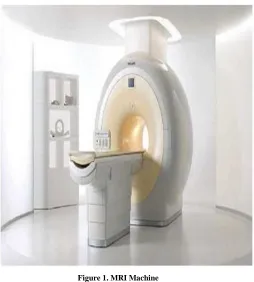
Figure 1. MRI Machine
The approach of the PCA is to compute the eigenvectors of the covariance vectors of the original data and then give the approximate result by the linear combination of the leading eigenvectors With the help of PCA procedure, the input image can be test or identify first and then projecting the image on to the eigen face space for obtaining the corresponding sets of weights of the input images and then compare it with the sets of weights of the training sets.
Let Xi=[x1, x2…..xn] represents the input data matrix, Yi represents the output data matrix vector and Wi is the set of weights. Now the linear transformation of original image vectors in PCA can be written as,[6]
Yi =WiT X i (1)
II. CLASSIFICATION
A. Back Propagation Classifier
The weight factor for the hidden neurons can b written as,
ij P P
ij P
ij
w
E
w
w
1) ( ) (
£
(2)Where P is iteration number; i, j are index of input and hidden neuron, respectively; and £ is step size. The error function is given by
(3)
Where p is the number of output neurons, l is the index of neuron, tl and ol are the target and output values,
respectively. The activation function, net function and output function are given by equation (4)
( )
1
1
i net i
e
B
(4)(5)
Where n is the number of input neurons, and m is the number of output neurons. Let us define
(6)
And, (7)
Then we obtain the weight update equation.[14]
B. Radial Basis Classifier
The RBF network performs similar mapping of function with the more layers of neural network. Its function and structure are much different. RBF is a local network and it it trained by supervised manner.
The input layer of RBF network is a set of n units, n -dimensional input feature vector. n elements of the input vector x are input to the k hidden functions, and weight factor w(i, j), is input to the output layer. The mean value of the sample patterns belong to class k, i.e.
, k=1,2,3, … ,m (8)
Where is the eigenvector of the i th image in the class k, and Nk is the total number of trained images in
class k.
International Journal of Emerging Technology and Advanced Engineering
Website: www.ijetae.com (ISSN 2250-2459,ISO 9001:2008 Certified Journal, Volume 4, Issue 12, December 2014)
311
Typically the activation function of the RBF units (hidden layer unit) is chosen as a Gaussian function with mean vector µi and variance vector σi as follows
, i=1,2,…,l (9)
Note that x is an n -dimensional input feature vector, µi is an n -dimensional vector called the center of the RBF unit σi is the width of the i th RBF unit and l is the number of the RBF units. The response of the jth output unit for input x is given as:
(10)
Where w(i, j) is the connection weight of the i -th RBF unit to the j -th output node.
C. Learning Vector Quantization Classifier
Linear Vector Quantization neural network can realize the non-linear classification. And it can combine the supervised learning and competitive learning. LVQ has an input layer, hidden layer which is unsupervised competitive layer, which classifies input vectors into subclasses, and it has a supervised linear output layer, which combines the subclasses into the target classes. In the hidden layer, only the winning neuron are presents and has an input of one and other neurons have outputs of zero. In the hidden layers, The weight vectors of neurons are the prototypes.[10]
The winning neuron is chosen according to:
≤ , for k ≠ c (11)
The weight vector Wcof the winning neuron is updated
as follows:
If Xj and Wc belong to same class, then Wc (n+1) = Wc (n) + α(n)(Xj -Wc (n)) (12)
If Xjand Wido not belong to the same class, then
Wc (n+1) = Wc (n) - α(n)(Xj -Wc (n)) ( 13)
The weight vectors of other neurons keep constant.
Wk (n+1) = Wk (n) (14)
Where 0 ≤ α(n) ≤1 is the learning rate. The training algorithm is stopped after reaching a pre-specified error limit.
Because the neural network combines the competitive learning with supervised learning, its learning speed is faster than BP network.[14]
PCA preprocessed input vectors’ training result for third case shown in table 1.
Metho ds
PCA with
BP
PCA with
RBF
PCA with
LVQ
No. of error images =>
5 7 9
Recogn ition
Rate =>
95.0 % (97/102)
93.1%
(95/102)
91.1%
(93/102)
D. Neuro-Fuzzy Classifier
International Journal of Emerging Technology and Advanced Engineering
Website: www.ijetae.com (ISSN 2250-2459,ISO 9001:2008 Certified Journal, Volume 4, Issue 12, December 2014)
312
However, using a neuro-fuzzy technique this problem can be overcome. But, Neuro-Fuzzy classifier is more complex and time consuming.[10]
Some advantages of ANFIS systems are:
It does not requires prior human expertise.
It uses membership functions and desired dataset to approximate.
It provides greater choice of membership functions.
III. TRAINING GRAPHS &RESULTS
[image:4.612.324.563.116.334.2]Training graphs for Back Propagation applied to PCA preprocessed training set are shown in figure 1
Figure 2.Learning of BP after preprocessing by PCA. [14]
Training graphs for Radial Basis Function applied to PCA preprocessed training set are shown in figure 2.
Figure 3. Learning of RBF after preprocessing by PCA[14]
[image:4.612.47.291.281.495.2]According to Training graphs of LVQ applied to PCA preprocessed training set are shown in figure 3.
[image:4.612.323.564.377.579.2]International Journal of Emerging Technology and Advanced Engineering
Website: www.ijetae.com (ISSN 2250-2459,ISO 9001:2008 Certified Journal, Volume 4, Issue 12, December 2014)
313
[image:5.612.323.588.102.401.2]IV. METHODOLOGY
Figure 5. Methodology for Classification of MRI brain images
MRI image data set
For the classification and segmentation of normal and abnormal brain images, data set is collected from different sources. One of the source is the Harvard medical school website. [http://www.med.harvard.edu/aanlib/home.html] The various types of brain images includes Axial, T2- weighted, 256-256 pixels MR brain images. Figure shows one of the database considered for the classification. The below images are classified as normal and abnormal brain images.
Figure 6. Example of MRI brain image[10]
A. Image pre-processing
[image:5.612.60.285.118.423.2]International Journal of Emerging Technology and Advanced Engineering
Website: www.ijetae.com (ISSN 2250-2459,ISO 9001:2008 Certified Journal, Volume 4, Issue 12, December 2014)
314 B. Feature Extraction
The feature extraction is the process in which, it extracts the features of importance for image recognition. After the feature extracting, it gives the property of the text character, which can be used for training of database. The obtained trained feature is compared with the test sample feature and classified as extracted character. The feature extraction is done using principal component analysis (PCA).This technique is mostly used for the image reduction and image recognition. It reduces the large dimensionality of the data. The feature extraction of the test image is done. The memory of an Magnetic Resonance image recognizer is simulated by a training set. The training database is a set of Magnetic Resonance images. The task of Magnetic Resonance image recognizer is to find the similar feature vector among the test image and training set image. In the training process, feature vectors are extracted for each image in the training set.
C. Neuro-Fuzzy Classifier with Genetic Algorithm as an optimization technique
A Genetic Algorithm (or GA) is a search technique used in computing to find true or approximate solutions to optimization and search problems. Genetic algorithms are categorized as global search heuristics. Genetic algorithms are a particular class of evolutionary algorithms that use techniques inspired by evolutionary biology such as inheritance, mutation, selection, and crossover (also called recombination). Genetic algorithms are implemented as a computer simulation in which a population of abstract representations of candidate solutions to an optimization problem evolves toward better solutions.
Neural fuzzy models are performing successfully where other methods do not. The classification accuracy of combined neuro fuzzy classifier is comparatively higher than the individual fuzzy and neural classifiers. The convergence time period of neuro fuzzy classifier is more. To improving the convergence time, Neuro - Fuzzy classifier will merging with Genetic algorithm technique, and it will also improve the accuracy.[5]
V. CONCLUSION &RESULT
Neural network is method for automatic classification of magnetic resonance images (MRI). And it consist of supervised feed-forward back propagation neural network technique which is used to classify the normal or abnormal images. Artificial neural networks employed for brain image classification are being computationally heavy and also do not guarantee high accuracy.
Neural fuzzy models are performing successfully where other methods do not. The classification accuracy of combined neuro fuzzy classifier is comparatively higher than the individual fuzzy and neural classifiers. The convergence time period of neuro fuzzy classifier is more. To improving the convergence time, Neuro - Fuzzy classifier merging with Genetic algorithm technique, and it also improve the accuracy.
REFERENCES
[1] Wilburn E. Reddick,‖Automate segmentation and classification of multispectral Magnetic Resonance Image of Brain using Artificial Neaural Network‖,IEEE TRANSACTION ON MEDICAL IMAGING. Vol 16 No 6. DECEMBER 1997
[2] Jing-Hao XUE, Su RUAN, Bruno MORETTI,‖ Fuzzy MODELLING of knowledge for MRI Brain structure segmentation‖,IEEE,2000
[3] Jehan Zeb Shah,‖Tumor dtection in Brain MR Image using ANN based segmentation‖IEEE pp. 95-98,2002
[4] Walaa Hussien Ibrahim,‖ MRI brain image classification using Neural Network‖,ICCEEE,2003
[5] M. Hasanzadeh and S. Kasaei‖multispectral Brain MRI segmentation using Genetic Fuzzzy systems‖,IEEE 2007
[6] Alberto Landi,Paolo Piaggi,Giovanni Pioggia,‖Back Propagation – basedNon linear PCA for Biomedical Application‖,International conference on Intelligent systems design and aplications,2009 [7] Maria-Elena Algorri,‖Classification of Anatomical structures in MR
brain images using Fuzzy parameter‖,IEEE TRANSACTION ON MEDICAL ENGINEERING,vol 51 No 9 september 2004
[8] S.R.Kannan,‖A new segmentation systems for brain images based on fuzzy technique‖,ELSEVIER,19 january 2008
[9] El-Sayed Ahmed EI-Dahshan,‖Hybrid intelligent techniques for MRI brain images classification‖,ELSEVIER vol.20 pp.433-441.2010
[10] Suchita Goswami and Lalit P. Bhaiya,‖A Hbrid NEURO_FUZZY approach for Brain abnormality detection using GLCM based Feature Extraction‖IEEE,august 2013
[11] G Vijay Kumar, Dr GV Raju, ―Biological early brain canacer detection using artificial neural network‖, (IJCSE) International Journal on Computer Science and Engineering, Vol. 02, No. 08, 2010, 2721-2725.
[12] D. Jude Hemanth, C.Kezi Selva Vijila and J.Anitha, ―Application of Neuro-Fuzzy Model for MR Brain Tumor Image classification‖ International Journal of Biomedical Soft Computing and Human Sciences,Vol.16,No.1(2010)
[13] Minakshi Sharma1, Dr. Sourabh Mukharjee, ―Artificial neural network fuzzy inference system (ANFIS) for brain tumor detection. [14] Lalit P. Bhaiya, Virendra Kumar Verma,‖Classification of MRI
Brain Images Using Neural Network‖ International Journal of Engineering Research and Applications (IJERA)Vol. 2, Issue 5,, pp.751-756 September- October 2012.
[15] Atiq islam,’ Multifractal texture estimation for detection and segmentation of brain tumors’, IEEE TRANSACTIONS ON BIOMEDICAL ENGINEERING, vol. 60, no. 11, november 2013.
![Figure 3. Learning of RBF after preprocessing by PCA[14]](https://thumb-us.123doks.com/thumbv2/123dok_us/8705674.880674/4.612.324.563.116.334/figure-learning-rbf-preprocessing-pca.webp)
![Figure 6. Example of MRI brain image[10]](https://thumb-us.123doks.com/thumbv2/123dok_us/8705674.880674/5.612.323.588.102.401/figure-example-of-mri-brain-image.webp)
