ABSTRACT
The objective of the project is to simulate the real time Radar detection and tracking operations using MATLAB software. Radar system use modulated waveforms and directive antennas to transmit electromagnetic energy into a specific volume in space to search for targets. Objects (targets) within a search volume will reflect portions of this energy (radar returns or echoes) back to the radar. These echoes are then processed by radar receiver to extract target information such as range. Velocity, angular position, and other target identifying characteristics. The project mainly concentrates on the radar displays and different radar types to collect the information of the flying objects, such as the range, speed, distance, angles. The display types are A-scope, B-scope, C-scope, PPI, and RHI, which are used in modern radars. While others are either obsolete or are found only in very specialized applications. Signals displayed on these scopes can be raw video, synthetic video (detected video) or computer-generated symbols. The radar types consider in the project are CWT (Continuous Wave Transmission), Pulse, Doppler, and MTI (Moving Target Indicator). For each display, all the values related to the object are calculated in different patterns and graphs for the corresponding formulated values and angles.
CHAPTER I
INTRODUCTION
1.1 BACKGROUND
1.2 BASIC RADAR
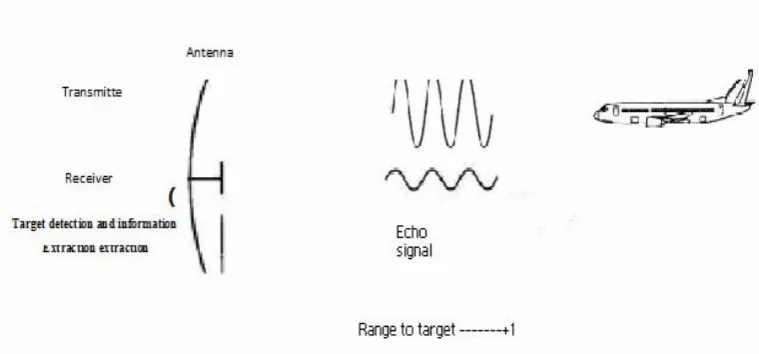
Radar systems, like other complex electronics systems, are composed of several major subsystems and many individual circuits. Although modern radar systems are quite complicated, you can easily understand their operation by using a basic block diagram of a pulse-radar system. The basic concept of radar is relatively simple even though in many instances its practical implementation is not. A radar operates by radiating electromagnetic energy and detecting the echo returned from reflecting objects (targets). The nature of the echo signal provides information about the target. The range, or distance, to the target is found from the time it takes for the radiated energy to travel to the target and back. The angular location of the target is found with a directive antenna (one with a narrow beamwidth) to sense the angle of arrival of the echo signal. If the target is moving, a radar can derive its track, or trajectory, and predict the future location. The shift in frequency of the received echo signal due to the Doppler effect caused by a moving target allows a radar to separate desired moving targets (such as aircraft) from undesired stationary targets (such as land and sea clutter) even though the stationary echo signal may be many orders of magnitude greater than the moving target. With sufficiently high resolution, a radar can discern something about the nature of a target's size and shape. Radar resolution may be obtained in range or angle, or both. Range resolution requires large bandwidth. Angle resolution requires (electrically) large antennas. Resolution in the cross-range dimension is usually not as good as the resolution that can be obtained in range. However, when there is relative motion between the individual parts of a target and the radar, it is possible to use the inherent resolution in Doppler frequency to resolve in the range dimension. The cross-range resolution of a synthetic aperture radar (SAR) for imaging a scene such as terrain can be explained as being due to resolution in Doppler, although a SAR is usually thought of as generating a large "synthetic" antenna by storing received signals in a memory. The two views—Doppler resolution and synthetic antenna—are equivalent. Resolution in the Doppler domain is a natural way to envision the cross-range resolution achieved by the inverse synthetic aperture radar (ISAR) used for the imaging of a target.
near or far distances and can measure their range with precision in all weather, which is its chief advantage when compared with other sensors. The principle of radar has been applied from frequencies of a few megahertz (HF, or high-frequency region of the electromagnetic spectrum) to well beyond the optical region (laser radar). The particular techniques for implementing radar differ greatly over this range of frequencies, but the basic principles remain the same.
Radar was originally developed to satisfy the needs of the military for surveillance and weapon control. Military applications have funded much of the development of its technology. However, radar has seen significant civil applications for the safe travel of aircraft, ships, and spacecraft; the remote sensing of the environment, especially the weather; and law enforcement and many other applications. Figures 1.1 show us the basic principle of Radar.
[image:4.595.133.513.372.549.2]
1.3 DISSERTATION OBJECTIVE
The objectives of the project are:
- Study the radar systems and how radar works.
- Study the radar display types and how the information received by radar can be displayed. - Develop a simulation of the real time Radar detection and tracking operations, using “MATLAB” software.
1.4 Thesis Layout.
The thesis is organized as follows:
Chapter 1: The basic concepts of what is the radar.
Chapter 2: The introduction history and sub-system of radars.
Chapter 3: Object Detection Using Radar, we will present the details of types of displays; types of radar developed using MATLAB.
Chapter 4: The full details of the system including simulator development, project design, coding; flow charts and the description of functions used in MATLAB.
CHAPTER II
RADAR SYSTEM
2.1 INTRODUCTION
2.2 RADAR BLOCK DIAGRAM
The basic parts of a radar system are illustrated in the simple block diagram of Fig. 2.1. The radar signal, usually a repetitive train of short pulses, is generated by the transmitter and radiated into space by the antenna. The duplexer permits a single antenna to be time-shared for both transmission and reception. Reflecting objects (targets) intercept and reradiate a portion of the radar signal, a small amount of which is returned in the direction of the radar. The returned echo signal is collected by the radar antenna and amplified by the receiver. If the output of the radar receiver is sufficiently large, detection of a target is said to occur. A radar generally determines the location of a target in range and angle, but the echo signal also can provide information about the nature of the target. The output of the receiver may be presented on a display to an operator who makes the decision as to whether or not a target is present, or the receiver output can be processed by electronic means to automatically recognize the presence of a target and to establish a track of the target from detections made over a period of time. With automatic detection and track (ADT) the operator usually is presented with the processed target track rather than the raw radar detections. In some applications, the processed radar output might be used to directly control a system (such as a guided missile) without any operator intervention.
Fig 2.1 Simple block diagram of radar employing a power amplifier transmitter and a
superheterodyne receiver.
The operation of the radar is described in more detail, starting with the transmitter. The transmitter generates powerful pulses of electromagnetic energy at precise intervals. The required power is obtained by using a high-power microwave oscillator (such as a magnetron) or a microwave amplifier (such as a klystron) that is supplied by a low-power RF source. Transmitters not only must be able to generate high low-power with stable waveforms, but they must often operate over a wide bandwidth, with high efficiency and with long, trouble-free life.
The duplexer acts as a rapid switch to protect the receiver from damage when the high-power transmitter is on. On reception, with the transmitter off, the duplexer directs the weak received signal to the receiver rather than to the transmitter. Duplexers generally are some form of gas-discharge device and may be used with solid-state or gas-discharge receiver protectors. A solid-state circulator is sometimes used to provide further isolation between the transmitter and the receiver.
deliberate noise jamming) or if clutter echoes ( from the natural environment) are larger than the receiver noise, the threshold has to be varied adaptively in order to maintain the false alarm rate at a constant value. This is accomplished by a constant false alarm rate (CFAR) receiver. Radar usually receiver many echo pulses from a target. The process of adding these pulses together to obtain a greater signal-to-noise ratio before the detection decision is made is called integration. The integrator is often found in the video portion of the receiver. The signal processor is that part of the radar whose function is to pass the desired echo signal and reject unwanted signals, noise, or clutter. The signal processor is found in the receiver before the detection is made. The matched filter mentioned previously, is an example of a signal. Another example is the doppler filter that separates desired moving targets (whose are shifted in frequency due to the Doppler effect) from undesired stationary clutter echoes.
Some radars process the detected target signal further, in the data processor, before displaying the information to an operator. An example is an automatic tracker, which uses the locations of the target measured over a period of time to establish the track (or path) of the target. Most modern air-surveillance radars and some surface-surveillance radars generate target tracks as their output rather than simply display detections. Following the data processor, or the decision function if there is no data processor, the radar output is displayed to an operator or used in a computer or other automatic device to provide some further action. The signal processor and data processor are usually implemented with digital technology rather than with analog circuitry. The analog-to-digital (A/D) converter and digital memory are therefore important in modern radar system. In some sophisticated radars in the past, the signal and data processors were larger and consumed more power than the transmitter and were a major factor in determining the overall radar system reliability; but this should not be taken as true in all cases.
2.3 RADAR SUBSYSTEM
transmission line to radiation in space, and vice versa. The duplexer permits alternate transmission and reception with the antenna; in effect, it is a fast-acting switch that protects the sensitive receiver from the high power of the transmitter.
The receiver selects and amplifies the weak radar echoes so that they can be displayed on a television-like screen for the human operator or be processed by computer. The signal processor separates the signals reflected by target (e.g. echoes from an aircraft) from unwanted echo signals (the clutter from land, sea, rain, etc.). It is not unusual for these undesired reflections to be much larger than desired target echoes, in some cases more than one million times larger. Larger clutter echoes from stationary objects can be differentiated from small echoes moving target by noting the shift in the observed frequency produced by moving target. The type of signal waveform transmitted and associated received-signal processing in a radar system might be different depending on type of target involved and the environment in which it is located. An operator can select the parameters of the radar to maximize performance in a particular environment. Alternatively, electronic circuitry in the radar system can be automatically analyze and select the proper transmitted signal, signal processing and other radar parameters to optimize performance. The system control also can provide timing and reference signals needed to permit the various parts of the radar to operate effectively as an integrated system.
2.3.1 Transmitters
The system surrounding the transmitter is made is made up of three main elements: the oscillator, the modulator, and the transmitter itself. The transmitter supplies energy to the antenna in the form of high-energy electrical signal. The antenna then sends out electromagnetic radar waves as the passes through it.
2.3.1.1 Local Oscillators
mode, then amplitude variations will occur. This amplitude modulation (AM) may be very small in magnitude on the driver signal, but after a gain of 30 dB or more in the power amplifier, the magnitude can be considerable. Both FM and AM signals are undesirable and are classified as noise. Therefore, extra care in tuning and maintenance of the power supplies is required to mini- mize FM and AM noise generation.
2.3.1.2 The Modulator
The next stage of a radar system is modulator. It is the heart of the radar system and generates all the necessary timing pulses (triggers) for use in the radar and associated systems. Its function is to ensure that all subsystems making up the radar system operate in a definite time relationship with each other and that the intervals between pulses, as well as the pulses themselves, are of the proper length.
2.3.1.3 The Transmitter
The radar system’s transmitter increases the power of the oscillator. The transmitter amplifies the power from the level of about 1 watt to as much as 1 megawatter, or 1 million watts. Radar signals have such high power levels because so little of the original signal comes back in the return.
2.3.2 Receivers
2.3.2.1 The Duplexer
The duplexer acts as a rapid switch to protect the receiver from damage when the high-power transmitter is on. On reception, with the transmitter off, the duplexer directs the weak received signal to the receiver rather than to the transmitter. Duplexers generally are some form of gas-discharge device and may be used with solid-state or gas-discharge receiver protectors. A solid-state circulator is sometimes used to provide further isolation between the transmitter and the receiver.
2.3.2.2 Signal Processing
There has not always been general agreement as to what constitutes the signal-processing portion of the radar, but it is usually considered to be the processing whose purpose is to reject undesired signals (such as clutter) and pass desired signals due to targets. It is performed prior to the threshold detector where the detection decision is made. Signal processing includes the matched filter and the Doppler filters in MTI and pulse Doppler radar. Pulse compression, which is performed before the detection decision is made, is sometimes considered to be signal processing, although it does not fit the definition precisely.
2.3.2.2 Data Processing
range resolution. CFAR or its equivalent is necessary when automatic tracking computers cannot handle large numbers of echo signals, but it should be avoided if possible. When an operator is used to make the threshold decision, CFAR is not a necessity as in limited capacity automatic systems because the operator can usually recognize echoes due to clutter or to increased noise (such as jamming) and not confuse them with desired targets.
2.3.2.3 The Displays
The display for surveillance radar is usually a cathode-ray tube with a PPI (plan position indicator) format. A PPI is an intensity-modulated, maplike presentation that provides the target's location in polar coordinates (range and angle). Older radars presented the video output of the receiver (called raw video) directly to the display, but more modern radars generally display processed video, that is, after processing by the automatic detector or the automatic detector and tracker (ADT). These are sometimes called cleaned-up displays since the noise and background clutters are removed.
2.4 TYPES OF RADAR
Radar system may be categorized according to the function they perform (e.g. aircraft surveillance, surveillance, surface (ground or sea) surveillance, space surveillance, tracking, weapon control, missile guidance, instrumentation, remote sensing of the environment, intruder detection, or underground probing. They also may be classified, as in the listing below, on the basis of the particular radar technique they employ. It is difficult to give in only a few words precise and readily understandable descriptions of the many type of radar available. The following survey is necessarily brief and qualitative.
2.4.1 Simple pulse radar
2.4.2 Moving-target indication (MTI) radar
This is a form of pulse radar that uses the Doppler frequency shift of the received signal to detect moving target, such as aircraft, and to reject the large unwanted echoes from stationary clutter that do not have a Doppler shift. Almost all ground-based aircraft surveillance radar system use some form of MTI.
2.4.3 Airborne moving-target indication (AMTI) radar
An MTI radar in an aircraft encounters problems not found in a ground-based system of the same kind because the large undesired clutter echoes from the ground and the sea have sea have a Doppler frequency shift introduced by the motion of the aircraft carrying the radar. The AMTI radar, however, compensates for the Doppler frequency shift of the clutter, making it possible to detect moving targets even though the radar unit itself is in motion.
2.4.4 Pulse Doppler radar (with high pulse-repetition frequency)
2.4.5 Pulse Doppler radar (with medium pulse-repetition frequency)
A modified form of pulse Doppler radar that operates at a lower PRF (10 KHz, for example) than the above-mentioned high-PRF pulse Doppler system has both range and Doppler shift ambiguities. It is, however, better for detecting aircraft with low closing speeds than high-PRF pulse Doppler radar (which is better for detecting aircraft with high closing speeds). An aircraft medium-PRF pulse Doppler radar might have to use seven or eight different PRFs in order to extract the target information ambiguities.
2.4.6 High-range-resolution radar
This type of radar uses a very short pulse with range resolution from several metres to a fraction of a metre. Such a radar can profile a target and measure its projected length in the range dimension.
2.4.7 Pulse-compression radar
2.4.8 Synthetic aperture (SAR)
The SAR was described above as utilizing resolution in Doppler frequency to provide the equivalent of cross-range (or angle) resolution. More often, it is regarded as a synthetic antenna generated by a moving radar. The effect of a large antenna is obtained by storing the echo signals in a storage medium, or memory, and processing a substantial number of the previously received echoes just as if they were received by a large antenna. This kind of radar is primarily used for mapping the Earth's surface. Although it is not obvious, the two different models used for describing a SAR--a synthetic antenna and Doppler-frequency resolution--are equivalent and produce the same results.
2.4. 9 Inverse synthetic aperture radar (ISAR)
As previously noted, an ISAR depends on target motion to provide the Doppler frequency shift between various parts of the target and the radar unit so as to obtain high resolution in cross range. A two-dimensional high-resolution image of a target can be obtained by using ISAR for cross-range resolution in conjunction with either a short pulse or pulse-compression radar for resolution in the range dimension.
2.4.10 Side-looking airborne radar (SLAR)
2.4.11 Imaging radar
Synthetic aperture, inverse synthetic aperture, and side-looking airborne radar techniques are sometimes referred to as imaging radars.
2.4.12 Tracking radar
A radar tracker is a component of a radar system, or an associated command and control system, that associates consecutive radar observations of the same target into tracks. It is particularly useful when the radar system is reporting data from several different targets or when it is necessary to combine the data from several different radars or other sensors.
2.4.13 Track-while-scan radar
This form of surveillance radar can provide tracks of all targets within its area of coverage by measuring the location of targets on each rotation of the antenna. Though called track-while-scan radar, it is more often known as automatic detection and tracking, or ADT. The output on a visual display from such a radar usually consists of the tracks of the targets (vectors showing direction and speed) rather than individual detections (blips). This type of tracking is suitable for surveillance radars, while continuous tracking is more appropriate for weapon control and instrumentation-radar applications.
2.4.14 3D radar
target location in three dimensions, but a radar that is properly called 3D is an air-surveillance system that measures the azimuth and elevation angles as just described.
2.4.15 Electronically scanned phased-array radar
An electronically scanned phased-array antenna can position its beam rapidly from one direction to another without mechanical movement of large antenna structures. Agile, rapid beam switching permits the radar to track many targets simultaneously and to perform other functions as required.
2.4.16 Continuous-wave (CW) radar
Since a CW radar transmits and receives at the same time, it must depend on the Doppler frequency shift produced by a moving target to separate the weak echo signal from the strong transmitted signal. A simple CW radar can detect targets, measure their radial velocity (from the Doppler frequency shift), and determine the direction of arrival of the received signal. However, a more complicated waveform is required for finding the range of the target.
2.4.17 Frequency-modulated continuous-wave (FM-CW) radar
2.5 FACTORS AFFECTING RADAR PERFORMANCE
The performance of a radar system can be judged by the following: (1) the maximum range at which it can see a target of a specified size, (2) the accuracy of its measurement of target location in range and angle, (3) its ability to distinguish one target from another, (4) its ability to detect the desired target echo when masked by large clutter echoes, unintentional interfering signals from other "friendly" transmitters, or intentional radiation from hostile jamming (if a military radar), (5) its ability to recognize the type of target, and (6) its availability (ability to operate when needed), reliability, and maintainability. Some of the major factors that affect performance are discussed in this section.
2.5.1 Transmitter power and antenna size.
The maximum range of a radar system depends in large part on the average power of its transmitter and the physical size of its antenna. (In technical terms, this is the power-aperture product.) There are practical limits to each. As noted before, some radar systems have an average power of roughly one megawatt. Phased-array radars about 100 feet in diameter are not uncommon; some are much larger. Likewise, mechanically scanned reflector antennas about 100 feet or larger in size can be found. There are specialized radars with (fixed) antennas, such as some HF over-the-horizon radars and the U.S. Space Surveillance System (SPASUR), that extend more than one mile.
2.5.2 Receiver noise
desired signals and to reduce the noise and other undesired signals that interfere with detection. The designer attempts to maximize the detectability of weak signals by using what radar engineers call a "matched filter," which is a filter that maximizes the signal-to-noise ratio at the receiver output. The matched filter has a precise mathematical formulation that depends on the shape of the input signal and the character of the receiver noise. A suitable approximation to the matched filter for the ordinary pulse radar, however, is one whose bandwidth in hertz is the reciprocal of the pulse width in seconds.
2.5.3 Object size
usually be taken to insure that echoes from birds do not interfere with the detection of desired targets. The radar cross section of an aircraft and most other targets of practical interest is not a constant but, rather, fluctuates rapidly as the aspect of the target changes with respect to the radar unit. It would not be unusual for a slight change in aspect to cause the radar cross section to change by a factor of 10 to 1,000. (Radar engineers have to take this fluctuation in the radar cross section of targets into account in their design.)
2.5.4 Clutter
Echoes from land, sea, rain, snow, hail, birds, insects, auroras, and meteors are of interest to those who observe and study the environment, but they are a nuisance to those who want to detect and follow aircraft, ships, missiles, or other similar targets. Clutter echoes can seriously limit the capability of a radar system; thus a significant part of radar design is devoted to minimizing the effects of clutter without reducing the echoes from desired targets. The Doppler frequency shift is the usual means by which moving targets are distinguished from the clutter of stationary objects. Detection of targets in rain is less of a problem at the lower frequencies, since the radar echo from rain decreases rapidly with decreasing frequency and the average cross section of aircraft is relatively independent of frequency in the microwave region. Because raindrops are more or less spherical (symmetrical) and aircraft are asymmetrical, the use of circular polarization can enhance the detection of aircraft in rain. With circular polarization, the electric field rotates at the radar frequency. Because of this, the electromagnetic energy reflected by the rain and the aircraft will be affected differently, thereby making it easier to distinguish between the two. (In fair weather, most radars use linear polarization--i.e., the direction of the field is fixed.)
2.5.5 Atmospheric effects
performance as well. The decrease in density of the Earth's atmosphere with increasing altitude causes radar waves to bend as they propagate through the atmosphere. This usually increases the detection range at low angles to a slight extent. The atmosphere can form "ducts" that trap and guide radar energy around the curvature of the Earth and allow detection at ranges beyond the normal horizon. Ducting over water is more likely to occur in tropical climates than in colder regions. Ducts can sometimes extend the range of airborne radar, but on other occasions they may cause the radar energy to be diverted and not illuminate regions below the ducts. This results in the formation of what are called radar holes in the coverage. Since it is not predictable or reliable, ducting can in some instances be more of a nuisance than a help. Loss of radar energy, when propagation is through the clear atmosphere or rain, is usually insignificant for systems operating at microwave frequencies.
2.6 RADAR TO AN OBJECT
The most common radar signal, or waveform, is a series of short duration, somewhat rectangular-shaped pulses modulating a sine wave carrier. (This is sometimes called a pulse train.) The range to a target is determined by the time TR it takes is determined by the time TR it takes the radar signal to travel to the target and back. Electromagnetic energy in free space travels with the speed of light, which is c= 3 m/s. Thus the time for the singal to travel to a target located at a range R and returns back the back is 2R/c. The range to target is then
T= (2.1)
Ae=Antenna effective aperture Smin = Minimum detectable signal
σ= Radar cross section of the target
Power density at range R from an isotropic antenna=
Power density at range R from an directive antenna=
2.7 MAXIMUM UNAMBIGUOUS RANGE
The maximum unambiguous range, Rmax, corresponds to half the distance electromagnetic energy can travel between pulses (since the energy needs to travel to the target and back). The pulse repetition frequency (PRF) is a measure of how frequently the pulses are
transmitted. If c is the speed of light (taken as 3x10⁸ mڄs-1), then
R max =
(2.2)
2.8Radar Waveforms
The typical radar utilizes a pulse waveform, an example of which is shown in fig.2.3. the peak power in this example is Pt = 1 MW, pulse width T = 1μs, and pulse repetition period Tp= 1ms = 1000 μs. (the number shown were chosen for a medium-range air-surveillance
So the average power in this case is = 1 KW. The duty cycle of a radar waveform is defined as the ratio of the total time the radar is radiating to the total time it could have radiated, which is T/Tp = Tfp, or its equivalent Pav/Pt. in this case the duty cycle is 0.001. the energy of the pulse is equal to PtT, which is 1 J (joule). If duty cycle is 0.001. The energy of the pulse is equal a signal of W. the echo would be 180 dB below the level of the signal that was transmitted. A short-duration pulse waveform is attractive since the strong transmitted. A short-duration pulse waveform is attractive strong transmitter signal is not attractive since received. With a pulse width T of 1 μs. The waveform extends in space over a distance cT=300 m. two equal targets can be recognized as being resolved in range when they are separated a distance half this value, or CT/2. The factor of one-half results from the two-way travel of the radar wave. For example, when T=1 μs, two equal size targets can be resolved if they are separated by 150m.
A very long pulse is needed for some long range. A long pulse, however, has poor resolution in the range dimension. Frequency or phase modulation can be used to increase the spectral width of a long pulse to obtain the resolution of a short pulse. This is called pulse compression. Continuous wave ( CW) waveforms have also been used in radar. Since they have to receive while transmitting, CW radars depend on the Doppler frequency shift of the echo single, caused by a moving target, to separate in the frequency domain the weak echo signal from the large transmitted signal and the echoes from fixed clutter ( land, sea, or weather ), as well as to measure the radial velocity of the target. Simple CW radar does not measure range. It can obtain range, however, by modulating the carrier with frequency or phase modulation. An example is the frequency modulation ( FM – CW ) waveform used in the radar altimeter that measures the height ( altitude ) of an aircraft above the earth.
Pulse radars that extract the Doppler frequency shift are called either moving target indication ( MTI ) or pulse Doppler radars, depending on their particular values of pulse repetition frequency and duty cycle. MTI radar has a low PRF and a low duty cycle. A pulse Doppler radar, on the other hand, has a high PRF and a high duty cycle. Almost all radars designed to detect aircraft use the Doppler frequency shift to reject the large unwanted echoes from stationary clutter.
REFERENCES
[1] M. Arulampalam, S. Maskell, N. Gordon and T. Clapp, “A Tutorial on Particle Filters for Online Nonlinear/Non-Gaussian Bayesian Tracking,” IEEE Transactions on Signal Processing, Vol. 50, No. 2, pp. 174-188, February 2002.
[2] M. Basseville and L. Nikiforov, Detection of Abrupt Changes: Theory and Applications, Prentice Hall, 1993.
[3] Y. Bar-Shalom, X. Li, and T. Kirubarajan, Estimation with Application to Tracking and Navigation, Wiley, 2001.
[4] S. S. Blackman and R. Popoli, Design and Analysis of Modern Tracking Systems. Artech House, Boston, 1999.
[5] A. O. Hero, D. Casta˜n´on, D. Cochran and K. Kastella (eds.) Foundations and Applications of Sensor Management. Springer series on Signals and
Communication Technology, 2008.
[6] J. L. Williams, Information Theoretic Sensor Management. PhD thesis, Massachusetts Institute of Technology, USA, 2007.
[7] Y. Bar-Shalom, X. Rong Li and T. Kirubarajan, Estimation with Applications to Tracking and Navigation, John Wiley & Sons, Inc., 2001.
[8] S. Lakshmanan, K. Kluge, ”LOIS: A real-time lane detection algorithm” Proc. Conf. Information
Sciences and Systems, Princeton, NJ, pp. 1007-1012, 1997.
[10] Stephen J. Chapman, MATLAB Programming for Engineers, 2002 the Wadsworth Group.