Mustafa, Faisal
Dynamic Web Services Composition
Original Citation
Mustafa, Faisal (2014) Dynamic Web Services Composition. Doctoral thesis, University of Huddersfield.
This version is available at http://eprints.hud.ac.uk/id/eprint/24698/
The University Repository is a digital collection of the research output of the University, available on Open Access. Copyright and Moral Rights for the items on this site are retained by the individual author and/or other copyright owners. Users may access full items free of charge; copies of full text items generally can be reproduced, displayed or performed and given to third parties in any format or medium for personal research or study, educational or notforprofit purposes without prior permission or charge, provided:
• The authors, title and full bibliographic details is credited in any copy; • A hyperlink and/or URL is included for the original metadata page; and
• The content is not changed in any way.
For more information, including our policy and submission procedure, please contact the Repository Team at: [email protected].
Dynamic Web Services Composition
A Study of Services Composition Process to find an efficient and
optimal solution by using AI Planning Concepts
by
Faisal Mustafa
A thesis submitted to the University of Huddersfield in partial
fulfilment of the requirements for the degree of Doctor of Philosophy
Copyright Statement
i. The author of this thesis (including any appendices and/or schedules to this
thesis) owns any copyright in it (the Copyright) and he has given The University of
Huddersfield the right to use such Copyright for any administrative, promotional,
educational and/or teaching purposes.
ii. Copies of this thesis, either in full or in extracts, may be made only in
ac-cordance with the regulations of the University Library. Details of these regulations
may be obtained from the Librarian. This page must form part of any such copies
made.
iii. The ownership of any patents, designs, trademarks and any and all other
in-tellectual property rights except for the Copyright (the Inin-tellectual Property Rights)
and any reproductions of copyright works, for example graphs and tables
(Repro-ductions), which may be described in this thesis, may not be owned by the author
and may be owned by third parties. Such Intellectual Property Rights and
Repro-ductions cannot and must not be made available for use without the prior written
permission of the owner(s) of the relevant Intellectual Property Rights and/or
Acknowledgements
My sincere appreciation and regards goes to my supervisors Prof. Lee McCluskey
and Dr. Gary Allen for their help and guidance. I would like to take this
opportu-nity to thank my principal supervisor Professor Lee for his patience, guidance and
appreciation throughout this thesis.
In addition, I appreciate the assistance of Ms Julie Wilkinson and ARTFORM
research group. I would like to acknowledge the financial, academic and technical
support of the University of Huddersfield.
To my parents for their support, prayers, encouragement and dreams, for staying
with me in every hardship and showing me the candle of kindness for every single
arduous abstraction of life.
To my two little flowers Subhaan and Eiman for spending some of their best life
moments apart from me while allowing me to focus on this thesis.
Last, but by no means least, to my wife who deserve the most thanks for her
endless encouragement, constant patience and prayers.
Abstract
Emerging web services technology has introduced the concept of autonomic
inter-operability and portability between services. The number of online services has
in-creased dramatically with many duplicating similar functionality and results.
Com-posing online services to solve user needs is a growing area of research. This entails
designing systems which can discover participating services and integrate these
ac-cording to the end user requirements.
This thesis proposes a Dynamic Web Services Composition (DWSC) process
that is based upon consideration of previously successful attempts in this area, in
particular utilizing AI-planning based solutions. It proposes a unique approach for
service selection and dynamic web service composition by exploring the possibility
of semantic web usability and its limitations.
It also proposes a design architecture called Optimal Synthesis Plan Generation
framework (OSPG), which supports the composition process through the evaluation
of all available solutions (including all participating single and composite services).
OSPG is designed to take into account user preferences, which supports optimality
and robustness of the output plan. The implementation of OSPG will be
config-ured and tested via division of search criteria in different modes thereby locating
the best plan for the user. The services composition and discovery-based model is
evaluated via considering a range of criteria, such as scope, correctness, scalability
Contents
List of Tables xi
List of Figures xii
1 Introduction 1
1.1 Preliminaries . . . 1
1.1.1 Key Research Issues . . . 4
1.1.2 Example Scenario . . . 5
1.2 Research Question and Contribution . . . 8
1.2.1 Research Methodology . . . 12
1.2.2 Thesis Outline. . . 13
1.2.3 Concluding Remarks . . . 15
2 Background and Related Work 17 2.1 Motivation . . . 17
2.1.1 Service Oriented Computing . . . 18
2.1.2 Definitions . . . 20
2.1.3 Static Composition Methods . . . 22
2.1.4 Common Static Composition Methods Development Technolo-gies . . . 23
2.1.6 Common Dynamic Composition Methods Development
Tech-nologies . . . 27
2.2 Services Compositions Procedures and Methods . . . 39
2.2.1 Services Composition by Distributed Web Development Based Technologies . . . 40
2.2.2 Web Services and Distributed Computing . . . 41
2.2.3 Workflow Based Web Services Composition Techniques . . . . 42
2.2.4 Planning Based Solution Analysis . . . 43
2.2.5 AI (Artificial Intelligence) Planning Based Web Services Com-position Techniques . . . 44
2.2.6 Forward, Backward State Space and Rule based planning . . . 48
2.2.7 Hierarchical Task Network based planning . . . 48
2.2.8 Graph based Planning . . . 50
2.2.9 Enforced Hill Climbin bg d g algorithm . . . 52
2.3 Research Directions and Problems of Composition Process . . . 54
2.3.1 Concluding Remarks . . . 59
3 Web Services Composition and AI planning Support 60 3.1 General Discussion . . . 60
3.2 The Requirement of Dynamic web services Composition. . . 61
3.2.1 The Execute Ability Problem . . . 62
3.2.2 Data Distribution and Quality of Services . . . 63
3.3 AI and Dynamic Web Services Composition . . . 65
3.3.1 Services Selection Procedure . . . 68
3.3.2 Preference Based Planning . . . 70
3.3.3 Conformant Planning . . . 71
3.3.5 Examples of Static Composition Methods. . . 77
3.3.6 Examples of Dynamic Composition Methods . . . 79
3.4 Optimal Synthesis Plan Generation (OSPG) . . . 82
3.4.1 The Planning Environment Design . . . 83
3.4.2 The Procedural Context . . . 86
3.4.3 Preferences for Services . . . 87
3.4.4 Example Scenario . . . 91
3.4.5 Concluding Remarks . . . 95
4 Dynamic Web Services Composition (DWSC) Framework 96 4.1 Proposed Framework Model Support . . . 96
4.1.1 Functional Level Composition (FLC) . . . 99
4.1.2 Process Level Composition (PLC) . . . 100
4.1.3 Proposed System Concept . . . 100
4.2 Services Analysis and Composition Process . . . 102
4.2.1 Technical Context. . . 104
4.2.2 Composite Services and Packages Exploration . . . 109
4.3 User Preferences Logic and Algorithms . . . 112
4.3.1 Preferences Plus Package (PPP) . . . 112
4.3.2 Complete Desired Package (CDP) . . . 117
4.3.3 Partial Desired Package (PDP) . . . 118
4.3.4 Concluding Remarks . . . 121
5 Results and Evaluation 122 5.1 Planning Requirements . . . 122
5.1.1 Testing Environment . . . 123
5.1.2 Implementation Approach (OSPG) . . . 125
5.2 Evaluation Methods . . . 129
5.3 Results and Discussion . . . 132
5.4 Travel Plan Domain . . . 137
5.4.1 Example 1 . . . 138
5.4.2 Example 2 . . . 147
5.4.3 Example 3 . . . 150
5.4.4 Example 4 . . . 151
5.4.5 Example 5 . . . 154
5.4.6 Example 6 . . . 156
5.4.7 Example 7 . . . 158
5.5 Health-Scallops Domain . . . 160
5.5.1 Example 8 . . . 162
5.5.2 Example 9 . . . 162
5.5.3 Example 10 . . . 166
5.5.4 Example 11 . . . 168
5.5.5 Example 12 . . . 168
5.5.6 Example 13 . . . 171
5.5.7 Example 14 . . . 173
5.5.8 Example 15 . . . 173
5.5.9 Effectiveness of Results in conjunction with Evaluative Metrics176 5.6 Comparison with related work results . . . 180
5.6.1 Summary . . . 184
6 Conclusion and Future Work 188 6.1 Summary . . . 188
6.2 Research Contribution . . . 191
6.2.2 Directions of Future Work . . . 193
List of Tables
5.1 OSPG Results (Travel Plan Results) . . . 139
5.2 Example 1 . . . 141
5.3 Example 2 . . . 149
5.4 Example 3 . . . 150
5.5 Example 4 . . . 153
5.6 Example 5 . . . 155
5.7 Example 6 . . . 157
5.8 Example 7 . . . 159
5.9 OSPG Results (Health Plan). . . 161
5.10 Example 8 . . . 164
5.11 Example 9 . . . 165
5.12 Example 10 . . . 167
5.13 Example 11 . . . 169
5.14 Example 12 . . . 170
5.15 Example 13 . . . 172
5.16 Example 14 . . . 174
5.17 Example 15 . . . 175
5.18 OSPG Results (Preferences Plus Package) . . . 185
5.19 OSPG Results (Complete Desired Package) . . . 186
List of Figures
1.1 Current Web Contents Based Queries . . . 3
2.1 The Web Services Composition Process . . . 31
2.2 The Service Discovery Process . . . 33
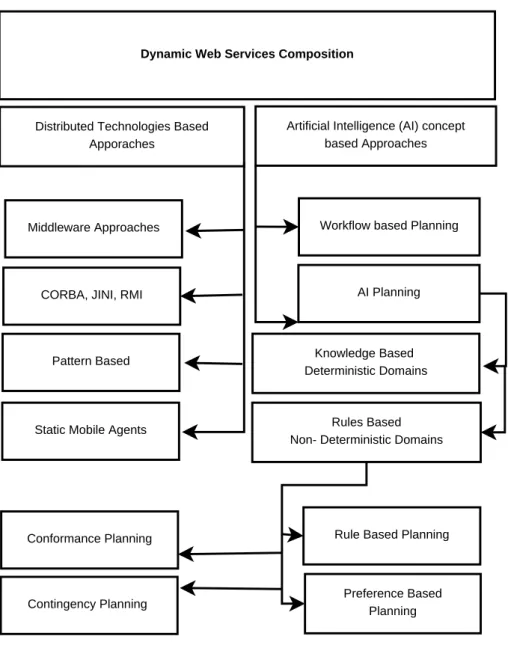
2.3 Dynamic Web Services Composition Structure . . . 38
2.4 Enforced Hill Climbing . . . 52
2.5 The Development Process . . . 55
3.1 Types of Semantic Services Composition Process . . . 66
3.2 Planning Process . . . 75
3.3 Travel Line Planner . . . 92
4.1 Planning Process For Web Services . . . 98
4.2 Service Conversion into Planning Problem . . . 102
4.3 The process of OSPG . . . 103
4.4 The User Preferences based Conformance Process . . . 116
5.1 Full Procedural Flow Diagram (OSPG) . . . 124
5.2 Full Procedural Flow Diagram (OSPG) . . . 133
5.3 OSPG User Interface (OSPG User Interface) . . . 135
5.4 The System Flow Diagram . . . 136
5.6 Comparison of Packages Results (Graph) . . . 178
5.7 Comparison of overall Results (Graph) . . . 180
Chapter 1
Introduction
1.1
Preliminaries
During the last 20 years, the Internet has emerged as a ubiquitous aspect of society,
situating computing function at the heart of business, personal, entertainment and
educational activity [134]. There are well-established arrangements for utilizing
online resources through the daily use of e-tools, which interact with digital libraries
and integrated databases; making the World Wide Web (W3C) increasingly the first
stop for information [39]. The Internet provides an enormous amount of information
and it is regarded by the majority as one of the greatest inventions of the 20th
century. Currently the internet is growing exponentially in size, processing power
and software sophistication, making it the fastest growing technology in the world
[93,99, 167].
According to W3C, web services are pieces of software, designed in a particular
way, to facilitate interaction amongst machines, and to provide a machine
process-able arrangement for other applications to interact with each other [27, 140]. The
current web was initially designed for the use of human beings, with the system
The need for composing existing web services into composite services (for user
support) is also increasing but full automation (services integration) is not
possi-ble without providing a description to the system about the meaning of the basic
contents [158]. It is only possible to develop the aforementioned concept of W3C
if the system (computer) is able to understand the inherited meanings of the
con-cepts [75]. But as discussed, the contents of the current web (or online available
services interfaces) are only understandable by human operators, and not by
sys-tems (machines) [75]. As such, it is very difficult to adopt the characteristics of
automatic integration processes [144]. For example, it will be difficult to automate
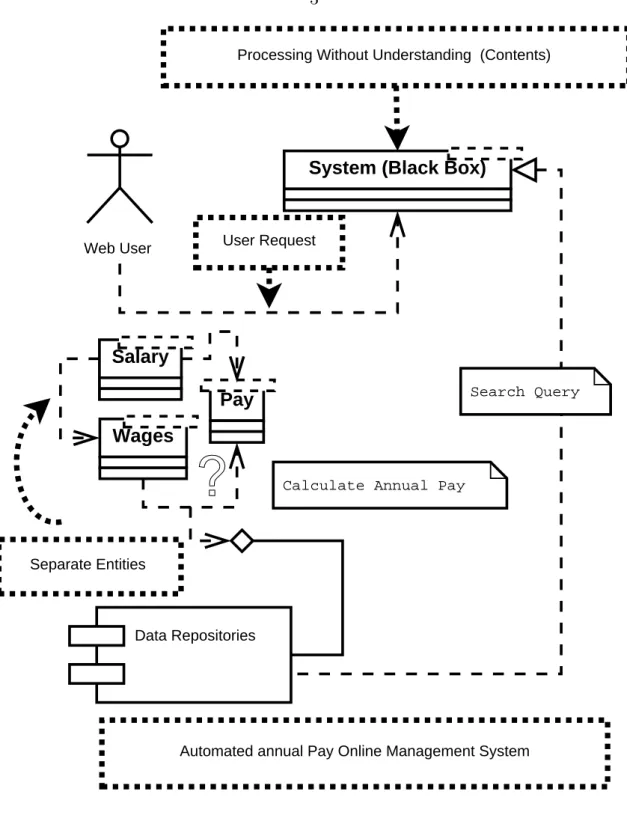
an annual pay online management system (as shown in Figure 1.1) which generates
reports after integrating and collaborating via different online services containing
information such as tax, bank details, employee record, extra allowances and
na-tional insurance contribution. Such composing environments are difficult to develop
as a system 1 cannot understand the inherited meaning of all used concepts, which
are in use by different services [163]. The pay online management system needs a
high level of effort and technical skills to integrate, as all services are using different
concepts and technical terms. For example without differentiating and considering
the different instances of pay (pay, salary and wages), all participating services are
unable to communicate. As all services are using different concepts, so semantic
similarity between entities is not possible unless the environment supports services
composition.
Web User
System (Black Box)
Data Repositories
Search Query
Salary
Wages
Pay
Calculate Annual Pay
Processing Without Understanding (Contents)
Separate Entities
Automated annual Pay Online Management System User Request
Figure 1.1: Current Web Contents Based Queries
Figure 1.1 shows the high level abstraction of inner class communication in
ob-jects where, essentially, the system cannot differentiate between the available
con-straints. By considering, firstly, the three separate entities (pay, salary and wages),
show the information flow and dependency of all involved entities in the system).
Secondly, there are ontologies (models with logical mapping) required in order to
operate/process such applications [2]. At this stage, the development of such an
application is carried out by providing static binding (logical or causal connections)
between concepts which is a time consuming method [55]. As discussed in the
pre-vious paragraph, by making the system aware of the basic concepts’ meanings, the
integration of the services should then be possible, and carried out without the
oper-ator’s intervention [58]. The environment will be able to understand and coordinate,
to solve simple or complex tasks [21]. The discussed scenario is representing a very
basic example, but for millions of available online services the same concept is
forc-ing towards non-automatic or human operated environments based developments
[21].
1.1.1
Key Research Issues
The main aim of this research is to explore the possibility of
auto-matic dynamic web services composition and to provide more scalable,
optimal, and robust final solutions according to user requirements.
So-lutions already exist that support the web services composition process, and that
are being developed through the use of different methods [138]. However, for
dy-namic web services composition, AI (Artificial Intelligence) planning-based models
have been utilized in previous research, that provide more scalable, and efficient
results [23, 59, 67, 92, 137]. AI planners can be used in order to solve the web
services composition problem, through the production of a sequence of actions that
perform a particular task [89,92]. This is because planners are able to perform any
goal-oriented task within a web services domain if there is a procedural description
There is, however, a requirement for a planning environment which can
accom-modate and support the services composition methods. This is the main reason for
the AI planning-based approach being chosen. Though this problem has existed
for the last few years, there is still no standard framework available that can be
adopted by businesses, or other organizations, where the requirement is to obtain
results following the analysis and composing of multiple services.
As discussed, a framework can be designed for the discussed composition
ap-proach, but it is difficult to put it into a working context, due to variations of
development methods, communication protocols, compatibility and services
secu-rity issues [16]. It is very difficult to adopt, or accept, a common framework, until
all the major leading stakeholders in the IT industry (Microsoft, Amazon, Oracle,
IBM, Apple etc.) adopt a common development model. The common model needs a
unique framework, language, protocols and ontological structure for communication,
and for inter communication of composite services [185].
1.1.2
Example Scenario
To explain the process of web services composition, let’s consider a simple example
of holiday planning. Travel planning is a simple, easily evaluative and traditional
ex-ample of a web services composition problem, discussed by different research groups
in the services composition area. Every year, thousands of web users around the
world browse different websites in order to plan their holidays. There is the facility
for customers (through web-based forms) to provide their basic requirements, such
as tour time, food preferences, budget, and travel arrangements.
After basic input values have been entered (inserted), the system will attempt to
match the desired preference-based results, and will present them to the user. The
finalized through manual comparison of the search results. There is a common
terminology used while searching and analyzing the plan, Packages. Some tour
operators will offer tailor-made packages, where travelers will have some of their
preferences catered for, but must also accept, and pay for, additional, undesired
facilities. Some websites provide a matched package in a few seconds, once the user
has provided their desired location and preferences. These holiday offers are made,
not only by a particular holiday planning company or travel agency, but by different
stakeholders such as hotels, car rental firms, travel insurance companies and banks
(Details provided in [73, 95,97, 110, 116]).
Currently, the aforementioned offers are found through searching a static database,
using search engines, or provided interfaces [8]. The system uses static repositories,
with the traveler not getting the full advantage of services from other providers,
which may have been uploaded or updated recently. The above problem is not the
only problem of this kind. There are a number of contextual domains where the
services composition process is required, but faster internet, technological
advance-ments, and an ease of application access normally removes these types of problem
from the sight of the common user [147]. The development of well-arranged data
repositories has led to compiling of knowledge, which has helped to make
develop-mental decisions quicker and easier [66]. There are many information repositories in
which search facilities are in need of services composition, some examples including
police investigation systems, weather forecasting applications, bio-medical research,
and financial management institutions2. These are not the only examples, but with
rapid growth of online solutions, and new technological concepts emerging, the need
of services composition has increased.
Presently, the composition process is handled either manually, or by using
dis-tributed technologies-based, domain-to-domain static composition methods [163].
The current methods are still useful, however the automatic services composition
methods can provide a more effective, accurate and timely response.
As discussed previously, the basic layer of development, to support the Dynamic
Web Services Composition (henceforth DWSC), is to implement the semantic
web-based contents, which should enable the system applications to interact with each
other [177]. However, the main critique comes from the fully-automated, semantic
contents-based DWSC process, as changing the existing web appears to be a complex
task. The DWSC research publications provide evidence that full automation is not
impractical [41, 84]. The services composition task implementation is also being
challenged by the amount of available services conversion processes, as it is not a
feasible approach to convert the huge repositories of non-semantic-based contents
available on the web. After development of semantic contents, the next stage is to
locate these services, using a search procedure. During the discovery process, planner
or software agents have to consider all related services, and available composite plans,
before presenting the final solution to users.
In the aforementioned travel plan example, the planner has to consider all
ser-vices. These can be singular or composite services [62], where a composite service
is a service whose implementation calls upon other services, or consists of related
sub-interfaces. This is as opposed to an atomic service, whose implementation is
self-contained, not invoking any other services. Occasionally, there is a tailor-made
package available, so that when the planner considers services, it has to consider,
also, all partial plans e.g. travel company’s packages for partial fulfilment of the
actual output. This proposed approach can help clients (user) to obtain precise,
accurate and updated access to results, as well as allowing potential clients access
1.2
Research Question and Contribution
Research led activities related to services composition are moving towards the
dy-namic features of the SOA (Services Oriented Architecture). The researcher’s main
goal is to approach the services composition problem according to the demand of
the fully automatic environments. How can a normal user also take advantage of
all available web services and packages without practical knowledge of the details
of the services, is the main focus of the current work. Considerable attention has
already been given towards web services composition through consideration of the
different approaches [177]. Still, however, no one addresses the full workflow context
(end-to-end) to support composition processes, by considering available plans and
composite services [144]. The current work will also look at user preferences for the
composition process, and how to provide user’s final results through evaluation of
the desired constraints. It is very important to consider the user preferences before
the composition process, in order to gain full advantage from the services
composi-tion process [159]. Along with user preferences, the final results will be analyzed,
by conforming the input values, for optimal results, and ultimately to provide the
user with choice-based options [101].
The main objective of the current thesis is to explore the AI planning-based
solutions for the Dynamic Web Services Composition (DWSC) process, with an
incorporated knowledge acquisition approach. A significant number of publications
are already available in the dynamic web services composition area i.e. how the
planner will locate services of the user’s choice, but still, no discussion about the
consideration of services by selecting composite existing services has been made.
The main problem with all available AI planning-based solutions is that they can
only be applied to one particular set of services, or similar domains [126,183].
domain [2], but in the current thesis, the composition framework has been developed
to consider, not only similar kinds of domains, but other similar problems.
Practi-cally, it is not possible to test the solution of DWSC by considering different domains
however where possible, domains problems and related solutions will be discussed in
the current thesis. The obtained results will be compared with the similar efforts in
DWSC area. For the rapid and dynamic discovery of services’ support it is necessary
to consider QoS (Quality of Services) features. In the proposed framework model,
known as OSPG (Optimal Synthesis Plan Generation), the QoS constraint has been
considered, along with user inputs. Within the main contribution to the Dynamic
Web Services Composition (DWSC) model, for web services research context, the
current work will also address the following research questions.
• RQ1: Which mechanisms are required in order to automate the
Dynamic Web Services Composition process? Further, is it
pos-sible to develop a framework which can support the composition
process without user (operator) involvement)? The main aim of this
thesis is to analyze the requirements for supporting the workflow planning for
web services composition that will address ongoing problems. Currently, the
main problem with all available DWSC solutions is that all models work very
well for deterministic domains where the static interfaces are designed to
sup-port that particular domain, but do not provide fully automated functionality
for the non-deterministic domains [20]. Even by using existing interfaces, a
high level of expertise from the technical user is required in order to carry out
a single task.
Initially, the available solutions for reducing the complexity for the user will be
analyzed and a new and common framework will be proposed to improve the
and this new common framework will be established in order to support the
DWSC process. As discussed above, the AI-planning-based solution will be
selected, however, research tasks will be actioned in order to establish
alter-native options and techniques for services composition. For example, it is
possible to solve the DWSC problem by using a common structural model and
languages-based platforms provided via the distributed web technologies (such
as RMI, CORBA and JINI 3) [135]. Due to the complexity of the proposed
solution, it is very difficult to test this proposed framework within an online
environment and by selecting different domains [31]. However, the system
will be tested offline by using the OWLS-XPlan platform [85]. Two domains
will be considered and within each one, a range of separate test cases will be
applied and the results will be evaluated according to proposed concepts.
• RQ2: How should the framework be designed to consider
func-tional and non-funcfunc-tional attributes when providing a final
solu-tion, according to user requirements? There are a number of input
requirements for the composition process, which can be differentiated through
consideration of their functional and non-functional attributes [94]. The
com-position process cannot be observed without some of the inputs, while some of
the inputs are not required when narrowing down to the final solution. There
is a requirement for the DWSC process to plan for a high level framework
and a structural model, whereby it will be possible to accommodate the user’s
preferences during the final results of the services’ composition [158]. The
DWSC process model requires a common approach when considering the
ap-propriate and relevant inputs for the discovery process. The proposed work
3(Remote Method Invocation,Common Object Request Broker Architecture, JINI (pronounced
will present a planning-based, intelligent solution for the search process and
discover services by considering the different possible combinations of input
values.
• RQ3: How will participating services be analyzed and considered
for the composition process in order to establish optimal results?
The selection of appropriate services, and provision of optimal results to the
user, is also one of the requirements of the DWSC process. After the discovery
process, the next step is to find the best solution according to the user
prefer-ences. The combined results of several services are also contained within some
of the participating services in the composition process (as discussed in the
travel plan example). There are different combinations of singular, or
com-posite, web services available for the planner to analyze. The methods will be
formulated to consider those combined results, if they are comparatively more
efficient than the integrated multiple services (composite services) while the
current work will also include the methods of optimum selection process.
The number of online, available services are increasing, and many services are
shaping up to provide the same functionality. It is very difficult, therefore,
to choose the best services. The web services research community introduced
different ways to address this problem, however, the available solutions can
provide a search functionality from a static repositories, without analyzing
the services description. There is a requirement for the domain-independent
framework, which will carry out the composition task without involvement the
1.2.1
Research Methodology
To address the problems described above, the existing approaches will be analyzed.
Instead of re-inventing the wheel, the previous state-of-the-art techniques will be
employed in the current work [84,86,88,104,157]. Due to the nature and
complex-ity of the system, a mixed set of approaches will be used in order to analyze, and
design, the integrated artefact-based model for the services composition. As
dis-cussed, previous successful efforts will be analyzed such as SHOP2, OWLS-XPlan
and OWLS-MX [84, 86, 88, 104]. The discussed concepts and platform will be
uti-lized as a basic testing system to evaluate the framework. The discovery process
will be investigated, while the dataset of the European Union IST programme
CAS-COM 4 and planning environment of the SCALLOPS5 project will be utilized. The
proposed framework results will be compared with existing outputs for evaluation
purpose however due to nature of the proposed model and extra user preferences
based functionality (the exact output (results) providing environment), is not
avail-able.
For the services discovery process, AI-planning-based algorithms are being
stud-ied so that self-regulating services composition facilities may be provided, without
involving the user during the composition process. There have already been many
attempts to compose services by using an AI-planning-based approach [188],
how-ever in the current work, the user preferences consideration-based solution is adopted
(the details are available inchapter 4). The required solution for the different types
of possible input preferences from users, and the possible solution through
con-forming of the user requirements, will be further tested. Our proposed framework
4CASCOM is a Specific Targeted Research and Innovation Project (no. FP6 - 511632) supported
by the European Union’s IST programme . It has a total funding of 2.7 M
5Project of German Research Center for Artificial Intelligence (DFKI) further details available
model which is called OSPG (Optimal Synthesis Plan Generation) will address user
preferences and will be able to provide an optimal solution.
1.2.2
Thesis Outline
As discussed in the previous section, the main contribution of this research project
is to provide a conceptual workflow model that includes all pre-compiled web
ser-vices packages during the Dynamic Web Serser-vices Composition (DWSC) process.
AI-based applications have existed for years that have a marvelous reputation for
solving complex mankind problems [28, 153]. There are different AI-based
auto-mated environments available, and in this thesis the planning-oriented solution will
be employed. However, during the analysis phase, the available distributed web
de-velopment technologies will be considered. The current work has been divided into
four stages.
• The first stage explores the limitations of the distributed web development
technologies (RMI, JINI, CORBA) and the related, proposed solution for
Dy-namic Web Services Composition (DWSC). Concurrently, the main focus has
been on researching the current problems, and any unsolved issues in the
previ-ous research, while the proposed framework model will be finalized to support
the DWSC process.
• In the second stage, the available planning environments requirements and
the final outputs, will be observed in order to find gaps in the implementation
process, and to understand how the planning process can support the DWSC
process.
• The third stage demonstrated that the proposed, developed model, OSPG
used in any related solution for services composition, where the automated
environment can perform any task on its own after receiving the initial and
final stage parameters from the web user.
• The final stage of the system will be observed through analysis of the final
results, and by conforming to user preferences. The system will be
evalu-ated by comparing the results (findings) with the available, state-of-the-art,
environments in the DWSC area.
The thesis is structured around the following chapters, with the above research
questions mapped into the respective chapters.
• Chapter 2addresses the review of the literature to develop the basic concepts
of semantic content and ontological representation requirements, while the
leading services composition solutions are also discussed in detail. Finally
the requirements for the DWSC process are taken for the proposed model of
composition.
• Chapter 3supports the proposed solution by providing the AI-planning-based
discovery mechanisms that are already utilized in different attempts. Further,
how to approach the optimal solution through the use of existing, modified
techniques has also been well thought out.
• Chapter 4 provides the basic requirements of the DWSC, and how the
pro-posed framework will take into consideration the features of QoS, and user
preferences. The chapter will also contain the basic expectations of users
(common user) of the automated services environment. The technical
im-plementation considers user preferences, and conforms to user desires for the
services discovery. The conformance and contingency planning requirements
• Chapter 5explains the implementation details, where the practical activities-based results are discussed. In the same chapter the final outcome will be
compared with the related work in the DWSC area.
• Chapter 6 concludes the research framework by explaining the main
out-comes, and by discussing the suggested directions of the futures in the DWSC
area.
1.2.3
Concluding Remarks
History has shown that with every new development, there are issues that mankind
could not have perceived at its onset [36, 60, 122]. The emerging concept of the
semantic web is still in its infancy, as there is a collaborated effort required to
im-plement and change the current structure from all services providers and developers
[43]. The inspiring example of services composition can be fully automated by
intro-ducing the semantic context awareness, and the attached services description. The
services automatic composition will play an important role, one which will reduce the
current time consumption and incorrect results-based, manual search procedures.
The progress in the AI-based-planning solution is one of the driving forces that
makes the DWSC process an achievable goal and that provides a new direction of
research for web researchers. With the help of AI planning-based solutions, it is
possible to provide solution and to plan according to users’ choices. The overall
DWSC process will be meaningless if the final results are not in accordance to user
requirements. The user preferences need to be considered before finalizing any plan
and as discussed in the last section, by using an AI planning heuristic, it is possible
to conform to user requirements, resulting in the best use of data repositories and
resources.
work in the services composition area by using the AI planning-based approach, is
Chapter 2
Background and Related Work
2.1
Motivation
The Internet has become part and parcel of everyday life. The World Wide Web
(WWW) has made a contribution in every sphere of life (e.g. socio-economic and
environmental) [180]. It has provided connection in the form of various networking
sites (e.g; Facebook, Twitter, MySpace and Flickr), and helped to spread knowledge
by new communications techniques [47]. This has resulted in the world becoming a
global village. Various entertainment applications such as computer games, music,
animations and real time videos have paved the way for a cherished life for youngsters
and old people alike [98].
The Internet has emerged as one of the tremendous achievements and innovations
in the field of computing, attracting many people, irrespective of age [51].
Every-one has started to think about personal web pages, businesses have uploaded their
websites, and educational establishments have launched teaching activities on the
Internet [98]. Researchers in web based resources development are particularly
in-terested in new techniques and directions to produce new applications [102]. There
field, involving home desktop and laptops, normal phones and i-phones, RPG1 and
MMORPG 2 games [149].
Modern computing fields such as Cloud computing, Grid computing and
Vol-unteer computing have provided web researchers with many directions in which to
advance their research and bridge the gaps among the different application domains
for inter-communication [10, 32, 40]. Different applications have to be identified
for inter-communication by using common protocols and unrelated deterministic
behavior such as location, platform and tools [176].
With the help of current developments, progress in computation devices and
speedy apparatus, it is possible to integrate the online applications and to enhance
the capability of services for effective solutions [32,132]. Here, an effective or optimal
solution means providing users with final results after finding the best solution
according to user requirements. In order to achieve optimal solutions we have to
develop common protocols and models [121].
The current chapter is structured as follows, Firstly, the basic concepts, literature
review and related work is discussed. The second section is about services
compo-sition procedures. The third section will explain the requirements of Dynamic Web
Services Composition by considering issues and related research questions to support
web services.
2.1.1
Service Oriented Computing
The Service Oriented Computing (SOC) concept has been around since 1999,
How-ever, during the last couple of years, it has been receiving more attention from the
automated web research community [132]. The main idea behind the concept of
SOC is to utilize the software capabilities from different domains and to provide
1Role-Playing Game
on demand solution to users which will improve the machine-to-machine interaction
[145]. The exploratory research topic of SOC raised many questions in the
exist-ing paradigm of intercommunication [10]. The different research directions were
suggested along with a few efficient solutions for the integration of distributed
envi-ronments. The developed software’s environment integration and automatic
inter-communication were the key priorities of SOC, but still the current research is not
up to a level to adopt a fully autonomic model where services can be discovered by
other systems or applications and will provide results to users [82,112, 145].
One of the leading areas of research in SOC is the composition of web services
to obtain an efficient solution from available web services [120]. A Web service is a
software system designed to support inter-operable machine-to-machine interaction
over a network [27]. The current setup of the web is now providing a vision of a
well planned structured repository of resources. The available services are further
multiplexing with available online resources and providing effective solutions [6].
With the introduction of cloud computing concepts (SaaS,PaaS,IaaS)3, the web repositories are being populated and businesses are competing by improving their
services for customers [130].
As the services repositories’ sizes are increasing, the search functionality needs a
better coordinated communication scope to return respective queries or results with
minimum time and cost [168]. The improved search functionality will result in the
common user being able to easily search for the best solution and indeed they will
get an optimal solution. [2,23, 88]. To improve the search facility, the requirement
is to design the services by using contents which are easily interpretable by the
software processes. In recent attempts, there is improvement in the designing side
of the services to enable the intercommunication in services [105]. Currently, the
following web variations and characteristics have been discussed in the literature.
2.1.2
Definitions
• Syntactic Web: In the first generation of the web, the services only contained
basic information regarding the contents. The user has little control, as they
can only change the interfacing options (font selection, layout, color and use
of plug-ins) but the contents are not interpretable by the system [12].
• Semantic Web: The main objective of the semantic web is that the contents
of the web are machine processable. The information which is available on the
internet is not interpretable by machines at the moment. Sir Tim Berners- Lee
gave us the idea of the World Wide Web (WWW) and after years of its
utiliza-tion in different direcutiliza-tions of technology, a new vision has been proposed which
is the semantic web [37]. The semantic web can be defined as,is an extension
of the current Web in which information is given well-defined meaning, better
enabling computers and people to work in cooperation [44, 111].
• Pragmatic Web: The Pragmatic web introduced the concept of the next
generation web, where the concept of automatically extracting (or
manipu-lating) information by software agents or planners, and to utilize contents is
carried out without humans’ involvement. Information retrieval will involve a
simple search, for example last year’s temperature (or weather conditions) on
one particular day, to provide answers for complex queries by applying data
mining rules or simple heuristics based solutions, which are not possible to
solve manually in real time [165].
For future developments, the new vision of the semantic web which was again
proposed by Sir Tim Berners- Lee is a fantastic approach, but after more than a
decade of effort, is still in its infancy [151]. There are many reasons behind this
Life Project, but one reason is that people are not aware of the impact and
appli-cation of the Semantic web and Pragmatic web [9]. The one possibility to introduce
this concept, which is discussed by Sir Tim Burners-Lee, is to develop a critical
mass for the semantic services which will include the development of data bridging
(patches), semantic data and common ontologies [9]. The development of critical
mass, which will be helpful for the enhancement and awareness of semantic services
based composition models.
At the stage of the literature review of conducting and analyzing different models,
it was observed that there is a requirement for an automated ontology 4 building
environment to integrate semantic data [37, 55, 59]. The environment can be a
part of the system or should be integrated with services repositories. The semantic
services model on its own cannot provide support for DWSC as there is also a
requirement for semantic data, domain ontologies and the planning environment to
support the composition process [96].
The Semantic Web will bring structure to the meaningful content of Web
pages, by creating an environment where software agents roaming from
page to page, can readily carry out advanced tasks for users [111].
.
The academic research community realized this fact and is trying to explore the
experimental evidence for utilization of characteristics provided by the Semantic
Web and Pragmatic Web as discussed the in last paragraph [172]. By analyzing and
considering semantic contents, applications can communicate easily by following any
provided rules [109]. These rules show the connection and link between concepts,
known as ontologies. The use of ontologies make it possible to invoke other services
4An ontology is a formal specification of a shared conceptualization and allows user to organize
on the internet [109]. There are two types of methods to invoke and combine other
service. The first type known as Static Web Services Composition (SWSC),suggests
that services should be composable if the details of the different bridging services are
provided up front. In the second type known as Dynamic Web Services Composition
(DWSC), the services should be considered without existing knowledge by following
certain standards applicable to all services.
Let us change our traditional attitude to the construction of programs.
Instead of imagining that our main task is to instruct a computer what
to do, let us concentrate rather on explaining to human beings what we
want a computer to do [63].
2.1.3
Static Composition Methods
Static composition environments are further divided into manual, and semi-automatic
types of services composition [142]. The manual methods are where services are
obtained from a repository of prearranged similar services. Semi-automatic
meth-ods, on the other hand, provide final results through consideration of user
require-ments [155]. The main difference between DWSC methods and semi-automatic
services composition is that the latter can operate on only preset (arranged)
ser-vices’ databases, and have consistent input and output values [166]. The methods
were being utilized in syntactic web based environments, the syntactic services
inter-action model concept assuming that parties may connect without prior knowledge
of the participants, by following URL links and observing some fundamental rules
[166]. In the web service-oriented interaction style, the particular web service request
takes the form of a complete XML (query) document, and will provide the result
on screen, with acknowledgement in the form of an email, or any other type of
framework in memory [187].
In the semi-automatic services composition method, the web services provider
and the client may use different platforms and programming languages. Web
ser-vices also hide the details of the application to the application interaction, hence
the distributed application development moves away from a tightly coupled system
to a loosely coupled one. Web services improve program integration by enabling
program-to-program communication, while an automated, dynamic composition of
web services requires a fairly rich, machine-understandable, description of services,
and relationships between their basic concepts (ontology) [6].
2.1.4
Common Static Composition Methods Development
Technologies
Static composition is the process of considering user requests in a predefined,
accept-able format, where either the user request is obtained by using an advertised format,
or the user must enter values manually, to initiate the composition process [178].
The protocol (SOAP) provides basic interfacing and the communication channel
be-tween the two applications. The protocol also established and agreed on the RPC
(remote procedure call) interaction model and the acceptable data encoding format
[178]. In the static composition process, the applications must follow binding rules,
the process being unable to start with incomplete information. The SOAP
speci-fication defines the messaging framework for exchanging data across the internet,
SOAP being, fundamentally, a one-way communication model that ensures a
coher-ent message is transferred from the sender to the receiver [136]. SOAP messages
have several parts.
• Envelope: (start and the end of the message)
• Header: (optional attributes of the message)
• Attachment: (attached documents)
• RPC Interaction: (structure of interaction)
• Encoding: (representation of data)
SOAP messages can be analyzed and subsequently related services will be mapped
to carry out the services composition process. Universal description discovery and
integration provide (UDDI) a registry service where a web service provider can
reg-ister and publish their web service [61]. The UDDI registry consists of the following
three parts. White pages contain contact information, human readable information
and web service related information including business name, address, contact
in-formation, and known identifiers such as tax ids, customer ids or postcode. This
information allows others to discover the service based on its business identification
[61,100].
The UDDI yellow pages contain a register of keywords that characterize the
service, information that describes a web service using different categorizations,
in-cluding industrial categorizations based on standard taxonomies [170]. Green pages
actually contain technical information such as web service rules and a description
for application invocation. Green Pages also include references or pointers to
speci-fications for Web Services [100].
The UDDI registry has two kinds of clients: businesses that want to publish
a service and clients who want to obtain single or composite services. Two APIs
(Application Programming Interfaces) are described by this UDDI specification: the
Inquiry API and the Publishing APIs [170]. The Inquiry API locates information
about a business, the business offers, the specifications of services and information
authen-ticated access and is subsequently accessed using HTTP but the UDDI detailed
format does not support semantic descriptions [100].
The technologies of Microsoft’s SOAP Contract Language (SCL) and IBM’s
Net-work Accessible Service Specification Language (NASSL) were combined to form the
basics of WSDL(Web Services Description Language) . Although the technology is
still under development, nearly all web services provide support for WSDL, and
most development tools auto-generate WSDL files [100]. WSDL is divided into
three major elements:
• Data Type definition
• Abstract operations
• Service bindings
SOAP, WSDL and UDDI based environments provided the basic functionality for
services composition but their basic capabilities are insufficient for the DWSC
pro-cess. OWL-S (Ontology Web Language) provides the description of semantic web
services, and the details of its services enable planners or agents to locate, execute
and compose services automatically [161].
Service Profile contains information about what a service does; goals which a
service can achieve and the requirements to execute the particular service.
With the help of OWL-S, it is now possible to specify the inputs and outputs
which are required by a service before the start of the actual execution process
[175]. For the services composition problem, OWL-S also offer non-functional
properties to be considered along with main requirement expectations from
the DWSC process
Service Model contains information about the use of the service and how the
Service Grounding contains the details of communication protocols and message format to integrate the service with the service model and operation details
[175].
2.1.5
Dynamic Web Services Composition Methods
The design time services composition methods are discussed by many researchers,
the concept being that services have to be discovered and composed according to
user requirements at the time of design [12,108,182]. At the development stage, the
services description has to be considered, and the set of services arranged in such
a way, that the composite service will provide the user with a final solution. By
following the aforementioned methods, it is possible to develop composite services
for each type of user query, and in order to be successful, the user requirements must
be well known in advance, the method not being suitable for on-demand services
composition methods [12, 108,182].
To apply these techniques for accurate results, the requirement of DWSC is
to introduce semantic and ontological concepts to propose a web service model.
Otherwise, dynamic web service composition will provide the same concept as any
other distributed computing applications or static composition model [179]. The
setup will provide a platform for the client and web services to find each other
without prior knowledge of each other. Hence, the act of looking up the capabilities
of a Web service and composing it with others may be done simultaneously, rather
than using inflexible, static binding [179].
These issues can be addressed by using the DWSC process, where the individual
services are considered as atomic entities. Each service atomicity enables the service
to present itself for the composition process.
services composition models.
• The autonomic environments to compose services dynamically.
• The algorithms to support the discovery and composition process.
The above mentioned examples are some of the available solutions, however
there is a requirement to develop algorithms for the discovery and composition
process. The next section will explain the available solutions and will lead towards
the composition requirements.
2.1.6
Common Dynamic Composition Methods Development
Technologies
The number of services available over the web increases dramatically [179], and can
be created and updated on the fly [178]. To achieve this dynamistic goal for web
services composition, the AI Planning community provides a number of planning
based solutions for the discovery and composition of web services [76]. The research
based publications explain that while generating a plan, how the planner will locate
any required services and how user preferences would be considered [58]. But as of
now, no one has discussed the selection of services by searching existing composite
packages based services (pre-compiled services) which is an important part of our
research [84].
Considering existing pre-compiled web services during the composition process
is a very important issue because there are many services around the web and each
one has a limited functionality. In many cases, a single web service is not sufficient
to respond to the user’s request and often services need to be combined through a
pattern of composition to achieve a specific goal. In some cases one service contains
individual services it is more efficient and effective to consider only one particular
service which holds a composite plan.
Mostly, services composition solutions are based on HTN (Hierarchical Task
Net-work) such as SHOP2 (which is domain independent) [58]. HTN planning techniques
have existed since the 1980s, and are utilized in planning problems of complex
do-mains. In the HTN-planning domain, the goal state is typically achieved by using
a set of operators (which contain the details of the procedure for decomposition of
the main task) [69]. Along with operators, there are also attached methods that will
help to decompose the main task into subtasks [157] (details in subsection 2.2.7).
SHOP2 is a HTN based solution by Evren Sirin which is domain independent [181].
The planning process proceeds by task decomposition. The set of methods and
op-erators are available to decompose the main task into smaller subtasks. The SHOP2
environment works by progressing towards planning steps of the composition task
in three stages.
• At the first stage, the domain is formulated by processing OWL-S files and by
replacing the operators of complex services with simple services.
• At the second stage, the main problem of services is transformed into a
plan-ning problem with the help of attached operators and methods. Here the
complex task will be identified and the tasks which are further decomposable
will be identified.
• At the third stage, SHOP2 will provide the planning steps to compose the
services [188]. The main advantage of the SHOP2 environment is that it
provides the sequence of steps, which later on can be executed in some order.
The sequence of steps based solution will provide a breakthrough which will
In order to start the planning process, SHOP2 requires knowledge about the domain
(knowledge of operators and method) [181]. In SHOP2, the planner works very well,
where the required information is available to decompose the main domain into
sub-task and the pattern of its hierarchical structure. The detailed knowledge about the
process and subprocesses within the domain and the dependency among different
processes should be available for a developer or planner to analyze. The planning
solutions can be best supported if the detailed knowledged of the domains are
avail-able in advance which is not the case in the services discovery and composition
problem. Here detailed knowledge means the input, output, facts (attached with
methods) and preferences based requirements. Planners usually store a solid
prede-fined hierarchical structure to decompose the main task. In SHOP2 environments,
the planner’s main objective is to perform simple (primitive) tasks instead of directly
achieving one particular goal. Main tasks are divided into subtasks and the process
will carry on until we reach a primitive condition which is directly addressable by
using common methods [124, 181].
The HTN based model consists of a network of nodes and with every node
one method is attached which actually shows a description of the node and its
conjunctive and disjunctive relationships. Each node represents a complete sub task
or composite task. Due to the dynamic nature of services composition problems there
are limitations of the HTN based structure as discussed in [49, 74, 113]. The main
problem with HTN based planning for DWSC is that the planner has to follow HTN
hierarchical steps that have a predefined structure. However in DWSC problems,
planners may observe changes during runtime so it will be difficult to traverse firstly
all the nodes before reaching to the actual required goal. The following example
will explain a few limitations which will be useful in explaining towards our research
In DWSC examples any online service at a (or any) node will provide the final
output either from its own domain or by considering other nodes (services). One
particular task may only need a single service from a node (either side of a leg) of
a HTN. For example in a travel planning domain it might be the case that some
services have to use a currency converter which may be attached to any other node.
If we are using HTN, the planner has to start again using breadth first search for
a currency converter which will result in session time out or waste of time before
composition. Session time out is also an undesirable output for service composition.
To address this kind of issue, we tried to use pre-compiled service structures. For
any particular domain we can address such problems by using one related method
attached to every node. But if we are looking for generalized AI based DWSC
solution then it will be undesirable option.
In our current research, we are proposing a compiled web idea to adopt either
at an individual service level or a complied services (packages) level. the proposed
solution is that related services must be at one particular node or on an adjacent
node. By adopting this kind of structure results will be more reliable and the
composition process execution time will be faster.
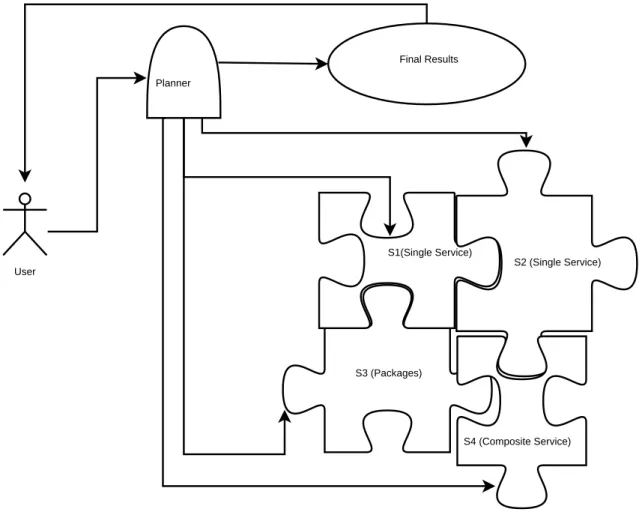
Figure 2.1 provides the high-level abstraction of user requirements from the
DWSC process which shows the response to a user query after composing different
types of services. An intelligent software environment is required to provide final
results to the user without the further involvement of the user.(Details inchapter 3)
In the WSC process, all the above mentioned requirements are not known in
ad-vance. The queries from the users are also non-deterministic as the user can search
for any kind of solution while the solution can be obtained by exploring different
ontological relations, semantic dependencies and attached constraints. The HTN
af-S1(Single Service)
S2 (Single Service)
S3 (Packages)
S4 (Composite Service) Planner
Final Results
User
fordable for such kinds of dynamic WSC solutions, as none of them are designed
to adopt the patterns of non deterministic domains. However, for small domains
where the sequence of services arrangement is well known in advance it is possible
to utilize HTN planners. Along with all the above factors a human expert is
re-quired to analyze and tailor the decomposition requirements. As discussed before,
the requirement of DWSC is that planners have to find a solution by taking different
actions described in methods but without following the predefined pattern of
com-position. Here the predefined pattern can be a HTN structure or domain dependent
rules, which can only support a particular domain.
After considering the above mentioned issues, a system is required which will be
able to meet the above mentioned requirements and which can provide a solution
for any type of non deterministic request without human expert involvement. At
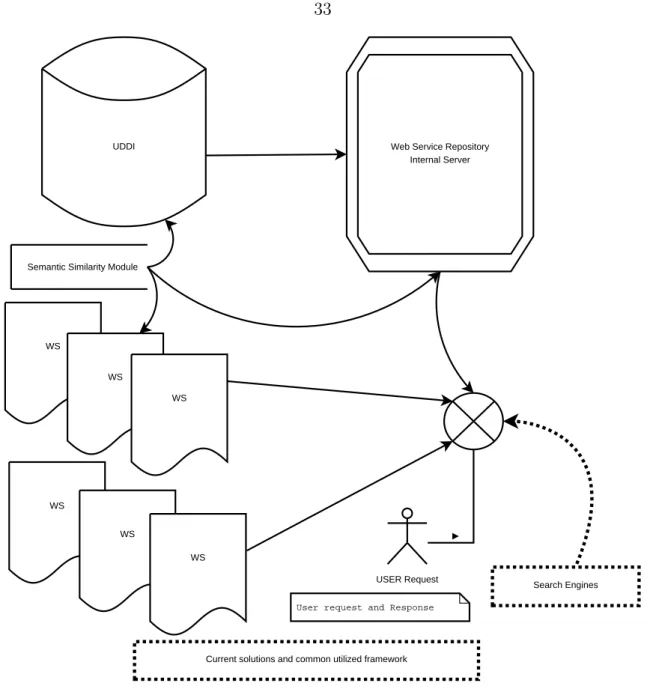
this stage of discussion,Figure 2.2shows the basic functionality of the current setup
which has been utilized by different research groups to locate services from UDDI
[66, 127]. There were many attempts after the IPC (International Planning
Com-petition) award winning attempt of SHOP2 to address the few deficiencies within
the environment by using AI planning techniques and to enrich the final goal steps.
The following are related attempts and helpful examples to formulate the solution
Web Service Repository Internal Server UDDI
WS
WS
WS
WS
WS
WS Semantic Similarity Module
USER Request
User request and Response
Current solutions and common utilized framework
Search Engines
Figure 2.2: The Service Discovery Process
John Gekas and Maria Fasli presented a methodology for automatic web service
composition that views the composition search space as a dynamic hyperlink
envi-ronment of scalable size, and uses the envienvi-ronment’s link connectivity structure in
order to guide the composition process effectively [56].
Evren Sirin team considered user preferences and provided a framework to
in-clude user preferences along with related required goals however the system will
presented SCUP (social media monitoring service) with integrated algorithm to
decompose the domain by using task decomposition method [92, 101]. Shelia A.
Macllraith and her team ha also worked in the user preferences area [158].
Mark Carman, Luciano Serafini and Paolo Traverso introduced a semantic type
matching algorithm, and an interleaved search and execution algorithm that together
allow for basic automated service composition [33].
Similar work has been presented, known as ’PORSCE II’, which provides a
composition environment through consideration of the semantic contents, and the
attached information of the services [67]. However, while the authors suggested
that user preferences will be considered, the required functionality was not
tack-led. PORSCE II contains a visual interface. All other systems required domain
knowledge before starting the process of composition, while the requirements of the
services composition process are to dynamically adopt the changes and new
con-straint values. By considering the updated services that best provide a solution,
according to the user’s requirements. The three main advantages of PORSCE II
are discussed by the authors. The exploitation of semantic services (which is the
requirement of future developments) is seen as the main advantage. The second
is that the system is not designed for one particular set of domains, in which the
system has no power of analysis, or rigidly sticks to a predefined pattern. Also the
system is integrated with a re-planning module that can help in case of any service
failure [67]. PORSCE II supports a full composition process, and can consider only
available services by evaluating the attached semantic description. The distance
for-mula based evaluation metric has been used in the PORSCE framework. (Details
of results and comparison are available in Figure 5.8).
One of the most prominent efforts in the direction of an advanced DWSC was
hy-brid AI-planner, the services matching being supported by the external component
OWLS-MX, which provides a process level support for the discovery of the
ser-vices. To enhance the semantic composition of the services, and to verify the IOPE
(Input, Output, Preconditions and effects) of all involved services during the
compo-sition process, the OWLS-XPlan environment utilized the OWLS-MXP [85,86, 88].
For the proposed framework evaluation and development purpose, the XPlan and
OWLS-MX environment will be utilize.
The PDDL (Planning Domain Definition Language) was utilized which was
pro-posed by McDermott in 1998 [4]. PDDL is a formal specification language used
for encoding knowledge about actions in a specific application (called a ‘domain
description’). The domain description is written in the form of generalized operator
schema. A planning problem to be solved is represented separately by an initial
state of the problem, and a set of goal predicates to be achieved. Different versions
of PDDL are available depending on the expressiveness of the domain description
and problem languages. We will use PDDL3 which enables the encoding of user
preferences. PDDL3 features can be utilized to consider the QoS (Quality of
Ser-vice) factors, but in current work QoS constraints are also mapped as a preferences
based factor.
As our proposed model is similar to OWLS-XPlan and PORSCE II, so where
possible the outputs will be compared. The available OWLS-XPlan converts all
OWL-S, OWL services and anthologies to PDDL 2.1. Hence the planner can use
PDDL (Planning Domain Definition Language) as input which includes descriptions
of objects, the initial stage, predicates and the final stage to achieve. The
require-ment of the proposed solution is to consider the user’s strong and soft constraints
along with the input requirements. To encode the user strong and soft constraints
strong constraints represent the user main preferences which must be considered
dur-ing plan execution while soft constraints are user desired goals. The soft constraints
are preferences which the planner can suggest to user. As the OWLS- XPlan
envi-ronment is designed to accept PDDL 2.1, the hard-coded user preferences in PDDL
3 format are used as input for the testing domains.
In similar attempts, the composition process is logically divided into vertical and
horizontal composition based separate instances [65]. The vertical composition is,
where the planning of an appropriate combination of services is involved to fulfil a
certain task, while horizontal composition deals with finding the appropriate services
for the composition process. The proposed attempts in the services composition area
show that most of the related work is on vertical composition [65].