ABSTRACT
Interpolation is the process of transferring image from one resolution to another without losing image quality. In Image processing field, image interpolation is very important function for doing zooming, enhancement of image, resizing any many more. Here in this paper, we have reviewed different interpolation algorithms. We have implemented all reviewed interpolation algorithms and done comparison of all.
Keywords
Interpolation, DWT, Filtering
1.
INTRODUCTION
Approximating continues function’s value using discrete samples is called interpolation [16]. Image interpolation is nowadays available in many image processing tools like Photoshop [1] and other so we thought the review of interpolation method will be useful for researchers. Most common interpolation techniques are nearest neighbor, bilinear and cubic convolution. Applications of image interpolation methods are image enlargement, image reduction, subpixel image registration, image decomposition and to correct spatial distortions and many more [13, 14]. In figure 1 we have shown the basic concept of how we can enlarge image using interpolation.
Digital image is a signal, spatially varying in two dimensions. This signal is sampled and quantized to get values. All these values called pixels of image. When we increase the resolution of image from low to high, it is called up-sampling or up-scaling while reverse is called down sampling or down scaling. In this paper we have presented algorithms for up-sampling only. Two main categories are there for image interpolation algorithms called adaptive and non-adaptive. In non-adaptive method same procedure is applied on all pixels without considering image features while in adaptive methods, image quality and its features are considered before applying algorithm [2, 3].
In this paper we have studied many interpolation algorithms and implement all. We have done the comparisons of all these algorithms.
Paper organization is as follow. Section 2 contains non adaptive interpolation algorithms, section 3 contains adaptive algorithms, and in section 4 we have shown the comparisons
[image:1.595.322.539.224.335.2]of all algorithms and finally section 5 contain conclusion and future work.
Figure 1. Basic Interpolation Concept
2. NON ADAPTIVE INTERPOLATION
ALGORITHMS
Without thinking or considering the content of image, we simply apply some computational in this methods. Normally commercial product like Adobe Photoshop cs5 uses this kind of interpolation methods.
2.1 Nearest Neighbour Interpolation
This method is very simple and requires less computation as it use nearest neighbor's pixel to fill interpolated point. This method is just copies available values, not interpolate values as it doesn’t change values.
The interpolation kernel for each direction for this method is [16]:
u(x) = { 0 |x| > 0.5 { 1 |x| < 0.5
Where x = distance between interpolated point and grid point.
2.2 Bilinear Interpolation
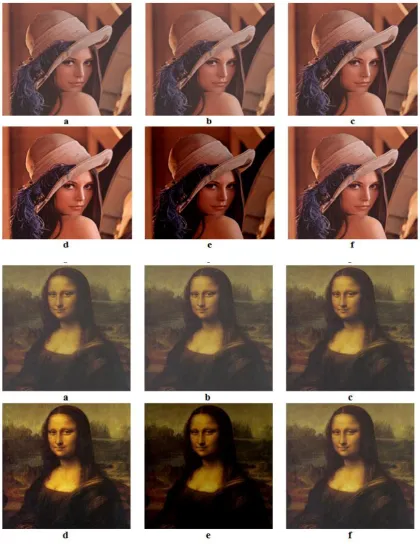
Figure 2 : Comparison of non adaptive methods
[image:2.595.310.548.343.620.2]interpolation in vertical direction. We need to calculate four interpolation function for grid point in Bilinear Interpolation. The interpolation kernel for linear interpolation is[16] : u(x) = { 0 |x| > 1
{ 1 – |x| |x| < 1
Where x = distance between interpolated point and grid point.
2.3 Bicubic Interpolation
In this method, interpolated point is filled with sixteen closest pixel’s weighted average. We can get sharper image than bilinear method.
The interpolation kernel for cubic interpolation is[16] : { 3/2|x|3 – 5/2|x|2 + 1 0<= |x| < 1 u(x) = { -1/2|x|3 + 5/2|x|2 – 4|x| + 2 1<= |x| < 2
{ 0 2 < |x|
Where x = distance between interpolated point and grid point.
2.4Filtering-based(Re-sampling)
Techniques
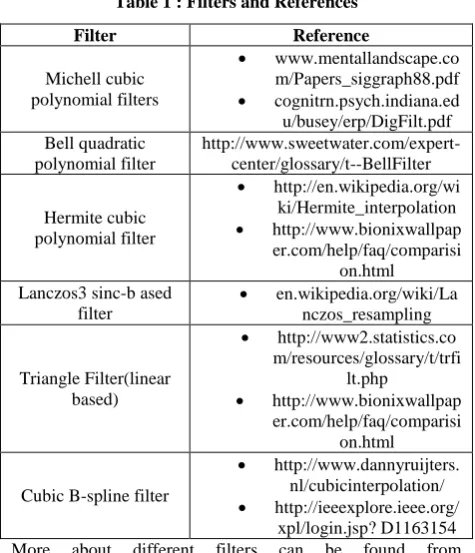
Transforming image pixel from one coordinate to another(different resolution) is called Re sampling process. Digital image is discrete function in two dimension so we need 2D filtering or convolution. But it is computationally costly. We can separate 2D function and apply it first row wise and then column wise on 1D. We have studied different filters used for interpolation algorithm[1]. Filters are used for blur and noise removal as well as edge identification. We have listed some of the filters and website from which one can learn more about these filters.
Table 1 : Filters and References
Filter Reference
Michell cubic polynomial filters www.mentallandscape.co m/Papers_siggraph88.pdf cognitrn.psych.indiana.ed u/busey/erp/DigFilt.pdf Bell quadratic polynomial filter http://www.sweetwater.com/expert-center/glossary/t--BellFilter Hermite cubic polynomial filter http://en.wikipedia.org/wi ki/Hermite_interpolation http://www.bionixwallpap er.com/help/faq/comparisi on.html Lanczos3 sinc-b ased
filter en.wikipedia.org/wiki/La nczos_resampling Triangle Filter(linear based) http://www2.statistics.co m/resources/glossary/t/trfi lt.php http://www.bionixwallpap er.com/help/faq/comparisi on.html
Cubic B-spline filter
http://www.dannyruijters. nl/cubicinterpolation/
http://ieeexplore.ieee.org/ xpl/login.jsp? D1163154 More about different filters can be found from http://lodev.org/cgtutor/filtering.html. Many research papers are also available for studying different filters.
3. ADAPTIVE ALGORITHMS
algorithm based on Pulse-Coupled Neural Networks (PCNN). Here clusters and the propagation paths of pulse are obtained by using the synchronous pulse burst property of PCNN. Different interpolation methods are used in the inner of clusters and at the intervals of clusters to complete all interpolations of image.
We have studied one research paper of Image Enhancement by Intensity Based Interpolation and Selective Threshold[19]. Here they have proposed one technique which determines edges by comparing the intensity variations between center pixel and its neighboring pixels of window size 5 5. On the basis of designed thresholds, extrapolated blank pixels are filled.
We have studied one edge based interpolation algorithm presented in [20]. Here the gradient directions are explicitly estimated with a statistical-based approach. The local dominant gradient directions are obtained by using principal components analysis (PCA) on the four nearest gradients. The angles of the whole gradient plane are divided into four parts, and each gradient direction falls into one part. Then they implement the interpolation with one-dimension (1-D) cubic convolution interpolation perpendicular to the gradient direction.
We have studied one interpolation algorithm presented in [6]. Here they have applied threshold and Wavelet lifting transform based denoising method first on image and then interpolation algorithm. We have given steps of that algorithm here.
If (value of pixel < threshold) than
A(I,j) = A(i-1,j-1) + A(i-1,j+1) + A(i+1,j-1) + A(i+1,j+1) / 4;
B(i,j) = B(i-1,j) + B(i+1,j)/2;
If (value of pixel < threshold)
than I(m,n) = (I(m-1,n-1) + I(m-1,n+1) + I(m+1,n-1) + I(m+1,n+1))/4;
B = (I(m-1,n) + I(m,n+1) + I(m+1,n) + I(m,n-1))/4;
C = (I(m,n-1) + I(m+1,n) + I(m,n+1))/3;
D = (I(m-1,n) + I(m,n+1) + I(m+1,n))/3;
E = (I(m-1,n-1) + I(m-1,n) + I(m,n+1))/3;
F = (I(m-1,n-1) + I(m-1,n) + I(m+1,n))/3;
So here more pixel values are considered while calculating interpolated point’s value as well as consider the noise present in image too. Here instead of finding mean value of pixels, we can use max or median function of matlab as per the type of image to implement algorithm.
We have studied An Edge-Guided Image Interpolation Algorithm via Directional Filtering and Data Fusion presented in [5]. For edge information they have partition pixels into two directional and orthogonal subsets. Directional interpolation is made for each Subset and two interpolated values are fused. Algorithm presented in [5] work for gray scale images only. Figures below shows how they fill interpolated point.
[image:3.595.310.484.544.732.2]Modification for this algorithm presented in [12]. Here they made modification so that algorithm works for RGB image also. They have stored each R,G and B components of one image into three different images of two dimension (same as grayscale image) and give that as a input to original algorithm. Finally they have merged all three output arrays into single RGB image[4].
Figure 4 : Edge Guided interpolation[5]
for i=1:x
for j=1:y
R(i,j)=Input(i,j,1); G(i,j)=Input(i,j,2); B(i,j)=Input(i,j,3); end
end
for i=1: (2*x) for j=1: (2*y)
RGB(i,j,1)=Output(i,j); end
end % same way RGB(i,j,2)and RGB(i,j,3)is achieved We have studied “image up-sampling using DWT presented
in [9]. Here they have used 9/7 bi-orthogonal spline based DWT. Presented algorithm preserve the edges and color of
original image. Below we have shown the figure, how they do image up-sampling (Here S is scaling factor and I is original image).
Figure 5 : DWT based up sampling[9]
4.
EXPERIMENT
RESULTS
AND
COMPARISON
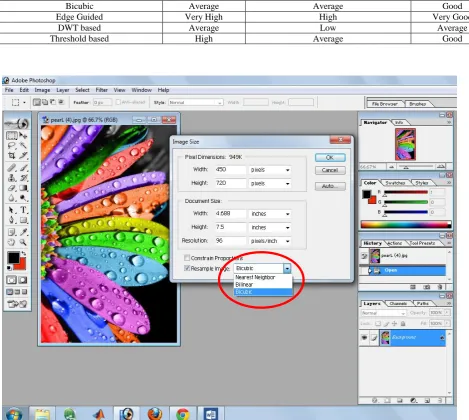
We have used Photoshop [1] for basic methods and for other algorithms, we have implemented basic algorithms in matlab.
[image:4.595.193.411.471.690.2]5. CONCLUSION AND FUTURE WORK
In this paper we have shown different interpolation algorithms. We have implemented all algorithms and done the comparison. For commercial tools and applications which are not very important(use for commercial purpose only), non-adaptive algorithms are better to use while in application like medical, bioinformatics, satellite images, adaptive methods are good to use.In future we would like to modify above algorithms so it will work better as well as we would like to implement our own algorithm for interpolation based on wavelet.
6. REFERENCES
[1] Adobe® CS2 software.
(http://www.adobe.com/products/photoshop/)
[2] D. Kirk, Graphics Gems III (IBM Version), Academic Press, San Diego, CA, 1992.
[3] G. Sharma and H.J. Trussell, Digital Color Imaging, IEEE Transactions on Image Processing, 6 (7) (1997) 901-932.
[4] Image Types :: Displaying Bit-Mapped Images : (MATLAB®),http://www.mathworks.in/help/techdoc/cre ating_plots/f2-10709.html
[5] Lei Zhang, Xiaolin Wu, “An Edge-Guided Image Interpolation Algorithm via Directional Filtering and Data Fusion”, IEEE TRANSACTIONS ON IMAGE PROCESSING, VOL. 15, NO. 8, AUGUST 2006. [6] Liyakathunisa & C.N. Ravi Kumar, "A Novel and
Efficient Lifting Scheme based Super Resolution Reconstruction for Early Detection of Cancer in Low Resolution Mammogram Images", International Journal of Biometrics and Bioinformatics (IJBB), Volume (5) : Issue (2) : 2011.
[7] M.D. Fairchild, Color Appearance Models, Reading, MA: Addison Wesley, 1997.
Supplement no. 2 to CIE publication no. 15(E.-l 31) 1971/(TC-1.3), 1978.
[11] sapan Naik, Viral Borisagar, " Super-Resolution using Interpolation and Wavelet lifting scheme" , IJCA journals, VOL 40, 2012.
[12] Sapan Naik, Viral Borisagar," A novel Super Resolution Algorithm using Interpolation and LWT based denoising method ", IJIP journal, VOL. 6, issue 4,2012.
[13] T. Acharya and A. K. Ray, Image Processing: Principles and Applications, John Wiley & Sons, Inc., Hoboken, NJ, 2005.
[14] T. Lehmann, C. Gonner, and K. Spetzer, “Survey: Interpolation Methods in Medical Image Processing,” IEEE Trans. Med. Imaging, 18:1049-1067,1999. [15] www.mathwork.com
[16] www.wikipedia.com
[17] Xiao-feng Wang, He-fei Ling, “An Edge-Adaptive Interpolation Algorithm for Super-Resolution Reconstruction”, 2010 International Conference on Multimedia Information Networking and Security. [18] Chunmei Liu, Lei Xu, “A New Image Interpolation
Algorithm Based on Pulse-Coupled Neural Networks”, 2011 International Conference on Computational and Information Sciences.
[19] Sanjay Kumar Maurya, Pavan Kumar Mishra, “Image Enhancement by Intensity Based Interpolation and Selective Threshold”, 2012 International Conference on Communication Systems and Network Technologies. [20] Bing Yang, Zhiyong Gao, Xiaoyun Zhang, “Principal
Components Analysis-Based Edge-Directed Image Interpolation”, 2012 IEEE International Conference on Multimedia and Expo (ICME).
Interpolation Algorithms Computation
Time Complexity of Algorithm Visual Quality
Nearest neighbour Low Low Poor
Bilinear Low Low Average
Bicubic Average Average Good
Edge Guided Very High High Very Good
DWT based Average Low Average
[image:7.595.50.545.78.283.2]Threshold based High Average Good
[image:7.595.52.522.233.653.2]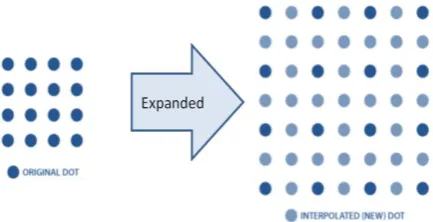
![Figure 3 : Threshold based interpolation[11]](https://thumb-us.123doks.com/thumbv2/123dok_us/8097462.786615/3.595.310.484.544.732/figure-threshold-based-interpolation.webp)
![Figure 4 : Edge Guided interpolation[5]](https://thumb-us.123doks.com/thumbv2/123dok_us/8097462.786615/4.595.193.411.471.690/figure-edge-guided-interpolation.webp)