How to cite this paper: Razmy, A.M. (2016) Effect of Sample Size on the Control Limits of Exponentially Weighted Moving Average Distance Square Scheme. Open Access Library Journal, 3: e2663. http://dx.doi.org/10.4236/oalib.1102663
Effect of Sample Size on the Control Limits
of Exponentially Weighted Moving Average
Distance Square Scheme
Athambawa Mohamed Razmy
Department of Mathematics and Statistics, Sultan Qaboos University,Muscat, Oman
Received 22 May 2016; accepted 17 June 2016; published 21 June 2016
Copyright © 2016 by author and OALib.
This work is licensed under the Creative Commons Attribution International License (CC BY).
http://creativecommons.org/licenses/by/4.0/
Abstract
In the series of quality monitoring schemes with exponentially weighted moving average, the ex-ponentially weighted moving average distance square scheme was introduced for joint monitoring of process mean and variance. This scheme claims that it has a special feature that the control lim-its of the scheme are independent of sample size and therefore it gives more freedom to the users. However, this claim was not studied in detail. In this study, the control limits were found for this scheme through simulations, for different sample sizes with different combination of other scheme parameters. This study concludes that the control limits for designing this scheme are in-dependent of sample size.
Keywords
Average Run Length, Control Limit, Exponential Weighted Moving Average, Joint Monitoring
Subject Areas: Mathematical Statistics
1. Introduction
The exponentially weighted moving average (EWMA) chart was introduced for monitoring the sample mean of a quality parameter by Robrts in 1959 [1]. This chart is more sensitive in detecting any small shift in mean compared to the conventional Shewhart control chart which was introduced by Shewhart in 1939 [2]. In EWMA chart, EWMA Variable At is plotted against the sample number t(t=1, 2,), where
(
1)
1 .t m t m t
A = −λ A− +λ X (1)
OALibJ | DOI:10.4236/oalib.1102663 2 June 2016 | Volume 3 | e2663
t
X is the tth sample mean of the quality parameter, to be monitored. This chart issues an out-of-control signal if
At is greater than the upper control limit (UCL) or lower than the lower control limit (LCL). For designing this chart, λm values and control limits for detecting different shifts in mean under different sample sizes and in- control ARLs, can be found in Crowder (1989) [3].
Chang and Gan introduced an EWMA chart for monitoring sample variance of a quality parameter in 1993 [4]. In their chart, the EWMA variable Bt is plotted against the sample number t (t=1, 2,), where
(
)
( )
21
1 log .
t v t v t
B = −λ B− +λ S (2)
Normally, the value of Bt is taken as Elog
( )
St2 and 2 tS is the sample variance of the quality parameter interested. λv is a positive constant which has the possible values of 0 < λv < 1 and it is based on the shift in the variance to be detected quickly for a given in-control ARL. Like in the EWMA chart for monitoring sample mean, this chart also issues an out-of-control signal if Bt is greater than UCL or the lower than the LCL.
The above discussed two EWMA charts are used for monitoring the process mean and variance independently. In 1997, it was understood that monitoring the sample mean and variance was a bivariate problem and these two had to be monitored jointly [5]. A joint monitoring scheme for monitoring mean and variance simultaneously using EWMA technique was introduced by Gan [6]. Another two joint monitoring schemes, called max EWMA scheme and EWMA semicircle scheme for joint monitoring of process mean and variance were proposed by Chen et al.[7] [8]. The scheme parameters to design these joint monitoring schemes differ based on the sample sizes. This issue restricts the users in selecting a convenient sample size.
Subsequently, a new joint monitoring scheme named EWMA distance square scheme (EWMAD2) was in-troduced with a claim that its control limits were independent of sample size [9]. This scheme uses the standar-dized sample mean Ut and variance Vt such that
0 0 t t X U n µ σ −
= (3)
and
(
)
21
2 0 1
Φ t : 1 .
t
n S
V H n
σ
− −
= −
(4)
(
)
2(
)
(
)
2 2
0
1
: 1 ; for ~
t
v
n S
H n H w v P W w W χ
σ
−
− = = ≤
(5)
the chi-square distribution with v degrees of freedom and ɸ(.) is the cumulative distribution function of a stan-dard normal random variable [10]. St is the sample standard deviation, σ0 is the population standard deviation and n is the sample size.
A statistics Dt2 is defined by
2 2 2
t t t
D =U +V (6)
The EWMAD2 scheme is obtained by plotting the EWMAD2 statistic Ct against the sample number t where
(
)
21
1 .
t d t d t
C = −λ C− +λ D (7)
( )
20 Dt 0
C =E = and λd is a constant selected based on the shift in
2 t
D , to be detected quickly. The opti-
mum λd values for detecting various shifts in
2 t
D , for the selected in-control ARLs can be read in Razmy (2005) [9]. This research paper examines the effect of sample size on the control limits of the EWMAD2 scheme for different ARLs.
2. Methodology
ob-OALibJ | DOI:10.4236/oalib.1102663 3 June 2016 | Volume 3 | e2663 tained for different values of λd (λd =0.05, 0.1, 0.2,, 0.9,1.0).
Initially arbitrary control limits (CL) were assumed for each combination of λd and in-control ARLs. Then,
if C1 < CL, then the second sample was simulated. This procedure was continued till Ct > CL where Ct is an out-of-control point. Each time, the number of samples generated till to find an out-of-control point was record-ed and it is the run length. In the same way 100,000 runs were performrecord-ed and the ARLs were found. Subse-quently, the assumed CL values were adjusted till to obtain the required in-control ARLS of 100, 250, 300, 370, 500 and 1000 for different λd values. By this procedure, the CLs for different combinations of in-control
ARLs, sample sizes and λd values were found. In all cases, simulations were run until the standard error of the
ARL was less than 1%of the pre-specified ARL.A sample program with sample size 5, is given in the Appendix.
3. Results and Discussion
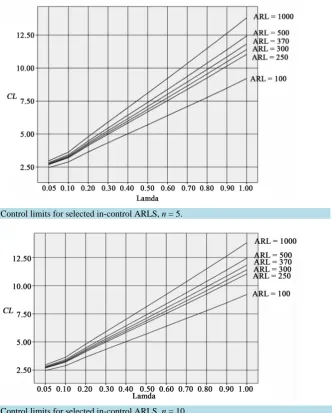
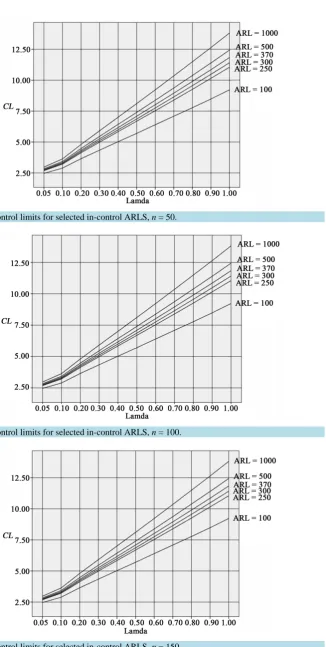
The obtained CLs were plotted against the lambda value for the selected in-control ARLS and sample sizes. From theFigures 1-5, it could be observed that the control limits was increased with λd. It is obvious that the
CL increases with in-control ARLs for a given λd value. The main observation is, for given λd and in-con-
trol ARL, the CL limit is constant with any sample size. This proves the claim that in the EWMAD2 scheme,
CLs are independent of sample size and this property eases the procedure of designing this scheme with unre-stricted sample sizes.
[image:3.595.163.496.302.716.2]Figure 1. Control limits for selected in-control ARLS, n = 5.
OALibJ | DOI:10.4236/oalib.1102663 4 June 2016 | Volume 3 | e2663 Figure 3. Control limits for selected in-control ARLS, n = 50.
Figure 4.Control limits for selected in-control ARLS, n = 100.
[image:4.595.176.480.502.707.2]OALibJ | DOI:10.4236/oalib.1102663 5 June 2016 | Volume 3 | e2663
Acknowledgements
The outputs for numerous programs were recorded and arranged by Ms. Iresha Dilhani.
References
[1] Roberts, S.W. (1959) Control Chart Tests Based on Geometric Moving Averages. Technometrics, 1, 239-250.
http://dx.doi.org/10.1080/00401706.1959.10489860
[2] Shewhart, W. A. (1939) Statistical Methods from the Viewpoint of Quality Control. Graduate School, Department of Agriculture, Washington DC, 75.
[3] Crowder, S.V. (1989) Design of Exponentially Weighted Moving Average Schemes. Journal of Quality Technology,
21, 155-162.
[4] Chang, T.C. and Gan, F.F. (1993) Optimal Designs of One-Sided EWMA Charts for Monitoring a Process Variance. Journal of Statistical Computing & Simulations, 49, 33-48. http://dx.doi.org/10.1080/00949659408811559
[5] Gan, F.F. (1997) Joint Monitoring of Process Mean and Variance. Nonlinear Analysis, Theory, Methods and Applica-tions, 30, 4017-4024. http://dx.doi.org/10.1016/S0362-546X(97)00224-1
[6] Gan, F.F. (1995) Joint Monitoring of Process Mean and Variance Using Exponentially Weighted Moving Average Control Charts. Technometrics, 37, 446-453. http://dx.doi.org/10.1080/00401706.1995.10484377
[7] Chen, G., Cheng, S.W. and Xie, H.W. (2001) Monitoring Process Mean and Variability with One EWMA Chart. Journal of Quality Technology, 33, 223-233.
[8] Chen, G., Cheng, S.W. and Xie, H.W. (2004) A New EWMA Control Chart for Monitoring Both Location and Disper-sion. Quality Technology &Quantitative Management, 1, 217-231.http://dx.doi.org/10.1080/16843703.2004.11673074 [9] Razmy, A.M. (2005) Joint Monitoring of Process Mean and Variance. MSc Thesis, Department of Statistics and
Ap-plied Probability, National University of Singapore, Singapore.
OALibJ | DOI:10.4236/oalib.1102663 6 June 2016 | Volume 3 | e2663
Appendix
data raw; mu0 = 0; sigma = 1.0;
sigmasq = sigma*sigma; nnn = 5;
nnnsqrt = sqrt(nnn); nnn1 = nnn -1; totalrun = 100,000; maxsamp = 1,000,000; seed = 86,924,569; lam = 0.7;
onelm= 1.0 − lam; bigh = 7.0856; dobigd = 0; dosmalld = 1;
actuals = smalld * sigma;
actualm = mu0 + bigd * sigma/nnnsqrt; message = 'OK';
dorunnum = 1tototalrun; qqq = 2;
runlen = 0;
do sample = 1tomaxsamp;
x1 = actualm + actuals * rannor (seed); x2 = actualm + actuals * rannor (seed); x3 = actualm + actuals * rannor (seed); x4 = actualm + actuals * rannor (seed); x5 = actualm + actuals * rannor (seed); xsum = x1 + x2 + x3 + x4 + x5;
x2sum = x1*x1 + x2*x2 + x3*x3 + x4*x4 + x5*x5; xbar = xsum/nnn;
s = x2sum − xsum*xsum/nnn; s = s/nnn1;
uu = (xbar − mu0)/sigma*nnnsqrt; uuu = uu*uu;
h = nnn1*s/sigmasq;
hhh= CDF('CHISQUARE', h, nnn1);
ifhhh > 0.0000000000001 and hhh < 0.999999999999999then vv = probit(hhh); else
vv = 8.21; vvv = vv*vv; rrr = uuu + vvv; runlen = runlen + 1;
qqq = onelm * qqq + lam * rrr; ifqqq > bighthendo;
output; goto DONE1; end;
keep lam runlenbigdsmalldbighxbarqqqrrrvvvuuu message ; end;
OALibJ | DOI:10.4236/oalib.1102663 7 June 2016 | Volume 3 | e2663 DONE1:
end; end; end;
procmeans data = raw; by bigdsmalld;