0095-1137/05/$08.00⫹0 doi:10.1128/JCM.43.9.4737–4743.2005
Copyright © 2005, American Society for Microbiology. All Rights Reserved.
Multilocus Sequence Typing of Intercontinental Bovine
Staphylococcus aureus
Isolates
E. M. Smith,
1† L. E. Green,
1* G. F. Medley,
1H. E. Bird,
1L. K. Fox,
2Y. H. Schukken,
3J. V. Kruze,
4A. J. Bradley,
5R. N. Zadoks,
3and C. G. Dowson
1Department of Biological Sciences, The University of Warwick, Coventry CV4 7AL, United Kingdom1; Department of Veterinary
Clinical Science, College of Veterinary Medicine, Washington State University, Pullman, Washington 99164-66102;
Quality Milk Production Services, 22 Thornwood Drive, Ithaca, New York 148503; Microbiology Department,
Faculty of Sciences, Austral University of Chile, P.O. Box 167, Valdivia, Chile4; and Division of
Food Animal Science, School of Veterinary Science, University of Bristol,
Langford House, Langford, Bristol BS40 5DU, United Kingdom5
Received 31 December 2004/Returned for modification 13 March 2005/Accepted 17 April 2005
A total of 258 bovine-associatedStaphylococcus aureusisolates from the United States, Chile, and the United Kingdom, plus the reference isolateS. aureusNewbould 305 (NCIMB 702892), were analyzed by multilocus sequence typing (MLST). A collection of previously characterized United Kingdom isolates were also included in the analysis. The results demonstrated that MLST is suitable for the differentiation of bovineS. aureus
isolates from various sites (milk, teat skin, milking machine unit liners, hands, and bedding) and countries. The theory of the host specificity ofS. aureusis supported by the detection of a previously undescribed clonal complex that comprised 87.4% of the isolates studied, with representatives from all geographic locations investigated. This suggests that a single clonal group has achieved a widespread distribution and is responsible for the majority of infections. Some sequence types (STs; ST25, ST115, ST124, and ST126) demonstrated site specificity, as they were significantly (P< 0.05) associated with milk or teat skin.
Staphylococcus aureusis a major cause of bovine mastitis and
is spread from cow to cow (skin or milk) via the milking machine (35, 57). Environmental spread may also occur, since strains ofS. aureushave been isolated from the environment of dairy farms and from other species that are present on dairy farms (32, 39).
A number of studies have identified potential sources of the pathogen and have investigated strain-specific differences (19, 40). The major potential sources identified were milk, body sites, and, to a lesser extent, the environment (40). Studies investigating the global population structure of bovineS. au-reussuggest that a relatively few specialized clones are respon-sible for the majority of intramammary infections (IMIs) (26, 55), although some authors did not report between-farm ge-netic homogeneity (25, 46). Most of these studies have used techniques such as phage typing (19, 40) and pulsed-field gel electrophoresis (PFGE) (7, 25) to compare isolates. These methods lack intercenter reproducibility (55). Library typing systems such as binary typing (BT) (53) and multilocus se-quence typing (MLST) (31) have been developed to overcome these problems by producing results that are repeatable be-tween laboratories and over time.
The aim of this study was to investigate the effectiveness of MLST as a method for the typing ofS. aureusisolates of bovine origin from a number of distinct geographical sources. A col-lection of isolates previously characterized by phage typing
(19) and by PFGE and binary typing (55) was used to compare these methods to MLST. The data were then used in a pre-liminary analysis of the evolutionary and population biology of
S. aureusisolates of bovine origin.
MATERIALS AND METHODS
Bacterial isolates.A total of 263 coagulase-positive staphylococci were ana-lyzed. This included 231 epidemiologically well-defined isolates from 43 herds in the United States (19) detected in milk (n⫽117), on teat skin (TS;n⫽75), in milking machine unit liners (n⫽34), on milkers’ hands (n⫽4), and in dairy cow bedding (n⫽1). A further 20 isolates were from milk, submitted by private veterinary practitioners to the Mastitis Laboratory at the Austral University of Chile, from 14 communes within four provinces of two regions in the south of the country. A further 11 isolates came from dairy cow IMIs in Somerset, United Kingdom. The reference strainS. aureusNewbould 305 (NCIMB 702892), orig-inally isolated from the milk of a cow with nonsevere mastitis (37) and now used for experimental challenge studies (42), was also included in the study.
Species identification.The primers developed by Sˇtepa´n et al. (48), based upon a species-specific 826-bp SmaI restriction fragment of genomic DNA, were used to confirm that the coagulase-positive staphylococcal isolates wereS. aureus prior to MLST.
MLST.MLST was performed as described previously (45). Briefly, the primers of Enright et al. (13) were used to amplify genes for MLST. The products were purified with a MinElute 96 UF PCR purification kit (QIAGEN) and sequenced on a Prism Genetic Analyser 3100 DNA sequencer (Applied Biosystems, War-rington, United Kingdom) by using a BigDye Terminator (version 3.1) ready reaction cycle sequencing kit (Applied Biosystems).
Allele number and sequence types (STs) were assigned by using theS. aureus MLST website (http://saureus.mlst.net). Trace files of putative novel alleles and the allelic profiles of novel STs were sent to the database curator for allele or ST number assignment and entry into the database.
Data analysis.The samples described above, together with a collection of previously typed isolates collected from a United Kingdom organic dairy farm (45), were included in the analyses where indicated to provide a broader per-spective. The data were analyzed by using chi-square tables (EpiInfo, version 6.04d; Centers for Disease Control and Prevention, Atlanta, Ga.).
Isolates were divided into clonal complexes by using the program BURST (Based Upon Related Sequence Types) (14). Further analysis of the data in * Corresponding author. Mailing address: Department of Biological
Sciences, University of Warwick, Coventry CV4 7AL, United King-dom. Phone: 44 (0) 24 7652 3797. Fax: 44 (0) 24 7652 4619. E-mail: [email protected].
† Present address: Human and Molecular Genetics Center, Medical College of Wisconsin, Milwaukee, WI 53226.
4737
on May 15, 2020 by guest
http://jcm.asm.org/
conjunction with the entireS. aureusMLST database (http://saureus.mlst.net) was done by using the enhanced version of BURST (eBURST) (16).
The seven locus sequences were concatenated in the orderarcC,aroE,glpF, gmk,pta,tpi, andyqiLto produce a 3,198-bp sequence for each ST. Phylogenetic and molecular evolutionary analyses were conducted by using MEGA (Molec-ular Evolutionary Genetics Analysis), version 2.1 (27). Data for STs not detected in the present study were derived from the MLST database (http://saureus.mlst .net). Splits graphs were constructed by using Splitstree, v.3.2 (12, 24).
Estimates of the rate of recombination were made as described previously (15). Briefly, single-locus variant (SLV) STs identified by BURST analysis were compared to the ancestral ST to determine the variant locus. Ancestral and variant loci were compared to determine nucleotide and synonymous or nonsyn-onymous amino acid changes. Mutational changes were assigned to alleles that differed at one nucleotide site and produced alleles unique to that ST; alleles not satisfying these criteria were considered to have arisen by recombination.
Sampling bias.While the same sequence type was never isolated from the exact same site (milk, teat skin, milking machine unit liners, hands, and bedding) on the same farm more than once, the potential effects of the repeated isolation of the same sequence type from the same farm in the isolates from the United States were investigated. Two further data sets were compiled from the results: the first contained one datum point for each varying ST isolated from each site on each farm; the second ignored the site of isolation and contained one datum point for each varying ST isolated from each farm. These data sets were then used to analyze any ST and site-of-isolation interactions and also the effects on the discriminatory power of MLST.
Nucleotide sequence accession numbers.The DNA sequences of the novel alleles detected in this study have been deposited in EMBL under accession numbers AJ849331 to AJ849354.
RESULTS
Two-hundred fifty-nine isolates were successfully typed: 227 from the USA (3 isolates were species other thanS. aureusand 1 isolate was nontypeable), 20 from Chile, 11 from the United
Kingdom, andS.aureusNewbould 305 (NCIMB 702892). This gave a typeability rate of 99.6% (50, 51).
A total of 25 different STs were detected; this included 18 novel STs isolated from the United States (n⫽13), Chile (n⫽
4), and the United Kingdom (n⫽1); the reference isolate,S.
aureusNewbould 305, was ST115.
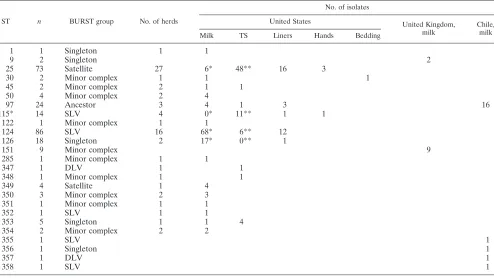
Among the American isolates, eight STs (93.0% of the iso-lates) were represented four or more times; among these, ST50 (n⫽4) and ST349 (n⫽4) were isolated only from milk, while ST115 (n ⫽ 13) was never detected in milk. There was a significant difference (P⬍0.05) in the frequency of isolation of ST25, ST115, ST124, and ST126 from milk and TS (Table 1). In 25 of the 43 herds sampled in the United States, only one ST (but of various types) was detected, with a maximum of four STs detected in any one herd. Only two sequence types (ST124 and ST25) were detected in more than four herds (16 and 27 herds, respectively; Table 1). The discriminatory power (Simp-son’s index of discrimination [D]) of MLST was 0.74 (95% confidence interval [CI]⫽0.61 to 0.87) for the whole collec-tion (21, 23) (Table 2).
S. aureus was isolated from the hands of milkers of four
herds; of these; three of the herds had a positive milk sample, but only one yielded the same ST as that from the milker; however, all four herds gave a positive TS sample and three yielded the same ST.
[image:2.585.46.540.81.359.2]When the effects of the repeated isolation of the same ST from the same site on the same farm were taken into account, four STs were represented by four or more isolates; and of TABLE 1. BURST grouping of sequence types and number detected in each country and site of isolationa
ST n BURST group No. of herds
No. of isolates
United States United Kingdom,
milk
Chile, milk
Milk TS Liners Hands Bedding
1 1 Singleton 1 1
9 2 Singleton 2
25 73 Satellite 27 6* 48** 16 3
30 2 Minor complex 1 1 1
45 2 Minor complex 2 1 1
50 4 Minor complex 2 4
97 24 Ancestor 3 4 1 3 16
115* 14 SLV 4 0* 11** 1 1
122 1 Minor complex 1 1
124 86 SLV 16 68* 6** 12
126 18 Singleton 2 17* 0** 1
151 9 Minor complex 9
285 1 Minor complex 1 1
347 1 DLV 1 1
348 1 Minor complex 1 1
349 4 Satellite 1 4
350 3 Minor complex 2 3
351 1 Minor complex 1 1
352 1 SLV 1 1
353 5 Singleton 1 1 4
354 2 Minor complex 2 2
355 1 SLV 1
356 1 Singleton 1
357 1 DLV 1
358 1 SLV 1
aAll isolates from the United States were detected in cattle with subclinical mastitis, and the disease status of the cattle from which the United Kingdom and Chile
isolates were detected is not known. Figures in the same row with different superscript symbols differ significantly (P⬍0.05). Abbreviations:n, number of isolates; Ancestor, ancestral sequence type; minor complex, member of a minor clonal complex.
bSequence type of reference isolate NCIMB 702892.
on May 15, 2020 by guest
http://jcm.asm.org/
these, only ST115 (n⫽5) was never detected in milk. There remained a significant difference (P ⬍ 0.05) in the rates of isolation of ST25 and ST124 from milk and TS; however, for the other STs, too few data were available for analysis. The effects of sampling bias on the discriminatory power of MLST were not significant (Table 2), and BURST analysis of all data sets was consistent with the identification of ST97 as the an-cestral ST (data not shown).
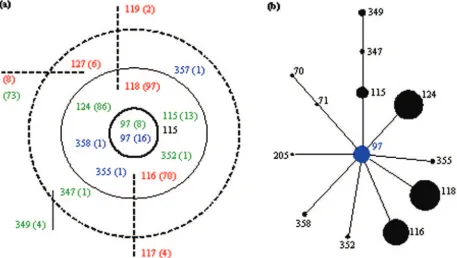
Identification of CCs.The BURST analysis (Fig. 1a) con-sisted of 450 isolates: the 259 isolates described above plus a further 191 isolates from an organic farm collection (45). One previously undescribed major clonal complex (CC), five minor clonal complexes, and five singleton STs were identified. A clonal complex was defined as a group of isolates which shared at least five of seven alleles with one other ST in the group; ancestral clones were assigned on the basis of the fact that they differed at a single locus from isolates with the highest number
of matching genotypes. The major CC had an identifiable an-cestor, whereas the minor CCs were restricted to two STs which differed at a single locus from isolates with the highest number of other genotypes (i.e., has the most SLVs). Single-tons were STs which did not share five of seven alleles with any other ST.
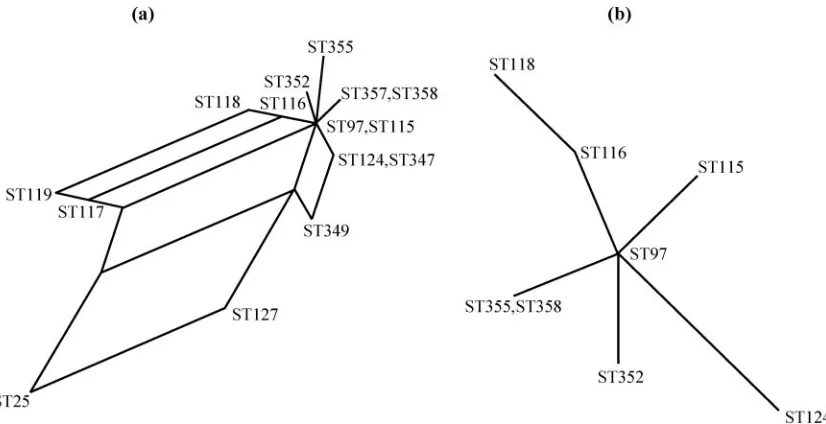
The predicted ancestor of the major CC was ST97, and henceforth, we describe this as CC97. Assignment of the an-cestral ST was supported by eBURST analysis of the data set with data from the MLST database (Fig. 1b) and was consis-tent with the placement of this ST at an internal node by splits decomposition analysis (Fig. 2). Bootstrap resampling of the eBURST analysis yielded a value of 100% for prediction of ST97 as the primary founder.
[image:3.585.44.284.81.147.2]The newly identified CC (CC97) contained a total of 14 STs, in addition to the predicted ancestor (Fig. 1a). There were seven SLVs (ST115, ST116, ST118, ST124, ST352, ST355, and ST358), three double-locus variants (DLVs; ST127, ST347, and ST357), and four satellite STs (ST25, ST117, ST119, and ST349) which were either SLVs or DLVs of other STs in the CC. While not all STs identified as members of CC97 by BURST analysis were included in the eBURST analysis re-sults, three further STs (ST70, ST71, and ST205) were (Fig. 1b). The discrepancy between the results of the BURST and eBURST analyses are due, in part, to the group definitions used by each algorithm and the ability to include all the data from the S. aureus online MLST database in the eBURST
[image:3.585.69.526.399.657.2]FIG. 1. Analysis of bovineS. aureusisolates by (a) BURST and (b) eBURST analyses. In the BURST analysis green numbers denote STs from the United States, red numbers denote STs from the United Kingdom, blue numbers denote STs from Chile, and the black number is reference isolateS. aureusNewbould 305; figures in parentheses are the numbers of isolates. The predicted clonal ancestor is in the central ring, SLVs are in the middle (solid) ring, and DLVs are in the outer (dashed) ring; more distantly related STs are classified as satellites, and their relationships are shown as a solid (single-locus difference) or a dashed (double-locus difference) line. In the eBURST analysis, the numbers displayed are STs; the blue circle represents the primary founder, all lines represent a single-locus difference, and the size of the circles is relative to the numbers of isolates in the input data.
TABLE 2. Discriminatory power of MLST
Collection No. of isolates
No. of
STs D
a 95% CIb
All 259 25 0.74 0.61–0.87
USA 227 19 0.73 0.70–0.76
1 ST/site/farm 98 19 0.76 0.66–0.86
1 ST/farm 69 19 0.80 0.73–0.88
aCalculated as described by Hunter and Gaston (23). bCalculated as described by Grundmann et al. (21).
on May 15, 2020 by guest
http://jcm.asm.org/
analysis. BURST analysis permits the inclusion of DLVs, i.e., those that share only five of seven homologous loci, whereas in eBURST analysis, DLVs are displayed only if the intermediary SLV is present in the data. Analysis of the data from theS.
aureusdatabase also permitted elucidation of other potential
members of CC97 identified in other studies but not present in our data set. Of the three additional STs identified by eBURST, two (ST70 and ST71) were reported as bovine-as-sociated strains isolated in The Netherlands (54).
The minor clonal complexes identified in this study (Table 1) contained three previously detected STs; two are predicted ancestral clones (ST30 and ST45), and one has been classified as a singleton (ST50) (13, 15). Three singletons (ST126, ST353, and ST9; Table 1) were represented by more than one isolate (18, 5 and 2 isolates, respectively) and were assigned as single-ton clones (having no clonal variants) in this collection. ST9 has been identified as the ancestral strain of a clonal complex (14, 15), while ST126 and ST353 are previously undescribed.
The STs most frequently detected in milk (ST124) and on teat skin (ST25) were members of CC97. Of the eight most common STs detected, five (ST25, ST97, ST115, ST124, and ST349) were members of CC97, one (ST50) was part of a minor clonal complex, and two (ST126 and ST353) were sin-gleton clones.
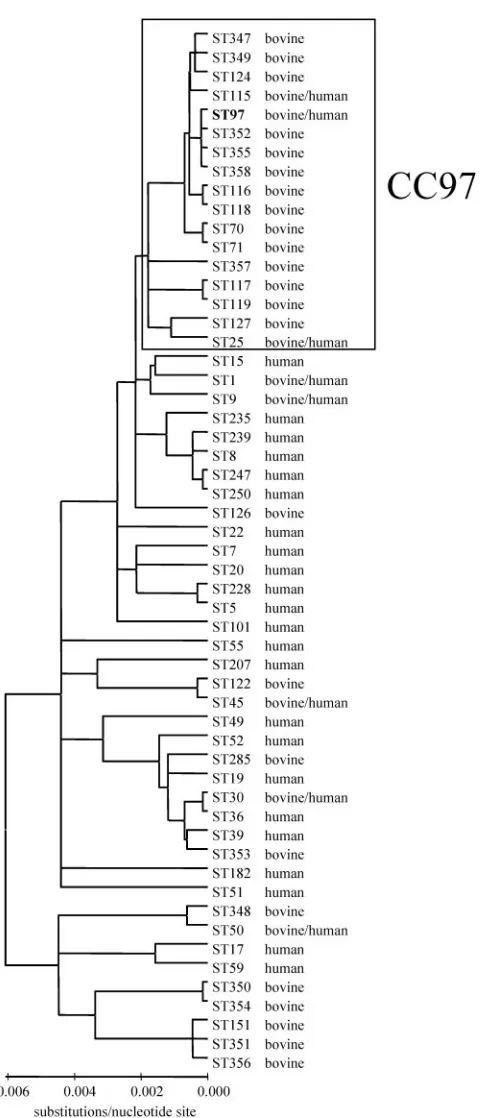
Phylogenetic analysis of S. aureus. All the STs in CC97 clustered on a dendrogram of bovine-associated STs and a diverse selection of human-associated STs (Fig. 3). The human strains included are the ancestral STs of the 11 major methi-cillin-resistant S. aureus clones, the ancestral STs of major methicillin-susceptible S. aureus clones, or distantly related STs (singletons) of these clones (10, 14). Clustering of isolates based on the host (bovine or human) is demonstrated, as is the putative presence of further bovine-associated CCs associated with wide geographic spread (ST151, ST351, ST356 and ST350, and ST354).
Estimates of recombination. Four SLVs had alleles that differed at one nucleotide site from the ancestral ST, three were unique to their ST, and all four were unique to CC97
(Table 3). Conversely, the alleles of the ancestor are present in more than one CC, supporting the assignment of ancestral and derived STs. Three SLVs contained alleles which differed at two nucleotide sites; of these, two were unique to their ST, and all three were unique to CC97. However,tpi-60(ST118) differs
fromtpi-59(ST116) by a single nucleotide polymorphism, and
it is probable this allele (tpi-60) arose as a point mutation of
tpi-59rather than by recombination fromtpi-5; this hypothesis
is supported by the splits graph of ST97 and its SLVs (Fig. 2b).
DISCUSSION
Typing. The discriminatory power of MLST is similar to those of other methods of typingS. aureusof bovine origin (1). The typeability and Simpson’s index of discrimination (D) ob-tained in this study were comparable to those obob-tained by PFGE, phage, and binary typing in previous studies, although inclusion of PFGE subtypes resulted in a significantly higher index of discrimination (55). Comparison of the discriminatory powers of MLST (D⫽0.74, 95% CI⫽0.61 to 0.87) and BT (D
⫽0.86, 95% CI⫽0.81 to 0.90) for the American isolates must be interpreted with caution, however, as only 142 isolates were typed by BT (55).
There was high overall agreement between MLST and PFGE (55), as has been demonstrated with human isolates (13, 20). PFGE was, however, able to differentiate isolates of ST124, and this could not be correlated to a herd or a site of isolation (data not shown). This may represent evidence of the initial stages of diversification of this strain or variations in the carriage of lysogenic bacteriophage. Previous studies have sug-gested a correlation between PFGE types and clinical mani-festation of infections (54), but clinical data are not available for isolates of ST124.
In contrast to binary typing, MLST and PFGE (55) results demonstrate congruence with the site of isolation, suggesting that MLST and PFGE are more suitable than BT for epide-miological investigations of bovineS. aureusisolates.
[image:4.585.86.499.67.279.2]Analysis of additional and/or host-specific factors, such as FIG. 2. Splits graph of (a) CC97 and (b) ST97 and its SLVs.
on May 15, 2020 by guest
http://jcm.asm.org/
the presence of the coagulase gene (29, 49), toxin production (2, 17), and plasmid profiles (33, 36), may further improve the discriminatory power of MLST for large-scale molecular epi-demiological analyses.
Clonal diversity. Detection of a limited number of strains per farm supports the hypothesis that S. aureus is a clonal organism and spreads from cow to cow (28, 57), although some studies have suggested a more environmental style of infection (25, 46). These differences may be due to the typing schemes used, but it is likely that there is also herd-specific variation due to differences in management. Effective contagious masti-tis control may prevent the spread of bacteria from cow to cow, essentially leading to the generation of environmental-style pathogens and reducing the likelihood of eradication (30, 56). The hypothesis that relatively few widely distributed clones
ofS. aureusare responsible for the majority of cases of bovine
IMI (26, 54) was supported by the detection of the majority of isolates (87.4%) within one clonal complex (CC97). This may help to overcome the discrepancy of the seemingly conflicting results of between-farm genetic heterogeneity (25, 46) and the global similarity ofS. aureus(26, 54). In this study, the domi-nant STs in each geographical location varied, probably due to localized selection pressures that drive the evolution of S.
aureus in diverse hosts and environments. Yet, they all
be-longed to CC97, suggesting that ST97 and its derivatives are adapted not only to the mammary gland but also to the bovine environment and have achieved a worldwide distribution. Fur-ther support for a bovine-specific CC was provided by eBURST analysis, which identified two bovine-associated strains related to ST97 in theS. aureusMLST database. The detection of different dominant clones in various locations may have implications for the control ofS. aureusmastitis, with the most effective strategy needing to be directed against the clones causing disease in each area (18, 52). It is possible that there are further bovine-associated (and potentially other host species-associated) CCs yet to be detected. Analysis ofS. au-reusisolates from bovine mastitis and from other hosts from a broader geographical area will help bridge this gap in knowledge. Of the 15 members of CC97, 2 (ST97 and ST25) have been described previously (13, 15). While ST97 was not detected in United Kingdom bovine isolates in this study, it has been detected in United Kingdom ovine isolates (8) and has been classified as a singleton in United Kingdom human isolates. ST25 has been identified as the ancestral strain of a CC (10, 15) and is a DLV of a DLV of ST97. This may represent initial evidence for a pathway of strain evolution, with ST127 forming an intermediary between ancestral strains. An unrooted Bayes-ian tree (15) supports the closer relationship of ST25 and ST97 than to other ancestral strains.
Recombination.Analysis of CC97 diversification generated some unexpected findings, suggesting that there is a roughly equal chance of alleles changing by point mutation and recom-bination. Evidence of recombination is also provided by the interconnected “network” of STs in the splits graph of CC97 (47). This contrasts with earlier results of MLST ofS. aureus
housekeeping genes (15), which estimated that alleles are at least 15-fold more likely to change by point mutation than by recombination in the early stages of clonal diversification. These results may be due to the smaller sample size of this study compared to that of an earlier report (15), or they may indicate a slightly altered population structure of bovine S.
aureusisolates compared with that of humanS. aureusisolates;
[image:5.585.45.286.62.621.2]this warrants further investigation. The presence of alleles which are thought to have changed by recombination in more FIG. 3. Dendrogram of all bovine STs detected in the United
States, United Kingdom, and Chile and a selection of ancestral clones and singleton STs detected in humans.
on May 15, 2020 by guest
http://jcm.asm.org/
than one strain suggests that they are being maintained in the population. It is likely that these changes (or those linked to the allelic variant detected by MLST) improve the ability of the resulting strains to colonize and infect cows (22).
Strain adaptation.Teat skin and milking machine unit liners were identified as important fomites forS. aureusIMIs based on phage typing (19). However, MLST, like PFGE, demon-strates that isolates from milk predominantly belong to differ-ent strains than isolates from teat skin, thus demonstrating not only host specificity but also site specificity (4, 55).
The STs detected on milkers’ hands were also detected in milk and on teat skin, suggesting that milkers’ hands can
trans-mit S. aureus to teat skin and the mammary gland, causing
IMIs. Previous studies investigating the relationships between
S. aureusisolated from humans and cows have been consistent
in agreeing in general with the theory of host specialization (8, 41). However, most authors also demonstrated that some strains ofS. aureus were able to infect and/or colonize both humans and cows (30, 41).
The ability of the environment to act as a reservoir of S.
aureus capable of causing IMIs was suggested in one herd,
where the same ST (ST30) was detected in bedding and as a cause of IMIs. This agrees with previous reports which have demonstrated the possibility that the environment acts as a reservoir of infection (32, 40, 54). The relative importance of this, however, will be dependent on herd management. In well-managed herds, environmental transmission ofS. aureus
is more likely than contagious transmission of the organism.
Strains for IMI models. Analysis of the reference strainS.
aureusNewbould 305 generated some surprising results. This
strain was first detected as a cause of clinical mastitis in 1958 (37) and has been used in challenge trials ever since (5, 42) to simulate infection with a naturally occurring isolate. Infections
withS. aureusNewbould 305 are known to be relatively gentle,
with a moderate increase in somatic cell counts, virtually no clinical signs, and high cure rates after therapy (42). Interest-ingly, in this studyS. aureusNewbould 305 was determined to be ST115, a strain detected on only four farms and significantly associated with teat skin. This may be indicative of the atypical nature ofS. aureus Newbould 305 as a representative of S.
aureus pathogenic for the udder; further work is therefore
needed to fully characterize the Newbould 305 strain. Typi-cally, intramammaryS. aureusinfections are characterized by high but variable somatic cell counts (11, 44), persistence (34, 38), variable shedding of bacteria (6, 43), and low cure rates (3, 9). While S. aureus Newbould 305 is convenient for use in challenge trials, it may not be representative of intramammary
S. aureus isolates. It may be wise to catalogue the current
strains of importance for use in challenge studies rather than relying on a strain that may now be better classified as a skin isolate. Potential candidate STs for challenge experiments identified in the current study are ST97, ST124, and ST126. The last two STs (ST124 and ST126) were the most common STs detected in milk, with ST97 being their predicted ancestral ST. These, plus other, perhaps more recently isolated bovine-associated strains ofS. aureusmay represent a more relevant target for the development of methods for the control ofS.
aureusIMIs. However, caution must be exercised in the use of
a strain which causes more typical disease, as this is likely to lead to a more chronic infection in experimentally challenged cows. The choice of a challenge strain(s) therefore requires careful consideration.
ACKNOWLEDGMENT
E.M.S. was supported by a Biotechnology and Biological Sciences Research Council studentship.
REFERENCES
1.Aarestrup, F. M., H. C. Wegener, and V. T. Rosdahl.1995. Evaluation of phenotypic and genotypic methods for epidemiologic typing of Staphylococ-cus aureusisolates from bovine mastitis in Denmark. Vet. Microbiol.45:139– 150.
2.Akineden, O¨ ., C. Annemu¨ller, A. A. Hassan, C. La¨mmler, W. Wolter, and M. Zscho¨ck.2001. Toxin genes and other characteristics ofStaphylococcus au-reusisolates from milk of cows with mastitis. Clin. Diagn. Lab. Immunol.
8:959–964.
3.Barrio, B., F. Vangroenweghe, H. Dosogne, and C. Burvenich.2000. De-creased neutrophil bactericidal activity during phagocytosis of a slime-pro-ducingStaphylococcus aureusstrain. Vet. Res.31:603–609.
4.Booth, M. C., L. M. Pence, P. Mahasreshti, M. C. Callegan, and M. S. Gilmore.2001. Clonal associations amongStaphylococcus aureus isolates from various sites of infection. Infect. Immun.69:345–352.
5.Brooks, B. W., and D. A. Barnum.1984. The susceptibility of bovine udder quarters colonized withCorynebacterium bovisto experimental infection with Staphylococcus aureusorStreptococcus agalactiae.Can. J. Comp. Med.48:
146–150.
6.Buelow, K. L., W. J. Goodger, M. T. Collins, M. K. Clayton, K. V. Nordlund, and C. B. Thomas.1996. A model to determine sampling strategies and milk inoculum volume for detection of intramammaryStaphylococcus aureus in-fections in dairy cattle by bacteriological culture. Prev. Vet. Med.25:343–355. 7.Buzzola, F. R., L. Quelle, M. I. Gomez, M. Catalano, L. Steele-Moore, D.
Berg, E. Gentilini, G. Denamiel, and D. O. Sordelli.2001. Genotypic analysis ofStaphylococcus aureusfrom milk of dairy cows with mastitis in Argentina. Epidemiol. Infect.126:445–452.
8.Carter, P. E., K. Begbie, and F. M. Thomson-Carter.2003. Coagulase gene variants associated with distinct populations ofStaphylococcus aureus. Epi-demiol. Infect.130:207–219.
9.Craven, N., and J. C. Anderson.1984. Phagocytosis ofStaphylococcus aureus by bovine mammary gland macrophages and intracellular protection from antibiotic actionin vitroandin vivo. J. Dairy Res.51:513–523.
[image:6.585.43.556.81.173.2]10.Day, N. P., C. E. Moore, M. C. Enright, A. P. Berendt, J. M. Smith, M. F. Murphy, S. J. Peacock, B. G. Spratt, and E. J. Feil.2002. Retraction of: a link between virulence and ecological abundance in natural populations of Staph-ylococcus aureus.Science, 292, 114–116. Science295:971.
TABLE 3. Allelic variants of SLVs of ST97
SLV ST Variable locus Ancestral allele SLV allele No. nuc. differencesa
Other clones with SLV allele
Amino acid change
115 yqiL 3 53 1 ST347, ST349b Nonsynon.c
116 tpi 5 59 1 None Synonymous
118 tpi 5 60 2 None Synonymous
124 gmk 1 37 2 ST347, ST349b Nonsynon.
352 aroE 1 78 1 None Nonsynon.
355 arcC 3 49 2 None Nonsynon.
358 aroE 1 81 1 None Synonymous
a
No. nuc. differences, number of nucleotide differences.
b
SLV allele found in these STs within CC97 but not outside CC97.
c
Nonsynon., nonsynonymous.
on May 15, 2020 by guest
http://jcm.asm.org/
11.de Haas, Y., H. W. Barkema, and R. F. Veerkamp.2002. The effect of pathogen specific clinical mastitis on the lactation curve for somatic cell count. J. Dairy Sci.85:1314–1323.
12.Dress, D., D. Huson, and V. Moulton.1996. Analyzing and visualizing se-quence and distance data using SPLITSTREE. Disc. Appl. Math.71:95–109. 13.Enright, M. C., N. P. Day, C. E. Davies, S. J. Peacock, and B. G. Spratt.2000. Multilocus sequence typing for characterization of methicillin-resistant and methicillin-susceptible clones ofStaphylococcus aureus. J. Clin. Microbiol.
38:1008–1015.
14.Enright, M. C., D. A. Robinson, G. Randle, E. J. Feil, H. Grundmann, and B. G. Spratt.2002. The evolutionary history of methicillin-resistant Staphy-lococcus aureus(MRSA). Proc. Natl. Acad. Sci. USA99:7687–7692. 15.Feil, E. J., J. E. Cooper, H. Grundmann, D. A. Robinson, M. C. Enright, T.
Berendt, S. J. Peacock, J. M. Smith, M. Murphy, B. G. Spratt, C. E. Moore, and N. P. Day.2003. How clonal isStaphylococcus aureus? J. Bacteriol.
185:3307–3316.
16.Feil, E. J., B. C. Li, D. M. Aanensen, W. P. Hanage, and B. G. Spratt.2004. eBURST: inferring patterns of evolutionary descent among clusters of re-lated bacterial genotypes from multilocus sequence typing data. J. Bacteriol.
186:1518–1530.
17.Fitzgerald, J. R., P. J. Hartigan, W. J. Meaney, and C. J. Smyth.2000. Molecular population and virulence factor analysis ofStaphylococcus aureus from bovine intramammary infection. J. Appl. Microbiol.88:1028–1037. 18.Fitzgerald, J. R., W. J. Meaney, P. J. Hartigan, C. J. Smyth, and V. Kapur.
1997. Fine-structure molecular epidemiological analysis ofStaphylococcus aureusrecovered from cows. Epidemiol. Infect.119:261–269.
19.Fox, L. K., M. Gershman, D. D. Hancock, and C. T. Hutton.1991. Fomites and reservoirs ofStaphylococcus aureuscausing intramammary infections as determined by phage typing—the effect of milking time hygiene practices. Cornell Vet.81:183–193.
20.Grundmann, H., S. Hori, M. C. Enright, C. Webster, A. Tami, E. J. Feil, and T. Pitt.2002. Determining the genetic structure of the natural population of Staphylococcus aureus: a comparison of multilocus sequence typing with pulsed-field gel electrophoresis, randomly amplified polymorphic DNA anal-ysis, and phage typing. J. Clin. Microbiol.40:4544–4546.
21.Grundmann, H., S. Hori, and G. Tanner. 2001. Determining confidence intervals when measuring genetic diversity and the discriminatory abilities of typing methods for microorganisms. J. Clin. Microbiol.39:4190–4192. 22.Herron, L. L., R. Chakravarty, C. Dwan, J. R. Fitzgerald, J. M. Musser, E.
Retzel, and V. Kapur. 2002. Genome sequence survey identifies unique sequences and key virulence genes with unusual rates of amino acid substi-tution in bovineStaphylococcus aureus. Infect. Immun.70:3978–3981. 23.Hunter, P. R., and M. A. Gaston.1988. Numerical index of the
discrimina-tory ability of typing systems: an application of Simpson’s index of diversity. J. Clin. Microbiol.26:2465–2466.
24.Huson, D. H.1998. SplitsTree: analyzing and visualizing evolutionary data. Bioinformatics14:68–73.
25.Joo, Y. S., L. K. Fox, W. C. Davis, G. A. Bohach, and Y. H. Park.2001. Staphylococcus aureusassociated with mammary glands of cows: genotyping to distinguish different strains among herds. Vet. Microbiol.80:131–138. 26.Kapur, V., W. M. Sischo, R. S. Greer, T. S. Whittam, and J. M. Musser.1995.
Molecular population genetic analysis ofStaphylococcus aureusrecovered from cows. J. Clin. Microbiol.33:376–380.
27.Kumar, S., K. Tamura, I. B. Jakobsen, and M. Nei.2001. MEGA2: molec-ular evolutionary genetics analysis software. Bioinformatics17:1244–1245. 28.Lam, T. J. G. M., L. J. A. Lipman, Y. H. Schukken, W. Gaastra, and A.
Brand. 1996. Epidemiological characteristics of bovine clinical mastitis caused byStaphylococcus aureusandEscherichia colistudied by DNA fin-gerprinting. Am. J. Vet. Res.57:39–42.
29.Lange, C., M. Cardoso, D. Senczek, and S. Schwarz.1999. Molecular sub-typing ofStaphylococcus aureusisolates from cases of bovine mastitis in Brazil. Vet. Microbiol.67:127–141.
30.Larsen, H. D., K. H. Sloth, C. Elsberg, C. Enevoldsen, L. H. Pedersen, N. H. R. Eriksen, F. M. Aarestrup, and N. E. Jensen.2000. The dynamics of Staphylococcus aureusintramammary infection in nine Danish dairy herds. Vet. Microbiol.71:89–101.
31.Maiden, M. C. J., J. A. Bygraves, E. Feil, G. Morelli, J. E. Russell, R. Urwin, Q. Zhang, J. J. Zhou, K. Zurth, D. A. Caugant, I. M. Feavers, M. Achtman, and B. G. Spratt.1998. Multilocus sequence typing: a portable approach to the identification of clones within populations of pathogenic microorgan-isms. Proc. Natl. Acad. Sci. USA95:3140–3145.
32.Matos, J. S., D. G. White, R. J. Harmon, and B. E. Langlois.1991. Isolation ofStaphylococcus aureusfrom sites other than the lactating mammary gland. J. Dairy Sci.74:1544–1549.
33.Matthews, K. R., B. M. Jayarao, and S. P. Oliver.1992. Plasmid pattern analysis ofStaphylococcusspecies isolated from bovine mammary secretions. J. Dairy Sci.75:3318–3323.
34.Myllys, V., J. Ridell, J. Bjo¨rkroth, I. Biese, and S. Pyo¨ra¨la¨.1997. Persistence in bovine mastitis ofStaphylococcus aureusclones as assessed by random amplified polymorphic DNA analysis, ribotyping and biotyping. Vet. Micro-biol.57:245–251.
35.Newbould, F. H. S.1968. Epizootiology of mastitis due toStaphylococcus aureus. J. Am. Vet. Med. Assoc.153:1683–1687.
36.Piccinini, R., and A. Zecconi.2001. Relationship among plasmids recovered fromStaphylococcus aureus, milk leukocytes, and antimicrobial resistance. J. Dairy Sci.84:2641–2648.
37.Prasad, L. B., and F. H. Newbould.1968. Inoculation of the bovine teat duct withStaph. aureus: the relationship of teat duct length, milk yield and milking rate to development of intramammary infection. Can. Vet. J.9:107–114. 38.Raimundo, O., M. Deighton, J. Capstick, and N. Gerraty.1999. Molecular
typing ofStaphylococcus aureusof bovine origin by polymorphisms of the coagulase gene. Vet. Microbiol.66:275–284.
39.Roberson, J. R., L. K. Fox, D. D. Hancock, J. M. Gay, and T. E. Besser.1994. Ecology ofStaphylococcus aureusisolated from various sites on dairy farms. J. Dairy Sci.77:3354–3364.
40.Roberson, J. R., L. K. Fox, D. D. Hancock, J. M. Gay, and T. E. Besser.1998. Sources of intramammary infections fromStaphylococcus aureusin dairy heifers at first parturition. J. Dairy Sci.81:687–693.
41.Schlegelova´, J., M. Dendis, J. Benedı´k, V. Baba´k, and D. Rysˇa´nek.2003. Staphylococcus aureusisolates from dairy cows and humans on a farm differ in coagulase genotype. Vet. Microbiol.92:327–334.
42.Schukken, Y. H., K. E. Leslie, D. A. Barnum, B. A. Mallard, J. H. Lumsden, P. C. Dick, G. H. Vessie, and M. E. Kehrli.1999. ExperimentalStaphylococcus aureusintramammary challenge in late lactation dairy cows: quarter and cow effects determining the probability of infection. J. Dairy Sci.82:2393–2401. 43.Sears, P. M., B. S. Smith, P. B. English, P. S. Herer, and R. N. Gonzalez.
1990. Shedding pattern ofStaphylococcus aureusfrom bovine intramammary infections. J. Dairy Sci.73:2785–2789.
44.Shoshani, E., G. Leitner, B. Hanochi, A. Saran, N. Y. Shpigel, and A. Berman. 2000. Mammary infection withStaphylococcus aureus in cows: progress from inoculation to chronic infection and its detection. J. Dairy Res.
67:155–169.
45.Smith, E. M., L. E. Green, G. F. Medley, H. E. Bird, and C. G. Dowson.2005. Multilocus sequence typing of Staphylococcus aureusisolated from high-somatic-cell-count cows and the environment of a United Kingdom organic dairy farm. J. Clin. Microbiol.43:4731–4736.
46.Sommerha¨user, J., B. Kloppert, W. Wolter, M. Zscho¨ck, A. Sobiraj, and K. Failing.2003. The epidemiology ofStaphylococcus aureusinfections from subclinical mastitis in dairy cows during a control programme. Vet. Micro-biol.96:91–102.
47.Spratt, B. G., and M. C. Maiden.1999. Bacterial population genetics, evo-lution and epidemiology. Phil. Trans. R. Soc. London Ser. B354:701–710. 48.Sˇtepa´n, J., R. Pantucek, V. Ruzˇva´, S. Rosypal, V. Ha´jek, and J. Dosˇkar.2001.
Identification ofStaphylococcus aureusbased on PCR amplification of spe-cies specific genomic 826 bp sequence derived from a common 44-kb SmaI restriction fragment. Mol. Cell. Probes15:249–257.
49.Stephan, R., C. Annemu¨ller, A. A. Hassan, and C. La¨mmler.2001. Charac-terization of enterotoxigenic Staphylococcus aureusstrains isolated from bovine mastitis in north-east Switzerland. Vet. Microbiol.78:373–382. 50.Struelens, M. J., A. Bauernfeind, A. van Belkum, D. Blanc, B. D. Cookson,
L. Dijkshoorn, N. El Solh, J. Etienne, J. Garaizar, P. Gerner-Smidt, N. Legakis, H. de Lencastre, M. H. Nicolas, T. L. Pitt, U. Ro¨mling, V. Rosdahl, and W. Witte.1996. Consensus guidelines for appropriate use and evaluation of microbial epidemiologic typing systems. Clin. Microbiol. Infect.2:2–11. 51.Struelens, M. J., A. Bauernfeind, A. van Belkum, D. Blanc, B. D. Cookson,
L. Dijkshoorn, N. El Solh, J. Etienne, J. Garaizar, P. Gerner-Smidt, N. Legakis, H. de Lencastre, M. H. Nicolas, T. L. Pitt, U. Ro¨mling, V. Rosdahl, and W. Witte.1996. Consensus guidelines for appropriate use and evaluation of microbial epidemiologic typing systems. Clin. Microbiol. Infect.2:5. (Er-ratum,2:236.)
52.Su, C., C. Herbelin, N. Frieze, O. Skardova, and L. M. Sordillo.1999. Coagulase gene polymorphism ofStaphylococcus aureusisolates from dairy cattle in different geographical areas. Epidemiol. Infect.122:329–336. 53.van Leeuwen, W., A. van Belkum, B. Kreiswirth, and H. Verbrugh.1998.
Genetic diversification of methicillin-resistantStaphylococcus aureusas a function of prolonged geographic dissemination and as measured by binary typing and other genotyping methods. Res. Microbiol.149:497–507. 54.Zadoks, R., W. van Leeuwen, H. Barkema, O. Sampimon, H. Verbrugh, Y. H.
Schukken, and A. van Belkum.2000. Application of pulsed-field gel electro-phoresis and binary typing as tools in veterinary clinical microbiology and molecular epidemiologic analysis of bovine and humanStaphylococcus au-reusisolates. J. Clin. Microbiol.38:1931–1939.
55.Zadoks, R. N., W. B. van Leeuwen, D. Kreft, L. K. Fox, H. W. Barkema, Y. H. Schukken, and A. van Belkum.2002. Comparison ofStaphylococcus aureus isolates from bovine and human skin, milking equipment, and bovine milk by phage typing, pulsed-field gel electrophoresis, and binary typing. J. Clin. Microbiol.40:3894–3902.
56.Zecconi, A., R. Piccinini, and L. K. Fox.2003. Epidemiologic study of intramammary infections withStaphylococcus aureusduring a control pro-gram in nine commercial dairy herds. J. Am. Vet. Med. Assoc.223:684–688. 57.Zscho¨ck, M., J. Sommerha¨user, and H. Castaneda.2000. Relatedness of Staphylococcus aureusisolates from bovine mammary gland suffering from mastitis in a single herd. J. Dairy Res.67:429–435.