1467
CLOUD RANKING MODEL FOR OPTIMAL SERVICE
SELECTION BASED ON RANDOM FUZZY LOGIC
M. SATHEESH1, M. ARAMUDHAN2
1. Research Scholar, Department of Computer Science, Don Bosco College Arts and Science, Karaikal.India -609601.
2. Head, Department of Information Technology, Perunthalaivar Kamarajar Institute of Engineering and Technology (PKIET), Karaikal. Puducherry 60960.
1. [email protected], 2. [email protected]
ABSTRACT
The digital-Era generation is tuned to operate on Multi-mode resources with verity of choices of cloud services to satisfy their customers’ requirement. In the past the cloud service providers were very limited to satisfy these multi-mode customers with their inadequate available resources. Hence there is a wide increase on cloud service providers in a federated environment, due to its advantages of multiple reductions in infrastructural cost, service availability, performance and scalability. From the available cloud services, there is a great need of the hour to choose the service provider through the Cloud Broker Architecture. Along with the cloud broker architecture, the cloud service ranking model comes as an aid for an efficient selection of the cloud provider for the requested user. Hence cloud service ranking becomes a process of selecting the best and suitable provider. In this work we base our proposed method of ranking on the Fuzzy logic set. We discuss on different ranking methods and propose a suitable ranking method based on Random variable selection in ranking with the extended parameters like quality of service, cost reduction, performance and response time by the cloud service providers. In the proposed approach, Federated Cloud Architecture (FCA) shortlists the related CSPs for the user tasks automatically and chooses the optimal provider using the concept of preferential ranking mechanism. The solution is arrived by accomplishing the quality of service based SMI attributes which is the measuring parameters form the pool of cloud service provider (CSP)s.
Keywords: Cloud service Provider (CSP), Random Fuzzy Logic, Ranking Mechanism, Quality of Service, Service Measurement Index (SMI), Service Provisioning
1. INTRODUCTION
A cloud is large group of interconnected computers that extends beyond a single company or enterprise. Cloud computing is a upcoming model of convenient, on-demand communication and symbol of collaborative internet, representing complex infrastructure, including configurable computing resources such as software, hardware, infrastructure, application and storage as a Service from different pool of resources. The cloud computing environment helps the customers to expand their services from local computing boundary onto relatively infinite processing realm of the internet. In a global economic scenario, businesses are gradually looking for more innovative ways to cut technical costs while maximizing their business and service value. In the IT market, growing acceptance of the pioneering technologies make cloud computing as the biggest buzzword for the customers to use what they require and pay for what they use.
1468 Ranking Mechanism is a technique that short lists the related CSP and automatically selects the optimal cloud provider for the customer. The cloud broker acts an agent to assign and allocate the cloud services as per the request of the cloud user. All broker information is collected and updated periodically in the Broker Manager Registry (BMR) for ranking the cloud service provider. Cloud Service Measurement Index Consortium (CSMIC) has identified some metrics in the form of service Measurement Index (SMI). Later the proposal of SMI has become standard in examining and selecting the cloud provider.[1]
2. RELATED WORK
In the earlier period of Cloud development, a number of research efforts have been on cloud service selection based on QoS. The Quality based approach consider the criteria for decision making. Cloud Service selection proposed by Rehman, Hussain proposed making use of the QoS history over different time periods, ranks the service using Multi Criteria Decision Making(MCDM) in each time period and aggregates the results to determine the overall rank for service available options.[2]Han, Yoon, Lee and Huh explained in their work that QoS is considered by assigning weights using logistic delay function. This method selects the best combination of services from different cloud providers by maintaining a record of all available resources in the market and ranks based on QoS values.[3]
Garg, Versteeg and Buyya proposed SMI Cloud which is based on Service Measurement Index (SMI for comparing and ranking cloud services on the SMI criteria. It measures all the QoS attributes in SMI and then uses Analytic Hierarchy Process (AHP) using QoS criteria such as usability, functionality, Scalability, cost, vendor Reputation etc.[4]Ghosh and Members presented a framework for selection based on the Risk estimation based on trustworthiness and competence. Quality of service is usually employed for describing the nonfunctional characteristics of cloud services and employed as an important differentiating point of different quality cloud service providers. Zeng and Zhao designed a cloud service selection algorithm using the maximized-gain and minimized-cost approach.[5] Based on the user request, the service selection algorithm aggregates the gain and cost values by a weighted sum of relative importance of involved factors. With regard to Quality of service (QoS) Ranking prediction on cloud services, A. Bonatti and
P. Festa proposed exact and approximated algorithms for optimal service selection based on a given set of service requests, a set of service users from the available services that associates each request to the set of users that can satisfy with a numeric preference measure. The high computational complexity of the Service Selection Problem (SSP) is caused by the one-time costs associated with service users (e.g. Initialization and registration costs). In the absence of one-time costs, the optimal selection problem can be solved in polynomial time by applying a greedy approach. A Heuristic algorithm seems to be faster, but it has no guarantee on the quality of the solution.[6]
J.S. Breese and D. Heckerman promotes a collaborative filtering algorithm which is a proposed memory based algorithm and Model based algorithm that predicts the utility of items to a particular user based on a database of user votes from a sample or population of other users. Here we use two basic classes of evaluation metrics. The first characterizes accuracy over a set of individual predictions in terms of average absolute deviation. The second estimates the utility of a ranked list of suggested items. Collaborative filtering approach addresses the item ranking problem directly by modeling user preferences derived from the ratings. It performs ranking items based on the preferences of similar users.[7]
M.Deshpande and G.Karypis introduces item based Top-N recommendation Algorithm which determines the similarities between the various items from the set of items to be recommended. The key steps in this class of algorithms are 1. The method used to compute the similarity between the items, and 2. The method used to combine these similarities in order to compute the similarity between a basket of items and a candidate recommender item.[8] The goal of this algorithm is to classify the cloud providers into services purchased by an individual user into two classes: liked and disliked. These proposed algorithms are independent of the size of the user-item matrix.
1469 are those that can be measured without any uncertainty, e.g., response time, while qualitative characteristics refer mainly to non-functional service characteristics and cannot be quantified in an objective manner, as they are based typically on the user experience and significance of qualitative characteristics are identified, existing approaches up to now do not provide models and methods to handle qualitative service characteristics in an efficient and objective way. [1,4]
However, imprecise models are closer to the human needs when expressing preferences since they can capture the vagueness of the user requirements. We define an imprecision model as a set of qualitative cloud service metrics that cannot be objectively quantified or measured. These metrics can be used for both describing a cloud service and expressing requirements during the cloud service selection phase. This imprecision can be entered in the cloud consumer’s requirements as quantitative metrics. For instance, while availability is a quantitative metric, it is for the user to express his/her requirements by using expressions such as High or Medium, rather than specifying precise numerical thresholds. For this reason, we use the notion of precise metrics or criteria and imprecise metrics or criteria for either describing a cloud service or capturing the cloud consumer’s requirements. The precise metrics refer to those that include only crisp values(measurable without any uncertainty) while the imprecise metrics refer to those that cannot be objectively quantified or measured, usually include Fuzzy and linguistic values, describing and expressing a requirement for a cloud service offering. There is very miniscule effort has been put up with fuzzy logic driven solution in the cloud service selection, hence this work evaluates the fuzzy driven approach for an improvised service selection strategy such that this work is unique than the previous efforts.
3. CLOUD AND FUZZY LOGIC
Clouds are a concept for uncertainty mediating between the concept of a fuzzy set and that of a probability distribution. A cloud is to a random variable what an interval is to a number. We discuss the basic theoretical and numerical properties of clouds, and relate them to histograms, cumulative distribution functions, and likelihood ratios. We show how to compute nonlinear transformations of clouds, using global optimization and constraint satisfaction techniques. We also show how to compute rigorous enclosures for the expectation of
arbitrary functions of random variables, and for probabilities of arbitrary statements involving random variables, even for problems with more than a few variables.[9]
3.1 Fuzzy set
The man who introduced the Fuzziness in Mathematics is L.A.Zadesh in 1965. A fuzzy set µin a given set X is associated with an assignment of a degree of membership µ to each element of X where degree of membership means some real number on the closed interval[0,1].The larger the membership the stronger the sense of “belongingness” to X.
A Fuzzy set in X is a map from X to [0,1], it is an element of [0,1]x, it is an element of [0,1] x. Let F(X) = [0,1]x be the set of all fuzzy sets in X. If µ ϵ F(X), then the subset in X in which µ assumes non-zero values is known as the support of µ. For every x ϵ X, µ(x) is known as the degree of membership of x in µ. If µonly takes 0 and 1 then µ is called the crisp set. If any subset A of a set X can be identified with its characteristic function if ΨA: X →{0,1} defined by ΨA(X) = { 1 if X ϵ A and 0 if X ɇ A} and such characteristic functions are fuzzy sets in X [10].
3.2 Fuzzy Ranking Methods
In many fuzzy decision problems, the first scores of alternatives are represented in terms of Fuzzy numbers. To express a crisp preference of alternative, we need a method for constructing a crisp total ordering from fuzzy numbers. The Lattice of fuzzy numbers (R, MIN, MAX) is not linearly ordered. Then they are not directly comparable.
3.2.1 Methods of Ranking
There are many methods of ranking in fuzzy set. Analyzing from many available methods we take for consideration only the following three principle methods.
3.2.1.1 Hamming distance
Defining a hamming distance on the set R of all fuzzy numbers for a given fuzzy number A and B, the Hamming distance, d (A, B) is defined and the formula
𝑑 𝐴, 𝐵 ʃ |A X – B X |dx --- (1)
1470 the Lattice. Then calculate the Hamming distance d (MAX (A, B) A) and d (MAX (A, B) B) and define
A B if d MAX A, B B --- (2)
If A≤B, then the MAX (A, B) =B i.e. ordering by the Hamming distance is compatible with the ordering of comparable fuzzy number in R. [11]
3.2.1.2 Method based on α-cuts
A α-cuts method proceeds as follows. Given fuzzy numbers A and B to be compared we select a particular value of αϵ[0,1]and determine the α-cuts αA=[a
1,a 2] and αB[b1, b2] then we define A≤B if a2 ≤b2 then it defines the degrees expressing the dominance of one fuzzy number over the other for all α-cuts. [12]
3.2.1.3 Method based on Extension Principle
This method is based on the extension principle which employs for ordering several fuzzy numbers, say A1, A2 ,A3…An, constructing a fuzzy set P on { A1, A2, A3…An} called a priority set, such as P(C is the degree to which Ai is named on the greatest fuzzy number. Thus, P is defined for each iϵNn by →P(Ai)=Sup Min/iϵNnAK(rk) where supernum for all vectors {r1, r2, r3…rn} ϵNn. Thus, we can construct a priority fuzzy set P on {A, B} as expressed in [13]
P(A) =SupMin{A(r1), B(r2)] =0.75 where r1≥ r2 --(3)
P(B) =SupMin{A(r1), B(r2)] = 1 where r2 ≥ r1 --(4)
3.3 Service Provisioning
Service provisioning helps in determining what and how long a service is required for a submitted request of the cloud user demands are so that the Quality of Service parameters such as security, availability and reliability and memory utilization can be maintained. In fact, determining right cloud service provider to be assigned for a dedicated task of a cloud user is a complex task. The quality and availability of services should be certain and immediate for a required demands of the user along with the maintenance of a desirable level of service quality or maximum throughput, with minimum completion of execution time for a required task to be accomplished by the cloud user. Various cloud-based resource and service
provisioning mechanisms are there in the existing research works.[14]
3.3.1 Service provisioning Mechanisms
Below is the various mechanism being used currently,
1. Hybrid cloud-based Model
In this category, resource provision schemes have been proposed where researcher has taken more than one cloud to improve scalability. Resources have been allocated to the processes based on priority of the process. High priority processes go to private cloud for resources whereas medium and low priority processes go to public cloud for resources. Proposed approaches proved to be cost effective while increasing the resource utilization.
2. Ontology Based Model
In this model an inter cloud Resource provisioning scheme is proposed and the proponent addressed the problem of interoperability between the clouds with the help of Ontology.
3. Service Level Agreement based Model Resource provisioning policy for heterogeneous cloud is proposed by considering their SLA agreement and policy. The policy results in maximum utilization of resources also by decreasing risk of underutilization of resources.
4. Reliability Based Model
This method takes care of resource provisioning in cloud-based environment while improving reliability of the virtual machines providing these cloud recourses. Various brokering strategies have been proposed while modifying the backfilling scheduling algorithm to give a fault free environment for private cloud for provisioning resources.
5. Queuing based Model
A dynamic resource provisioning mechanism is proposed while removing deadlocks among the processed requesting resources.
6. Application Based Model.
1471
4. BROKER LEARNING ALGORITHM
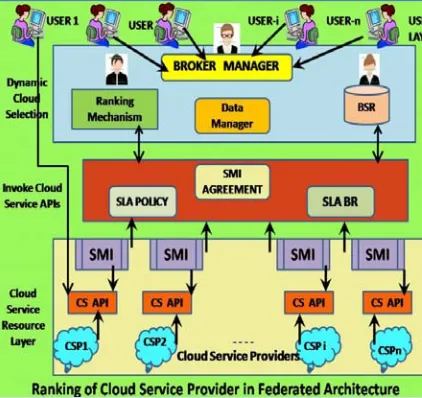
Federated cloud provider selection algorithm uses the quality metrics according to the Service Measurement Index (SMI), short list the matched providers depends on the SLA and functional requirements. Let CP= {CP1, CP2…. CPn} are the list of cloud providers in the Federated Cloud (FC). Let CB= {CB1, CB2…. CBn} are the cloud brokers that connected CP to the Cloud Manager (CM) in the proposed federated cloud architecture. Cloud broker considered the list of QoS indicators Qi = {Q1, Q2, Q3….QN} for the service requests submitted by the user, broker initiated the processing and short listed the providers based on the value for the quality indicators assured. Then apply ranking on the short-listed providers using Fuzzy based logic sets approach. In order to normalize the value of QoS indicators, the following are considered such as QoS metrics are measured in uniform values, qualities of the providers are analyzed using uniform index and assign threshold for the quality indicators based on the priority of it. The matching of provider is identified by the representation of the given set
MP = {QI, FA, RCP, CCP}
[image:5.612.93.304.497.696.2]MP denotes the Matching provider for the service. QI is the list of Quality Indicator recognized by the SMI. FA discuss the functional requirements refers the resource demand by the service and released by the provider. Cloud providers are clustered based on the service referred as CCP.[6] The functionality of provider discovery is shown in Figure 1.
Figure: 1 Ranking of Cloud Service Provider in Federated Architecture
Broker registry in broker manages information about the provider and helps to select the matching provider based on the equation MP = {Q1, FA, RCP, CCP}. The Algorithm steps are as follows.
1. Broker manager shortlisted the cloud providers and rank it using Fuzzy Logic set
2. Resource layer comprises of cloud providers, mapping with broker using service mapping (SM). SM can help the respective broker register the status of its connected provider in its registry including the failures of some services. 3. Each provider defines API (Application Programming Interface) as Means invoked by broker and used after finishing the process of cloud service selection.
4. Cloud providers are clustered based on the level of service group, the number of available and matched providers are shortlisted for ranking using fuzzy logic set.[16]
5. RANKING MECHANISM WITH FUZZY LOGIC
To propose ranking mechanism based on fuzzy set approach having three general phases such as problem decomposition, judgment of priorities and aggregation of these priorities. Ranking of Cloud services is one of the most challenging tasks in the framework of Federated Cloud. The ranking system computes the relative ranking values of various cloud services based on the Quality of services (QoS) requirements of the user and features of the Cloud services. To calculate the selection of ranking the service provider using two distinct threshold values, then recalculate using a fuzzy set membership function to assign the membership values for each of the individual cloud provider ranking criteria and then used fuzzy composition rules to combine these data. Finally, the overall ranking of the cloud providers is considering by the selected SMI attributes.
5.1 Ranking based on fuzzy logic set
1472 throughput and efficiency. Brokers responsible for interaction with users and understanding their request requires Ranking system to be considered based on the two aspects such as
(i) Service quality ranking based on fuzzy set
(ii) Final ranking based on the cost quality ranking.
The usual Cloud provider selection model is based on following three steps evaluation [17].
Step:1 is to identify the suitability of each service provider for the service render by the user. Suitability evaluation carried out by considering to reduction in the effect of any measure in class A.
Step:2 Confirms that provider can extend service providers. Cloud providers are selected based on the overall and individual cut off threshold values of the attributes considered for evaluation.
5.2 Fuzzy Random Theory based ranking cloud providers
The principle of fuzzy sets and fuzzy functions found useful in applications such as pattern recognition, clustering, information retrieval, and systems analysis. The notion of fuzzy random variables was introduced as a natural generalization of random set to represent associations between the outcomes of random experiment and non-statistical in exact data. Kwakernakk introduces the concept of a fuzzy random variable as a function F:Ω→F(R) where (Ω, A, P) is a probability space and F(R) denotes all piecewise continuous functions U:R→[0, 1]. A notion of a fuzzy random variable [14] slightly different than that of Kwakernakk that it as a measurable fuzzy set valued function x:Ω→F0(R), where R is the real line, (Ω, A, P) is a probability space, 0(R) = {A:R→[0, 1]} and {xϵR; A(x) ≥ } is a bounded closed interval for each ϵ (0, 1). Let U be a nonempty usual set, P(U) denote the set of all subsets in U and F(U) denote the set of all fuzzy subsets in U. For AϵF(U) we define two subsets of U as follows:
A = {xϵU; A(x)≥} for any ϵ [0, 1], ---(3.1)
A = {xϵU; A(x)>} for any ϵ [0, 1], ---(3.2)
Where A(x) is the membership functions of A. These are known as -cuts of the fuzzy set A.
Without loss of generality in the sequential X, F, G, F, G, denote the respective -cut functions [18].A = [A-, A+] Where A, = inf A, A+ = sup A.
The suggested ranking model consists of three phases namely
(i) Discover service providers
A fuzzy random process satisfying the fuzzy Markov property can make predictions of the future process based on the present conditions. Consider user requirement parameters like availability, security, cost etc as Y. Broker Manager as X, service providers as P (p1, p2 ... pn) and selected service provider as SP, then the stochastic Markov property is defined as F {SP ≤ X (P) / SP(Y) = P(Y)}. Selected service providers based on Markov process, are entered in the form of matrix called compatibility decision matrix. [19]
(ii) Rank the selected service provider
The fuzzy random membership function provides the maximum separation between those serials in the middle of the ranking system, while those serials at either extreme are bunched together closely. To propose ranking mechanism based on Fuzzy random approach having three general phases such as problem decomposition, judgment of priorities and aggregation of these priorities. The following membership fuzzy random function used is given as below
A= {xϵU; A(x)≥}for any ϵ [0, 1] --- (3.1) A = {xϵU; A(x)>}for any ϵ [0, 1] ---(3.2)
(iii) Choosing the best service provider
1473 become easy to ensure the achievement of the best compromise solution based on the objective function.[20]
6. SIMULATION RESULTS AND DISCUSSIONS
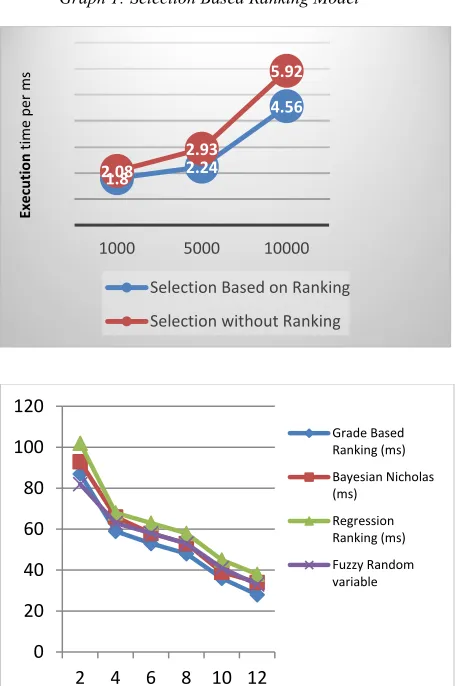
[image:7.612.313.541.100.443.2]Simulation experiments were implemented on the JADE 4.3.0 platform and on a computer whose configuration was an Intel Core i5-3337UCPU 1.80 GHz, 4.0GB RAM, Windows 7 (64 bits) operating system, Service Pack 1.Average response time and throughput was computed and the performance was also analyzed. The parameters considered for the simulation are number of users, number of cloud service providers, deadline of tasks etc. The execution time for each task is assigned randomly between 0.1ms to 0.5ms. Number of users considered are 1000, 5000 and 10000 at a time. Number of service providers available is fixed as 100, and deadline for each request is fixed as 0.5ms. Every cloud service provider has 50 computing hosts and a time-shared VM scheduler. Cloud broker on behalf of user request consist of 256MB of memory, 1GB of storage, 1 CPU, and time-shared Cloudlet scheduler. The broker requests instantiation of 25 VMs and associates one Cloudlet to each VM to be executed. There are two experiments were conducted and performance is analyzed with existing approaches. The experimental results prove that the proposed ranking model performs better in terms of average response time compared to the without ranking model in the Federated architecture. Simulation results are shown in Table below.
Table 1. Average Response Time
The Graph -1 shows the average response time of selection based on fuzzy random variables. The result shows that the assigned cloud provider satisfies the requirements in terms of trust, security and performance.
Graph 1: Selection Based Ranking Model
The overhead of the ranking mechanism depends on its implementation. The attributes in levels are assigned with constant and the execution time for performing ranking mechanism for 100 providers is 50ms. Similarly, having considered the existing
1.8 2.24
4.56
2.08
2.93
5.92
1000 5000 10000
Selection Based on Ranking
Selection without Ranking
Execution
tim
e per
m
s
0 20 40 60 80 100 120
2 4 6 8 10 12
Grade Based Ranking (ms)
Bayesian Nicholas (ms)
Regression Ranking (ms)
Fuzzy Random variable
0 50 100 150
2 4 6 8 10 12
Grade Based Ranking (ms)
Bayesian Nicholas (ms)
Regression Ranking (ms)
1474
ranking model, we have taken the following ranking mechanism for our experiments. 1. Grade based Ranking, 2. Bayesian ranking model, 3. Regression ranking model. The proposed fuzzy Random variable selection Model is taken for comparison. Results prove from Table-2 that the proposed fuzzy Random Variable based ranking model performs better in terms of average response time against other existing Ranking models in a federated cloud. The second Observation is that we can make it as the number of service providers are on the increase, the minimal response time as been
recorded for accessing the requested
applications in the cloud.
Table-2: Average Response Time (M/S) Comparison
7. CONCLUSION AND FUTURE WORK
Cloud computing has become an important technology for outsourcing various resource needs of the organizations. The Proposed Ranking based federated cloud mechanism helps to resolve the difficulties of selecting the optimal cloud provider for the service based on fuzzy random theory. Ranking of Cloud services is one of the most challenging tasks in the framework of Federated Cloud. The ranking system computes the relative ranking values of various cloud services based on the Quality of services (QoS) requirements of the user and features of the Cloud services. The optimal cloud selection control is proposed to ensure the
believability of the federated cloud
environment and characterizing the importance of each SMI attributes suggested by the cloud consortium. Fuzzy random theory based ranking model was simulated; the performance was compared with outranking model and found that the proposed idea provides improved status to broker based federated cloud architecture. Future research will focus on
mathematically formal frameworks for
reasoning about trust, including modeling, languages, and algorithms for computing optimal services of cloud provider based on trust serviceability.
REFERENCES:
[1] Buyya, R., Garg, S., Versteeg, S., SMI Cloud: A Framework for computing and Ranking Cloud Services. 2011 Fourth IEEE International Conference on Utility and Cloud Computing, (2011), pp. 210 -218.
[2] Rehman, Z.U., Hussain, O.K., Parallel Cloud service selection and Ranking based on QoS History, International Journal of Parallel Program. (2014), Vol.42, No.5, pp. 820-852. [3] L. Sun, J. Ma, Y.Zhang, H. Dong, Cloud-FuSer:
Fuzzy Ontology and MCDM based cloud service selection, Future Generation Computer System.(2016), Vol.57,pp.42-55.
[4] Buyya, R., Garg, S., Catheiros, R., SLA-Oriented Resource Provisioning for Cloud Computing: Challenges, Architecture and Solutions. International Conference on Cloud and Service Computing-CSC, (2011), pp.1-10 [5] Ghosh, S. Members, “SelCSP: A Framework to
Facilitate Selection of Cloud Service Providers”,IEEE trans. Of Cloud Computing, (2015), Vol.3. No.1., pp.66-79.
[6] Bonatti P.A., Festa, P., On Optimal Service Selection, Proceedings of 14th International Conference of World Wide Web (WWW 2005), pp.530-538.
[7] Breese, J.S., Heckerman, D., Empirical Analysis of Predicative Algorithms for Collaborative Filtering, Proceedings of 14th Ann. Conf. Uncertainty in Artificial Intelligence (UAI 1998) pp.43-58.
1475 [9] Abdul Wahab M., El-Abyed, Fuzzy Inner
Product Spaces, Fuzzy Sets and Systems,1991, Vol. 44, pp.309-326.
[10]L.A. Zadesh, Fuzzy Sets, Information and Control. 1965, Vol.8, pp.338-353.
[11]Timothy A, Rose J.,Fuzzy Logic – Beginners Approach, 2009, Prince Hall, Delhi.
[12]Pooja C, Bedi R.P,Fuzzy Logic based Model to Reprioritize Cloud Computing Process Requests using extended Parameters, International Journal of Computer Applications,2018., Vol.28, pp.20-23.
[13]Timothy A, Rose J.,Fuzzy Logic – Beginners Approach, 2009, Prince Hall, Delhi.
[14]Sigh, S., Chana, I., Cloud Resource Provisioning: Survey, status and future research directions, Knowledge and Information Systems, (2016), Vol.49(3), pp.1005-1019. [15]Subha, M., Saravanan, K., Achieve Better
Ranking Accuracy using Cloud Rank Framework for Cloud Services, International Journal of Engineering Trends and Technology, 2013, Vol.6(6), pp.307-313.
[16]Prasanth V., M. Nithya Barathan, Fuzzy Logic in Cloud Computing, International Journal of Engineering and Technology,2013, vol.,2(3), pp.1-6.
[17]Buyya, R., Yeo, C., Venugopal, S., Broberg, Cloud Computing and Emerging IT Platforms: Vision, Hype and Reality for Delivering Computing as the 5th Utility. Future generation Computer Systems, (2009), pp.599-616 [18]RinkuRajankar, R.W. Jasutkar "Fuzzy
Approach to Mobile Cloud Computing “, International Journal of Recent Technology,2012, Vol.1(2), pp.38-45
[19]Vadivel, G., Aramudhan, M., Priority Based Prediction Mechanism for Ranking Providers in Federated Cloud Architecture, International Journal of Engineering Research and Application, vol.7. (1), pp.82-85.