942
OUTPUT TRACKING BY STATE FEEDBACK FOR
HIGH-ORDER NONLINEAR SYSTEMS WITH TIME-DELAY
1,2KEYLAN ALIMHAN, 2NAOHISA OTSUKA, 3MAKSAT KALIMOLDAYEV, 3,4NURBOLAT
TASBOLATULY
1L.N. Gumilyov Eurasian National University, Kazakhstan 2Tokyo Denki University, Japan
3Institute of Information and Computational Technologies, Kazakhstan 4Al-Farabi Kazakh National University, Kazakhstan
E-mail: 1[email protected]; 2[email protected]; 3[email protected]; 4[email protected]
ABSTRACT
This paper addresses the problem of global practical output tracking for a class of high-order time-delay uncertain non-linear systems via state feedback. On the basis of the homogeneous domination technique, under mild conditions on the system nonlinearities involving time delay, we construct a homogeneous state feedback controller with an adjustable scaling gain. With the aid of a homogeneous Lyapunov-Krasovskii functional, the scaling gain is adjusted to dominate the time-delay nonlinearities bounded by homogeneous growth conditions and make the tracking error arbitrarily small while all the states of the closed-loop system remain to be bounded. Finally, a simulation example is given to illustrate the effectiveness of the tracking controller.
Keywords: Output Tracking, Time-Delay Nonlinear Systems, State Feedback, Homogeneous Domination Technique
1. INTRODUCTION
This paper addresses the global practical output tracking problem for a class of uncertain nonlinear systems with time-delay which is described by
1
1
( ) ( ) ( , ( ), ( ), ( )), 1, , 1, ( , ( ), ( ), ( )), ( ),
i
p
i i i
n n
x t x t t x t x t d u t i n
x u t x t x t d u t y x t
(1)
where T
1
( ): ( ( ), , ( )) n n
x t x t x t R ,u t( )R, and
( )
y t R are the system state, control input and output, respectively. The constant d0 is a given
943
system initial condition is
0
( ) ( ), [ , 0] .
x d The terms i( )
represent nonlinear perturbations that are continuous functions and 1 : { [0, ) :
i odd
p R p q p and q
are odd integers,pq} (i1, ,n1)are said to be the high orders of the system.
Global practical output tracking problem of nonlinear systems is one of the most important and challenging problems in the field of nonlinear control and has received a great deal of attention. By posed some conditions on system growth and power order, the practical output tracking problem of system (1) has been well-studied and a number of interesting results have been achieved over the past years, see [1-10], as well as the references therein. However, the aforementioned results have not considered the time-delay effect which is actually very common in state, input, and output due to the time consumed in sensing, information transmitting, and controller computing. It is well known that time-delay phenomena exist in many practical systems such as electrical networks, microwave oscillator, and hydraulic systems, etc., due to the presence of time delay in systems, it often significant effect on system performance, it often causes deterioration of control system performance and may induce instability, oscillation. Therefore, the study of output tracking and stabilization of time-delay nonlinear systems has important practical significance and has received much attention in recent years. In recent years, by employing the Lyapunov-Krasovskii method to deal with the time-delay, control theory, and techniques for stabilization problem of time-delay nonlinear systems were greatly developed and
advanced methods have been made; see, for instance, [11-20] and reference therein. Compared with study the stabilization problem contain time-delay, the theory of output tracking control developed slower. In the case when the nonlinearities contain time-delay, for the output tracking problems, some interesting results have been obtained [21-24]. However, the contributions only considered the case
1 i
p for the system (1). When the system under consideration is inherently time-delay non-linear, i.e. the case pi1 , the problem becomes more complicated and difficult to solve, and not many results have been reported in the literature for such a nonlinear system. To the best of our knowlege, due to no unified method being applicable to nonlinear control design, many interesting and important output tracking control problems for time delay inherently nonlinear systems unsolved yet.
944 existing results in [21-24], due to the appearance of high-order, time-delay and nonlinear assumption, how to construct an appropriate Lyapunov-Krasovskii functional for system (1) is a nontrivial work.
2. MATHEMATICAL PRELIMINARIES
At first, we give the following notations which will be used in this study.
Notations: Rn denotes the real 𝑛-dimensional space and R: [0, ) . For any vector
1 ( , , )
: T n
n
x x x R , denote
1
: ( , , )T i,
i i
x x x R i1, , n and || ||x
denotes Euclidean norm of x . A function
: n
f R Ris said to be Ck-function, if its partial derivatives exist and are continuous up to order
, 1 .
k k A C0 function means it is continuous. A Cfunction means it is smooth, that
is, it has continuous partial derivatives of any order. Besides, the arguments of functions (or functionals) are sometimes omitted or simplified, whenever no confusion can arise from the context. For instance, we sometimes denote a function ( ( ))f x t by f x( ),
( )
f , or f .
Now, we collect the definition of homogeneous function and several useful lemmas.
Definition1[25]. For a set of coordinates
1, , n
nx x x R and an 𝑛-tuple r( , , )r1 rn
of positive real numbers we introduce the following definitions.
(i) A dilations( )x is a mapping defined by
1
1
( ) , , ,
r r rn
s x s x s xn x ( , ,x1 xn)Rn,
0
s , where ri are called the weights of the coordinate. For simplicity of notation, the dilation
weight is denoted by ( , , )r1 rn .
(ii) A function ( n, )
VC R R is said to be homogeneous of degree if there is a real number
R
such that
1
( ( ))r ( , , ), n 0 .
s n
V x s V x x x R
(iii) A vector field ( n, n)
f C R R is said to
be homogeneous of degree if the component fi
is homogeneous of degreeri for each i, that is,
1 (r( )) ri ( , , ),
i s i n
f x s f x x n,
x R
0,
s fori1, , n.
(iv) A homogeneous p -norm is defined as
1
, 1 , , 1
i p
p r
n n
i
p i
x x x p
R .For the simplicity, write x for x,2.
Next, we introduce several technical lemmas which will play an important role and be frequently used in the later control design.
Lemma1[25]. Denote ( , , )r1rn as dilation
weight, and suppose V x1( ) and V x2( ) are
homogeneous functions with degree 1 and 2,
respectively. Then, V x V x1( ) ( )2 is also
homogeneous function with degree of 1 2with
respect to the same dilation Δ.
Lemma2[25]. Suppose : n
V R R is a
homogeneous function of degree with respect to the dilation weight . Then, the following (i) and (ii) hold:
(i) V xi is also homogeneous of degree
i
r
with ri being the homogeneous weight of
i
x .
945 ( )
V x x . Moreover, if V x( ) is positive
definite, there is a constant 0 such that
( )
x V x
.
Lemma3[27]. For all x y, R and a constant 1
p the following inequalities hold:
(i) p 2p 1 p p
xy x y ,
1p 1p 1px y x y 2p1p
x y
1pIf 1
odd
pR , then
(ii) p 2p1 p p
xy x y and
1 1
1p 1p 2p p p.
x y xy
Lemma4[25]. Let c d, be positive constants. Then, for any real-valued function ( , ) 0,x y the following inequality holds:
( , ) ( , ) .
c
c d c d c d
d
c d
x y x y x x y y
c d c d
This paper deals with the practical output tracking problem by state feedback for time-delay high-order nonlinear systems (1). Here, we give a precise definition of the problem.
The problem of global practical tracking by a
state feedback: Consider system (1) and assume that
the reference signal y tr( )is a time-varying C1
-bounded function on [0, ). For any given 0, design a state feedback controller having the following structure
( ) ( ( ), ( )),r
u t g x t y t (2) such that
(i) All the state of the closed-loop system (1)
with state controller (2) is well-defined and globally bounded on
R .
(ii) For any initial condition, there is a finite timeT 0, such that
( ) r( ) , 0
y t y t t T (3)
In order to solve the global practical output tracking problem, we made the following two assumptions:
Assumption1. There are constants C1, C2 and
0
such that
1 2
1
( ) ( ) ( )
1 1 2
( ) ( )
1 2
( , ( ), ( ), ( ))
( ) ( ) ( )
( ) ( )
i i i i
i i i
i
r r r r r r
i
r r r r
i
t x t x t d u t
C x t x t x t
x t d x t d C
(4)
where
11, i1 i i 0, 1, ,
r r p r i n (5) andpn1.
Remark1. In the Assumption1, when 0 is a high-order growth condition which is actually homogeneous (see Definition1) with the dilation (5) (For simplicity, in this paper we assume p q
with an even integer p and an odd integer q.
Therefore, ri is a ratio of two odd integers). Moreover, when d0, it reduces assumptions in [4]-[7] and this played an essential role to solve the practical tracking problem by a state or output feedback. Specifically, when pi 1,i1,,n, it
encompasses the assumptions in existing results [21].
Assumption2. The reference signal y tr( ) is continuously differentiable. Moreover, there is a known constant D0, such that
( ) ( ) , [0, )
r r
y t y t D t .
946 This paper deals with the practical output tracking problem by delay-independent state feedback for high-order time-delay nonlinear systems (1) under Assumptions 1-2. To this end, we first introduce the following coordinate transformation:
Define
1: 1 , : , 2, , , : 1
i n
i
r i
x u
z x y z i n v
L L
(6)
where 10,i(i11) pi1, i2, , n and 1
L is a constant (scaling gain) to be determined
later. Then, the system (1) can be described in the new coordinates zi as
1
1
( , ( ), ( ), ), 1, , 1, ( , ( ), ( ), ),
i
p
i i i
n n
r
z Lz t z t z t d v i n z Lv t z t z t d v y z y
(7)
where
1( , ( ), ( ), ) 1( , ( ), ( ), ) ,
( , ( ), ( ), ) ( , ( ), ( ), ) , 2, , .
i
r
i i
t z t z t d v t z t z t d v y t z t z t d v t z t z t d v L
i n
Remark 2. We need to emphasize that the gain 𝐿 creates an extra freedom in control design. As a matter of fact, in the proof of main results, complex uncertainties will inevitably be produced in the amplification of nonlinearities. Hence, the gain 𝐿 can be used to effectively dominate all the possible uncertainties.
Now, using Assumption 1, Lemma 3 and the fact that
1
L , the following inequalities can be obtained:
1 1 1 1 1 1 1 1 1 1 1 1 1
1 1 1
2 1 1 1 ( , ( ), ( ), ) ( ) ( ) ( , ( ), ( ), ) ( , ( ), ( ), ) ( ) ( ) ( ) ( ) i i i i r r r r r r r i i r r r r r i r r r r r i
t z t z t d v
C z t y z t d y
C y
t x t x t d u t z t z t d v
L
C
z t y L z t
L
z t d y L z t d
2 i C L
Further, the boundedness of yrand yrguaranteed
by Assumption 2, ensures the existence of constants
i
C , i1, 2 only depending on constants
1, 2, , i and
C C L, under which (4) becomes
1 1
1 1
1
1 1 1 2
( ) ( ) 1 1 1 2 ( , ( ), ( ), ) ( ) ( ) ( , ( ), ( ), ) ( )
, 2, ,
i j i j
i
i
r r
r r
i
i r r r r
v
j j
j
t z t z t d v
C z t z t d C
t z t z t d v
C L z t z t d
C i n L
(8)where C10, C2 0 and
( )
: min 1 j i , 2 , 1 0
i i
j
r
j i i n r
are some constants.
Since it can be seen that by definition
1 1
: 1 ( )
j j j
947
1 1
1
1 1
1 1 1 1
1 1 1 1 1 1 1 1, 1
2, , , 1, , .
j i i
i i
j i i
j j j
j j i i j
j j
j
j j
p p r p
r p p
p p p p p p p p
j i i n
In what follows, we will employ the homogeneous domination approach to construct a global state feedback controller for system (7).
3.1. Stability analysis for Nominal Nonlinear System.
First, we construct a homogeneous state feedback stabilizer (controller) for the nominal nonlinear system without considering the non-linearities of i( ) , i1, , n1 in (7), i.e.,
1
1
, 1, , 1, , i p i i n r
z Lz i n z Lv
y z y
(9)
Using similar the approach in [14, 26], we can design a homogeneous state feedback stabilizer for (9), which can be described in the following Theorem1.
Theorem1. For a real given number 0, there is a homogeneous state feedback controller of degree such that the nonlinear systems (9) is globally asymptotically stable.
Proof. To prove the result, we use an inductive
argument (recursive design method) to explicitly construct a homogeneous stabilizer for system (9).
Initial step1. Let 1 1
1 z1 r z1 r
, where
1 0
z and max1 i n
1, ri
is a positivenumber. Choose the Lyapunov function
11 1 1
1
2
1 1 1
r
z r r
z
V W s z ds
, i.e.
1 2 1 1
1 1 0
z r r
V W
s dsFrom (9), it follows that
2 1
1 1
2
1 1 1 2 2
r p p
V nL L z z (10)
where z2 the virtual controller and it is chosen as
1 2 2
1
1 2 1
1
2 1 : 1 1 , 1 .
r r r
p
p r p
z n z n
(11)
Step k k( 2, , )n . Suppose at the step k-1, there
is a C1, positive definite and proper Lyapunov function Vk1, and a set of virtual controllers
1, , k
z z defined by
1 1
2 2 2 2
1 1 1 1
2 1 1 2 2 2
1 1
0,
,
,
k k k k
r r
r r r r
r r r r
k k k k k k
z z z
z z z
z z z
(12)
with i 0, 1 i k 1 being constants, such that
1
1 1
1 2 1 1 2 1 ( 2)
k k k
k
k l
l
r p p
k k k
V n k L
L z z
(13)We claim that (13) also holds at Step k, i.e., there is
a C1, proper, positive definite Lyapunov function defined by
* 1 1 2 * ( ) ( ) ( ),( ) k k k k
k
k k k k k k
r
z r r
k k z k
V z V z W z
W z s z ds
(14)and virtual controller 1 1
1 rk rk
k k k
z
such
948
2 1 2
1 1
( 1)
k k k
k
k j
j
r p p
k k k
V n k L L z z
. (15)
Since the prove of the claim (15) is very similar [4-5, 14], so omitted here.
Using the inductive argument above, we can conclude that at the 𝑛-th step, there exists a state feedback controller of the form
1
1 1
1
n i
n n
r n
r
r r
n n i i
i
v z
(16)with the C1, proper and positive definite Lyapunov function,
*
2 * 1
i
i i i
i
n z r
r r
n z i
i
V s z ds
(17)we arrive at
2 1
,
n
n j
j
V L
(18)
where ri ri
i zi zi
and, 1, ,
i n i i n
are positive constants. Thus, the closed-loop system (9) and (16) is globally asymptotically stable.
3.2. Tracking control design for the time-delay nonlinear system (1)
Now, we are ready to use the homogeneous domination approach to design a global tracking controller for the system (1), i.e., state the following main result in this paper.
Theorem 2. For the time-delay nonlinear system (1) under Assumptions 1-2, the global practical output tracking problem is solvable by the state feedback controller uLn1v in (7) and (16).
Proof.
Step1. We first prove that u preserves the
equilibrium at the origin. From (16), we have
1
1 1
1
n i
n n
r n
r
r r
n n i i
i
v z
(19)By which and the definitions of ri ’s and 𝜎, we
easily see that uLn1v is a continuous function of z and u0 for z0 . This together with
Assumption1 implies that the solutions of z
system is defined on a time interval [0,tM ], where
0
M
t may be a finite constant or +∞, and u
preserves the equilibrium at the origin.
Step 2.
Define the compact notations
1, ,
, T
n
z z z
1 1
2
( ) ,, n ,
T
p p
n
E z z z v and
2
1 2
( ) , , , n T n
F z L L . (20)
Using the same notation (6) and (20), the closed-loop system (7) - (16) can be written as the following compact form:
( ) ( )
zLE z F z (21) Moreover, by introducing the dilation weight
1
( ,r , )rn
, from Definition 1, it can be shown that Vn is homogeneous of degree 2𝜎 − 𝜏 with
respect to.
Hence, adopting the same Lyapunov function (17) and by Lemm2 and Lemma 3, it can be concluded that
2
1 1
( ) ( )
( )
n n
n
n n
i i
i
V V
V z L E z
z z
V
F z m L z
z
(22)
where m10is constant.
949 constants i 0 and 0 i 1 such that
( ) ( ) ( ) 1 1 1 2 2 ( ) ( ) ( ) ( ) j i i i j i j j i i i i i i r r r i r k r r j j j r r iC L z t z t d
C C
L z t z t d
L L
(23)and noting that for i1, ,n , by Lemma2, Vn ziis homogeneous of degree 2 ri,
2 2 , i r n i V m z z
20
m (24)
and by
2 2 1 2
2 1
2 1
2 2 2
2 ( )
1
1
2 ( )
2
1 1
2 1
2 ( )
2 1
2 2 (1 ) ( ) (1 )
, 2
:
2
2
i i i
i i i
i i i i i i i i i i i i
i i i i
r r i r i r r r C
m z L z
L L
r m C m L z
r L
L m L z L
L m L z
L So,
2 2 1 2 2 1 1 2 22 ( )
2
2 (1 ) ( ) (1 )
2 2
1 1
2 2
( ) ( )
(1 ) (1 )
( )
(1 ) (1 )
( ) i i i i i i i i i i
i i i i
i i i i r n i i r r i i i r r r r r i i r V m z z C L z t z t d
L m L z m L z z t d
L
m L z m L z z t d
2 (1 i) ,
i r L (25)
where :m C2 2 , 2 1
2
ri
, 2 1
ri
,
and 2 (1 ) (1 ) 1 i i i i r .
Substituting (25) into (22) yields
2
1 2
2 2
2
1 1
2 ( ) 1 1
( ) ( (1 (1 )
(1 ) i ( ) i )
i i i i n n n r r i i r n i
V z L m z m
L z m L z z t d
L
(26)where max
i , i1, , n.By Lemma4, there exists a constant m30 such
that
2 2
2 2
3
(1 ) ( )
( ) ,
i i
r r
m z z t d
z m z t d
(27)
which yields 2 1 2 2 2 3 1 1
2 ( )
1 1
( ) ( (2 (1 ))
( ) ) i i i i n n n i i r n i
V z L m z m L z m L z t d
L
, (28)
Construct a Lyapunov-Krasovskii functional as follows:
* 2 * 1 2 ( ( )) ( ( )) ( ( )), , ( ( )) ( ) , i i i i i nn z r
r r
n z i
i t
t d
V z t V z t U z t
V s z ds
U z t z s Mds
(29)where M is a positive constant. Let
1
3 1 i.
n i
Mm
L It follows from (28) and (29)that
1 2 3 1
2 1
1
(2 (1 ) )
( ) .
i
n i
V L m m m L
z t L
(30)Hence, by choosing a large enough L as
2 3 1
max 1, (((2 (1 ) ) ))
950
1 min
i n i
and 1 2 ( )
1
in
r
i
the
inequality (30) becomes
2 1
1 ( ( )) ( ) .
V z t L z t
L
(31)
In (29), Vn( )z and U z( ) are homogeneous of
degree 2 and 2 with respect to , respectively. Therefore, it follows from Lemma2 that there exist positive constants 1, 2, 1and 2
such that
2 2
1 ( ) ( ( )) 2 ( )
n
z t V z t z t
(32)
and 1 z t( )2 U z t( ( )) 2 z t( )2
(33)
Moreover, by Lemma 4, we have
1
2 2 2
2
2
2 2
2
( ) ( )
2 ( )
2 2
L
z t L z t
L L
L L z t
(34)
Then, we have
2 2
2 2 2
( ( )) ( )
2
V z t L z t
L
(35)
or 2 2 2 2 2 2 1 ( ( )) ( ) 2
V z t L z t
L
(36)
where 2 : 2 2 2 .
Therefore, it follows from (29) and (35) that
2 2 2 2 2 2 1 2 1 2 2 1 2 ( ( )) ( ) 2 2 1 ( ( )) ,
V z t L z t
L
L L
V z t
(37)
where 2 1
1 2 2 1
2 2 L L . That is
2
21 ( ( ))
t t
d
e V z t e
dt
(38)
taking integral on both sides,
2 2
1
( ( )) ( (0)) 1
t t
e V z t V z e (39)
Hence, there exists a T 0 , for all tT
2 2
1 1
( ( )) t ( (0)) 1 t 3
V z t e V z e (40)
from which it is clear that z1 y yr can be rendered smaller than any positive tolerance with a sufficiently large L.
3.3. Extension of main result
In this subsection, using homogeneous domination approach, we will show that the triangular growth condition as required in Assumption 2 is not necessary to achieve the global practical tracking of (1) under the following more general assumption.
Assumption3.
There are constants
10, 20, 1, 0 i 1,
C C L and 0such that
1 1 1 2 ( ) ( ) ( ) , i i j j ii j j
i
r r
r
n r j j
j i
j
x t d t x t
C L
L L L
C L
(41)where 10,r1 1, i1
i1
pi, and1 0, 1, ,
i i i
r p r i n.
951 Assumtion 3 from inequality (41), the condition of Assumption 3 is more weaker than that of Assumption 1. Therefore, the following theorem is a more general result achieved under Assumption 3.
Theorem 3. Under Assumptions 2 and 3, the global practical output tracking problem of system (1) can be solved by a state feedback controller of the form (19).
Proof. Similar to (23), Assumption 3 will directly
lead to (25). Rest of the proof is similar to that of Theorem 2 and hence is omitted here.
4. AN ILLUSTRATIVE EXAMPLE AND SIMULATION
In this section, we give a simple numerical example to illustrate the correctness and effectiveness of the theoretical results by considering the following nonlinear system
5 3 1 3
1 2 1
5 3
2 3 2
1 3
3 3
1
( ) ( ) ( )
( ) ( ) 2 ( )
( ) ( ) ( )
( ) ( )
x t x t x t d
x t x t x t
x t u t x t
y t x t
(42)
wherep15 3,p25 3, p31 and d represent a time-delay parameter. Our objective is to design a state feedback practical output tracking controller such that the output of the system (42) tracks a desired reference signal yr, and all the states of the system (42) are globally bounded.
Clearly, the system is of the form (1). It is worth pointing out that although system (42) is simple, it
cannot be solved the global practical tracking problem using the design method presented in [4-5] and [7] because of the presence of time-delay term
1 3 1 ( )
x t d . Choose 2 3 and r11, then
2 3 1
r r and r45 3 . Further, choose the reference signal yrsin( 3) sint t . Then, by Lemma 4, it is easy to obtain
4
1 1
3
3 3
1 1 1
5 5
3 3 1
( ) ( ) 2 ( )
1 4
( ) 2
5 5
z t d z t d
z t d
,
3 2 2 3 5 3 5 22 2 2 2
3 2
( ) 2 2 2
5 5
z z z
,
1 3 4 3 1 3 5 3 5 3
3 3 3 3
1 4
( ) 2 2
5 5
z z z
and
sin( 3) sin 2,
1 4
cos( 3) cos
3 3
r
r
y t t
y t t
.
Clearly, Assumptions 1-2 holds with C13 5,
216 5
C and D4. According to the design procedure proposed in Section 3 (by Theorem2), we can obtain a state feedback tracking controller
5 349 25 24 25 3 5
3 2 1
2 2 2 r
u L L x L x x y (43)
In the simulation, by choosing the initial values as
1( ) 3,
z z2( ) 5, z3( ) 2,[0, ],d where 1
d and the reference signalyr sin( 3) sint t. Then, we have the following (i) and (ii).
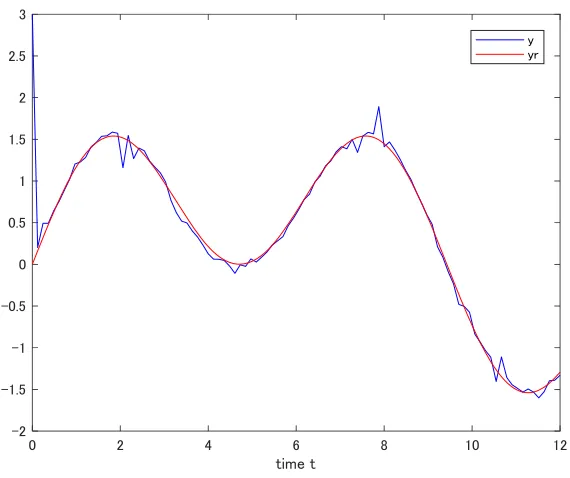
(i) When the scaling gain L is chosen as L100, the tracking error obtained is about 0.45 as
952
Fig. 1(a). Tracking error yyr for L100.
Fig. 1(b). The trajectories of x t1( ),y tr( ) for L100
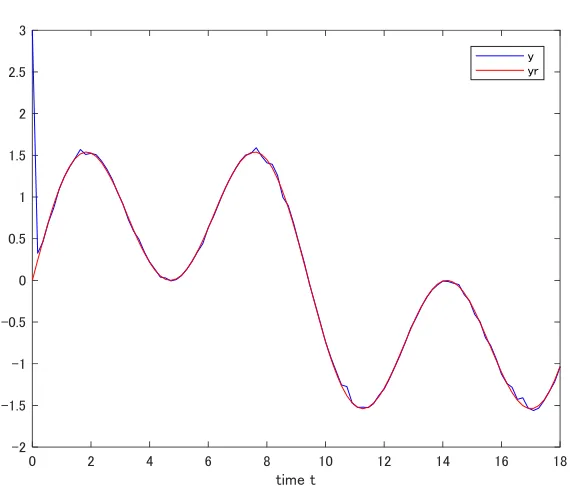
(ii) When the scaling gain L is chosen as L700, then the tracking error reduces to about 0.1 as
0 2 4 6 8 10 12
time t
-0.5 0 0.5 1 1.5 2 2.5 3
y-yr
0 2 4 6 8 10 12
time t
-2 -1.5 -1 -0.5 0 0.5 1 1.5 2 2.5 3
[image:11.612.165.450.106.350.2] [image:11.612.164.449.419.658.2]953 shown in Fig. 2.
Fig. 2(a). Tracking error y y r for L 700.
Fig. 2(b). The trajectories of x t1( ),y tr( ) for L700
0 2 4 6 8 10 12 14 16 18
time t
-0.5 0 0.5 1 1.5 2 2.5 3
y-yr
0 2 4 6 8 10 12 14 16 18
time t
-2 -1.5 -1 -0.5 0 0.5 1 1.5 2 2.5 3
[image:12.612.123.457.79.658.2] [image:12.612.164.449.411.654.2]954
5. CONCLUSION
In this paper, we have studied the practical output tracking problem for a class of uncertain high-order time-delay nonlinear systems under a homogeneous condition. First, we design a homogeneous state feedback controllers have been constructed with adjustable scaling gains. Then, with the help of a homogeneous Lyapunov-Krasovskii functional, we’ve redesigned the homogeneous domination approach to tune the scaling gain for the overall the closed loop systems. It is shown that an appropriate choice of gain will enable us to globally track for a class of uncertain non-linear systems in finite time. Moreover, the proposed approach can also widen the applicability to a broader class of systems with non-triangular structure. It should be noted that the proposed controller can only work well when the whole state vector is measurable. Therefore, a natural and more interesting problem is how to design feedback output tracking controller for the time-delay nonlinear systems studied in the paper if only partial state vector being measurable, which is now under our further investigation.
FUNDING
This work was supported in part by JSPS KAKENHI Grant Number 26420428.
REFERENCES
[1] A. Isidori, C.I. Byrnes, Output regulation of nonlinear system, IEEE Trans. on Automatic
Control, 35 ,(1990), pp. 31-140.
[2] C.J. Qian, W. Lin, Practical output tracking of nonlinear systems with uncontrollable unstable linearization, IEEE Trans. on Automatic Control,
(2002), 47, pp. 21-36.
[3] Z.Y. Sun, Y.G. Liu, Adaptive practical output tracking control for high-order nonlinear uncertain systems, Acta Automatica Sinica,
(2008), 34, pp. 984-989.
[4] K. Alimhan, H. Inaba, Practical output tracking by smooth output compensator for uncertain nonlinear systems with unstabilisable and undetectable linearization, Int. J. of Modelling,
Identification and Control, (2008), 5, pp.1-13. [5] K. Alimhan, H. Inaba, Robust practical output
tracking by output compensator for a class of uncertain inherently nonlinear systems,Int. J. of
Modelling, Identification and Control, (2008), 4,
pp.304-314.
[6] W.P. Bi, J.F. Zhang, Global practical tracking control for high-order nonlinear uncertain systems, Proc. of the Chinese Control and
Decision Conference, (2010), pp.1619-1622. [7] J. Zhai, S. Fei, Global practical tracking control
for a class of uncertain non-linear systems, IET
Control Theory and Applications, (2011),
5, pp.1343-1351.
[8] K. Alimhan, N. Otsuka, A note on practically output tracking control of nonlinear systems that may not be linearizable at the origin,
Communications in Computer and Information
Science, 256 CCIS , (2011), pp. 17-25.
[9] K. Alimhan, N. Otsuka, A. A. Adamov, M. N. Kalimoldayev, Global practical output tracking of inherently non-linear systems using
continuously differentiable
controllers, Mathematical Problems in
Engineering, (2015), Article ID 932097, 10
955
[10]K. Alimhan, N. Otsuka, M. N. Kalimoldayev, A. A. Adamov, Further results on output tracking problem of uncertain nonlinear systems with high-order nonlinearities, Int. J. of Control and
Automation, (2016), 9, pp.409-422.
[11]Zongyao Sun, Yungang Liu and Xuejun Xie, Global stabilization for a class of high-order time-delay nonlinear systems, Int. J. of
Innovative Computing, Information and Control,
(2011), 7, pp. 7119-7130.
[12]Sun Z, Xie X, Liu Z., Global stabilization of high-order nonlinear systems with multiple time delays, Int. J. of Control, (2013), 86, pp.768–
778.
[13]Sun Z, Zhang X, Xie X., Continuous global stabilization of high-order time-delay nonlinear systems, Int. J. of Control, (2013), 86, pp. 994–
1007.
[14]Lin Chai, Global output control for a class of inherently higher-order nonlinear time-delay systems based on homogeneous domination approach, Discrete Dynamics in Nature and
Society, (2013), Article ID 180717, 6 pages. [15] Fangzheng Gao, Fushun Yuan, Yuqiang Wu,
Global stabilisation of high-order non-linear systems with time-varying delays. IET Control Theory & Applications, 2013, 7(13): 1737-1744.
[16]Nengwei Zhang, Enbin Zhang, Fangzheng Gao, Global stabilization of high-order time-delay nonlinear systems under a weaker condition,
Abstract and Applied Analysis, (2014), Article
ID 931520, 8 pages.
[17]Fangzheng Gao, Yuqiang Wu, Further results on global state feedback stabilization of high-order
nonlinear systems with time-varying delays, ISA
Trans., (2015), 55, pp. 41–48.
[18]Fangzheng Gao, Yuqiang Wu, Global stabilisation for a class of more general high-order time-delay nonlinear systems by output feedback, Int. J. of Control, (2015), 88,
pp.1540-1553.
[19]Fangzheng Gao, Yuqiang Wu , Fushun Yuan, Global output feedback stabilisation of high-order nonlinear systems with multiple time-varying delays. International Journal of Systems Science, 2016, 47(10): 2382-2392.
[20]Xu Zhang, Wei Lin, and Yan Lin, Nonsmooth feedback control of time-delay nonlinear systems: a dynamic gain based approach, IEEE
Trans. on Automatic Control, (2017), 62, pp.
438-444.
[21]Xuehua Yan, Xinmin Song, Global practical tracking by output feedback for nonlinear systems with unknown growth rate and time delay, The Scientific World J., 2014, Article ID
713081, 7 pages.
[22]Xianglei Jia, Shengyuan Xu, JunChen, Ze Li, Yun Zou, Global output feedback practical tracking for time-delay systems with uncertain polynomial growth rate, J. of the Franklin
Institute, 352(2015), pp. 5551–5568.
[23]Xianglei Jia, Shengyuan Xu, Global practical tracking by output feedback for nonlinear time-delay systems with uncertain polynomial growth rate, Proc. of the 34th Chinese Control
Conference, (2015), pp. 607-611.
time-956 delay systems”, IMA J. of Mathematical Control
and Information, (2016), 33, pp.1067–1080. [25]L. Rosier, Homogeneous Lyapunov function for
homogeneous continuous vector fields, Systems
& Control Letters, (1992),19, pp. 467–473. [26]J. Polendo, C. Qian, A generalized
homogeneous domination approach for global stabilization of inherently nonlinear systems via output feedback, Int. J. of Robust and Nonlinear
Control, (2007), vol. 7, No.7, pp. 605–629. [27]J. Polendo, C. Qian, A universal method for
robust stabilization of nonlinear systems: unification and extension of smooth and non-smooth approaches, Proc. of the American
Control Conference, (2006), pp.4285-4290.