Technology (IJRASET)
©IJRASET 2013: All Rights are Reserved
670
- Splitting Graphs
Selvam Avadayappan1, M. Bhuvaneshwari2, R. Iswarya3
1,2,3
Research Department of Mathematics, VHNSN College(Autonomous), Virudhunagar-626001, India.
Abstract--Let G(V,E) be a graph. A dominating set is a subset S of V such that every vertex not in S is adjacent to at least one vertex in S. The cardinality of a minimum dominating set is called the domination number, (G). A dominating set with vertices is called a -set. Let denote the number of -sets in G. For a graph G, the splitting graph S(G), is obtained by adding a new vertex v corresponding to each vertex v of G and joining v to all vertices which are adjacent to v in G. Here we introduce a new type of graphs called minimum domination splitting graphs or simply -splitting graphs. Let G be a graph and let S1, S2,…,S be
the -sets in G. The -splitting graph, S(G), of a graph G is the graph obtained from G by adding new vertices w1,w2,…,w and
joining wi to each vertex in Si where 1 i . In this paper, we establish some results on -splitting graphs.
Keywords: Dominating set, domination number, splitting graph, -splitting graph. AMS Subject Classification Code(2010): 05C(Primary)
I. INTRODUCTION
Throughout this paper, we consider only finite, simple, undirected graphs. For notations and terminology we follow [3]. Let G(V,E) be a graph of order n. We denote the cycle on n vertices by Cn, the path of n vertices by Pn, and the complete graph on n vertices by
Kn. The complete bipartite graph is denoted by Km,n. In a graph G, degree of a vertex v is denoted by d(v). If S is a subset of V, then
<S> denotes the vertexinduced subgraph of G induced by S. For any vertex vV(G), the open neighbourhood N(v) of V(G) is the set of all vertices adjacent to v, that is, N(v) ={uV(G) / uvE(G)}, and the closed neighbourhood of v is defined by N[v] = N(v)
{v}. Nc(v) = V- N(v) is called the neighbourhood complement. For any set S, N(S) =
S v
v
N
)
(
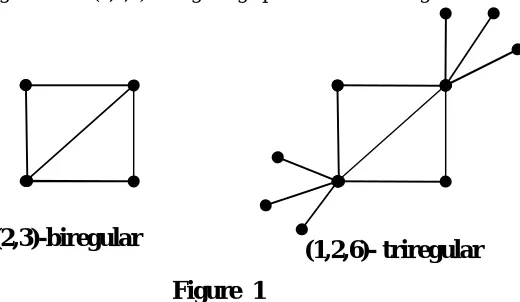
.A full vertex of G is a vertex in G which is adjacent to all other vertices of G. A graph G is said to be r-regular if every vertex in G is of degree r. For any two integers k and d, k d, a (k,d)- biregular graph is a graph in which every vertex is of degree either k or d. For any three integers x, a, and b, x a b, a (x,a,b)- triregular graph is a graph in which every vertex is of degree either x or a or b. For example, a (2,3)-biregular and a (1,2,6)- triregular graphs are shown in Figure 1.
The distance d(u,v) in G between two vertices u and v is the length of a shortest u-v path in G. The eccentricity e(u), of a vertex u is the distance of a farthest vertex from u, and radius rad(G) of G is the minimum eccentricity. The maximum distance between any two vertices in G is the diameter of G, denoted by diam(G), that is, diam(G) =
) ( ,
max
v V Gu {d(u,v)}. A vertex u with e(u) = rad(G) is
called a central vertex. A graph G for which rad(G) = diam(G) is called a self-centered graph of radius rad(G). Or equivalently, a graph is self-centered if all of its vertices are central vertices. For further basic definitions on distance in graphs one can refer [4]. Let Hn,n denote the graph with vertex set {v1,v2,…,vn ; u1,u2,…,un} and edge set {viuj / 1 i n, n-i+1 j n }. The graph Bm,n
is the bistar obtained from the stars K1,m and K1,n by joining their central vertices by means of an edge. For example, the graph H4,4
(2,3)-biregular
[image:2.612.180.440.458.609.2]
(1,2,6)- triregular
Technology (IJRASET)
©IJRASET 2013: All Rights are Reserved
671
and the bistar B4,5 are shown in Figure 2.
The join G
H of the graph G and H is the graph obtained from G
H by joining every vertex of G to each vertex of H by means of an edge. The graph Wn = Cn-1 K1 is called the wheel graph on n vertices. The corona G
H of two graphs G and H is obtainedby taking one copy of G and
V
(
G
)
copies of H, and by joining each vertex in the ith copy of H to the ith vertex of G, where 1 i )
(
G
V
. The corona graph C5
K2 is depicted in Figure 3, for reference,In a graph G, the process of deleting an edge uv and introducing a new vertex w and the edges uw and vw is called the subdivision of the edge uv. A spider is a tree on 2n + 1 vertices obtained by subdividing each edge of a star K1,n. In other words, spider is
nothing but K1,n ◦ K1. A wounded spider is a graph obtained from subdividing at most n – 1 edges of a star K1,n. The wounded spider
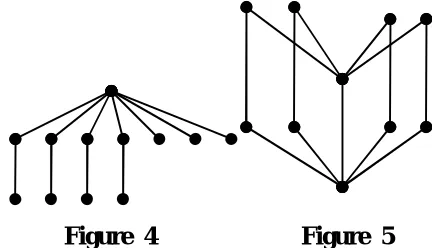
includes K1, the star K1,n-1. For example, a wounded spider G the graph shown in Figure 4. The cartesian product of two graphs G1
and G2 is denoted by G1 G2. The graph K1,m P2 is called the m-book graph and it is denoted by Bm. For example, the book
graph B4 is shown in Figure 5.
A dominating set is a subset S of the vertex set V such that every vertex is either in S or adjacent to a vertex in S, that is, such that every vertex in V-S is adjacent to at least one vertex in S. The domination number is the number of vertices in a smallest dominating set of G, it is denoted by (G). A dominating set with elements is called a -set. For example, S1 = {b,d} and S2 = {a,c} are the
minimum dominating sets of the graph G can be verified in Figure 6. For further results on domination in graphs, one can refer [5].
[image:3.612.134.471.102.206.2]B₄‚₅
Figure 2
H₄‚₄
Figure 3
[image:3.612.195.411.520.644.2]Technology (IJRASET)
©IJRASET 2013: All Rights are Reserved
672
Note that S3 = {a,b,c,d,e,f,g,h} and S4 = {a,b,c,d}, etc., are also dominating sets in G.The concept of splitting graph was introduced
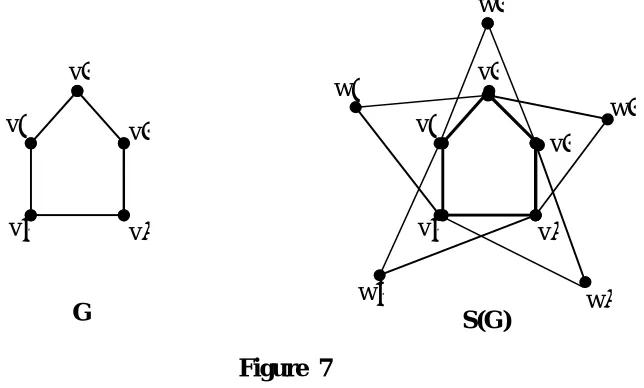
[image:4.612.141.463.329.523.2]by Sampath Kumar and Walikar [6]. The splitting graph S(G), is the graph obtained from G, by adding a new vertex w for every vertex v V(G), and joining w to all vertices of G adjacent to v. For example, a graph G and its splitting graph S(G) are shown in Figure 7.
The concept of cosplitting graphs has been recently introduced by Selvam Avadayappan and M. Bhuvaneshwari [1]. Let G be a graph with vertex set {v1, v2,…,vn}. The cosplitting graph CS(G) is the graph obtained from G, by adding a new vertex wi for each
vertex vi and joining wi to all vertices which are not adjacent to vi in G. As an illustration, a graph G and its cosplitting graph CS(G)
are shown in Figure 8.
a
b
c
d
e
f
g
h
G
Figure 6
Figure 7
v
₁
v
₂
v
₃
v
₄
v
₅
G
v
₁
v
₂
v
₃
v
₄
v
₅
w
₁
w
₂
w
₃
w
₄
w
₅
S(G)
v
₁
v
₂
v
₃
G
v
₁
v
₂
v
₃
w
₁
w
₂
w
₃
CS(G
Technology (IJRASET)
©IJRASET 2013: All Rights are Reserved
673
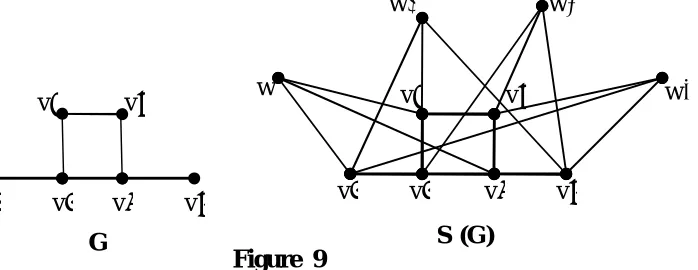
The concept of -splitting graph has been introduced by Selvam Avadayappan, M. Bhuvaneshwari and B. Vijaya Lakshmi [2]. Let S1,S2,…,S be the maximum independent sets of G. The -splitting graph S(G) of a graph G is a graph obtained from G by
adding new vertices w1,w2,…,w such that each wi is adjacent to each vertex in Si, for 1 i . For example, a graph G and its
-splitting graph S(G) are shown in Figure 9.
In this paper, we introduce a new type of splitting graphs called - splitting graphs. Let G be a graph and let be the number of -sets in G. Let S1, S2,…,S be the minimum dominating sets in G. The -splitting graph, S(G), of a graph G is the graph obtained
from G by adding new vertices w1,w2,…,w and joining wi to each vertex in Si where 1 i . For example, the - splitting
graph of P4 is shown in Figure 10.
.
Clearly, S1 = {v1,v4}, S2 = {v2,v3}, S3 = {v1,v3}, S4 = {v2,v4} are the -sets in P4, also w1,w2,w3,w4 are newly added vertices in S(P4).
Here, we discuss a few results on -splitting graphs. In this paper, we independently characterise graphs for which S(G) is a regular,
biregular, tree, unicyclic graph. We attain bounds for the maximum and minimum degree of a vertex in S(G). Finally we study the
distance properties of -splitting graphs.
II. CHARACTERISATION OF -SPLITTING GRAPHS
The following facts can be easily verified for -splitting graphs. For a vertex v in S(G), let d*(v) denote the degree of v in S(G).
Fact 2.1 The newly added vertices {w1,w2,…,w} are independent in S(G), that is, d(wi,wj) 2, for any i, j, 1 i, j .
Fact 2.2 d*(wi) = (G), for i, 1 i .
Fact 2.3 For any vertex v V(G), d(v) d*(v).
Fact 2.4 Every graph G is an induced subgraph of S(G). Even more G is a proper subgraph of S(G), since every graph contains at
least one -set.
Fact 2.5 The graph having only one full vertex, bistar graph, the graph Hn,n, the path P3k, k 1 and the book graph Bm are some
v
₁
v
₂
v
₃
v
₄
G
v
₆
v
₅
v
₁
v
₂
v
₃
v
₄
v
₆
v
₅
w
₁
w
₂
w
₃
w
₄
S
(G)
Figure 9
v
₁
v
₂
v
₃
v
₄
w
₁
w
₂
w
₃
w
₄
[image:5.612.138.487.142.277.2]S
(P₄)
Technology (IJRASET)
©IJRASET 2013: All Rights are Reserved
674
graphs whose -splitting graphs contain exactly one newly added vertex.
Fact 2.6 S(Kn) Kn
K1 for any n 1.Fact 2.7 S(K1,n) K1,n+1 for any n 2 .
Fact 2.8 S(Knc) K1,n for any n 1.
The following theorems establish some properties of -splitting graphs.
Proposition 2.9 For any m 1 and n 1, (Km,n) =
mn
mn
1
6
2
1
Proof Let V = {u1,u2,…,um ; v1,v2,…,vn} be the vertex set of Km,n.
Case (i) Suppose m = n =1, then clearly {u1} and {v1} are only the -sets and hence (Km,n) = 2.
Case (ii) If m = n= 2, then clearly {u1,v1},{u2,v2},{u1,v2},{u2,v1},{u1,u2}and {v1,v2} are the only -sets in K2,2 and hence (Km,n)
= 6.
Case (iii) If m =1 and n 2, then G K1,n, and therefore {u1} is the only -set. That is, (G) = 1.
Case (iv) Suppose m = 2 and n > 2. Then {u1,u2} and {uj,vk} 1 j 2, 1 k n are the -sets of G. Thus (Km,n) = mn+1.
Case (v) If m 3 and n 3, then clearly {ui,vk} 1 i m, 1 k n. Thus (Km,n) = mn. ■
Theorem 2.10 For any n 1, there exists a graph G of order n, such that S(G) is n-regular.
Proof When n = 1,G K1, for which S(G) K2 is the required graph. Therefore assume that n 2, consider the graph G Kn
Kcn1 with vertex set {v1,v2,…..,vn; u1,u2,…,un-1} with edge set {vivj / 1 i, j n}. For any i, 1 i n, clearly {vi, u1,u2,….…, un-1}
is a -set of G, that is, (G) = n. Hence there are n such -sets in G. Let w1,w2,…,wn be the newly added vertices in S(G). Now for
any i, j, 1 i n, 1 j n-1. Thus d*(vi) = d*(wi) = d*(uj) = n. Hence S(G) is n-regular. Thus G is the required graph.
For example, the graph K3
K2c and S( K3
K2c ) which is a 3-regular graph are shown in Figure 11.Now, consider the star graph K1,n-1, n 3, which is biregular. In addition S(K1,n-1) is also biregular. This shows that there are
biregular graphs G whose S(G) are also biregular. Some examples are listed below:
v
₁
v
₂
v
₃
u
₁
u
₂
w₁
w
₂
w
₃
S
( K₃ ∪ K₂ )
Figure
K₃ ∪ K
2v
₁
v
₃
v
₂
•
u
₁
•
u
₂
if m = 1, n
2
if m = n = 1
if m = n = 2
Technology (IJRASET)
©IJRASET 2013: All Rights are Reserved
675
Graph G Degree set of G
S(G) Degree set of S(G)
K1,n-1, n 3
P5
Bm
{1, n-2}
{1, 2}
{2, m+1}
K1,n
S(P5)
S(Bm)
{1,
(G)+1}{2,
(G)+2}{2,
(G)+1}Theorem 2.11 The graph S( Km,n ) is biregular if m = n and S( Km,n ) is triregular if m n for m 2.
Proof Let V = {v1,v2,…,vm; u1,u2,…,un} be the vertex set of Km,n.
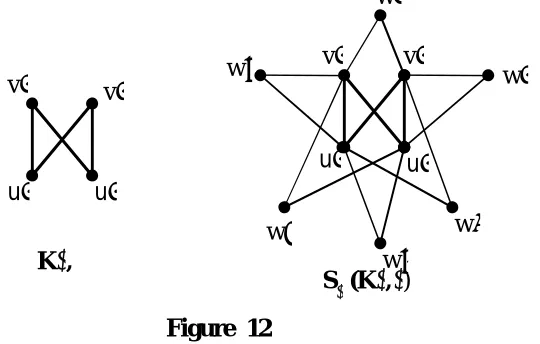
Case (i) Suppose m = n, and m 3. The graph S(Km,m), then d*(wi) = 2. Also, by Proposition 1, = m2. Each ui or vi belongs to
exactly m -sets. Hence d*(ui) = d*(vi) = 2m. Then S(Km,m) is a ( 2m, 2)-biregular graph when m = n.
Case (ii) Let m n. The graph S(Km,n), then d*(wi) = 2, and = mn. Each ui belongs to n - sets and each vi belongs to m -sets.
Then d*(ui) = 2n and d*(vi) = 2m. Hence S( Km,n ) is a ( 2m, 2n, 2)-triregular graph when m n. Hence the proof.
For example, the graph K2,2 and S(K2,2) are shown in Figure 12.
Theorem 2.12 The graph S(G) is a tree if and only if G is one among the following graphs Knc, P2,
k ini
K
1,
1
Kmc, k 1, ni 2, m 1, or
k
i ni
K
1 , 1
, k 1, ni 2.
Proof Consider a graph G for which S(G) is a tree. Since G is an induced subgraph of S(G), G is acyclic. If G contains only two
vertices, then obviously G K2 or K2c for which S(G) P4 or P3 respectively. So we assume that G contains at least three vertices.
Case (i) Suppose G is a tree. Then G contains at most one full vertex. If G contains only one full vertex, then G K1.n for which
S(G) K1,n+1. If G contains no full vertex, then (G) > 1 and thus G contains at least two vertices u and v in any -set S of G. Let w
be the newly added vertex in S(G), corresponding to S. Now the u-v path together with the edges uw and wv forms a cycle in S(G),
which is a contradiction to our assumption that S(G) is a tree. Therefore, this case does not arise.
Case (ii) Let G be a forest. If a -set contains at least two vertices in the same component, then S(G) contains a cycle, which is a
contradiction. Therefore every component must contain exactly one vertex of each -set of G, which is possible when each
v
₁
v
₂
u
₁
u
₂
K₂‚
v
₂
w
₆
v
₁
u
₁
u
₂
w
₅
w
₄
w
₃
w
₂
w
₁
[image:7.612.172.442.336.508.2]S
(K₂‚₂
)
Technology (IJRASET)
©IJRASET 2013: All Rights are Reserved
676
component is a star or a trivial graph and hence G
k i niK
1 ,1
Kmc, k 1, ni 2 and m 1 or G
k i ni
K
1 , 1 , k 1, ni 2.
And the converse is obvious. ■
For example, the graph S
3 1 3 , 1 iK
and S
2 1 3 , 1 iK
K3c
are shown in Figure 13.
Let Pk(m,n), where k 2 and m,n 1, be the graph obtained by identifying the centre vertices of the stars K1,m and K1,n at the ends
of Pk respectively. The graph C3(m1,m2,m3), where mi 0, is obtained from the cycle C3 = v1v2v3v1 by identifying the centre of the
star K1,mi, at vi of C3, for 1 i 3. For example, the graph P5( 3, 4 ) and C3( 3, 0, 0 ) are shown in Figure 14.
Theorem 2.13 The graph S(G) is unicyclic if and only if G is isomorphic to any one of the following graphs: (i) P2
K1, (ii) K3,(iii) Bm,n, m > 1, n > 1, (iv) Pk(m,n), k = 3, 4 and m,n 1, (v) Bm,n
Ktc, m > 1, n > 1, t 1, (vi) Pk(m,n)
Kt , k = 3, 4 andm, n 1, t 1, (vii) C3(m1,0,0)
r p n
pK
0 , 1
s q c nqK
0 where m1 1.
Proof Consider the graph G for which S(G) is unicyclic. Then there arise two cases.
Case (i) Suppose G is acyclic. Then clearly the cycle contains a newly added vertex w in S(G). Therefore, (G) 1. Let G be a
connected graph. Then = 1, that is, G contains exactly one -set, since every newly added vertex forms a new cycle. In particular, (G) = 2 with the -set {u,v}. Let w be the newly added vertex in S(G). Then the (u,v)-path in G together with the newly
added edges wu and vw forms the unique cycle in S(G) , this is possible only when G Bm,n, m > 1, n > 1, Pk(m,n), k = 3, 4
and m, n 1.
Let G be disconnected. If G has more than one component, with at least one edge, then S(G) has more cycles, which is a
contradiction to our assumption that S(G) is unicyclic. Hence only one component G1 of G can contain edges and the others are
isolated vertices. If G1 contains only one edge, then G must be P2
K1. If G1 contains more than one edge, then G1 is isomorphic toBm,n, m > 1, n > 1, Pk(m,n), k = 3,4 and m,n 1 and hence G Bm,n
Ktc, m > 1, n > 1, t 1, Pk(m,n)
Ktc, k = 3, 4 and m, n 1,t 1.
[image:8.612.142.462.371.472.2]Case (ii) Suppose G is unicyclic. Let G be a connected graph. Then newly added edges cannot be in a cycle. This is possible only
Figure 13
v
₁
v
₂
v
₃
w
v
₄
v
₅
v
₆
v
₈
v
₇
v
₁₀
v
₉
v
₁₁
V
₁₂
v
₅
v
₁
v
₂
w
v
₃
v
₄
v
₆
V
₁₁
v
₁₀
v
₉
v
₈
v
₇
P₅( 3, 4 )
C₃( 3, 0, 0 )
Technology (IJRASET)
©IJRASET 2013: All Rights are Reserved
677
when (G) = 1. This forces that G K3 or C3(m1,0,0) where m1 1.
Let G be disconnected graph. Then (G) 2. Clearly, one of the component of G is unicyclic and the remaining are trees. Since every component is connected, by the above argument exactly one vertex of each component belongs to -set of G. Also, the -set
must be unique to avoid cycles formed by newly added vertices. Such a graph is isomorphic to C3(m1,0,0)
r p n
pK
0 , 1
s q c nqK
0 where m1 1. And the converse is obvious. ■
For example, the graphs S(B4,5
K3c) and S(C3(3, 0, 0)
K1,4
K3c) are shown in Figure 15.Theorem 2.14 Let G be a graph. Then S(G) has a full vertex if and only if G Knc or H
K1 where H is a graph without a fullvertex.
Proof Let wi be the newly added vertices in S(G) for 1 i . Let v be a full vertex in S(G).
Case (i) Suppose v is a newly added vertex. Since wi’s are all independent in S(G), v is the only newly added vertex. And hence
V(G) is the only dominating set of G. This is possible only when G Knc.
Case (ii) Let v V(G). Then v is a full vertex of G. If G has a full vertex u other then v, then there are w1 and w2 corresponding to
the -sets {u} and {v}. But w1 and w2 are not adjacent. In addition uw2 and vw1 are not the edges in S(G). Thus S(G) contains no
full vertices, a contradiction. Therefore, G has exactly one full vertex. In other words, G H
K1 where H has no full vertex.Conversely, assume that G H
K1. The graph S(G) is nothing but a graph obtained from H
K1 by adding a new vertex andjoin it to the vertex of K1. Also S( Knc ) K1,n. In both the cases, S(G) has a full vertex. Hence the proof.
Proposition 2.15 For any connected graph G,
(G)
( S(G)) max{
(G) + , }.Proof Let v be a vertex of maximum degree in S(G). If v is a newly added vertex, then
(S(G)) = . Otherwise, if v V(G), then there arise two cases. When v
S
i, 1 i , then
(S(G)) =
(G). When v
S
i, 1 i ,
(S(G)) =
(G) + . Hence the maximum degree of the graph S(G) varies as,
(G)
( S(G)) max{
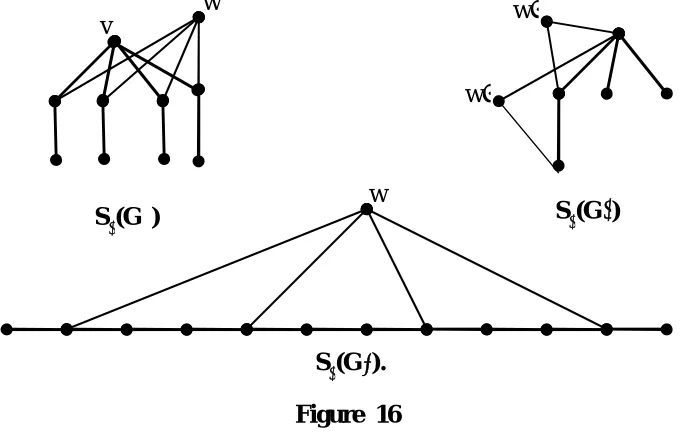
(G) + , }. Hence the proof.■For any n 6, there exists a graph of order n with
(S(G)) = (G), P3k, k 2 is one such a graph. Also the spider graph proves theexistence of graphs with
(S(G)) =
(G). The wounded spider graph stands as an example of graphs with
(S(G)) =
(G) +.For example the graphs G1,G2,G3 with
(S(G1)) =
(G1),
(S(G2)) =
(G2) + and
(S(G3)) = (G) respectively are shownin Figure 16. Here G1 is the spider graph on 9 vertices, G2 is the wounded spider graph on 5 vertices and G3 is the path graph on 12
vertices.
S
( B₄‚₅ ∪ K₃ )
S
( C₃( 3, 0, 0 ) ∪ K₁‚₄ ∪ K₃ )
Figure
v
₁
v
w
v
₆
v
₅
v
₄
v
₃
v
₇
v
₈
v
₉
v
₁₀
v
₁₁
v
₁
₂
v
₁₃
v
₁₄
v
₅
v
₄
v
₁₀
w
v
₂
v
₃
Technology (IJRASET)
©IJRASET 2013: All Rights are Reserved
678
III. DISTANCE PROPERTIES OF -SPLITTING GRAPHS
Here we are interested in studying about the distance properties in S-graphs. Also normally we expect diam(S(G)) < diam(G). But
there are graphs with diam(S(G)) diam(G). This behaviour gives rise to following three definitions S+-graphs, S--graphs, and
S*-graphs as given below:
A graph G is called a S+-graph if diam(G) < diam(S(G)).
It is called a S--graph if diam(G) > diam(S(G)).
Finally, it is said to be a S*-graph if diam(G) = diam(S(G)). For example, S+, S-, and S*-graphs are shown in Figure 17.
[image:10.612.137.486.86.305.2]Some standard graphs with their diameters and corresponding families are listed below:
Figure 16
w
₂
w
₁
S
(G₂)
w
S
(G₃).
w
v
S
(G₁)
S
+-graph
S
--
S
*
-graph
[image:10.612.81.531.494.654.2]Technology (IJRASET)
©IJRASET 2013: All Rights are Reserved
679
Graph G diam(G) diam(S(G)) Type
Kn
Km,n
W3
Graph with exactly one full vertex
Hn,n
Bm
Bm,n
Spider
1
2
1
2
3
3
3
4
3
3
2
2
3
3
3
4
S+-graph
S+-graph
S+-graph
S*-graph
S*-graph
S*-graph
S*-graph
S*-graph
Theorem 3.1 For any graph G, the distance between newly added vertices in S(G) is 2 or 3.
Proof Let G be any graph of order n, and w1 and w2 be any two newly added vertices in S(G). We know that d*(wi) = (G), 1 i and d(w1,w2) 2 (Fact 2.1).
Case (i) Suppose N(w1)
N(w2) . Let x
N(w1)
N(w2). Then x is the common neighbour of w1 and w2, and so d(w1,w2) =2.
Case (ii) Suppose N(w1)
N(w2) = . Then let x N(w1). Since N(w1) is a -set, every vertex in Nc(w1) is adjacent to at least onevertex in N(w1). But N(w2)
Nc(w1). Therefore, there exists a vertex y N(w2) such that y is adjacent to a vertex x in N(w1).Then d(w1,w2) = 3. ■
Theorem 3.2 For any graph G, diam(S(G)) 4.
Proof Let G be any graph and S(G) be its corresponding -splitting graph. Let u and v be any two vertices in S(G). We claim that
d(u,v) 4 for every u,v V(G).
Case (i) If u and v are newly added vertices in S(G). By Theorem 3.1, d(u,v) 3.
Case (ii) If u is a newly added vertex and v V(G). Then N(u) is a dominating set, and therefore vN(u) or v is adjacent to a vertex in N(u) in S(G). This forces that d(u,v) 2.
Case (iii) Suppose u, v V(G). Then there arise two subcases.
Subcase (i) Let u belong to a -set S. Then there is a newly added vertex w corresponding to S. If v S, then uwv is a u-v path of length 2 in S(G). Therefore d(u,v) 2. If v
S, then there is a vertex v1 in S, adjacent to v. Therefore uwv1v is a u-v path of length3, and so d(u,v) 3. If v belongs to any other -set, then in a similar way we can show that d(u,v) 3.
Subcase (ii) Neither u nor v belongs to any -set. Fix a newly added vertex w. Clearly, N(w) is a -set. So V(G)
N(N(w)) inS(G). Therefore, d(u,v) 4. Hence diam(S(G)) 4. ■
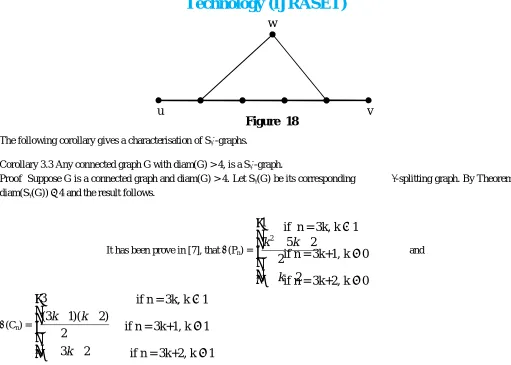
The inequality stated above is strict. For example, diam(S(P3k)) = 4, for any k 2. For example, diam(S(P6)) = 4 can be verified in
Technology (IJRASET)
©IJRASET 2013: All Rights are Reserved
680
The following corollary gives a characterisation of S--graphs.
Corollary 3.3 Any connected graph G with diam(G) > 4, is a S--graph.
Proof Suppose G is a connected graph and diam(G) > 4. Let S(G) be its corresponding -splitting graph. By Theorem 3.2,
diam(S(G)) 4 and the result follows. ■
It has been prove in [7], that (Pn) =
2
2
2
5
1
2k
k
k
and(Cn) =
2
3
2
)
2
)(
1
3
(
3
k
k
k
Proposition 3.4 The path graph Pn is S+-graph if n 2, S*-graph if n = 3, 4, and S--graph if n 5.
Proposition 3.5 The cycle graph Cn is S+-graph if n 5, S*-graph if n = 6, 7, and S--graph if n 8. REFERENCES
[1] Selvam Avadayappan and M. Bhuvaneshwari, Cosplitting and coregular graphs, International Journal of Mathematics and Soft Computing Vol.5, (2015), 57-64.
[2] Selvam Avadayappan, M. Bhuvaneshwari and B. Vijaya Lakshmi, -splitting graphs, Preprint.
[3] R. Balakrishnan and K. Ranganathan, A Text Book of graph Theory, Springer-Verlag, New York, Inc(1999). [4] F. Bunkley and F.Harary, Distance in Graph, Addison-Wesley Reading, 1990.
[5] T.W. Haynes, S.T. Hedetneimi and P.J. Slater, Fundamentals of domination in graphs, Marcel Dekker Inc., New York, (1998). [6] Sampath Kumar. E, Walikar. H.B, On the Splitting graph of a graph, (1980), J. Karnatak Uni. Sci 25 : 13.
[7] H. B. Walikar, H. S. Ramane, B. D. Acharya, H.S. Shekhareppa, S. Arumugum, Partially balanced incomplete block design arising from minimum dominating sets of path and cycles, AKCE J. Graph. combin., 4(2) (2007), 223-232.