5
X
October 2017
Efficient Modified Normalized Pixel Difference
Face Detection Algorithm
Dr. M. Sharmila Kumari2, Ramakrishna B B1
1
Assistant Professor, 2Professor & Head
1,2
Department of Computer Science and Engineering
1
VCET, Puttur, Karnataka, 2PACE, Mangalore, Karnataka.
Abstract: Face detection plays an important role in many computer vision systems. Typically, a face detector identifies faces within a gray scale or color image. Due to the recent increase in consumer depth cameras, obtaining both color and depth images of a scene has never been easier. We propose a technique that utilizes depth information to improve face detection. Standard face detection methods, such as the Viola-Jones object detection framework, detect faces by searching an image at every location and scale. Our method increases the speed and accuracy of the NPD face detector by utilizing pixel value data to constrain the detector’s search over the image. In this paper, we have made an attempt to study and modify Normalized Pixel Difference (NPD) based face detection algorithm and explore their merits and suitability by considering different situations. We have alsodescribed detectiontechnique with some application domain along with different challenges in this field.
Index Terms: Face detection, normalized pixel difference, deep quad tree,AdaBoost.
I. INTRODUCTION
any aspects of human physiology are used to authenticate a person’s identity. The characteristics trait can be broadly classified in to two categories i.e. physiological and behavioral. Measurement of physical features for personal identification is an age old practice. With the advancement in technology, biometric authentication has been widely used for access management, law enforcement, security system. A person can be identified on the basis of different physiological and behavioral traits like faces, iris, hand geometry, ear pattern, voice recognition, and thermal signature.
Face detection is the stepping stone towards the entire facial analysis algorithms,including face alignment, face relighting, face modeling,face recognition, head pose tracking, face verification/authentication, facial expression tracking/recognition, gender/age recognition and lots of more. The difficulty associatedwith face detection can be attributed to many variations inscale, location, orientation (in-plane rotation), facial expression, occlusions, andlighting conditions.
This paper presents comparative study of Viola-Jones,NPD based, NPD2 and Variant of normalized pixel difference based face detection approaches. Advantage and disadvantage of all the four algorithms are discussed and compared with help of various features.
II. FACEDETECTION
Face detection determines the presence and location of aface in an image, by distinguishing the face from all otherpatterns present in the scene. This requires appropriateface modeling and segmentation. The approach shouldalso take into account the sources of variation of facial appearance like viewing geometry (pose), illumination(color, shadowing, and self-shadowing), the imaging process (resolution, focus, imaging noise, perspective effects), and other factors like occlusion[4]. Alternatively, face detection can be carried out by using the entire face[5], [6], making occlusion difficult to handle. Face detection methodologies are classified on the basis of the image information used to aid in detection—color [7],geometric shape [8], or motion information [9], [10].
Face detection is also a part of object detection[16]. Outcome of face detection can be classified into two classes face and non-face. Most applications are based on face recognition and tracking. Moreover, face detection has added a much needed aspect of security in the recent years. Biometric systems, a front sided camera (Selfie) of smart phone, human presence detection are some ofthe key implementations of face detection. Basically face detection senses the presence of the face in a 2D frame. Several methods and approaches are developed for face detection.
Input Image Integral Image
A B
C D
Type 1 Integral
Type 3 Type 5
Type 2
A very fast and accurate approach to detect a face was developed by Viola and Jonesin the year 2001. The breakthrough in face detection occurred with Viola & Jones idea to combine many weak classifiers to create one strong classifier. In their paper, Viola & Jones introduce four main concepts which are: the Haar-like features, the integral image, the use of AdaBoost in machine training, and a cascade of classifiers [1].
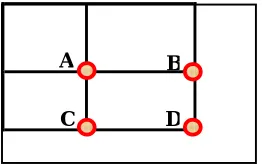
The basic principle of the Viola-Jones algorithm [1] is to scan a sub-window capable of detecting faces across a given input image. The image processing approach would be to rescale the input image to different sizes and then run the fixed size detector through these images. This approach turns out to be rather time consuming due to the calculation of the different size images. The first step of the Viola-Jones face detection algorithm is to turn the input image into an integral image. This is done by making each pixel equal to the entire sum of all pixels above and to the left of the concerned pixel. This is demonstrated in figure 1.
1 1 1
1 1 1
[image:3.612.188.403.213.291.2]1 1 1
Figure 1: The integral image.
[image:3.612.245.376.357.441.2]This allows for the calculation of the sum of all pixels inside any given rectangle using only fourvalues. These values are the pixels in the integral image that coincide with the corners of therectangle in the input image. This is demonstrated in figure 2.
Figure 2: Sum calculation.
Sum of grey rectangle = D - (B + C) + A
Since both rectangle B and C include rectangleA the sum of A has to be added to the calculation.
Figure 3: The integral image.
types of features are shown in figure 3. Each feature results in a single value which is calculated by subtracting the sum of the white rectangle(s) from the sum of the black rectangle(s). In order to find these features Viola-Jones use a modified version of the AdaBoost algorithm developed by Freund and Schapire in 1996 [11]. AdaBoost is a machine learning boosting algorithm capable of constructing a strong classifier through a weighted combination of weak classifiers.
The main advantages of Viola-Jones algorithm is uncompetitive detection speed while relatively high detectionaccuracy, comparable to much slower algorithms. Constructing a cascade of classifiers totally reduces computation time while improving detection accuracy. Viola Jones gives accurate face detection.
1 2 3
2 4 6
[image:3.612.97.445.520.629.2]Drawback of Viola-Jones algorithm is it takes long training time and detector is most effective only on frontal images of faces. Another major drawback is that it can hardly cope with 45° face rotation both around the vertical and horizontal axis.
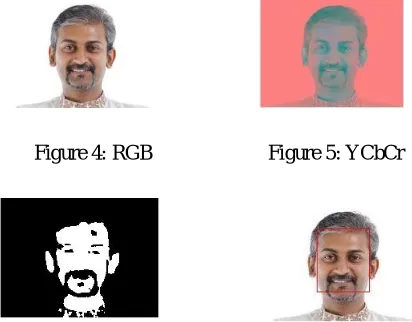
[image:4.612.207.413.164.325.2]Face detection by skin color is one of the more simple methods [14]. First it relies on extracting the regions, within a colored image, as shown in figure 4, which are likely to contain human skin. These regions are found by applying filters that rely on color and texture. Then after finding areas which contain human skin, a gray scale image is used, along with the information about skin locations to detect the face location. YCbCr skin color classification algorithm is used for further process.
Figure 6: Binary image Figure 7: Detected face
Which represents skinregion YCbCr skin color classification algorithm [12] uses color statistics gathered from YCbCr color space shown figures 5. Pixels belonging to skin region exhibit similar Cb and Cr values. Skin color model based on the Cb and Cr values can provide good coverage of different human races. The thresholds be chosen as [Cr1, Cr2] and [Cb1, Cb2].A pixel is classified to have skin tone if the values [Cr, Cb] fall within the thresholds. The skin color distribution gives the face portion in the color image. This algorithm is also having the constraint that the image should be having only face as the skin region.
After getting the skin region, facial features like Eyes and Mouth are extracted. The image obtained after applying skin color statistics is subjected to binarization i.e., it is transformed to gray-scale image and then to a binary image by applying suitable threshold which is shown figures 6. This is done to eliminate the saturation values and consider only the luminance part. This luminance part is then transformed to binary image with some threshold because the features to consider further for face extraction are darker than the background colors. After thresholding, opening and closing operations are performed to remove noise. Now to extract the eyes, ears and mouth from the binary image by considering the threshold for areas which are darker in the mouth than a given threshold.
A triangle is drawn with the two eyes and a mouth as the three points in case of a frontal face to get an isosceles triangle (i j k) [14] in which the Euclidean distance between two eyes is about 90-110% of the Euclidean distance between the center of the right/left eye and the mouth. Then face region is identified which is shown in figure 7.
The main advantage of color based face detection is very simple to implement. Irrespective of face angles it detects face. A disadvantage of the color based face detection is its sensitivity to illumination color changes and, especially in thecase of RGB, sensitivity to illumination intensity.
Color based face detection is affected by complex background.Due to which it is difficult to locate facial features because of several abnormalities (illumination, noise, occlusion) and detects non face regions in addition to face.
IV. NPDANDNPD2 BASEDFACEDETECTION
A new type of feature, called Normalized Pixel Difference (NPD) is proposed in [32], which is efficient to compute and has several
desirableproperties, including scale invariance, boundedness,and enabling reconstruction of the original image.Deep quadratic tree
learner is used to learn and combine an optimal subset of NPD features to boost their discriminability. The Normalized Pixel Difference feature between two pixelsin an image is defined as
f(x,y)=
Figure 4: RGB Figure 5: YCbCr
differencebetween two pixel values. The sign of f(x,y) indicates theordinal relationship between the two pixels x and y, and the magnitude of f(x,y) measures the relative difference (as apercentage of the joint intensity x + y) between x and y. Note that the definition f(0,0)=0 is reasonable because, inthis case, there is no difference between the two pixels xand y. Compared to the absolute difference │x-y│, NPD isinvariant to scale change of the pixel intensities.
NPD uses the AdaBoost algorithm toselect the most discriminative features and constructsinglestrong classifiers. AdaBoost algorithm[27] is used to learn the NPD feature based deep quadratictrees. Further cascade classifier is used for rapidface detection. NPD learn only one single cascade classifierfor unconstrained face detection robust to occlusions andpose variations.
Advantages in NPD arethat there is no need to label the pose of each face imagemanually or cluster the poses before training the detector.In the learning process, the algorithm automatically dividesthe whole face manifold into several sub-manifolds by thedeep quadratic trees. NPD detector is also efficient and faster when it is compared with Viola-Jones face detector.
NPD face detection algorithms performance is less when it is used on low image resolutions. Because the NPD featuresinvolve only two pixel values, they do not extract rich texture information on the face.
New variant called NPD2 uses same features of NPD but pixel intensities modified as f(x,y)=
Where x, y ≥ 0 are intensity values of the two pixels, and f(0,0) is defined as 0 when x= y=0. Performance NPD2 is considerably
low when it is compared with NPD. Computation of pixel features are complicated than NPD.
V. VARIANTOFNPD
Variant of NPD (VNPD) is implemented using the concepts of NPD and NPD2 algorithm. VNPD uses same features that of NPD.
In VNPD features between two pixels are identified using mathematical algebraic model. The variant Normalized Pixel Difference
feature between two pixels in an image is computed as f(x1,y1)=
where (x1+y1) 2 = ((x1 ) 2+(y1 ) 2+2x1y1)
where x1, y1≥ 0 are intensity values of the two pixels, and f(0,0) is defined as 0 when x1= y1=0 [32]. VNPD feature measures the relative difference between two pixel values. The sign of f(x1,y1) indicates the ordinal relationship between the two pixels x1and y1, and the magnitude of f(x1,y1) measures the relative difference (as a percentage of the joint intensity x1 + y1) between x1 and y1. Note that the definition f(0,0)=0 is reasonable because, in this case, there is no difference between the two pixels x and y. Compared to the absolute difference │x1-y1│, modified NPD is invariant to scale change of the pixel intensities.
Modified NPD uses the AdaBoost algorithm to select the most discriminative features and construct single strong classifiers. AdaBoost algorithm [27] is used to learn the NPD feature based deep quadratic trees. Further cascade classifier is used for rapid face detection. NPD learn only one single cascade classifier for unconstrained face detection robust to occlusions and pose variations.
Advantages in VNPD is that there is no need to label the pose of each face image manually or cluster the poses before training the detector. In the learning process, the algorithm automatically divides the whole face manifold into several sub-manifolds by the deep quadratic trees. VNPD detector is also efficient and faster when it is compared with Viola-Jones face detector.
VNPD uses deep quadratic tree to detect faces in an image.VNPD uses single cascade classifier for unconstrained face detection robust to occlusions and pose variations. This implementation has the advantage that there is no need to label the pose of each face image manually or cluster the poses before training the detector. In the learning process, the algorithm automatically divides the whole face manifold into several sub-manifolds by the deep quadratic trees. Besides, we adopt the soft cascade structure for efficient training and early rejection of negative samples. Specifically, soft cascade can be regarded as a single AdaBoost classifier with one exit per weak classifier. In each iteration, a deep quadratic tree is learned as the weak classifier, and a threshold of the current AdaBoost classifier is also learned for rejecting nonfaces. Finally, the learned deep quadratic trees and thresholds are aggregated sequentially to represent as face.
VI. EXPERIMENTALCOMPARISONOFALGORITHMS
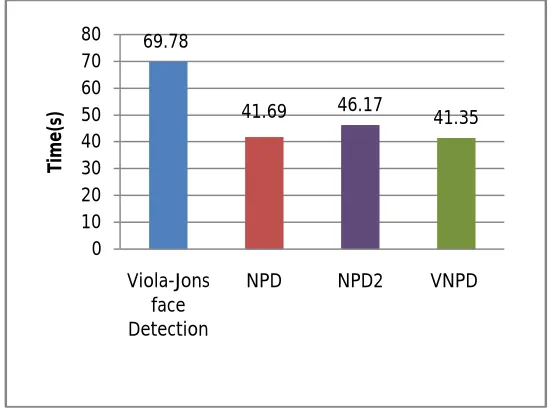
The graph in figure 8 shows the time taken for each method to process an image. The images used from FDDB dataset to establish those benchmarks were approximately 348x450 pixels and were processed on relatively similar processor. Similarly graph in figure
x
1-y
1(x
1+y
1)
2x-y
69.78
41.69 46.17 41.35
0 10 20 30 40 50 60 70 80 Viola-Jons face Detection
NPD NPD2 VNPD
T im e (s ) 78.31
46.92 48.63 45.39
0 10 20 30 40 50 60 70 80 90 Viola-Jons face Detection
NPD NPD2 VNPD
Ti
m
e
(s
)
[image:6.612.150.452.115.286.2]9 shows the time taken by all the four algorithms to process an image. Images are used from real dataset of size 100x113 pixels. By referring both the graphs we can say that the time taken byNPD2 based face detection algorithm is relatively more than the Viola-Jones, NPD and VNPD based face detection algorithms.
Figure 8: Graph showing time taken by each method on FDDB dataset
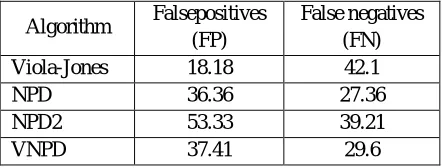
[image:6.612.158.438.471.679.2]In color based face detection algorithm the speed of detection wasn’t taken into account as such. Crowley and Coutaz [15] said one of the simplest algorithms for detecting skin pixels is to use skin color algorithm. The perceived human color varies as a function of the relative direction to the illumination. The pixels for skin region can be detected using a normalized color histogram, and can be further normalized for changes in intensity on dividing by luminance. And thus an [R, G, B] vector is converted into an [r, g] vector of normalized color which provides a fast means of skin detection. This gives the skin color region which localizes face. As in [13], the output is a face detected image which is from the skin region. This algorithm fails when there is some more skin region like legs, arms, etc.Viola-Jones algorithm consumes more time to detect tilted faces inimages. NPD2 based face detection algorithm is also requiresmore time compared to NPD based face detection algorithm on different types of images.Hence, it can be clearly concluded that VNPD method work significantly faster when compared with NPD, Viola-Jones and NPD2 based face detection algorithm. Table 1 and Table 2 shows the detection rate of Viola-Jones, NPD, NPD2 and VNPD based face detection algorithm. NPD2 based face detection algorithm shows very high false positive and false negative detection rate when compared to other three face detection algorithms.
Figure 9: Graph showing time taken by each method on Real dataset
Algorithm
(FP) (FN)
Viola-Jones 18.18 42.1
NPD 36.36 27.36
NPD2 53.33 39.21
[image:7.612.196.417.74.158.2]VNPD 37.41 29.6
Table 2: Comparison of detection rate (%) of four face detection algorithms on real dataset
Algorithm Falsepositives (FP)
False negatives (FN)
Viola-Jones 74.25 65.22
NPD 28.11 41.32
NPD2 31.28 51.21
[image:7.612.195.418.208.293.2]VNPD 26.32 41.27
Table 3: Performance Comparison Chart of theAlgorithms on different FDDB (FD) and Real dataset (RD)
Algorithm Viola-Jones (% of detecti on) NPD (% of detectio n) NPD2 (% of detectio n) VNPD (% of detectio n) Clear Frontal Face
FD 100 70 69 70
RD 100 62 64 62
Tilted Face
FD 1 40 36 39
RD 3 53 51 53
Profile Face
FD 60 44 26 58
R
D 71 38 39 38
Comple x Backgr ound Frontal Image
FD 70 30 27 30
R
D 58 21 23 20
VII. CONCLUSION
In this paper a comparison has been made between Viola-Jones, NPD, NPD2 and VNPD based face detection algorithm fordetecting faces in the controlled background. Results show thatViola-Jonesalgorithm is more efficient in comparison to NPD, NPD2 and VNPD based face detection algorithms when frontal face images are used as input. For tilted and curved face images NPD based face detection and VNPD algorithms shows almost same good performance. But still all thesefour algorithms are not able to give very good results in different environmental conditions. The results can change depending on the dataset to being analyzed but in all cases it is possible to identify the presence of faces in the image. Based on theexperiment results of the all four algorithms, it can be concluded that all the four algorithms have their own advantages and disadvantages in different environments.
ABOUTAUTHORS
Ramakrishna B B received the BE and M.Tech degree from Visvesharaya Technological University, Karnataka, India. He is currently working as professor in the department of computer science and
engineering, VCET, Puttur, Karnataka. His Research interest are face detection and tracking, image and vision processing, computer networks. He published more than 10 research papers in reputed journals and conferences.
Dr. Sharmilakumari distinguished professor and Head in the Department of Computer science and Engineering at PA College of Engineering, Mangalore, Karnataka. She received BE from Mangalore University, M.Tech from NITK Surathkal and Ph.D from Magalore university, Karnataka. Her research interest includes image and vision processing, biometrics, text processing, face recognition. She published and presented many research papers in national and international conferences.
REFERENCES
[1] Paul Viola, Michael J. Jones, Robust Real-Time Face Detection, International Journal of Computer Vision 57(2), 2004.
[2] Sanjay Kr. Singh1, D. S. Chauhan2, Mayank Vatsa3, Richa Singh3A Robust Skin Color Based Face Detection AlgorithmTamkang Journal of Science and Engineering, Vol. 6, No. 4, pp. 227-234 2003.
[3] Phung, S. L., Chai, D. K., &Bouzerdoum, A. Skin colour based face detection. Proceedings of 7th Australian and New Zealand Intelligent Information Systems Conference. Australia. IEEE. pp. 0. 2001.
[4] RaginiChoudhuryVerma, CordeliaSchmid, and KrystianMikolajczyk, ―Face Detection and Tracking in a Video by Propagating Detection Probabilities, ieee transactions on pattern analysis and machine intelligence, vol. 25, no. 10, october 2003.
[5] H.A. Rowley, S. Baluja, and T. Kanade, ―Neural Networks Based Face Detection, IEEE Trans. Pattern Analysis an Machine Intelligence, vol. 20, no. 1, pp. 22-38, Jan. 1998.
[6] K.K. Sung and T. Poggio, ―Example-Based Learning for View-Based Human Face Detection, IEEE Trans. Pattern Analysis andMachine Intelligence, vol. 20, no. 1, pp. 39-51, Jan. 1998.
[7] J.-C. Terrillon, M. Shirazi, H. Fukamachi, and S. Akamatsu,―Comparative Performance of Different Skin Chrominance Modelsand Chrominance Spaces for the Automatic Detection of HumanFaces in Color Images, Proc. Int‘l Conf. Automatic Face andGesture Recognition, pp. 54-61, 2000.
[8] D. Decarlo and D. Metaxas, ―Deformable Model Based Face Shapeand Motion Estimation, Proc. Int‘l Conf. Face and GestureRecognition, 1996.
[9] G. Hager and K. Toyama, ―X Vision: A Portable Substrate forReal- Time Vision Applications,‖ Computer Vision and ImageUnderstanding, vol. 69, no. 1, pp.
23-37, 1998.
[10] J. Yang and A. Waibel, ―Tracking Human Faces in Real Time,Technical Report CMU-CS-95-210, School of Computer Science,Carnegie Mellon Univ., Pittsburgh, Pa., 1995.
[11] J. P. Kapur, “Face Detection in Color Images,” University of Washington Department of Electrical Engineering, 1997. [Online]. Available: http://web.archive.org/web/20090723024922/http:/geocities.com/jaykapur/face.html. [Accessed 10 December 2013].
[12] Cahi, D. and Ngan, K. N., “Face Segmentation Using Skin-Color Map in Videophone Applications,” IEEE Transaction on Circuit and Systems for Video Technology, Vol. 9, pp. 551-564. 1999.
[13] Christopher M. Bishop, Pattern Recognition and Machine Learning, first edition, Springer 2006.
[14] Sanjay Kr. Singh, A Robust Skin Color Based Face Detection Algorithm, Tamkang Journal of Science and Engineering, Vol. 6, No. 4, pp. 227-234 2003. [15] Crowley, J. L. and Coutaz, J., “Vision for Man Machine Interaction,” Robotics and Autonomous Systems, Vol. 19, pp. 347-358, 1997.
[16] Hsu, Rein-Lien, Mohamed Abdel-Mottaleb, and Anil K. Jain."Face detection in color images." Pattern Analysis and Machine Intelligence, IEEE Transactions on 24.5 :696-706, 2002.
[17] Mohamed Theo Gevers, “Robust Segmentation and Tracking of Colored Objects in Video”,CSVT, IEEE, pp. 178-181 Jul2004.
Technologies, Vol. 5 (2), 2014, 1615-1618.
[20] G. Yang and T. S. Huang, ―Human Face Detection in Complex Background,‖ Pattern Recognition, vol. 27, no. 1, pp. 53-63, 1994.
[21] T.K. Leung, M.C. Burl, and P. Perona, ―Finding Faces in Cluttered Scenes Using Random Labeled Graph Matching, Proc. Fifth IEEE Int’l Conf. Computer Vision, pp. 637-644, 1995.
[22] K.C. Yow and R. Cipolla, ―Feature-Based Human Face Detection, Image and Vision Computing, vol. 15, no. 9, pp 713-735, 1997. [23] J. Yang and A. Waibel, ―A Real-Time Face Tracker, Proc. Third Workshop Applications of Computer Vision, pp. 142-147, 1996.
[24] S. McKenna, S. Gong, and Y. Raja, ―Modelling Facial Colour and Identity with Gaussian Mixtures, Pattern Recognition, vol. 31, no. 12, pp. 1883-1892, 1998 [25] R. Kjeldsen and J. Kender, ―Finding Skin in Color Images, Proc. Second Int’l Conf. Automatic Face and Gesture Recognition, pp. 312- 317, 1996.
[26] I. Craw, D. Tock, and A. Bennett, ―Finding Face Features,Proc. Second European Conf. Computer Vision, pp. 92-96, 1992.
[27] A. Lanitis, C.J. Taylor, and T.F. Cootes, ―An Automatic Face Identification System Using Flexible Appearance Models, Image and Vision Computing, vol. 13, no. 5, pp. 393-401, 1995.
[28] H. Rowley, S. Baluja, and T. Kanade, Neural Network-Based Face Detection, IEEE Trans. Pattern Analysis and Machine Intelligence, vol. 20, no. 1, pp. 23-38, Jan. 1998.
[29] Sharifara, Ali, et al. "A general review of human face detection including a study of neural networks and Haar feature-based cascade classifier in face detection." Biometrics and Security Technologies (ISBAST), 2014 International Symposium on. IEEE, 2014.
[30] Zhengming Li; LijieXue; Fei Tan, "Face detection in complex background based on skin color features and improved AdaBoost algorithms," Progress in Informatics and Computing (PIC), 2010 IEEE International Conference on ,vol.2, no., pp.723,727, 10-12 Dec. 2010.
[31] Yang, Ming-Hsuan, David J. Kriegman, and NarendraAhuja."Detecting faces in images: A survey." Pattern Analysis andMachine Intelligence, IEEE Transactions on 24.1 (2002): 34-58.
[32] Shengcai Liao, Anil K. Jain, and Stan Z. Li.“A Fast and Accurate UnconstrainedFace Detector: IEEE transactions on pattern analysis and machine intelligence, vol. 38, no. pp.723,727, February 2016
[33] V. Jain and E. Learned-Miller, “FDDB: A benchmark for face detection in unconstrained settings,” Univ. Massachusetts,Amherst, MA, USA, Tech. Rep. UM-CS-2010-009, 2010.
[34] R. Lienhart and J. Maydt, “An extended set of Haar-like features for rapid object detection,” in Proc. IEEE Int. Conf. Image Process.,2002, pp. I-900–I-903. [35] E. H. Weber, “Tastsinn and gemeingef€uhl,” in HandworterbuchderPhysiologie, R. Wagner, Ed. Brunswick, Germany: Vieweg, 1846,pp. 481–588.
[36] M. Jones and P. Viola, “Fast multi-view face detection,” Mitsubishi Electric Res. Lab, Kendall Square, Cambridge, Massachusetts, Tech. Rep. TR-2003-96, 2003.
[37] AdityaRajgarhia, “Face Detection using Independent Component Analysis”. CS 229 Final Project Report, December 14, 2007.
[38] M.S. Bartlett, J.R. Movellan, T.J. Sejnowski. Face Recognition by Independent Component Analysis. In IEEE Trans. on Neural Networks, pages 1450-1464, November2002.
[39] J. Chen, S. Shan, C. He, G. Zhao, M. PietikEainen, X. Chen, and W. Gao, “WLD: A robust local image descriptor,” IEEE Trans. Pattern Anal. Mach. Intell., vol. 32, no. 9, pp. 1705–1720, Sep. 2010.