Survey on Noise Estimation and Removal Methods
through SVM
Rakshita Pandya
Kshitij Pathak
Mahakal Institute of Technology, Ujjain Mahakal Institute of Technology, Ujjain
ABSTRACT
The Support vector machine is statistical learning method but it is also recognized as another approach to solve and simplify data classification. SVM have been discovered as one of the successful classification techniques for many areas and application and it works on different datasets and gives appropriate result. There is a noise or irrelevant data present in datasets which leads to poor result so to remove those meaningless data some approaches are introduced for better result. In this paper an introduction of SVM (Support Vector Machine) and various noise estimation and noise removal methods based on support vector machine is presented.
Keywords
SVM, Machine learning, Datasets, Noise estimation, noise Removal, Filters.
1.
INTRODUCTION
For data classification support vector machine is a very useful technique. SVM are supervised learning models in machine learning approach, this model is with the combination of different learning algorithms which observe data and recognizable patterns used for classification and regression analysis. Bayesian decision, or neural networks are different methods to classify any data but SVM [1] is recognized as a very easy to use method than other methods in data classification. Another method is not required because support vector machine classifier gives very good output or result with a minimum data set. Hence minimum amount of problem is obtained because SVM gives an easy way to produce better classification results.
The foundation of SVM is introduced and developed by Vapnik [2] which are very simple. If irrelevant or noisy data is used then support vector machines (SVM) is a method which produce improved classification and accuracies. The accuracy decreases, if the data is nonlinear or very noisy but it can also be improved by using extended data sets in support vector machine. SVM can work with binary as well as multiclass classifier but when a kernel is chosen in multiclass, sometimes there is a limitation of speed and size in training and testing but in terms of accuracy this results better when it is combined with SVM.
In real world data is dirty i.e. noisy, missing or incomplete. The data cleaning methods remove this irrelevant noise and has main focus on the estimation and removal of noise which results a data collection process but which is imperfect. From an imperfect data collection process, the existed noise removal methods have focus on noise removing technique which is results of low-level data errors. Many techniques proposed for noise estimation and noise removal in different fields. Noise estimation techniques are used in many areas like speech enhancement [3], noise estimation from a single image [4] and many more. To reduce noise from images some filters are used which check image details and minimize noise, if any noise pixel is detected a noise free filter like LUM [5,6], ROM
[7], recursive neurofuzzy filters[8], two-pass filter[9] is triggered to replace noise and give noise free output and if there is no noise in that dataset then it remain unchanged. In [7], the method used is applied only to the noisy pixels and the detection of noisy pixels is implemented with some threshold comparisons. The noisy pixels are replaced with the output of a called "Rank ordered mean" (ROM) filter. The filter is a modified median filter which input are the pixels in a window around the noisy pixel.
Noise estimation and noise removal methods are sometimes difficult to perform. Based on a simple piecewise-smooth image, a segmentation-based approach is proposed to automatically estimate and remove noise from color images [10]. There are many algorithms proposed which uses methods like median filters [11,12] and two pass filters[13] to remove noise if any image contain a noisy pixel.
This paper is organized as follows. Section 2 is the description of SVM, Section 3 provides techniques of noise estimation, and Section 4 provides removal using SVM. Finally, conclusion is given in Section 4.
2.
SVM METHOD
SVM is a combination of supervised learning models and learning algorithm in machine learning techniques which examine data and recognizable patterns, used for classification and regression analysis [14]. Firstly support vector machine chooses a group of data as input and predict, for every input i.e. given. A set of training examples is given, each possess one of the two categories, a support vector machine training algorithm form a model that allot new examples into one category or the another. A support vector machine model is a representation of the examples like points in space, mapped so that the examples of the individual categories are divided as wide as possible by a clear gap [15].
separated by a linear classifier and after that model is being extended to multi-class problems [15], non-separable data, and nonlinear models, and some more SVM performance. The data cleaning methods has main focus on the estimation and removal of noise.
SVM is the classifier which also deals with the small data sets. In table 1, SVM is compared with different classifiers and the analysis result is shown in this table and it is clear that the accuracy performance of SVM classifier with Gaussian kernel and polynomial kernel on raw data and extended attribute is better than back-propagation neural network (BPNN), linear discriminant analysis (LDA), C4.5 decision tree and logistic regression. In table 1 T1 refers to training and T2 refers to testing.
Table 1. [20]
Classification Performance of Various Classifiers
SVM SVM LDA C4.5 BPNN Logistic (poly) (Gaus) regression Raw T1 93.33 93.33 93.33 93.33 93.33 93.33 data T2 68.24 69.41 72.94 55.29 64.71 67.06 Extend T1 86.67 93.33 93.33 93.33 93.33 93.33 attribute T2 72.94 77.65 75.29 63.53 76.47 71.76
[image:2.595.55.290.494.612.2]SVM and its various applications are well known for many areas, including clustering, intrusion detection, and heterogeneous data. SVM literature contains predictor variable which is called an attribute, and a transformed attribute which is used to describe the hyperplane is known as a feature. Selecting the most appropriate representation is called as feature selection. A term vector is a group of features that explains one case. So the aim of support vector machine model is to search the optimal hyperplane that apart (separate) clusters of vector in a manner that cases which have one category of the target variable are fall on one side of the plane and cases of other category are on the other size of the plane. Vectors just near to the hyperplane are called support vectors.
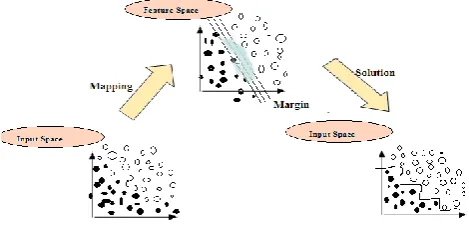
Figure 1. A Two-Dimensional Example of SVM
Fig.1 presents an overview of the SVM process [21]. Support Vector Machines (SVM) executes very well with noise free or meaningless data sets. The accuracy decreases, if the data is nonlinear or very noisy. But it is improved, by using extended data sets Noise is also regarded sometimes as “meaningless” and “irrelevant data”.
The data cleaning methods has main focus on the estimation and removal of noise which results a data collection process but which is imperfect. From an imperfect data collection process, the existed noise removal methods has focus on noise removing technique which is results of low-level data errors.
But data objects can significantly obstruct data analysis if they are irrelevant. Now these objects should also consider as noise, if the aim is to improve the data analysis as good as possible. Consequently, there is a need for noise estimation and removal techniques that remove different types of noise. These techniques may also discard a big amount of the data just because data sets contain number of noises and repeatedly there is a need for techniques like noise estimation and removal which discard all the noise. Below are some techniques intended for noise removal and estimation to enhance data analysis.
3.
NOISE ESTIMATION THROUGH
SVM
To estimate the noise through SVM many methods are proposed and give better result. Noise estimation methods [22] used in different areas like biophysical variable estimation [23], estimation of noise in images [24], automatic estimation from a single noise[10]. Some of the methods are described below:
3.1 Non parametric noise estimator
The method for the selection of the two hyperparameters of Least Squares Support Vector Machine (LS-SVM) approximators with Gaussian Kernels is discussed. A Nonparametric Noise Estimator (NNE) has been introduced for the selection of the hyperparameters of LS-SVM in the paper [25]. Two hyperparameters Gaussian kernels of width σ and the regularization parameter λ are taken. The main aim of the methodology used in the estimator is to convert γ and σ double optimization into simple optimization procedure. The double optimization of the metaparameters is very time consuming but efficient when used with Least one out(LOO) presented in [37]. The method describes in paper [25] is: 3.1.1) Firstly σ is selected and for each σ, the Nonparametric Noise Estimate is performed.
3.1.2) Then to estimate value of γ, bisection method is used.
3.1.3) For every value of σ the error least one out is estimated.
[image:2.595.310.552.555.655.2]3.1.4) The value of γ and σ minimizing the least one out error are selected.
Table 2. Performance of NNE
Example Used
Optimum value obtained
for σ
Corresponding value of γ
Advantage
Toy Example
0.295 9.727 This method
reduces computational
time for both the results. Pumadyn
Benchmark
95 6.4749e+008
3.2 Practical selection of meta-parameters
for SVM regression:
In practical selection of meta parameters the methodology shows analytic parameter selection directed from training data, except resampling technique commonly used in support vector machine applications. The proposed parameter selection gives good generalization result and is displayed empirically by using different high-dimensional and low-dimensional regression problems. The significance of Vapnik’s insensitive loss is pointed further for regression problems and with finite samples.
At the end, a study of generalization performance of support vector machine regression with regression using ‘least-modulus’ loss is compared. For finite sample settings, these types of comparisons discover superior generalization performance of support vector machine regression [26].
3.3 SVM robust function for channel
estimation
For the coherent robust demodulation in OFDM i.e. orthogonal frequency division multiplexing system, a new SVM algorithm is discussed in which support vector machine robust version for channel estimation which is specifically adapted to orthogonal frequency division multiplexing data structure is proposed. It includes two main novelties [27]: First, the scheme is discussed which uses the complex regression[28] in support vector machine formulation and provides simpler scheme than explaining OFDM signal with multilevel or nested binary support vector machine classification algorithms.
Second, in presence of impulse noise –Huber robust cost function [29] is discovered.
4.
NOISE REMOVAL THROUGH SVM
The SVM noise reduction is a common structure or framework where many implementations can be done. Basically there are two types of possibilities are there for finding noisy pixel: recursive and non recursive. In non recursive method firstly the noisy pixels is find and then reconstruction values is obtained using noisy image value. Removal of noise can be done by many techniques like modified median filter [30], minimize impulse noise by SVM [31] and a large number of different methods like wrapper approaches[13] and filter approaches[32,33] which take noisy dataset and filter all noise and give good result. Some of the methods of noise reduction are:
4.1 Removal of impulse noise in images
An efficient way to cancel the impulse noise in images by using the Support Vector Machines (SVMs) is presented. The suppression of impulse noise is a classic problem in nonlinear processing, and results show that the SVMs are especially useful in the processing. In the new approach presented in[31] the classification and the regression based on SVMs is used and they present a new algorithm for impulse noise reduction which is totally based upon the use of Support Vector Machines. They use the SVMs for two tasks:4.1.1) Classify the pixels between noisy and not noisy.
[image:3.595.309.561.85.375.2]4.1.2) Obtain the reconstruction value by means of the SVMs regression.
Table 3. PSNR results in dB [31]
Table 4. PSNR results in dB [31]
In table 3 and 4 SVM is compared with different techniques. The data presented in these tables are the PSNR (Peak Signal to Noise Ratio) of the reconstructed images and this is measured in dB which is the inverse of normalized reconstruction error.
In the work of removal of impulse noise, a similar scheme is implemented but the detection and the substitution of noisy pixels is made with SVMs. The pixels of the noisy images are classified in ”noisy” and ”not noisy” using the SVMs as classifier and the substitution values are obtained with SVMs regression.
The method provides excellent results in PSNR, which measures the reconstruction error, in visual quality and in maintenance of the edges even for very high rates of noise [31].
4.2 Noise reduction for instance-based
learning with a local maximal margin
approach
By developing learning techniques which are noise tolerant the problem of noise reduction which is present in machine learning is finessed. Even-so it is very difficult to make instance-based learning noise tolerant and noise reduction still plays an important role in
KNN classification. There are
also some other reasons for noise reduction, just for an example the elimination of noise results in simpler models and data cleansing may also be sometimes as an end. A new technique is presented in the paper to reduce the noise which gives an advantage of maximum margin classifier that bear noise reduction and it is based on local Support Vector Machines (LSVM). It gives an alternative to the majority rule at which almost each and every already existed noise reduction techniques is based. Approximately for each and every training example a support vector machine is trained at its neighbor and if the support vector machine classificationAlbert
20% 30% 40% 50%
SDROM 30.6 28.61 26.66 24.46
Median 3x3 27.11 23.13 18.95 15.3 Median 5x5 26.6 25.93 24.77 22.47 SVM Median 30%
training 33.9 31.35 28.7 26.62 SVM 30% training 29 27.51 26.83 25.83 SVM 40% training 32.77 30.27 29.27 27.91
Peppers
20% 30% 40% 50%
SDROM 31.44 29.3 26.94 24.42
Median 3x3 29.05 23.84 18.94 15.17 Median 5x5 30 28.53 26.58 23.57 SVM Median 30%
training
37.68 33.95 28.26 23.57
for the central example does not match with its real class there is proof in favor of deleting it from the training set.
An empirical evaluation at 15 real datasets is presented which shows an improved classification accuracy if training data is used which is changed with the method and also particular experiments concerning the spam filtering application domain. Further assessment on two different artificial datasets where two distinct noise types like Gaussian feature noise and mislabeling noise and the affect of those class densities are presented.
Finally it is concluded that for real and for artificial datasets local support vector machine noise reduction is notably better than another analyzed algorithms modified by Gaussian noise and also in the presence of uneven class densities [34].
4.3 An SVM classifier including
simultaneous noise reduction
A different technique which involves symbolization of data which remove noise and uses conditional entropy minima for the extraction of non-redundant and relevant features is proposed in combination with SVM which obtain more strong classification algorithm or approach. 3 datasets shows that classification efficiency is better when it is tested. The type of work shows a new algorithm to discard simultaneously noisy, redundant and irrelevant information. The technique applied the method which solve dual problem of data symbolization and the problems are filtering and noise reduction. In presence of some external noise symbolization it works well [32]. The data symbolization method includes discretization of raw data into a limited set of values which is called symbols which minimize noise. After that, compute the conditional entropy of class labels to determine if feature is correlated to class or not [33].
Table 5 [33]
SVM Classifier results for non-noisy case
Classifier Type
Ionosphere data
Wine data Colon cancer data Test error (%) Test error (%) Test error (%)
F1 12.44 5 18.75
F2 12.44 0 18.75
F3 5.97 2.5 15.63
F4 4.98 0 9.38
Table 5 and 6 describes SVM classifier result for non-noisy and noisy case. The original data is taken firstly in this process which is directly classifying using SVM algorithm. This type of classifier is regarded as F1 in the above tables. Sometimes the original data may contain some outliers that can be decreased or removed by the method called symbolization after that the data obtained is being classified and regarded as F2. Then by using conditional entropy further irrelevant or noisy features is computed and that conditional entropy can be used as relevance filter. After removing noisy data sometimes large number of features is left. That can be further removed with the help of wrapper system with SVM as induction algorithm. After obtaining the relevant attributes, numerical value is used for classification purpose. This type of classifier is regarded as F3 and F4 is regarded as SVM classifier with selected features in symbolized form.
Table 6 [33]
SVM Classifier results for noisy case
Classifier Type
Ionosphere data
Wine data Colon cancer data Test error (%) Test error (%) Test error (%)
F1 16.42 12.5 15.63
F2 16.42 2.5 12.50
F3 16.42 12.5 15.63
F4 14.93 2.5 15.63
The advantage of the type of preprocessing include a reduction in total amount of data which is used to achieve learning, improved efficiency and accuracy.
4.4 Edge detection in presence of impulsive
noise with the use of Support Vector
Machines
The paper [35] describes the method for edge detection which is discovered in presence of impulsive noise which is based on the use of support vector machines. The approach shows how support vector machine detect edge in an optimal way. There are two ways by which noisy images are processed, first the noise is reduced by using support vector machine regression and then classification is done using the support vector machine classification. By using SVM the reduction process of noise is performed. By using the information data in a 3x3 neighborhood of every pixel a regression process is made in the method and then replaces the pixel value with the regressed value.
[image:4.595.311.544.102.183.2]The result which is obtained with no noise is same as those from previous methods and clearly higher in quality when it is compared to some previously defined and classical methods in noisy images. The results coming from the method shows that the approach discussed in paper [35] is better than the previous or classical ones when the images are influenced by impulsive noise and, besides, it is very good when the images are not noisy.
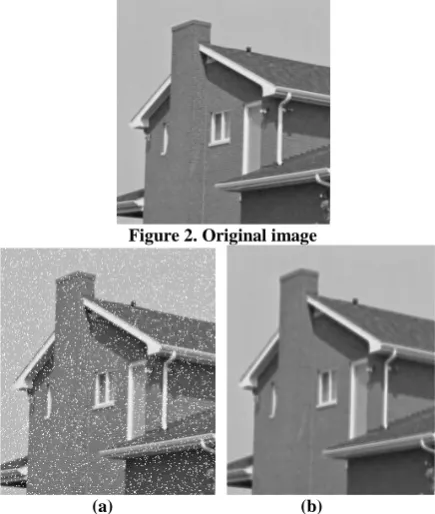
Figure 2. Original image
(a) (b)
[image:4.595.48.284.465.541.2] [image:4.595.317.535.489.746.2][image:5.595.316.536.82.506.2]
(c) (d)
Figure 4. Comparison of edge detectors (a) SVM detector (b) Canny edge detector
In figure 2[35] the original image of “house” is taken, the images are grey scaled images. Figure 3[35] is the example of noise reduction with noisy image and no noisy image. Fig. 3-a shows corrupted image having impulsive noise 10% and Fig. 3-b shows image after using noise reduction process which is explained in the paper [35] and lastly Figure 4[35] shows the comparison between SVM method and the canny edge detector and it is clear with the image that SVM technique is superior in this case and it performs better in presence of impulsive noise and give good and efficient results.
4.5 Decision based median type filter for
image denoising using SVM
A new decision based filter approach which is based on support vector machine that protect image details and effectively decreases impulse noise is proposed in the paper. By using SVM detector the filter detect that whether an input pixel is noisy or not. If any noisy pixel is noticed then with the help of LUM (least mean square) filter that pixel is replaced, otherwise it remain unchanged. The adaptive LUM filter weight can be obtained by using least mean square learning algorithm. Finally the result calculated presented in fig. 5 shows that the proposed technique [11] performs better than other decision based median filter if the detail preservation and noise suppression is consider. The filter is robust in against of different stages of impulse noise. The proposed method is ASCV i.e. adaptive support vector classifier based filter comprise of a support vector machine impulse detector and LUM i.e. low-upper-middle smoothers [5].
The ASCV filter uses the support vector machine approach is used in which an algorithm of impulse detector is used which separate the noise pixels that is corrupted and noise free pixels. As in figure 5[11] the picture of cameraman is taken, fig 5-a is an original image of that picture fig 5-b is an image corrupted by 20% random valued impulsive noise and that image is being filtered with different filters like MED, FM filter, ATM filter and ASCV filter. According to the Figure 5 it is clear that ASCV filter is best among all other filters and it gives a clear image when the image is corrupt.
The LUM filter uses a compromised weight and the scalar quantizer method and learning approach which is based on the LMS algorithm [36] is used to obtain the weight for independently every block.
(a) (b)
(c) (d)
(e) (f)
Figure 5. Subjective visual quality of restored image ‘Cameraman’ (a) Original image, (b) image corrupted by 20% random-valued impulsive noise, and images filtered by (c) MED filter, (d) FM filter, (e) ATM filter and (f)
ASCV filter[11]
A new decision based median type filter i.e. ASCV based on SVM perform very well when compared with different techniques it also outperforms in terms of robustness.
5.
CONCLUSION
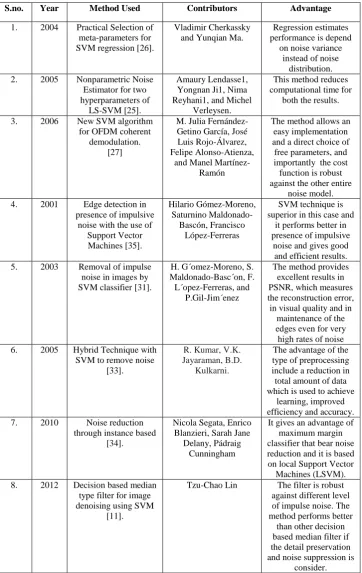
[image:5.595.54.275.85.236.2]Table 7. Summary of noise removal and estimation methods of SVM
S.no. Year Method Used Contributors Advantage
1. 2004 Practical Selection of meta-parameters for SVM regression [26].
Vladimir Cherkassky and Yunqian Ma.
Regression estimates performance is depend
on noise variance instead of noise
distribution. 2. 2005 Nonparametric Noise
Estimator for two hyperparameters of
LS-SVM [25].
Amaury Lendasse1, Yongnan Ji1, Nima Reyhani1, and Michel
Verleysen.
This method reduces computational time for
both the results.
3. 2006 New SVM algorithm for OFDM coherent
demodulation. [27]
M. Julia Fernández-Getino García, José Luis Rojo-Álvarez, Felipe Alonso-Atienza,
and Manel Martínez-Ramón
The method allows an easy implementation and a direct choice of
free parameters, and importantly the cost function is robust against the other entire
noise model. 4. 2001 Edge detection in
presence of impulsive noise with the use of
Support Vector Machines [35].
Hilario Gómez-Moreno, Saturnino
Maldonado-Bascón, Francisco López-Ferreras
SVM technique is superior in this case and
it performs better in presence of impulsive
noise and gives good and efficient results. 5. 2003 Removal of impulse
noise in images by SVM classifier [31].
H. G´omez-Moreno, S. Maldonado-Basc´on, F. L´opez-Ferreras, and
P.Gil-Jim´enez
The method provides excellent results in PSNR, which measures the reconstruction error, in visual quality and in
maintenance of the edges even for very high rates of noise 6. 2005 Hybrid Technique with
SVM to remove noise [33].
R. Kumar, V.K. Jayaraman, B.D.
Kulkarni.
The advantage of the type of preprocessing include a reduction in total amount of data which is used to achieve
learning, improved efficiency and accuracy. 7. 2010 Noise reduction
through instance based [34].
Nicola Segata, Enrico Blanzieri, Sarah Jane
Delany, Pádraig Cunningham
It gives an advantage of maximum margin classifier that bear noise reduction and it is based on local Support Vector
Machines (LSVM). 8. 2012 Decision based median
type filter for image denoising using SVM
[11].
Tzu-Chao Lin The filter is robust against different level of impulse noise. The method performs better
than other decision based median filter if the detail preservation and noise suppression is
consider.
Many wrappers and filters methods as well as hybrid approach is used for noise removal in image processing which remove noise and gives promising result.
Table 7 show the summary of methods used in this paper. First three methods describe about noise estimation and
another six methods describe about noise removal technique with year and contributors.
further research in multiclass classifiers for classifying data. If several limitations related to speed and size is solved then the work of SVM can be expanded with multiclass classifier. SVM can work with binary as well as multiclass classifier but when a kernel is chosen in multiclass, sometimes there is a limitation of speed and size in training and testing but in terms of accuracy this results better when it is combined with SVM.
6.
REFERENCES
[1] N. Cristianini and J. Shawe-Taylor “An introduction to Support Vector Machines and other kernel-based methods”, Cambridge, Cambridge University Press, 2000.
[2] Corinna Cortes, Vladimir Vapnik, "Support-Vector Networks", Machine Learning, 20, pp.273-297 (1995). [3] Veisi, H. ; Dept. of Comput. Eng., Sharif Univ. of
Technol., Tehran, Iran ; Sameti, H., “A comparative study on single-channel noise estimation methods for speech enhancement” IEEE Transactions On Intelligent Systems Design and Applications (ISDA), pp. 645 – 650, Nov 2012.
[4] Ce Liu ; CS and AI Lab, MIT ; Freeman, W.T. ; Szeliski, R. ; Sing Bing Kang, “Noise Estimation from a Single Image” Computer Vision and Pattern Recognition, 2006 IEEE Computer Society Conference on Vol:1, pp. 901 – 908.
[5] R. Lukac and S. Marchevsky, Boolean Expression of “LUM Smoothers”, IEEE Signal Processing Letters, Vol. 8, pp. 292-294, 2001.
[6] R. Lukac “Boolean LUM Smoothing”, IEEE Signal Processing Letters, Vol. 9, pp. 400-403, 2002
[7] E. Abreu, M. Lightstone, S.K. Mitra, K. Arakawa, “A new Efficient Approach for the Removal of Impulse Noise from Highly Corrupted Images” IEEE Trans. on Image Processing, Vol. 5, No. 6, 1996, pp. 1012-1025. [8] F. Russo, “Noise Removal from Image Data Using
Recursive Neurofuzzy Filters” IEEE Trans. On Instrumentation and Measurement, Vol. 49, No. 2, 2000, pp. 307-314.
[9] Tzu-Chao Lin, Pao-Ta Yu, “Adaptive Two-Pass Median Filter Based on Support Vector Machines for Image Restoration”, February 2004, Vol. 16, No. 2, Pages 333-354.
[10]Ce Liu, Richard Szeliski, Sing Bing Kang, C. Lawrence Zitnick, and William T. Freeman, “Automatic Estimation and Removal of Noise from a Single Image” IEEE Trans. On Pattern Analysis And Machine Intelligence, Vol. 30, No. 2, Feb 2008.
[11]Tzu-Chao Lin, “A Novel Decision Based Median-Type Filter using SVM for Image Denoising” ICIC, Information and Control, Vol 8, No. 5(A), pp. 3189-3202 May 2012.
[12]Chen, T., & Wu, H. R. (2000). “Impulse noise removal by multi-state median filtering” In Proceeding IEEE Int. Conf. Acoustics, Speech, Signal Processing, Vol. IV, pp. 2183-2186.
[13]R. Caruana, D. Freitag, “Greedy attribute selection”, Proceedings of the 11th International Conference on
Machine Learning, New Brunswick, NJ, USA, 1994, pp. 28–36.
[14]J. Zhu, T. Hastie, “Kernel logistic regression and the import vector machine, in: Advances in Neural Information Processing Systems" Vancouver, British Columbia, Canada, 2001, pp. 1081–1088.
[15]Chih-Wei Hsu, Chih-Chung Chang, and Chih-Jen Lin, “A Practical Guide to Support Vector Classification”, Department of Computer Science National Taiwan University, Taipei 106, Taiwan, 2010.
[16]V. Vapnik. “The Nature of Statistical Learning Theory”, New York, Springer-Verlag, 2000.
[17]B. E. Boser, I. Guyon, and V. Vapnik. A training algorithm for optimal margin classifers. In Proceedings of the Fifth Annual Workshop on Computational Learning Theory, pages 144-152. ACM Press, 1992. [18]V. Vapnik, “Statistical Learning Theory” New York:
Wiley, 1998.
[19]J. Weston, C. Watkins, “Support vector machines for multiclass pattern recognition”, M. Verleysen (Ed.), Proceedings of the Seventh ESANN, D. Facto Press, Brussels, 1999, pp. 219–224.
[20]Der-Chiang Li and Chiao-Wen Liu “Extending Attribute Information for Small Data Set Classification” IEEE Transaction on Knowledge and Data Engineering, VOL. 24, NO. 3, MARCH 2012.
[21]www.dtreg.com/svm.htm.
[22]Tai Shen-chuan and Yang Shih-ming, “A fast method for image noise estimation using laplacian operator and adaptive edge detection,” 3rd International Symposium on Communications, Control and Signal Processing, pp. 1077–1081, March 2008.
[23]Camps-Valls, G. , Bruzzone, L. ; Rojo-Alvarez, J.L.; Melgani, F., “Robust Support Vector Regression for Biophysical Variable Estimastion from Remotely Sensored Images” Geoscience and Remote Sensing Letters, IEEE July 2006, Vol:3, pp. 339 – 343.
[24]S.I.Olsen, “Estimation of Noise in Images: An Evaluation,” Graphical Models and Image Process. vol. 55, pp. 319-323, July 1993.
[25]Amaury Lendasse1, Yongnan Ji1, Nima Reyhani1, and Michel Verleysen, “LS-SVM Hyperparameter Selection with a Nonparametric Noise Estimator”, LNCS 3697, pp. 625 – 630, 2005. Springer-Verlag Berlin Heidelberg 2005.
[26]Vladimir Cherkassky and Yunqian Ma, “Practical Selection of SVM Parameters and Noise Estimation for SVM Regression”, Neural Networks, Vol 17, Issue 1, pp. 113-126 Jan 2004.
[27]M. Julia Fernández-Getino García, José Luis Rojo-Álvarez, Felipe Alonso-Atienza, and Manel Martínez-Ramón, “Support Vector Machines for Robust Channel Estimation in OFDM”, IEEE SIGNAL PROCESSING LETTERS, VOL. 13, NO. 7, JULY 2006, pp. 397-400. [28]M. P. Sánchez-Fernández, M. de Prado-Cumplido, J.
Signal Process, vol. 52, no. 8, pp. 2298–2307, Aug. 2004.
[29]J. L. Rojo-Álvarez, G. Camps-Valls, M. Martínez-Ramón, E. Soria-Olivas, A. N. Navia Vázquez, and A. R. Figueiras-Vidal, “Support vector machines framework for linear signal processing,” Signal Process., vol. 85, no. 12, pp. 2316–2326, 2005.
[30]Anna Fabijańska, “Modified Ranked Order Adaptive Median Filter for Impulse Noise Removal”, Advances in Intelligent and Soft Computing Vol 95, 2011, pp 73-82, Springer-Verlag Berlin Heidelberg 2011.
[31]H. G´omez-Moreno, S. Maldonado-Basc´on, F. L´opez-Ferreras, and P.Gil-Jim´enez, “Removal of Impulse Noise in Images by Means of the Use of Support Vector Machines”, Artificial and Natural Neural Networks, IWANN 2003 Maó, Menorca, Spain,Volume 2687, 2003, pp 536-543.
[32]D. Koller, M. Sahami, “Toward optimal feature selection”, Proceedings of the 13th International Conference on Machine Learning (ML), Bari, Italy, 1996, pp. 284–292.
[33]R. Kumar, V.K. Jayaraman, B.D. Kulkarni, “An SVM classifier incorporating simultaneous noise reduction and
feature selection”, Pattern Recognition Society. Published by Elsevier Ltd., 2005, pp. 41 – 49.
[34]Nicola Segata, Enrico Blanzieri, Sarah Jane Delany, Pádraig Cunningham, “Noise reduction for instance-based learning with a local maximal margin approach”, Journal of Intelligent Information Systems archive, Kluwer Academic Publishers Hingham, MA, USA, Volume 35 Issue 2, October 2010 Pages 301 – 331. [35]Hilario Gómez-Moreno, Saturnino Maldonado-Bascón,
Francisco López-Ferreras, “Edge Detection in Noisy Images Using the Support Vector Machines”,Vol 2084, 2001, pp 685-692, Springer-Verlag Berlin Heidelberg. [36]C. Kotropoulos and I. Pites, “Adaptive LMS L-Filters for
Noise Suppression in Images”, IEEE Trans. On Image Processing, vol. 5, pp 1596-1609, 1996.
[37]Suykens, J., A., Van Gestel, K., T., De Brabanter, J., De.Moor, B., Vandewalle, J.: “Least Squares Support Vector Machines”, World Scientific, Singapore, ISBN 981-238-151-1 (2002).
![Table 3. PSNR results in dB [31]](https://thumb-us.123doks.com/thumbv2/123dok_us/8055644.775060/3.595.309.561.85.375/table-psnr-results-in-db.webp)
![Figure 5. Subjective visual quality of restored image (e) (f) ‘Cameraman’ (a) Original image, (b) image corrupted by 20% random-valued impulsive noise, and images filtered by (c) MED filter, (d) FM filter, (e) ATM filter and (f) ASCV filter[11]](https://thumb-us.123doks.com/thumbv2/123dok_us/8055644.775060/5.595.316.536.82.506/figure-subjective-restored-cameraman-original-corrupted-impulsive-filtered.webp)