http://dx.doi.org/10.4236/wjet.2015.33C016
Producing Renewable Biodiesel Fuel Using
the Transesterification Process
T. W. Chung, Y. J. Chen
Department of Chemical Engineering, Chung Yuan Christian University, Taoyuan, Taiwan Email: [email protected]/tw, [email protected]
Received 22 August 2015; accepted 15 October 2015; published 22 October 2015
Abstract
Biodiesel fuels are considered an alternative to fossil fuels. This is one of the effective means of transferring solar energy to dynamic energy via photosynthesis. It is also being considered in or-der to reduce the levels of carbon dioxide production worldwide. Biodiesel fuels are a renewable, biodegradable, and clean energy source. Producing enough biofuels to replace fossil fuels will bring the advantages of reduced air pollution and reduced other environmental impacts of fossil fuels. In this study, the response surface methodology (RSM) was used to design the experimental runs and to discuss the manufacturing variables on the transesterification of palm oil into fatty acid methyl ester (i.e. biodiesel fuel). The variation of the degree of effect for each variable in the transesterification process was observed. A second-order model was obtained to predict the yield of biodiesel fuel and the viscosity as a function of the reaction time, the mass fraction of catalyst in methanol and the molar ratio of methanol to plant oil. The experimental data of the yield and the viscosity of biodiesel fuels in different manufacturing variables are discussed in this study. Analy-sis of variance (ANOVA) was also applied to discuss the main factor and interaction factor effects of the manufacturing variables on the responses of the yield of unrefined biodiesel fuels. The shortage of farmland in Taiwan is a problem that needs to be solved before mass propagation of biofuels can be accomplished. In southeastern Asia, there are many farms and most energy farm products are cultivated (e.g. palm oil or Jatropha oil). In addition to sunflowers and soybeans in Taiwan, those energy farm products are possible choices for production of biodiesel fuel in Tai-wan. The cooperation between Indonesia and Taiwan on the plantation of palm or Jatropha trees in Indonesia has conducted and will be one of the possible ways to solve the problem of the short-age of energy farm products in Taiwan.
Keywords
Renewable, Biodiesel, Palm Oil, Transesterification, Response Surface Methodology (RSM)
1. Introduction
to convert the 220,000 hectares of fallow farmlands to cultivation of energy plants as a means of helping the economies of the farm villages and of solving problems in agriculture, environmental impact, and the energy shortage. The selected energy plants are grown in the central and southern parts of Taiwan. A demonstration factory for producing biodiesel fuel was built in 2004. In 2008, the government plans to cultivate 20,000 hec-tares of energy farm products to produce 9000 tons of biodiesel fuel and to propagate 41,000 tons of biodiesel fuel in Taiwan. After 2010, 2% biofuel will be added to fossil fuel according to the fuel regulations of Taiwan. This will result in a demand of 80,000 to 100,000 tons of biodiesel fuel per year in Taiwan. By 2015, the de-mand for biodiesel fuel in Taiwan will rise to 150,000 tons per year [4]. In reality, the shortage of farmland in Taiwan is a problem that needs to be solved. The cooperation between Indonesia and Taiwan on the plantation of palm or Jatropha trees in Indonesia will be one of the possible ways to solve the problem of the shortage of energy farm products in Taiwan. The price of the self-produced biodiesel fuel in Taiwan is still high and cannot compete with fossil diesel fuel. However, to reduce the fossil fuel crisis and environmental impact, the propaga-tion of biodiesel fuels is considered. Since it can replace fossil fuels, solve the air pollupropaga-tion problem, and reduce the production of carbon dioxide, the Environmental Protection Administration, the Bureau of Energy, and the Council of Agriculture are trying to promote the production of biodesel fuels as an important cooperative issue.
The demand for biodiesel fuel is going to be very high all over the world. It is estimated that the need for bio-diesel fuel will rise to 105 billion liters in Europe by 2010. However, the total production of the biobio-diesel fuel at the time will be only 30 billion liters if current trends in production of biodiesel fuel are not changed. Therefore, many new factories for the production of biofuels are being built around the world. It has been noted that Ger-many is the largest producer and consumer of biodiesel fuel in Europe. In southeastern Asia, Malaysia and In-donesia produce biodiesel fuel from palm oils, and the Philippines produce biodiesel fuel from coconut oils. In Taiwan and Japan, recycled oils or waste edible oils are used to make biodiesel fuel. Since joining the WTO, the Taiwan government has promoted the cultivation of energy plants in fallow farmlands to produce different sources of plant oils for biodiesel fuel.
The objectives of this study are to report the experimental works by using the statistic principles of factorial design and RSM for the analysis of variances, which is rare in the literature, especially for the systemic discus-sion of manufacturing variables and the interactions between variables in the transesterification process.
2. Experimental Section
2.1. Raw Materials
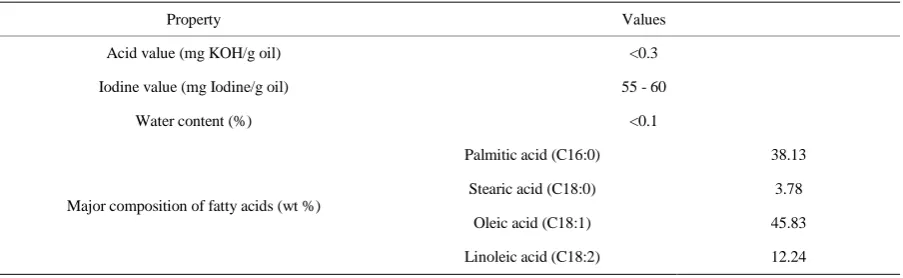
[image:2.595.88.540.582.721.2]The properties and the composition of fatty acids of the palm oil used in this study are measured and listed in
Table 1. The methanol (99.8%), acetic acid (99.8%), sodium chloride (96%), and sodium hydroxide (96%) were bought from the Aldrich Company.
2.2. Experimental Design
The manufacturing variables discussed in this study are the molar ratio of methanol to palm oil, the mass frac-tion of the catalyst (NaOH) in methanol, and the reacfrac-tion time. In this study, the molar ratios of palm oil to me-thanol were chosen as 3.6, 6.0, and 8.4. The mass fractions of NaOH in meme-thanol were 1.0 wt%, 1.3 wt%, and
Table 1. The property of the palm oil in this study.
Property Values
Acid value (mg KOH/g oil) <0.3
Iodine value (mg Iodine/g oil) 55 - 60
Water content (%) <0.1
Major composition of fatty acids (wt %)
Palmitic acid (C16:0) 38.13
Stearic acid (C18:0) 3.78
Oleic acid (C18:1) 45.83
1.6 wt%. The reaction times were 40 min, 80 min, and 120 min. The kinetic viscosity (cSt at 40˚C), the yield (wt%), and the gross heat of combustion (J/g) of the methyl ester were measured with the standard methods.
The desired amount of the catalyst of NaOH was dissolved into the methanol first. Then 423.6 g of palm oil was placed into the reactor (a 1000 mL two-necked flask) to mix with the methanol solution. The reactor was kept at 65˚C and stirred at a speed of 600 rpm. When the color of the palm oil changed from light yellow to brown, the reaction was completed.
The products of the reaction were a mixture of glycerol and methyl ester (i.e. biodiesel fuel). The mixture was placed into a separation funnel and left in the funnel for 15 min to allow the mixture to separate into two levels. The upper level of the mixture in the funnel was the methyl ester, and the lower level of the mixture was the glycerol, which is usually used to make soap, wax, and cleaner. The methyl ester was distilled at 65˚C - 70˚C to recover the methanol. This unrefined methyl ester can be refined further. Acetic acid (CH3COOH) was added to the methyl ester to neutralize the unrefined biodiesel fuel to a pH value of around 7, and the neutralized solution was washed with saturated salt solution three times to remove the residues of glycerol and NaOH. It should be noted that the washing procedure may cause the soap reaction to change the yield of biodiesel fuel.
3. Results and Discussion
Since the effects of manufacturing variables on the response variables discussed by the statistical method have gradually attracted interest in recent years [5], the factorial design and RSM was applied in this study. Compared to the traditional analysis of the “one factor at a time” technique, the factorial design and RSM provides an ex-perimental design to reduce the number of the exex-perimental runs and gives a chance to review the interaction effects between variables. In this study, the factorial design model and RSM was used to identify the three se-lected manufacturing variables influencing the yield (Y1) and viscosity (Y2) of the biodiesel fuel and to under-stand the interactions between these manufacturing variables [6]. The statistical analysis system for a factorial design of three factors applied in this analysis of the transesterification process was designed, and the coded le-vels (+1 - −1) of the manufacturing variables are tabulated in Table 2. A mere 15 experimental runs was enough for this type of analysis. The three manufacturing variables (or factors) chosen in this study were the reaction time (X1), the mass fraction of NaOH in methanol (X2) and the molar ratio of methanol to palm oil (X3). The responses in the yield and the viscosity of biodiesel fuels are represented as Y1 and Y2 in Table 3. Since the de-finition of the yield is the weight ratio of biodiesel product to palm oil, and the biodiesel product still contains some catalyst and residues, which will be washed out in the refining procedure, the value of yield may be higher than 100%. In accordance with the usual assumption, higher order interaction effects are insignificant when compared with lower order interaction effects. A second-order polynomial model with a multiple linear regres-sion to estimate the model coefficients of the terms of main factor (Xi) and 2-factor interaction (XiXj) was calcu-lated using the JMP software algorithm.
1 1 2 3 1 2 1 3
2 2 2
2 3 1 2 3
101.09 0.87 0.59 3.50 0.95 0.38 0.83 1.25 0.66 0.10
Y X X X X X X X
X X X X X
= + ∗ ∗
∗
+ + - +
+ + + + (1)
2 1 2 3 1 2 1 3
2 2 2
2 3 1 2 3
3.65 0.13 0.16 0.99 0.12 0.17
0.05 0.034 0.09 0.94
Y X X X X X X X
X X X X X
= − − − + ∗ + ∗
− ∗ − − + (2)
where Yi is the response variable and Xi is the factors. The experimental results agree with the above model well
[image:3.595.88.540.634.720.2]since the coefficient of determination (R2) was 0.90 and 0.98 for Y1 and Y2, respectively, for the models of bio-diesel fuels.
Table 2. The coded level of the manufacturing variables.
Variable Symbol
Coded level
−1 0 +1
Time (mins) X1 40 80 120
NaOH (g) X2 1.0 1.3 1.6
Table 3. Representation of factorial design and variables for unrefined biodiesel fuels.
No. pattern X1 X2 X3 Y1 (%) Y2 (cSt)
1 0 − + 80 1 8.4 103.6 3.59
2 − + 0 40 1.6 6 102.3 3.42
3 − 0 + 40 1.3 8.4 106.9 3.74
4 + 0 + 120 1.3 8.4 108.0 3.77
5 0 0 0 80 1.3 6 102.8 3.28
6 0 0 − 80 1.6 3.6 100.3 5.53
7 0 0 + 80 1.6 8.4 107.8 3.07
8 + - 0 120 1 6 105.6 3.41
9 − − 0 40 1 6 100.6 3.86
10 − 0 − 40 1.3 3.6 99.5 5.69
11 0 − − 80 1 3.6 99.4 5.85
12 + 0 − 120 1.3 3.6 99.1 5.05
13 + + 0 120 1.6 6 103.5 3.44
14 0 0 0 80 1.3 6 99.6 3.85
15 0 0 0 80 1.3 6 100.9 3.85
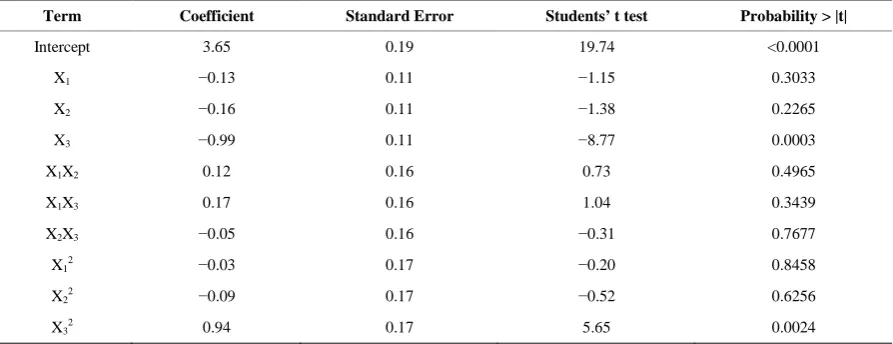
Table 4 shows the statistical analysis including the main factor and interaction factor effects of the manufac-turing variables on the responses of the yield of biodiesel fuels. As shown in Table 4 the effect of the main fac-tors influencing the response of the yield was significant for the factor of X3 (probability = 0.0024) only. The statements “very significant” (probability ≤ 0.001) or “not significant” (probability > 0.1) are quoted from the statistics book by Montgomery (Box et al., 1978). The definitions of the standard error, the Students’ t test, and the probability in Table 4 can be found in statistics books [6] [7] or the author’s previous work [8]. Since the probability of the factor was small and its t ratio was comparatively larger, the effect of the factor on the yield of unrefined biodiesel fuel was significant. Table 5 shows the statistical analysis including the main factor and in-teraction factor effects of the manufacturing variables to the responses of the viscosity of unrefined biodiesel fu-els. As shown in Table 5, the effect of the main factors influencing the response of the viscosity was very sig-nificant for the factor of X3 (probability = 0.0003) only. Since the probability of the factor was very small and its t ratio was comparatively larger, the effect of the factor on the viscosity of unrefined biodiesel fuel was very significant. It should be noted that the interactions between variables (XiXj) were not significant (probability > 0.1) in Table 4 and Table 5. On the basis of the values of probability, the molar ratio of methanol to palm oil (X3) is one of the most important variables for manufacturing unrefined biodiesel fuels.
The factor of mass fraction of NaOH in methanol (X2) is not significant in the process of biodiesel fuel in the
Figure 1. The variation of factors with respect to the responses.
Table 4. Probability for main effects and interaction effects on Y1 (yield) for biodiesel fuels. (R2 = 0.89).
Term Coefficient Standard Error Students’ t test Probability > |t|
Intercept 101.09 1.01 99.86 <0.0001
X1 0.87 0.62 1.40 0.2212
X2 0.59 0.62 0.95 0.3868
X3 3.50 0.62 5.64 0.0024
X1X2 −0.95 0.88 −1.08 0.3280
X1X3 0.38 0.88 0.44 0.6808
X2X3 0.83 0.88 0.94 0.3899
X12 1.25 0.91 1.37 0.2292
X22 0.66 0.91 0.72 0.5037
X32 1.02 0.91 1.12 0.3125
Table 5.Probability for main effects and interaction effects on Y2 (viscosity) for biodiesel fuels. (R2 = 0.96).
Term Coefficient Standard Error Students’ t test Probability > |t|
Intercept 3.65 0.19 19.74 <0.0001
X1 −0.13 0.11 −1.15 0.3033
X2 −0.16 0.11 −1.38 0.2265
X3 −0.99 0.11 −8.77 0.0003
X1X2 0.12 0.16 0.73 0.4965
X1X3 0.17 0.16 1.04 0.3439
X2X3 −0.05 0.16 −0.31 0.7677
X12 −0.03 0.17 −0.20 0.8458
X22 −0.09 0.17 −0.52 0.6256
X32 0.94 0.17 5.65 0.0024
4. Conclusion
[image:5.595.92.539.483.655.2]fraction of NaOH in methanol is not significant in the process. However, the effects of the raw materials (me-thanol and palm oil) on the yield and the viscosity of biodiesel fuels were very significant in the process. Since the reaction time selected in this study was long enough to allow the transesterification reaction, the factor of reaction time had almost no effect on the yield and the viscosity of biodiesel fuels. In addition to the discussions of the yield and the viscosity of biodiesel fuels as related to the trends of process variables, the method of analy-sis of variances (ANOVA) was used to analyze the effects of the process variables and the interaction between these variables.
References
[1] Kalam, M.A. and Masjuki, H.H. (2004) Emissions and Deposit Characteristics of a Small Diesel Engine When Oper-ated on PreheOper-ated Crude Palm Oil. Biomass Bioenerg, 27, 89-297. http://dx.doi.org/10.1016/j.biombioe.2004.01.009 [2] Almeida, A.C.A., Belchior, C.R., Nascimento, V.G., Vieira, L.S.R. and Fleury, G. (2002) Performance of a Diesel
Ge-nerator Fuelled with Palm Oil. Fuel, 81, 2097-2102. http://dx.doi.org/10.1016/S0016-2361(02)00155-2
[3] May, C.Y., Liang, Y.C., Foon, C.S., Ngna, M.A., Hook, C.C. and Basiron, Y. (2005) Key Fuel Properties of Palm Oil Alkyl Esters. Fuel, 84, 1717-1720. http://dx.doi.org/10.1016/j.fuel.2005.02.010
[4] Chung, T.W., Chen, Y.J. and Chen, M.T. (2007) Biodiesel Technology and Its Propagation in Taiwan. 3rd Interna-tional Green Energy Conference (IGEC-III), Vasteras, Sweden, 18-21 June 2007.
[5] Tiwari, A.K., Kumar, A. and Raheman, H. (2007) Biodiesel Production from Jatropha Oil (Jatropha curcas) with High Free Fatty Acids: An Optimized Process. Biomass & Bioenergy, 31, 569-575.
http://dx.doi.org/10.1016/j.biombioe.2007.03.003
[6] Box, G.E.P., Hunter, W.G. and Hunter, J.S. (1978) Statistics for Experimenters. John Wiley and Sons, New York.
[7] Montgomery, D.C. (1997) Design and Analysis of Experiments. John Wiley & Sons, New York.
[8] Lai, M.H., Chang, Y.N., Wang, C.M., Wu, H.D. and Chung, T.W. (2003) Analysis of the Absorption-Dehumidification Process Variables Using the Experimental Design Methodology. Separation Science and Technology, 38, 2447-2464.