How to cite this paper: Pandey, P.K. (2015) Non-Standard Difference Method for Numerical Solution of Linear Fredholm Integro-Differential Type Two-Point Boundary Value Problems. Open Access Library Journal, 2: e1465.
http://dx.doi.org/10.4236/oalib.1101465
Non-Standard Difference Method for
Numerical Solution of Linear
Fredholm Integro-Differential Type
Two-Point Boundary Value Problems
Pramod Kumar Pandey
Department of Mathematics, Dyal Singh College, University of Delhi, New Delhi, India Email: [email protected]
Received 27 August 2015; accepted 12 September 2015; published 17 September 2015 Copyright © 2015 by author and OALib.
This work is licensed under the Creative Commons Attribution International License (CC BY). http://creativecommons.org/licenses/by/4.0/
Abstract
In this article we have considered Fredholm integro-differential equation type second-order boundary value problems and proposed a rational difference method for numerical solution of the problems. The composite trapezoidal quadrature and non-standard difference method are used to convert Fredholm integro-differential equation into a system of equations. The numerical results in experiment on some model problems show the simplicity and efficiency of the method. Numer-ical results showed that the proposed method is convergent and at least second-order of accu-rate.
Keywords
Composite Trapezoidal Method, Fredholm Integro-Differential Equations, Boundary Value Problem, Non-Linear Equation, Non-Standard Difference Method, Quadrature Formulas
Subject Areas: Numerical Mathematics, Ordinary Differential Equation
1. Introduction
ap-OALibJ | DOI:10.4236/oalib.1101465 2 September 2015 | Volume 2 | e1465
proximate numerical solution such as difference and compact finite difference method [1]-[3], Tau method [4], an extrapolation method [5], Taylor series method [6], method of regularization [7] [8], variational method [9], adomian decomposition method [10], variational iterations method [11] and references therein.
In this article we consider a method for the numerical solution of the following linear Fredholm integro-dif- ferrential equations of the form
( )
(
,)
b( ) ( )
, d , .a
y′′ x = f x y +
∫
K x t y t t a≤ ≤x b (1)subject to the boundary conditions
( )
and( )
.y a =α y b =β
where α and β are real constant. The functions f x y
( )
, and the kernel K x t( )
, are known. The solution( )
y x is to be determined.
The emphasis in this article will be on the development of an efficient numerical method to deal with ap-proximate numerical solution of the integro-differential equation and then to prove theoretical concepts of con-vergence and existence. The theorems of uniqueness, existence and concon-vergence are important and can be found in the literature [1] [12] [13]. The specific assumption to ensure existence and uniqueness of the solution to problem (1) will not be considered. Thus the existence and uniqueness of the solution to problem (1) are as-sumed. We further assumed that problem (1) is well posed.
Last few decades have seen substantial progress in the development of approximate solution by non-conven- tional methods. One such method, a non-standard finite difference method has increasingly been recognized as a efficient method for the numerical solution of initial value problems in ordinary differential equation [14]-[16]. The non-standard finite difference method is simple and generates impressive numerical result with high accu-racy. Hence, the purpose of this article is to develop a non-standard finite difference method similar to [16] for numerical solution of the second-order boundary value problems of Fredholm integro-differential Equation (1).
We have presented our work in this article as follows. In the next section we derived a non-standard finite difference method. In Section 3, we have discussed local truncation error in propose method and convergence under appropriate condition in Section 4. The applications of the proposed method to the model problems and illustrative numerical results have been produced to show the efficiency in Section 5. Discussion and conclusion on the performance of the new method are presented in Section 6.
2. The Non-Standard Finite Difference Method
Let us assume that K x t
( )
, is smooth and separable kernel otherwise by using the Taylor series expansion for the kernel, reduce it to separable kernel. Let further assume that K x t( )
, is bounded by 𝛿𝛿for at all points of{
}
Ω= a≤ ≤x b a, ≤ ≤t b i.e. K x t
( )
, ≤δ .We define N finite nodal points of the domain [a, b], in which the solution of the problem (1) is desired, as
0 1 N 1 N
a=x <x <<x − <x =b using uniform step length h such that xi= + ⋅a i h i, =0 1
( )
N. Suppose that we wish to determine the numerical approximation of the theoretical solution y x( )
of the problem (1) at the nodal point x ii, =1, 2,,N. We denote the numerical approximation of y x( )
at node xi as yi. Let us denotei
f as the approximation of the theoretical value of the source function f x y x
(
,( )
)
at node x ii, =0,1, 2,,N. Thus the integro-differential Equation (1) at node xi may be written as( )
i(
i, i) ( )
i ab( ) ( )
d .y′′ x = f x y +ξ x
∫
ϑ t y t t (2) where ξ( ) ( )
x ϑ t =K x t( )
, .We approximate the integral that appeared in Equation (2) by the repeated/composite trapezoidal quadrature method [17] which will yield the following
( )
( )
( ) ( )
( )
1( ) ( )
( )
( ) ( )
0
, d
N b
j j j tj i i i a
j j i
I x y t ξ x ϑ t y t t ξ x ϑ t λ y t E ξ x ϑ t λy t
+
= ≠
= = + +
∫
∑
(3)where a= < < <t0 t1 t2 <tN−1<tN <tN+1=b j, =0,1, 2,,N+1 using uniform step length h such that tj = +a
, 0,1, 2, , 1
j h j⋅ = N+ , Etj is the truncation error in th
j interval and quadrature nodes λj,j=
OALibJ | DOI:10.4236/oalib.1101465 3 September 2015 | Volume 2 | e1465
1
if 0, 1,
2
otherwise 1, 2, , .
j
h j N
h j N
λ = = +
=
and λ =i,i 1, 2, 3,,N, do not depend on the function y t
( )
. The term Etj in (3) depends on N and large N reduces Etj considerably. Let us define a function F x y t(
,( )
,I x y t ,( )
)
node x=xi after neglecting theerror terms in (3) such that
( )
10
.
N
i i i j j j i i i i j
j i
F f ξ ϑ λ y t ξ ϑ λy
+
= ≠
= +
∑
+ (4)Thus with the application of (4), the considered problem (1) at node x=xi may be written as,
.
i i
y′′ =F (5)
subject to the given boundary conditions.
Let us assume a local assumption as in [18] that no truncation errors have been made i.e.
(
i)
i iy x ±h = y±
and following the ideas [19], we propose non-standard finite difference method for the approximation of the analytical solution y x
( )
of the problem (5) at node x=xi as,2 2
1 1 2
12
2 , 1, 2, , .
12
i i i i
i i h F
y y y i N
F h F
+ − + − = ′′ =
− (6)
where 2 2 i i F F x ∂ ′′=
∂ . Thus we will obtain the system of nonlinear equations at each nodal point x ii, =1, 2,,N.
For the computational purpose in Section 4, we have used the following finite difference approximation in place of 2
i
h F′′ in (6),
2
1 2 i1.
i i i
h F′′=F+ − F +F− (7)
Thus from (7) we can write (6) as,
2 2
1 1
1 1
12
2 , 1, 2, , .
14
i i i i
i i i h F
y y y i N
F F F
+ −
+ −
− + = =
− − (8)
which is a nonlinear system of equations. We have to solve a nonlinear system with a large number of equations. So there is some complexity in the system and computation is difficult. However we have applied an iterative method to solve above system of nonlinear Equation (8).
3. Local Truncation Error
The local truncation error at the node x=xi using the exact arithmetic, is given as: 2 2
1 1 2
12
2 .
12
i i i i i
i i h F
T y y y
F h F
+ −
= − + −
′′ −
At the nodal point x=xi, i=1, 2,,N, the truncation error Ti in Method (5) may be written [17], 1
2 2 2
1 2 1 1 .
12
i i i i i
i i h F
T y y y h F
F − + − ′′ = − + − −
writing the Taylor series expansion for yi±1 at nodal point x=xi and binomial expansion under appropriate
conditions for above equation. Simplify the expression so obtained by using yi′′ =Fi and
( )4 i i
y =F′′ we have following expression
( )
( )
( )
2 4 66
2 5 .
OALibJ | DOI:10.4236/oalib.1101465 4 September 2015 | Volume 2 | e1465
Thus we obtain a truncation error at each node of O h
( )
6 .4. Convergence of the Non-Standard Difference Method
Consider the difference Method (6),( )
12 2 2
2 2
1 1 2
2 2 2 2 2 2 2 2 4 12 2 1 12 12 1 12 12 12 . 12 12 i i i i
i i i i
i i i i i i i i i i
h F h F
y y y h F
F
F h F
h F h F
h F
F F
F h
F h F h
F − + − ′′ − + = − ′′= − ′′ ′′ = + + + ′′ ′′ = + + +
Let us ignore the third and other terms on right side of the above expression. After replacing 2 i
h F′′ by the second order difference approximation Fi+1+Fi−1−2Fi, we have
(
)
2
1 2 1 10 1 1
12
i i i i i i
h
y+ − y +y− = F +F+ +F−
Thus
(
)
2
1 2 1 10 1 1 0
12
i i i i i i
h
y− y y+ F F+ F−
− + − + + + = (10)
Let us define
( )
10 N
i i j j j j
j i
G ξ ϑ λ y t
+
= ≠
=
∑
So we can write (10) as,
(
)
(
)
3 3 3
1 1 1 1 1 1
2
1 1 1 1
10
1 2 1
12 12 12
10 0
12
i i i i i i i i i
i i i i i i
h h h
y y y
h
f G f G f G
ξ ϑ− − − ξ ϑ ξ ϑ+ + +
− − + + − + + + + − + + + + + + + = (11)
Let us define
(
)
(
)
(
)
(
)
(
)
(
)
2 31 1 1 1 1 1
2
1 1 1 1
2 3
1 1 1 1 1 1
10 1 , if 1
12 12
10 , if 2 1
12
10 1 , if .
12 12
i i i i i i i i
i i i i i i i
i i i i i i i i
h h
f G f G f G i
h
f G f G f G i N
h h
f G f G f G i N
ξ ϑ α
ϕ
ξ ϑ β
− − + + − − − − + + − − + + + + + + + + + + − + = = + + + + + ≤ ≤ − + + + + + + − + =
Let us define column matrix ϕN×1 and yN×1 as
[
]
T[
]
T1, 2, , N N1 and y y1, 2, ,yN N 1
ϕ ϕ ϕ × ×
= y=
ϕ
The difference Method (11) represents a system of nonlinear equations in unknown y ii, =1, 2,,N. Let us write (11) in matrix form as,
( )
+ =
OALibJ | DOI:10.4236/oalib.1101465 5 September 2015 | Volume 2 | e1465
3 3
1 1 2 2
3 3 3
1 1 2 2 3 3
3 3
1 1
10
2 1 0
12 12
10
1 2 1
12 12 12
10
0 1 2
12 N N 12 N N N N
h h
h h h
h h
ξ ϑ ξ ϑ
ξ ϑ ξ ϑ ξ ϑ
ξ ϑ− − ξ ϑ
× + − + − + + − + = − + + D
is tridiagonal matrix. Let Y be the exact solution of (11), so it will satisfy matrix equation
( )
+ + =
DY ϕ Y T 0 (13) where Y is column matrix of order N×1 which can be obtained replacing y by Y in matrix y and T is truncation error matrix in which each element has
( )
6O h . Let us define
(
)
(
)
(
)
(
)
(
)
(
)
1 1 1 1 1 1 1 1 1
1 1 1
, , , , , ,
, , , , , .
i i i i i i i i i i i i i i i i i i
f f x Y f f x y f f x Y
f f x y f f x Y f f x y
+ + + + + + − − −
− − −
= = =
= = =
After linearization of fi+1, we have
(
)
1 1 1 1 1
i i i i i f+ = f+ + y+ −Y+ Q+
where 1
1 i i f Q Y + + ∂
= ∂ . Let us define Ei=
(
yi−Yi)
,i=1, 2,,N. Thus we have1 1 1 1.
i i i i
f+ − f+ =E Q+ + (14)
Similarly, we can linearize fi−1, fi and obtained the following results : 1 1 1 1.
i i i i
f− − f− =E Q− − (15)
.
i i i i
f −f =E Q (16) By Taylor series expansion of Qi±1. about x=xi, and from (14)-(16), we can write
( )
y −( )
Y =PE.ϕ ϕ (17)
where E=
[
E E1, 2,,E]
TN×1andP=( )
Pl m, N N× is a tri-diagonal matrix defined as2
2
,
2
10
, if , 1, 2, ., ,
12
, if 1, 1, 2, , 1, 12
, if 1, 1, 2, , 2. 12
i l m i
i i
i h
Q i l m l N
h Q
P Q h m l i l N
x
h Q
Q h i l m m N
x = = = ∂ = + = + = = − ∂ ∂ − = = + = − ∂
Let us assume that the solution of difference Equation (11) has no round off error. So from (12), (13) and (17) we have
(
D+P E)
=JE=T (18)Let us define G0=
{
Q ii: =1, 2,,N}
[ ] [ ]
* *
, ,
min , max
x a b x a b
OALibJ | DOI:10.4236/oalib.1101465 6 September 2015 | Volume 2 | e1465
* 0
*
0≤G ≤Q≤G , ∀ ∈Q G .
We further define 0 : 1, 2, ,
i Q
H i N
x
∂
=∂ =
.
Let there exist some positive constant W such that Q0 ≤W,∀ ∈Q H0. So it is possible for very small h,
2
,
,
1, 1, 2, , 1
10
12 1, 1, 2, , 2.
l m l
l m
P m l l N
h Q
P l m m N
∀ = + = − ≥ ∀ = + = −
Let R=
[
R R1, 2,,R]
TN×1, denotes the row sum of the matrix J =( )
Jl m, N N× where i Q x ∂ ∂ (
)
2 31 1 1 2 2
1 3
2
1 1 1 1
2 3
1 1
11
1 10 , if 1
12 12
10 , if 2 1
12 11
1 10 , if .
12 12
l i i i i i i i
N N N N N
N
h h Q
Q l i
x h
R h Q l i N
h h Q
Q l i N
x ξ ϑ ξ ϑ
ξ ϑ ξ ϑ ξ ϑ
ξ ϑ ξ ϑ
− − + + − − + + + +∂ = = ∂ = + + + ≤ = ≤ − + + + −∂ = = ∂
Neglecting the higher order terms i.e. O h
( )
3 in Rl then it is easy to see that J is irreducible [20]. Alsoby row sum criterion matrix J is for sufficiently small h monotone [21]. For the bound of J, we define
[22]-[24],
( )
, , , 1, 2, , Nl l l l m l m
d J J l N
≠
= −
∑
=J
where
( )
2 31 1 1 1 2 2
1
11
1 10 , if 1
12 12
h h Q
d Q l i
x ξ ϑ ξ ϑ
∂ = + + + + = = ∂ J
( )
2 3(
)
1 1 10 1 1 , if 2 1,
12
l i i i i i i i
h
d J =h Q + ξ ϑ− − + ξ ϑ ξ ϑ+ + + ≤ = ≤l i N−
( )
2 3 1 111
1 10 , if .
12 12
N N N N N N
N
h h Q
d Q l i N
x ξ ϑ ξ ϑ− −
∂ = + + + − = = ∂ J
It is easy to prove after neglecting higher order terms i.e. O h
( )
3 in the above expressions that matrix J is diagonally dominant. Thus matrix J is nonsingular [25] i.e. −1J exist and 1
0 − ≥
J [21]. Let dl
( )
J ≥ ∀0, land
( )
( )
*
1minl N l .
d d ≤ ≤ = J J Then
( )
1 * 1 d − ≤ JJ (19)
Thus from (18) and (19), we have
( )
* 1 d ≤ E TJ (20)
OALibJ | DOI:10.4236/oalib.1101465 7 September 2015 | Volume 2 | e1465
5. Numerical Experiments
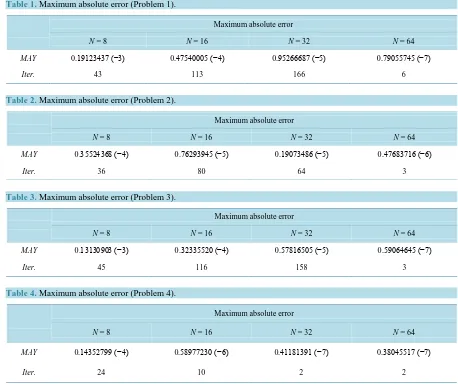
To illustrate our method and demonstrate its computational efficiency, we have considered four model problems. In each model problem, we took uniform step size h. In Tables 1-4, we have shown MAY the maximum absolute error in the solution y of the problems (1) for different values of N. We have used the following formula in computation of MAY,
( )
1max i i.
i N
MAY y x y
≤ ≤
= −
The order of convergence ON of the Method (8) is estimated by the formula
log N .
N m
mN MAY O
MAY
=
where m can be estimated by considering the ratio of different values of N.
We use Newton-Raphson iteration method to solve the system of nonlinear equations arising from Equation (9). All computations are performed on a Windows 2007 Ultimate operating system in the GNU FORTRAN en-vironment version 99 compiler (2.95 of gcc) on Intel Core i3-2330M, 2.20 Ghz PC. The solutions are computed on N nodes and iteration is continued until either the maximum difference between two successive iterates is less than 10−10 or the number of iterations reaches 103.
[image:7.595.81.539.337.721.2]Problem 1. The model linear problem given by
Table 1.Maximum absolute error (Problem 1). Maximum absolute error
N = 8 N = 16 N = 32 N = 64
MAY 0.19123437 (−3) 0.47540005 (−4) 0.95266687 (−5) 0.79055745 (−7)
Iter. 43 113 166 6
Table 2.Maximum absolute error (Problem 2). Maximum absolute error
N = 8 N = 16 N = 32 N = 64
MAY 0.35524368 (−4) 0.76293945 (−5) 0.19073486 (−5) 0.47683716 (−6)
Iter. 36 80 64 3
Table 3. Maximum absolute error (Problem 3). Maximum absolute error
N = 8 N = 16 N = 32 N = 64
MAY 0.13130903 (−3) 0.32335520 (−4) 0.57816505 (−5) 0.59064645 (−7)
Iter. 45 116 158 3
Table 4.Maximum absolute error (Problem 4). Maximum absolute error
N = 8 N = 16 N = 32 N = 64
MAY 0.14352799 (−4) 0.58977230 (−6) 0.41181391 (−7) 0.38045517 (−7)
OALibJ | DOI:10.4236/oalib.1101465 8 September 2015 | Volume 2 | e1465
( )
( )
1(
) ( )
( )
0 1 d , 0 1,
y′′ x =y x +
∫
x −t y t t+ f x ≤ ≤xsubject to boundary conditions
( )
0 0 and( )
1 1.y = y =
where f x
( )
is calculated so that the analytical solution of the problem is( )
1 e 11 e
x
y x
−
− − =
− . The MAY computed
by Method (8) for different values of N and no. of iterations Iter. are presented in Table 1.
Problem 2. The model linear problem given by
( )
( )
(
1)
1( )
0
2e 1 d , 0 1,
y′′ x =y x +x − − +
∫
xty t t ≤ ≤xsubject to boundary conditions
( )
( )
10 1 and 1 e .
y = y = −
The analytical solution is y x
( )
=e−x. The MAY computed by Method (8) for different values of N and num-ber of iterations Iter. are presented in Table 2.Problem 3. The model nonlinear problem [26] given by
( )
(
( )
)
(
) ( )
2 1
0
2
1 d , 0 1, 1
y x
y x x x t y t t x
x
′′ = − + + ≤ ≤
+
∫
subject to boundary conditions
( )
( )
10 1 and 1 . 2
y = y =
The analytical solution is
( )
11
y x x
=
+ . The MAY computed by Method (8) for different values of N and
number of iterations Iter. are presented inTable 3.
Problem 4. The model nonlinear problem given by
( )
( ) 1(
) ( )
( )
0
e y x 1 d , 0 1,
y′′ x = − − − +x
∫
x −t y t t+ f x ≤ ≤xsubject to boundary conditions
( )
0 0 and( )
1 ln 2 .( )
y = y =
where f x
( )
is calculated so that the analytical solution of the problem is y x( )
=ln 1(
+x)
. The MAY com-puted by Method (8) for different values of N and number of iterations Iter. are presented inTable 4.We have described a numerical method for numerical solution of Fredholm integro-differential type boundary value problem and four model problems considered to illustrate the preciseness and effectiveness of the pro-posed method. Numerical results for example 1 which is presented in Table 1, for different values of N show decreases with step size maximum absolute errors in our method decrease. Similar observation can be found in result of example 2, 3 and 4. Over all Method (6) is convergent and convergence of the method does not de-pends on choice of step size h.
6. Conclusion
OALibJ | DOI:10.4236/oalib.1101465 9 September 2015 | Volume 2 | e1465
rate of convergence of the present method is quadratic. The idea presented in this article leads to the possibility to develop non-standard difference methods for the numerical solution of higher-order integro-differential equa-tions. Works in these directions are in progress.
References
[1] Delves, L.M. and Mohamed, J.L. (1985) Computational Methods for Integral Equations. Cambridge University Press, Cambridge. http://dx.doi.org/10.1017/CBO9780511569609
[2] Liz, E. and Nieto, J.J. (1996) Boundary Value Problems for Second Order Integro-Differential Equations of Fredholm Type. Journal of Computational and Applied Mathematics, 72, 215-225.
http://dx.doi.org/10.1016/0377-0427(95)00273-1
[3] Zhao, J. and Corless, R.M. (2006) Compact Finite Difference Method Has Been Used for Integro-Differential Equa-tions. Applied Mathematics and Computation, 177, 271-288. http://dx.doi.org/10.1016/j.amc.2005.11.007
[4] Ortiz, E.L. and Samara, L. (1981) An Operational Approach to the Tau Method for the Numerical Solution of Nonli-near Differential Equations. Computing, 27, 15-25. http://dx.doi.org/10.1007/BF02243435
[5] Chang, S.H. (1982) On Certain Extrapolation Methods for the Numerical Solution of Integro-Differential Equations. Mathematics of Computation, 39, 165-171. http://dx.doi.org/10.1090/S0025-5718-1982-0658220-4
[6] Yalcinbas, S. (2002) Taylor Polynomial Solutions of Nonlinear Volterra-Fredholm Integral Equations. Applied Ma-thematics and Computation, 127, 195-206. http://dx.doi.org/10.1016/S0096-3003(00)00165-X
[7] Phillips, D.L. (1962) A Technique for the Numerical Solution of Certain Integral Equations of the First Kind. Journal of the ACM, 9, 84-96. http://dx.doi.org/10.1145/321105.321114
[8] Tikhonov, A.N. (1963) On the Solution of Incorrectly Posed Problem and the Method of Regularization. Soviet Ma-thematics, 4, 1035-1038.
[9] He, J.H. (2000) Variational Iteration Method for Autonomous Ordinary Differential Systems. Applied Mathematics and Computation, 114, 115-123. http://dx.doi.org/10.1016/S0096-3003(99)00104-6
[10] Wazwaz, A.M. (1999) A Reliable Modification of the Adomian Decomposition Method. Applied Mathematics and Computation, 102, 77-86. http://dx.doi.org/10.1016/S0096-3003(98)10024-3
[11] Saadati, R., Raftari, B., Abibi, H., Vaezpour, S.M. and Shakeri, S. (2008) A Comparison between the Variational Itera-tion Method and Trapezoidal Rule for Solving Linear Integro-Differential EquaItera-tions. World Applied Sciences Journal, 4, 321-325.
[12] Hu, S., Wan, Z. and Khavanin, M. (1987) On the Existence and Uniqueness for Nonlinear Integro-Differential Equa-tions. Journal of Mathematical and Physical Sciences, 21, 93-103.
[13] Hairer, E., Nørsett, S.P. and Wanner, G. (1993) Solving Ordinary Differential Equations I Nonstiff Problems (Second Revised Edition). Springer-Verlag, New York.
[14] Van Niekerk, F.D. (1988) Rational One Step Method for Initial Value Problem. Computers & Mathematics with Ap-plications, 16, 1035-1039. http://dx.doi.org/10.1016/0898-1221(88)90259-3
[15] Pandey, P.K. (2013) Nonlinear Explicit Method for First Order Initial Value Problems. Acta Technica Jaurinensis, 6, 118-125.
[16] Ramos, H. (2007) A Non-Standard Explicit Integration Scheme for Initial Value Problems. Applied Mathematics and Computation, 189, 710-718. http://dx.doi.org/10.1016/j.amc.2006.11.134
[17] Jain, M.K., Iyenger, S.R.K. and Jain, R.K. (1987) Numerical Methods for Scientific and Engineering Computation. Willey Eastern Limited, New Delhi.
[18] Lambert, J.D. (1991) Numerical Methods for Ordinary Differential Systems. Wiley, England.
[19] Pandey, P.K. (2013) A Non-Classical Finite Difference Method for Solving Two Point Boundary Value Problems. Pa-cific Journal of Science and Technology, 14, 147-152.
[20] Varga, R.S. (2000) Matrix Iterative Analysis, Second Revised and Expanded Edition. Springer-Verlag, Heidelberg. http://dx.doi.org/10.1007/978-3-642-05156-2
[21] Henrici, P. (1982) Discrete Variable Methods in Ordinary Differential Equations. John Wiley and Sons, New York. [22] Volkov, Y.S. and Miroshnichenko, V.L. (2009) Norm Estimates for the Inverses of Matrices of Monotone Type and
Totally Positive Matrics. Siberian Mathematical Journal, 50, 982-987. http://dx.doi.org/10.1007/s11202-009-0108-2 [23] Varah, J.M. (1975) A Lower Bound for the Smallest Singular Value of a Matrix. Linear Algebra and Its Applications,
11, 3-5. http://dx.doi.org/10.1016/0024-3795(75)90112-3
OALibJ | DOI:10.4236/oalib.1101465 10 September 2015 | Volume 2 | e1465
and Applied Mathematics, 11, 95-104. http://dx.doi.org/10.1137/0111007
[25] Horn, R.A. and Johnson, C.R. (1990) Matrix Analysis. Cambridge University Press, New York.
[26] Shaw, R.E., Garey, L.E. and Lizotte, D.J. (2001) A Parrllel Numerical Algorithm for Fredholm Integro-Differential Two Point Boundary Value Problems. International Journal of Computer Mathematics, 77, 305-318.