Munich Personal RePEc Archive
Explaining the US Bond Yield
Conundrum
Bandholz, Harm and Clostermann, Joerg and Seitz, Franz
February 2007
Online at
https://mpra.ub.uni-muenchen.de/2386/
FACHHOCHSCHULE
AMBERG - WEIDEN
FH
im Dialog
Weidener
Diskussionspapiere
Diskussionspapier No. 2
Februar 2007
Explaining the US Bond Yield Conundrum
Impressum
Herausgeber Prof. Dr. Horst Rottmann (FH Amberg-Weiden)
Prof. Dr. Franz Seitz (FH Amberg-Weiden)
Fachhochschule Amberg-Weiden, University of Applied Sciences, Abt. Weiden, Hetzenrichter Weg 15, D-92637 Weiden
Telefon: +49 961 382-0 Telefax: +49 961 382-110
e-mail: [email protected]
Internet: www.fh-amberg-weiden.de
Druck Hausdruck
Die Beiträge der Reihe "FH im Dialog: Weidener Diskussionspapiere" erscheinen in
unregelmäßigen Abständen.
Bestellungen schriftlich erbeten an: Fachhochschule Amberg-Weiden, Abt. Weiden, Bibliothek, Hetzenrichter Weg 15, D-92637 Weiden
Die Diskussionsbeiträge können elektronisch unter www.fh-amberg-weiden.de abgerufen werden.
Alle Rechte, insbesondere das Recht der Vervielfältigung und Verbreitung sowie der Übersetzung vorbehalten. Nachdruck nur mit Quellenangabe gestattet.
Explaining the US Bond Yield Conundrum
Harm Bandholz
#, Jörg Clostermann*, Franz Seitz
+January 2007
#
) Bayerische HypoVereinsbank *) University of Applied Sciences +) University of Applied Sciences Global Research Ingolstadt Weiden
Arabellastraße 12 Esplanade 10 Hetzenrichter Weg 15 D-81925 München D- 85049 Ingolstadt D-92637 Weiden
Germany Germany Germany
[email protected] [email protected] [email protected]
Abstract:
We analyze if and to what extent fundamental macroeconomic factors, temporary influences or more structural factors have contributed to the low levels of US bond yields over the last few years. For that purpose, we start with a general model of interest rate determination. The empirical part consists of a cointegration analysis with an error correction mechanism. We are able to establish a stable long-run relationship and find that the behavior of bond yields, even during the last two years, can well be explained. Alongside the more traditional macroeconomic determinants like core inflation, monetary policy and the business cycle, we also include foreign holdings of US Treasuries. The latter should capture the frequently mentioned structural effects on long-term interest rates. Finally, our bond yield equation outperforms a random walk model in different forecasting exercises.
Keywords: bond yields, interest rates, cointegration, inflation, forecasting
Deutscher Abstract:
Explaining the US Bond Yield Conundrum
∗1. Introduction
Long-term interest rates in Europe and in the US fell to all-time lows in the last few years.
And despite a rebound, they still have been traded at historically low levels in 2006,
especially in the US. This is even more remarkable as the economic environment during the
same time has been unfavorable for Treasuries: The US economy has so far been growing
above trend, the Fed has raised its target rate several times and core inflation has been
increasing since 2004.
In his February 2005 testimony before the Committee on Banking, Housing, and Urban
Affairs of the U.S. Senate, Alan Greenspan asserted: "For the moment, the broadly
unanticipated behavior of world bond markets remains a conundrum. Bond price movements
may be a short-term aberration, but it will be some time before we are able to better judge the
forces underlying recent experience." In the monthly report of April 2005, the ECB also stated
that macroeconomic fundamental factors alone cannot explain the development of long-term
interest rates and pointed to structural factors that are behind recent bond market
developments. "A number of changes in the regulatory environment for pension funds and life
insurance corporations appear to be under way in the euro area and the United States, which
aim to reduce the problems of mismatches between the duration of their assets and liabilities.
It is generally perceived that these regulatory changes will favor the purchase of bonds over
other asset classes by pension funds and life insurance corporations." (ECB, 2005, 23). As a
result of these changes and anticipatory effects of the proposed legislation, there may have
been an increase in the structural demand for bonds of longer maturities from institutional
investors which contributed to a bullish market.
While some of these more structural factors point to a possible permanent change in
long-term real interest rates, there are hints that other, more temporary market influences related to
speculative behavior may have played a role, too. The alleged widespread use of so-called
carry trades - borrowing at low short-term interest rates and investing in higher yielding,
longer-term maturities - appears to exploit market trends, and thus may have amplified the
downturn in long-term interest rates. Speculative flows of this sort, however, are likely to be
∗
reversed at some point and hence should not have a permanent effect on the level of long-term
interest rates. In addition, as Bernanke et al. (2004) pointed out, the massive purchases of
government bonds by Asian central banks probably have had a significant impact on
long-term bond yields in the US. According to the ECB (2006), quantitative estimates about the
yield impact of foreign reserve accumulation ranges from 30 to 200 basis points.
Moreover, recent empirical papers find tentative evidence that structural factors are at work.
Clostermann and Seitz (2005) developed a traditional US-bond yield model driven by
monetary policy, the business cycle and inflation expectations. Although the out-of-sample
performance of their model was good, they conclude that, "there are hints of some instabilities
in the last years". Kozicki and Sellon (2005, 29) suggest "that the key factor behind the
conundrum is a large reduction in the term premium." Bandholz (2006) shows that the
unexplained part of his US bond model increases to values not seen in the past when data for
2006 are included. Moreover, Rudebusch et al. (2006) confirm on the basis of empirical
no-arbitrage macro-finance models of the term structure "that the recent behavior of long-term
yields has been unusual - that is, it cannot be explained within the framework of the models."
On the other hand, Fels and Pradhan (2006) find that a conundrum no longer exists. They
state that "a drop of bond yields below their fair value such as the one seen last year did not
represent a break with past pattern and, as such, did not require a new paradigm to explain it.
In fact, our statistical tests suggest that the relationship between bond yields and our three
fundamental factors (i.e., the real federal funds rate, inflation expectations and inflation
volatiltiy, BCS) did not change significantly in recent years. And, as in previous episodes of
overvaluation in the bond market, actual bond yields eventually corrected since the fall of
2005, rising towards their fundamental fair value."
To find out whether fundamental macroeconomic, temporary or more structural factors have
been at work we proceed as in Clostermann and Seitz (2005). First, we discuss which
fundamentals should theoretically determine bond yields. These are essentially the three
macroeconomic factors identified by Dewachter and Lyrio (2006) and Diebold et al. (2006):
monetary policy, inflation expectations and the business cycle which are augmented by
structural factors.1 Next, we estimate an interest rate model for ten-year (10Y) US Treasury
notes and analyze whether there are hints of unexplained interest rate developments and of
overvaluations of the bond market in recent years. In doing so, we also derive a "fair value"
1
for the yield of 10Y Treasuries which we compare to actual developments to get an idea of the
magnitude of the evolving disequilibrium. This helps to answer the question whether the bond
market overvaluation in 2005/06 has been unusually strong in a historical context.
Furthermore, we perform some out-of-sample forecasting exercises of our preferred model
and compare it to a random walk model.
The existing empirical literature approaches the problem of bond yield determination in four
different ways. The first strand of literature looks for fundamental factors as explanatory
variables (see, e.g., Mehra, 1995; Caporale and Williams, 2002; Brooke et al., 2000; Durré
and Giot, 2005). The second approach uses high-frequency (in most cases daily) data to
analyze the reaction of yields to news or announcements (see, e.g., Monticini and Vaciago,
2005; Demiralp and Jordà, 2004). The third kind of models discusses the international
transmission of shocks with respect to bond markets (see, e.g., Ehrmann et al., 2005). And,
finally, the fourth approach combines bond yield modeling strategies from a finance and
macroeconomic perspective to get a comprehensive understanding of the whole term structure
of interest rates (e.g. Dewachter and Lyrio, 2006; Diebold et al., 2006). Our view is a
synthesis of especially 1 and 3, but also partly borrows from 4.
2. What determines interest rates? Some theory
Generally, interest rates should be determined by the supply of and the demand for loanable
funds and their determinants including the production opportunities in the economy
(depending on technological developments), the rate of time preference, risk aversion and the
relative returns of alternative investments. Ideally, this would necessitate a dynamic and
stochastic general equilibrium model of the economy with supply and demand conditions
derived from first principles.2 So far, however, DSGE models with an elaborated financial
sector are still in their infancy.
Therefore, and in line with other studies, our analysis starts with a general model for the term
structure of interest rates:
(1) l = s+ ( , )
t t t
r r rp l c
where rlt is the real long-term rate, rst is the real short-term rate, l and s denote the terms of the
bonds, ct is a set of variables that influences investors’ risk attitudes and rp is the function
2
defining that influence which gives us the term or risk premium in rlt (Caporale and Williams,
2002, 121).3
To make (1) suitable for empirical work, we need information on the specifics of rp.
Following Breedon, Henry and Williams (1999), Caporale and Williams (2002) and others, ct
is a catch-all variable for risks arising from macroeconomic policy developments.
Specifically, we define
(2) rtl = ßrts+γrp l bc etc( , t, t),
t
where bc is a variable capturing the state of the business cycle. In "etc" different further
factors influencing the macroeconomic environment could be subsumed. In this direction,
Caporale and Williams (2002) as well as Paesani et al. (2006) analyze the fiscal position.
Jordá and Salyer (2003) ask whether the liquidity situation helps to explain bond yields (see
also ECB, 2005, 23). Durré and Giot (2005) investigate whether stock market variables are
responsible for bond market developments. We decided to include an indicator variable which
has already been considered in the past, but in a different way than we do (see Warnock and
Warnock, 2005; Wu, 2005; Frey and Moëc, 2005). It refers to a changing structural demand
by foreigners for US Treasuries. A more concrete description and discussion are provided in
section 3.1.
(1) and (2) are specified in real terms. Two problems arise in this context (Caporale and
Williams, 2002, 122). First, real rates are not directly observable but have to be proxied for
empirical work. Second, the strength of the effect of expected inflation on nominal long-term
rates (il) is ambiguous. It might be a one-to-one relationship if the Fisher effect holds. This is
the case in all models in which the real interest rate does not depend on monetary variables
and monetary neutrality holds. It is violated, however, in models where an increase in
expected inflation lowers the real interest rate (e.g. Tobin, 1965). Even a greater than
one-to-one relationship is possible as in Tanzi (1976). Therefore, we change (2) and leave the exact
response of il to expected inflation open.
(3) = 1 + 2 + ( , , )
l s e
t t t t
i ß i ßπ γrp l bc etc
where il (is) is the nominal long-term (short-term) interest rate and πe is expected inflation. This suggests estimation of the following equation:
3
(4) 1 2 1 , 2
=
= + + + +
∑
n +l s e
t o t t t i t i
i
i α βi β π γ bc γ etc εt
where α0 is a constant and εt is a white-noise error term.
Equations (3) and (4) have several testable economic implications and allow the testing of
various hypotheses. For example, the pure expectations hypothesis implies α0 = γi = β2 = 0
∇ i and β1 = 1. If the Fisher effect holds either for the long-term or the short-term interest
rate, (β1+β2)=1. For α0≠ 0, we would have a constant term-premium model. If an exogenous
higher demand for US bonds (d) occurs, we would get γ2 < 0. Finally, the coefficient on bc
may be positive or negative depending on whether the supply of or the demand for bonds
changes more with altered business cycle conditions.
This framework allows us to test empirically whether macroeconomic factors and/or structural
factors and/or temporary factors are important determinants of interest rates. However, proper
inference can only be drawn within an appropriate econometric framework. This will be
discussed in the next section.
3. Estimation
3.1 The Data
In what follows, we estimate an equation for yields of 10Y US Treasuries from the mid 1980s
until mid-2006. Thus, we concentrate mainly on the Greenspan era. On the right hand side, we
distinguish between long-run influences and determinants of short-run dynamics. This split is
done by economic reasoning and unit root tests. The short-term interest rate is the 3-month
money market rate. Both interest rates are end-of-month data. End-of-month data have the
advantage of incorporating all information of the respective month and, in contrast to monthly
averages, do not introduce smoothness into the data which in turn leads to autocorrelation in
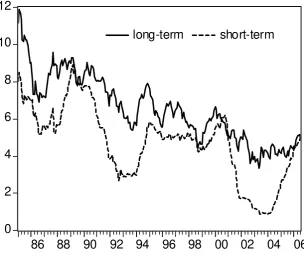
the residuals (Gujarati, 1995, 405). The two interest rates are shown in figure 1.
0 2 4 6 8 10 12
86 88 90 92 94 96 98 00 02 04 06
long-term short-term
We measure inflation expectations with core inflation, i.e. the annual change of headline CPI
excluding food and energy prices to capture the underlying price trend (see figure 2).4 As a
measure for the state of the business cycle, we use the Institute for Supply Management’s
manufacturing index (ism, see figure 3). It has the advantage (and this is especially important
for forecasting exercises) of not being revised and of being available with only a short
[image:12.595.85.390.83.340.2]publication lag.
Figure 2: Core inflation
4
1 2 3 4 5 6
86 88 90 92 94 96 98 00 02 04 06
[image:13.595.77.394.78.583.2]Core Inflation
Figure 3: ISM index
35 40 45 50 55 60 65
86 88 90 92 94 96 98 00 02 04 06
ISM
Our “d”-variable captures structural factors.5 As mentioned above, higher foreign demand for
US Treasuries, due to (i) demand from Asian central banks, (ii) the recycling of petrodollars,
(iii) the strong interest of institutional investors and (iv) liquidity-driven demand due to
world-wide expansionary monetary policies, could be responsible for the low level of US
5
bond yields during the last two years. To quantify the influence of these factors, we include
official and private foreign holdings of US Treasuries ("Treasury Securities") in percent of the
overall federal debt ("total liabilities").6 The following figure 4 shows that, since the
beginning of the Japanese FX market intervention in 2002, the external debt of the US in the
form of Treasuries has increased considerably. Overall, the volume of Treasuries held by
foreigners nearly doubled between 2002 and 2006 from USD 1,100 bn to USD 2,000 bn. This
is equivalent to about 35% of Federal Government`s total liabilities.
Figure 4: Foreign holdings of US Treasuries in % of federal debt outstanding
10 15 20 25 30 35
86 8 8 90 92 94 96 98 00 02 04 06 08
D ebt Ratio
Our sample of monthly data runs from 1986:1 to 2006:6. All variables, except interest rates,
the inflation rate and the foreign debt ratio, are in logarithms. The difference operator Δ refers
to first (monthly) differences.7
3.2 Econometric analysis
Standard unit root tests suggest that most of our variables are I(1) in levels and stationary in
first differences.8 The only exception is the "ism" index which (in line with theoretical
6
Wu (2005) shows that it is not convincing to only concentrate on increases in purchases of US Treasury securities by foreign central banks.
7
All data are available upon request and can alternatively be downloaded at http://freenet-homepage.de/clostermann/data_us_bonds.xls.
8
[image:14.595.80.453.243.529.2]considerations) is identified as a stationary variable. Owing to the non-stationarity of the time
series, the nominal long-term yield is estimated within a vector error correction model
(VECM) based on the procedure developed by Johansen (1995; 2000). This approach seems to
be particularly suited to verify the long-term equilibrium (cointegration) relationships on
which the theoretical considerations are based. The empirical analysis starts with an
unrestricted VECM which takes the following form:
(5)
1
1 1
−
− − =
Δ = Πt t +
∑
k Γ Δi t i + Ψ + +t iy y y x η εt,
where yt represents the vector of the non-stationary variables il, is, πe and d. ε denotes the
vector of the independently and identically distributed residuals, Ψis the coefficient matrix of
exogenous variables and η the vector of constants. The number of cointegration relationships
corresponds to the rank of the matrix Π. Granger’s representation theorem asserts that if the
coefficient matrix Π has reduced rank r < n, then there exist (nxr) matrices α (the loading
coefficients or adjustment parameters) and ß (the cointegrating vectors) each with rank r
(number of cointegration relations) such that Π = αß’ and ß’yt is I(0). The cointegration
vectors represent the long-term equilibrium relationships of the system. The loading
coefficients denote the importance of these cointegration relationships in the individual
equations and the speed of adjustment following deviations from long-term equilibrium. The
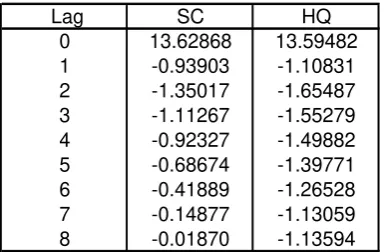
lag order (k) of the system is determined by estimating an unrestricted VAR model in levels
and using the information criteria suggested by Schwarz (SC) and Hannan-Quinn (HQ). All
[image:15.595.171.364.550.676.2]criteria recommend a lag length of 2 (see table 1).
Table 1: Lag length tests
Lag SC HQ 0 13.62868 13.59482 1 -0.93903 -1.10831 2 -1.35017 -1.65487 3 -1.11267 -1.55279 4 -0.92327 -1.49882 5 -0.68674 -1.39771 6 -0.41889 -1.26528 7 -0.14877 -1.13059 8 -0.01870 -1.13594
The number of cointegration vectors is verified by determining the cointegration rank with the
trace-test and the max-eigenvalue-test. Both tests suggest one cointegration relationship, i.e.
Table 2: Test for the number of cointegration relationships in the VECM
Unrestricted Cointegration Rank Test (Trace) Hypothesized Trace
No. of CE(s) Eigenvalue Statistic Critical Value Prob.** None * 0.1358 55.1177 47.8561 0.0090 At most 1 0.0522 18.0517 29.7971 0.5622 At most 2 0.0171 4.4279 15.4947 0.8661 At most 3 0.0002 0.0443 3.8415 0.8332
Trace test indicates 1 cointegrating eqn(s) at the 0.05 level * denotes rejection of the hypothesis at the 0.05 level **MacKinnon-Haug-Michelis (1999) p-values
Unrestricted Cointegration Rank Test (Maximum Eigenvalue) Hypothesized Max-Eigen
No. of CE(s) Eigenvalue Statistic Critical Value Prob.** None * 0.1358 37.0659 27.5843 0.0023 At most 1 0.0522 13.6238 21.1316 0.3966 At most 2 0.0171 4.3836 14.2646 0.8168 At most 3 0.0002 0.0443 3.8415 0.8332
Max-eigenvalue test indicates 1 cointegrating eqn(s) at the 0.05 level * denotes rejection of the hypothesis at the 0.05 level
**MacKinnon-Haug-Michelis (1999) p-values
Therefore, it seems reasonable to restrict the VECM to one cointegration relationship and, as
the above mentioned unit root tests suggest, to include the indicator for the expected stance of
the business cycle "ism" as a stationary (non-modeled exogenous) variable (with a lag length
of 0 to 1) into the system. Hence, a VECM with the following structure is estimated:
(6)
(
)
1 1 1 1 1 1 1 1 1 1 − − − − − − − −
⎛ ⎞ ⎛ Δ ⎞ ⎛ ⎞ ⎛ ⎞
⎜ ⎟ ⎜ Δ ⎟ ⎜ ⎟ ⎜ ⎟ ⎛ ⎞
⎜ ⎟= Γ ⎜ ⎟+⎜ ⎟ ⎜ ⎟+ ⎜ ⎟+ +
⎜ ⎟ ⎜Δ ⎟ ⎜ ⎟ ⎜ ⎟ ⎝ ⎠
⎜ ⎟ ⎜ ⎟ ⎜⎜ ⎟⎟ ⎜ ⎟
⎜ ⎟ ⎜Δ ⎟ ⎝ ⎠ ⎜ ⎟
⎝ ⎠ ⎝ ⎠ ⎝ ⎠
l l il l
t t t
s s is s
is d
t t t t
t
e e e
t t t t
d
t t t
i i i
i i i ism
ism
d d d
π π α α 1 −
β β β ψ η
π π α π
α
ε .
The long run relationship of this system – after the cointegration coefficients have been
normalized to the long-term interest rate il – is obtained from (il −βis⋅ −is β ππ⋅ e−βd⋅d), where the βs reflect the long-term coefficients.
To interpret the long-term relationship as an equation for the long-term interest rate, however,
all variables except the long-term interest rate il have to be weakly exogenous, i.e. deviations
from the long-term equilibrium are corrected solely through movements of il. As mentioned
above, the extent to which the individual variables adjust to the long-term equilibrium is
captured by the α-values. In a formal test, the null of weak exogeneity of is, d and πe
p-value = 0.60).9 In contrast, the null of weak exogeneity of il has to be rejected at all levels of
significance (χ²(1)= 21.41, p-value = 0.00). Summing up, the following regression results for
the VECM ensue (see table 3). For reasons to be mentioned below, the results and their
implications are not discussed here but in the context of equation (8).
Table 3: Coefficients and test statistics of the VECM (t-values in brackets)
Cointegrating Eq: CointEq il-1 1.00000
is-1 -0.34096
[-5.35907]
πe
-1 -0.54466
[-3.27147] d-1 0.08133
[ 3.64565] Constant -4.87872
Error Correction: Δil Δis Δπe Δd
α -0.19123 0.00000 0.00000 0.00000 [-6.06881] [ NA] [ NA] [ NA]
Δil-1 0.15323 0.08281 -0.01582 0.01699 [ 2.36096] [ 1.62024] [-0.49044] [ 0.45743]
Δis-1 -0.18083 0.03621 0.00656 -0.11276
[-2.02968] [ 0.51606] [ 0.14809] [-2.21123]
Δπe
-1 0.09165 -0.05428 -0.02915 -0.13977
[ 0.71014] [-0.53407] [-0.45440] [-1.89215]
Δd-1 0.08131 0.02928 0.00029 0.71839
[ 1.06432] [ 0.48670] [ 0.00769] [ 16.4290] Constant -1.22078 -1.09858 -0.15435 -0.17138
[-4.79346] [-5.47767] [-1.21949] [-1.17570] log(ism) 0.04843 0.02177 -0.00272 -0.01146
[ 5.13196] [ 2.92931] [-0.58086] [-2.12069] log(ism-1) -0.02567 -0.00100 0.00552 0.01516
[-2.76646] [-0.13728] [ 1.19766] [ 2.85433] R-squared 0.19572 0.20017 0.02051 0.53541 S.E. equation 0.27806 0.21897 0.13819 0.15915 F-statistic 8.55167 8.79494 0.73586 40.50041
Owing to the weak exogeneity of the fundamentals, switching to a single equation error
correction model (SEECM; Engle et al., 1983, Johansen, 1992) may improve the efficiency of
the estimates. We test the existence of a stable long-run relationship within this approach
according to an error correction model, i.e. the significance of the error correction term. To be
more specific, we proceed with the single equation non-linear approach of Stock (1987)
9
When exogeneity is tested for each variable separately the conclusions do not change: is: χ²(1)= 0.39,
where the error correction model and the cointegration relation are estimated
simultaneously.10 Thus, we estimate the following equation:
(7) 1 1
1 0 0
( − − ) − − −
= = =
Δ = ⋅l l − ⋅ +
∑
m ⋅Δl +∑
m ⋅Δ +∑
m ⋅ +t t t j t j j t j j t j t
j j j
i α i ß z γ i ϕ z ψ x ε
1 − s t i
where z is the vector of I(1)-variables is, d and πe which enter the cointegration space, x is a
vector of (stationary) regressors only entering short-run dynamics (in our case ism), α is the
error correction term and ε is a white-noise residual. The significance of α is assessed
according to the critical values of Banerjee et al. (1998). Significance is taken as evidence of
cointegration.11 To obtain the standard errors and the t-statistics of the long-run coefficients ß,
we estimate the Bewley transformation of the model (West, 1988).
The bracket term of (7) with the variables in levels describes the cointegration relationship
that has been normalized to the long-term interest rate. The lag length (m) is restricted to a
maximum of four. A general-to-specific-modeling is pursued with the so-called backward
procedure, i. e. insignificant coefficients (error probability > 5 %) have been successively
deleted. The final regression reads as (absolute t-values in brackets below coefficients)
(8)
1 1 1 1
(5.8) (6.9) (4.6) (6.9) (2.3)
1 1
(2.4) (4.1) (2.4) (7.1) (2.3)
0.25 ( 0.33 0.56 0.07 8.61)
0.15 1.88 1.02 0.53 0.20
− − − −
− −
Δ = − ⋅ − − + +
+ + − + Δ − Δ
l l s e
t t t t t
l s
t t t t
i i i d
i ism ism i
π
R² = 0.32; SE = 0.25; LM(1) = 0.04; LM(4) = 1.09; ARCH(1) = 0.10; ARCH(4) = 1.10; JB = 1.00; CUSUM: stable; CUSUM square: stable.
The coefficients of the long-run relationship show the theoretically expected signs and are
statistically significant at standard levels. They largely resemble those of the Johansen
procedure. This is indicative of some stability irrespective of the applied econometric
methodology. In the long run, a rise in core inflation has almost a 1-to-1-effect on the
long-term interest rate (assuming that a rise in expected inflation increases the short run interest
rate one to one). This might confirm the existence of the Fisher effect and is in line with
Keeley and Hutchison (1986) who emphasize that this result could be due to monetary regime
stability. The Greenspan era on which we concentrate in this paper obviously was
10
characterized by such stability. The short-term interest rate also exerts a highly significant
positive impact. This result points to the important role of monetary policy and arbitrage in
determining long-term rates. The coefficient on is indicates that a permanent rise in the
short-term interest rate of, say, 100 basis points will result in an increase of the long-short-term interest
rate of 33 basis points.12 Accordingly, the term structure is going to flatten with higher and to
steepen with lower short-term rates (see also Diebold et al., 2006). The less than proportional
response of il to is in the US has also been detected by Ducoudré (2005). The overall impact of
the business cycle, measured by ism, on il is positive, indicating that the effect via the supply
of bonds is dominating (in line with Diebold et al., 2006). The contemporaneous reaction of il
to ism is positive and highly significant. In the short-run, a contemporaneous 1% increase of
the ism results in a 1.9 percentage point increase in il. This value, being greater than 1, implies that the nominal interest rate is on average more volatile than expectations about the future
development of the business cycle. The significantly positive relationship between il and its
first lag may be an indication that the interest rate is in the short run also driven by
non-fundamental factors. This could be due to the market behavior of chartists and technical
analysts (Nagayasu, 1999) whose interest rate forecasts are usually based on past interest rate
movements.
The coefficient of the structural factor d is significantly positive. A value of 0.07 means that
an increase of the debt ratio by 1 percentage point lowers the bond yield by 7 basis points. In
the last four years, the amount of Treasuries held by foreigners increased by about 10
percentage points. This alone would have had a downward impact of 70 basis points on bond
yields. This result is in line with Warnock and Warnock (2005), Frey and Moët (2005) as well
as Bernanke et al. (2004). Longstaff (2004), in contrast, argues that if US investors, who
presumably may benefit more from the highly liquid Treasury market than many foreign
holders of Treasury debt, suddenly begin to purchase Treasuries from these foreign holders,
the yields on Treasuries should increase to reflect the increased popularity of holding
Treasuries. However, he finds that this effect is only significant for maturities up to three
years.
The coefficient of the error correction term is negative and highly significant. Thus, one
condition for long-run stability is satisfied. The parameter estimate of -0.25 suggests a
11
The conclusions of Pesavento (2004) indicate that such kind of tests, if suitably specified, perform better than other cointegration tests in terms of power in large and small samples and are also not worse or better in terms of size distortions.
12
life of shocks of about two months. In other words, the gap between the long-term nominal
interest rate and its equilibrium value is halved within two months after the occurrence of an
exogenous shock. Within one year, the gap is accordingly reduced by over 97%.13
Breusch-Godfrey Lagrange multiplier tests (LM) do not indicate autocorrelation in the
residuals (1st and 4th order). Nor can the Lagrange multiplier (ARCH) test for autoregressive
conditional heteroskedasticity (1st and 4th order) identify any violations of the white-noise
assumptions. In addition, the Jarque-Bera (JB) test confirms the normality of the residuals.
And finally, CUSUM tests do not indicate parameter or variance instability. This once again
underscores the stability of the estimated relation.
In the introduction, we mentioned that some commentators argue that structural or uncommon
factors are needed to explain the recent behavior of bond yields. To examine whether the
foreign debt ratio d captures these structural or uncommon factors adequately, we use the
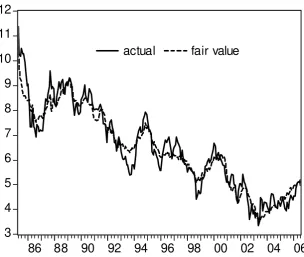
cointegration relation of our model to calculate a "fair value" of bond yields. Figure 5 shows
that bond markets were overvalued in the course of 2005. But obviously the "disequilibrium"
was not unusually high in a historical perspective. Our four variables seem to capture the
evolution of bond yields quite well. Therefore, it is not necessary to revert to additional
structural or technical factors. In contrast, the macro factors (is, πe, ism) alone are not capable to explain the developments satisfactorily as would have been the case until mid 2005 (see
Clostermann and Seitz, 2005).
13
Figure 5: The fair value of 10-year Treasury bonds (in %)
3 4 5 6 7 8 9 10 11 12
86 88 90 92 94 96 98 00 02 04 06
actual fair value
3.3 Forecast evaluation
In order to assess the quality of our single equation error correction model (SEECM) in
forecasting exercises, we compare it with a random-walk-model (RWM). Following the
influential article of Meese and Rogoff (1983), the RWM has become a very popular
benchmark in forecast evaluation. In line with the unit root tests, the RWM is specified
without a constant or trend.
We run two different kinds of out-of-sample forecasts of up to 12 months into the future. The
first are fully dynamic forecasts which assume that the forecaster has no idea about the future
evolution of the right-hand side variables and bases his predictions of these variables on
simple univariate time series models. Thus, the forecasts include only information that had
actually been available at the time it was carried out. In contrast to this narrow information
set, the second approach assumes that the forecaster knows the true values of the exogenous
variables. Realistically, the actual forecasting environment should be somewhere between
these two extreme cases.
The h-step-ahead forecast error (et+h,t) is calculated as the difference between the actual value
of il at time t+h (ilt+h) and its forecast value (ilt+h,t)
The forecasts are carried out recursively. The “first” estimation period is 1986:1-1995:7 and
the first forecast period runs from 1995:8 to 1996:7. The forecast "window" is then
successively extended month by month. Consequently, the next estimation period is
1986:1-1995:8 and the forecast period is from 1995:9 to 1996:8. And the last forecast period is from
2005:7 to 2006:6. In sum, we get 120 true out-of-sample forecast errors for each "h".
The quality of the forecasts of the competing models is assessed using two criteria. The first is
the root mean squared error (RMSE):
(10) 2 ,
1
1
+ =
=
∑
Th t
t h t
RMSE e
T
A smaller RMSE implies better forecast performance. A formal test based on the loss
differential (Diebold and Mariano, 1995) provides information on the significance of the
relative forecasts.
Additionally, we calculate a so-called hit ratio (HR). It assesses the correct sign match and
makes use of an indicator variable J which has the following properties
(
)
(
)
(
)
(
)
, , 1 0 + + + + − = − ⇔ = − ≠ − ⇔ =l l l l
t h t t h t t
l l l l
t h t t h t t
if sign i i sign i i J if sign i i sign i i J
Therefore, HR is defined as
(11) 1 1 100 = ⎛ ⎞ =⎜ ⎟⋅ ⎝
∑
⎠ T h t t HR J T .The higher the HR, the more often the forecast signals the correct direction of interest rate
changes.14 For example, a HR of 70% implies that in 70% of all cases the model predicts the
correct sign of future interest rate changes. The significance relative to the RWM is again
tested according to the test statistics developed in Diebold and Mariano (1995). Both forecast
evaluation criteria - RMSE and HR - are discussed in Cheung et al. (2005).
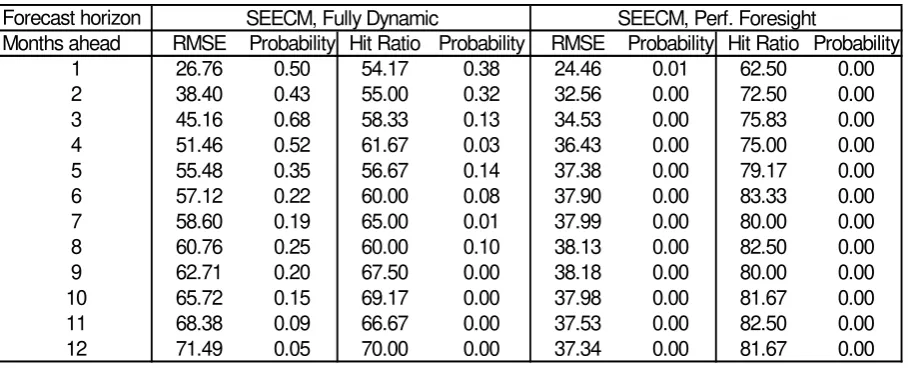
Table 4 shows the two forecasting metrics as well as the p-values of the null that the SEECM
and the RWM have equal forecasting accuracy. As is evident from this table, our model
always outperforms the RWM significantly in the perfect foresight case, i.e. the average
forecast errors of the SEECMs are lower and the signs of interest rate changes are more often
correctly forecasted by the SEECMs. In the fully dynamic case, the predictions of the SEECM
especially true for the RMSE where we are only able to beat the RWM significantly for the
two longest forecast horizons (h=11, 12). Overall, the results underpin the superiority of the
SEECMs, especially for longer forecast horizons. Moreover, it is obvious that the SEECM
does a better job the better the forecaster's predictive abilities with regard to the exogenous
[image:23.595.72.530.199.383.2]variables.
Table 4: Forecast quality of different models
Forecast horizon
Months ahead RMSE Probability Hit Ratio Probability RMSE Probability Hit Ratio Probability
1 26.76 0.50 54.17 0.38 24.46 0.01 62.50 0.00
2 38.40 0.43 55.00 0.32 32.56 0.00 72.50 0.00
3 45.16 0.68 58.33 0.13 34.53 0.00 75.83 0.00
4 51.46 0.52 61.67 0.03 36.43 0.00 75.00 0.00
5 55.48 0.35 56.67 0.14 37.38 0.00 79.17 0.00
6 57.12 0.22 60.00 0.08 37.90 0.00 83.33 0.00
7 58.60 0.19 65.00 0.01 37.99 0.00 80.00 0.00
8 60.76 0.25 60.00 0.10 38.13 0.00 82.50 0.00
9 62.71 0.20 67.50 0.00 38.18 0.00 80.00 0.00
10 65.72 0.15 69.17 0.00 37.98 0.00 81.67 0.00
11 68.38 0.09 66.67 0.00 37.53 0.00 82.50 0.00
12 71.49 0.05 70.00 0.00 37.34 0.00 81.67 0.00
SEECM, Perf. Foresight SEECM, Fully Dynamic
4. Summary and conclusions
Our results reveal that the development of long-term bond yields in the US can be very well
explained by three standard macroeconomic factors which are widely considered to be the
minimum set of fundamentals needed to capture basic macroeconomic dynamics - monetary
policy, the business cycle and inflation expectations - augmented by the share of Treasuries
held by foreigners.The latter variable captures the structural factors often mentioned in the
literature. These four variables are able to explain the movement of bond yields in a stable
manner. Further macro variables are not needed to capture the evolution of bond yields from
2004 to 2006.
Our forecasting exercises show that we are able to outperform a random walk model. In these
tests, the fully-dynamic approach assumes that the forecaster has no information at all about
the exogenous variables. An assumption that is obviously conservative in real world
applications. On the other side, the perfect foresight case neglects informational deficiencies.
The random walk model which we use as a benchmark might be criticized as being too
"naive" in that it can be improved by including more ar- and ma-terms. Nevertheless, it is
standard in the literature (see, e.g., Cheung et al., 2005). In this respect, one may be interested
14
in further evaluation metrics, e.g. a consistency criterion, to check the robustness of our
results. This is left to future research.
References
Bandholz, H. (2006), US Treasuries: Cyclical Outweighing Structural Factors, HVB Friday Notes, 30 June 2006, 3-5.
Banerjee, A., J. Dolado, D.F. Hendry & G.W. Smith (1986), Exploring Equilibrium Relationships in Econometrics Through Static Models: Some Monte Carlo Evidence,
OxfordBulletin of Economics and Statistics 48, 253-277.
Banerjee, A., J. Dolado & R. Mestre (1998), Error Correction Mechanism Tests for Cointegration in a Single Equation Framework, Journal of Time Series Analysis 19, 267-283.
Bernanke, B.S., V.R. Reinhart & B.P. Sack (2004), Monetary Policy Alternatives at the Zero Bound: an empirical assessment, Finance and Economics Discussion Series of the Federal Reserve Board, 2004-48, September 2004.
Breedon, F., S.G.B. Henry & G.A. Williams (1999), Long-term Real Interest Rates: evidence on the global capital market. Oxford Review of Economic Policy 15, 128–142.
Brooke, M., A. Clare & I. Lekkos (2000), A Comparison of Long Bond Yields in the United Kingdom, the United States and Germany, Bank of England Quarterly Bulletin 40, 150-158.
Campos, J., N. Ericsson & D.F. Hendry (1996), Cointegration Tests in the Presence of Structural Breaks, Journal of Econometrics 70, 187-220.
Caporale, G.M. & G. Williams (2002), Long-term Nominal Interest Rates and Domestic Fundamentals, Review of Financial Economics 11, 119-130.
Cheung, Y.-W., M.D. Chinn & A.G. Pascual (2005), Empirical Exchange Rate Models of the Nineties: Are any fit to survive?, Journal of International Money and Finance 24, 1150-1175.
Christiano, L., M. Eichenbaum & C. Evans (2005), Nominal Rigidities and the Dynamic Effects of a Shock to Monetary Policy, Journal of Political Economy 113, 1-45.
Clostermann, J. & F. Seitz (2005), Are Bond Markets Really Overpriced: The case of the US, University of Applied Sciences Ingolstadt, Working Paper Nr. 11, December.
Demiralp, S. & O. Jordà (2004), The Response of Term Rates to Fed Announcements, Journal of Money, Credit, and Banking 36, 387-405.
Dewachter, H. & M. Lyrio (2006), Macro Factors and the Term Structure of Interest Rates, Journal of Money, Credit, and Banking 38, 119-140.
Diebold, F.X. & R. Mariano (1995), Comparing Predictive Accuracy, Journal of Business and Economic Statistics 13, 253-265.
Diebold, F.X., G.D. Rudebusch & S.B. Aruoba (2006), The Macroeconomy and the Yield Curve: A Dynamic Latent Factor Approach, Journal of Econometrics 131, 309-338.
Durré, A. & P. Giot (2005), An International Analysis of Earnings, Stock Prices and Bond Yields, ECB Working Paper No. 515, August.
Ehrmann, M., M. Fratzscher & R. Rigobon (2005), Stocks, Bonds, Money Markets and Exchange Rates: Measuring International Financial Transmission, NBER Working Paper 11166, March.
Engle, R. & C. Granger (1987), Cointegration and Error Correction: Representation, Estimation, and Testing, Econometrica 35, 251-276.
European Central Bank (2005), Monthly Bulletin April 2005.
European Central Bank (2006), The Accumulation of Foreign Reserves, Occasional Paper No. 43, February.
Fels, J. & M. Pradhan (2006), Fairy Tales of the US Bond Market, Morgan Stanley Research Global, July 26, 2006.
Frey, L. & G. Moët (2005), US Long-term Yields and FOREX Interventions by Foreign Central Banks, Banque de France Bulletin Digest no. 137, May 2005, 19-32.
Greenspan, A. (2005), Testimony Before the Committee on Banking, Housing, and Urban Affairs of the U.S. Senate on February 16, 2005.
Gujarati, D.N. (1995), Basic Econometrics, 3rd ed., McGraw-Hill, Singapore.
Johansen, S. (1995), Likelihood-based Inference in Cointegrated Vector Auto-regressive Models, Oxford University Press, Oxford, New York.
Johansen, S. (2000), Modelling of Cointegration in the Vector Autoregressive Model, Economic Modelling 17, 359-373.
Jordá, O. & K.D. Salyer (2003), The Response of Term Rates to Monetary Policy Uncertainty, Review of Economic Dynamics 6, 941-962.
Keeley, M.C. & M.M. Hutchison (1986), Rational Expectations and the Fisher Effect: implications of monetary regime shifts, Federal Reserve Bank of San Francisco, Working
Papers in Applied Economic Theory86-11.
Kozicki, S. & G. Sellon (2005), Longer-Term Perspectives on the Yield Curve and Monetary Policy, Federal Reserve Bank of Kansas City Economic Review 99, No 4, 5-33.
Longstaff, F.A. (2004), The Flight-to-Liquidity Premium in U.S. Treasury Bond Prices, Journal of Business 77, 511-526.
MacKinnon, J.G., A.A. Haug & L. Michelis (1999), Numerical Distribution Functions of Likelihood Ratio Tests for Cointegration, Journal of Applied Econometrics 14, 563-577.
Meese, R. & K. Rogoff (1983), Empirical Exchange Rate Models of the Seventies: do they fit out of sample?, Journal of International Economics 14, 3-24.
Mehra, Y.P. (1995), Some Key Empirical Determinants of Short-Term Nominal Interest Rates, Federal Reserve Bank of Richmond Economic Quarterly 81/3, 33-51.
Monticini, A. & G. Vaciago (2005), Are Europe's Interest Rates led by Fed Announcements, Working Paper, University of Exeter.
Nagayasu Y. (1999), Japanese Effective Exchange Rates and Determinants: A Long-Run Perspective, in: R. MacDonald & J. Stein: Equilibrium Exchange Rates, Norwell, MA., 323-347.
Pesavento, E. (2004), Analytical Evaluation of the Power of Tests for the Absence of Cointegration, Journal of Econometrics 122, 349-384.
Poole, W. (2005), Understanding the Term Structure of Interest Rates, Federal Reserve Bank of St. Louis Review 87, 589-595.
Rudebusch, G.D., E.T. Swanson & T. Wu (2006), The Bond Yield “Conundrum” from a Macro-Finance Perspective, Federal Reserve Bank of Dallas, Working Paper 2006-16.
Stock, J.H. (1987), Asymptotic Properties of Least Squares Estimators of Cointegrating Vectors, Econometrica 55, 1035-1056.
Tanzi, V. (1976), Inflation, Indexation and Interest Income Taxation, Banca Nazionale del Lavoro Quarterly Review 29, 54-76.
Tobin, J. (1965), Money and Economic Growth. Econometrica 33, 671–684.
Warnock, F.E. & V.C. Warnock (2005), International Capital Flows and U.S. Interest Rates, International Finance Discussion paper 840, September 2005.
West. K.D. (1988), Asymptotic Normality, When Regressors have a Unit Root, Econometrica 56, 1397-1417.
Bisher erschienene Weidener Diskussionspapiere:
1 "Warum gehen die Leute in die Fußballstadien? Eine empirische Analyse der Fußball-Bundesliga" von Horst Rottmann und Franz Seitz
2 "Explaining the US Bond Yield Conundrum" von Harm Bandholz, Jörg Clostermann