SRJIS/BIMONTHLY/ DR. KAILAS SAHEBRAO DAUNDKAR (5912-5918)
MAY-JUNE 2017, VOL- 4/31 www.srjis.com Page 5912 EFFECTIVENESS OF MIND MAPS ON CREATIVITY AND ACADEMIC
ACHIEVEMENT OF STUDENTS
Kailas Sahebrao Daundkar, Ph.D.
Principal, Dr. M. A. Khan College of Education, Manchar
Mind maps have been used for centuries, for learning, brainstorming, visual thinking and problem solving by educators. These mind maps were presented in different colours, using symbols, images and keywords, the latter for the pupils to realize the hierarchy of the subjects taught also uses a combination of text, graphics to enhancing the learning process. An attempt is being made to find the effectiveness of Mind Maps for General Science subject of 8th standard student. The objective of the research to develop Mind Maps and its effectiveness on creativity and academic achievement of students. Multi-method research was adopted, by using survey method creativity measure using Creativity Test by Baqer Mehdi (Hindi Version). Researcher developed Mind Maps for General Science subject of 8th standard student. Researcher also used Experimental Method and Creativity Test by Baqer Mehdi (Hindi Version) & General Science Achievement test as a data collection tool.so researcher developed Mind Map is useful as a teaching method to learn the concepts of general Science very easily and is useful to improve the Achievement and Creativity of primary level students. Key Words: Mind Map, Creativity, Academic Achievement.
INTRODUCTION
Mind maps have been used for centuries, for learning, brainstorming, visual thinking and
problem solving by educators. These mind maps were presented in different colours, using
symbols, images and keywords, the latter for the pupils to realize the hierarchy of the subjects
taught also uses a combination of text, graphics to enhancing the learning process. The claim
of the origin of the mind maps has been made by a British popular psychology author, Tony
Buzon. He argues that "traditional" outlines rely on the reader to scan left to right and top to
bottom, whilst what actually happens is that the brain will scan the entire page in a non-linear
fashion. He also used popular assumptions about the cerebral hemispheres in order to
promote the exclusive use of mind mapping over other forms of note taking. The mind maps
were presented in different colours, using symbols, images and keywords, the latter for the
Scholarly Research Journal's is licensed Based on a work at www.srjis.com
SRJIS/BIMONTHLY/ DR. KAILAS SAHEBRAO DAUNDKAR (5912-5918)
MAY-JUNE 2017, VOL- 4/31 www.srjis.com Page 5913 students to realize the hierarchy of the subjects taught. By the teaching of mapping
techniques the action regulation can be initiated in children with learning impairments which
makes it possible on the one hand to structure and categories information and on the other
hand to memories information in long-term memory, so the teaching and learning make more
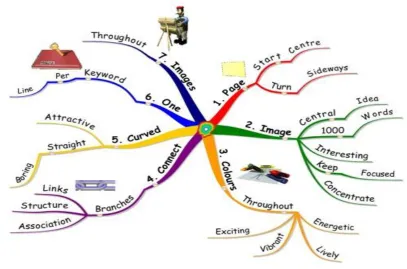
effective due of the mind mapping method. The following figure shows the classification or
[image:2.595.89.497.199.468.2]ways of mind maps
Fig 1:- Classificaion of Mind Maps (Buzan T & Buzan B., 2001)
Therefore it‟s necessary to develop the Mind Map Program to increase the creativity and
achievement in science today, hence it is essential to conduct various programs based on
Mind Map for improve creativity and achievement in science subject.
REVIEW OF RELATED LITERATURE
A study entitled Dane, H.G. (2011). A study of effectiveness of specially designed teaching strategy on general creativity and mathematical creativity on middle school children. In present research objectives are to design special design teaching strategy of teaching
mathematics to middle school children and to ascertain comparative effectiveness of special
design and traditional strategy of mathematics. In present research experimental method was
used the sample of research was 59 student. T- Test and ANNOVA was used as statistical
tool. And it found that the strategy was not found to be effective for developing mathematical
SRJIS/BIMONTHLY/ DR. KAILAS SAHEBRAO DAUNDKAR (5912-5918)
MAY-JUNE 2017, VOL- 4/31 www.srjis.com Page 5914 Paul, Hussain & Hennessy (2002) Conducted research on The efficacy of the mind map study
technique. The main objective was to examine the effectiveness of using the mind maps to improve the factual recall from written information. It is found that mind maps provide an
effective study technique when applied to written material.
Sharma R.C (1991) conducted research on Comparison of the Effect of Various Modes of Classroom Teaching. Compared the effect of various modes of classroom teaching involving video-based instruction, teacher discussion, demonstration, self-experimentation, etc., on the
achievement in science of the secondary level learners. It is found that most of the
video-based instruction while self-experimentation under the guidance of the teacher was more
effective.
STATEMENT OF THE PROBLEM:
To assess an existing status regarding the creativity and academic achievement of students as
to develop the program on Mind Maps and find out the effectiveness on the academic
achievement in science subject and creativity of 8th Standard students.
DEFINITION OF KEY TERMS:
Effectiveness
Conceptual Definition:
“Producing result that is wanted or invented, producing a successful result.” (Hornby, 2000).
Operational Definition:
Effectiveness means a significant difference in the scores of Achievement Test and Test of
creativity (Post-test) of students of the Control and Experimental Group in Science subject of
8th standard after implementation of the Program of Mind Map.
Mind Map:
Operational Definition:
Mind Map mean an action plan based on uses a combination of text, graphics, pictures,
diagrams, Images, colours, symbols, keywords, by using learning materials of topic
Biodiversity, Light and Microorganism for 8th standard students of science subject
OBJECTIVE OF THE STUDY:-
1. To assess the existing status regarding the creativity and academic achievement of
science subject of 8th standard students.
2. To develop Mind Maps for 8th standard General science subject.
3. To find out the effectiveness of Mind Maps on academic achievement in science subject
SRJIS/BIMONTHLY/ DR. KAILAS SAHEBRAO DAUNDKAR (5912-5918)
MAY-JUNE 2017, VOL- 4/31 www.srjis.com Page 5915 HYPOTHESIS:-
H1: There is a significant difference between the mean scores of academic achievement in
general science subject of Experimental and Control Group on the post test.
H2: There is a significant difference between the mean scores of creativity of Experimental
and Control Group on the post test.
NULL HYPOTHESIS
H01: There is no significant difference between the mean scores of academic achievement in
general science subject of Experimental and Control Group on the post test.
H02: There is no significant difference between the mean scores of creativity of Experimental
and Control Group on the post test.
ASSUMPTION
The mind maps provide an effective study technique when applied to written
material.(Paul,et.al.2002)
SCOPE, LIMITATION AND DELIMITATION
SCOPE: -
1. The research is conducted in Maharashtra State.
2. This study is related to 8th standard of General Science subject students.
LIMITATION:
1. The attitude, interest and fatigue of Teacher and students are beyond the control of
researcher.
2. The Teacher and students who were present at the time of data collection are included
in the study.
DELIMITATIONS
1. This survey is delimited to the Primary level Teacher of Tal; khed.
2. Only two schools from Pune district are included in the Experiment.
3. This experiment is delimited to the 8th standard students only.
4. The research study includes only Marathi Medium School.
5. This study is delimited to the use of Mind Map program.
6. Only three (Biodiversity, Light & Microorganism) units from syllabus are taken into
SRJIS/BIMONTHLY/ DR. KAILAS SAHEBRAO DAUNDKAR (5912-5918)
MAY-JUNE 2017, VOL- 4/31 www.srjis.com Page 5916 PLAN AND PROCEDURE OF STUDY:-
The present study is based on Applied Research and Multi method was used. In survey
research 200 students selected as a sample, sample selected as purposive sample method,
Creativity Test by Baqer Mehdi (Hindi Version) and researcher made Questionnaire used as
tool of data collection. Mind Maps program developed by Researcher. Developed Mind Maps
program implemented on 100 students of 8th standard students. Researcher used equivalent
pretest-posttest control group design for Experiment.
DATA ANALYSIS:-
In the present study survey study data analyzed using mean after normality test were
conducting using SPSS program. For the experimental study descriptive and inferential
analysis used. Mean, median and Standard deviation calculated. T-test‟ used to determine the
difference between pretest and posttest scores in creativity and academic achievement of
experimental group.
HYPOTHESIS TESTING:-
H01: There is no significant difference between the mean scores of achievement in general
science subject of Experimental and Control Group on the post test.
Table No: 01: Paired T test for posttest of Experimental and control group of
Achievement
Group N Mean S.D. df value
Paired
T-value Effect size
Control 50 24.73 3.62
49 7.88 0.57
Experimental 50 28.30 4.38
Observations:
The result of the experiment shows the t value of posttest of Experimental group and Control
Group is 7.88 which is significant at 0.5 level. Also the calculated size effect is 0.57
(Moderate Effect) indicates that the program was effective. It reflects that there were a
significant difference between the achievement of students of Experimental and Control
Group after the implementation of the Mind Map Program.
Hence the Null Hypothesis is rejected and therefore the Research Hypothesis is accepted i.e.
„There is a difference between the mean scores of students of Experimental and Control Group
on the post test.
H02: There is no significant difference between the mean scores of creativity of Experimental
SRJIS/BIMONTHLY/ DR. KAILAS SAHEBRAO DAUNDKAR (5912-5918)
[image:6.595.84.508.114.176.2]MAY-JUNE 2017, VOL- 4/31 www.srjis.com Page 5917 Table No: 02: Paired T test for posttest of Experimental and Control Group of
Creativity
Group N Mean S.D. df value
Paired
T-value Effect Size
Control 50 86.98 13.60
49 3.54 0.63
Experimental 50 92.02 13.16
FINDINGS:
The result of the experiment shows the t value of posttest of Experimental group and Control
Group is 3.54 which is significant at 0.5 level. Also the calculated size effect is 0.63
(Moderate Effect) indicates that the program was effective. It reflects that there were a
significant difference between the mean score of creativity of Experimental and Control
Group on posttest after the implementation of the mind map Program.
Hence the Null Hypothesis is rejected and therefore the Research Hypothesis is accepted i.e.
„There is a difference between the mean scores creativity of students of Experimental and
Control Group on the post test.
MAJOR FINDINGS:
From objective: 1
1. Most of the students of the 8th standard were low creativity.
2. Maximum Science Teacher not used the Mind Map at the time of teaching.
From objective: 2
Researcher made Mind map program were useful and positive responses given by the
students
From objective: 3
1. The achievement of Science subject of Experimental Group was increased than the
achievement of Science subject of Control Group because of the implemented Program of
mind map in Science subject.
2. The scientific attitude of Experimental Group was increased than the creativity of Control
Group because of implemented Program of mind map in Science subject
DISCUSSION ON FINDINGS:
The present research study was conducted by using the Multi Research Methods such as;
Survey Method, Product Development Method and Experimental Method. The survey
Method was conducted to assess the existing condition regarding the creativity and
achievement of students. The findings regarding the Survey reflected that creativity and
SRJIS/BIMONTHLY/ DR. KAILAS SAHEBRAO DAUNDKAR (5912-5918)
MAY-JUNE 2017, VOL- 4/31 www.srjis.com Page 5918 The objective number three of the present research study was to find out the effectiveness of
the program on creativity and achievement of students. For fulfill this objective Experimental
Method was followed. This objective was assessed by conducting Test of Creativity by Baqer
Mehdi (Hindi Version) and Test of Achievement made by researcher. The test was
administered on Experimental and Control Group. The finding indicates that the Test of
creativity and achievement of Experimental Group was increased than Control Group
because of the implemented Program of Mind Maps in science. The developed Program was
effective. Similar finding regarding the effect of Program were found in the research of Dane,
(2011) found that the creativity of students in mathematics can increases and students
actively participated in that program also Paul, Husain & Hennessy (2002) found that mind
maps provide an effective study technique when applied to written material.
CONCLUSION:
Mind Maps were increased the creativity and academic achievement of students of 8th
standard of science subject.
CONTRIBUTION OF THE STUDY TO THE FIELD OF EDUCATION:-
The present study is helpful to the Teacher -
To understand the theoretical and practical aspects of the Mind Maps. To acquaint with various types of mind maps.
To plan their teaching by including Mind Maps.
The present study is helpful to the students -
1. To get improve the students Scientific attitude and creativity.
2. To learn the things with group or peers with motive and interest.
3. To do self-study by using various Mind Maps.
REFEFENCES:
Agarwal, J. C. (2009). Essentials of educational Psychology. Delhi: Vikas Publishing House Pvt. Ltd.
Buzan T. Buzan B. (1997) The Mind Map Book. London: BBC Books
Best, J.W. and Kahn, J. V. (2004). Research in Education. (VII and IX Edi). New Delhi: prentice
Hall.
Golani, T. P. (1982). The Use of Audio-Visual Aids in the Secondary School of District Thane. Ph. D.
Edu. University of Pune.
Sharma S. (Eds) Constructivist Approches to teaching learning handbook for teachers of secondary
stage, New Delhi; NCERT.