ISSN 2250-3153
Assessment of The Availability and Utilization of
Information Communication Technology (ICT)
Resources In Public And Private Secondary Schools In
Abuja Nigeria
Okolo Margaret Amina
DEPARTMENT OF SCIENCE TECHNOLOGY AND MATHEMATICS EDUCATION, NASARAWA STATE UNIVERSITY KEFFI, NASARAWA STATE NIGERIA
DOI: 10.29322/IJSRP.9.02.2019.p8613
http://dx.doi.org/10.29322/IJSRP.9.02.2019.p8613
Abstract
The vast and rapid developments in computer communications have significantly affected contemporary
educational system. This study was a comparative analysis of assessment of the availability and utilization of
ICT resources in public and private secondary schools in FCT Abuja. The study adopted a descriptive survey
design. Stratified random sampling technique was employed. The target population was 2,472 and 331 subjects
was randomly selected. A structured questionnaire was constructed and titled ICT resources availability and
utilization scale (IRAUS) with reliability of 0.72. The data was analyzed using frequency counts, percentages,
mean and standard deviation and t-test. The result of the study shows that the level of availability and
utilization of ICT resources was acceptable. However, the result also shows that utilization of ICT resources in
private secondary schools in FCT was higher with a mean score of 2.73 against 2.59 of the public secondary
schools. It is therefore recommended that there should be full implementation of ICT policy at all levels of
education.
Keyword; Assessment, Availability Information Communication Technology, Resources, and Utilization
Introduction
The modern world is a product of science and technology, its impact is felt in every sphere of human
endeavors (education, agriculture, medicine and many more). The development and invention of science
technology has made the world a global village in which Information Communication Technology (ICT) has
played a significant role. ICT in education is said to be a diverse set of tolls and resources used to communicate,
ISSN 2250-3153
and components that enables modern computing through net-working this may include internet, wireless
networks, cell phones, audiovisual processing and transmission systems and monitoring functions.
The importance of ICT in education cannot be over emphasized as Akudolu (1996) pointed out that the wake of
the millennium has witnessed a mismatch between the education Nigerian learners receive in Nigeria schools
and the life of activities they are expected to engage in, therefore the need to integrate ICT curriculum to
science education became expedient. Development is partly dependent in the synergy interaction between
technological innovation and human values. The rapid rate at which ICT has evolved in this century, the
convergence and pervasiveness, gives it a strong toil in development and globalization (Nwagu, 2008).
The field of education has been affected by ICT which undoubtedly affected teaching and learning and research
(Yusuf, 2005). A great deal of research has proven the benefits of ICT to the quality of education (AL-Anasai,
2006). Some of the benefits of ICT include the potentials to accelerate, enrich and deepen skills, to motivate
and engage students to help relate school experiences to work practices, create economic variability as well as
strengthening schools to change (Davis and Tearlem, 1999, Kemke and Cenghln, 1998 as cited by Yusuf,
2005). Economic commission for Africa has indicated that ICT is no luxury but a necessity for development,
unfortunately many developing countries especially in Africa are not vibrant in ICT applications in secondary
schools (Aduwa and Iyamu, 2005).
On this basis, the research is to ascertain the awareness of ICT in Nigeria Secondary Schools in FCT-Abuja, as
this is a pivotal to National Development in the century.
Statement of the Problem
The field of education has been affected by ICT which unstably affected teaching, learning and research
(Yusuf, 2005). It has been discovered that ICT has the potential of accelerating students’ skills. He noted that
Nigeria Secondary Schools students are below other counter parts in the developed nations. Some researchers
like (Adejoke, 2010) added credence to this fact and pointed out that teachers, students and technicians are not
ICT literate, this demands for ICT literacy in Nigerian schools and the society more to this, employers have
realized that ICT can enhance their efficiency and there is a high demand for ICT literacy in the work force.
Therefore, the study is to determine the level of ICT availability and utilization resources in public and private
secondary in FCT Abuja.
Objective of the study.
The objective of the study is to determine the level of accessibility of ICT resources by teachers of private and
ISSN 2250-3153
1. determine the level of availability of ICT resources by teachers of private and public secondary
schools in FCT–Abuja
2. determine the level of utilization of ICT resources in public and private secondary schools FCT-
Abuja.
Research Questions
1. What is the level of availability of ICT resources amongst the teachers of public and private
secondary schools in FCT–Abuja?
2. What is the level of utilization of ICT resources amongst the teachers of public and private secondary
schools in FCT-Abuja.
Research Hypothesis
The following null hypotheses are formulated to guide the study at 0.05 level of significance;
H01: There is no significance difference in the level of availability of ICT resources between the private and public secondary schools teachers in FCT-Abuja.
H02: There is no significance difference in the level of utilization of ICT resources between the private
and public secondary schools teachers in FCT-Abuja
Methods
The method adapted for this research is a descriptive survey research design which sought to ascertain the
responses of teachers in private and public secondary schools in FCT. The target population consists of teachers
of private and secondary schools in FCT, target population 2,472, made up of 1142 male teachers and 1330
female teacher. (Education research centre 2009). The sample used was 331 based on Krejare and Margan
(1970). The stratified random sampling technique were adopted based on the school type, subjects were drawn
from each stratum in such a way that the relative proportion of the strata in the resultant sample were the same
as they existed in the parent population. A sample of 138 and 198 teachers were drawn from private and public
secondary schools respectively; on the whole 331 teachers were used as sample for the study.
The instrument used for this study for collection of data is a self-developed questionnaire titled: ICT resources
Availability and utilization Scale (IRAUS). This consist of 20 items placed alongside the response format
strongly Agree (SA), Agree (A), Disagree (D), and strongly disagree (SD). The weightings of the response were
SA = 4, A = 3, D = 2, SD = 1. The bench mark of 2.50 was chosen as basis for agreement or disagreement for
each item. The instrument was validated by expert in science and environmental education in University of
Abuja. Twenty copies were trial tested on teachers who are not part of the study, data collected were analyzed
with split-half method to determine the reliability coefficient of 0.72.
ISSN 2250-3153
The data collected from the study was analyzed using frequency counts, standard deviation to answer the
research questions and t-test to analyze the hypotheses at 0.05 significant levels
Demographic Data
The following tables, 1 – 2 shows the respondents’ demographic data in terms of categories of respondents by
gender and ownership of school.
Table 1: Distribution of Respondents by Gender
Gender No of Respondents Percentage
Male 200 60.0
Female 131 40.0
Total 331 100
Table: 1 show that two hundred respondents representing 60.0% were male teachers while the one hundred and
thirty one respondents representing 40.0% of the sample were female teachers. The total sample of the study
was one three hundred and thirty one. Result of this analysis showed that the number of male teachers were in
the majority
Table 2: Distribution of Respondents by School Type
Ownership No of Respondents Percentage
Public 198 59.8
Private 133 40.2
Total 331 100
In Table 2; one hundred and ninety eight respondents representing 59.8.0% were respondents from public
secondary schools. On their own part, one hundred and thirty three respondents representing 40.2% of the
sample were teachers from private secondary schools. The number of respondents that constituted sample was
three hundred and thirty one teachers while the majorities were teachers from private secondary school.
Results
Research Question one
[image:4.612.42.525.646.725.2]To what extent do availability of ICT resources as perceived by public and private school teachers differ?
Table 3: Analysis of Public Secondary School Teachers’ Responses on the Level of Availability of ICT
Resources
Statements Number Mean Standard
Deviation
Decision
1 There is ICT Centre in my School 331 3.80 1.08 Agree
ISSN 2250-3153 school
3 There is constant electricity supply and a stand-by source of supply in my school
331 2.74 1.04 Agree
4 Our school has qualified ICT personnel in the centre
331 2.40 1.00 Disagree
5 There is an internal connectivity in my school
331 2.42 1.02 Disagree
Sectional Mean/Std. Deviation 2.84 1.18 Agree
Results of the analysis on table 3 shows that most teachers in public schools showed mixed reactions. While
some agreed that ICT resources were available in their schools, other disagreed especially in respect of
interconnectivity and quality of ICT personnel. But in the cases of others, the respondents observed that such
ICT facilities were available. The overall mean for the items in respect of respondents from this section was
[image:5.612.64.510.419.643.2]2.84 which indicated overall availability of ICT resources.
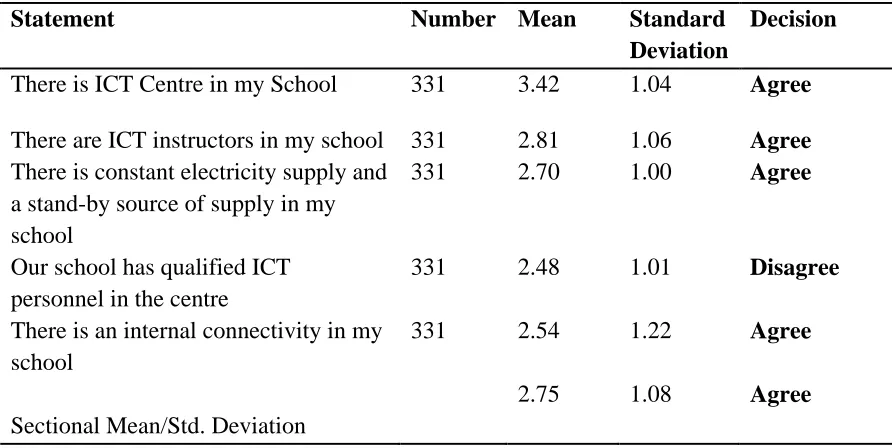
Table 4: Analysis of Private Secondary School Teachers’ Responses on the Availability of ICT Resources
Statement Number Mean Standard
Deviation
Decision
1 There is ICT Centre in my School 331 3.42 1.04 Agree
2 There are ICT instructors in my school 331 2.81 1.06 Agree 3 There is constant electricity supply and
a stand-by source of supply in my school
331 2.70 1.00 Agree
4 Our school has qualified ICT personnel in the centre
331 2.48 1.01 Disagree
5 There is an internal connectivity in my school
331 2.54 1.22 Agree
Sectional Mean/Std. Deviation
2.75 1.08 Agree
Results of the analysis on table 4 shows that most teachers in private secondary schools agreed with the
ISSN 2250-3153
respondents observed that such facilities were not available in their schools. The overall mean for the items in
respect of respondents was 2.75 which indicated that the majority were in agreement.
Research Question Two
What is the level of utilization of ICT resources as perceived by teachers in private and public secondary
schools in Abuja? To answer this question, frequency counts, means and standard deviations were used to
[image:6.612.48.514.220.404.2]analyze the data based on the items as shown on tables 5and 6
Table 5: Analysis of Public Secondary School Teachers’ Responses on the Level of Utilization of ICT
Resources.
Statements Number Mean Standard
Deviation
Decision
1 I visit ICT resource centre before I teach 331 3.30 1.24 Agree
2 My School made available time for ICT resources
331 2.80 1.20 Agree
3 I make use of ICT resources to teach my lesson
331 3.58 1.00 Strongly Agree 4 There is constant maintenance and
upgrading of ICT resources in my school
331 2.78 1.44 Agree
5 I always made use of multi-media
resources in the ICT centre during lesson
331 3.70 1.00 Strongly Agree
Sectional Mean/Std. Deviation 3.23 1.11 Agree
Analysis on table 5 showed that most teachers in public secondary schools agreed that they variously utilized
the ICT resources in their schools. None of the respondents was found to be in disagreement. The overall mean
for the items in respect of respondents from this section was 3.23 which indicated positive level of utilization of
ICT resources.
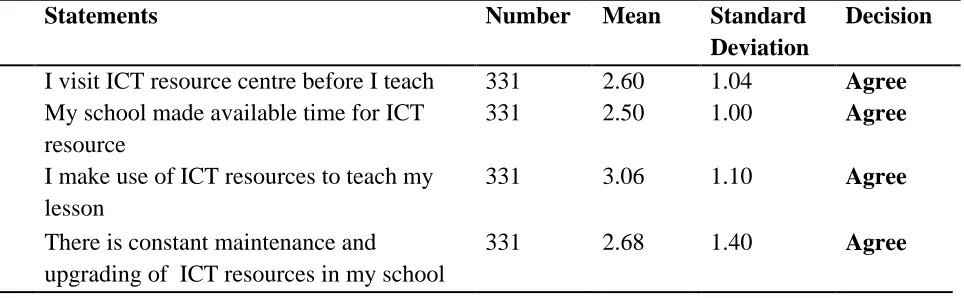
Table 6: Analysis of Private Secondary School Teachers’ Responses on the Level of Utilization of ICT Resources
Statements Number Mean Standard
Deviation
Decision
1 I visit ICT resource centre before I teach 331 2.60 1.04 Agree 2 My school made available time for ICT
resource
331 2.50 1.00 Agree
3 I make use of ICT resources to teach my lesson
331 3.06 1.10 Agree
4 There is constant maintenance and
upgrading of ICT resources in my school
[image:6.612.46.528.550.699.2]ISSN 2250-3153
5 I always make use of multi-media
resources in the ICT centre during lesson
331 3.40 1.00 Agree
Sectional mean/ std. deviation 2.85 1.12 Agree
Results on 6 showed that most private secondary school teachers agreed that the listed statements that border on
level of utilization of ICT resources. Again none of the respondents in this category was found to be in
disagreement. The overall mean for the items in respect of respondents from this section was 2.85 which
indicated an overall agreement for utilization.
Null Hypothesis Two (Ho1)
HO1: There is no significant difference in the mean responses of public and private secondary school teachers
on the availability of ICT resources.
The above hypotheses were tested using t-test statistical technique.
Table 7: Two-tailed t-Test Result in respect of Mean responses of public and private secondary school
teachers on the availability of ICT resources.
Category Number (N)
Mean (X)
Standard deviation (SD)
df t-value
Std. Error
Sig. Decision
Public Private
198 133
2.77 2.86
1.08
1.18 ∞ 1.02 1.0014 0.3115 Accepted
Table 7 shows the result of analysis for hypothesis two. It indicated that there was no significant difference in
respect of mean responses of private and public secondary school teachers on the availability of ICT resources.
The hypothesis was therefore accepted in the light of present result.
Null Hypothesis Three (Ho2)
HO2: There is no significant difference in the mean responses of public and private secondary school teachers
on their level of Utilization of ICT resources.
The hypothesis was tested using t-test statistical technique. Results were presented in tables below:
Table 8: Two-tailed, t-Test Result In Respect of Mean Responses of Public and Private secondary School
Teachers on their Level of Utilization of ICT resources.
ISSN 2250-3153
(N) (X) deviation
(SD)
Error
Public Private
198 133
2.59 2.79
1.10
1.11 ∞ 4.38 1.015 0.0000 Rejected
Result on table 8 showed that there was significant difference between the mean responses of public and private
secondary school teachers on the level of utilization of ICT resources. As a result, the first hypothesis was
rejected. In other words, private and public secondary teachers did differ significantly on their level of
utilization.
Conclusion
It was fond that, there were positive responses on the llevel of the availability of ICT resources in Secondary
Schools in FCT-Abuja:- The analysis on null hypothesis indicate that, the level of utilization of ICT resources
in private secondary schools is higher than that of pubic Secondary Schools in FCT-Abuja. This study
encourages a need for teachers and teachers’ educators to integrate ICT into teaching and learning effectually.
There should be continuous monitoring, evaluation and supervisory commitment on ICT resources in schools.
The study concludes that with adequate provision of the necessary infrastructure of ICT resources such as
computers, projectors, televisions, laptops, free wi-fi, internet connectivity to secondary schools, will appreciate
the nation towards global educational standards, hence promoting development and contributing to a better
lifestyle.
Recommendation
It is established that ICT is important in the development of national building which prepare students for in
meeting the innovations in the global arena. On this facts the following recommendations are made;
1. Government education policy makers cooperate bodies and the society should facilitate greater access
and availability to ICT and its related components to both teachers and students in Secondary Schools.
2. Human resources and training department should train schools’ principals, teachers ICT Support staff on
proper utilization of the ICT resources and its related technologies.
3. There should be monitoring and evaluation to support the development and delivery of ICT in education
sector.
4. There should be the full adoption of the ICT national policy to provide regulatory and implementation
ISSN 2250-3153
References
[1] Adejoke, D.S. (2010), E – Education in Nigeria a proposal for college level Technology Capacity
Building. Taye Solar in college of Education, Ogun State Nigeria. Proper presented by NIM meeting.
[2] Aduwa_Ogieby, Iyamu (2005), using information communication technology in secondary schools in
Nigeria, problems and prospects. Education Technology and Society. 8(1), 1 of – 112.
[3] EL-HIND etal, (1998) Beyond classroom Boundaries, Constructing Teaching with the internet. Reading
Teacher, 51(8),694-700.
[4] Federal Republic of Nigeria (2004), National Policy in Education, Lagos NERDC.
[5] Nwagu, W.E. (2006); Integrating ICT into globalization of the poor developing countries. Information
Development 22(3), 177-179.
[6] Yusuf, M.O. (2005); Information and Communication Technology and Education, Analysing the Nigerian
Policy for Information technology. International Journal 6(3), 316-320.
[7] E-Learning Nigeria Schools, University of Jos, [email protected]
[8] Nation Policy of Information Technology http://www.Niter.Go.Does/policy/Nig/Policy/pdf