© 2017, IRJET | Impact Factor value: 5.181 | ISO 9001:2008 Certified Journal
| Page 1628
Utilization of Solid Waste Materials as Aggregates in M25 Grade
Concrete
Sandeep Sharma
1, Sahil Pathania
2, Sandeep Singla
3 1Assistant Professor, Civil Engineering, ACET, Punjab, India
2Assistant Professor, Civil Engineering, RIMT UNIVERSITY, Punjab, India
3Assistant Professor, Civil Engineering, RIMT UNIVERSITY, Punjab, India
---***---Abstract-
Extensive laboratory experimentation has been carried out to analyze the performance of M25 concrete made by partially replacing aggregates with waste materials like construction debris, leather waste, PVC waste, cast iron waste. The resultant concrete has been tested for parameters like a slump, unit weight, compressive strength, flexural strength and split tensile strength and compared with conventional plain cement concrete. It has been observed that the use of waste materials results in the formation of light weight concrete. A considerable increase in the strength of concrete has been observed when the coarse aggregates are fully or partially replaced with construction debris and cast iron waste. However, a reduction in workability of the concrete mix has been observed in some cases. When the coarse aggregates have been replaced with PVC waste in small percentage by weight, the resultant concrete shows the fair value of compressive strength and good workability. However, on the partial introduction of leather waste in place of sand, the concrete passed the slump test but failed dreadfully in a compressive strength test. The study shows that the use of recycled waste materials in concrete is an effective method to deal with the scarcity of natural aggregates. Their use can also solve the problem of their disposal. Hence, their utilization is a beneficial proposition which is economical and environment friendly as well.
Key Words: Construction debris, leather waste, PVC waste, cast iron waste, strength.
1. INTRODUCTION
There is an evident need to recycle and reuse the solid waste materials being generated in order to reduce their stockpiling and harmful environmental effects. The construction industry, in particular, is notorious for the creation of vast amounts of waste. It is only sensible that this industry should do more to develop new ways of bringing waste that can potentially be recycled back into the production line. Because concrete is the most widely used construction material in the world today, the
Present study focuses on a specific component that accounts for 80% of the volume of concrete, that is, aggregates. Aggregates are becoming increasingly scarce in urban areas. That means that aggregates have to be transported from longer distances into the urban areas, which is where most buildings are constructed. Stringent environmental laws and growing public awareness towards a more sustainable society have driven organizations and governments to search for a replacement to aggregates.
In particular, this study examines the compressive strength of concrete made with recycled aggregates. The goal is to identify if concrete made from recycled aggregates can perform qualitatively as conventional concrete. A considerable amount of research has been carried out with different types of materials. The present study investigates the performance of concrete made from recycled aggregates such as concrete debris, PVC waste, leather waste and cast iron waste from various industries.
Overall, the purpose of this study is to increase the awareness about the scarcity of aggregates in the metropolitan areas and to present alternatives that can be used in place of conventional aggregates. Due to the diminishing amount of aggregates extracted from nature, the use of recycled aggregates creates an opportunity to preserve natural resources and offers and assists the pursuit of a greener planet for the present and future generations.
2. OBJECTIVES
The following objectives have been undertaken before the commencement of the study:
2.1. The design of M25 grade concrete mix.
© 2017, IRJET | Impact Factor value: 5.181 | ISO 9001:2008 Certified Journal
| Page 1629
2.3. Determination of compressive strength of concrete. 2.4. Determination of flexural strength of concrete. 2.5. Determination of split tensile strength of concrete.
3. LITRETURE REVIEW
Wang, Zureick and Cho(1994) - The study was carried out to evaluate the use of recycled fibers from carpet industrial waste for reinforcement of concrete at 1 and 2 volume % fractions. Compressive, flexural, splitting tensile and shrinkage tests were performed.
Meyer (2002) - Author has reviewed numerous by-products of industrial processes with pozzolanic properties which can be a substitute partially for cement, such as fly ash and ground granulated blast furnace slag. Also, applications of other recycled materials in concrete production have been suggested.
Ghailan (2005) - The author reported that natural aggregate is the main source of aggregate used in concrete work in Iraq. Synthetic aggregate is also used in limited scale around the world. An industrial solid waste is produced from iron and steel industry. It was physically treated and fully inspected and incorporated in concrete as coarse aggregate.
Siddique, Khatib and Kaur (2008) - The authors have carried out an extensive review of solid waste management in context with concrete technology. They reported that numerous waste materials are generated from manufacturing processes, service industries and municipal solid wastes.
Zega and Maio (2011)- Authors reported that the usage of waste materials for the development of new products is a global trend undergoing rapid development. Recycling materials allow for a more efficient life cycle and contribute to environmental protection.
Ahmed (2013)- Authors have reported the properties of concrete containing recycled coarse aggregate (RCA) sources from local construction and demolition (C&D) wastes and fly ash (FA) sourced from Western Australia (WA). The RCA were used as 25, 50, 75, and 100% (by weight) replacement of natural coarse aggregate (NCA). Bahoria, Parbat, Nagarnaik, and Waghe (2013)- Authors have utilized waste plastic of fabric form shapes in various percentages in concrete mixtures as a modifier, in order to reduce the propagation of micro cracks. This study insures that reusing waste plastic as a sand-substitution aggregate in concrete gives a good approach to reduce the cost of materials and solve some of the solid waste problems posed by plastics.
YI, LI and XU (2013) - Authors reported that in China, large amounts of construction waste produced by the large-scale urban construction, the new rural construction and road construction currently, among which waste concrete is the largest. Waste concrete is permanent garbage that cannot be broken down by the environment itself through natural circulation. This makes the recycling of Waste concrete a necessity, which is not only a good solve to the environmental problems caused by Waste concrete but also a good way to protect the mine gravel and other natural resources.
Senhadji, Escadeillas, Benosman, Mouli, Khelafi, and Kaci (2015)- Authors have used non-biodegradable plastic aggregates made of polyvinylchloride (PVC) waste, obtained from scrapped PVC pipes, as a partial replacement to conventional aggregates in concrete. For this purpose, a number of laboratory prepared concrete mixes were tested, in which natural sand and coarse aggregates were partially replaced by PVC plastic waste aggregates in the proportions of 30, 50, and 70% by volume (granular classes 0/3 and 3/8).
Kurup and Kumar (2016)- Authors have studied the influence of electronic waste as an additive in concrete. Electronic waste (e-waste) in concrete is the new revolutionary concept of sustainable concrete because it reduces the environmental pollution and solid waste problem. In this paper, the extracted outer casing insulation of electrical wire was made into fibers. Özalp, Yilmaz, Kara, Kaya and Şahin (2016)- Authors have investigated the utilization criteria of the recycled aggregates gained from construction and demolition wastes, in the production of various ready-mixed and precast concrete elements. Within this scope, construction and demolition waste materials were selectively separated to have homogeneous concrete wastes in the recycling plant.
© 2017, IRJET | Impact Factor value: 5.181 | ISO 9001:2008 Certified Journal
| Page 1630
4. MATERIALS AND METHODOLOGY
4.1 Cement
The cement used for this experiment is OPC (43Grade) Conforming to IS 8112-1982 and has the following properties which have been experimentally determined at the time of use:
Table-1: Physical Properties of Cement
S.No. Physical Properties Values Determined
in Laboratory
1. Specific Gravity 3.07
2. Fineness (%) 3.5
3. Standard Consistency (%) 34 4. Initial Setting Time (minutes) 45 5. Final Setting Time (minutes) 240
6. Soundness (mm) 2
4.2 Aggregates
The size of the aggregate, particle shape, color, surface texture, density(heavyweight or lightweight), impurities, all of which have an influence on the durability of concrete, should conform to IS 383–1970.The size of coarse aggregates used are 20mm and that of fine aggregates are of ZONE-II as given
Table-2: Physical properties of sand
S.No. Physical Properties Values Determined in
Laboratory
1. Specific Gravity 2.67 2. Water Absorption (%) 1.020 3. Moisture Content (%) 0.155
4. Bulking (%) 2.48
5. Fineness Modulus 2.715
6. Grading Zone II
Table-3: Physical properties of aggregates
S.No. Physical Properties Values Determined in
Laboratory
1. Specific Gravity 3.01 2. Water Absorption (%) 3.806 3. Moisture Content (%) 0.806 4. Fineness Modulus 7.36 5. Nominal Size (mm) 10
4.3 Concrete debris
Concrete debris has been obtained from left over pile heads and has been recycled to 10 mm of average particle size. These recycled aggregates have been used as a replacement to conventional coarse aggregates. Physical properties of recycled concrete debris aggregates (RCDA) have been determined by carrying out tests for specific gravity, water absorption, moisture
content and fineness modulus as per the specifications of IS 2386(Part 3):1963 and IS 2386 (Part 1):1963.The nominal size of different proportions of RCDA (25%, 50%, 100%) in conventional aggregates has been observed to be 12.5 mm.
4.4 Leather waste
Leather waste has been collected from nearby industries and recycled by pulverizing it to 1.18 mm of average particle size. Leather waste is a very lightweight material and has an egligible affinity towards water hence only sieve analysis tests have been performed on different percentages (5%, 10%, 100%) of leather waste in fine aggregates. The grain size distribution has been shown in Figure 3.6. Fineness modulus values have been determined as per the specifications of IS 2386(Part 1):1963 and observed as 2.632, 2.82 and 3.77 at 5%, 10%, 100% replacement of fine aggregates respectively.
4.5 PVC waste
PVC waste has been collected from nearby industries and recycled by pulverizing it to 4.75 mm of average particle size. PVC is a very lightweight material and has an egligible affinity towards water hence only sieve analysis tests have been performed on different percentages (5%, 10%, 100%) of PVC in coarse aggregates. The grain size distribution has been shown in Figure 3.7. Fineness modulus values have been determined as per the specifications of IS 2386(Part 1):1963 and observed as 7.28, 7.213 and 5.89 at 5%, 10%, 100% replacement of coarse aggregates respectively.
4.6 Cast Iron waste
Cast Iron Waste (CIW) has been procured locally from nearby industries. The material was in powder form having a density of about 1967.79 kg/m3. Physical properties of CIW have been determined by carrying out tests for specific gravity and fineness modulus as per the specifications of IS 2386(Part 3):1963 and IS 2386 (Part 1):1963. The values of specific gravity and fineness modulus have been observed to be 4.50 and 2.65 respectively.
4.7 Methodology
© 2017, IRJET | Impact Factor value: 5.181 | ISO 9001:2008 Certified Journal
| Page 1631
These specimens are tested by compression testing machine at intervals of 7,14 and 28 days curing as Load has been applied gradually at the rate of 140 kg/cm2 per minute till the failure of the cube. The ratio of load at the failure and area of specimen gives the compressive strength of concrete. Test for compressive strength has been carried out on the cubes as per the specifications of IS 516-1959.
Flexural strength is the stress in the material before it yields. It is also known as bend strength. The centre point loading method has been used to check the flexural strength of concrete beams. For this purpose, a total of 20 beams of dimensions 100 mm x 100 mm x 500 mm have been casted. These specimens are tested by flexure testing machine at intervals of 7 and 28 days curing. The samples have been tested immediately after removal from the curing tank. The load has been applied gradually at the rate of 400 kg per minute till the failure. The tests have been conducted as per the specifications of IS 516-1959.
The split tensile strength of concrete is required for the design of concrete structural elements subject to transverse shear, torsion, shrinkage and temperature effects. Its value is also used in the design of pre-stressed concrete structures, liquid retaining structures, roadways and runway slabs. A total of 20 cylinders of diameter 150 mm and length 300 mm have been casted. Tests have been conducted at the recognized ages of the test specimens, the most usual being 7 and 28 days. Specimen have been tested immediately on removal from the water. Surface water and grit has been wiped off the specimens and any projecting fins removed from the surfaces which are to be in contact with the packing strips. The load has been applied without shock and increased continuously at a nominal rate within the range 1.2mm2/min to 2.4mm2/min. The tests have been conducted as per the specifications of IS 5816-1999.
5. EXPERIMENTAL RESULTS AND DISCUSSIONS
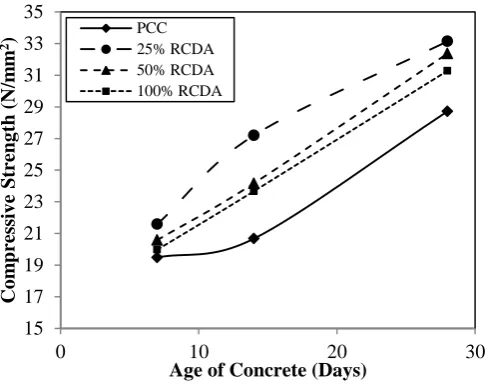
Compressive strength: Tests for compressive strength have been carried out on 90 cubes as per the specifications of IS 516-1959.The 28 Days compressive strength of PCC has been observed to be28.72 N/mm2.It shows that RCDA and natural aggregates perform better when used in combination. The variation of the compressive strength of RCDA concrete with age is shown in Figure 1. For PLW, a catastrophic failure has been observed at all percentages. The variation of the compressive strength of PLW concrete with age is shown in Figure 2.
No significant change in the value of compressive strength of concrete has been observed at 5% addition of PVC as a replacement to natural coarse aggregates. However, at 10% addition of PVC as an aggregate, a
[image:4.595.319.562.148.340.2]slight decrease in compressive strength has been observed. The variation of the compressive strength of PVC concrete with age is shown in Figure 3.
Fig-1: Variation of Compressive Strength with Age of Concrete for Different Percentages of RCDA A significant improvement in the compressive strength of concrete has been observed on addition of CIW as a replacement to sand. The variation of the compressive strength of resultant concrete with age is shown in Figure 4.
Fig-2: Variation of Compressive Strength with Age of Concrete for Different Percentages of PLW 15
17 19 21 23 25 27 29 31 33 35
0 10 20 30
Co
m
press
iv
e
Str
eng
th (
N/m
m
2)
Age of Concrete (Days) PCC
25% RCDA 50% RCDA 100% RCDA
0 5 10 15 20 25 30 35
0 10 20 30
C
o
m
pr
essiv
e
St
re
ng
th
(N
/m
m
2)
Age of Concrete (Days) PCC
5% PLW
© 2017, IRJET | Impact Factor value: 5.181 | ISO 9001:2008 Certified Journal
| Page 1632
Fig-3: Variation of Compressive Strength with Age of Concrete for Different Percentages of PVC Flexural strength: Tests for flexural strength have been carried out on 20 beams as per the specifications of IS 516-1959. The 28 Days flexural strength of PCC has been observed to be 4.708 N/mm2.A significant increase in the flexural strength of concrete has been observed on addition of RCDA as a replacement to natural coarse aggregates. However, the maximum strength has been observed at 25% RCDA content and lowest at 100% RCDA content as aggregates.
Fig-4: Variation of Compressive Strength with Age of Concrete for Different Percentages of CIW
Fig-5: Variation of Flexural Strength with Age of Concrete for Different Percentages of RCDA It shows that RCDA and natural aggregates also performs better in flexure when used in combination. The variation of the flexural strength of RCDA concrete with age is shown in Fig. 5.
Fig-6: Variation of Flexural Strength with Age of Concrete for Different Percentages of PVC No significant improvement in the value of flexural strength of concrete has been observed at 10% addition of PVC as a replacement to natural coarse aggregates. However, at 5% addition of PVC as an aggregate, an impressive increase in flexural strength has been observed. The variation of the flexural strength of PVC concrete with age is shown in Fig. 6.
15 17 19 21 23 25 27 29 31
0 10 20 30
Co
m
press
iv
e
Str
eng
th (
N/m
m
2)
Age of Concrete (Days) PCC
5% PVC 10% PVC
15 17 19 21 23 25 27 29 31 33 35
0 10 20 30
Co
m
press
iv
e
Str
eng
th (
N/m
m
2)
Age of Concrete (Days) PCC
20% CIW 10% CIW
2.5 3 3.5 4 4.5 5 5.5
0 10 20 30
F
lex
ura
l
Str
eng
th (
N/m
m
2)
Age of Concrete (Days) PCC
25% RCDA 50% RCDA 100% RCDA
3 3.5 4 4.5 5 5.5
0 10 20 30
F
lex
ura
l
Str
eng
th (
N/m
m
2)
Age of Concrete (Days) PCC
5% PVC
© 2017, IRJET | Impact Factor value: 5.181 | ISO 9001:2008 Certified Journal
| Page 1633
No significant improvement in the flexural strength of concrete has been observed on addition of CIW as a replacement to sand. The variation of the flexural strength of resultant concrete with age is shown in Fig. 7.
Fig-7: Variation of Flexural Strength with Age of Concrete for Different Percentages of CIW Split tensile strength: Tests for split tensile strength have been carried out on 20cylinders as per the specifications of IS 5816-1999. The 28 Days split tensile strength of PCC has been observed to be 2.952 N/mm2. A significant increase in the split tensile strength of concrete has been observed on addition of RCDA as a replacement to natural coarse aggregates. However, the maximum strength has been observed at 25% RCDA content and lowest at 100% RCDA content as aggregates. It shows that RCDA and natural aggregates also performs better in tension when used in combination. The variation of the split tensile strength of RCDA concrete with age is shown in Figure 8.
No significant improvement in the value of split tensile strength of concrete has been observed at 10% addition of PVC as a replacement to natural coarse aggregates. However, at 5% addition of PVC as an aggregate, a slight increase in split tensile strength has been observed. The variation of the split tensile strength of PVC concrete with age is shown in Figure 9.
Fig-8: Variation of Split Tensile Strength with Age of Concrete for Different Percentages of RCDA
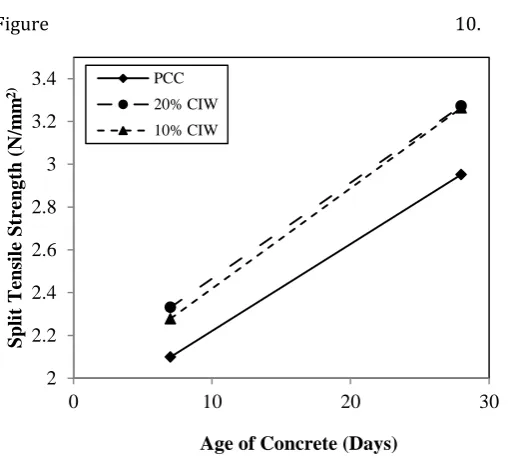
Fig-9: Variation of Split Tensile Strength with Age of Concrete for Different Percentages of PVC A significant improvement in the split tensile strength of concrete has been observed on addition of CIW as a replacement to sand. The variation of the split tensile strength of resultant concrete with age is shown in 2.5
3 3.5 4 4.5 5
0 10 20 30
F
lex
ura
l
Str
eng
th (
N/m
m
2)
Age of Concrete (Days) PCC
20% CIW 10% CIW
2 2.2 2.4 2.6 2.8 3 3.2 3.4 3.6 3.8 4
0 10 20 30
Sp
lit
T
ens
ile
Str
eng
th (
N/m
m
2)
Age of Concrete (Days) PCC
25% RCDA 50% RCDA 100% RCDA
2 2.2 2.4 2.6 2.8 3 3.2 3.4
0 10 20 30
Sp
lit
T
ens
ile
Str
eng
th (
N/m
m
2)
Age of Concrete (Days) PCC
5% PVC
© 2017, IRJET | Impact Factor value: 5.181 | ISO 9001:2008 Certified Journal
| Page 1634
Figure 10.
Fig-10:Variation of Split Tensile Strength with Age of Concrete for Different Percentages of CIW On the careful assessment of results, it has been observed that concrete samples with 25% RCDA and 5% PVC performed well in all tests. These concrete variants can be used in reinforced construction works without the use of superplasticizers. Significant reduction in a slump has been observed for rest of the cases and hence can be used with superplasticizers. Utilization of leather waste in concrete production is not at all recommended.
6. CONCLUSION
The following conclusions are derived from this study:
A significant increase in the compressive strength of concrete has been observed on addition of RCDA as a replacement to natural coarse aggregates. However, the maximum strength has been observed at 25% RCDA content and lowest at 100% RCDA content as aggregates. It shows that RCDA and natural aggregates perform better when used in combination.
For PLW, a catastrophic failure has been observed at all percentages. The variation of the compressive strength of PLW concrete with age. Hence, utilization of leather waste in concrete production is not at all recommended.
No significant change in the value of compressive strength of concrete has been observed at 5% addition of PVC as a replacement to natural coarse aggregates. However, at 10% addition of PVC as an aggregate, a slight decrease in compressive strength has been observed. It shows that PVC
can be used along with natural aggregates while preparing concrete for common construction works.
A significant improvement in the compressive strength of concrete has been observed on addition of CIW as a replacement to sand.
A significant increase in the flexural strength of concrete has been observed on addition of RCDA as a replacement to natural coarse aggregates. However, the maximum strength has been observed at 25% RCDA content and lowest at 100% RCDA content as aggregates. It shows that RCDA and natural aggregates also performs better in flexure when used in combination.
No significant improvement in the value of flexural strength of concrete has been observed at 10% addition of PVC as a replacement to natural coarse aggregates. However, at 5% addition of PVC as an aggregate, an impressive increase in flexural strength has been observed.
No significant improvement in the flexural strength of concrete has been observed on addition of CIW as a replacement to sand.
A significant increase in the split tensile strength of concrete has been observed on addition of RCDA as a replacement to natural coarse aggregates. However, the maximum strength has been observed at 25% RCDA content and lowest at 100% RCDA content as aggregates. It shows that RCDA and natural aggregates also performs better in tension when used in combination.
No significant improvement in the value of split tensile strength of concrete has been observed at 10% addition of PVC as a replacement to natural coarse aggregates. However, at 5% addition of PVC as an aggregate, a slight increase in split tensile strength has been observed.
A significant improvement in the split tensile strength of concrete has been observed on addition of CIW as a replacement to sand.
The study shows that the use of recycled waste materials in concrete is an effective method to deal with the scarcity of natural aggregates. Their use can also solve the problem of their disposal. Hence, their utilization is a beneficialproposition which is economical and
environment friendly as well.
REFERENCES
1. Ahmed, S.F.U. (2013), “Properties of Concrete Containing Construction and Demolition Wastes and Fly Ash”, Journal of Materials in Civil Engineering, Volume 25, Issue 12, pp. 1864-1870.
2 2.2 2.4 2.6 2.8 3 3.2 3.4
0 10 20 30
Spli
t
Tensi
le
St
re
ng
th
(N
/m
m
2)
Age of Concrete (Days) PCC
20% CIW
© 2017, IRJET | Impact Factor value: 5.181 | ISO 9001:2008 Certified Journal
| Page 1635
2. Bahoria, B., Parbat, D.K., Nagarnaik, P.B. and Waghe, U.P. (2013), “Effect of Replacement of Natural Sand by Quarry Dust and Waste Plastic on Compressive & Split Tensile Strength of M20 Concrete”, 4th Nirma University International
Conference on Engineering, Procedia
Engineering, Institute of Technology,
NirmaUniversity, Ahmedabad.
3. Ghailan, A.H. (2005), “Modified Concrete by Using a Waste Material as a Coarse Aggregate”, Construction Research Congress 2005, San Diego, California.
4. IS 10262 (1982), “Recommended Guidelines for Concrete Mix Design”, Bureau of Indian Standards, New Delhi.
5. IS 1199 (1959), “Indian Standard Methods of Sampling and Analysis of Concrete”, Bureau of Indian Standards, New Delhi.
6. IS 2386 - Part 1 (1963),“Methods of Test for Aggregates for Concrete: Part 1Particle Size and Shape”, Bureau of Indian Standards, New Delhi. 7. IS 2386 - Part 3 (1963),“Methods of Test for
Aggregates for Concrete: Part 3 Specific Gravity, Density, Voids, Absorption and Bulking”, Bureau of Indian Standards, New Delhi.
8. IS 383 (1970), “Specifications for Coarse and Fine Aggregates from Natural Sources for Concrete”, Bureau of Indian Standards, New Delhi.
9. IS 4031 - Part1 (1996),“Methods of Physical
Tests for Hydraulic Cement: Part 1
Determination of Fineness by Dry Sieving”, Bureau of Indian Standards, New Delhi.
10. IS 4031 - Part 3 (1988),“Methods of Physical
Tests for Hydraulic Cement: Part 3
Determination of Soundness”, Bureau of Indian Standards, New Delhi.
11. IS 4031 - Part 4 (1988),“Methods of Physical
Tests for Hydraulic Cement: Part 4
Determination of Consistency of Standard Cement Paste”, Bureau of Indian Standards, New Delhi.
12. IS 4031 - Part 5 (1988),“Methods of Physical
Tests for Hydraulic Cement: Part 5
Determination of Initial and Final Setting Times”, Bureau of Indian Standards, New Delhi. 13. IS 4031 - Part 6 (1988),“Methods of Physical
Tests for Hydraulic Cement: Part 6
Determination of Compressive Strength of Hydraulic Cement (other than masonry cement)”, Bureau of Indian Standards, New Delhi.
14. IS 456 (2000), “Plain and Reinforced Concrete Code of Practice”, Bureau of Indian Standards, New Delhi.
15. IS 516 (1959), “Indian Standard Code of Practice - Methods of Test for Strength of Concrete”, Bureau of Indian Standards, New Delhi.
16. IS 5816 (1999), “Indian Standard –Splitting Tensile Strength of Concrete - Method of Test”, Bureau of Indian Standards, New Delhi.
17. IS 8112 (1989), “Specifications for 43-Grade Portland Cement”, Bureau of Indian Standards, New Delhi.
18. Kabir, S., Al-Shayeb, A. and Khan, I.M. (2016), “Recycled Construction Debris as Concrete Aggregate for Sustainable Construction Materials”, Procedia Engineering Volume 145, pp. 1518 – 1525.
19. Kurup, A.R. and Kumar, K.S. (2016), “Novel Fibrous Concrete Mixture Made from Recycled PVC Fibers from Electronic Waste”, Journal of Hazardous, Toxic, and Radioactive Waste, pp. 04016020- (1-7).
20. Meyer, C. (2002), “Concrete and Sustainable Development”, Concrete and Sustainable
Development, Special Publication ACI
206,Concrete Materials Science to Application – A Tribute to Surendra P. Shah, American Concrete Institute, Farmington Hills.
21. Orlov, M.L. (1996), “Multiple Linear Regression Analysis Using Microsoft Excel”, Online Document, Chemistry Department, Oregon State University.
22. Özalp, F., Yilmaz, H.D., Kara, M., Kaya, Ö. and Şahin, A. (2016), “Effects of Recycled Aggregates from Construction and Demolition Wastes on Mechanical and Permeability Properties of Paving Stone, Kerb and Concrete Pipes”, Construction and Building Materials, Volume 110, pp. 17–23.
23. Puri, N. and Jain, A. (2015), “Correlation Between California Bearing Ratio and Index Properties of Silt and Clay of Low Compressibility”, 5th Indian Young Geotechnical Engineers Conference (5iygec), 14th-15th March, 2015, Vadodra, Organized by IGS Baroda Chapter and MSU, Vadodra.
24. Ren, X., Zhang, L. (2016), “The Complete Recycling of Waste Concrete to Produce Geopolymer Concrete”, Geo-Chicago 2016:
Sustainability, Energy, And The
Geoenvironment, Chicago, Illinois.
25. Sahoo, K., Pathappilly, R.D. and Sarkar, P. (2016), “Behaviour of Recycled Coarse Aggregate Concrete:Age and Successive Recycling”, Journal of The Institution of Engineers India: Series A, Volume 97, Issue 2, pp. 147–154.
© 2017, IRJET | Impact Factor value: 5.181 | ISO 9001:2008 Certified Journal
| Page 1636
Penetration Behaviour of Concrete”, Journal of Adhesion Science and Technology, Volume 29, Issue 7, pp. 625-640.
27. Siddique, R., Khatib, J. and Kaur, I. (2007), “Use of Recycled Plastic in Concrete: A Review”, Waste Management, Volume 28, pp. 1835–1852. 28. Silva, D., Gameiro, F. and Brito, J.D. (2014),
“Mechanical Properties of Structural Concrete Containing Fine Aggregates from Waste Generated by the Marble Quarrying Industry”, Journal of Materials in Civil Engineering, Volume 26, Issue 6, pp. 04014008- (1-8).
29. SP – 23 (1982), “Handbook on Concrete Mixes (Based on Indian Standards)”, Bureau of Indian Standards, New Delhi.
30. Wang, Y., Zureick, A. and Cho, B. (1984), “Properties of Fibre Reinforced Concrete Using Recycled Fibres from Carpet Industrial Waste”, Journal of Materials Science, Volume 29, pp. 4191.
31. YI, C., LI, X. and XU, H. (2013), “The Recovery and Utilization of Construction Waste: Waste Concrete”, International Conference on Construction and Real Estate Management (ICCREM2013), Karlsruhe, Germany.