http://dx.doi.org/10.4236/opj.2014.412034
An Electrostatic Catastrophe Machine as an
Attosecond Pulse Generator
Andrey Gitin
Max Born Institute for Nonlinear Optics and Short Pulse Spectroscopy, Berlin, Germany Email: [email protected]
Received 11 October 2014; revised 8 November 2014; accepted 1 December 2014
Copyright © 2014 by author and Scientific Research Publishing Inc.
This work is licensed under the Creative Commons Attribution International License (CC BY). http://creativecommons.org/licenses/by/4.0/
Abstract
The generation of an attosecond pulse in the ultraviolet range is described in the terms of the ca-tastrophe theory. A simple criterion of tunneling is proposed. The criterion allows constructing the quasiclassical model of the generator of attosecond laser pulses based on the interaction of an electric field of extremely powerful femtosecond pulse with the valence electron in the potential well of the gas atom.
Keywords
Ultrafast Optics, Catastrophe Theory, Bohr Model of the Atom
1. Introduction
Since the advent of the laser in 1960, there has been a sustained interest in the quest of generating laser pulses of the shortest duration and of the maximum power. A pulse is the packet of monochromatic waves and the central frequency of the packet is the so-called carrier frequency of the pulse. Thus, there is a fundamental physical limit of duration of a pulse. It is the period of its carrier frequency. The pulse whose duration is of the order of the period of its carrier frequency is called the ultrashort pulse.
In the visible range of the electro-magnetic spectrum, the ultra short laser pulse can have femtosecond dura-tions (1 fs = 10−15 s). Such laser pulses can be directly produced by modern mode-locked lasers [1] [2]. By using the technique of chirped pulse amplification [3]-[8] the power of the femtosecond pulse can be brought up to the Petawatt level (1 PW = 1015W). Focusing with parabolic mirrors [9] allows getting the intensity of this pulse at the target about 1022 W/cm2, which corresponds to the electric field with the strength well above the interatomic electric field (about several volts per angstrom, 109 V/cm).
How-disappears, the ball jumps to the second potential minimum. This jump is called a “catastrophe”.
The heavy ball in the gravitational potential well can be replaced by an electron in the electrostatic potential well and the external influence by an electric field of a femtosecond laser pulse. In the same way we can create an “electrostatic catastrophe machine” in which the electron jumps from one local minimum with high energy to another one with lower energy. If the difference of the energy levels is of the order of tens of electron volt, the electron jump is accompanied by emission of attosecond electromagnetic pulse in the ultraviolet range of spec-trum.
The aim of the article is to explain the work of the hypothetical electrostatic generator of attosecond pulses from the point of view of the catastrophe theory and classical mechanics, and to use the obtained concepts for a quantum description of the real (quantum) electrostatic generator of attosecond pulses.
2. The Hypothetical Attosecond Electromagnetic Pulses Generator
Let’s consider a classical particle with an elementary charge in a potential well V x
( )
, where V is an electric potential (in volts) at the point x. Assume that the shape of the potential well is described by a biquadratic eq-uation(
)
4 2o ;
V x A =x − ⋅A x , (1) where A is a parameter. This potential well has a mirror symmetry. If A<0, then the well has a minimum at
point x=0, and if A>0, then it has minima at two points x1,2 = ± A2 with values V x Ao
(
1,2;)
= −A2 4and a maximum at the point x3,4=0 with the value of V x Ao
(
3,4;)
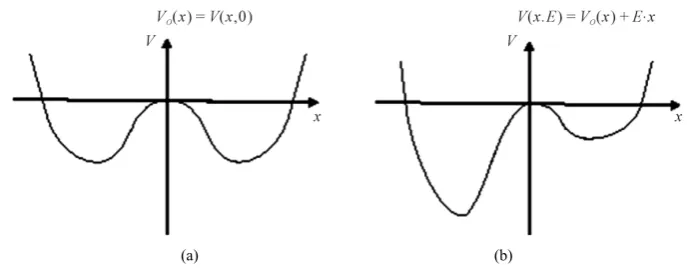
=0. Thus, in case A>0, the potential well has a W-shaped profile with two minima at points “x1“ и “x2“, separated by a potential barrier with the height of ∆Vo (Figure 1(a)):(
) (
)
2o o 3,4; o 1,2; 4
V V x A V x A A
∆ ≡ − = . (2)
Since the distance between the minima (i.e. the width of the potential barrier)
( )
2 1 2
x x x A
∆ ≡ − =√ (3)
is proportional to the square root of the parameter A, the height of the potential barrier ∆Vo is associated with the distance between the minima ∆x by the formula
(
)
42
o 4 2
V A x
∆ = = ∆ . (4) If we add the potential of the electric field of the laser pulse with the maximum strength E (in the form of a linear function Ex) to the initial W -shaped potential function, the resulting function takes the form (Figure 1(b))
(
)
(
)
4 2o
; , ;
V x A E ≡V x A E x x+ ⋅ = − ⋅ + ⋅Á x E x (5) and its potential minima will be redistributed.
(a) (b)
Figure 1. The initial electrostatic potential well V xo
( )
(a) and its deformation by an externaluniform electric field E: (a) E=0, (b) E>0.
(
; ,)
0U x A E = , (6) where
(
; ,)
d d 4 3 2U x A E = V x= x − Ax E+ . (7) Combining (6) and (7) one gets the equation of equilibrium states
3
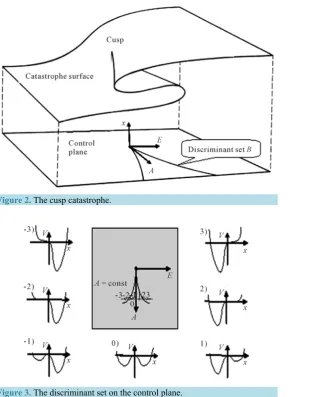
4x −2Ax E+ =0. (8) Equation (8) gives a surface M in the three-dimensional space with coordinates
(
x A E, ,)
which is the so-called catastrophes surface (Figure 2). The surface M divides(
x A E, ,)
-space into two regions. In the re-gion located generally higher than M we have U x A E(
; ,)
>0. In the region located generally below M we have U x A E(
; ,)
<0.Let the x-axis be vertical to the plane of control variables
(
A E,)
. The solutions of Equation (8) can be found by drawing a vertical line passing through the point(
A E,)
of the control plane. The line intersects the surface М at the points(
x A E, ,)
, where x is the desired solution. As the catastrophes surface М has a fold, the number of solutions based on the parameters(
A E,)
may be equal to 1, 2 or 3 (Figure 2).Minima of the function V x
( )
are achieved at those values of x for which the function U x( )
changes its sign from minus to plus. Therefore, the case when Equation (5) has one solution corresponds to a minimum of the potential well. When it has three solutions, the middle solution corresponds to the maximum. When it has two solutions, one solution is not the minimum or the maximum, but the second solution is the minimum. At the points of the double solution the vertical line touches the surface M , so if one looks from the top at the surface M, one can see a “visible path” B along which the surface bends (Figure 2). This path B in the(
A E,)
-plane is called the discriminant set of U. This set separates the points(
A E,)
of the control plane giving one solution to U t( )
=0 (“outside” B) from those giving three solutions (“inside” B) (Figure 3).Thus, if the control variables
(
A E,)
vary, the catastrophe can happen: the charged particle can jump sud-denly from the high local potential minimum to the lower one (This jump is accompanied by the emission of electromagnetic radiation). In this case the moment of the catastrophe is determined by the principle of maxi-mum delay [13]: the state of the system is determined by the local minimum until it exists.The discriminant set B can be found using the condition that at these points the equation U x
( )
=0 has a double root, i.e. U x( )
=U x′( )
=0. Excluding the variable x from the corresponding equations3
4x −2Ax E+ =0 (9) 2
12x −2A=0, (10) we obtain B:
3 2
8A =27E . (11) The generation of ultrashort pulses is a process when A is constant and E is a function of time t. Let
const 0
A= > , then the discriminant set B degenerates into two points E
( )
2 3(
2A3 3)
[image:3.595.65.539.85.354.2]Figure 2. The cusp catastrophe.
Figure 3. The discriminant set on the control plane.
Figure 3) and E
( )
2 3(
2A3 3)
− = − √ (point “−2” in Figure 3). If E E< −, then there is only the right potential
local minimum (point “−3” in Figure 3), if E−< <E E+, then there are two potential local minima (points “−1”,
“0”, “1” in Figures 3), and if E E> +, there is only the left potential local minimum (point “3” in Figure 3).
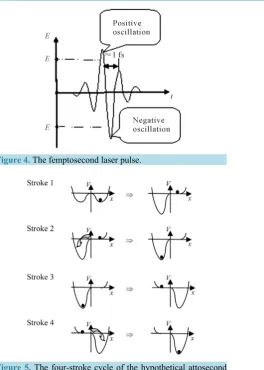
Let a femtosecond laser produce an ultra short laser pulse in the form of two big oscillations and the ampli-tude of the first (positive) oscillation is bigger than E+ and the amplitude of the second (negative) oscillation is
smaller than E− (Figure 4). On the attosecond time scale, the femptosecond pulse can be considered
quasis-tatic.
If the quasistatic laser pulse falls on the system “the charged particle in the second potential well”, we have a generation of ultrashort pulses which are described by a four-stroke cycle (Figure 5).
Stroke 1 The leading edge of the positive oscillation raises the charged particle in the second potential minimum until this potential well disappears. During this time interval, the particle reserves the energy ∆E+ = ∆ ⋅x E.
Stroke 2 According to the principle of maximum delay, in the moment when the positive amplitude of the leading edge equals E+ the second potential well disappears and a catastrophe occurs: the charged particle
jumps from the high second minimum ∆ ⋅x E+ to the low first minimum −∆ ⋅x E+ and radiates an attosecond
pulse with a carrier frequency of ω= ⋅ ∆ ⋅2 x E+e .
Figure 4. The femptosecond laser pulse.
Figure 5. The four-stroke cycle of the hypothetical attosecond generator.
Stroke 4 According to the principle of maximum delay, in the moment when the negative amplitude of the leading edge equals E− the first potential well disappears and a catastrophe occurs: the charged particle jumps
from the high first minimum ∆ ⋅x E− to the low second minimum −∆ ⋅x E− and radiates an attosecond pulse
with a carrier frequency of ω= − ⋅ ∆ ⋅2 x E−e .
At the end of the fourth stroke the system returns to its initial state and the cycle can be repeated. Thus, if this catastrophe machine could exist in nature, it would be a perfect attosecond pulse generator.
3. The Real Attosecond Electromagnetic Pulses Generator
There is a real generation of attosecond pulses in which an electric field of a focused extremely powerful femto-second pulse interacts with a valence electron in the potential well of the noble gas atom [15]-[17]. Note that the work of a real generator of attosecond pulses can be explained by using the concepts of the hypothetical genera-tor of attosecond pulses and the so-called semi classical approximation of quantum mechanics.
According to de Broglie, electrons have wave properties. An electron is described by a wave function. The wave function has a wave length λ. In semi classical Bohr model of the atom (1913), valence electrons rotate in circular stationary orbits around the atom nucleus [18]. The stationary orbit satisfies the standing wave condi-tion: the whole number of the electron wavelengths λ must fit along the circumference of the orbit [18]:
( )
ZeV x k Ex
x
= − − , (14)
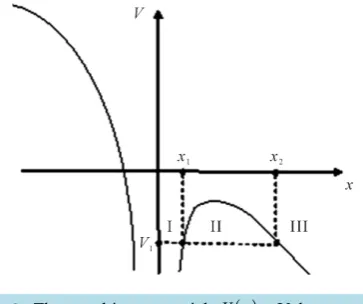
where e is the charge of the electron, k is Coulomb’s constant. Note that the resulting potential V x
( )
, Eq-uation (14), has the potential barrier with the height Vmax (see Figure 6). The width of the barrier is determined by the distance between the turning points x1 and x2, where the potential V x( )
is equal to the basic energy level –Vn:( )
en
k E t x V
x
− − = − . (15)
The quadratic equation with respect to x
2 e 0
n
E x V x k⋅ − + = (16) gives two solutions:
2
1
4 e 2
n n
V V k E
x
E
+ − −
= (17a)
is the left turning point (a particle from the region I falls into the region II),
2
2
4 e 2
n n
V V k E
x
E
+ + −
= (17b)
is the right turning point (a particle from the region II falls into the region III).
For further calculations it is necessary to choose a simple criterion of the barrier width at which the electron tunnels through the barrier. The condition of the stationary orbit, Equation (12), and the condition for tunneling (the width of the barrier is comparable to the wavelength of the electron λ) allow us to formulate a simple cri-terion:the electron tunnels through the barrier if the barrier width equals the diameter of the stationary orbit di-vided by n (points “−2” and “2” in Figure 7). Note that this criterion can be written in the arithmetic form as
Figure 6. The resulting potential V x
( )
. Value V1= −13.9corresponds to the basic energy level of the hydrogen atom
[image:6.595.223.405.531.683.2]Figure 7. The tunneling curve on the control plane.
(
)
1 2
2 1
2
x x x x
n
+ = −
. (18)
2 2 2 16 e 4 1 n n
V k E
n
=
− . (19)
The generation of ultrashort pulses is a process when Vn is constant and E is a function of time t, as we can see in Figure 7. Let Vn=const 0> , then the tunneling curve T degenerates into two points:
2 2 2
4 1
16 e n
n
E V
n k
+ = − (point “2” in Figure 7) and 2 2 2
4 1
16 e n
n
E V
n k
−= − − (point “−2” in Figure 7). If E−<E E< +,
then tunneling is not impossible (points “−1”, “0”, “1” in Figure 7). If E E= − , then the left potential barrier can be tunneled by the electron (point “−2” inFigure 7) and if E E= +, the right potential barrier can be tun-neled by the electron (point “2” in Figure 7).
Let a femtosecond laser produce an ultrashort laser pulse in the form of two oscillations where the amplitude of the first (positive) oscillation is bigger than E+ and the amplitude of the second (negative) oscillation is smaller than E− (Figure 4). On an attosecond time scale, the femtosecond pulse can be considered as quasis-tatic.
According to Keldysh [22] [23], the process of tunneling ionization of the valence electron is “quasistatic” too, if the carrier frequency of the laser pulse
ω
is significantly less than the frequency of an electron ωt tunneling through the potential barriere 2 t
E mV ω<<ω ≡ ,
where e, m and V are the charge, mass and energy of the electron, and E is the maximum amplitude of the laser pulse.
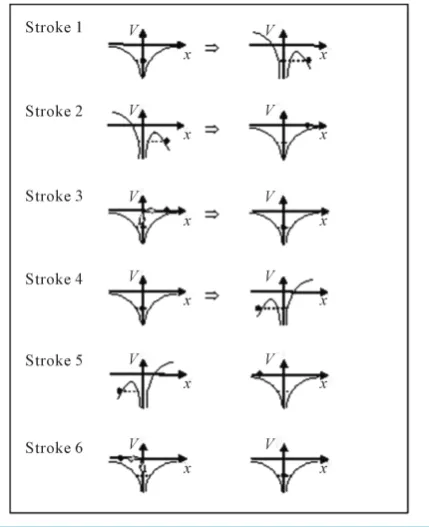
If a quasistatic laser pulse falls on a quasistatic system “electron in the potential well of the atom nucleus”, we have the generation of ultrashort pulses which is described by a six-stroke cycle (Figure 8).
Stroke 1 When the electric strength E in the positive oscillation increases from 0 to E+, the width of the right potential barrier reduces. When the electric strength E equals E+, the electron tunnels through the right potential barrier .
Stroke 2 When the electric strength E reduces from E+ to 0, the electronreserves the energy
2 13,6 n Z V n = − ⋅ .
Stroke 3 When the electric strength E equals 0, the potential barrier disappears and, according to the prin-ciple of maximum delay, a catastrophe occurs: the electron jumps from the zeroenergy level to the basic energy level and radiates an attosecond pulse with a carrier frequency of ω =Vne .
Figure 8. The six-stroke cycle of the real attosecond generator.
right potential barrier reduces too.When the electric strength E equals E−, the electron tunnels through the
left potential barrier .
Stroke 5 When the electric strength E increases from E− to 0, the electronreserves the energy
2
13,6
n Z
V
n
= − ⋅
Stroke 6 When the electric strength E equals 0, the potential barrier disappears and, according to the prin-ciple of maximum delay, a catastrophe occurs: the electron jumps from the zeroenergy level to the basic energy level and radiates an attosecond pulse with a carrier frequency ω =Vne .
At the end of the sixth stroke the system returns to its initial state and the cycle can be repeated.
In the table of the elements there is a periodic trend for ionization energy [19]: each period begins at a mini-mum for the alkali metals, and ends at a maximini-mum for the noble gases. So, to generate attosecond pulses the hy-drogen or the noble gases are used. As the H ionization energy [19] is 13.59 eV, He—24.58 eV, Ne—21.56 eV, Ar—15.76 eV, Kr—13.99 eV, Xe—12.13 eV, Hg—10.43 eV, Rn—10.74 eV, the corresponding radiation refers to the soft EUV region of the spectrum. The duration of the ultra short pulse in a photon energy range of 10 eV to 25 eV cannot be less than 100 as.
In the catastrophe theory the principle of maximum delay is widely used [13]. In this article we have used this principle too. However, it does not allow taking into account the kinetic energy of an electron oscillating in an external laser field the so-called ponder motive energy. To produce the hard EUV-rays or even X-rays ponder motive energy must be taken into account. In this case, the principle of maximum deceleration should be re-placed by a different, more suitable principle.
4. Conclusion
References
[1] Yariv, A. (1965) Internal Modulation in Multimode Laser Oscillators. Journal of Applied Physics, 36, 388-391.
http://dx.doi.org/10.1063/1.1713999
[2] Gitin, A.V. (2013) Application of the Sampling and Replication Operators to Describe Mode-Locked Radiation. Optics and Photonics Journal, 3, 305-310. http://dx.doi.org/10.4236/opj.2013.35047
[3] Strickland, D. and Mourou, G. (1985) Compression of Amplified Chirped Optical Pulses. Optics Communications, 56, 219-221. http://dx.doi.org/10.1016/0030-4018(85)90120-8
[4] Gitin, A.V. (2008) Geometrical Method for Calculating the Group Velocity Dispersion of Stretcher Taking into Account the Influence of Optical System Parameters. Quantum Electronics, 38, 1021-1026.
http://dx.doi.org/10.1070/QE2008v038n11ABEH013830
[5] Gitin, A.V. (2012) Tautochronism Principle and Grating Dispersive Delay Lines. Applied Optics, 51, 27-32.
http://dx.doi.org/10.1364/AO.51.000027
[6] Gitin, A.V. (2010) Zero-Distance Pulse Front as a Group Delay Characteristic of the Two-Grating Compressor. Optics Communication, 283, 1090-1095. http://dx.doi.org/10.1016/j.optcom.2009.11.042
[7] Gitin, A.V. (2012) Using the Unfolding Method for Dispersion Calculations of Reflective Grating Delay Lines in the Chirped Pulses Amplifier. Optics Communication, 285, 1375-1382. http://dx.doi.org/10.1016/j.optcom.2011.11.085
[8] Gitin, A.V. (2013) Zero-Distance Pulse Fronts of a Compressor, a Stretcher, and the Optical System of the Stretcher.
Optics Communication, 295, 161-169. http://dx.doi.org/10.1016/j.optcom.2012.12.068
[9] Gitin, A.V. (2009) Optimal Two-Mirror System for Laser Radiation Focusing. Quantum Electronics, 39, 977-980.
http://dx.doi.org/10.1070/QE2009v039n10ABEH013815
[10] Poston, T. and Stewart, I. (1978) Catastrophe Theory and Its Applications. Pitman Publishing, Ltd., London. [11] Bruce, J.W. and Geblin, P.G. (1993) Curves and Singularities. Cambridge University Press, Cambridge. [12] Zeeman, E.C. (1976) Catastrophe Theory. Scientific American, 234, 65-83.
http://dx.doi.org/10.1038/scientificamerican0476-65
[13] Gilmore, R. (1981) Catastrophe Theory for Scientists and Engineers. Wiley, New York.
[14] Brocker, T. and Lander, L. (1975) Differentiable Germs and Catastrophes. Universitat Regensburg Fachbereich Mathe- matik. Cambridge Universitz Press, Cambridge. http://dx.doi.org/10.1017/CBO9781107325418
[15] Corkum, P.B. (1993) Plasma Perspective on Strong-Field Multiphoton Ionization. Physical Review Letters, 71, 1994- 1997. http://dx.doi.org/10.1103/PhysRevLett.71.1994
[16] Hellerer, T. (2012) Attoscience Goes OPCPA. New Laser Developments in High Harmonic Generation. Optik & Photonik, 7, 53-55. http://dx.doi.org/10.1002/opph.201390000
[17] Uiberacker, M., Uphues, T., Schultze, M., Verhoef, A.J., Yakovlev, M.F., Kling, V., Rauschenberger, J., Kabachnik, N.M., Schrцder, H., Lezius, M., Kompa, K.L., Muller, H.-G., Vrakking, M.J.J., Hendel, S., Kleineberg, U., Heinzmann, U., Drescher, M. and Krausz, F. (2007) Attosecond Real-Time Observation of Electron Tunnelling in Atoms. Nature,
446, 627-632. http://dx.doi.org/10.1038/nature05648
[18] Bohr Model. From Wikipedia, the Free Encyclopedia.http://en.wikipedia.org/wiki/Bohr_model
[19] Ionization Energy. From Wikipedia, the Free Encyclopedia. https://en.wikipedia.org/wiki/Ionization_energy [20] Effective Nuclear Charge. From Wikipedia, the Free Encyclopedia.
http://en.wikipedia.org/wiki/Effective_nuclear_charge
[21] Pastor, A.A. and Serdobintsev, P.Y. (2007) Methods of Generation of Attosecond Pulses of Laser Radiation and Elec-tron Beams Attosecond Pulses in Intense Field of Femtosecond Duration. http://ckp.lab2.phys.spbu.ru/pdf/new/24.pdf
[22] Keldysh, L.V. (1965) Ionization in the Field of a Strong Electromagnetic Wave. Journal of Experimental and Theoret-ical Physics, 20, 1307-1314. http://www.jetp.ac.ru/cgi-bin/dn/e_020_05_1307.pdf
[23] Popov, V.S. (2004) Tunnel and Multiphoton Ionization of Atoms and Ions in a Strong Laser Field (Keldysh Theory).