6
II
February 2018
Optimal Design of PID Controller for a CSTR
System Using BF-PSO
Abhay Katyayan1, Dr. Deependra Singh2, Arvind kumar Ojha3
1
M.Tech. student 2Professor, Electrical Engineering Department, KNIT Sultanpur (UP 3
CDMS, Indian Railways, Modern Coach Factory Raebareli
Abstract: Social foraging behavior of a Escherichia–colibacteria has been explored to develop a novel algorithm for distributed optimization and control. Recently hybrid approach developed, involving PSO and BFOA (bacterial foraging optimization algorithm) algorithm for optimizing multi-model and high dimensional function.
This paper presents the optimal design of PID controller based on a Bacterial foraging particle swarm optimization (BF-PSO) approach for continuous stirred tank reactor (CSTR). The mathematical model of experimental system had been approximated near the operating point for the PSO algorithm to adjust PID parameters for the objective function. The results show the adjustment of PID parameters converting into the optimal point. The good control response is obtained based on the optimal values by the BF-PSO technique.
Index Terms: PSO (Particle swarm optimization),BF-PSO, optimal control, simulation.
I.INTRODUCTION
The process control techniques in the industry have made great advances during the past decades. A no of control methods such as adaptive control, neural control, and fuzzy control have been studied. Among them, the best known is the proportional-integral-derivative (PID) controller, which has been widely used in the industry because of its simple structure and robust performance in a wide range of operating conditions. Unfortunately, it has been quite difficult to tune properly the gains of PID controllers because many industrial plants are often burdened with problems such as high order, time delays, and nonlinearities. It is hard to determine optimal or near optimal PID parameters with the classic tuning method (Ziegler-Nichol’s method for instance). For these reasons, it is highly desirable to increase the capabilities of PID controllers by adding new features.
Many artificial intelligence (AI) techniques have been employed to improve the controller performances for a wide range of plants while retaining their basic characteristics. AI techniques such as neural network, fuzzy system, and neural-fuzzy logic have been widely applied to proper tuning of PID controller parameters.
Particle swarm optimization (PSO) [1], first introduced by Kennedy and Eberhart, is one of the modern heuristic algorithms. It was developed through simulation of a simplified social system, and has been found to be robust in solving continuous nonlinear optimization problems. The PSO technique can generate a high-quality solution within shorter calculation time and stable convergence characteristic than other stochastic methods. PSO method is an excellent optimization methodology and a promising approach for solving the optimal PID controller parameters. Therefore, this study develops the PSO-PID controller to search optimal PID parameters. This controller is called the PSO-PID controller. In this paper, we propose a particle swarm optimization approach for optimal design of PID controller for continuous stirred tank reactor.
The Bacterial Foraging Optimization Algorithm (BFOA) is currently gaining popularity in the community of researchers, for its effectiveness in solving certain difficult real-world optimization problems. BFOA is based on the foraging strategies of Ecoli bacterium cells and was proposed by Prof. K. M. Passino in 2001 [19]. PSO and DE are excellent heuristics like other evolutionary algorithms
[17].Practical experiences suggest that they reach stagnation after certain number of generations as the population is not converged
locally, so they will stop proceeding towards global optimal solutions. The stochastic search methods are proven in reaching global solutions for certain difficult real world optimization problems [18]. Hence this article comes up with a hybrid approach involving PSO-DE and BFOA algorithm for solving non-convex DED problem considering valve-point loading effects, ramp-rate limits, prohibited operating regions and spinning reserve capacity.
II. FUNDAMENTALS OF PID CONTROLLERS
Widely applied in industry to solve various control problems. PID controllers have been used for decades. During this time, many modifications have been presented in the literatures [2]-[6]. As modeled in this paper, the transfer function of PID controller is
described by the following equation in the continuous s-domain (Laplace operator).
( )
( )= Kc + + sKd + (1)
Where U(s) and E(s) are the control (controller output) and tracking error signals in s-domain, respectively; kp is the proportional
gain, ki is the integration gain, and kd is the derivative gain. Ti is the integral action time or reset time and Td is referred to as the
derivation action time or rate time. In this context, output of the PID controller in time domain is given by
u(t) = Kpe(t) + Ki∫ ( ) ( ) + Kd
( )
+ b (2)
Where u(t) and e(t) are the control and tracking error signals in time domain, respectively. The proportional part of the PID
controller reduces error responses to disturbances. The integral term of the error eliminates steady state error and the derivative term of error dampens the dynamic response and thereby improves stability of the system. The parameter settings of a PID controller for optimal control of a plant depend on the plant’s behavior. To design the PID controller the engineer can appropriately choose the combination of and to simultaneously take care of the transient response as well as the steady-state error. In the design of a PID controller, the three gains of PID must be selected in such a way that the closed loop system has to give the desired response. The desired response should have minimal settling time with a small or no overshoot in the step response of the closed loop system. A performance index is a quantitative measure of the performance of the system. A system is considered an optimal control system when the system parameters are adjusted so that the index reaches an extreme value, commonly a minimum value [7]. A suitable performance index taken for the CSTR system
F=e2 * β+sys _ overshoot *α
α = 10
β = 10
e = error
III. CSTR PROCESS DESCRIPTION
In this paper, we consider the control problem of an ideal jacketed Continuously Stirred Tank Reactor (CSTR) system (Fig.1), where the following exothermic and irreversible first-order reaction is taking place:
A→B (3) the kinetics rate law
−rA=KT (CA ) = K0 exp (− E* CA / RT ) (4)
Under the assumptions of constant volume, perfect mixing inside the reactor and constant reacting mixture heat capacity, one may
write down the following mass balance for species A, as well as an overall energy balance for the reactor:
dCA/dt =F(CA,in)/V-k(T)CA (5)
dT/dt=F(Tin-T)/V-hr(kT)CA/ρcp-UAr(T-Tj)/Vρcp(6)
Under the assumptions of uniform temperature of the jacket fluid inside the circulation tubes and constant water heat capacity, an energy balance for the jacket may also be written down:
dTj/dt=Fcw*ρw*(Tcw-Tj)/mo+P/Cwmo+ UAr (T-Tj)/ Cwmo (7)
In equations (5) – (7) t is the time, c are concentrations, T represents temperatures, Tj is the jacket temperature, cp is used for specific
heat capacities, F represents Volumetric flow rate, m0 is overall effective mass of the heating/cooling system, V is reactor volume, ρ
represents densities, Ar is the heat exchange surface, cw is heat capacity of water, P is power input to the heater, Tcw is temperature of
cooling water and U is the heat transfer coefficient. The numerical values taken from [5] (see, [6] for more details on CSTR). A
linear model will be developed around the steady-state operating point. The linearization will be respect to CA and T,CA,in .in and Tin
. The goal is to control the reactor composition by manipulating the cool rate through the control signal u. Without getting into more
Hyu=
. ∗ .
( . )( . ) (8)
Fig.1. A CSTR Control System
IV. BF-PSO ALGORITHM
Particle swarm optimization (PSO) [1] is a stochastic optimization technique that draws inspiration from the behavior of a flock of birds or the collective intelligence of a group of social insects with limited individual capabilities. In PSO a population of particles is
initialized with random positions Xi and velocities Vi , and a fitness function, f, is evaluated, using the particle’s positional
coordinates as input
values. In an n-dimensional search Xi = (Xi1, Xi2, Xi3,.…..,Xin) and Vi= (Vi1, Vi2, Vi3,…….,Vin ).
Positions and velocities are adjusted, and the function is evaluated with the new coordinates at each time- step. The velocity and
positions and update equation for the dth dimension of the ith particle in the swarm may be given as follows:
Vid (t+1) = wVid (t) + c1Φ1(P1id–Xid(t)) + c2Φ2(Pgd – Xid(t)) (9)
Xid(t+1) = Xid(t) + Vid (t+1)(10)
The BFOA is on the other hand is based upon search and optimal foraging decision making capabilities of the E. Colibacteria [16].
The coordinates of a bacterium here represent an individual solution of the optimization problem. Such a set of trial solutions converges towards the optimal solution
following the foraging group dynamics of the bacteria population. Chemo-tactic movement is continued until a bacterium goes in the direction of positive nutrient gradient (i.e. increasing fitness). After a certain number of complete swims the best half of the population undergoes reproduction, eliminating the rest of the population. In order to escape local optima, an elimination-dispersion event is carried out where, some bacteria are liquidated at random with a very small probability and the new replacements are initialized at random locations of the search space. A detailed description of the complete algorithm can be traced
in [1].In the proposed approach, after undergoing a chemo-tactic In the proposed approach, after undergoing a chemo-tactic step, each bacterium also gets mutated by a PSO operator. In this phase, the bacterium is stochastically attracted towards the globally best position found so far in the entire population at Synergy of PSO and Bacterial Foraging Optimization 257 current time and also towards its previous heading direction. The PSO operator uses only the ‘social’ component and eliminates the ‘cognitive’ component as the local search in different regions of the search space is already taken care of by the chemo tactic steps of the BFO Aalgorithm. In what follows we briefly outline the new BSO algorithm step by step.
[Step 1]Initialize parameter n,N,Nc,Ns,Ned,Nrc,Pef,C(i) where,
n = dimension of the search space N = The no of bacteria in the population
Nc = no of chomo-tactic steps
Nrc = The no of reproduction steps
Ned = The no of elimination dispersal events
Pef = elimination dispersal with probability
C(i) = swarm confidence
Vi = velocity vector of ith bacteria
[Step 2] Update the following:
J (i, j, k): Cost or fitness value of the i-th bacterium in the jthchemo-taxis, and k-th reproduction loop.
Өgbest: Position vector of the best position found by all bacteria.
Jbest (i, j, k): Fitness of the best position found so far.
[step 3] reproduction loop k=k+1 [step 4] chemotaxix loop j=j+1
[substep a] For i= 1,2,3…..N take a chemotactic bacteria I as follows
[substep b] compute fitness function J (i, j, k)
[substep c] let J least= J (i, j, k)to same this value since weman find a better cost via a run
[substep d] Tumble : generate a random vector
∆(i) ∈R with each element Dm(i) ,m=(1,2,…p)A random no on[-1,1]
[substep e] Move:
Let
θ(i, j+1, k) = θ(j, j, k) + C (i) Δ(i)/{∆ ( )∆( )}
[substep f] complete q (i, j +1, k)
[substep g] swim: we consider i-th bacteria is swimming while other are not moving then Let m = m+1
If J(i, j + k)<Jlast(if doing better) Let J last= J (i, j + 1, k)and let
θi(j+1, k, l) =θi (j, k, l) + C (i) Δ(i)/√{∆ ( )∆( )}
And use this J (i, j +1, k) to complete the new J (i, j +1, k) as we did in [substep a]
Else let s m = N this is the end of the control statement
[step 5] mutation with PSO operator For i= (1,2,3,4……….S)
Update the q g _ best&J best( i j k)
Update the position and velocity of the d-th coordinate of thei-th bacterium according the following rule Vidnew = w Vidnew + c1Φ1(q g _ best – qdold(i, j +1, k))
qdnew(i, j +1, k)) = qdold(i, j +1, k) + Vidnew
[step 6] LetS_r = S/2
The S_rbacteria with highest cost function (J)values die and the other half of bacteria population with the best values split (and the copies that are made are placed atthe same location as their parent).
[step 7] If k<Nre, go to step 1. We have not reached the specified number of reproduction steps. So we start the next generation in
the chemo-taxis loop.
V. OPTIMAL PID CONTROLLERS With BF-PSO
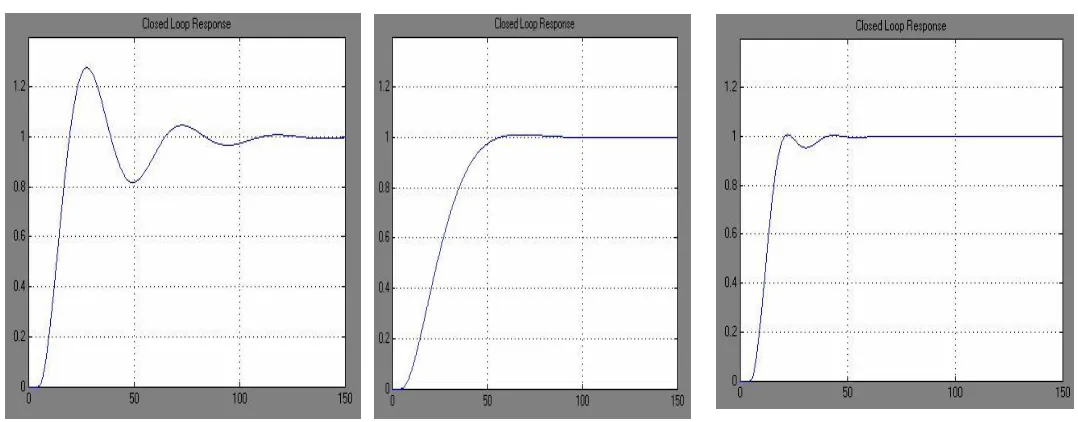
The control system with a set of optimal PID parameters can obtain an excellent response output show in Fig.2. The value of fitness function defined by optimization algorithm would be the minimum. Performance characteristic of evaluation function includes overshoot, rise time, settling time and static error time. The evaluation function as in (6), to compute the evaluation value of each particle in swarm according to control performance.
p =3; Dimension of search space
s=10; The number of bacteria
Nc=15; Number of chemotactic steps
Ns=4; Limits the length of a swim
Nre=4The number of reproduction steps
Ned =2The number of elimination- dispersal events
Sr = S/2; The number of bacteria reproductions (splits) per generation
ped=0.25; The probabilty that each bacteria will be eliminated/dispersed
c(:,1)=0.5*ones(s,1); the run length The single loop PID parameter tuning for CSTR system is accomplished by Ziegler
[image:6.612.36.575.471.682.2]Nichols[15] , PSO algorithm and BF-PSO Algorithm,. The desired parameters are obtained according to Table 1
Table 1
Obtained Parameters by Proposed Methods
Kp Ki Kd
Ziegler-Nichols -1.4702 -0.0601 0
PSO Algorithm -.43278 -.030605 0.23803
BF-PSO Algorithm -2.1638 -0.0587 -11.2071
A. Simulation Result
Step response of the proposed method;
(a) Ziegler-Nichols (b) PSO Algorithm (c) BF-PSO Algorithm
VI. CONCLUSION
The essence of our work is that we managed to combine two major paradigms PSO and BFA in order to create a robust clustering algorithm. The resulting hybrid method showed improved result. This work explains a design of PID controller by using the BF-
PSO algorithm to search for optimal parameters of PID controller ( kp , ki , kd ) in off linemode. Experiment with CSTR system
shows that the parameter obtained from the hybrid-PSO (BF-PSO) method gives better response and tracking to the optimal value. Finally, this experiment is flexible to apply for adaptive control.
REFERENCES
[1]. J.Kennedy and R. Eberhart, “Particle Swarm Optimization” in Proc.IEEE Int. Conf. Neural Networks, Vol.4, 1995, pp1942- 1948.
[2]. V. Overschee and B. De Moor, “RAPID: the end of heuristic PID tuning,” Proc. of the IFAC Workshop on Digital Control, Terrassa, Spain, pp. 595- 600, 2000. [3]. P. Cominos and N. Munro, “PID controllers: recent tuning methods and design to specification,” IEE Proc.-Control Theory Appl., vol. 149, no. 1, pp. 46-53,
2002.
[4]. K. J. Åström and T. Hägglund, “The future of PID control,” Control Engineering Practice, vol. 9, no. 11, pp. 1163-1175, 2001.
[5]. C. W. Alexander and R. E. Trahan, “A comparison of traditional and adaptive control strategies for systems with time delay,” ISATransactions, vol. 40, no. 4, pp. 353-368, 2001.
[6]. W. K. Wojsznis and T. L. Blevins, “Evaluating PID adaptive techniques for industrial implementation,” Proc. of American ControlConference, Anchorage, AK, USA, pp. 1151-1155, 2002.
[7]. M.W.Iruthayarajan, S. Baskar, “OPTIMIZATION OF PID PARAMETERS USING GENETIC ALGORITHM AND PARTICLE SWARM OPTIMIZATION”,
IET-UK International Conference on Information and Communication Technology in Electrical Sciences, India, pp.81-86. 2007
[8]. C. Barrios,S. Niculescu,C. Morarescu, and K.Gu.: “On the Fragility of PI Controllers for Time-Delay SISO Systems” 16th Mediterranean Conference on Control and Automation, pp.529- 534, 2008.
[9]. Jana, A.K.: “Nonlinear State Stimation and Generic Model Control of a Continuous Stirred Tank Reactor,” Int. J. Chemical Reactor Eng., vol. 5, pp.1-15, 2007. [10].ZHANG Li-ping, YU Huan-jun, HU Shang-xu. Optimal choice of parameters for particle swarm optimization. Journal of Zhejiang University SCIENCE 2005
6A(6):530 528- 534
[11].Clerc M, Kennedy J. The Particle Swarm: Explosion, Stability, and Convergence in Multi-Dimension Complex Space [J]. IEEE Transactions on Evolutionary Computation, 2002, 16(1): 58-73
[12].Huang, C.T., Chou, C.J. and Wang, J.L.: “Tuning of PID Controllers Based on the Second-Order Model by Calculation,” Journal of theChinese Institute of Chemical Engineering, vol.27(2), pp.107-120,1996.
[13].Hwang, S.H.: “Closed-loop Automatic Tuning of Single-Input-Single- Output Systems,” Industrial Engineering of ChemicalResearch, vol.34, pp.2406-2417, 1995.
[14].Chao, Y.C., Lin, H.S., Guu, Y.W. and Chang, Y.H.: “Optimal Tuning of a Practical PID Controller for Second Order Process with Delay,” Journal of the Chinese Institute of Chemical Engineering , vol.20(1),pp.7-15, 1989.
[15].Ziegler, J.C. and Nichols, N.B.: “Optimum Setting for Automatic Controllers”, Trans. ASME, vol.64, pp.759-768, 1942. [16].Stephens, D.W., Krebs, J.R., Foraging Theory, Princeton University Press, Princeton,New Jersey, (1986).
[17].Praveena, P, Vaisakh, K, S R M Rao, "A Bacterial Foraging and PSODE Algorithm for Solving Dynamic Economic Dispatch Problem with Valve-Point Effects," Integrated Intelligent Computing (ICIIC), 2010 First International Conference on , vol., no., pp.227-232, 5-7 Aug. 2010.
[18].G. Acampora, M. Gaeta, and V. Loia, "Exploring e-learning knowledge through ontological memetic agents," IEEE Comput. Intell. Mag., vol. 5, no. 2, pp. 66-77, 2010.
[19].. Passino, K.M.: Biomimicry of Bacterial Foraging for Distributed Optimization and Control, IEEE Control SystemsMagazine, 52-67, (2002).
Raise time(in sec)
peak overshoot
Settling time system
Open loop 25 - - unstable
Closed loop(Z-N method) 18.3 27 80 stable
Closed loop(PSO-PID method) 45 1 60 stable