MUHAMMAD FADDTL BIN AHMAD REBUDI
This project report is submitted in partial fulfilment o f the requirement for the award of the Degree of Master of Electrical Engineering
Faculty o f Electrical and Electronic Engineering Universiti Tun Hussein Onn Malaysia
ABSTRACT
i
TABLE OF CONTENTS
TITLE PAGES
TITLE PAGE i
DECLARATION ii
ACKNOWLEDGEMENTS iii
DEDICATION iv
ACKNOWLEDGEMENT v
ABSTRACT vi
TABLE OF CONTENTS viii
LIST OF TABLES xii
LIST OF FIGURES xiii
LIST OF SYMBOLS AND ABREVIATION xv
1.2 Problem Statement 2
1.3 Objective 3
1.4 Scope of Project 3
CHAPTER 2 LITERATURE REVIEW 4
2.1 Inverter
2.1.1 Three Phase Voltage Source Inverter
2.1.2 PWM
2.1.3 SPWM
2.2 Distribution Generation
2.2.1 Introduction
2.2.2 Fuel cells (FCs)
2.2.3 Micro-turbines (MT)
2.2.4 Photovoltaic systems (PVs)
2.2.5 Wind energy conversion system
2.2.6 Small hydro-turbines
4
4
6
7
8
8
9
10
11
12
iii
2.2.7 Biomass
2.3 Controller Type
2.3.1 The Three Element of PID controller
2.4 IGBT and Mosfet
13
14
15
20
CHAPTER 3 METHODOLOGY 23
3.1 Introduction
3.2 Block Diagram
3.3 Project Flowchart
3.4 TMS320F28335
3.5 Three Phase Inverter
3.6 Driver Circuit
3.7 ADC module TI board
3.8 Voltage sensor technique
3.9 PID Controller
3.10 Matlab Simulink
23 23 24 25 26 26 29 30 32 34
CHAPTER 4 RESULT AND DISCUSSION 37
4.4 Hardware Closed Loop Result
4.4.1 20V Voltage reference
4.4.2 Comparison for Different Voltage
Reference
45
48
51
CHAPTER 5 CONCLUSION
53
5.1 Conclusion
5.2 Recommendation
53
54
REFERENCES 55
v
LIST OF TABLES
3.1 Component for Inverter 27
3.2 Component for Driver Circuit 29
3.3 Component List for Voltage Sensor 31
4.1 PID Tuning Summation for Simulation 40
4.2 PID Tuning Table for Hardware 46
4.3 Hardware Result for ADC input and SPWM 51
LIST OF FIGURES
2.1 3 Phase Voltage Source Inverter 5
2.2 PWM waveform 6
2.3 SPWM waveform 7
2.4 Distributed Generation Technologies 8
2.5 Fuel Cell System 10
2.6 Micro Turbine System 11
2.7 Wind Energy Conversion System 12
2.8 Biomass Source 14
2.9 PI Controller in Automatic Reset Configuration 16
2.10 Block Diagram of a PID Controller in a Feedback Loop 19
3.1 Block Diagram of The Project 23
3.2 Flowchart of the Project 24
3.3 TMS320F28335 board 26
3.4 Three phase inverter 26
3.5 3 input 6 output driver circuits PCB design 28
3.6 3 input 6 output driver circuit 28
3.7 Voltage Divider and Voltage Shifter Design 30
3.8 Voltage Divider and Voltage Shifter PCB Design 31
3.9 PID Control System Block Diagram 32
3.10 SPWM Generation for Three Phase Inverter 33
3.11 Target Preference Block and Setting 34
3.12 Digital Output Block and Setting 35
3.13 ADC Block and Setting 36
4.1 Inverter Circuit Simulations for Open Loop 38
4.2 SPWM Waveform for Three Phase Inverter 38
vii
4.4 Simulation Output of Three Phase Inverter after Filter 39
4.5 Inverter Circuit Simulations for Closed Loop 40
4.6 Output Voltage for Close Loop 41
4.7 Open Loop Matlab Simulink Circuit for Hardware
Implementation
42
4.8 Three Phase Output SPWM 43
4.9 Three Phase Output SPWM after Driver Circuit 43
4.10 Three Phase Inverter Output before Filter 44
4.11 Three Phase Inverter Output after Filter 44
4.12 Closed Loop Matlab Simulink Circuit for Hardware
Implementation
45
4.13 Hardware for Closed Loop Circuit 45
4.14 Line To Line Voltage Output 46
4.15 Line to Neutral Output Value for Inverter after Filter 47
4.16 SPWM Output for 20V of Vref 48
4.17 Inverter Output for 20V of Vref 49
4.18 Filtered inverter output for 20V of Vref 49
LIST OF SYMBOLS AND ABREVIATION
ADC - Analog to Digital Converter
DAC - Digital to Analog Converter
DG - Distributed Generation
DSP - Digital Signal Processing
IC - Integrated Circuit
PID - Proportional Integral Derivative
PWM - Pulse Width Modulation
SPWM - Sinusoidal Pulse Width Modulation
V - Voltage
Vdc - Direct Current Voltage
Vref - Voltage Reference
Vp-p - Voltage Peak to Peak
ix
LIST OF APPENDICES
APPENDIX TITLE PAGE
A GANTT CHART FOR MASTER PROJECT 1 58
B GANTT CHART FOR MASTER PROJECT 2 59
CHAPTER 1
INTRODUCTION
1.1 Project Background
Malaysia is actively involved with promoting renewable energy to feed the needs of
the country. Renewable energy is opportunities and challenges in unlocking the
potential of biomass, solar, wind and small hydro through a clear regulatory and
incentive driven framework. The government of Malaysia has launched a feed in
tariff scheme for renewable energy in December 2011 to encourage the development
of renewable energy [1]. The continuously increasing energy consumption may cause
overloads and creating problems such as outages, grid instability or deterioration of
power quality. To balance the energy demand and generation, renewable energy
resources such as Photovoltaic (PV), Wind, and Biomass is a good solution to these
problems. Since the generated renewable energy is in DC, an inverter is needed to
convert the DC supply to AC supply before connecting it to the equipment. There are
three basic types of DC to AC converters, depending on their output waveform
which are square wave, modified sine wave and pure sine wave. Considering power
wattage, efficiency and harmonic content, pure sine wave inverters has proved to
have the best quality among the three types because a pure sine wave inverter
produces power that is exactly like the power which is produced by the utility
company.
A number of different controllers are used in industry and in many other
fields. Generally, these controllers can be divided into two main groups that are
conventional controllers and unconventional controllers. The example of
2
for the process of conventional controller is needed in order to design these
controllers. While unconventional controllers utilize a new approaches to the
controller design in which knowledge of a mathematical model of a process
generally is not required. The examples of unconventional controller are fuzzy
controller and neuro-fuzzy controllers [2]. Majority of industrial processes are
nonlinear and thus complicate to describe mathematically. However, it is known that
many processes can be controlled using PID controllers providing that controller
parameters have been tuned well. This type of control has a lot of sense since it is
simple and based on 3 basic behavior types that is proportional (P), integration (I)
and derivation (D). Instead of using a small number of complex controllers, a larger
number of simple PID controllers are used to control simpler processes in an
industrial assembly in order to automate the certain more complex process. In spite
their simplicity, they can be used to solve even a very complex control problems.
While proportional and integrative modes are also used as single control modes, a
derivative mode is rarely used on its own in control systems. Combinations such as
PI and PD control are very often in practical systems. PID controller can be
integrated with inverter as one of its controlling techniques to ensure a stable
voltage[3].
1.2 PROBLEM STATEMENT
Electrical power system consists of several stages, which are power
generation, power transmission and power distribution. Usually power generated
from the power plant is in DC but it will be converted to AC in order to be
transmitted. For power transmission, the AC voltage is connected through the
National Grid for Malaysia and then it is distributed to different kind of user such as
industrial and domestic user. System frequency is a continuously changing variable
that is determined and controlled by the real time balance between system demand
and total generation. Nowadays renewable energy is becoming popular in this
country because the government is encouraging the usage of the renewable energy to
promote green technology. The most common renewable energy that can be
waveform from VDC to VAC but the VAC amplitude is directly proportional to the
input of the VDC. Thus, a control method is needed to enable the VAC to be adjusted
without changing the VDC input of the inverter. The benefit of using a control method
is the three-phase inverter can adapt to a variety of loads and able to mitigate any
small disturbance in the system.
1.3 AIM AND OBJECTIVES
Creating a stable voltage output for 3 phase inverter is the aim of this project. To
achieve this aim, the objectives are shown as below:
a. To design a 3 phase inverter.
b. To use TI C2000 TMS320F28335 board as a signal processing device.
c. To implement PID control system in voltage control of the inverter.
1.4 SCOPE
This project is primarily concerned with the control method of the 3 phase inverter.
To achieve the objective, these are the scope that needed to be done:
a. To simulate the inverter in closed loop and open loop system by using Matlab
Simulink.
b. Voltage sensor techniques are needed in determining the appropriate SPWM
signal to be feed to the inverter.
4
CHAPTER 2
LITERATURE REVIEW
2.1 Inverter
Inverter is one of static power converters. It produces an ac output waveform
from a dc power supply. These are the types of waveforms required in adjustable
speed drives (ASD), uninterruptible power supplies (UPS), static var compensators,
active filters, and voltage compensators, which are only a few applications. For
sinusoidal AC outputs, the magnitude, frequency, and phase should be controllable.
According to the type of ac output waveform, these topologies can be considered as
voltage source inverters (VSI), where the independently controlled ac output is a
voltage waveform. Static power converters, specifically inverters, are constructed
from power switches and the ac output waveforms are therefore made up of discrete
values. This leads to the generation of waveforms that feature fast transitions rather
Figure 2.1: 3 Phase Voltage Source Inverter [6]
Bridge configuration is most commonly used for generating output because
the transformer required in this case is not as complicated as in the case of other
inverter circuits. For high power applications a fast switching thyristors are used.
While for low and medium power applications IGBT is used.
Figure 2.1 shows the circuit topology for a three-phase inverter. In this
circuit, the transistors are made to conduct in the order T1, T6 , T2, T4 ,T1, T5. The
recommended operation for this inverter is 120° inverter. Each leg is delayed by
120°. This mode of operation has the advantage of no possibility of a short circuit
across the dc input because the period of 60° elapses between the end of conduction
of one thyristor and the beginning of conduction of the other thyristor of the same
branch. In this particular mode of operation, three thyristors will be conducting at
any time. Triggering frequency of the thyristors will decide the output voltage wave
frequency. The output voltage amplitude can be change by changing the dc input
6
[image:18.595.133.501.85.517.2]2.1.2 PWM
Figure 2.2: PWM waveform [6]
Pulse Width Modulation is a signal which is generated by comparing the
amplitudes of the triangular wave (carrier) and sine wave (modulating). These are
done by using simple analogue comparator. Another method to create a PWM is
using digital sampling. Digital sampling is widely used in industry. The duty ratio D
is the fraction of time during which the switch is on. For control purposes the pulse
width can be adjusted to achieve a desired result by adjusting the Vin for the
Figure 2.3: SPWM waveform [6]
The sinusoidal PWM (SPWM) method also known as the triangulation,
subharmonic, or suboscillation method, is very popular in industrial applications. For
creating a SPWM signal, a high-frequency triangular carrier wave is compared with a
sinusoidal reference of the desired frequency. The intersection of wave determines
the switching instants and commutation of the modulated. When sinusoidal wave has
magnitude higher than the triangular wave the comparator output is high, otherwise it
8
2.2 Distribution Generation
Distributed generation is electric power generators that produce electricity at a site
close to customers or that are tied to an electric distribution system and generally
refers to small-scale generation from 1 kW to 50 MW.
[image:20.595.120.517.222.491.2]2.2.1 Introduction
Figure 2.4: Distributed Generation Technologies [8]
Figure 2.4 shows the distributed energy generation that are divided into two, which
are conventional generators and non-conventional generators. It is shown that DG
can be powered by reciprocating engine, gas turbine, electrochemical devices and
renewable energy devices. DG takes place on two levels that is the local level and the
end point level. Local level power generation plants often include renewable energy
technologies that are site specific, such as wind turbines, geothermal energy
production, solar systems, and some hydro-thermal plants. At the end-point level, the
individual energy consumer can apply many of these same technologies with similar
effects. One DG technology frequently employed by end point users is the modular
energy directly into electrical energy and heat. Fuel cells have two electrode
separated by an electrolyte. Fuel cells are generally characterized by the material of
electrolyte used. Presently five major types of fuel cells in different stages of
commercial availability exist. They include proton exchange membrane fuel cell
(PEMFC), alkaline fuel cell (AFC), phosphoric acid fuel cell (PAFC), solid oxide
fuel cell (SOFC), and molten carbonate fuel cell (MCFC). AFC is not suitable for
DG application since they are nearly zero tolerance to CO2 and CO constituents in
the fuel. To obtain AC current from fuel cell technology, power conditioning
equipment is required to handle the inversion of DC current generated by fuel cell to
AC current that is required to be integrated into the distribution network. Physically a
fuel cell plant consists of three major parts as shown in Figure 2.5. A fuel processor
that removes fuel impurities and may increase concentration of hydrogen in the fuel,
a power section (fuel cell itself) which consists of a set of stacks containing catalytic
electrodes, generating the electricity and lastly a power conditioner that converts the
direct current produced in the power section into alternating current to be connected
to the grid. Resulting advantages of this technology are high efficiency, almost at
partial load, low emissions, and noiselessness as a result of non-existence of moving
parts, and free adjustable ratio from 50 kW to 3MW of electric and heat generation.
The energy savings result from the high conversion efficiency, is typically 40% or
higher, depending on the type of fuel cell. When utilized in a cogeneration
application by recovering the available thermal energy output, fuel cell’s overall
[image:21.595.126.502.592.738.2]energy utilization efficiencies can be in the order of 85% or more [8].
10
2.2.3 Micro-turbines (MT)
Micro-turbines are becoming widespread for distributed power and combined heat
and power applications as they can start quickly. They are one of the most promising
technologies for powering hybrid electric vehicles. Generally micro-turbine systems
have range of power from 30 to 400 kW, while conventional gas turbines range from
500 kW to more than 300MW. Part of their success is due to advances in power
electronics, which enables unattended operation and interfacing with the commercial
power grid. Typical micro-turbine efficiencies are between 33% and 37%, especially
with 85% effective recuperator. It could achieve efficiencies above 80% in a
combined heat and power (CHP) application. Micro-turbines operate in a similar
manner as conventional gas turbines, based on the thermodynamic cycle known as
the Brayton cycle. Air is drawn into the compressor via the air inlet pipe as
illustrated in Figure 2.6. In the compressor, it is pressurized and forced into the cold
side of the recuperator, where it is preheated before it enters the combustion
chamber. The heated air and fuel are thoroughly mixed together and burnt. It is the
mixture, which expands through the turbine that is used to drive the turbine at a
speed of 96,000 rpm, since this has been coupled to the shaft of the generator. The
generator thus produces high frequency AC power that is converted to power
frequency by the use of power electronic devices. Micro-turbine systems have many
advantages over reciprocating engine generators, such as higher power density, with
respect to footprint and weight, extremely low missions and few or just one moving
part. Those designed with foil bearings and air-cooling operates without oil, coolants
or other hazardous materials. Micro-turbines also have the advantage of having the
majority of their waste heat contained in their relatively high-temperature exhaust,
whereas the waste heat of reciprocating engines is split between its exhaust and
cooling system. However, reciprocating engine generators are quicker to respond to
changes in output power requirement and slightly more efficient. Micro-turbines also
Figure 2.6: Micro Turbine System [8]
2.2.4 Photovoltaic systems (PVs)
Conversion of solar energy directly to electricity is possible by using photovoltaic
systems (PVs). These systems are commonly known as solar panels. PV solar panels
consist of discrete multiple cells, connected together either in series or parallel, that
convert light radiation into electricity. PV technology could be standalone or
connected to the grid. The output power of PV panels is directly proportional to the
surface area of the cells and footprint sizes. Therefore, footprint needs to be
relatively large (0.02 kW/m2). Even though the operating efficiency of this
technology may be relatively low (10–24%), nevertheless, it cannot be compared
with non-renewable systems. Since the output current of PVs is a function of solar
radiation and temperature, a maximum power point tracking (MPPT) stage is
required in the converter to always obtain the maximum power output. PV units are
12
2.2.5 Wind energy conversion system (WECS)
Windmills or wind turbines convert the kinetic energy of the streaming air to electric
power. The power from wind turbine is produced in the wind speed of 4–25 m/s
range. The size of the wind turbine has increased rapidly during the last two decades
with the largest units now being about 4 MWcompared to the 1970s in which unit
sizes were below 20 kW. Wind turbines above 1.0MW size are equipped with a
variable speed system incorporating power electronics to overcome mechanical
stresses. Single units of wind turbine can normally be integrated to the distribution
grid of 10–20 kV. In the present, the trend for wind turbine is that the wind power is
being located off shore in larger parks that are connected to high voltage levels and
through the transmission system. The power quality of the wind turbine depends on
the system design. Direct connection of synchronous generators may result in
increased flicker levels and relatively large active power variation. At present, wind
energy has been found to be the most competitive among all renewable energy
technologies. Figure 2.7 presents the schematic block diagram of WECS connection
[image:24.595.129.520.436.601.2]to the power grid [8].
at low power levels. Usually, the power from such installations can be in the range of 5 to 100 kW for ‘‘micro hydroelectric’’ power stations, and between 500 kW and
10MW for mini hydro-power stations. The heads of such plants can be in the range
of 1.5 to 400 m with flows ranging from several hundreds of liters per second to
several tens of cubic meters per second. In a small hydro-power station the technical
electromechanical solutions to be adopted should be robust and as simple as possible
to reduce costs and decrease maintenance, assuring profitability of the investments.
Various turbine manufacturers have developed standardized units for small
hydroelectric systems. Their designs are based on these three principles that is the
optimum use of the latest research into turbine machinery, the supply of the
electromechanical equipment in a compact ready-to-install and ready to operate form
and simple hydraulic design, using standard components to reduce costs and delivery
times. This approach is applicable to powers between 100 and 2000 kW [8].
2.2.7 Biomass
Biomass is considered one of the most important energy sources among the
renewable energies in near future. Biomass is organic material made from plants and
animals. It is considered as a renewable energy source because trees and crops can
always be grown, and waste from them would always exist. Modern biomass energy
recycles organic waste from forestry and agriculture such as corn stovers, rice husks,
wood waste and pressed sugar cane. Fast growing energy crops like willow and
switchgrass also can be used as fuel for the biosmass. Some examples of biomass
fuels are wood, crops, manure, and some garbage as portrayed in Figure 2.8. The
potential of biomass to help the world energy demand has been widely recognized.
When burnt, the chemical energy in biomass is released as heat, which is used to
produce steam that can be used to either drive a turbine for the production of
electricity or to provide heat to industries and homes. Combustion of biomass
involves burning the biomass in air at a flow rate of 4 to 5 kg of air per kg of
14
large-scale combustion plant with steam cycle is essential for power generation.
[image:26.595.173.477.132.383.2]Biomass can as well produce fuel for cars that is cleaner than oil [8].
Figure 2.8: Biomass Source [8]
2.3 Controller Type
Basically controller can be divided into two categories which is the adaptive and
passive controller. The example of adaptive controller is PID, Fuzzy and Neural
Network. Adaptive Control covers a set of techniques which provide a systematic
approach for automatic adjustment of controllers in real time, in order to achieve or to maintain a desired level of control system performance when the parameters of the
to the expression
(2.1)
Where is the proportional gain. It implements the typical operation of
increasing the control variable when the control error is large. The transfer function
of a proportional controller can be derived as:
(2.2)
With respect to the On–Off controller, a proportional controller has the
advantage of providing a small control variable when the control error is small and
therefore to avoid excessive control efforts. The main drawback of using a pure
proportional controller is that it produces a steady-state error. It is worth noting that
this occurs even if the process presents an integrating dynamics, in case a constant load disturbance occurs. This motivates the addition of a bias term , namely,
(2.3)
The value of can be fixed at a constant level or can be adjusted manually
until the steady-state error is reduced to zero. It is worth noting that in commercial
products the proportional gain is often replaced by the proportional band PB, which
is the range of error that causes a full range change of the control variable.
The integral action is proportional to the integral of the control error. The
equation is
16
Ki is the integral gain. It appears that the integral action is related to the past values of the control error. The corresponding transfer function is:
The presence of a pole at the origin of the complex plane allows the reduction
to zero of the steady-state error when a step reference signal is applied or a step load
disturbance occurs. In other words, the integral action is able to set automatically the
correct value of in (2.3) so that the steady-state error is zero. This fact is better
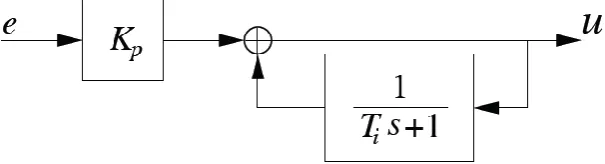
explained in Figure 2.9, where the resulting transfer function is a PI controller result.
For this reason the integral action is also often called automatic reset. Thus,
the use of a proportional action in conjunction to an integral action of a PI controller,
solves the main problems of the oscillatory response associated to an On–Off
controller and of the steady-state error associated to a pure proportional controller. It
has to be stressed that when integral action is present, the so-called integrator windup
[image:28.595.171.474.565.647.2]phenomenon might occur in the presence of saturation of the control variable.
Figure 2.9: PI Controller in Automatic Reset Configuration
(2.5)
(2.7)
(2.8)
(2.9)
(2.10) derivative control law can be expressed as:
Where is the derivative gain. The corresponding controller transfer
function is
In order to understand better the meaning of the derivative action, it is worth
considering the first two terms of the Taylor series expansion of the control error at time ahead:
If a control law proportional to this expression is considered as:
This naturally results in a PD controller. The control variable at time t is
therefore based on the predicted value of the control error at time t + Td. For this
reason the derivative action is also called anticipatory control, or rate action, or
pre-act. It appears that the derivative action has a great potentiality in improving the
control performance as it can anticipate an incorrect trend of the control error and
18
A proportional-integral-derivative controller (PID controller) is a generic
control loop feedback mechanism widely used in industrial control systems. A PID
controller calculates an "error" value as the difference between a measured process
variable and a desired set point. The controller attempts to minimize the error by
adjusting the process control inputs. Many processes can be controlled using PID
controllers providing that controller parameters have been tuned well. Instead of
using a small number of complex controllers, a larger number of simple PID
controllers are used to control simpler processes in an industrial assembly in order to
automate the certain more complex process. In spite their simplicity, they can be
used to solve even a very complex control problems. While proportional and
integrative modes are also used as single control modes, a derivative mode is rarely
used on its own in control systems. Combinations such as PI and PD control are very
often in practical systems [2][3].
The PID controller involves three separate constant parameters that are
proportional (P), integration (I) and derivation (D) as in Figure 2.10. These values
can be interpreted in terms of time where P depends on the present error, I on the
accumulation of past errors, and D is a prediction of future errors, based on current
rate of change [2].
The PID control scheme is named after its three correcting terms, whose sum
constitutes the manipulated variable (MV). The proportional, integral, and derivative terms are summed to calculate the output of the PID controller. Defining as the
Where,
: Proportional gain, a tuning parameter
: Integral gain, a tuning parameter
: Derivative gain, a tuning parameter
e : Error
t : Time or instantaneous time (the present)
[image:31.595.169.454.318.470.2]: Variable of integration, takes on values from time 0 to the present t.
Figure 2.10: Block Diagram of a PID Controller in a Feedback Loop
A proportional controller will have the effect of reducing the rise time
but never eliminate the steady-state error. An integral control will have the
effect of eliminating the steady-state error for a constant or step input, but it may make the transient response slower. A derivative control will have the effect of
increasing the stability of the system, reducing the overshoot, and improving the
transient response. The effects of each of controller parameters and on a
20
Table 2.1: Effects of each of controller parameters
CL Response Rise Time Overshoot Settling Time S-S Error
Kp Decrease Increase Small Change Decrease
Ki Decrease Increase Increase Eliminate
Kd Small Change Decrease Decrease No Change
These correlation may not be exactly accurate, because and are dependent
on each other. In fact, changing one of these variables can change the effect of the
two other. The Table should only be used as a reference when determining the values for and [3].
2.4 IGBT and Mosfet
Insulated Gate Bipolar Transistor (IGBT) combined the best of conventional bipolar
transistors and FETs they only require a voltage across the base in order to conduct.
However, like conventional bipolar, they are efficient conductors of current through
their collector or emitters.
The bipolar transistor requires a high base current to turn on, has relatively
slow turn off characteristic and is liable for thermal runaway due to a negative
temperature coefficient. In addition, the lowest attainable on state voltage or
conduction loss is governed by the collector emitter saturation voltage VCE (SAT).
The Mosfet however is a device that is voltage and not current controlled.
Mosfet have a positive temperature coefficient, stopping thermal runaway. The on state resistance has no theoretical limit hence on state losses can be far lower. The
Mosfet also has a body drain diode which is particularly useful in dealing with
limited freewheeling currents.
The IGBT has the output switching and conduction characteristics of a
bipolar transistor but is voltage controlled like a Mosfet. In general, this means it has
Another potential problem with some IGBT types is the negative temperature
coefficient, which could lead to thermal runaway and makes the paralleling of
devices hard to effectively achieve. This problem is now being addressed in the latest
generations of IGBT that they are based on non punch through technology. This
technology has the same basic IGBT structure but is based on bulk diffused silicon,
rather than the epitaxial material that both IGBT and Mosfets has historically used.
Comparing both of Mosfet and IGBT structures look very similar. The basic
difference is the addition of a P substrate beneath the N substrate. The IGBT
technology is certainly the device of choice for breakdown voltage above 1000 V,
while the Mosfet is certainly the device of choice for device breakdown voltage
below 250 V.
Choosing between IGBTs and Mosfets is very application specific and cost,
size, speed and thermal requirement should all be considered. Table 2.4 shows
22
Table 2.2: Differential between IGBT and Mosfet
IGBT Mosfet
Preferred Condition:-
Low duty cycle
Low frequency
Narrow or small line or load
variation
High voltage application
Operation at high junction
Temperature is allowed (>100
C)
>5 kW output power
Preferred Condition:-
High frequency application
Wide line or load variation
Long duty cycle
Low voltage application (<250 V)
Typical IGBT application includes:
Motor control : frequency <20
kHz
Uninterruptible power supply
Low power lighting
Typical Mosfet application includes:
Battery charging
CHAPTER 3
METHODOLOGY
3.1 Introduction
This chapter will describe the method for this subject in order to achieve the desired
objective. Figure 3.1 consist of block diagram of the project and Figure 3.2 shows the
flowchart of the project.
3.2 Block Diagram
TMS320F28335 board can create SPWM pulse by using Matlab Simulink and Code
Composer Studio V3 (CCSV3). Six pulses that have been created are fed into tree
phase inverter. DC voltage from the DC supply is converted to an AC voltage using a
3 phase inverter. The voltage output from the three-phase inverter is connected to RL
filter to get sine wave. The voltage of the inverter is then step down by using voltage
divider and the voltage level is increase to be in range of 0V to 3V as
[image:35.595.113.524.613.749.2]TMS320F28335 ADC module can only read from 0V to 3V
Figure 3.1: Block Diagram of the Project Filter
3 Phase Inverter
DC Supply AC Voltage
TI board
(SPWM) Voltage
24
3.3 Project Flowchart
Create driver circuit and inverter circuit
Vp-p = VDC Start
Troubleshoot the circuit
Create voltage divider circuit and
offset circuit
ADC input is less than 3V
Troubleshoot the voltage divider
circuit Literature Review
Software research Hardware research
Generate SPWM
Simulate 3phase inverter
Choose proper LC filter
Create PID control system
Vp-p=Vref Tune PID
[image:36.595.114.513.91.751.2]Combine hardware and software Test run End yes yes yes no no no
from http://www.parlimen.gov.my/images/webuser/artikel/ro/amy/FiT%20%
20and%20RE%20Fund.pdf
[2] P. Z. U. of Z. Vukic (2012), “LECTURES ON PID”. University of Zagreb
[3] K. ARI, F. T. Asal, and M. Cosgun (2012), “EE 402 DISCRETE TIME SYTEMS PROJECT REPORT PI , PD , PID,” Middle East Technical
University.
[4] M. H. Rashid (2001), Power Electronic Handbook. Academic Press.
[5] B. Crowhurst, E. F. El-Saadany, L. El Chaar, and L. a. Lamont (2011), “Single-phase grid-tie inverter control using DQ transform for active and reactive load power compensation” 2010 IEEE Int. Conf. Power Energy, pp.
489–494.
[6] D. Van (1988), “Pulse width modulation inverter” EP Pat. 0,273,899, pp.
189–195.
[7] X. Xie, Q. Song, G. Yan, and W. Liu, (2003), “MATLAB-based simulation of
three-level PWM inverter-fed motor speed control system” Appl. Power
Electron. …, vol. 00, no. , pp. 1105–1110, 2003..
[8] M. F. Akorede, H. Hizam, and E. Pouresmaeil (2010), “Distributed energy resources and benefits to the environment” Renew. Sustain. Energy Rev., vol.
14, no. 2, pp. 724–734
[9] B. A. Welchko, M. B. De Rossiter Correa, and T. A. Lipo (2004), “A
three-level MOSFET inverter for low-power drives” IEEE Trans. Ind. Electron.
56
[11] J. Doucet and J. Shaw (2007), “DC / AC Pure Sine Wave Inverter”
[12] Tntech (2014), “CHAPTER 2 SINGLE PHASE PULSE WIDTH
MODULATED INVERTERS” pp. 16–44, Retrieved om June 16, 2013, from
https://www.tntech.edu/files/cesr/StudThesis/asuri/Chapter2.pdf
[13] H. M. Inverter (2013), "Control of Single Stage Single Phase Full Bridge Pv
Inverter, UTM.
[14] S. J. Chapman (2004) "Electric Machine Fundamentals", Fourth Edition. BAE
SYSTEMS Australia.
[16] A. Bakar, M. Ahmad, and F. Abdullah (2013), “Design of FPGA-Based
SPWM Single Phase Full-Bridge Inverter” Int. J., pp. 81–88.
[17] P. Zoran (2002), “LECTURES ON PID” Univercity of Zagreb.
[18] D. L. Jia, S. Z. Wei, Q. Wu, and P. Xu (2011), “A Switching-inverter power controller based on fuzzy adaptive PID” 6th International Forum on Strategic
Technology, IFOST 2011, vol. 2, pp. 695–699.
[19] N. G. M. Thao, M. T. Dat, T. C. Binh, and N. H. Phuc, (2010) “PID-fuzzy
logic hybrid controller for grid-connected photovoltaic inverters”, IFOST.
[20] A.H. Azit (2014), “TNB Technical Guidebook on Grid-interconnection of
Photovoltaic Power Generation System to LV and MV Networks” , TNB
[21] Paul Purification (2007), “Performance and Analysis of DC to AC Pure Sine Wave Inverter”, (BRAG University).
[22] Mohd Razdhi bin Kamaruddin (2010), “Thesis of Single Phase Full Bridge Inverter with Bipolar SPWM Controller”. (Universiti Teknologi Mara).
![Figure 2.1: 3 Phase Voltage Source Inverter [6]](https://thumb-us.123doks.com/thumbv2/123dok_us/8766843.896887/17.595.197.453.109.282/figure-phase-voltage-source-inverter.webp)
![Figure 2.2: PWM waveform [6]](https://thumb-us.123doks.com/thumbv2/123dok_us/8766843.896887/18.595.133.501.85.517/figure-pwm-waveform.webp)
![Figure 2.3: SPWM waveform [6]](https://thumb-us.123doks.com/thumbv2/123dok_us/8766843.896887/19.595.126.566.117.341/figure-spwm-waveform.webp)
![Figure 2.4: Distributed Generation Technologies [8]](https://thumb-us.123doks.com/thumbv2/123dok_us/8766843.896887/20.595.120.517.222.491/figure-distributed-generation-technologies.webp)
![Figure 2.5: Fuel Cell System [8]](https://thumb-us.123doks.com/thumbv2/123dok_us/8766843.896887/21.595.126.502.592.738/figure-fuel-cell-system.webp)
![Figure 2.6: Micro Turbine System [8]](https://thumb-us.123doks.com/thumbv2/123dok_us/8766843.896887/23.595.162.496.80.280/figure-micro-turbine-system.webp)
![Figure 2.7: Wind Energy Conversion System [8]](https://thumb-us.123doks.com/thumbv2/123dok_us/8766843.896887/24.595.129.520.436.601/figure-wind-energy-conversion-system.webp)
![Figure 2.8: Biomass Source [8]](https://thumb-us.123doks.com/thumbv2/123dok_us/8766843.896887/26.595.173.477.132.383/figure-biomass-source.webp)