DEVELOPMENT OF FABRY PEROT ANTENNA
INSPIRED BY PATCH-TYPE FREQUENCY
SELECTIVE SURFACE (FSS) FOR X BAND
COMMUNICATION
MOHAMED ALI ELMI
DEVELOPMENT OF FABRY PEROT ANTENNA INSPIRED BY PATCH-TYPE
FREQUENCY SELECTIVE SURFACE (FSS) FOR X BAND COMMUNICATION
MOHAMED ALI ELMI
This thesis submitted in partial fulfillment
of the requirements for the award of the Master’s Degree in Electrical Engineering.
Faculty of Electrical and Electronic Engineering Universiti Tun Hussein Onn Malaysia
ACKNOWLEDGEMENT
First and foremost, I would like to express my heartily thankful to Allah, the Almighty, and the Merciful for his guidance and blessing that inspired me to go through all the resistance in completing this project.
I would like to express sincere gratitude to my honorable supervisor, Dr Shamsul Haimi Bin Dahlan for the support, patience and encouragement throughout the duration in completing this project. That gives me solid background about my project, ongoing comments and knowledge sharing. I am glad to works under his supervisory and most importantly he was a kind person with deep vision through his work.
ABSTRACT
Fabry Perot antenna with Frequency Selective Surface (FSS) has been presented and analyzed in this project. Fabry perot antenna has numerous applications like satellites communication, radar, telecommunications and broadcasting and sensor systems. The proposed antenna structure consist of microtrip patch antenna which is the primary source of radiation, ground plane which acts as a totally reflective surface, and Partially Reflective Surface (PRS) with a distance of half wavelength in between them. The PRS is a dielectric material with a periodically spaced square patches of copper printed on it.
ABSTRAK
Fabry perot antenna dengan frequency selective surface (FSS) telah digunakan dan dianalisa dalam projek ini. Fabry perot antenna mempunyai banyak aplikasi gunaan seperti komunikasi satelit, radar, telekomunikasi, penyiaran dan system penderia. Struktur antenna yang digunakan dalam projek ini mengandungi microtrip antenna yang digunakan sebagai sumber utama radiasi, tapak pembumi yang bertindak sebagai pemantul permukaan penuh dan pemantul permukaann (PRS) dengan jarak separuh panjang gelombang. PRS adalah bahan nyah elektrik dengan kuprum tercetak diantara ruang segi empat.
CONTENTS
CHAPTER TITLE PAGE
TITLE PAGE i
DECLARATION ii
DEDICATION iii
ACKNOWLEDGEMENT iv
ABSTRACT v
ABSTRAK vi
CONTENTS x
LIST OF TABLES xi
LIST OF FIGURES xii
LIST OF ABBREVIATIONS xiv
LIST OF SYMBOLS xv
LIST OF APPENDICES xvii
CHAPTER ONE INTRODUCTION
1.1. Project background 1
1.2. Problem statement 3
1.3. Objective of the project 4
CHAPTER 2 LITERATURE REVIEW
2.1. Introduction 6
2.2. Antenna parameters 6
2.2.1. Return loss 7
2.2.2. Radiation Pattern 7
2.2.3. Bandwidth 7
2.2.4. VSWR 9
2.2.5. Beamwidth 9
2.2.6. Directivity and Gain 10
2.2.7. Antenna Gain 11
2.2.8. Antenna Efficiency 12
2.2.9. Impedance matching 13
2.3. Feeding methods 14
2.3.1. Coaxial feeding 14
2.3.2. Microstrip line 14
2.3.3. Aperture Coupled Feed 15
2.3.4 Proximity Coupled Feed 16
2.4. Partially reflective surfaces 17
2.4.1. Electromagnetic and Gap characteristics 17
2.4.2. Resonant circuit models for EBG structures 18
2.4.3. Patch antenna with EBG structures 18
2.4.4. Patch antennas on high permittivity substrate 19
2.4.5. Surface wave antennas 20
2.4.6. A grounded slab loaded with periodic patches 20
2.5 Frequency selective surfaces 20
2.5.1 Types of FSS 22
2.7 Relevant and related articles and publications 25
CHAPTER 3 METHODOLOGY 3.1. Methodology Overview 28
3.2. Flow chart of design methodology 30
3.3. Antenna design configuration 32
3.3.1. Design Procedure Using Mathematical Method 33
3.3.2. Designing procedure 33
3.3.3 CST studio design procedure 34
3.3.3.1Create new project 34
3.3.3.2Set all the parameters 35
3.3.4 Create the proposed design 36
3.3.5 Design Procedure of frequency selective surface and mathematical equations 37
CHAPTER 4 RESULTS AND ANALYSIS 4.1 Introduction 39
4.2Antenna design 40
4.3Parametric study 41
4.3.1 Inter-element spacing 41
4.3.2 Number of cells used 42
4.3.3 Unit cell size 43
4.4Simulation result 44
4.4.1 S11 parameter or return loss 44
4.4.2 Bandwidth 45
4.4.3 Gain 46
4.4.4 Voltage standing wave ratio 47
4.4.5 Input impedance 47
4.5.1 Return loss 51
4.5.2 Bandwidth 53
4.5.3 Voltage standing wave ratio (VSWR) 54
4.5.4 Input impedance 55
4.5.5 Radiation Pattern 56
4.6Comparison of Measurement and Simulation result 57
4.6.1 Return loss and Bandwidth comparison 58
4.6.2 VSWR Comparison 60
4.6.3 Impedance matching Comparison 60
4.6.4 Radiation Pattern Comparison 61
CHAPTER 5 CONCLUSION AND RECOMMENDATION 5.1 Conclusion 63
5.2 Recommendation 65
LIST OF TABLES
LIST OF FIGURES
2.1 Graph return loss versus frequency 8
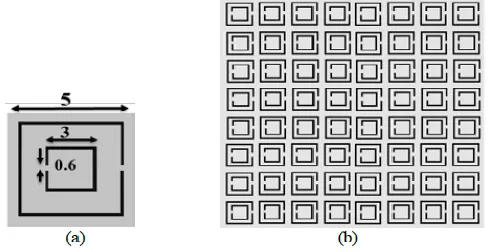
2.2 Top and side view of coaxial feeding method 14 2.3 Microstrip line feed 15 2.4 Aperture-coupled feed 16 2.5 Proximity-coupled Feed 16 2.6 Electromagnetic Bandgap Structure 18 2.7. (a) SRR unit cell (b) the 8x8 SRR array that is implemented as PRS. 19
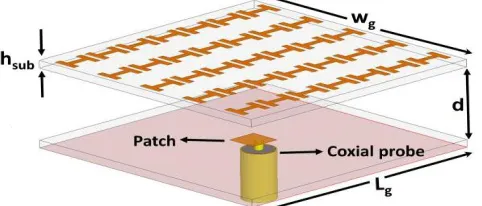
2.8 Geometry of fabry perot antenna 21
LIST OF ABBREVIATIONS
LHM Left-handed Material
CST Computer Simulated Technology FP Fabry Perot
PRS Partially Reflective Surface VSWR Voltage Standing Wave Ratio FL Lowest Frequency
FH Highest Frequency HPBW Half-power Beamwidth FNBW First-null Beamwidth
GPS Global Positioning System
EBG Electromagnetic Band Gap SWA Surface Wave Antennas
RCS Radar Cross Section
IEEE Institute of Electrical and Electronic Engineering PCB PC Board
dB Decibels
SMA Sub Miniature A FR4 Fire Retardant 4
UTHM University Tunn Hussein Onn Malaysia MWS Microwave Studio
LIST OF SYMBOLS
GHz Gegahertz MHz Megahertz
Ohm
λ lamda (wavelength) W width of the antenna L Length of the antenna h height of the antenna lg length of the ground plane lp length of the patch
ro outer radius of the feeding pin rad inner radius of the feeding pin xf feeding position
CHAPTER I
INTRODUCTION
1.1. Project background
In 1897, Marconi created antenna and for the first time realized radio communication. The history of antenna is just about a century, but because of its important application in military, it has been highly valued and emphasized. Due to the development in the past half century, the hardware technology of antenna is now relatively mature. Now antenna design is developing towards wide band、multi-function and high gain and directivity. Various kinds of antenna technologies like dual-polarization、adjustable electrical down-tilt and multi-frequency band multiplexing are gradually being launched into commercial operation; great advances have been made in smart antenna technology too [1].
enhanced directivity. According to the numerical results, the antenna showed significant improvement in directivity, compared to conventional patch antennae. This was cited in 2007 for
an efficient design of directive patch antennas in mobile communications using metamaterials.
This design was based on the left-handed material (LHM) transmission line model, with the circuit elements L and C of the LHM equivalent circuit model. This study developed formulae to determine the L and C values of the LHM equivalent circuit model for desirable characteristics of directive patch antennas. Design examples derived from actual frequency bands in mobile communications were performed, which illustrates the efficiency of this approach. [3]
The technologies of wireless communication developed rapidly and lead to the miniaturization of the device. Hence the attraction of a compact and small size internal antenna that can operate for more than one application has grown significantly to fulfill the requirement. This project report presents a microstrip patched antenna with partially reflective surface. This type of Fabry perot antenna is capable of producing both very high gain and better performance. Planar antennas are the newest generations of antennas boasting the attractive features required, such as broad operating bandwidth, low profile, light weight and ease of integrations into arrays of radio frequency circuits, to make them ideal components of modern communications systems.
1.2. Problem statement
Satellite communications play a vital role in the global telecommunications system. Approximately 2,000 artificial satellites orbiting Earth relay analog and digital signals carrying voice, video, and data to and from one or many locations worldwide.
The purpose of this project is to design a microstrip antenna with partially reflective surface for X-band communication. The X band is a segment of the microwave radio region of the electromagnetic spectrum). X band has many applications like satellite communications, radar systems, Terrestrial communications and networking, Space communications and Amateur radio.
Although microstrip antenna has light weight and small in size, and low volume, low profile, but its disadvantages are narrow bandwidth, low gain and low efficiency. One of the ways to resolve these problems is designing a microstrip patch with partially reflective surfaces. In this project microstrip patch antenna with partially reflective surface had been designed. A single rectangular patch is designed at the beginning of the project and simulated. Then, a periodic partially reflective surface had been developed in the proceeding steps to obtain wider bandwidth, higher gain and better performance.
1.3. Objective of the project
To design a microstrip antenna with single layer partially reflective surface (PRS) for X band communication.
1.4 Scope of the project
In order to achieve the objectives of the project, the following project scopes have been listed in realizing the microstrip antenna with PRS:
The antenna will be operating in X band frequencies 10 GHz. With a bandwidth range of 8 GHz to 12 GHz.
Enhancement of gain up to 7dB and Bandwidth of about 2.3% improvement of microstrip patch antenna using PRS
CHAPTER II
LITERATURE REVIEW
2.1. Introduction
This chapter discuss about the theoretical information that is related to the project such as the basics of antenna, its characteristics and essential components of the partially reflected surfaces (PRS).
This section of the thesis also reviews a number of papers, which have formed the basis for the research component of this paper. This thesis provides an insight into the background of co-formality antennas. Many papers have been studied in order to gain required knowledge that is needed in the design process. There are also many references from source such as books, publications and articles.
2.2. Antenna parameters
2.2.1. Return loss
The return loss is another way of expressing mismatch. It is a logarithmic ratio measured in dB that compares the power reflected by the antenna to the power that is fed into the antenna from the transmission line.
The relationship between SWR and return loss is the following:
(2.1)
A very good antenna might have a value of -10dB (90% absorbed and 10%reflected) [5].
2.2.2. Radiation Pattern
An antenna radiation pattern or antenna pattern is defined as “a mathematical function or a graphical representation of the radiation properties of the antenna as a function of space coordinates. In most cases, the radiation pattern is determined in the far field region and is represented as a function of the directional coordinates.
2.2.3. Bandwidth
Bandwidth is another fundamental antenna parameter. Bandwidth describes the range of frequencies over which the antenna can properly radiate or receive energy. Often, the desired bandwidth is one of the determining parameters used to decide upon an antenna. For instance, many antenna types have very narrow bandwidths and cannot be used for wideband operation.
The bandwidth can also be described in terms of percentage of the center frequency of the band.
(2.2)
where FH is the highest frequency in the band, FL is the lowest frequency in the band, and FC is the center frequency in the band. In this way, bandwidth is constant relative to frequency
[5].
If bandwidth was expressed in absolute units of frequency, it would be different depending upon the center frequency. Different types of antennas have different bandwidth limitations.
GSM900 for example works from 890MHz to 960MHz and therefore has an allocated bandwidth of 70MHz. This means the antenna must perform well over that range of frequencies.
[image:24.612.108.349.527.647.2]
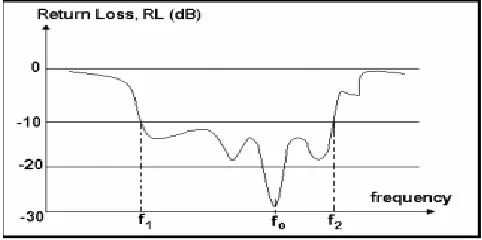
Return loss is a measure of reflection from an antenna. 0 dB means that all the power is reflected; hence the matching is not good. -10dB means that 10% of incident power is reflected; meaning 90% of the power is accepted by the antenna. So, having -10dB as a bandwidth reference is an assumption that 10% of the energy loss.
Referring to figure 2.1, the value of bandwidth can be calculated in the form of percentage as formula 2.3 indicates. [5] – [6]
Bandwidth = 2− 1 / 2+ 1 100% (2.3)
2.2.4. Voltage standing wave ratio (VSWR)
For radio (transmitter or receiver) to deliver power to an antenna, the impedance of the radio and transmission line must be well matched to the antenna’s impedance. The parameter VSWR is a measure that numerically describes how well the antenna is impedance matched to the radio or transmission line it is connected to.
VSWR stands for Voltage Standing Wave Ratio and is also referred to as Standing Wave Ratio (SWR). VSWR is a function of the reflection coefficient (s11 or return loss), which describes the power reflected from the antenna. [5]- [7]
2.2.5. Beamwidth
Associated with the pattern of an antenna is a parameter designated as beamwidth. The beamwidth of a pattern is defined as the angular separation between two identical points on opposite side of the pattern maximum. In an antenna pattern, there are a number of beamwidths. One of the most widely used beamwidths is the Half-Power Beamwidth (HPBW), which is defined by IEEE as: “In a plane containing the direction of the maximum of a beam, the angle between the two directions in which the radiation intensity is one-half value of the beam.”
antenna is a very important figure of merit and often is used as a trade-off between it and the side lobe level; that is, as the beamwidth decreases, the side lobe increases and vice versa. [5]- [6]- [7].
2.2.6. Directivity and Gain
Directivity is the ability of an antenna to focus energy in a particular direction when transmitting, or to receive energy better from a particular direction when receiving. In a static situation, it is possible to use the antenna directivity to concentrate the radiation beam in the wanted direction. However in a dynamic system where the transceiver is not fixed, the antenna should radiate equally in all directions, and this is known as an Omni-directional antenna. [5].
Gain is not a quantity which can be defined in terms of a physical quantity such as the Watt or the Ohm, but it is a dimensionless ratio. Gain is given in reference to a standard antenna. The two most common reference antennas are the isotropic antenna and the resonant half-wave dipole antenna. The isotropic antenna radiates equally well in all directions. Real isotropic antennas do not exist, but they provide useful and simple theoretical antenna patterns with which to compare real antennas. Any real antenna will radiate more energy in some directions than in others. Since it cannot create energy, the total power radiated is the same as an isotropic antenna, so in other directions it must radiate less energy.
The gain of a rectangular microstrip patch antenna with air dielectric can be very roughly estimated as follows. Since the length of the patch, half a wavelength, is about the same as the length of a resonant dipole, we get about 2 dB of gain from the directivity relative to the vertical axis of the patch. If the patch is square, the pattern in the horizontal plane will be directional, somewhat as if the patch were a pair of dipoles separated by a half-wave; this accounts for about another 2-3 dB. Finally, the addition of the ground plane cuts off most or all radiation behind the antenna, reducing the power averaged over all directions by a factor of 2 (and thus increasing the gain by 3 dB). Adding this all up, we get about 7-9 dB for a square patch, in good agreement with more sophisticated approaches [6] - [7].
2.2.7. Antenna Gain
The term Antenna Gain describes how much power is transmitted in the direction of peak radiation to that of an isotropic source. Antenna gain is more commonly quoted in a real antenna's specification sheet because it takes into account the actual losses that occur.
An antenna with a gain of 3 dB means that the power received far from the antenna will be 3 dB higher (twice as much) than what would be received from a lossless isotropic antenna with the same input power.
Antenna Gain is sometimes discussed as a function of angle, but when a single number is quoted the gain is the 'peak gain' over all directions. Antenna Gain (G) can be related to directivity (D) by:
G = RD (2.4)
2.2.8. Antenna Efficiency
The efficiency of an antenna relates the power delivered to the antenna and the power radiated or dissipated within the antenna. A high efficiency antenna has most of the power present at the antenna's input radiated away. A low efficiency antenna has most of the power absorbed as losses within the antenna, or reflected away due to impedance mismatch
The losses associated with an antenna are typically the conduction losses (due to finite conductivity of the antenna) and dielectric losses (due to conduction within a dielectric which may be present within an antenna).
The antenna efficiency (or radiation efficiency) can be written as the ratio of the radiated power to the input power of the antenna.
R = Pradiated/ Pinput (2.5)
Efficiency is ultimately a ratio, giving a number between 0 and 1. Efficiency is very often quoted in terms of a percentage; for example, an efficiency of 0.5 is the same as 50%. Antenna efficiency is also frequently quoted in decibels (dB); an efficiency of 0.1 is 10% or (-10 dB), and an efficiency of 0.5 or 50% is -3 dB
Equation 2.5 is sometimes referred to as the antenna's radiation efficiency. This distinguishes it from another sometimes-used term, called an antenna's "total efficiency". The total efficiency of an antenna is the radiation efficiency multiplied by the impedance mismatch loss of the antenna, when connected to a transmission line or receiver (radio or transmitter). This can be summarized in Equation 2.6, where T is the antenna's total efficiency, ML is the antenna's loss due to impedance mismatch and R is the antenna's radiation efficiency
Since ML is always a number between 0 and 1, the total antenna efficiency is always less than the antenna's radiation efficiency. Said another way, the radiation efficiency is the same as the total antenna efficiency if there was no loss due to impedance mismatch.
Efficiency is one of the most important antenna parameters. It can be very close to 100% (or 0 dB) for dish, horn antennas, or half-wavelength dipoles with no lossy materials around them. Mobile phone antennas, or wifi antennas in consumer electronics products, typically have efficiencies from 20%-70% (-7 to -1.5 dB). The losses are often due to the electronics and materials that surround the antennas; these tend to absorb some of the radiated power (converting the energy to heat), which lowers the efficiency of the antenna. Car radio antennas can have a total antenna efficiency of -20 dB (1% efficiency) at the AM radio frequencies; this is because the antennas are much smaller than a half-wavelength at the operational frequency, which greatly lowers antenna efficiency. The radio link is maintained because the AM Broadcast tower uses a very high transmit power. [5] – [7]
Improving impedance mismatch loss is discussed in the Smith Charts and impedance matching section. Impedance matching can greatly improve the efficiency of an antenna.
2.2.9. Impedance matching
Antenna impedance relates the voltage to the current at the input to the antenna. This is extremely important as we will see. Let's say an antenna has an impedance of 50 ohms. This means that if a sinusoidal voltage is applied at the antenna terminals with an amplitude of 1 Volt, then the current will have an amplitude of 1/50 = 0.02 Amps. Since the impedance is a real number, the voltage is in-phase with the current. Alternatively, suppose the impedance is given by a complex number, say Z=50 + j*50 ohms.
time-90 degrees in phase. If Z=50 + j*50, then the impedance has a magnitude equal to:
(2.7) For an efficient transfer of energy, the impedance of the radio, of the antenna and of the transmission cable connecting them must be the same. Transceivers and their transmission lines are typically designed for 50Ω impedance. If the antenna has impedance different from 50Ω, then there is a mismatch and an impedance matching circuit is required.
2.3. Feeding methods
A planar antenna can be fed by a variety of methods. These methods can be classified into two categories such as contacting and non-contacting method. In the non-contacting method, electromagnetic field coupling is done to transfer power between the Microstrip line and the radiating patch. Meanwhile for contacting method, the RF power is fed directly to radiating patch using a connecting element such as Microstrip line. There are four most popular ways to feed a planar antenna like coaxial probe, Microstrip line, aperture coupling and proximity coupling.
2.3.1. Coaxial feeding
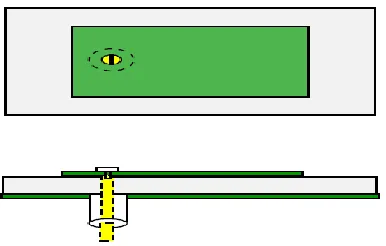
Figure 2.2: top and side view of coaxial feeding method
2.3.2. Microstrip line
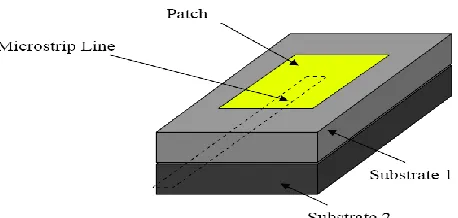
In Microstrip feed, the patch is fed by a Microstrip line that is located on the same plane as the patch. In this case both the feeding and the patch form one structure. Microstrip feeding is simple to model, easy to match and easy to fabricate. It is also a good choice for use in antenna-array feeding networks. However Microstrip feed has the disadvantage of narrow bandwidth and the introduction of coupling between the feeding line and the patch which leads to spurious radiation and the required matching between the Microstrip patch and the 50 Ώ feeding line. [7]- [9]
Figure 2.3: Microstrip line feed
2.3.3. Aperture Coupled Feed
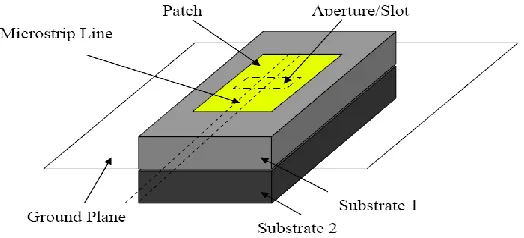
[image:31.612.215.447.437.560.2]amount of coupling from the feed line to the patch is determined by the shape, size and location of the aperture. Since the ground plane separates the patch and the feed line, spurious radiation is minimized. Generally, a high dielectric material is used for the bottom substrate and a thick, low dielectric constant material is used for the top substrate to optimize radiation from the patch [10]. The major disadvantage of this feed technique is that it is difficult to fabricate due to multiple layers, which also increases the antenna thickness. This feeding scheme also provides narrow bandwidth. [5]- [9]
Figure 2.4: Aperture-coupled feed
2.3.4.
Proximity Coupled FeedFigure 2.5: Proximity-coupled Feed
2.4. Partially reflective surfaces
The recent explosion in antenna developments has been fueled by the increasing popularity of wireless communication systems and devices. From the traditional radio and TV broadcast systems to the advanced satellite system and wireless local area networks, wireless communications have evolved into an indispensable part of people's daily lives. Antennas play a paramount role in the development of modern wireless communication devices, ranging from cell phones to portable GPS navigators, and from the network cards of laptops to the receivers of satellite TVs. A series of design requirements, such as low profile, compact size, broad bandwidth, and multiple functionalities, keep on challenging antenna researchers and propelling the development of new antennas.
Progress in computational electromagnetics, as another important driving force, has substantially contributed to the rapid development of novel antenna designs. It has greatly expanded the antenna researchers' capabilities in improving and optimizing their designs efficiently. Various numerical techniques, such as the method of moments, finite element method, and the finite difference time domain method, have been well developed over the years. [10]
designs have become a thrilling topic for antenna scientists and engineers.
2.4.1. Electromagnetic Band Gap Characteristics and classifications
Over the last decade, diversified and novel electromagnetic band gap (EBG) structures have appeared in the literature. They exhibit interesting electromagnetic properties, which are not readily available in natural materials. In this chapter, we illustrate these interesting properties of EBG structures. A classification of various EBG structures is also provided. [10] [4]
[image:34.612.179.535.284.432.2]Figure 2.6 Electromagnetic Bandgap Structure
2.4.2. Resonant circuit models for EBG structures
2.4.3. Patch antenna with EBG structures
Electromagnetic band gap structures have been characterized and designed in
previous sections. We now shift our focus to EBG applications in antenna engineering. In this chapter, the EBG structures are integrated into microstrip patch antenna designs and their surface wave band gap property helps to increase the antenna gain, minimize the back lobe, and reduce mutual coupling in array elements. Some applications of EBG patch antenna designs in high precision GPS receivers, wearable electronics, and phased array systems are highlighted. [10]
2.4.4. Patch antennas on high permittivity substrate
[image:35.612.189.433.537.663.2]Microstrip patch antennas are widely used in wireless communications due to the advantages of low profile, light weight, and low cost [11-14]. In principle, the microstrip patch antenna is a resonant type antenna, where the antenna size is determined by the operating wavelength and the bandwidth is determined by the Q factor of the resonance. An important research topic in microstrip antenna designs is to broaden the inherent narrow bandwidth of microstrip antennas. Parasitic patches are used to form a multi-resonant circuit so that the operating bandwidth is improved. The parasitic patches are located on the same layer with the main patch. In [14], a multi-layer microstrip antenna is investigated with parasitic patches stacked on the top of the main patch. The multi-resonant behavior can also be realized by incorporating slots into the metal patch. Several single-layer single-patch microstrip antennas have been reported, such as the U-slot microstrip antenna and the E-shaped patch antenna. [12-14] [4] [17]
2.4.5. Surface wave antennas
The concept of surface wave antennas (SWA) was initiated in the 1950s [10] and numerous theoretical and experimental investigations have been reported in the literature. To support the propagation of surface waves, a commonly used structure in SWA designs is a corrugated metal surface. However, the corrugated structure is thick, heavy, and costly, which may limit the applications of surface wave antennas in wireless communication systems.
In this section, novel surface wave antennas are presented. Compared to traditional SWA designs, surface waves are now guided along a thin grounded slab loaded with periodic patches, resulting in a low profile conformal geometry. In contrast to the previous wire-EBG antennas or patch antennas that radiate to the broadside direction, the proposed SWA achieve a monopole-like radiation pattern with a null in the broadside direction. The low profile SWA is more attractive than a traditional monopole antenna that is a quarter-wavelength high. [10]
2.4.6. A grounded slab loaded with periodic patches
We start with analyzing a complex artificial ground plane, which will be subsequently used in surface wave antenna designs. As we see there aretwo artificial surfaces: a mushroom-like EBG surface and a grounded dielectric slab loaded with periodic patches. In the latter structure vertical vias are removed, which results in different surface wave properties in the two ground planes.
2.5. Frequency selective surfaces
A frequency-selective surface (FSS) is any thin, repetitive surface designed to reflect, transmit or absorb electromagnetic fields based on frequency. In this sense, an FSS is a type of optical filter or metal-mesh optical filters in which the filtering is accomplished by virtue of the regular, periodic (usually metallic, but sometimes dielectric) pattern on the surface of the FSS. Frequency-selective surfaces have been most commonly used in the radio frequency region of the electromagnetic spectrum and find use in applications as diverse as the aforementioned microwave oven,antenna radomes and modern metamaterials. [15-16] Sometimes frequency selective surfaces are referred to simply as periodic surfaces and are a 2-dimensional analog of the new periodic volumes known as photonic crystals.
Many factors are involved in understanding the operation and application of frequency selective surfaces. These include analysis techniques, operating principles, design principles, manufacturing techniques and methods for integrating these structures into space, ground and airborne platforms. [15-18]
Figure 2.9: Geometry of the FSS unit cell substrate antenna
2.5.1. Types of FSS
FSS Based on shapes on shape it can be categorized as four classes.
The center connected or N-poles
The loop types
Solid interiors or plate types
Combinations of 1,2,3
FSS Characteristics
Typically narrow band
Periodic, typically in two dimensions
Element type: dielectric or metallic/circuit
Depends on Element shape, size.
2.6. Fabry Perot Cavity Antenna Based on Capacitive Loaded Strips Superstrate for X-Band Satellite Communication
Over the last few years, high gain, low profile and low-cost planar antennas composed of a single feed have attracted much attention. Consequently, in recent years different planar and non-planar methods have been investigated to overcome these drawbacks. [19]
The array technique is a common method which is often used to achieve high directivity and broadband antennas, while introduction of power dividers inevitably brings in some losses in the design of feeding network [20-21]. So achieving a high gain with a low-profile antenna that utilizes a single antenna element opposed to an array is always a desired design goal. The Fabry Perot (FP) optical concept is a well-known solution to this demand [21-25]. This structure in comparison with antenna array techniques has some advantages such as having a simple structure.
The model of FP antenna consists of a radiating element placed between two metallic arrays which act as partially reflective surfaces (PRS) or between one periodic metallic array and a ground plane. The PRS is placed by the distance of half a wavelength in air (λ0/2) from the plate on which the radiating element is placed. According to antenna structure in Fig. 2.10:
[image:39.612.188.429.439.542.2]Table 2.1 Comparison of resonance frequency, bandwidth and gain of three structures of antenna
Antenna F (GHz) BW% Gain (dB.
Microstrip antenna 10.2 7.78 6.11
Microstrip antenna with PRS
10.2 4.28 10.3
Microstrip antenna with PRS and EBG
10.3 8.6 12
REFERENCES
[1] Wireless Communications Principles and Practice 2nd Edition, T Rappaport, Prentice Hall-2001
[2] Fundamentals of Antennas, Arrays, and Mobile Communications Thomas F. Eibert
Universität Stuttgart John L. Volakis The Ohio State University
[3] Nicolas Guérin, Stefan Enoch, Gérard Tayeb, Pierre Sabouroux, Patrick Vincent, and Hervé Legay ‘’A Metallic Fabry–Perot Directive Antenna,’’ ieee transactions on antennas and propagation, vol. 54, no. 1, january 2006
[4] Mst. Nargis Aktar, Muhammad Shahin Uddin, Md. Ruhul Amin, and Md. Mortuza Ali “enhanced gain and bandwidth of patch antenna using ebg substrates” International
Journal of Wireless & Mobile Networks (IJWMN) Vol. 3, No. 1, February 2011.
[5] C. A. Balanis, Antenna Theory, Analysis and Design, 3rd edition, John Wiley & Sons, Inc., 2005.
[6] Antennas and propagation for wireless communication systems second edition simon r. saunders, university of surrey, guildford, uk alejandro arago´ n-zavala, tecnolo´ gico demonterrey, campus quere´taro, mexico.
[7] Antennas from theory to practice, Yi Huang, University of Liverpool, UK Kevin Boyle
NXP Semiconductors, UK
[8] Daniel J Bern, PawelKabacik,-”Smart Antennas for Mobile Communication Systems”. [9] Dau-ChyrhChang and Cheng-Nan Hu, “Smart Antennas for Advanced Communication
Engineering, The Cambridge RF and Microwave Engineering Series, Cambridge University Press,Cambridge, Mass, USA, 2008.
[11] Li, B., B. Wu, and C.-H. Liang, “Study on high gain circular waveguide array antenna withmetamaterial structure,” Progress In Electromagnetics Research, PIER 60, 207– 219, 2006.
[12] Boutayeb, H., K. Mahdjoubi, A. C. Tarot, and T. A. Denidni, “Directivity of an antenna embedded inside a Fabry-Perot cavity: theory and design,” Micro. Opt. Tech. Lett., Vol. 48, 12–17, 2006.
[13] Gu, Y. Y., W. X. Zhang, and Z. C. Ge, “Two improved Fabry- Perot resonator printed antennas using EBG substrate and AMC substrate,” Journal of Electromagnetic Waves and Applications, Vol. 21, 719–728, 2007.
[14] Gautheir, G. P., A. Courtay, and G. M. Rebiez, “Microstrip antennas on synthesized low dielectric constant substrate," IEEE Trans. Ant. Propag., 1997.
[15] Brito DB, d'Assunção AG, Maniçoba RHC, Begaud X. 2013. “Metamaterial inspired Fabry-Perot antenna with cascaded frequency selective surfaces,” Microwave Opt. Technol.
[16] Ehsan Beiranvand, Majid afsahi, “ improving the Bandwidh of High Gain Fabry-perot antenna Using FSS Substrate” the third Iranian Conference on Engineering Electromagnetics, Dec. 3-4, 2014
[17] R. Garg, I. Bhartia, I. Bahl, and A. Ittipiboon, Microstrip Antenna Design Handbook, Artech House, Boston, Mass, USA,2001.
[18] Y. Lee and Y. Hao, “Characterization of microstrip patch antennas on metameterial substrate loaded with complementary split-ring resonators,” Microw. Opt. Technol. Lett., vol.50, Aug. 2008.
[19] Y. Sun, Z. N. Chen, Y. Zhang, H. Chen, and T. S. P. See, “Sub wavelength substrate-integrated Fabry-Perot cavity antennas using artificial magnetic conductor,” IEEE Trans. on Antennas and Wireless Propagation, vol. 60, no. 1, pp. 30-34, Jan. 2012. [20] C. Vazquez, G. Hotopan, S. Ver Hoeye, M. Fernandez-Garcia, L. F. Herran Ontanon,
reconfigurable two dimensional planar array topologies,” Progress In Electromagnetics Research, vol. 97, pp. 95-104, 2009.
[21] J. R. Kelly, and A. P. Feresidis “Array antenna with increased element separation based on a Fabry–Perot resonant cavity with AMC walls,” IEEE Trans. on Antennas and Propagation, vol. 57, no 3, pp. 682-687, 2009.
[22] A. Ghasemi, S. N. Burokur, A. Dhouibi, and A.de Lustrac “High Beam Steering in Fabry–Pérot Leaky-Wave Antennas,” IEEE Antenna and Wireless Propagation Letters, vol. 12, pp. 128-131, Feb. 2013.
[23] Z. Mousavi Razi1, P. Rezaei, “Fabry Perot Cavity Antenna Based on Capacitive Loaded Strips Superstrate for X-Band Satellite Communication”, ARS JOURNAL, VOL. 2, NO. 1, DECEMBER 2013.
[24] G. Kumar, and K. P. Ray, Broadband microstrip antennas, Artech House, Antennas and Propagations Library, 2003.
[25] Z. Mousavi Razi, and P. Rezaei, “Design of Fabry Perot antenna and compensating bandwidth with defected ground structure,” IEEE AP-S Int. Symp. on Antennas and Propagation, pp. 758-759, 2013.
[26] Nicolas Guérin, Stefan Enoch, Gérard Tayeb, Pierre Sabouroux, Patrick Vincent, and Hervé Legay, “A Metallic Fabry–Perot Directive Antenna”, ieee transactions on antennas and propagation, vol. 54, no. 1, january 2006.
[27] Sarawuth Chaimool, Kwok L. Chung, Prayoot Akkaraekthalin, “A 2.45-GHz WLAN High-Gain Antenna Using A Metamaterial Reflecting Surface” The 2009 International Symposium on Antennas and Propagation (ISAP 2009) October 20-23, 2009, Bangkok,
THAILAN.
[28] Wenbo Pan, Cheng Huang, Po Chen, Xiaoliang Ma, Chenggang Hu, and Xiangang Luo, “A Low-RCS and High-Gain Partially Reflecting Surface Antenna”, ieee transactions on antennas and propagation, vol. 62, no. 2, february 2014.
Loaded Strips Superstrate for X-Band Satellite Communication”, ARS JOURNAL, VOL. 2, NO. 1, DECEMBER 2013.
[31] A. Foroozesh, L. Shafau, “Investigated into the effects of the reflection phase characteristics of highly-reflective superstrates on resonant cavity antennas,” IEEE Trans. Antennas Propag., vol. 58, no. 10, pp. 3392– 3396, Oct. 2010.
[32] N. Guerin, S. Enoch, G. Tayeb, P. Sabouroux, P. Vincent, H. Legay, “A metallic Fabry-Perot directive antenna,” IEEE Trans. Antennas Propag., vol. 54, no. 1, pp. 220–226, Jan. 2006.
[33] Yi-Fong Lu and Yi-Cheng Lin, “Design and Implementation of Broadband Partially Reflective Surface Antenna”.