Volume 3, Issue 4, April 2014
Page 353
Abstract
This paper Describe Accelerometer based gesture recognition method for Digit Recognition. Accelerometer based gesture recognition is one of the widely implemented method in the recognition scenario. We have implemented a 3D input digital pen which works on triaxial accelerometer to sense human gesture. This digital pen embedded with triaxial accelerometer, microcontroller, RF wireless transmitter module. The triaxial accelerometer measure acceleration signal along all the 3 axis. Accelerated signal process through microcontroller and serially transmitted through RF transmitter which can be received at remote place RF receiver. With the help of MATLAB tool feature vector are generated from received accelerated signal using zero crossing detector(ZCD) & range to recognize handwritten numeric digit and PNN classifier technique for the best accuracy purpose.
Keywords: MEMS, PNN, ZCD, GUI
1. INTRODUCTION
Handwriting Recognition is mostly used for security & authentication purpose. There are two types of recognition offline recognition & online recognition. The constructed system is an online hand writing character recognition written in air. The character recognition is done by an MEMS accelerometer. This accelerometer gives response for every slight deflection or movement in the system. Accelerometer is developed by using MEMS technology.(2)A significant advantage of accelerometer for general motion sensing is that they can be operated without any external reference and limitation in working conditions.However, gesture recognition is relatively complicated because different users have different speeds and styles to generate various motion trajectories. Thus, many researchers have tried to increasing the accuracy of handwriting recognition systems.(1)
Recently, some researchers have working on reducing the error of handwriting trajectory reconstruction by using acceleration signals and angular velocities of inertial sensors. However, the reconstructed trajectories suffer from various intrinsic errors of inertial sensors. Hence, many researchers have focused on developing effective algorithms to reduce error of inertial sensors & to improve the recognition accuracy. (2)
An efficient acceleration error compensation algorithm based on zero velocity compensation was developed to reduce acceleration errors for acquiring accurate reconstructed trajectory. The features of the preprocessed acceleration signals of each axis include ZCD and Range. Before classifying the hand motion trajectories, we perform the procedures of feature selection and extraction methods. The PNN classifier is used to get better accuracy. If the orientation of the instrument was estimated precisely, the motion trajectories of the instrument were reconstructed accurately.(1)
2. Hardware Design of Digital Pen
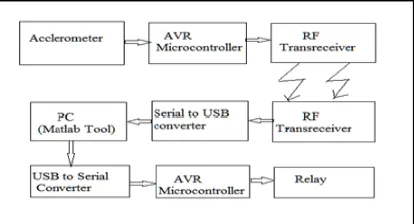
Digital pen consist of Triaxial accelerometer, RF transreceiver & AVR microcontroller(ATMEGA 16). The MEMS based accelerometer measures the acceleration signals generated by a user’s hand motions. The microcontroller convert the analog acceleration signals to digital ones via the A/D converter. The wireless transceiver transmits the acceleration signals wirelessly to a personal computer (PC).
The output signals of the accelerometer are sampled at 100 Hz by the 12-b A/D converter. Then, all the data sensed by the accelerometer are transmitted wirelessly to a PC by an RF transceiver at 2.4-GHz transmission band with 1-Mb/s transmission rate(1).The schematic of hardware design of digital pen as shown in fig1.
GESTURE RECOGNITION OF
HANDWRITTEN DIGIT USING
ACCELEROMETER BASED DIGITAL PEN
Mr. Kunal J. Patil11, Mr. A. H. Karode2, Mr. S. R. Suralkar3
1Student, E&TC, SSBT’s COET, Jalgaon (MH), India 2
Asst. Professor, E&TC, SSBT’s COET, Jalgaon (MH), India
3
Asso. Professor, E&TC, SSBT’s COET, Jalgaon (MH), India
Volume 3, Issue 4, April 2014
Page 354
By deciding any two digits we can control relay action connected to the another microcontroller serial to USB converter has been used to send data from PC to microcontroller.3. Trajectory Recognition Algorithm
The block diagram of the trajectory recognition algorithm include acceleration acquisition, signal preprocessing, feature generation, feature selection, and feature extraction is shown fig 3.
Figure 2 Block Diagram of Trajectory recognition algorithm[1]
3.1 Flow of Trajectory Recognition Algorithm
The raw acceleration signals of hand motions are generated by the triaxial accelerometer are given to microcontroller. Our hand always trembles slightly while moving due to human nature, which causes certain amount of noise. The signal preprocessing consists of calibration, a moving average filter, a high-pass filter, and normalization (1). Using moving average filter we collect set of 10 value received from accelerometer & takes average of this value because of that the signal become smoother and if there is any sudden change in signal due to hand movement is avoided with the help of high pass filter. The normalization is to start the signal from start point.
The characteristics of different hand movement signals can be obtained by extracting features from the preprocessed x,y, and z-axis signals, and we extract two features from the triaxial acceleration signals, include ZCD & RANGE.
Table I Zero crossing Detector table Digit Digit ZCD for X ZCD for Y
0 1 2
1 1 0
2 1 3
3 1 4
4 2 1
5 1 3
6 1 3
7 1 1
8 1 4
9 2 2
From above table we can see that ZCD for digit 2, 5, 6 & 3, 8 are same for that we have to use classifier to recognize the digit correctly. For feature extraction there are various type of various type of classifier like PNN, FNN, FDA, HMM, GMM, LDA. They have different recognition rate but in our system we are using PNN classifier because of its higher recognition rate.
3.2 Classifier for Recognition 3.2.1 PNN Classifier:-
Volume 3, Issue 4, April 2014
Page 355
1) Layer 1: The first layer is the input layer, and this layer performs no computation. The neurons of this layer convey the input features x to the neurons of the second layer2) Layer 2: The second layer is the pattern layer, and the number of neurons in this layer is equal to NL.
Figure 3. PNN Classifier[1]
3) Layer 3: The third layer is the summation layer. The contributions for each class of inputs are summed in this layer to produce the output as the vector of probabilities. Where Ni is the total number of samples in the kth neuron.
4) Layer 4: The fourth layer is the decision layer [8].
4. Performance Analysis & Result
The Digit which we want to recognize can be draw in air using gesture analysis as follow.
Table II Pictorial Digit Trajectories [1]
4.1. Character Success Index
In character success index we plot a graph between recognized digit & recognition rate in percent. In this a single digit we can draw continuously & count how much time it successively recognized.
Graph 1 Character success index
4.2Simulation Result
Volume 3, Issue 4, April 2014
Page 356
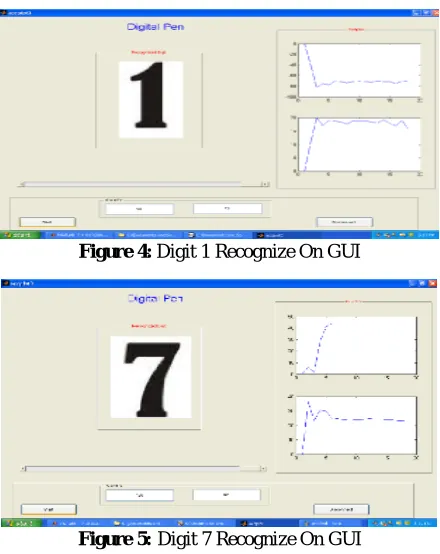
Figure 4: Digit 1 Recognize On GUIFigure 5: Digit 7 Recognize On GUI
The above graphical user interface window shows the recognize digit output .In this as the slider moves from one end to another end we have to draw the digit then we get recognize digit along with X value & Y value graph.
We can use this project work in the various applications where gesture recognition is used. The application area like providing the security using gesture recognition that means operating the system with predefined digit stored in the database & the digit will act as a authenticate digit of accessing the system & second any other digit will act as a closing the system. To operate relay we use digit 1 & digit 7 as we recognize the digit 1 then relay will be ON & when we recognize the digit as 7 then relay will be OFF. we can use any digit to operate the relay.
Table III. Database Of Different Person Person
0 1 2 3 4 5 6 7 8 9
P1 √ √ √ √ √ √ √ √ √ √
P2 x √ √ √ √ √ x √ x √
P3 √ √ √ √ √ √ √ x √ x
P4 √ √ √ x x √ √ √ √ √
P5 √ √ √ x √ √ √ √ √ √
P6 x √ √ √ √ √ x x √ √
P7 x √ √ √ √ √ √ √ √ √
P8 √ √ √ √ √ √ √ √ √ √
P9 √ √ √ √ √ √ x √ √ x
P10 √ √ √ x √ √ x √ √ √
Now we collect the database of 10 people that they draw the digit from 0 to 9 , the sign √ shows that digit is
successfully recognized & the sign x means digit not recognize.
5. Conclusion
In this work we construct trajectory reorganization system for developing handwriting & gesture reorganization which can be implemented in the data protection .We also use the PNN for accurate measuring of digit .In this work by using Trajectory recognition algorithm & PNN , we try to recognize perfect matching of gesture in Handwriting.
Volume 3, Issue 4, April 2014
Page 357
REFERENCES
[1] Jeen-Shing Wang and Fang-Chen Chuang, “An Accelerometer-Based Digital Pen With a Trajectory Recognition Algorithm for Handwritten Digit and Gesture Recognition,” IEEE Sens. J., vol. 59, no. 07, pp. 1543–1551, July. 2012.
[2] Z. Dong, U. C. Wejinya, and W. J. Li, “An optical-tracking calibration method for MEMS-based digital writing instrument,” IEEE Sens. J., vol. 10, no. 10, pp. 1543–1551, Oct. 2010.
[3] J. S.Wang, Y. L. Hsu, and J. N. Liu, “An inertial-measurement-unit-based pen with a trajectory reconstruction algorithm and its applications,” IEEE Trans. Ind. Electron., vol. 57, no. 10, pp. 3508–3521, Oct. 2010.
[4] S.-H. P. Won, W. W. Melek, and F. Golnaraghi, “A Kalman/particle filter-based position and orientation estimation method using a position sensor/inertial measurement unit hybrid system,” IEEE Trans. Ind. Electron., vol. 57, no. 5, pp. 1787–1798, May 2010.
[5] A. D. Cheok, Y. Qiu, K. Xu, and K. G. Kumar, “Combined wireless hardware and real-time computer vision interface for tangible mixed reality,” IEEE Trans. Ind. Electron., vol. 54, no. 4, pp. 2174–2189, Aug. 2007.
[6] E. Sato, T. Yamaguchi, and F. Harashima, “Natural interface using pointing behavior for human–robot gestural interaction,” IEEE Trans. Ind. Electron., vol. 54, no. 2, pp. 1105–1112, Apr. 2007.
[7] Y. S. Kim, B. S. Soh, and S.-G. Lee, “A new wearable input device: SCURRY,” IEEE Trans. Ind. Electron., vol. 52, no. 6, pp. 1490–1499, Dec. 2005
[8] Miss Leena mahajan ,Prof G,.A.Kulkarni ,” Digital Pen for Handwritten Digit and Gesture Recognition Using Trajectory Recognition Algorithm Based On Triaxial Accelerometer- A Review
Author Profile
Mr.Kunal J.Patil received his B.E. degree in Electronics & Telecommunication Engineering from R.S C.O.E. Pune, Pune University in 2011. He is pursuing his M.E degree from S.S.B.T’S C.O.E.T Bambhori Jalgaon, North Maharashtra University
Mr.Atul H Karode received his B.E.degree in Electronics Engineering from S.S.B.T’S C.O.E.T Bambhori Jalgaon, North Maharashtra University in 1999. He received his M.E degree from Professor Ram Meghe Institute of Technology & Research Badnera Amravati, SGBAU Amravati University in 2010. Recently, he is working as Assistant Professor in Electronics & Telecommunication Engineering Department in S.S.B.T’S C.O.E.T Bambhori, Jalgaon. He has 13 years of teaching experience. His research interest includes Image Processing & Pattern recognition
![Figure 2 Block Diagram of Trajectory recognition algorithm[1]](https://thumb-us.123doks.com/thumbv2/123dok_us/9765075.1961594/2.612.216.414.424.578/figure-block-diagram-trajectory-recognition-algorithm.webp)
![Table II Pictorial Digit Trajectories [1]](https://thumb-us.123doks.com/thumbv2/123dok_us/9765075.1961594/3.612.188.441.458.664/table-ii-pictorial-digit-trajectories.webp)