40
Copyright © 2018. IJEMR. All Rights Reserved.
Volume-8, Issue-1 February 2018
International Journal of Engineering and Management Research
Page Number: 40-64
The Organizational Culture of Gaza Strip Construction Companies
Othman A. Tayeh1, Khalid El-Hallaq2 and Bassam A. Tayeh3
1M.Sc Degree, Department of Civil Engineering, Islamic University of Gaza, Gaza, PALESTINE 2,3Assistant Professor, Department of Civil Engineering, Islamic University of Gaza, Gaza, PALESTINE
3Corresponding Author: [email protected]
ABSTRACT
Organizational culture gives identity to an organization. Nowadays with the increasing of the internationalization of the construction industry, the organizational culture become more importance than any other times. The aim of this research is to investigate the organizational cultural profile of the Gaza Strip construction organizations, this aim was achieved by investigating the importance of the organizational culture, identifying the current organizational cultural type of the Gaza Strip construction organizations, and identifying the desired organizational cultural type of the Gaza Strip construction organizations. The study used a questionnaire that was administered by contracting companies classified at the Palestinian Contractors Union. Out of 134 questionnaires were distributed, only 74 questionnaires were received. The results of the organizational culture profile present that the dominant current and the desired organizational culture was clan culture type for all Gaza Strip construction organizations. Also results showed that the organizational culture affected by changing the organizations size. The results showed that the very small organizations had hierarchy type as the dominant current culture and preferred to be clan type as the dominant desired culture, it showed also that the small organizations had a market type as the dominant current and desired organizational culture, it presented also that the clan culture type was the dominant
current and desired organizational culture medium
organizations, it showed that the large organizations had clan type as the dominant current culture and preferred to be market type as the dominant desired culture.
Keywords— Construction Companies, Organizational Culture, Gaza Strip.
I.
INTRODUCTION
The construction industry has become internationalized, thereby making it difficult for construction companies to compete on the global scene.
This occurrence is further exacerbated by inadequacy of profits and financial returns in construction business, which has stifled the success of many construction companies. Under these conditions, it is important for business organizations to understand be aware of their own culture and the culture of other organizations so as to be able adjust their ways and traditions more flexibly while conducting business (Yazic, Arditi, & Uwakweh, 2007). Socio-economic report in the first quarter of 2013 reveals that the construction sector contributes 27.1% to the economy of the Palestine State. With this statistics, the construction sector’s GDP contribution is higher than other sectors in the Palestine. Regardless of the exceptional circumstances the construction sector remains one of the most important sectors in the total GDP in Gaza Strip, so it is very important that to focuses on construction sector and on construction companies. It is necessary to study these companies and their culture because that the organizational culture have an impact on their success or failure. This research was therefore undertaken for this. Any organization is driven by their own kind of culture known as ‘organizational culture’, which has important affect upon member’s perceptions as well as behaviors and guides daily workers activities to meet organization goals (Amah, 2012). When the organization set its goals, it is important to determine the type of culture to achieve a successful implementation of the organization’s goals and objectives.
41
Copyright © 2018. IJEMR. All Rights Reserved.
II.
LITERATURE REVIEW
2.1 Concept of Organizational Culture
Shared meanings, assumptions, beliefs and understandings held by a team are considered as the basic component of the organizational culture definition, despite different definitions of organizational culture. Table 1 illustrate a set of these definitions.
Table 1: Organizational culture definitions.
Definition Reference
Organization's characteristic formed within the framework of the society, environment, law and norms.
Albayrak and Albayrak, (2014)
The specific collection of values and norms that are shared by people and groups in an organization and that control the way they interact with each other and with stakeholders outside the organization.
James Ng'ang'a and Nyongesa, (2012)
The taken-for-granted values, underlying assumptions, expectations, collective memories, and definitions present in an organization, it reflects the prevailing ideology that people carry inside their heads, it conveys a sense of identity to employees, provides unwritten and often unspoken guidelines for how to get along in the organization, and it enhances the stability of the social system that they experience.
Cameron and Quinn, (2005)
A pattern of shared basic assumptions that was learned by a group as it solved its problems of external adaptation and internal integration, that has worked well enough to be considered valid and, therefore, to be taught to new members as the correct way to perceive, think, and feel in relation to those problems.
Schein, (2006)
A set of norms and values that are widely shared and strongly held throughout the organization.
OReilly and Chatman, (1996)
The part of the stock of knowledge that is shared by a substantial portion of the employees of the firm, but not to the general population from which they are drawn.
Crémer, (1993) As (a) a pattern of basic assumptions, (b) invented, discovered, or developed by a
given group, (c) as it learns to cope with its problems of external adaptation and internal integration, (d) that has worked well enough to be considered valid and, therefore (e) is to be taught to new members as the (f) correct way to perceive, think, and feel in relation to those problems.
Schein, (1990)
The pattern of shared values and beliefs that help individuals understand organizational functioning and thus provide them norms for behavior in the organization.
Deshpande and Webster Jr, (1989)
The system of such publicly and collectively accepted meanings operating for a given group at a given time.
Trice and Beyer, (1984)
2.2 Culture Levels
Schein (2006) proposed culture levels for the analysis and understanding of culture or OC? The author divided OC into three levels according to the degree of visibility to the observer., These levels are Artifacts,
Espoused Beliefs and Values, and Underlying Assumptions as shown in Figure 1.these levels range from the very tangible overt manifestations that one can see and feel to the deeply embedded, unconscious, basic assumptions.
42
Copyright © 2018. IJEMR. All Rights Reserved.
Characteristics ExamplesLevels of Culture
Surface but hard to Decipher Visible Organizational
Structures and processes
Sharing with espoused Justification Strategies, goals,
philosophies
Concordance for being the ultimate source of
values and Action Unconscious, taken-for
granted beliefs, perceptions, thoughts and feelings
Figure 1 : Levels of culture. (Cheung, Wong, & Wu, 2011)
2.2.1 Artifacts
This level include all the phenomena that one sees, hears, and feels when one encounters a new group with an unfamiliar culture. An example is the architecture of a physical environment, language, technology and products and artistic creations. . At the organizational level, artifacts reflect the beliefs and values shared by members of an organization (Cheung et al., 2011). This level of culture is easy to observe but difficult to decipher (Schein, 2006).
2.2.2 Espoused Beliefs and Values
"This refers to significant values, morals or beliefs that are important in an organization. The deeper levels of organizational culture begin as a shared value and eventually become shared basic assumptions (over time, after repetition). For example, values such as trust, honesty and integrity play a strong role within the moral structure of many organizations" (Ricketts, 2013). Further, espoused beliefs and values are developed over time as workable solutions to critical problems that the organization faces, and if these solutions exist long enough, it become basic assumptions (Heracleous, 2001).
2.2.3 Underlying Assumptions
This refers to ….."How situations or problems within the organization are treated after repetition; they evolve as the situation is repeated over and over again. rules, policies, and procedures found within an organization are based on shared basic assumptions that have developed within the organizational culture. A good example of shared assumptions within any group is the constitution or bylaws by which the group is governed" (Ricketts, 2013). However, basic assumptions may be so implicit, taken for granted, and unconscious that surfacing them can require intensive interviewing and observation (Kaarst-Brown, Nicholson, Von Dran, & Stanton, 2004).
2.3 Organizational Culture in Construction Industry
Recently, the organizational culture studies in construction sector increase significantly, this increasing as a result of internationalization of the construction industry (Yazic et al., 2007). The nature of construction industry is being an industry whose firms come together as temporary organizations to deliver the construction projects (or products), the success of construction projects depend mainly on smooth coordination among the members in this temporary organizations (Nifa & Ahmed, 2010). The contractor team is divided into two categories (i) permanent employees, (ii) temporary employees according the project lifecycle, the permanent employees are affected by the organizational culture. There exist small differences between the cultures of each project but the dominant culture is the culture of the organization which refers to the subcultures of company’s managers and engineers (Albayrak & Albayrak, 2014).
2.4 Frameworks for evaluating OC The Competing Values Framework (CVF)
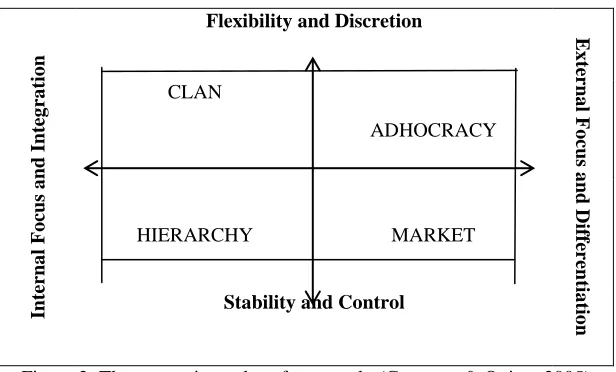
The competing values framework (CVF) is used to assess OC through the way people think, their values and assumptions, and the ways they process information (Cameron & Quinn, 2005). CVF based on two major dimensions. The first dimension differentiates between criteria that emphasize flexibility, discretion and dynamism and that criteria which emphasize stability, order and control the second dimension (internal versus external), differentiates between the criteria that emphasize the internal orientation and integration from the criteria that focuses on external orientation and rivalry. The two dimensions create four quadrant, each one of them represent a basic organizational culture type which are (1) clan, (2) adhocracy, (3) market, and (4) hierarchy. As shown in Figure 2, the CVF with the two dimensions and the four quadrants represent the organizational culture types.
Artifact s
Espoused Beliefs
and Values
43
Copyright © 2018. IJEMR. All Rights Reserved.
Inte rna l F o cus a nd I nte g ra tio nFlexibility and Discretion
E x ter na l F o cus a nd Dif fer en tia tio n CLAN ADHOCRACY
HIERARCHY MARKET
Stability and Control
Figure 2: The competing values framework, (Cameron & Quinn, 2005)
Organizational Culture Assessment Instrument (OCAI)
Based on Cameron and Quinn (1999) developing an instrument used to predict the current organizational culture in the organizations and used for determine the organizational culture type that the organization have these instrument called Organizational Culture Assessment Instrument (OCAI) which will be discussed in the following section.
2.4.1 Clan Culture Type
The clan culture type supports shared values, goals, cohesion, participation, teamwork, employee involvement and corporate commitment to employees. They seemed more like extended families than economic entities (Cameron & Quinn, 2005). Yu and Wu, (2009) defined the clan culture type as sharing of values and common goals, including teamwork and mutual help. The organizations that have the clan culture type as a dominant organizational culture type embrace team work and information sharing As a result, such organizations are very friendly workplace where individuals share and interact among themselves (Harinarain, Bornman, & Botha, 2013). Furthermore, Yazic et al., (2007) stated that these type of organizations focus on teamwork, employee-involvement programs, and organization obligation to employees. This promotes employee commitment to the organization’s visions and vice versa (Nummelin, 2006).
2.4.2 Adhocracy Culture Type
The adhocracy culture type focuses on adaptability, readiness and expansion (Harinarain et al., 2013). According to Yazic et al. (2009), the adhocracy culture is comparable to a new and temporary organization that dismembers anytime organization duties are finished, and reconvenes quickly whenever new duties arise. According to Cameron and Quinn (2005), this manner of OC demonstrates the ability of an organisation to be adaptable and innovative. Nummelin, (2006) pointed that the adhocracy culture type basically founded in young organizations where the surrounding organization's
environment lead the organization to be flexible in their actions that motivate the organization employees to be innovative and creative. Similarly, Yazic et al., (2007) pointed that the adhocracy culture exists in organizations that have innovation and dynamic characteristics where the major goal is to adopt adaptability, flexibility and creativity.
2.4.3 Market Culture Type
According to Yu and Wu (2009), the market culture focuses on the transactions in the business environment of an organization as alternative to the inner operations. Hence, the aim of the market culture is to enhance the competitiveness in business and to achieve maximum profit. Similarly, according to Rameezdeen & Gunarathna (2012), the market culture type emphasizes on the maximization of output, goal clarification, providing direction of what needs to be done to ensure competitive orientation towards competitors. In corroboration, Nummelin, (2006) pointed that the market culture is externally oriented and the main values are profitability, market shares, competitiveness and productivity.
2.4.4 Hierarchy Culture Type
The hierarchy culture emphasizes on clear organizational structure, standardized rules and procedures, strict control, and well defined responsibilities (Yu & Wu, 2009), which helps all members of an organization to determine what to do or embark on (Cameron, 2008). Still, the support of the leadership in an organization is required to ensure effective hierarchy culture (Cameron, 2008). Under hierarchy culture, the long term attributes for an organization are stability, predictability and efficiency (Cameron and Quinn, 2005; Yazic et al., 2007). According to Nummelin (2006), the hierarchy culture exists mainly in public sector and old organizations that are more stable and consistent.
2.5 Organizational Culture Assessment Instrument
44
Copyright © 2018. IJEMR. All Rights Reserved.
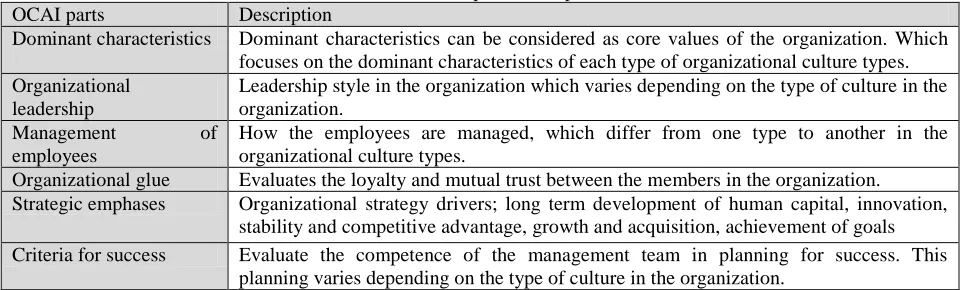
Quinn in 1999. This instrument used to predict the currentorganizational culture in the organizations also can help in determine what culture that organizations should be developed to improve the organization performance (Cameron & Quinn, 2005).The purpose of this instrument is to determine the organization core values, assumptions, interpretations and approaches (Harinarain et al., 2013). The instrument is like a questionnaire divided into six parts (items) each part contain four alternatives, after filling the instrument the instrument give you a full picture about the
assumptions on which your organization operates (Cameron & Quinn, 2005). The six parts which consist the OCAI are (1) dominant characteristics, (2) organizational leadership, (3) management of employees, (4) organizational glue, (5) strategic emphases and (6) criteria for success. Table 3 illustrate the OCAI parts depending on (Cameron and Quinn, 2005; Cheung et al., 2011; Rameezdeen and Gunarathna, 2012; Igo and Skitmore, 2006).
Table 3: OCAI parts description. OCAI parts Description
Dominant characteristics Dominant characteristics can be considered as core values of the organization. Which focuses on the dominant characteristics of each type of organizational culture types. Organizational
leadership
Leadership style in the organization which varies depending on the type of culture in the organization.
Management of employees
How the employees are managed, which differ from one type to another in the organizational culture types.
Organizational glue Evaluates the loyalty and mutual trust between the members in the organization. Strategic emphases Organizational strategy drivers; long term development of human capital, innovation,
stability and competitive advantage, growth and acquisition, achievement of goals Criteria for success Evaluate the competence of the management team in planning for success. This
planning varies depending on the type of culture in the organization. The OCAI later on became the most important
and reliable way in organizational culture studies especially in construction industry where almost all researchers who have studied the organizational culture in construction industry in the world depend on OCAI.
III.
RESEARCH METHODOLOGY
The data was collected by using the questionnaire method, which is the most widely used method for data collection for both descriptive and analytical surveys. Furthermore, the questionnaire is a fast and easy method of data collection and more accurate when starting processing and analyzing the collected data. The target population for this research includes all classified contractors according to PCU. There exist 331 classified contractors in 2015 in Gaza Strip. According to PCU construction works divided into five major areas (roads, Buildings, electromechanical, water / sewage, public works and maintenance) each one of these areas contains five classes (class one, class two, class three, class four, and class five). The contractor can have more than one classification in different areas of the above-mentioned five areas.
3.1 Sample Size
Fellows and Liu, (2015) defined the sample as a part of total population that represents this population. Israel, (1992) explained that, there are several approaches to determine the sample size. These include using a census for small populations, imitating a sample size of similar
studies, using published tables, and applying formulas to calculate a sample size.
Fellows and Liu, (2015) showed that, three types of sampling can be conducted during the research study; a systematic sampling, stratified sampling, and the cluster sampling. The stratified sampling will be used in this study after the determination of sample size. Fellows and Liu, (2015) showed that, having determined the strata, sampling occurs most commonly by considering the relative importance of each stratum in population and using such weighting to divide this population.
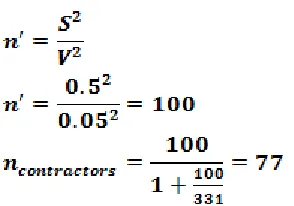
Kish, (1965) equation was used to determine the sample size for each population of contractors and subcontractors.
The definitions of all variable can be defined as the following:
n: sample size from finite population.
n': the sample size from infinite population, which can be calculated from this formula.
[n' = S²/V²].
N: Total population (331 contractors).
V: Standard error of sample population equal 0.05 for the confidence level 95%, t= 1.96.
S²: Standard error variance of population elements, S²= P (1-P); maximum at P= 0.5.
45
Copyright © 2018. IJEMR. All Rights Reserved.
Although the calculated sample size forcontractors is 77. To avoid the risk of not responding from
the contractors the questionnaire was distributed to 134 contractors. The 134 questionnaire that distributed was delivered to the contractors by one of two ways (i) by delivery to the place of the company - 84 questionnaire was distributed by this way- , or (ii) by sending the questionnaire to the company via email - 50 questionnaire was distributed by this way-. Table 4 show the calculated sample, the number of distributed questionnaires, the number of retained questionnaires and the response rate.
Table 4: Sample size and response rate of the study population Total
Population
Calculated Sample Size
Distributed Questionnaire Retained Questionnaire
Response Rate 331 77 By delivery to the place of the company 82 72 88%
By sending to the company via email 52 2 4%
3.2 Questionnaire Design and Contents
After making a review for all studies that focusing on organizational culture spatially in construction industry. The questionnaire was designed with all necessary information that can help in achieving the research objectives. The questionnaire was contained a covering letter, that explained the study purpose, the way of filling the questionnaire, the research aim and the security of the information for encourage high response. The questionnaire structure divided into three parts: (i) General information about the response person, (ii) General information about the construction organization,
(iii) Questions to measure the organizational culture of the construction organization. The following are explanation of each part of these parts.
3.2.1 General Information about the Response Person
The first section is about the personal characteristics of the respondents. This part mainly designed to provide general information about the respondents in terms of the type of institutions of the respondent, position of the respondent in the company, experience of the respondent, age of the respondent, scientific degree of the respondent, scientific specialization of the respondent, and the respondent gender. Table 5: Respondents information
General information Frequency Percentage% Respondents’
professional designation
Head/Board Member 20 27.03
Project Manager 38 51.35
Site Engineer 16 21.62
Work experience (years) Less than 5 years 25 33.78
5- 10 years 17 22.97
11- 15 years 18 24.32
16- 20 years 8 10.81
Over 20 years 6 8.11
Respondent educational
level
Diploma 8 10.81
Bachelors 52 70.27
Master 14 18.92
Doctorial 0 -
Specialization
Civil Engineer 46 62.16
46
Copyright © 2018. IJEMR. All Rights Reserved.
Mechanical Engineer 2 2.7Other 5 6.76
3.2.2 General Information about the Construction Organization
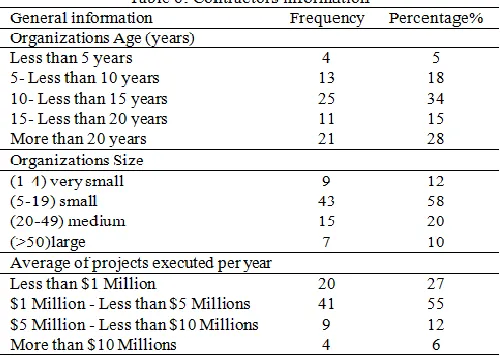
This is the second section in the questionnaire and aimed to determine the characteristics of the respondent companies. This section include several questions like the
company age, and the company size according the number of permanent employees in the company, work types that carried out the company, the company classification in PCU, and average of projects executed per year.
Table 6: Contractors information
3.2.3 Questions to Measure the Organizational Culture of Gaza Strip Construction Organization
The third section was designed to measure and assess the organizational culture in the construction companies. There exist several standards for this purpose, in this research OCAI has been used. The OCAI was the most popular used especially in construction, almost all researchers who have studied the organizational culture in construction industry used the OCAI without any changes like (Rameezdeen and Gunarathna, 2012; Von Meding et al., 2012; Zhang and Liu, 2006; Zhang and Liu, 2003; Dulaimi et al., 2007; Nummelin, 2006; Harinarain et al., 2013; Yazic et al., 2007; Giritli et al., 2006; Koh & Low, 2008; Giritli et al., 2013; Igo and Skitmore, 2006). The OCAI divided into six questions each one have four alternative and in the assessment process the rating will done in two stages now (to measure the current organizational culture in the organizations) and preferred (to measure what is the expected organizational culture of the organization after five years). As mentioned previously for each one of the six questions there are four alterative in the assessment process 100% will distributed between the alternative in the two columns Now and Preferred.
IV.
RESULTS AND DISCUSSION
4.1 For All Surveyed Organizations
The culture profile for the organizations was done by calculating the average value for each alternative in the
six questions "by addition A alternative in all questionnaires and divide by the number of the questionnaires and this process is repeated for all other alternatives B, C, and D", then calculate the average for the alternatives "in other words for all questionnaires calculate the average for each alternative in all questions by addition the average of A alternative in questions 1,2,3,4,5,and 6 that calculated before and divide by 6". This process is repeated for the two phases Now phase and for Preferred phase.
47
Copyright © 2018. IJEMR. All Rights Reserved.
Table 7: Results for individual questions on the OCAI for all organizationsQuestions culture type Now Preferred
Average standard deviation Average standard deviation
1 A Clan 29.66 15.38 30.34 15.16
B Adhocracy 22.57 7.18 22.84 30.34
C Market 26.15 12.04 26.24 11.11
D Hierarchy 21.08 13.48 20.36 12.64
2 A Clan 28.18 11.72 29.39 10.56
B Adhocracy 24.39 8.87 24.39 7.12
C Market 22.91 10.79 23.04 9.86
D Hierarchy 23.99 12.11 22.43 10.73
3 A Clan 29.59 14.64 30.88 14.32
B Adhocracy 20.61 29.59 21.42 7.10
C Market 24.26 10.91 22.57 10.54
D Hierarchy 25.54 13.28 25.00 11.96
4 A Clan 28.99 13.85 30.47 14.74
B Adhocracy 22.30 8.28 22.77 8.11
C Market 25.74 9.42 26.15 12.12
D Hierarchy 22.97 8.91 20.54 9.12
5 A Clan 25.20 12.62 27.77 13.14
B Adhocracy 24.12 8.93 23.65 8.53
C Market 24.12 9.80 22.97 9.51
D Hierarchy 26.49 11.22 25.74 12.89
6 A Clan 21.49 12.10 25.27 11.40
B Adhocracy 22.77 9.30 23.45 9.65
C Market 27.91 13.77 25.61 12.55
D Hierarchy 27.57 14.44 25.54 12.89
Table 8 illustrates the graphical representation of the current organizational culture profile "Now phase" and
desired organizational culture profile "Preferred phase" for individual questions for all organizations.
Table 8: Profiles for individual questions on the OCAI for all organizations No
.
Now profiles Preferred profiles
48
Copyright © 2018. IJEMR. All Rights Reserved.
23
4
49
Copyright © 2018. IJEMR. All Rights Reserved.
6Table 9 shows the overall results for all organizations, it shows that the dominant culture type for both phases is clan culture type then market culture type.
That’s mean Gaza Strip construction organizations like an extended family which support
participation, information sharing, teamwork and employee involvement. The organizations which are characterized by a clan culture type are described as a friendly workplace where individuals share of themselves.
Table 9: Overall culture results for all organizations
No. Culture type Now Preferred
Average standard deviation Average standard deviation 1 Clan 27.18 7.50 29.02 8.38 2 Adhocracy 22.79 3.82 23.08 3.48 3 Market 25.18 5.58 24.43 5.87 4 Hierarchy 24.6 5.75 23.27 5.40 Table 10 illustrate for all organizations the
graphical representation of the current organizational
culture profile "Now phase" and desired organizational culture profile "Preferred phase".
Table 10: Overall culture profile for all organizations
Now profile Preferred profile
Table 11 shows the number of organizations in each of the four organizational culture types in the two phases, in some cases two or more organizational cultures
50
Copyright © 2018. IJEMR. All Rights Reserved.
Table 11: The total number of organizations that possess each of the current or preferred culture types for all organizations Clan Adhocracy Market Hierarchy Dual Culture Total
Now 22 4 17 18 13 74
Preferred 27 7 21 15 4 74
The result of this research is expected because the Gaza Strip construction organizations in fact, like a family. The result of the current culture type agreed with the results of (Dulaimi et al., 2007; Giritli et al., 2006) which showed that the construction organizations in Turkey have clan culture type as current culture type and Yazic et al., (2007) which showed that the construction organizations in the U.S have clan culture type as current culture type. While the results of this research differed with (Harinarain et al., 2013; Nummelin, 2006; Zhang and Liu, 2006; Zhang and Liu, 2003; Rameezdeen and Gunarathna, 2012).
The result of the desired culture type of the Gaza Strip construction organizations showed that these organizations perferred to have clan culture type which agreed with the results of Nummelin, (2006) in Finland construction organizations and differed with Harinarain et al., (2013) in South African construction organizations.
4.2 OCAI Results According to Organizations Size
The data collected could be analyzed, in order to establish the different organizational cultures within organizations of different size. The Palestinian Central Bureau of Statistics adopted for statistical purposes the organizations size according to the number of permanent employees very small organizations if the number of employees from 1 to 4, small organizations if the number of employees from 5 to 19, medium organizations if the number of employees from 20 to 49, and large organizations if the number of employees greater than 50.
4.2.1 Very Small Organizations
Table 12 illustrate the graphical representation of the current organizational culture profile "Now phase" and desired organizational culture profile "Preferred phase" for individual questions for very small organizations. It shows the results for individual questions on the OCAI for all organizations, it’s shown that for question 1 the dominant culture type for both Now and Preferred phases is hierarchy type and come in second place clan culture type, for question 2 the dominant culture type for both Now and Preferred phases is clan type and come in second place adhocracy culture type, for question 3 the dominant culture type for Now phase is hierarchy type and come in second place market culture type, but for Preferred phase is hierarchy type and come in second place clan culture type, for question 4 the dominant culture type for Now phase is market type and come in second place clan culture type, but for Preferred phase is clan type and come in second place market culture type, for question 5 the dominant culture type for Now phase is hierarchy type and come in second place market culture type, but for Preferred phase is hierarchy type and come in second place adhocracy culture type, and for question 6 the dominant culture type for Now phase is hierarchy type and come in second place market culture type, but for Preferred phase is market type and come in second place hierarchy culture type.
Table 12: Profiles for individual questions on the OCAI for very small organizations
No. Now Preferred
51
Copyright © 2018. IJEMR. All Rights Reserved.
23
52
Copyright © 2018. IJEMR. All Rights Reserved.
5
6
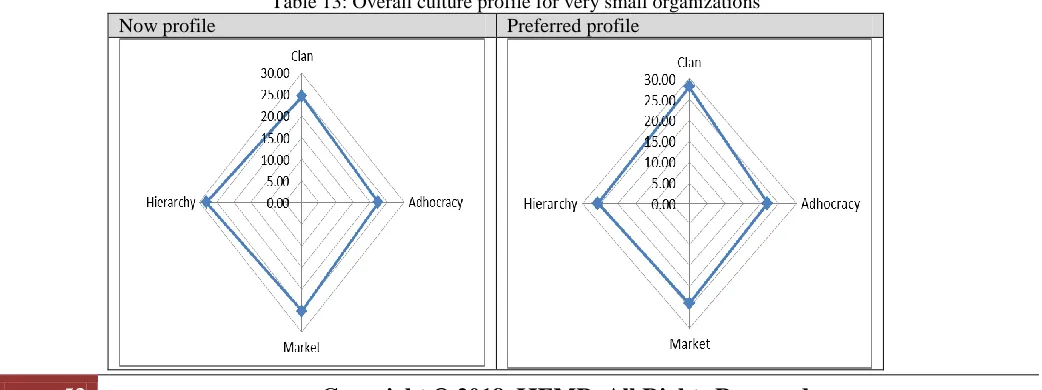
Table 13 illustrate for very small organizations the graphical representation of the current organizational culture profile "Now phase" and desired organizational culture profile "preferred phase". It shows the overall results for very small organizations, it shows that the dominant culture type for Now phase is hierarchy type and come in second place market culture type, but for Preferred phase is clan type and come in second place hierarchy culture type.
The very small organizations which characterized by a hierarchy culture type at Now phase can be described as a clear organizational structure, standardized rules and procedures, strict control, and well defined responsibilities. But these organizations prefer to have in the future clan culture type where this type is characterized by a friendly workplace where individuals share of themselves.
Table 13: Overall culture profile for very small organizations
53
Copyright © 2018. IJEMR. All Rights Reserved.
Table 14 shows the number of organizations ineach of the four organizational culture types in the two phases, in some cases two or more organizational cultures
were found to be equal for an organization, being referred as a dual culture, for very small organizations.
Table 14: The total number of organizations that possess each of the current or preferred culture types for very small organizations
Clan Adhocracy Market Hierarchy Dual Culture Total
Now 2 1 1 5 0 9
Preferred 2 2 2 2 1 9
As mentioned previously the organizational culture of the Gaza Strip organizations in fact as family so the results for very small organizations is unexpected. Logically, the organizations with least the number of employees close to be as a family. Very small organizations class does not exist in the previous studies, because the previous studies have classed the organizations to small, medium and large.
4.2.2 Small Organizations
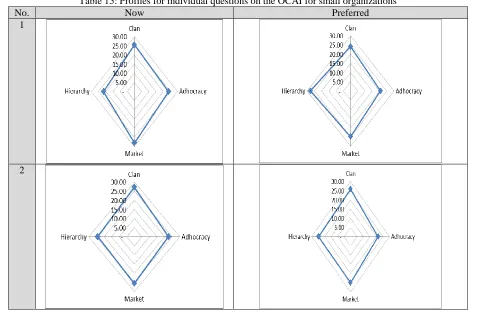
Table 15 illustrates the graphical representation of the current organizational culture profile "Now phase" and desired organizational culture profile "Preferred phase" for individual questions for small organizations. It shows the results for individual questions on the OCAI for all organizations, it’s shown that for question 1 the dominant culture type for Now phase is market type and come in second place clan culture type, but for Preferred phase is
hierarchy type and come in second place market culture type, for question 2 the dominant culture type for both Now and Preferred phases is clan type and come in second place market culture type, for question 3 the dominant culture type for both Now and Preferred phases is clan type and come in second place market culture type, for question 4 the dominant culture type for Now phase is market type and come in second place clan culture type, but for Preferred phase is market type and come in second place hierarchy culture type, for question 5 the dominant culture type for Now phase is clan type and come in second place hierarchy culture type, but for Preferred phase is clan type and come in second place market culture type, and for question 6 the dominant culture type for Now phase is market type and come in second place hierarchy culture type, but for Preferred phase is clan type and come in second place market culture type.
Table 15: Profiles for individual questions on the OCAI for small organizations
No. Now Preferred
1
54
Copyright © 2018. IJEMR. All Rights Reserved.
34
5
55
Copyright © 2018. IJEMR. All Rights Reserved.
Table 16 illustrates for small organizations thegraphical representation of the current organizational culture profile "Now phase" and desired organizational culture profile "Preferred phase". It shows the overall results for small organizations, it shows that the dominant culture type for both Now phase and Preferred phase is
market type and come in second place clan culture type. The organizations with market culture type working on emphasis the maximization of output" maximum profit ", goal clarification, and market shares. The main goal of these organizations is how to compete in the market to achieve the maximum profit possible.
Table 16: Overall culture profile for small organizations
Now profile Preferred profile
Table 17 shows the number of organizations in each of the four organizational culture types in the two phases, in some cases two or more organizational cultures
were found to be equal for an organization, being referred as a dual culture, for small organizations.
Table 17: The total number of organizations that possess each of the current or preferred culture types for small organizations Clan Adhocracy Market Hierarchy Dual Culture Total
Now 8 1 14 10 10 43
Preferred 13 3 15 10 2 43
The results for small organizations showed that small organizations have market culture type as current culture type and do not want to change in the future, these results agreed with Harinarain et al., (2013) and differed with (Giritli et al., 2006; Dulaimi et al., 2007). Always organizations that have a large number of employees tend to focus on how to compete in the market and achieve high profits.
4.2.3 Medium Organizations
Table 18 illustrate the graphical representation of the current organizational culture profile "Now phase" and desired organizational culture profile "Preferred phase" for individual questions for medium organizations. It shows the results for individual questions on the OCAI for all organizations, its shown that for question 1 the dominant culture type for both Now and Preferred phases is clan
56
Copyright © 2018. IJEMR. All Rights Reserved.
Table 18: Profiles for individual questions on the OCAI for medium organizations No.
Now Preferred
1
2
57
Copyright © 2018. IJEMR. All Rights Reserved.
45
6
Table 19 illustrate for medium organizations the graphical representation of the current organizational culture profile "Now phase" and desired organizational culture profile "preferred phase". It shows the overall results for medium organizations, it shows that the dominant culture type for both Now phase and Preferred
phase is clan type and come in second place adhocracy culture type. The organizations with clan culture type are like an extended family which support participation, information sharing, teamwork and employee involvement.
58
Copyright © 2018. IJEMR. All Rights Reserved.
Table 19: Overall culture profile for medium organizationsNow profile Preferred profile
Table 20 shows the number of organizations in each of the four organizational culture types in the two phases, in some cases two or more organizational cultures
were found to be equal for an organization, being referred as a dual culture, for medium organizations.
Table 20: The total number of organizations that possess each of the current or preferred culture types for medium organizations
Clan Adhocracy Market Hierarchy Dual Culture Total
Now 9 2 1 1 2 15
Preferred 11 0 2 1 1 15
These results agreed with Harinarain et al., (2013) and differed with (Giritli et al., 2006; Dulaimi et al., 2007). But as mentioned previously the organizational culture of the Gaza Strip organizations in fact as family so the results for medium organizations is predicted.
4.2.4 Large Organizations
Table 21 illustrate the graphical representation of the current organizational culture profile "Now phase" and desired organizational culture profile "preferred phase" for individual questions for large organizations. It shows the results for individual questions on the OCAI for all organizations, its shown that for question 1 the dominant culture type for Now phase is clan type and come in second place adhocracy culture type, but for Preferred phase is market type and come in second place adhocracy
59
Copyright © 2018. IJEMR. All Rights Reserved.
Table 21: Profiles for individual questions on the OCAI for large organizations No.
Now Preferred
1
2
3
60
Copyright © 2018. IJEMR. All Rights Reserved.
56
Table 22 illustrate for large organizations the graphical representation of the current organizational culture profile "Now phase" and desired organizational culture profile "Preferred phase". It shows the overall results for large organizations, it shows that the dominant culture type for Now phase is clan type and come in second place hierarchy culture type, but for Preferred phase is market type and come in second place clan culture type.
The large organizations have clan culture type as current organizational culture, the organizations which are characterized by a clan culture type are described as a
friendly workplace where individuals share of themselves, where the organization look like an extended family which support participation, information sharing, teamwork and employee involvement. But for the desired culture the large organizations preferred to have market culture type where the organizations with market culture type working on emphasis the maximization of output “maximum profit", goal clarification, and market shares. The main goal for organizations that have market culture type is how to compete in the market to achieve the maximum profit possible.
61
Copyright © 2018. IJEMR. All Rights Reserved.
Table 23 shows the number of organizations ineach of the four organizational culture types in the two phases, in some cases two or more organizational cultures
were found to be equal for an organization, being referred as a dual culture, for large organizations.
Table 23: The total number of organizations that possess each of the current or preferred culture types for large organizations Clan Adhocracy Market Hierarchy Dual Culture Total
Now 3 0 1 2 1 7
Preferred 1 2 2 2 0 7
The results for large organizations agreed with Harinarain et al., (2013) for desired culture type and differed with (Giritli et al., 2006; Dulaimi et al., 2007) and with Harinarain et al., (2013) for current culture type. For current culture type the large organizations have clan culture type like most Gaza Strip organizations. But for desired culture type preferred to have market culture type because always organizations that have a large number of employees tend to focus on how to compete in the market and achieve high profits.
4.3 Discussion Of Findings
Table 24, shows the comparison between the results of this research and the results of the previous studies.
Nummelin, (2006) has studied the organizational culture in construction sector in Finland, the main findings that the dominant current organizational culture type is market culture type but the dominant desired organizational culture is clan culture type.
Harinarain et al., (2013) the study was conducted to investigate the organizational culture of the South African construction industry, their sample was divided into two parts quantity surveyors and contractors, the main findings show that for contractors the dominant current organizational culture type is market culture type but the dominant desired organizational culture is market culture type.
Giritli et al., (2006) they have studied the organizational culture for both contractors and
architectures in Turkey, the results show that for contractors the dominant current organizational culture type is clan culture type.
Dulaimi et al., (2007) they have determined that the clan culture type is the dominant current organizational culture in Turkish construction organizations.
Zhang and Liu, (2006) they have studied the organizational culture for Chinese contractors, the results show that the dominant current organizational culture type is hierarchy culture type.
Yazic et al., (2007) they have determined that the clan culture type is the dominant current organizational culture in U.S construction organizations.
Zhang and Liu, (2003) they have determined that the hierarchy culture type is the dominant current organizational culture for Chinese contractors.
Rameezdeen and Gunarathna, (2012) they have studied the organizational culture for both consultants and contractors in Sri Lanka, the results show that for contractors the dominant current organizational culture type is market culture type.
Sandrk Nukic and Huemann, (2015) they have determined that the Construction companies in Croatia currently function with domination of the hierarchy type of organizational culture and preferred to be clan culture type in the future. Atuahene, (2016) has studied the organizational culture in Ghanaian Construction Industry, the main findings that the dominant current organizational culture type is hierarchy culture.
Table 24: Comparison with the previous studies Now organizational
culture
Preferred organizational culture
This research clan clan
Harinarain et al., (2013) market market
Dulaimi et al., (2007) clan …
Nummelin, (2006) market clan
Giritli et al., (2006) clan …
Zhang and Liu, (2006) hierarchy …
Yazic et al., (2007) clan …
Zhang and Liu, (2003) hierarchy …
Rameezdeen and Gunarathna, (2012)
market …
Nukic and Huemann, (2015) hierarchy clan
62
Copyright © 2018. IJEMR. All Rights Reserved.
Some of the previous studies studied theorganizational culture according to the organizations size like (Harinarain et al., 2013; Giritli et al., 2006; Dulaimi et al., 2007), they proposed that the organizations divided according to the size into three parts (i) small organizations were defined as organizations with less than 50 employees, (ii) Medium organizations with 50 to 150 employees, and (iii) large organizations with over 150 employees. But in this research the adopted classification for organizations size was (i) very small organizations if the number of employees from 1 to 4, (ii) small organizations if the number of employees from 5 to 19, (iii) medium
organizations if the number of employees from 20 to 49, and (iv) large organizations if the number of employees greater than 50, this classification was adopted for statistical purposes by The Palestinian Central Bureau of Statistics.
Table 25, shows the comparison between this research and previous studies that studied the organizational culture according to the organizations size, its shows that the results for small and medium organizations agreed with the results of (Harinarain et al., 2013).
Table 25: Comparison with the previous studies according to organizations size Organizations
size
very small small Medium large
Now Preferred Now Preferred Now Preferred Now Preferred This research hierarchy clan market market clan clan clan market Organizations
size
small medium Large
Now Preferred Now Preferred Now Preferred Harinarain et al.,
(2013)
market market clan clan market market Giritli et al.,
(2006)
clan … hierarchy … hierarchy … Dulaimi et al.,
(2007)
clan … hierarchy … hierarchy …
V.
CONCLUSION
This research was aimed to determine the organizational culture profile for the Gaza Strip construction organizations, by utilizing the CVF with its measurement scale OCAI. For this purpose the data was collected from the construction organizations that operates in Gaza Strip by using the questionnaire technique. The results of the organizational culture profile present that the dominant current and the desired organizational culture was clan culture type for all Gaza Strip construction organizations. The findings also show that all of organizational culture items are emphasized in clan culture type for all Gaza Strip construction organizations except the fifth and sixth items which are " strategic emphases and criteria for success ". This means that the Gaza strip construction organizations described as an internally focused organizations.
This study has proofed that the organizational culture affected by the organizations size, where the results showed that the organizational culture type change with changing the organizations size:
For very small organizations, the findings showed that the dominant current organizational culture type is hierarchy type, but the dominant desired organizational culture type is clan type.
For small organizations, the findings showed that the dominant current and desired organizational culture type is market type.
For medium organizations, it showed that the dominant current and desired organizational culture type is clan type.
For large organizations, the findings showed that the dominant current organizational culture type is clan type, but the dominant desired organizational culture type is market type.
REFERENCES
[1] Albayrak, G., & Albayrak, U. (2014). Organizational culture approach and effects on Turkish construction sector. APCBEE Procedia, 9, 252-257.
[2] Aluko, M. (2003). The impact of culture on organizational performance in selected textile firms in Nigeria. Nordic Journal of African Studies, 12(2), 164-179.
[3] Amah, E. (2012). Corporate Culture and Organizational Effectiveness. A Study of the Nigerian Banking Industry. European Journal of Business and Management, 4(8), 212-229.
63
Copyright © 2018. IJEMR. All Rights Reserved.
[5] Calori, R., & Sarnin, P. (1991). Corporate culture andeconomic performance: A French study. Organization studies, 12(1), 049-074.
[6] Cameron, K. (2008). A process for changing organization culture. Handbook of organization development, 14(5), 2-18.
[7] Cameron, K. S., & Quinn, R. E. (2005). Diagnosing and changing organizational culture: Based on the competing values framework: John Wiley & Sons.
[8] Cheung, S. O., Wong, P. S., & Wu, A. W. (2011). Towards an organizational culture framework in construction. International Journal of Project Management, 29(1), 33-44.
[9] Crémer, J. (1993). Corporate culture and shared knowledge. Industrial and corporate change, 2(3), 351-386.
[10] Deshpande, R., & Webster Jr, F. E. (1989). Organizational culture and marketing: defining the research agenda. The journal of marketing, 3-15.
[11] Dulaimi, M., Oney-Yazıcı, E., Giritli, H., Topcu-Oraz, G., & Acar, E. (2007). Organizational culture: the case of Turkish construction industry. Engineering, Construction and Architectural Management, 14(6), 519-531.
[12] Elena, G. M., & Elena, P. D. (2013). STUDY ON THE IMPORTANCE OF ORGANIZATIONAL CULTURE IN A COMPANY. Anale. Seria Stiinte Economice. Timisoara, 19, 292.
[13] Fellows, R. F., & Liu, A. M. (2015). Research methods for construction: John Wiley & Sons.
[14] Giritli, H., Oney-Yazici, E., Topcu-Oraz, G., & Acar, E. (2006). Organizational culture, A comparative analysis from the turkish construction industry CCIM2006 Sustainable Development through Culture and Innovation, 26–29 November 2006, 1-9.
[15] Giritli, H., Öney-Yazıcı, E., Topçu-Oraz, G., & Acar, E. (2013). The interplay between leadership and organizational culture in the Turkish construction sector. International Journal of Project Management, 31(2), 228-238.
[16] Harinarain, N., Bornman, C.-L., & Botha, M. (2013). Organisational culture of the South African construction industry. Acta Structilia: Journal for the Physical and Development Sciences, 20(1), 22-43.
[17] Hartnell, C. A., Ou, A. Y., & Kinicki, A. (2011). Organizational culture and organizational effectiveness: a meta-analytic investigation of the competing values framework's theoretical suppositions American Psychological Association.
[18] Heracleous, L. (2001). An ethnographic study of culture in the context of organizational change. The Journal of Applied Behavioral Science, 37(4), 426-446. [19] Igo, T., & Skitmore, M. (2006). Diagnosing the organizational culture of an Australian engineering consultancy using the competing values framework. Construction Innovation, 6(2), 121-139.
[20] Harinarain, N., Bornman, C. & Botha, M. (2013). Organisational culture of the south african construction industry. Acta Structilia, 20(1), 22-43.
[21] James Ng'ang'a, M., & Nyongesa, W. J. (2012). The impact of organisational culture on performance of educational institutions. International Journal of Business and Social Science, 3(8), 1-7.
[22] Kaarst-Brown, M. L., Nicholson, S., Von Dran, G. M., & Stanton, J. M. (2004). Organizational cultures of libraries as a strategic resource. Library Trends, 53(1), 33-53.
[23] Heracleous, L. (2001). An ethnographic study of culture in the context of organizational change. The Journal of Applied Behaioral Science, 37(4), 426-446.. [24] Madu, B. C. (2012). Organization culture as driver of competitive advantage. Journal of Academic and Business Ethics, 5, 1-9.
[24] Nifa, F. A. A., & Ahmed, V. (2010). The role of organizational culture in construction partnering to produce innovation Procs of 26th Annual ARCOM Conference, 6th-8th September (pp. 725-734).
[25] Nummelin, J. (2006). Measuring organizational culture in construction sector–Finnish sample Proceedings of Joint International Conference Construction Culture, Innovation and Management, Dubai, UAE, 26-29.
[26] OReilly, C. A., & Chatman, J. A. (1996). Culture as social control: Corporations, cults, and commitment. Research In Organizational Behavior, 18, 157-200. [27] Rameezdeen, R., & Gunarathna, N. (2012). Organisational culture in construction: An employee perspective. Construction Economics and Building, 3(1), 19-30.
[28] Ricketts, K. (2013). Understanding your Organization's Culture. University of Kentucky, College of Agriculture, Lexington, KY, 40546.
[29] Sandrk Nukic, I and Huemann, M. (2015). Organizational culture of the Croatian construction industry. Engineering, Construction and Architectural Management.23(2 237-260), 237-260.
[30] Ng‟ang‟a, M.J. & Nyongesa, W.J. (2012). The impact of organisational culture on performance of educational institutions. International Journal of Business and Social Science, 3(8), 211-217.
[31] Schein, E. (2004). Organizational culture and leadership. (3rd ed.). San Francisco: The JosseyBass Business & Management Series.
[32] Shahzad, F., Luqman, R. A., Khan, A. R., & Shabbir, L. (2012). Impact of organizational culture on organizational performance: An overview. Interdisciplinary journal of contemporary research in business, 3(9), 975-985.
[33] Trice, H. M., & Beyer, J. M. (1984). Studying organizational cultures through rites and ceremonials. Academy of management review, 9(4), 653-669.
64
Copyright © 2018. IJEMR. All Rights Reserved.
Palestine: Office of the United Nations SpecialCoordinator for the Middle East Peace Process
[35] Aluko, M. (2003). The impact of culture on organizational performance in selected textile firms in nigeria. Nordic Journal of African Studies , 12(2), 164-79. [36] Yazic, E., Arditi, D., & Uwakweh, B. (2007). Organizational culture in US construction companies. Journal of Management, 6, 219-228.
[37] Yu, T., & Wu, N. (2009). A review of study on the competing values framework. International Journal of Business and Management, 4(7), 37-42.
[38] Zhang, S., & Liu, A. M. (2006). Organisational culture profiles of construction enterprises in China. Construction Management and Economics, 24(8), 817-828.