Design and Implementation of Scientific
Inquiry using Technology in a Teacher
Education Program
Rachel S. Sheffield and Leonie McIlvenny
Corresponding Author: [email protected]
School of Education, Curtin University, Perth WA 6845, Australia
Keywords: Inquiry, pedagogy, pre-service teacher, sustainability, online learning
International Journal of Innovation in Science and Mathematics Education, 22(6), 46-60, 2014.
Abstract
Two hundred and fifteen pre-service teachers engaged in a scientific inquiry unit in the newly created Bachelor of Primary and Early Childhood Education course at an Australian university This paper discusses how the Technological, Pedagogical and Content Knowledge (TPACK) model provided the conceptual framework to design an online inquiry unit. The unit enabled students to research an authentic problem focusing on environmental sustainability using an inquiry framework and an array of information and communication technology (ICT) tools. The survey data collected at the conclusion of the unit indicated that 90 % of students thought the unit improved their understanding of the inquiry process and 88% reported more confidence in their understanding of science concepts. Ninety four percent of students reported an increase in their knowledge and confidence of Web 2.0 tools in supporting scientific inquiry in science. The research determined that the online scaffolded inquiry improved students’ knowledge and confidence in the skills and processes associated with inquiry and in science concepts. It will, however, not replace more traditional hands-on investigative approaches but provides a complementary valuable tool to teach interesting and engaging science.
Introduction
This paper discusses an initiative to improve pre-service teachers’ knowledge of the inquiry process and their engagement and confidence in science education in a first year scientific inquiry unit in the newly developed Bachelor of Primary and Early Childhood Education course at an Australian university. Tertiary courses are often run in parallel learning environments that include face-to-face tutorials and workshops and distance education with students in regional areas and massive online courses (MO(O)Cs). There is an expectation that all students will have fair and equitable access to the course regardless of the delivery mode undertaken. In this new course, units were also informed by the Teaching Teachers for the Future (TTF) project, the new Australian Curriculum and the Australian Institute for Teaching and School Leadership (AITSL) teaching standards.
the process of inquiry. The Technology, Pedagogy and Content Knowledge (TPACK) framework (Fullan, 1999) was used to map the intersection of technology (focused around Web 2.0 tools), pedagogy (inquiry skills) and content knowledge (environmental sustainability) as applied in a pre-service tertiary setting. The nine key elements of authentic e-Learning also informed on the creation of this unit (Herrington, 2010).
This paper considers the creation and implementation of a tertiary unit of study documenting the intersection of pedagogy and technology. It explores the affordances of the embedded ICT technology tools to develop a foundation of selected science inquiry skills and considers the learners’ experiences and understanding of inquiry and Web 2.0 tools during the progression of the unit.
The Learning and Teaching Problem
Preparing tertiary students for their chosen careers requires curriculum designers to develop courses and units to meet multiple objectives. Within the university framework these include adhering to assessment policy, working within the parameters of specific learning management systems and ensuring students meet tertiary graduate attributes by the conclusion of their degrees. University diversification to meet the needs of a changing market has resulted in courses being offered both on-campus and online (to regional and Open Universities Australia students).
Within the teacher education program, students need to meet the Australian Institute for Teaching and School Leadership (AITSL) teaching standards. These standards for teachers require graduates to be competent in a range of skills including ICT within the context of the new Australian Curriculum (Australian Curriculum Assessment and Reporting Authority, 2011). Within Australia, the Melbourne Declaration on Educational Goals for Young Australians (Ministerial Council on Education Employment Training and Youth Affairs, 2008) identifies essential skills for twenty-first century learners in literacy, numeracy, ICT, thinking, creativity, teamwork and communication. It describes individuals who can manage their own wellbeing, relate well to others, make informed decisions about their lives, become citizens who behave with ethical integrity, relate to and communicate across cultures, work for the common good and act with responsibility at local, regional and global levels (Ministerial Council on Education Employment Training and Youth Affairs, 2008). These goals marry with the other international change drivers from UNESCO and the International Society for Technology in Education (International Society for Technology in Education (ISTE), 2008) standards for teachers and students which focus on creative and inspired teaching and learning through the use of technology.
In 2013 the university sought to develop and implement a new Bachelor of Education course. As well as the compliance requirements outlined above, it was further informed by the Teaching Teachers for the Future (TTF) project (Australian Government Department of Education Employment and Workplace Relations, 2012). The advent of the new course provided the opportunity to create new units designed to meet the changing needs of children by creating flexible teachers with a range of twenty-first century skills and knowledge. It was decided that the Bachelor of Primary and Early Childhood Education would have a common first year and then diversify into separate courses in the subsequent years.
units that complemented, extended and reinforced essential inquiry skills. In the Bachelor of Primary Education, a second year science unit was reviewed to focus on inquiry in the science classroom, the third year unit was developed with a new focus on inquiry in a social science classroom and a fourth year unit was created that examined integrated programming around a key inquiry question. A new common first year unit, called Inquiring about the
World was to be the foundation for the inquiry-focused units.
The dilemma for us as tertiary educators was how to create an interesting and engaging 13 week/10 workshop unit that met all the parameters set by the university, teacher education organisations and important criteria identified by national and international research -- and in the process develop flexible, confident, engaged and responsive teachers ready for the challenges of twenty-first century learners. The unit was compulsory for all the students in the Bachelor of Education Course and included regional online, Open Universities Australia and on-campus students.
These considerations led to a design framework with a focus on inquiry within the context of environmental sustainability using Web 2.0 tools. Students were encouraged to select topics that were of personal interest to them and that explored real life problems. For example, an Aboriginal student developed her research topic around the impact that hunting dugongs in her community in the North West of Western Australia was having on dugong numbers. Through her proactive approach to this unit she explored primary and secondary sources of data and information that both informed her research and enhanced her personal understanding of the topic.
Theory
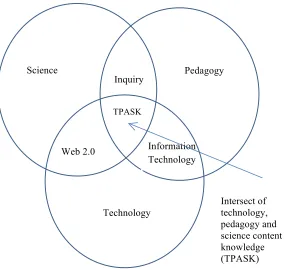
This paper uses the TPACK framework as the theoretical framework to describe the convergence of technological, pedagogical content knowledge in the development of the unit. The TPACK framework (Fullan, 1999) was developed as an extension of Shulman’s (2005) pedagogical content knowledge (PCK).
Applying the TPACK framework to science inquiry builds on research that has already occurred in a tertiary setting in technology focused units (Guba & Lincoln, 1981; Lambert & Gong, 2010) and in science contexts. Capturing the essence of TPACK in a practical application and examining its delivery and implementation, however,has proved challenging (Figg & Jaipal, 2010).
Figure 1: TPASK framework showing the intersection of Technology, Inquiry and Information Literacy and Science.
Technology
Selwyn (2009) reported that teacher education students use the Internet for research purposes, often showing little discernment for effective protocols and critical analysis of presented information. They also demonstrate limited applications of ICTs in an educational setting. The Australian Professional Standards for Teachers require graduates to be competent ICT classroom practitioners within the context of the new Australian Curriculum (Australian Curriculum Assessment and Reporting Authority, 2011). Therefore, it is imperative that students are provided with repeated opportunities to develop these competencies throughout their pre-service training. A design principle of this work was to incorporate Web 2.0 tools into the online learning environment not only to enhance the learning opportunities but also to model a range of tools freely available and widely used in school settings today. These tools were selected carefully for their ability to support the various stages of the inquiry process and facilitate the development of specific skills and metacognitive understandings at each stage (Bybee, Ellis, & Mathews, 1992; International Society for Technology in Education (ISTE), 2008).
Science
The science content focus was environmental sustainability, a cross-curriculum priority in the Australian Curriculum (Australian Curriculum Assessment and Reporting Authority, 2011). Students chose a relevant problem of interest in their local environment. Research has determined that students often lack confidence in science understanding and inquiry, with some being reluctant to teach science once they are qualified (Hackling, Goodrum, & Rennie, 2001; Tytler, 2007). By allowing students to select their own topic they felt more confident and motivated to undertake the inquiry as it was something they felt strongly about rather than something that was imposed.
Technology
Web 2.0
tools
Pedagogy
Science
Information Technology
Inquiry TPASK
tools
Pedagogy
The pedagogical focus of science inquiry (Australian Curriculum Assessment and Reporting Authority, 2011) was informed by an information literacy framework from the Society of College and University Libraries (SCONUL) (Bent & Stubbings, 2011). The SCONUL Information Literacy (IL) framework was used to identify skills and competencies considered imperative to create information literate tertiary students. These skills include identifying a need, scoping to identify a gap in current knowledge, planning to locate information,
gathering to access the information, managing or organising information professionally and
ethically, evaluating to review then compare and evaluate information and presenting (Bent & Stubbings, 2011).
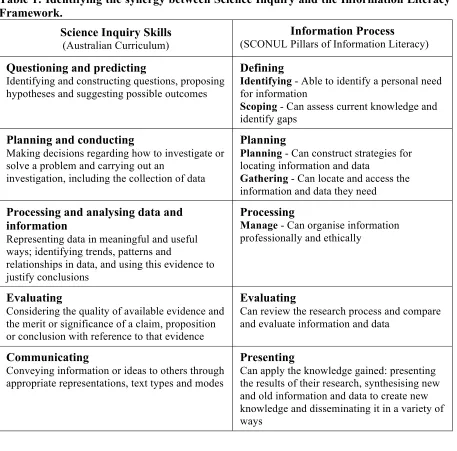
In determining the framework for inquiry to be used in this science unit, the Science Inquiry Skills from the Australian Curriculum were mapped against the SCONUL information literacy stages and it was determined that there was close alignment and overlap between these frameworks. Many of the processes and skills identified as imperative to science inquiry were also recognised in the IL framework. The resulting framework used in the unit was a fusion of the information literacy and inquiry pedagogy (Table 1).
Table 1: Identifying the synergy between Science Inquiry and the Information Literacy Framework.
Science Inquiry Skills (Australian Curriculum)
Information Process (SCONUL Pillars of Information Literacy) Questioning and predicting
Identifying and constructing questions, proposing hypotheses and suggesting possible outcomes
Defining
Identifying - Able to identify a personal need for information
Scoping - Can assess current knowledge and identify gaps
Planning and conducting
Making decisions regarding how to investigate or solve a problem and carrying out an
investigation, including the collection of data
Planning
Planning - Can construct strategies for locating information and data
Gathering - Can locate and access the information and data they need Processing and analysing data and
information
Representing data in meaningful and useful ways; identifying trends, patterns and
relationships in data, and using this evidence to justify conclusions
Processing
Manage - Can organise information professionally and ethically
Evaluating
Considering the quality of available evidence and the merit or significance of a claim, proposition or conclusion with reference to that evidence
Evaluating
Can review the research process and compare and evaluate information and data
Communicating
Conveying information or ideas to others through appropriate representations, text types and modes
Presenting
Inquiry necessitates identifying and creating questions and proposing hypotheses to suggest possible outcomes. Collecting and analysing data and identifying trends, patterns and relationships provide evidence to justify the conclusions formed. Evaluating considers whether the questions and hypotheses developed align with the collated data. Conclusions based on the evidence are then communicated to relevant stakeholders (Australian Curriculum Assessment and Reporting Authority, 2011). Whilst traditionally science inquiry is seen to be hands-on in the classroom, with the nature of the online learning platform the inquiry proposed for the unit used predominantly secondary data as opposed to data collected as a primary source, creating a guided on-line inquiry.
Design of the Learning Environment
Students were guided through a series of tasks on an external website (http://inquiringabouttheworld.weebly.com/) where the steps of the inquiry process scaffolded their use of ICT tools to explore problems and develop questions relating to environmental sustainability within local ‘real life’ contexts. Students were asked to explore ideas that interested them and each week they were guided through tasks to help them define, refine and develop their interest in an inquiry-based problem.
The inquiry needed to be authentic, engaging and contextual and the unit focused on local and regional issues to encourage students to do the same (Herrington, Reeves, & Oliver, 2010). The first workshop focused on the debate about sharks in the ocean and how to make swimming safer. Students were then encouraged to look in their local communities for suitable problems to investigate. Inquiry was also modelled by scientists in a variety of disciplines in ten minute videos on the website where they discussed their inquiry based approach to their work. The process was also scaffolded and due to the team teaching approach there were many opportunities for individual coaching of students and students to work in collaborative critiques to provide feedback to their peers (Herrington et al., 2010).
The pedagogy was also influenced by the selection of an online/blended learning approach. Students from online and on-campus groups used collaborative tools such as Google Plus or
Collaborize, and on-campus groups experienced a non-traditional classroom environment
consisting of large workshop groups (50 students) co-facilitated by two tutors (one technology- and the other inquiry-focused). Towards the completion of their research inquiry,
students were coached and supported either online through Blackboard Collaborate web-conferencing sessions or in class. As each project was unique, students received individual support. These approaches sought to ‘close-the-gap’ with regard to equity and access to the unit, with both groups working in a flexible, self-paced learning environment.
Creative Commons. Content creation tools (e.g. Scoop.it and Pinterest) assisted in collecting and managing online information sources. At the conclusion of the unit the students presented their findings in the form of a scientific report and as an exhibition. A wide range of exhibition presentation ideas were used by students, as evidenced in the diversity of final products.
While unit materials were hosted on an external website, there was a requirement for the assessment tasks to be submitted on the internal learning management system (LMS),
Blackboard, as part of university assessment protocols. Assessment was in the form of a
project that was divided into formative assessment parts through the Voki in week three of the unit and a formative report in week six to establish whether students had chosen questions that they could answer. This was followed by a week that was totally focused on coaching that students could attend in person or on-line if they wanted to receive additional support with the construction of their final report. Students were also required to deliver a short presentation to their peers, outlining their key findings in a format of their own choice.
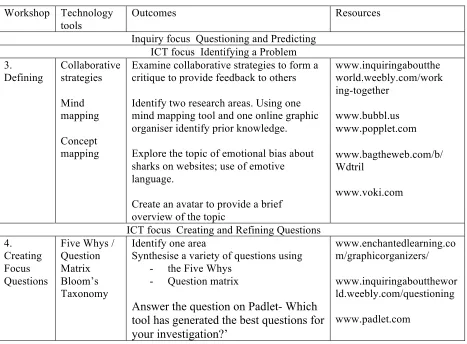
Table 2: Example of two weeks of the program including the weekly inquiry focus, technology tools and learning outcomes.
Workshop Technology tools
Outcomes Resources
Inquiry focus Questioning and Predicting ICT focus Identifying a Problem 3. Defining Collaborative strategies Mind mapping Concept mapping
Examine collaborative strategies to form a critique to provide feedback to others Identify two research areas. Using one mind mapping tool and one online graphic organiser identify prior knowledge. Explore the topic of emotional bias about sharks on websites; use of emotive language.
Create an avatar to provide a brief overview of the topic
www.inquiringaboutthe world.weebly.com/work ing-together
www.bubbl.us www.popplet.com www.bagtheweb.com/b/ Wdtril
www.voki.com
ICT focus Creating and Refining Questions 4.
Creating Focus Questions
Five Whys / Question Matrix Bloom’s Taxonomy
Identify one area
Synthesise a variety of questions using - the Five Whys
- Question matrix
Answer the question on Padlet- Which tool has generated the best questions for your investigation?’ www.enchantedlearning.co m/graphicorganizers/ www.inquiringaboutthewor ld.weebly.com/questioning www.padlet.com
could do this by typing the words or speaking them to create the talking avatar. The Voki is a useful tool not only in a primary or early childhood science classroom but in any discipline and with older students. Students were interested and engaged in the interactive character and it could be particularly useful to support students with limited literacy skills. The focus on sustainability as an authentic context for the inquiry process in the unit saw a range of Voki characters as environmentalists or endangered animals.
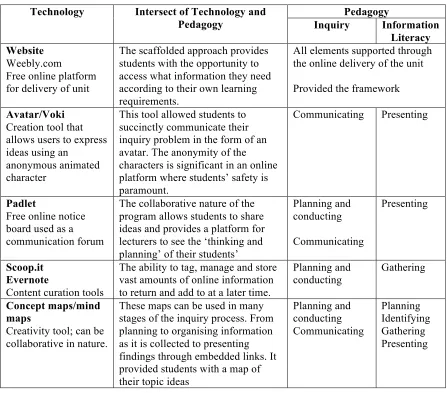
Table 3: Matrix of the affordances of the technology at the intersection of pedagogy and technology in the sustainability context.
Technology Intersect of Technology and Pedagogy
Pedagogy
Inquiry Information Literacy Website
Weebly.com
Free online platform for delivery of unit
The scaffolded approach provides students with the opportunity to access what information they need according to their own learning requirements.
All elements supported through the online delivery of the unit Provided the framework Avatar/Voki
Creation tool that allows users to express ideas using an
anonymous animated character
This tool allowed students to succinctly communicate their inquiry problem in the form of an avatar. The anonymity of the characters is significant in an online platform where students’ safety is paramount.
Communicating Presenting
Padlet
Free online notice board used as a communication forum
The collaborative nature of the program allows students to share ideas and provides a platform for lecturers to see the ‘thinking and planning’ of their students’
Planning and conducting Communicating Presenting Scoop.it Evernote
Content curation tools
The ability to tag, manage and store vast amounts of online information to return and add to at a later time.
Planning and
conducting Gathering Concept maps/mind
maps
Creativity tool; can be collaborative in nature.
These maps can be used in many stages of the inquiry process. From planning to organising information as it is collected to presenting findings through embedded links. It provided students with a map of their topic ideas
Planning and conducting Communicating Planning Identifying Gathering Presenting
Research Questions
1. How did the TPASK framework inform the design of the unit and how did the intersects of the TPASK model shape the delivery of the tertiary inquiry unit?
Sample
All 215 regional and on-campus students in the first Year Bachelor of Primary and Early Childhood Education course at an Australian university participated in the inquiry unit. Eighty-eight percent of the sample was female with 77% being aged between 18 and 24 years. Thirty percent of students in the cohort had left school in 2012 and 30% had left school over five years previous to 2012. Almost all students reported having used the – Internet (98%), email (98%), YouTube (97%) and presentation tools (82%) previous to commencing the unit.
Instruments
There were four tools used for this research; an anonymous survey pre and post, student assessment results, survey data from eVALUate and qualitative comments.
The quantitative data was collected through a pre and post online anonymous surveys using a mix of multiple-choice questions. In the pre survey, 215 students considered their confidence in science and the inquiry process and their experiences with technology in their lives. In the post survey 83 students completed the survey looking at changes in confidence and understanding of science and inquiry and perceived usefulness of the inquiry process and the Web 2.0 tools in authentic primary and early childhood curriculum delivery. Due to the nature of the anonymous surveys it was not possible to match the pre and post survey to a student.
The results from the students’ research report (Assessment 2B) were also included in the survey data. This report was the culmination of the students’ research and included outlining the problem, rationale and research questions. Marks were also allocated for the students’ literature review, a brief methodology, discussion as it related to the research questions, conclusion and then implications. The report was given a mark out of 25, with two marks for spelling and formatting and three marks for correct referencing.
The quantitative data was supported by qualitative data collected through anonymous in-class feedback where students were able to use a class iPad and leave a comment if they desired; and through the university wide evaluate tool called eVALUate students could use this anonymous platform.
Methodology
The unit ran in the second semester of 2013 from the first week of August to the beginning of November. Within these weeks there were 13 contact weeks where students completed the ten workshops around the inquiry process. An example showing the tasks and focus technology of weeks three and four can be seen in Table 2. Students were required to complete all the tasks and submit assessment items in week three, six, eleven and twelve.
In week one the students were asked to complete the first on-line survey through links on the website and in the university Learning Management System (LMS).
At the conclusion of the unit in the final week students were asked to complete the post online survey through Survey Monkey. Students were also able to leave comments and feedback in the University’s evaluation tool which could be completed online through the university student portal in the last few weeks of the semester.
Data Analysis
In the analysis we looked to identify two areas of data; the students’ confidence and understanding of the inquiry process and science concepts; and the students’ understanding, confidence and use of the focus technology tools, Web 2.0 tools.
Inquiry
Initial data determined that student were not confident in the inquiry process with 25% (n=53) of the students reported that they were not at all confident, and a further 28% (n=60) reported only being a little confident in conducting inquiry in a science context, whilst only 2% of the students reported being highly confident in their ability to conduct an investigation. Notably at the end of the project 90% of students reported an increase in their understanding of the inquiry process, this was split into 60% identifying it was very useful and 30% said it was fairly useful in improving their understanding. When asked about their confidence to conduct a science inquiry in a chemistry or biology context, 72% of students reported being confident or extremely confident, whilst only 2% reporting still lacking confidence in the process. The follow up question asked students to explain the steps in the inquiry process and the majority (approx. 78 %) of the students who answered this question were accurately able to describe the steps to an inquiry process.
In the initial survey students were asked about the usefulness of the science they had learnt at school. Thirteen percent of students thought the science learnt was mostly relevant, whilst 60% thought it was somewhat relevant and useful and 27% thought it was mostly or totally irrelevant to their lives. At the conclusion of the unit students were asked how useful the unit had been in improving their understanding of science ideas and concepts. The result was 88 % thought the unit was either very useful (44%) or fairly useful (44%) in promoting their understanding of science concepts.
The research report, Assessment 2B indicated that students could research using the inquiry process. Of the total cohort of 257 internal and regional students, 28% (71 students) received a mark of 80% (over 20 marks) or higher, whilst 4 % (11 students) completed the task and failed and 8% (22 students) failed as they did not complete the project.
Technology
Table 4: Percentage change in confidence of students in using technologies prior to the Inquiry unit (Pre-survey data).
Technology Extremely
confident
Quite Confident
Slightly Confident
Not confident
N/A
Internet (n=218) 68 28 3 0.5 0.5
Email (n=218) 68.5 27 3.5 0.5 0.5
Social media (n=215) 70 22 4 1 3
Word Processing (n=216) 52 40 6.5 1 2
YouTube (n=217) 55 31 10 2.5 1.5
Presentation software (n=217) 35 44 13.5 5.5 2
Web 2.0 tools (n=214) 3 6 12 39 40
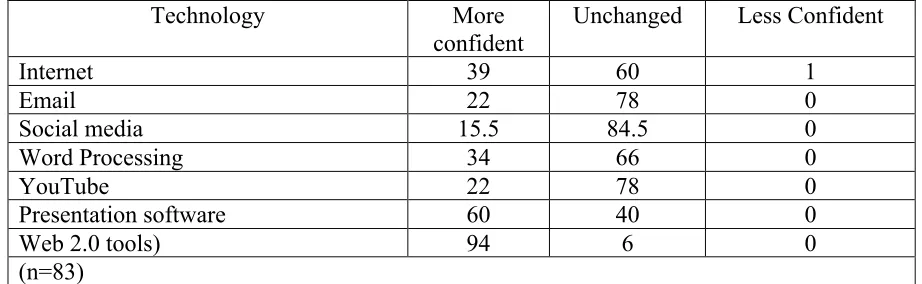
In the post survey students were asked if they felt their confidence had changed over the unit when considering technologies. The results showed that even for technologies such as the internet, word processing and presentation tools where students had shown high levels of confidence; they reported that their confidence had improved. Thirty nine percent of students said that they felt more confident using the Internet, whilst 60% of students felt they were more confident in choosing and using presentation tools. In the area of Web 2.0 tools which were the focus of the project 94% of students felt their confidence had increased in using these technologies (Table 5).
Table 5: Percentage change in confidence of students in using technologies subsequent to the Inquiry unit (Post-survey data, n=83).
Technology More
confident
Unchanged Less Confident
Internet 39 60 1
Email 22 78 0
Social media 15.5 84.5 0
Word Processing 34 66 0
YouTube 22 78 0
Presentation software 60 40 0
Web 2.0 tools) 94 6 0
(n=83)
Subsequently 94% (n=81) of students in the post survey reported that the unit was either very useful (64%) or sometimes useful (30%) in promoting their understanding of the Web 2.0 tools.
Students were asked to consider when they were teaching if they would use the technology in their classroom. Eighty nine percent of students felt that they would use technology either all the time or some of the time, 97% of students felt the Internet would be a valuable tool in their science classroom, whilst 89% thought that YouTube would be useful, 90% listed word processing skills and 84% presentation tools as useful tools in their science classrooms.
to be considered. In fact one student reported, “I measure the material in my head against the evaluation rubric” and another who said, “I always now look at the url and try to find .gov and other reliable sites”. In all, 93% of students reported confidence in the material that they searched on-line. Students also reported that they were able to use more than one search engine; students using only Google dropped from 85% in the initial pre survey to 49% with an increase in students using more than one search engine from 8% to 34%. It would seem that students were more aware of the number of search engines available as a consequence of the unit.
Findings
The findings consider the research questions, with the first section examining the design of the unit around the TPACK model focusing on the intersects of the technology, pedagogy and science content. The result was determined that the TPACK model provided a helpful frame for the design of the unit around the core areas. The second section of the findings summarises the students’ experiences throughout the unit and changes in their confidence and understanding.
Unit Design
The TPASK model (Technology, pedagogy and science content knowledge) provided the framework on which the design of the unit was based. The framework enabled us to construct a unit that was based on environmental sustainability as the science content, embed and thereby model a large range of Web 2.0 tools as the technology and use the blended pedagogy of inquiry and information literacy as the pedagogical focus. The result enabled us to deliver a totally on-line unit that modelled the skills and tools and scaffolded and supported students through the inquiry process on a sustainably focused topic of their choice. The tasks were all authentic real world problems that the students found in the media or in their local communities.
A range of Web 2.0 tools were modelled for students: A Voki avatar was used to articulate students’ chosen problem; a range of mind mapping tools were used to develop the projects questions; the Weebly website platform was used to enable students to move through the inquiry steps at their own pace; Padlet and Collaborize were useful online collaboration platforms to share information and present ideas; and curation tools such as Scoop.it and
Pinterest enabled students to gather and collate articles and websites.
The focus was on the Australian Curriculum science inquiry process from (Australian Curriculum Assessment and Reporting Authority, 2011) (Table 1). Students were able to see the flow of information and the way the inquiry built up step by step in subsequent weeks.
I enjoyed it and learnt about inquiry. Students should ensure they are engaged all semester in the topics for each week since one thing flows to another in learning about the inquiry process (Student 23. eVALUate).
tigers’, the ‘Tumours impacting on the survival of the Tasmanian devil’, the ‘Rediscovery of
Gilberts Potaro’ and the ‘Impact of the war in Afghanistan on the diversity of native fauna
and flora’.
Many students reported they enjoyed the flipped class approach where after a brief introduction students worked on the tasks pertaining to their project and were able to get individualised support from the two tutors in the room.
We have received so much in-class support and direction for our assessments, I feel that our teachers want us to succeed. It's a good mix of presentation, discussion and direct instruction. I like having 2 teachers and a larger class (Student 4 Anonymous feedback 23/10/2013)
Focus groups enabled students to critique each other’s work during the project clarification stage. Comments such as the one below indicated that students found these opportunities to collaborate valuable and productive.
This unit makes me think, it makes me ask questions that make me ask more questions. The classroom is well set up allowing small group interaction while encouraging
whole class presentations and discussion (Student 1 Anonymous feedback
23/10/2013).
Student Understanding and Confidence
Analysis of survey data determined that 90 % of students thought that the unit improved their understanding of the inquiry process and 88% reported they were more confident in their science understanding. Students also reported a 94% increase in their knowledge and confidence of Web 2.0 tools and they also felt more confidence in working with a raft of other technical tools.
This then provides a sturdy platform of confidence and understanding on which to build their science teaching skills.
Students reported,
This unit endeavours to challenge our views on controversial topics and question evidence that we've presented. It helps us develop personal positions and opinions.
It's fantastic (Student 3 anonymous feedback 23/10/2013).
The experience enabled the students to actively participate in the inquiry process and consequently be able to create similar experiences for the children in their primary classroom. The use of on-line scaffolded guided inquiry enables teachers to create interesting and engaging experiences for children and help them to negotiate the vast quantities of information available on the internet.
The unit also sought to engage students and challenge their ideas ‘I love the challenges this
unit present and the drive it evokes within me (Student 23 eVALUate).
Students’ responses would suggest some had really engaged in the unit and enjoyed the experience including this response “I enjoy this class a lot as I find it fun, interesting and
challenges our views…. Favourite class of the week!” (Student 2 anonymous feedback
23/10/2013).
Conclusion
This research highlights the complexities around teaching and the extensive skills and knowledge that teachers must weave together to create a meaningful an authentic learning experience. The unit illustrates the convergence of technology skills (in this instance Web 2.0 tools), pedagogy (science inquiry and ICT) and also science content knowledge (environmental sustainability). It demonstrated that meaningful inquiry could be achieved in the eLearning space; and by modelling the process pre-service teachers can actively participate in powerful inquiry. It is hoped they will transfer this pedagogical approach into their own classroom practice. Whilst in science, on-line inquiry can never replace inquiry that is more hands-on with students collecting primary field data, however the unit does give students some inquiry skills to become better discerners of information. There were aspects of the science inquiry process in the Australian Curriculum that were not able to be addressed in this study. These included the collection of primary data through field work or laboratory work as primary data. In the study students were only able to examine collected secondary data. It could be argues that this enabled them to examine more detailed and complex data which extended over years and needed highly specialised data collection instruments or challenging environments and large research budgets.
Science investigations are activities in which ideas, predictions or hypotheses are tested and conclusions are drawn in response to a question or problem. Investigations can involve a range of activities, including experimental testing, field work, locating and using information sources, conducting surveys, and using modelling and
simulations. The choice of the approach taken will depend on the context and subject of the investigation. In science investigations, collection and analysis of data and evidence play a major role. This can involve collecting or extracting information and reorganising data in the form of tables, graphs, flow charts, diagrams, prose, keys, spreadsheets and databases (ACARA Australian Curriculium Assessment and Reporting Authority, 2013).
One of the criticisms of collecting primary data in science classrooms is this severely restricts the complexity of the experiments due to practical and safety issues and results in recipe style activities being carried out. It would be better that on-line scaffolded guided inquiries add depth and variety to the inquiry process in science classrooms which would then have a mixture of hands-on and on-line scaffolded guided inquiry. Together these forms of inquiry would provide learning opportunities for all the outcomes set out in the two year band of the inquiry strand Australian Curriculum (ACARA Australian Curriculium Assessment and Reporting Authority, 2013).
The use of on-line scaffolded guided inquiry enables teachers to create interesting and engaging experiences for children and help them to negotiate the vast quantities of information available on the internet. In considering the future the unit has now been modified to create an inquiry unit suitable for Year 7 students with a focus on water. (http://y7pcwater.weebly.com/) The water focus meets the requirements for the science understanding component in Australian Curriculum in Earth and Space Science and also in Chemical Science. The new unit uses an animated Voki fish called Percy as the guide for the students to follow the steps in the inquiry process. The unit will run at the beginning of second term and its implementation will be evaluated. Analysis of the data in the Year 6, 7 band of the inquiry skills strand will be examined in detail to map the skills that can be achieved through on-line scaffolded inquiry. This detailed analysis will enable educators to clearly articulate the skills that can be achieved through on-line scaffolded inquiry and the areas to be addressed in ‘hands-on’ inquiry. When this on-line scaffolded inquiry is transferred into a second classroom extension Year 5/6 classroom the skills taught through on-line scaffolded inquiry can be further examined provide increased data (Sheffield, 2012).
References
ACARA Australian Curriculium Assessment and Reporting Authority. (2013). The Australian Curriculum Retrieved January 17, 2013, 2013 from http://www.australiancurriculum.edu.au/.
Albion, P., & Redman, R. (2008). Teaching by example? Integrating ICT in Teacher Education. Paper presented at the Australian Computers in Education Conference: ACT on IcT (ACEC 2008), Canberra, Australia. Australian Curriculum Assessment and Reporting Authority. (2011). Australian Cuuriculum Retrieved January
24, 2013, from http://www.australiancurriculum.edu.au/Curriculum/Overview.
Australian Government Department of Education Employment and Workplace Relations. (2012). Teaching Teachers for the Future. Retrieved March 4, 2014, from http://www.ttf.edu.au/.
Bent, M., & Stubbings, R. (2011). The SCONUL seven pillars of information literacy: The core model. In SCONUL (Ed.), SCONUL Working Group on Information Literacy. London SCONUL.
Bybee, R. W., Ellis, J. D., & Mathews, M. R. (1992). Teaching about the history and nature of science and technology: An introduction. Journal of Research in Science Teaching, 29(4), 327-239.
Figg, C., & Jaipal, K. (2010). Unpacking the “Total PACKage”: Emergent TPACK characteristics from a study of preservice teachers teaching with technology. Journal of Technology and Teacher Education, 18(3), 415-441.
Fontana, A., & Frey, J. (1994). Interviewing. The art of science. In N. Denzin & Y. Lincoln (Eds.), Handbook of Qualitative Research (pp. 361-375). Thousand Oaks: Sage Publishing Inc.
Fullan, M. (1999). Change Forces. The Sequel. Philadelphia: Falmer Press.
Guba, E., & Lincoln, Y. (1981). Effective evaluation. Improving the usefulness of evaluation results through responsive and naturalistic approaches. San Francisco: Jossey-Bass Inc.
Hackling, M., Goodrum, D., & Rennie, L. (2001). The state of science in Australia secondary schools.
Australian Science Teachers Journal, 47(4), 6-17.
Herrington, J., Reeves, T., & Oliver, R. (2010). A Guide to Authentic e-Learning New York: Taylor & Francis International Society for Technology in Education (ISTE). (2008). National Educational Technology Standards
for Teachers Retrieved April 28, 2014, from www.iste.org/standards.
Lambert, J., & Gong, Y. (2010). 21st century paradigms for pre-service teacher technology preparation.
Computers in the Schools, 27(1), 54-70.
Ministerial Council on Education Employment Training and Youth Affairs. (2008). Melbourne Declaration on Educational Goals for Young Australians. In Ministerial Council on Education Employment Training and Youth Affairs (Ed.). Melbourne
Rotary Australia World Community Service. (2005). RAWCS Retrieved October 23, 2012, from http://www.rawcs.com.au/aboutRAWCS.htm.
Selwyn, N. (2009). The digital native - myth and reality. Aslib Proceedings, 61(4).
Sheffield. (2012). Focus on teacher support: Considering access for the disabled at gosport community school. In L. Rennie, G. Venville & J. Wallace (Eds.), Integrating Science, Technology, Engineering and
Mathematics. Issues, Reflections and Ways Forward New York Routledge.