www.ann-geophys.net/24/3131/2006/ © European Geosciences Union 2006
Annales
Geophysicae
The cusp: a window for particle exchange between the radiation belt
and the solar wind
X.-Z. Zhou1,2, T. A. Fritz3, Q.-G. Zong4,2, Z. Y. Pu1, Y.-Q. Hao1, and J.-B. Cao2
1Institute of Space Physics and Applied Technology, Peking University, Beijing 100871, China 2Key Laboratory for Space Weather, Chinese Academy of Sciences, Beijing, China
3Center for Space Physics, Boston University, Boston, MA 02215, USA
4Center for Atmospheric Research, University of Massachusetts, Lowell, MA 01854, USA
Received: 18 February 2006 – Revised: 28 August 2006 – Accepted: 13 October 2006 – Published: 22 November 2006
Abstract. The study focuses on a single particle dynamics in the cusp region. The topology of the cusp region in terms of magnetic field iso-B contours has been studied using the Tsy-ganenko 96 model (T96) as an example, to show the impor-tance of an off-equatorial minimum on particle trapping. We carry out test particle simulations to demonstrate the bounce and drift motion. The “cusp trapping limit” concept is in-troduced to reflect the particle motion in the high latitude magnetospheric region. The spatial distribution of the “cusp trapping limit” shows that only those particles with near 90◦ pitch-angles can be trapped and drift around the cusp. Those with smaller pitch angles may be partly trapped in the iso-B contours, however, they will eventually escape along one of the magnetic field lines. There exist both open field lines and closed ones within the same drift orbit, indicating two possi-ble destinations of these particles: those particles being lost along open field lines will be connected to the surface of the magnetopause and the solar wind, while those along closed ones will enter the equatorial radiation belt. Thus, it is be-lieved that the cusp region can provide a window for particle exchange between these two regions. Some of the factors, such as dipole tilt angle, magnetospheric convection, IMF and the Birkeland current system, may influence the cusp’s trapping capability and therefore affect the particle exchang-ing mechanism. Their roles are examined by both the anal-ysis of cusp magnetic topology and test particle simulations.
Keywords. Magnetospheric physics (Energetic particles, trapped; Magnetopause, cusp and boundary layers; Solar wind-magnetosphere interactions)
Correspondence to: X.-Z. Zhou ([email protected])
1 Introduction
The polar cusp, as an essential part of the Earth’s high-latitude dayside magnetosphere, is a region with magne-tosheath plasma and electromagnetic turbulence (e.g. Cargill et al., 2005). The properties of the cusp region (location, ex-tent, etc) are highly influenced by the IMF and the dipole tilt angle (Tsyganenko and Russell, 1999; Zhou et al., 2000; Merka et al., 2002).
The cusp is also observed to contain an off-equatorial mag-netic minimum region (e.g. Newell and Meng, 1987; Zhou et al., 1997). Therefore, energetic particles in the cusp re-gion are affected by a mirror force that always points to the magnetic minimum, so it is natural to predict a cusp trap-ping region for energetic particles with near 90◦ pitch an-gles. Based on the Tsyganenko 96 (hereinafter as T96) model (Tsyganenko and Stern, 1996), test particle simulations were made to point out that a particle can drift on a closed path around the outer cusp (Sheldon et al., 1998). These simula-tions further demonstrated that the trapping time would be in-finite if no temporal variations were considered. The concept of cusp trapping was supported by Kirpichev et al. (1999) who examined the spatial distribution of energetic particles in the outer cusp using INTERBALL-1 data. Pugacheva et al. (2004, 2005) further suggested the existence of a “cusp radi-ation belt” containing energetic particles and elaborately dis-cussed how its occurrence and location are affected by the level of geomagnetic activity and dipole tilt angle.
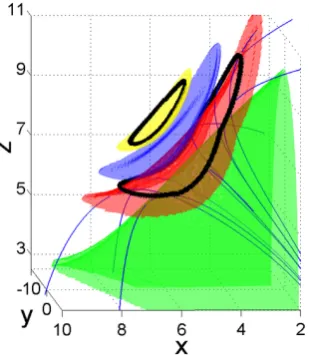
Fig. 1. T96 magnetic field topology in the cusp region during spring equinox (IMF: 0 nTByand –1 nTBz;Dst: –22.0; Solar Wind
Pres-sure: 2.53 nPa). Blue lines are field lines. Particles will drift around the cusp region as closed orbits, two examples of which are shown here as black lines. The yellow, blue, red and green planes are four contour planes, representing 20 nT, 30 nT, 40 nT and 60 nT, respec-tively.
plane drift sunward, they will move away from the equator to the cusp minimum under the effect of cuspward mirror force. However, it should be kept in mind that the T96 model is not a perfect model, especially in the cusp region. A sta-tistical survey of Cluster data was made by Lavraud et al. (2004) to represent the magnetic field deviations between ob-servations and the T96 model. The observed magnetic field strength was shown to be even weaker than the prediction of T96, probably caused by an additional diamagnetic current systems. Although there was an attempt by Tsyganenko and Russell (1999) to incorporate the effect of a diamagnetic de-pression in the T96 model, the modified model still had some difficulties in data fitting and thus could not represent the real magnetic field in the cusp region.
In this paper, we suggest the term of “cusp trapping limit” (CTL) of energetic particles after analyzing the magnetic topology of the cusp region using the T96 model. Only those particles with larger pitch angles than the CTL can be locally trapped, while the others will get lost during their bounce motion along the field lines. The value of CTL is shown to be spatially dependent, indicating regions for which it is more probable for particles to escape as they drift. Moreover, due to the sensitivity of the cusp on external conditions (IMF, dipole tilt angle, etc.), the value of CTL also varies with time, further activating the particle escaping mechanism. Be-cause of the coexistence of closed field lines and open ones in the cusp region, shown in T96 and also in observations (e.g. Fuselier et al., 1995; Zhou et al., 2000), these particles are connected to both the traditional dipole trapping region and the solar wind. Test particle simulations are carried out and
In order to better understand the relationship between mag-netic topology (magmag-netic minimum in the cusp region) and the motion of energetic particles, as an example, Fig. 1 vi-sualizes some of the cusp magnetic contour planes during spring equinox, based on T96 model.
In Fig. 1, four contour planes are presented, and each of them has a certain value of|B|(20 nT, 30 nT, 40 nT and 60 nT for yellow, blue, red and green, respectively). As can be seen clearly in this figure, the magnetic field strength is relatively small in the cusp region, so if a test particle is launched at a magnetic field minimum with a 90◦ pitch angle,
admit-tedly without considering the effect of electric fields, the mir-ror force will always keep the particle at the magnetic mini-mum points of different field lines, and the particle will drift around the cusp, due to the existence of magnetic gradients (Sheldon et al., 1998). The two black lines in Fig. 1 represent two test particles following this type of orbit in a steady T96 cusp, with different initial positions. Each of these particles is trapped by a set of field minima with a magnetic magnitude of around 20 nT and 40 nT, respectively.
(a) (b)
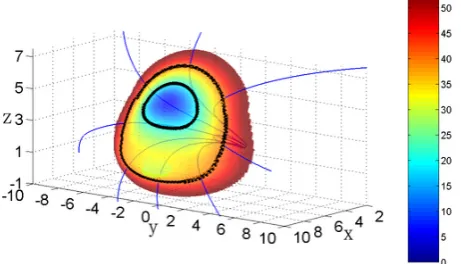
Fig. 2. The shape of the “cusp B-field minimum plane” during spring equinox (IMF: 0 nTByand –1 nTBz;Dst: –22.0; Solar (a) The color
represents the magnetic strength of each field minimum point in nT. (b) The color represents the pitch angle at minimum point of a given field line associated with the “cusp trapping limit”.
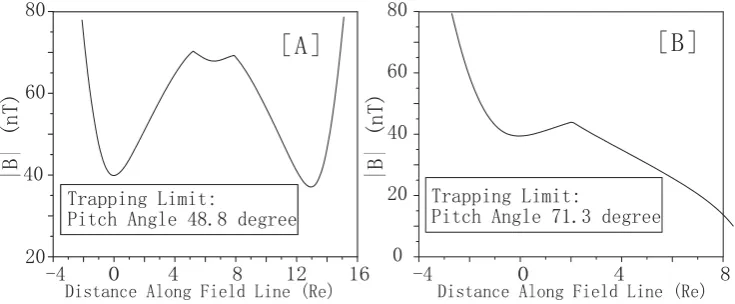
Fig. 3. Two examples of magnetic strength as a function of the distance along a field line in T96 model. The X=0 point in either example represents a magnetic minimum where the test particle ever passed by in the northern cusp. (A) The example when the particle is in a minimum of closed field lines. The two minimum regions represent northern cusp and southern cusp, respectively. (B) The example of open ones with only one minimum along the field line.
each field minimum point, i.e. different colors represent dif-ferent “cusp-shells”.
Before discussing the external conditions that can modify the shape of the stably-trapped region of the cusp, let us fo-cus on the trajectory of the test particle trapped within the 40 nT contour plane in more detail, as an example. In this tracing calculation, the full particle dynamics are considered by applying a fourth-order Runge-Kutta method with an au-tomatic correction for energy conservation in each step. A 50 keV proton is launched at the minimum of a closed field line near the dayside cusp, drifting to the west towards the flank region. After that, it begins a drift upward to larger values of GSM Z, staying in the minima of open field lines. Then it moves toward the dusk flank and returns back to the closed field line region. The distinct configurations of both closed field line regions and open ones within the same orbit
are displayed in Fig. 3, presenting|B|as the function of the distance along certain field lines.
If we treat these two kinds of configurations as two mag-netic mirrors, each of which has a magmag-netic minimum and a maximum in the northern cusp, the “cusp trapping limit” (CTL) can be accordingly defined as the loss cone pitch angle of those magnetic mirrors, say, arcsin(Bmin/Bmax)1/2. They
[image:3.595.114.482.291.443.2]Fig. 4. Similar to Fig. 2b, but with a negative IMFBy of –5 nT.
[image:4.595.57.283.69.199.2]The color shows the spatial distribution of the “cusp trapping limit” in T96 model.
Fig. 5. The shape of the “cusp minimum plane” during summer solstice, analogous to Fig. 2a.
The distribution example for the T96 model during spring equinox is displayed in Fig. 2b. It can be clearly seen that there are two peaks of the CTL on the duskside and dawn-side regions of the cusp, suggesting a relatively weak capa-bility of particle trapping in these regions. Along the drift paths of energetic particles (clockwise for positive particles and anti-clockwise for electrons), the regions with increasing CTL values will correspond to the regions where particles can more readily escape. On the contrary, in the regions with decreasing CTL values, there will be particles captured from other regions which become trapped in the cusp, as the or-bits calculated by Delcourt and Sauvaud (1999) demostrated. Based on the opposite drift direction of positive and negative particles, it is clear that the regions with a strong tendency for positive particles to escape from the cusp (higher latitude duskside cusp and lower latitude dawnside cusp in this case) are actually regions that will feed electrons into the cusp, and vice versa.
In this case, all of these regions are situated on closed field lines. Particles escaping from these regions will move along the field lines to find their mirror points in the Southern
erties. Figure 4 shows the T96 spatial distribution of “cusp trapping limit” when IMF By equals to –5 nT. There still
exist two peaks in the duskside and dawnside sector of the cusp region, however, the field lines in the dawnside peak are still closed while those in the duskside peak are open, in agreement with the observation. In this case, particles that either move away from the cusp region or move into the cusp through the dawnside peak will still be connected to the radi-ation belt, while those through the duskside peak will get lost into or are coming from the solar wind (see Fig. 3b). On the contrary, if the IMFBy is positive (5 nT), the duskside peak
will be closed while the dawnside peak would be open. Be-cause particles in different sections of the cusp, which can be easily connected to either the equator or the solar wind, are topologically linked together via drift motions, it is believed that the cusp can play a role as a bridge between the solar wind and the radiation belt for energetic particles.
The effect of the dipole tilt angle on the cusp trapping re-gion can also be evaluated based on the T96 model. Figure 5 shows the shape of the “cusp minimum plane” during sum-mer solstice. During winter solstice, the “cusp minimum plane” in the Northern Hemisphere disappears, which is con-sistent with the conclusion of Pugacheva et al. (2005). We will examine the reason for the existence and extent of the “cusp radiation belt” dependence on the geomagnetic dipole tilt. For example, during winter solstice, with relatively larger tilt angles, the northern cusp region should shift anti-sunward, with relatively less impact there by the solar wind. Therefore, the magnetic field would approximate the undis-turbed dipole field, with no magnetic minimum in the north-ern cusp. As a consequence, the cusp region would not trap particles, and accordingly lose its ability of providing any window for particle exchange with other regions.
3 Test particle simulations
[image:4.595.53.284.271.403.2]0 5 10
−10 −5
0 5 10
0 2 4 6 8 10
Y (Re)
X (Re) Z (Re)
(a)
−10 −5 0
5 10 10 5
0 0
2 4 6 8 10
(b)
−10 −5
0 5 10 10 5
0 0
2 4 6 8 10
[image:5.595.51.550.61.371.2](c)
Fig. 6. Trajectory of several test particles during spring equinox (IMF: –5 nTByand –1 nTBz;Dst: –22.0; Solar Wind Pressure: 2.53 nPa).
The black lines shows two 90◦50 keV protons drifting around the cusp region. (a) The green line represents the trajectory of another 50 keV proton initially with a 70◦pitch angle, while the red line shows the same proton with a pitch angle of 75◦. No electric field is considered here. (b) The effect of convection electric field is studied, and the red line represents a 50 keV proton’s orbit initially with a 90◦pitch angle, escaping in the duskside cusp. (c) The orbit of a 100 keV proton with an initially 90◦pitch angle. It drifts around the cusp for six times and escape to the equatorial plane via the dawnside cusp. Again, no electric field is considered. The particle’s nonadiabatic behavior is considered to be caused by the T96 Birkeland current term.
Tilt angle: According to the discussions, the existence of a “cusp minimum plane” strongly depends on the geo-magnetic dipole tilt. Test particle simulations are performed during spring equinox, summer solstice and winter solstice. Being identical with the prediction, the 90◦ test particle
(50 keV proton) can drift around the northern cusp region during both spring equinox (see the outer black circle in Fig. 2a) and summer solstice (the outer black circle in Fig. 5), while at winter solstice it can not be trapped. Instead, the particle simply bounces away from the northern cusp region (not shown here).
IMFBy: In the case of nonzero-By, one of the two peaks
is no longer situated on closed field lines. For example, when the IMFBy equals to –5 nT, the magnetic field lines in the
duskside peak are open, while those in the dawnside cusp are still closed. As was predicted before, duskside detrapping of particles will occur on open field lines and they will disap-pear into the solar wind, while those particles escaping in the
dawnside sector will be trapped on a relatively larger scale, such as being transferred to the radiation belt and drifting around the Earth.
Test particle tracing calculations are made to prove the result, shown in Fig. 6a. The red line displays the trajectory of a 50 keV proton escaping the cusp region in the duskside sector while the green one corresponds to another 50 keV proton escaping in the dawnside sector. Their distinct orbits, one getting lost to the solar wind while the other one merging into the dipole trapping region, are in agreement with the different topologies in different parts of the cusp region. These facts further confirm the cusp’s potent connectivity with both the solar wind and the equatorial radi-ation belt in the presence of a significant IMFBycomponent.
initially with a 90◦ pitch angle is calculated and shown in Fig. 6b as the red line. Instead of following a closed orbit, the particle escapes from the “cusp minimum plane” in the duskside sector, and joins up with the solar wind (because of the existence of negative IMFBy).
In brief, strong convection would favor cusp particle leakage from the duskside sector, connecting the leakage particles to the solar wind in the case of negative IMFByor
merging them to the dipole radiation belt during positive or zero IMFBy.
Birkeland current system: If we study the 90◦test parti-cle’s “closed orbit” carefully enough, we will discover that the orbit is not perfectly closed, which implies that the first adiabatic invariantµis not exactly conserved during a drift circle. The nonadiabatic behavior, first discovered by Kremser et al. (1995) and subsequently described by Zong et al. (2005) without a satisfactory explanation, is identi-fied to be caused by the Birkeland current system in the T96 model. The current which flows in relatively thin sheets can produce a significant B variation over a small distance, and thus will remotely modifiy the geometry of cusp.
Although the variation ofµis not significant, test parti-cles can still shift their “cusp-shells” and even move away from the “cusp minimum plane” after drifting for a relatively long time. Figure 6c presents the effect of Birkeland cur-rent system. The 100 keV proton initially with a 90◦pitch angle drifts around the cusp for six times, withµ decreas-ing by a total of 20%, and finally becomes detrapped to the equatorial trapping region. The non-adiabatic motion, as an effect of Birkeland current system, can probably decrease the steadiness of the “cusp radiation belt”, and also increase the possibility of particle exchange between the cusp and other regions.
In order to verify our conclusion, we perform exactly the same test particle simulation in a T96 model with the Birke-land term being removed. The resulting first adiabatic in-variantµnever changes, and the 90◦proton remains trapped forever (not shown here).
It is worth noting that the goal of our test particle simu-lations is to present the coexistence of the bounce and the drift motion of energetic particles in the cusp region, to test the particle behavior under different conditions, as can be predicted by the CTL spatial distribution, and to verify the
the CTL distribution and hence activate the particle exchange process between the equator, the cusp, and the solar wind.
Based on the statistical study of Lavraud et al. (2004) and Lavraud and Cargill (2005) that the magnetic field in the cusp is even weaker than the prediction of T96, it should also be noted that the “cusp trapping limit” in our calculation are probably overestimated, and the particle trapping capability of the cusp region may be stronger. To obtain a better estima-tion of the cusp’s role on particle trapping and exchanging, a more accurate magnetospheric magnetic model is strongly required and highly desirable.
4 Discussion and summary
We have displayed the T96 topology of the off-equatorial field minimum region, or “cusp radiation belt”, and thus have studied its effect on the behavior of energetic particles. Those particles with near 90◦pitch angles appear to be trapped by the field minimum and drift around the cusp via closed orbits if no temporal effects are considered. Numerical simulations that were performed demonstrate the existence of near 90◦ particle trapping in the cusp, which was also well observed by several satellites (Antonova et al., 1999; Fritz et al., 2000; Zong et al., 2004).
It is of importance to notice the coexistence of open field lines and closed field lines within the same drift orbit in the cusp. Particles may be temporarily trapped in the cusp re-gion, drift for some time and escape to different places. It has been shown that the special magnetic topology in the cusp re-gion can provide a window for particle exchange between the solar wind, the cusp, and the radiation belt, suggesting a pos-sible way of equatorial particle leakage or solar wind particle injection into the magnetosphere.
A set of test particle simulations in the T96 model are pre-sented to prove these results. To make a better prediction, a more accurate magnetic model in the cusp region is required. Acknowledgements. We are grateful to N. A. Tsyganenko, H. Zhang, P. Wu and X. G. Zhang for their helpful suggestions and discussions in this paper. The work was initiated during a visit by X.-Z. Zhou to Boston University in Fall/Winter 2004, supported by NASA grant NAG5-10108. This work is also supported by NSFC project 40528005, 40390152 and the International Collaboration Research Team Program of the Chinese Academy of Sciences.
Topical Editor I. A. Daglis thanks I. Sandahl and another referee for their help in evaluating this paper.
References
Antonova, A. E. and Shabansky, V. P.: Structure of the geomagnetic field at great distance from the Earth, Geomagn. Aeron., 8, 801– 811, 1968.
Antonova, A. E., Gubar, Y. I., and Kropotkim, A. P.: Energetic particle population in the high-latitude geomagnetosphere, Phys. Chem. Earth, 25, 47–50, 1999.
Cargill, P. J., Lavraud, B., Owen, C. J., Grison, B., Dunlop, M. W., Cornilleau-Wehrlin, N., Escoubet, C. P., Paschmann, G., Phan, T. D., Rezeau, L., Bogdanova, Y., and Nykyri, K.: Cluster at the Magnetospheric Cusps, Space Sci. Rev., 118, 321–366, doi: 10.1007/s11214-005-3835-0, 2005.
Delcourt, D. C. and Sauvaud, J.-A.: Recirculation of plasma sheet particles into the high-latitude boundary layer, J. Geophys. Res., 103, 26 521–26 532, 1998.
Delcourt, D. C. and Sauvaud, J.-A.: Populating of Cusp and Bound-ary Layers by energetic (hundreds of keV) equatorial particles, J. Geophys. Res., 104, 22 635–22 648, 1999.
Fritz, T. A., Chen, J., and Sheldon, R. B.: The Role of the Cusp as A Source for Magnetospheric Particles: A New Paradigm?, Adv. Space Res., 25, 1445–1457, 2000.
Fuselier, S. A., Anderson, B. J., and Onsager, T. G.: Particle signa-tures of magnetic topology at the magnetopause: AMPTE/CCE observations, J. Geophys. Res., 100, 11 805–11 821, 1995. Kirpichev, I., Fedorov, A., Grigoriev, A., Budnik, E., and Dubinin,
E.: Quasi-trapping of Charged Particles in the Region of a Local Magnetic Field Minimum in the Outer Cusp, Cosmic Research, 37, 638–643, 1999.
Kremser, G., Woch, J., Mursula, K., Tanskanen, P., Wilken, B., and Lundin, R.: Origin of energetic ions in the polar cusp inferred from ion composition measurements by the Viking satellite, Ann. Geophys., 13, 595–607, 1995,
http://www.ann-geophys.net/13/595/1995/.
Lavraud, B. and Cargill, P. J.: Cluster reveals the magnetospheric cusps, Astronomy and Geophysics, 46, 1.32–1.35, 2005. Lavraud, B., Fedorov, A., Budnik, E., Grigoriev, A., Cargill, P. J.,
Dunlop, M. W., R`eme, H., Dandouras, I., and Balogh, A.: Cluster survey of the high-altitude cusp properties: a three-year stastical study, Ann. Geophys., 22, 3009–3019, 2004,
http://www.ann-geophys.net/22/3009/2004/.
Merka, J., Safr´ankov´a, J., and Nemecek, Z.: Cusp-like plasma in high altitudes: a statistical study of the width and location of the cusp from Magion-4, Ann. Geophys., 20, 311–320, 2002, http://www.ann-geophys.net/20/311/2002/.
Newell, P. T. and Meng, C. I.: Cusp Width andBz: Observations
and a Conceptual Model, J. Geophys. Res., 92, 13 673–13 678, 1987.
Papitashvili, V. O. and Rich, F. J.: High-latitude ionospheric con-vection models derived from Defense Meteorological Satellite Program ion drift observations and parameterized by the inter-planetary magnetic field strength and direction, J. Geophys. Res., 107, doi:10.1029/2001JA000264, 2002.
Pugacheva, G., Gusev, A. A., Jayanthi, U. B., Schuch, N. J., and Sp-jeldvik, W. N.: Seasonal polar cap radiation zones in the dayside magnetosphere, Earth Planets Space, 56, e17–e20, 2004. Pugacheva, G., Gusev, A. A., Jayanthi, U. B., Schuch, N. J., and
Spjeldvik, W. N.: Cusp region radiation belts in the dayside mag-netosphere, J. Atmos. Solar-Terr. Phys., 67, 479–487, 2005. Shabansky, V. P.: Some processes in the magnetosphere, Space Sci.
Rev., 12, 299–418, 1971.
Sheldon, R. B., Spence, H. E., Sullivan, J. D., Fritz, T. A., and Chen, J.: The discovery of trapped energetic electrons in the outer cusp, Geophys. Res. Lett., 25, 1825–1828, 1998.
Tsyganenko, N. A. and Russell, C. T.: Magnetic signatures of the distant polar cusps: Observations by Polar and quantitative mod-eling, J. Geophys. Res., 104, 24 939–24 955, 1999.
Tsyganenko, N. A. and Stern, D. P.: Modeling the global magnetic field of the large-scale Birkeland current system, J. Geophys. Res., 101, 27 187–27 198, 1996.
Zhang, H., Fritz, T. A., Zong, Q. G., and Daly, P. W.: Stagnant Exte-rior Cusp Region as Viewed by Energetic Electrons and Ions: A Statistical Study Using CLUSTER Research with Adaptive Par-ticle Imaging Detectors (RAPID) Data, J. Geophys. Res., 110, A05211, doi:10.1029/2004JA010562, 2005.
Zhou, X.-W., Russell, C. T., Le, G., and Tsyganenko, N.: Com-parison of observed and model magnetic fields at high altitudes above the polar cap: Polar initial results, Geophys. Res. Lett., 24, 1451–1454, 1997.
Zhou, X. W., Russell, C. T., Le, G., Fuselier, S. A., and Scudder, J. D.: Solar wind control of the cusp at high altitude, J. Geophys. Res., 106, 245–251, 2000.
Zong, Q.-G., Fritz, T. A., Zhang, H., Korth, A., Daly, P. W., Dun-lop, M. W., Glassmeier, K.-H., Reme, H., and Balogh, A.: Triple cusps observed by Cluster – Temporal or spatial effect?, Geo-phys. Res. Lett., 31, doi:10.1029/2003GL019128, 2004. Zong, Q. G., Fritz, T. A., Korth, A., Daly, P. W., Dunlop, M.,