R E S E A R C H
Open Access
Determination of calculation parameters
for difference approximation of group
refractive index of air based on two-point
central method
Dong Wei
1*, Muzheng Xiao
2and Ping Yang
3Abstract
Background:The accurate knowledge of the refractive index of air is very important for environmental compensation in length measurements.
Methods:In this study, we apply difference approximation methods to facilitate the calculation of the group refractive index of air (GRA) over all calculable wavelengths. Our approach involves the determination of a suitable combination of the step sizeΔλand numbers of significant digits of calculations of the phase refractive index of air (PRA) by balancing the two main errors (round-off and truncation errors) over the entire calculable wavelength range. Results:Based on our calculations, we find that the GRA computation over the range of all calculable wavelengths (301.5-1698.5 nm) can be easily approximated by the two-point central difference method withΔλ= 1.5 nm and 12-digit PRA accuracy.
Conclusion:The approximation accuracy is less than 5 × 10⁻⁹. Our approach can be used by non-expert users to obtain the GRA with sufficient accuracy.
Keywords:Group refractive index, Difference approximation, Frequency comb, Length measurement, Metrology
Background
The accurate knowledge of the refractive index of air is very important in length measurements. The wavelength of a laser (which is commonly used for length measure-ments) propagating in air changes depending on the air refractive index. A lower refractive index of air corre-sponds to a higher speed of light, and as the speed of light changes, its wavelength also changes. When meas-uring linear displacements in air with a laser, it is par-ticularly necessary to perform wavelength compensation. For most applications, the refractive index of air is dir-ectly calculated by the Edlén equation (for e.g., [1–4]).
Here, we consider the case of a length measurement based on the use of the wavelength of a single-mode laser. Firstly, we determine values for air pressure,
temperature, and humidity using sensors. We next cal-culate the phase refractive index of air (PRA) as np.
Sec-ondly, we know the laser vacuum wavelength to beλvac,
and therefore, using np and λvac, we calculate the laser
wavelength in air, λair. For a linear displacement L, we
measure L as Lair=λair× (M + N)/2. Here, M and N
denote the integer and fraction parts, respectively, of the length measurement. Next, it is required to compensate for the influence of npon Lair. By calculating Lvac= Lair× np, we
can convert the length measured in air (Lair) to the length
in vacuum, Lvac. Without the influence of np, the values of
lengths in vacuum are comparable with each other. Probably the most exciting recent advancement in the field of length measurement is the development of the distance ranging technique based on the femtosecond optical frequency comb (FOFC) [5]. This technique en-ables us to measure length based on not only wavelength (e.g., [6–9]) but also the adjacent pulse repetition
* Correspondence:[email protected]
1Department of Mechanical Engineering, Nagaoka University of Technology,
Nagaoka City, Niigata 940-2188, Japan
Full list of author information is available at the end of the article
where λcen_vac represents the central wavelength of the
FOFC. Further, ðdnpðλvacÞ=dλvacÞλcen vac represents the
de-rivative of the function y = np(λvac) atλvac=λcen_vac.
We know that the vacuum value of APRIL is Λvac.
Using npandΛvac, we calculate the FOFC’s APRIL in air,
Λair. For a linear displacement L, we represent L as LΛair
=Λair× (MΛ+ NΛ)/2. Here, MΛand NΛdenote the
inte-ger and fraction parts, respectively, of the length meas-urement, and they are required when LΛair is measured
in units ofΛair. Next, we compensate for the influence of
ngon LΛair. By calculating LΛvac= LΛair× ng, we can
con-vert the length measured in air LΛairto the length in
vac-uum LΛvac. Without the influence of ng, the values of
the lengths in vacuum are comparable with each other. In essence, for APRIL-based distance evaluation, the GRA is required, which can be calculated via the deriva-tive of the PRA with respect to the wavelength.
The expression of the PRA given by the empirical for-mula is a complicated function, and mistakes in differen-tiation can lead to transformation and calculation mistakes. One way to avoid this problem is to use the difference approximation. The differential approximation is a method of approximating derivatives with algebraic operation of discrete values. In a previous research [22], we determined that by means of the two-point central difference with a step size of 10 nm, the GRA could ap-proximated by an order of 60 × 10−9for both the visible light range (380-770 nm) and the optical fiber light transmittance range (1260-1625 nm). In addition [23], we found that the GRA computation can be easily approximated by the four-point central difference approxi-mation method and that approxiapproxi-mation accuracies of less than 30 × 10−9can be achieved over the entire wavelength range (320-1680 nm) with a step size of 10 nm.
The question remains as to whether the applications of the two-point difference approximation could be suf-ficiently accurate to cater to non-expert users over the entire abovementioned wavelength range. When com-pared with the four-point central difference approxima-tion method, the calculaapproxima-tion of two-point difference approximation method is very simple. In previous re-searches [22,23], we calculated the PRA with nine-digit accuracy. In this study, we verify the achievable accuracy
Methods
Having understood the importance of environmental compensation in length measurement, we next focus our attention on differential calculations by difference ap-proximations (e.g., [24, 25]). The complexity of the calculation of the two-point difference methods (namely, two-point forward, two-point backward, and two-point central difference methods) is the same. As can been in-ferred from previous researches [22,23], when compared with the two-point central difference method, no signifi-cant improvement in the calculation accuracy can be ex-pected with the two-point forward and two-point backward difference methods. Based on these two facts, we only consider the two-point central difference method in the following discussion. We first present the difference approximation equations for the convenience of users. The expression for the GRA calculated by means of the two-point central np_2cent(λvac) difference
method is presented as Eqs. (2).
ng centðλvacÞ ¼npðλvacÞ−λvac
npðλvacþΔλÞ−npðλvac−ΔλÞ 2Δλ
ð2Þ
With this understanding of the calculation of ng for
environmental compensation and the concept of the difference approximation, we turn to the numerical calculations.
The goal of this study is to determine a specific step size and NSD of np that can be applied to most
wave-lengths, thereby resulting in an approximated calculation of ng with a negligible difference from the actual value.
The Edlén formula affords an accuracy of approximately 3~ 5 × 10⁻⁸ [26]. We set a difference of < 5 × 10⁻⁹ between differential calculations and the differential approximation as an acceptable level of difference.
Due to length constraints of this paper, we only dis-cuss the Edlén empirical equations [2–4] in which the PRA can be derived as a function of the wavelengthλvac,
Numerical experiments
The absolute value of (the) difference (between the the-oretical and approximated values) is a function of the approximation method, step size, differential wavelength point, and NSD of np. The calculable range of the
empir-ical formula [4] is 300 to 1700 nm, which means that
λvac+Δλ and/or λvac−Δλ must lie within this range. In
other words, for the two-point central difference method, the calculable ranges of the GRA is [λmin,λmax] ( λmax +Δλ≤1700,λmin−Δλ≥300). Since our objective is
the determination of a specific step size that can be ap-plied to almost all wavelengths, as a test, we apply step sizes that are multiples of 10 and less than 10 nm.
In the study, the first numerical calculations were per-formed under the following environmental conditions:
T= 20 °C,P= 101.325 kPa, andH= 50%. The theoretical value of ng(λvac) (λvac: 300≤λvac≤1700 nm) was
calcu-lated with the use of Eq. (1). The approximate values of ng_2cent(λvac) were calculated based on Eqs. (2), for
differ-ent λvac values. Subsequently, by using these values, we
calculated the absolute value of the difference between the theoretical and difference approximation values as |ng(λvac)−ng_2cent(λvac)| for the two-point central
difference method. The approximate values change when the step sizes and NSD of the PRA change.
Results and discussion
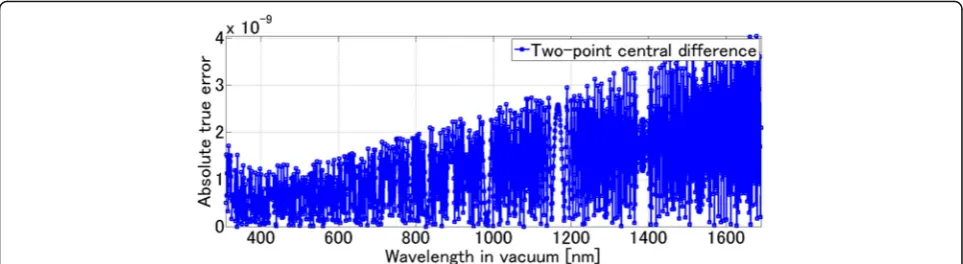
Figure1 shows the variation in the absolute value of dif-ference with the calculable wavelength with Δλ = 1 nm upon calculating the PRA with 12-digit accuracy. In Fig.1, we note that the maximum absolute value of the two-point central difference method is obtained at around 1700 nm. As mentioned in a previous study [23], the“ zig-zag”nature of the curves is due to the round-off error in calculating the PRA. The round-off error originates from numerical calculations that use a limited number of digits in a computer. In the case of this combination (namely,
Δλ = 1 nm and np with 12 digits), the absolute value of
the difference of the two-point central difference method is mainly affected by the round-off error. The reason underlying the high round-off error occurring at larger wavelengths is that the curve of PRA at larger wavelengths is “gentler” than that at smaller wavelengths. A gentle curve means the difference between these two values used for calculation is too small. If we do not consider more digits, we cannot accurately evaluate their difference.
Fig. 1Variation in the absolute value of difference as a function of wavelength forΔλ= 1 nm upon calculating the phase refractive index of air (PRA) with 12-digit accuracy
We next change the step sizeΔλand NSD of the PRA to observe the change in the maximum absolute value of difference. For example, Fig.2shows the variation in the absolute value of difference withΔλ = 0.1 nm upon cal-culating the PRA with 16-digit accuracy. From the fig-ure, we note that the maximum absolute value of difference obtained with the two-point central difference method exhibits a corresponding change, with the corre-sponding position shifting to around 300 nm. The abso-lute values of difference obtained at smaller wavelengths are mainly affected by the truncation error. Truncation
error exists because the difference approximation is cal-culated based on the linear Taylor expansion. This shift of the maximum value indicates that the main error con-tributor is now the truncation error and not the round-off error. In the case of this combination (namely, Δλ= 0.1 nm and np with 16 digits), the maximum absolute
value of difference for the two-point central difference method is mainly affected by the truncation error. The reason underlying high truncation error at smaller lengths is that the curve of the PRA at smaller wave-lengths is “steeper” than that at larger wavelengths.
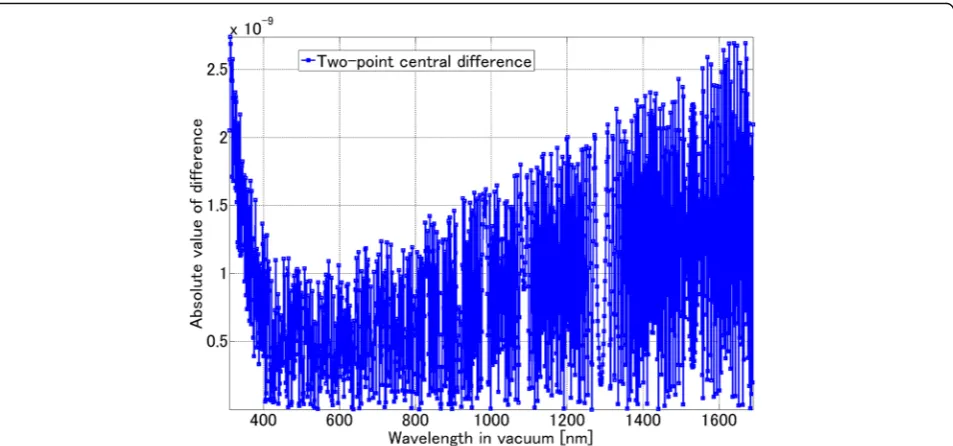
Fig. 3Variation in the absolute value of difference obtained with the two-point central difference method as a function of wavelength forΔλ= 1.5 nm upon calculating the phase refractive index of air (PRA) with 12-digit accuracy
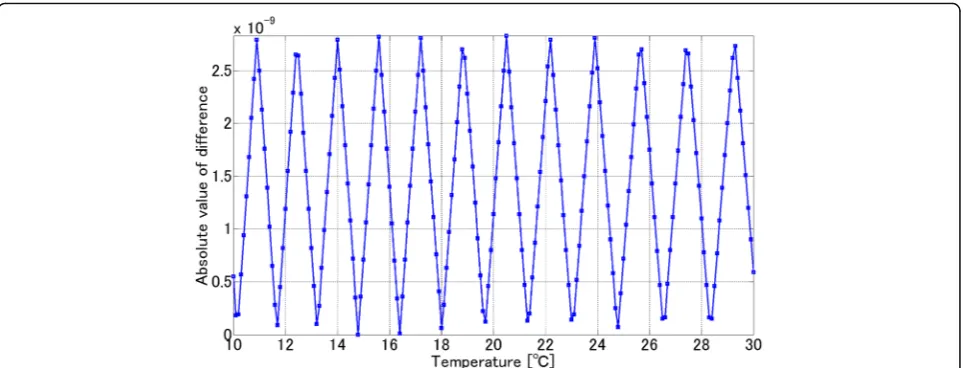
Fig. 4Variation in the absolute value of difference obtained the with two-point central difference method as a function of temperature (λvac= 301.5 nm,
Since the difference approximation is a linear approxi-mation, its precision is suitable for a gentle curve, and its accuracy is poor for a steep curve.
When the combination of Δλ and the NSD of PRA is changed, the main contributor of the error in the max-imum absolute value of difference also changes. It is dif-ficult to estimate the absolute value of difference based on the law of propagation of uncertainty. For this rea-son, we perform numerical simulations to evaluate the maximum absolute value of difference without consider-ing the main cause of error. Here, we remark that the PRA is a continuous function, and therefore, we only test the range around the upper and lower limits of the variation range of the environmental parameters. Since the maximum absolute value of the difference is
obtained around 300 nm and 1700 nm, we address only these two cases in the following discussion.
Figures1and2indicate that there is an optimal combin-ation ofΔλand NSD of PRA that can minimize the total error. We can determine a suitable estimate of this combin-ation by balancing the trunccombin-ation error and the round-off error of the PRA; this forms the basis of our strategy. We test different pairs ofΔλand PRA digits. Figure3shows a candidate result that can be optimized to almost all wave-lengths withΔλ= 1.5 nm and 12-digit PRA accuracy. We note that the maximum absolute value of difference is 2. 7 × 10⁻⁹. Since the purpose of this research is to determine a combination of the step size Δλ and NSD of the PRA satisfying the error conditions, we only consider this combination in the following discussion.
Fig. 5Variation in the absolute value of difference obtained with two-point central difference method as a function of temperature (λvac= 1698.5 nm,
P= 101.325 kPa,H= 50%)
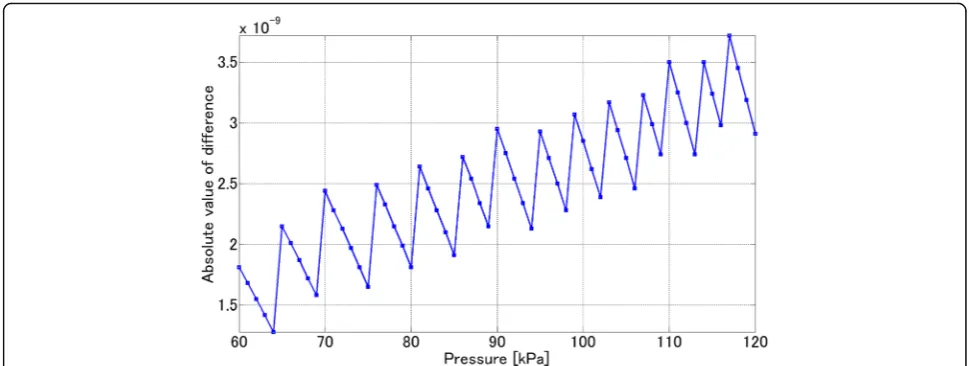
Fig. 6Variation in the absolute value of difference obtained with the two-point central difference method as a function of pressure (λvac= 301.5 nm,
Figures4and5show the variation in the absolute value of difference as a function of temperature. The maximum absolute values of difference in Figs.4and5are 3.5 × 10⁻⁹ and 2.8 × 10⁻⁹, respectively. The maximum absolute value of difference with λvac= 301.5 nm is larger than that of λvac= 1698.5 nm. In the following discussion, we only
present the results forλvac= 301.5 nm.
Figures 6 and 7 depict the variation in the absolute value of difference with pressure. The maximum abso-lute values of difference in Figs. 6 and 7 are 3.8 × 10⁻⁹ and 3.7 × 10⁻⁹, respectively. The maximum absolute value of difference atT= 10 °C is larger than that atT= 30 °C, and therefore, in the following discussion, we subsequently address only the case ofT= 10 °C.
Figure 8 shows the variation in the absolute value of difference as a function of humidity. The maximum ab-solute value of difference in Fig.8is 4.1 × 10⁻⁹.
Here, we again recall that the PRA is a continuous func-tion. The maximum or minimum value of the function ap-pears at the upper and lower bounds of the variable range. The round-off error leads to the zigzagging of the curve. As can be observed in the above figures, there is no significant deviation in the curve. Based on these facts, we can conclude that under environmental conditions ofT: 10≤T≤30 °C, P: 60≤P≤120 kPa, and H: 5≤H≤85 %, the maximum absolute value of difference is less than 5 × 10⁻⁹over the entire wavelength range (301.5-1698.5 nm). This result proves the feasibility of our approach.
Fig. 8Variation in the absolute value of difference obtained with the two-point central difference method as a function of humidity (λvac= 301.5 nm,
T= 10 °C,P= 120 kPa)
Fig. 7Variation in the absolute value of difference obtained with the two-point central difference method as a function of pressure (λvac= 301.5 nm,
Conclusion
Under environmental conditions of T: 10≤T≤30 °C, P: 60≤P≤120 kPa, and H: 5≤H≤85 %, we confirmed the accuracy of the two-point central difference approximation method via numerical calculations. Our strategy was to de-termine a suitable combination of the step size Δλ and NSD of PRA by balancing the truncation error and the round-off error. We determined that the GRA computation can be easily approximated by the two-point central differ-ence approximation method and that approximation accur-acies of less than 5 × 10⁻⁹can be achieved over the entire wavelength range (301.5-1698.5 nm) withΔλ= 1.5 nm and 12-digit PRA accuracy. Our method can be used by non-expert users to obtain the GRA with sufficient accuracy for environmental compensation in length measurements.
Abbreviations
APRIL:Adjacent pulse repetition interval length; FOFC: Femtosecond optical frequency comb; GRA: Group refractive index of air; NSD: Number of significant digits; PRA: Phase refractive index of air
Acknowledgments
This research work was partially financially supported by Japan Society for the Promotion of Science (JSPS) KAKENHI Grant-in-Aid for Young Scientists (B) (Grant Number 17 K17743).
Funding
Declared at acknowledgements.
Availability of data and materials Presented in the main paper.
Authors’contributions
WD proposed the idea, carried out the experiments and wrote the manuscript. All authors participated in the discussion of the experiments. All authors read and approved the final manuscript.
Authors’information
Dr. Dong WEI received his BSc and MSc in Engineering from the University of Electro-Communications of Japan, in 2006 and 2008, respectively, and he received his DSc from the university of Tokyo, Japan, in 2011. He is now an assistant professor in the Department of Mechanical Engineering at Nagaoka University of Technology in Japan. His interest includes applied optics and intelligent signal processing.
Competing interests
The authors declare that they have no competing interests.
Publisher’s Note
Springer Nature remains neutral with regard to jurisdictional claims in published maps and institutional affiliations.
Author details
1Department of Mechanical Engineering, Nagaoka University of Technology,
Nagaoka City, Niigata 940-2188, Japan.2School of Mechanical Engineering, Beijing Institute of Technology, Beijing 100081, People’s Republic of China. 3Department of Mechanical and Electrical Engineering, School of Aerospace
Engineering, Xiamen University, Xiamen City, Fujian Province 361006, People’s Republic of China.
Received: 14 January 2018 Accepted: 2 May 2018
References
1. Ciddor, P.E.: Refractive index of air: new equations for the visible and near
infrared. Appl. Opt.35, 1566–1573 (1996).
2. Birch, K.P., Downs, M.J.: An updated Edlén equation for the refractive index
of air. Metrologia.30, 155 (1993).
3. Bengt, E.: The refractive index of air. Metrologia.2, 71 (1966).
4. Stone JA and Zimmerman JH, Refractive index of air calculator.http://
emtoolbox.nist.gov/Wavelength/Edlen.asp.
5. Ye, J., Cundiff, S.T.: Femtosecond Optical Frequency Comb : Principle,
Operation, and Applications, p. 361. Springer, New York, NY (2005), xii).
6. Schuhler, N., Salvade, Y., Leveque, S., Dandliker, R., Holzwarth, R.:
Frequency-comb-referenced two-wavelength source for absolute distance
measurement. Opt. Lett.31, 3101–3103 (2006).
7. Hyun, S., Kim, Y.-J., Kim, Y., Jin, J., Kim, S.-W.: Absolute length measurement
with the frequency comb of a femtosecond laser. Meas. Sci. Technol.20,
095302 (2009).
8. Yasui, T., Kabetani, Y., Ohgi, Y., Yokoyama, S., Araki, T.: Absolute distance
measurement of optically rough objects using
asynchronous-optical-sampling terahertz impulse ranging. Appl. Opt.49, 5262–5270 (2010).
9. Yokoyama, S., Yokoyama, T., Hagihara, Y., Araki, T., Yasui, T.: A distance meter
using a terahertz intermode beat in an optical frequency comb. Opt.
Express.17, 17324–17337 (2009).
10. Yamaoka, Y., Minoshima, K., Matsumoto, H.: Direct measurement of the
group refractive index of air with interferometry between adjacent
femtosecond pulses. Appl. Opt.41, 4318–4324 (2002).
11. Ye, J.: Absolute measurement of a long, arbitrary distance to less than an
optical fringe. Opt. Lett.29, 1153–1155 (2004).
12. Cui, M., Schouten, R.N., Bhattacharya, N., Berg, S.A.: Experimental
demonstration of distance measurement with a femtosecond frequency
comb laser. J. Eur. Opt. Soc. Rapid Publ.3, 08003 (2008).
13. Matsumoto, H., Wang, X., Takamasu, K., Aoto, T.: Absolute measurement of
baselines up to 403 m using heterodyne temporal coherence interferometer
with optical frequency comb. Appl. Phys. Express.5, 046601 (2012).
14. Narin, C., Satoru, T., Kiyoshi, T., Hirokazu, M.: A new method for
high-accuracy gauge block measurement using 2 GHz repetition mode of a
mode-locked fiber laser. Meas. Sci. Technol.23, 054003 (2012).
15. Wang, X., Takahashi, S., Takamasu, K., Matsumoto, H.: Space position
measurement using long-path heterodyne interferometer with optical
frequency comb. Opt. Express.20, 2725–2732 (2012).
16. Wang, X., Takahashi, S., Takamasu, K., Matsumoto, H.: Spatial positioning
measurements up to 150m using temporal coherence of optical frequency
comb. Precis. Eng.37, 635–639 (2013).
17. Wei, D., Takamasu, K., Matsumoto, H.: A study of the possibility of using an
adjacent pulse repetition interval length as a scale using a helium–neon
interferometer. Precis. Eng.37, 694–698 (2013).
18. Wei, D., Aketagawa, M.: Comparison of length measurements provided by a
femtosecond optical frequency comb. Opt. Express.22, 7040–7045 (2014).
19. W. Sudatham, H. Matsumoto, S. Takahashi and K. Takamasu, "Verification of
the positioning accuracy of industrial coordinate measuring machine using optical-comb pulsed interferometer with a rough metal ball target," Precis.
Eng.41, 63-67 (2015)
20. W. Sudatham, H. Matsumoto, S. Takahashi and K. Takamasu, "Non-contact
measurement technique for dimensional metrology using optical comb,"
Measurement78, 381-387 (2015)
21. Saleh, B.E.A., Teich, M.C.: Fundamentals of Photonics, Wiley Series in Pure
and Applied Optics, p. 1177. Wiley-Interscience, Hoboken, N.J (2007), xix).
22. Wei, D., Xiao, M., Yang, P.: Group refractive index calculation by difference
approximation for length measurement. J. Eur. Opt. Soc. Rapid Publ.11,
16013 (2016).
23. Wei, D., Xiao, M., Yang, P.: Selection of numerical differentiation method for
calculation of group refractive index of air over all calculable wavelengths.
Optik Int. J. Light Electron Opt.382, 1362–1369 (2017).
24. Butt, R: Introduction to Numerical Analysis Using MATLAB®, Infinity Science
Series, Jones & Bartlett Learning, Burlington (2009)
25. Canale, R., Chapra, S: Numerical Methods for Engineers, McGraw-Hill
Education, New York City, (2014)
26. Schellekens, P., Wilkening, G., Reinboth, F., Downs, M.J., Birch, K.P., Spronck,
J.: Measurements of the refractive index of air using interference