REVIEW
A new view on the solar wind interaction
with the Moon
Anil Bhardwaj
1*, M B Dhanya
1, Abhinaw Alok
1, Stas Barabash
2, Martin Wieser
2, Yoshifumi Futaana
2,
Peter Wurz
3, Audrey Vorburger
4, Mats Holmström
2, Charles Lue
2, Yuki Harada
5and Kazushi Asamura
6Abstract
Characterised by a surface bound exosphere and localised crustal magnetic fields, the Moon was considered as a passive object when solar wind interacts with it. However, the neutral particle and plasma measurements around the Moon by recent dedicated lunar missions, such as Chandrayaan-1, Kaguya, Chang’E-1, LRO, and ARTEMIS, as well as IBEX have revealed a variety of phenomena around the Moon which results from the interaction with solar wind, such as backscattering of solar wind protons as energetic neutral atoms (ENA) from lunar surface, sputtering of atoms from the lunar surface, formation of a “mini-magnetosphere” around lunar magnetic anomaly regions, as well as several plasma populations around the Moon, including solar wind protons scattered from the lunar surface, from the mag-netic anomalies, pick-up ions, protons in lunar wake and more. This paper provides a review of these recent findings and presents the interaction of solar wind with the Moon in a new perspective.
Keywords: Moon, Solar wind, ENAs, Plasma, Mini-magnetosphere, Lunar wake, Pickup ions, SARA, CENA, SWIM, Chandrayaan-1, Kaguya, Chang’E-1, ARTEMIS, IBEX
© 2015 Bhardwaj et al. This article is distributed under the terms of the Creative Commons Attribution 4.0 International License (http://creativecommons.org/licenses/by/4.0/), which permits unrestricted use, distribution, and reproduction in any medium, provided you give appropriate credit to the original author(s) and the source, provide a link to the Creative Commons license, and indicate if changes were made.
Introduction
The Moon is a regolith covered planetary object char-acterised by a surface-bound exosphere (Killen and Ip 1999; Stern 1999; Sridharan et al. 2010) and an absence of a global magnetic field. However, the Moon possesses regions of stronger crustal magnetic fields, known as ‘magnetic anomaly’ regions (Coleman et al. 1972; Hood and Schubert 1980; Lin et al. 1998; Hood et al. 2001; Halekas et al. 2001; Richmond et al. 2003; Tsunakawa et al. 2015). The Moon was thought to be a passive absorber of the plasma when the supersonic solar wind is incident on its surface (Feldman et al. 2000; Crider and Vondrak 2002). However, observations from the recent missions, such as Chandrayaan-1, Kaguya, Chang’E-1, ARTEMIS, and IBEX have shown that the interaction of solar wind with the Moon is quite dynamic with a variety of processes involved, such as sputtering of lunar surface, scattering of 0.1–1 % solar wind protons with the same
charge state and ≤28 % as hydrogen energetic neutral
atoms (ENAs), existence of “mini-magnetosphere” at the lunar surface, reflection of solar wind protons from lunar magnetic anomalies, protons in near-lunar wake by dif-ferent entry mechanisms and so on.
This paper provides an overview of the recent findings in the area of solar wind interaction with the Moon and presents a new perspective on this subject. It also tries to correlate the lunar observations with those conducted in laboratories.
Review
Neutral particle environment around the Moon
The observations by the CENA sensor of the SARA experiment onboard Chandrayaan-1 (Bhardwaj et al. 2005, 2010; Barabash et al. 2009) and the IBEX-Lo and IBEX-Hi of IBEX (McComas et al. 2009) have provided new insights into the energetic neutral atom (ENA) envi-ronment around the Moon.
Energetic neutral hydrogen atoms (hydrogen ENAs) generated by the interaction of solar wind protons with lunar regolith have been observed by the ENA sensors onboard Chandrayaan-1 (Wieser et al. 2009) and IBEX
Open Access
*Correspondence: [email protected]
1 Space Physics Laboratory, Vikram Sarabhai Space Centre, Trivandrum 695022, India
(McComas et al. 2009b). The estimated backscatter frac-tion (albedo) of hydrogen ENAs from Chandrayaan-1 and IBEX observations are about 8–28 %. These values were much higher than those expected (Crider and Von-drak 2002). The ENA intensity displayed variations with the solar zenith angle (Fig. 1). The derived angular scat-tering function for the ENAs using CENA observations (Schaufelberger et al. 2011) suggests more scattering in the sunward direction (backscattering) than the forward scattering as the solar zenith angle increases, which is contrary to the expectations based on laboratory stud-ies (Niehus et al. 1993). Using this scattering function, the global mean for hydrogen ENA albedo from CENA/ SARA is 16±5 % (Fig. 2) (Vorburger et al. 2013), while the value estimated from IBEX observations is 11±6 % (Saul et al. 2013).
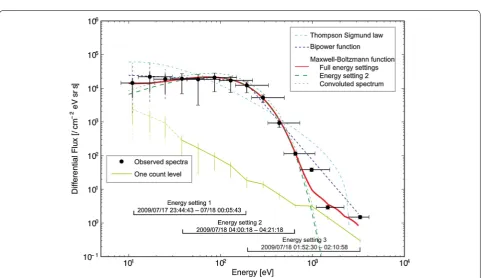
Futaana et al. (2012) found that the energy spectrum of the backscattered hydrogen ENAs is Maxwellian (Fig. 3) and that the ENA characteristic energies are cor-related with the solar wind velocity (rather than solar wind energy). This implied that the ENA emission is a momentum-driven process and the impacting solar wind protons experience multiple collisions within the top layer of the regolith before getting released into the space as neutral hydrogen. The backscatter fraction was com-puted by integrating the empirical energy spectrum, and its dependence on various solar wind plasma parameters, such as density, velocity, temperature, interplanetary magnetic field, and the fraction of alpha particles have also been investigated (Futaana et al. 2012). It is found
that the back-scatter fraction is not controlled by any of the solar wind parameters. However, Funsten et al. (2013) have reported the dependence of the ENA reflection coefficient on the incident solar wind speed from IBEX observations and the ENA reflection ratio ranges from ∼ 0.2 for slow solar wind to ∼0.08 for fast solar wind. The average energy per incident solar-wind ion reflected to space is found to be ∼30 eV for slow solar wind and ∼ 45 eV for fast solar wind. Also, from IBEX observations, Allegrini et al. (2013) found the energy spectra to be a power law, and the spectral shape of the ENA emission was represented by a linearly decreasing intensity with increasing energy for energy >250 eV (Funsten et al.
2013).
In the similar way as the interaction of solar wind with Earth’s magnetic field results in the formation of mag-netosphere which effectively shields the planet from the solar wind, the possibility that magnetic anomaly regions on Moon can form small-scale magnetospheres (“mini-magnetospheres”) has been suggested from Lunar Pros-pector observations (Lin et al. 1998). The discovery of “mini-magnetosphere” on Moon was made possible by means of ENA observations from Chandrayaan-1 over the Crisium antipode magnetic anomaly region (Wieser et al. 2010). The spatial extent of the mini-magnetosphere was found to be ∼360 km across at the lunar surface. The ENA intensity was found to reduce by about 50 % within the area of the mini-magnetosphere. This region of reduced ENA intensity was surrounded by a region of enhanced ENA intensity of width ∼300 km which is due
to the deflected flow of the solar wind plasma around the mini-magnetosphere (Fig. 4).
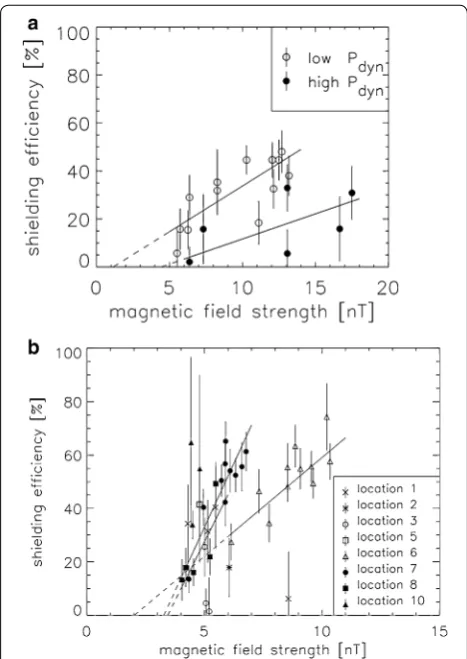
Vorburger et al. (2012) have investigated the shielding efficiency of several magnetic anomaly regions for vary-ing solar wind conditions and found that the shieldvary-ing
efficiency depends not only on the solar wind dynamic pressure but also on the geometry (structure) of the anomalies (Fig. 5). 3D kinetic particle-in-cell simulations of the solar wind with lunar crustal magnetic anomalies showed that the anomalies that are strong enough can Fig. 2 The histogram showing the reflection ratios for ENA computed from the SARA/CENA observations on Chandrayaan-1. The vertical dashed line shows the mean value of 0.16 and the vertical dotted lines show the standard deviation of 0.05 [from Vorbuger et al. (2013)]
stand-off solar wind and form mini-magnetosphere (Kal-lio et al. 2012; Jarvinen et al. 2014; Deca et al. 2014). The simulation showed that the interaction is mostly elec-tron driven and that the mini-magnetosphere is unstable over time, which leads to only temporal shielding of the surface underneath. Recent hybrid simulations of solar wind interaction with magnetic anomalies (Giacalone and Hood 2015) have also shown that magnetic anoma-lies deflect the solar wind and that the solar wind proton flux reduces by a factor of 4 at the centre of the anomaly
regions. Further, the hybrid simulation showed that the energy of the solar wind protons which hit the lunar sur-face within the magnetic anomaly region can be much lower than that of solar wind (10–60 % of solar wind energy) which indicates deceleration of the solar wind protons before reaching the lunar surface.
Futaana et al. (2013) estimated the lunar surface poten-tial using an empirical method that uses the observed ENA intensity over a magnetic anomaly. The empirical method is based on the energy change of the impinging Fig. 4 The back-scattered hydrogen ENA reflection ratio over the magnetic anomaly near 22° S and 240° E on the lunar farside observed from 200 km altitude on 17 June 2009. The maps show a unit-less reflection coefficient: neutral hydrogen number flux integrated over the specified energy range divided by total solar wind number flux integrated over energy and cosine of lunar latitude in the energy ranges a 150–600 eV. Black contours in the centre show the magnetic field magnitude at 30 km altitude obtained from Lunar Prospector data, with lines for 5, 15, and 25 nT. The dotted
circle represents the region of magnetic anomaly and the dashed circle represents the region just surrounding the anomaly. b Context image taken
solar wind protons being decelerated by the surface potential (solar wind energy at the surface) and relies on the ENA energy spectrum and the ENA characteristic energy. The surface potential map (Fig. 6) shows larger positive potential inside the anomaly region, which is expected due to the outward electric field resulting from the higher penetration of protons compared to that of electrons in this region (Kallio et al. 2012; Jarvinen et al. 2014). However, the lack of electrostatic poten-tial in the enhanced region [the region where the ENA intensity have been found be enhanced when the mini-magnetosphere was discovered (Wieser et al. 2010) as discussed in the paragraph above] indicates that there is no electric potential formed above the enhanced region and hence the deflection above the anomaly is mainly caused by magnetic forces. This suggests that a mini-scale bow shock, as hypothesised earlier, is evidently not formed above the magnetic anomaly. Using laboratory
experiments with a flowing plasma of energy up to 55 eV interacting with a magnetic dipole field above an insu-lating surface, Howes et al. (2015) investigated the lunar surface charging in the magnetic anomaly regions. They have found that the surface gets charged to larger positive potentials of around +50 V when the dipole moment was perpendicular to the surface. When the dipole moment becomes parallel to the surface, the potentials were found to be much lower (around +7V).
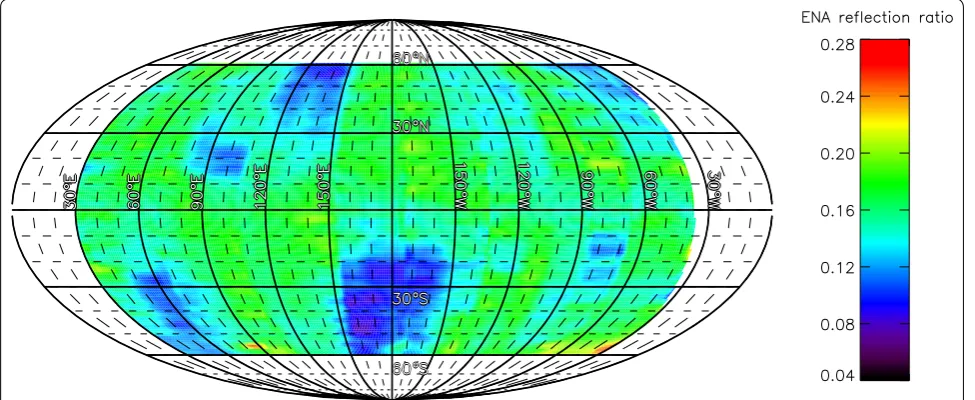
Using the entire data of ENA observations by Chan-drayaan-1/CENA, the first global ENA albedo map cov-ering ∼89 % of the lunar surface has been generated (Vorburger et al. 2013) (Fig. 7). Local variations in the ENA albedo were seen from the map, which indicated that lunar surface is not a homogeneous ENA reflector but exhibits local variations and the signatures of the anomaly regions could be clearly seen in the map. All these are indicative that the ENA imaging is a powerful tool to investigate the planetary surface.
The analysis of ENAs from the South pole Aitken basin has been carried out to investigate the effect of the sur-face properties on the variation of backscattered ENA albedo (Vorburger et al. 2015). South pole Aitken ter-rain has highly variable surface properties and magnetic anomalies around the rim. The analysis showed that the ENA albedo are sensitive to magnetic anomalies which causes the suppression of ENA intensity, whereas the other surface properties, e.g., changes in elevation of surface, chemical composition, and visible albedo do not play a significant role in the variation of ENA albedo.
Hydrogen ENAs are also found to be produced when the Moon is in the geomagnetic tail, where the plasma conditions are different compared to upstream solar wind (Allegrini et al. 2013; Harada et al. 2014). On an average, the ENA intensities are found to be higher when the Moon is in the Earth’s magnetosheath (Allegrini et al. 2013) compared to that in the upstream solar wind. The energy spectra of these ENAs are found to be described well by a power law, which matches with that of ENAs observed in upstream for energies above 0.6 times the solar wind energy, but below this energy there are large differences up to a factor of 10. The velocity distribution of plasma in the magnetosheath is broader compared to that of upstream solar wind (hence broader angu-lar distribution) and hence has smaller Mach number. This means that the area of the lunar regolith seen by the magnetosheath plasma will be higher compared to that of solar wind and hence more back-scattered ENAs. This was considered as potential factor that contributes towards the higher ENA emission in the magnetosheath region. ENAs have also been observed when the Moon was in the plasmasheet region with a backscattering frac-tion of ∼10 % (Harada et al. 2014). The backscattering Fig. 5 a The shielding efficiency as a function of magnetic field
fraction in the plasmasheet does not show significant difference between northern and southern hemispheres, whereas back-scattering fraction was found to reduce to almost 50 % in southern hemisphere over a large and
strong magnetic anomaly region when the Moon is in the upstream solar wind. Test particle trajectory simulations carried out to investigate the effect of simple dipole mag-netic fields for the backscattering process showed that the shielding of the surface by magnetic fields is less effi-cient for an incident beam of hot protons similar to that in the plasmasheet (Harada et al. 2014).
Solar wind has been considered as a potential contribu-tor towards lunar exosphere by sputtering of the lunar surface, a process which has been theoretically modelled (Wurz et al. 2007 and references therein). In the recent past, Killen et al. (2012) have estimated the sputter yields for different solar wind conditions such as fast and slow solar wind, solar energetic particle population, and cor-onal mass ejections (CME) using Monte Carlo model. They found that the enhancement of heavier ions such as He++ and O7+ increases the sputter yield. Under CME passage, the mass of elements such as Na, K, Ca, and Mg in the lunar exosphere was found to increase to more than ten times their background values.
The first direct observational evidence for the solar wind sputtering of lunar surface came from CENA/SARA sensor of Chandrayaan-1 with the observation of sput-tered oxygen atoms (Vorburger et al. 2014). The sputtered oxygen flux is around 0.2–0.4 times that of the backscat-tered hydrogen ENA flux. As expected, the sputbackscat-tered flux was found to be higher when the solar wind had higher He++ content, since He++ is a more efficient sputtering agent compared to H+ due to its higher mass (Fig. 8). The density of oxygen atoms at subsolar point was esti-mated to be (1.1±0.3)×107
m−3
for solar wind with low Helium content (<0.35 %) and (1.4±0.4)×107
m−3 for high Helium content (∼4.57 %), which agrees well with Fig. 6 Illustration of the solar wind interaction with the lunar
mag-netic anomaly. The blue lines indicate the flow of solar wind protons that are subsequently modified by the interaction with the magnetic anomaly resulting in a deflection and thereby reaching the enhanced region without a change in velocity, b deceleration inside the magnetic anomaly due to the potential structure of +150V and reach inside magnetic anomaly, or c heating and reflection to space before reaching the lunar surface [from Futaana et al. (2013)]
model predictions and observational upper bound. Weak signals of Helium ENAs have also been detected for the first time (Vorburger et al. 2014).
There have been several efforts towards modelling of the lunar exosphere which were later compared with measurements made by LRO and LADEE. Sarantos et al. (2012), also modelled the column abundances of expected lunar exospheric constituents and found that except for Ca, the modelled abundances matches with the available measurements. This suggested the role of loss processes such as gas-to-solid phase condensa-tion during micrometeoroid impacts or the formacondensa-tion of stable metallic oxides, which were not included in the model. In addition, Sarantos et al. (2012) have com-pared the estimates of the ion flux of the expected lunar exospheric constituents with the estimates for the ion fluxes ejected from the lunar surface by solar wind ions and electrons. This showed that measurements of ions around Moon will help to understand the abundances of many undetected species in the lunar exosphere because the expected ion flux levels from the exosphere exceed those from the surface. The observations of He in the lunar exosphere using the Lyman Alpha Mapping Project (LAMP) ultraviolet spectrograph on LRO showed day-to-day variations in the derived surface He density which correspond to the variations in the solar wind He++ flux (Feldman et al. 2012). In addition, there was a reduction by a factor of two in the surface He density when the Moon passes through Earth’s magnetotail, which was explained by models.
Recently, Ne was discovered in the lunar exosphere from the Neutral Mass Spectrometer (NMS) onboard the LADEE, and the first global characterization of He and Ar was also obtained from the observations (Benna et al. 2015). They found that He is controlled by the solar wind alpha particles and also by a endogenous source that sup-plies at a rate of 1.9×10²³
atoms s−1
. Neon was detected over the night side and the levels were comparable to that of He. Ne was found to exhibit the spatial distribution of a surface-accommodated non-condensible gas. Local-ized Ar enhancement was also observed at the western maria which was never observed before and the variabil-ity resulting from this local enhancement would couple to a more global source that is transient in nature. Using the data from the CHACE experiment on Chandrayaan-1 mission, Thampi et al. (2015) have derived the 2-D dis-tribution of the lunar molecular hydrogen (H2). By com-paring with the topography data from the Lunar Laser Ranging Instrument (LLRI) on Chandrayaan-1, they concluded that the surface processes play an important role in the small-scale variations of the H2 number den-sity in tenuous lunar atmosphere. Based on the observa-tions of Lunar-based Ultraviolet Telescope on Chang’E-3, an upperlimit of 1011
cm−2 for the column density of OH radical and 104
cm−3
for the OH surface concentration has been reported (Wang et al. 2015). This estimation was based on the assumption of a hydrostatic equilib-rium with a scale height of 100 km and that the recorded background to be fully contributed by the resonance flu-orescence emission. The concentration values were found to be lower than the previous reports by about two orders of magnitude, whereas it was closer to those predicted by the sputtering models.
Using soft X-ray imaging of the Moon from the Rönt-gen satellite (ROSAT), Collier et al. (2014) found that the increase in the soft X-ray intensity associated with the limb brightening is consistent with that expected from the solar wind charge exchange with the lunar exosphere based on the lunar exospheric models and hybrid simula-tion results of solar wind access beyond the terminator. Since the signal appears to be dominated by exospheric species arising from solar wind implantation, the soft X-ray imaging can be used to infer the lunar limb col-umn density as well as to determine how the exosphere varies with solar wind conditions. In addition, using the ground-based measurements from the National Solar Observatory McMath-Pierce Telescope, Mierkiewicz et al. (2014) have investigated the temperature and veloc-ity variation of the lunar sodium exosphere. They found effective temperatures ranging between 3260±190 K closer to sunlit east and 1000±135 K closer to south lunar limbs and velocity in the range 100–600 m s−1 between different locations off the lunar limb.
Plasma environment around the Moon
The electron and magnetic field measurements by Lunar Prospector (Lin et al. 1998; Halekas et al. 2001, 2005; Hood et al. 2001; Richmond and Hood 2008; Tsu-nakawa et al. 2015 and references therein) provided a map of the magnetic field over the lunar surface which clearly showed the magnetic anomaly regions and exten-sive investigations about the electrons in the near-lunar wake region, as well as the lunar surface charging. In the recent years, the ion measurements around Moon have been made by the plasma analysers onboard Kaguya, Chang’E-1, Chandrayaan-1, and ARTEMIS.
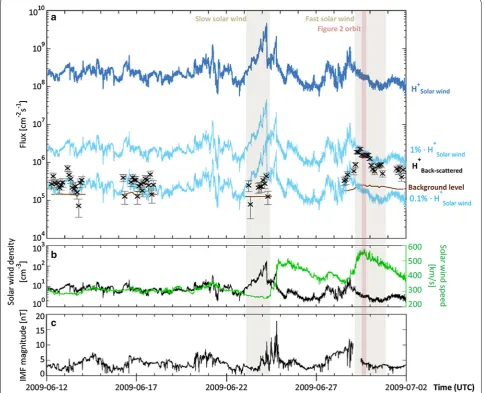
Mainly three ion populations have been observed as a result of the interaction of the solar wind with the day-side lunar surface: (1) solar wind protons scattered from the lunar surface, (2) protons scattered from lunar magnetic anomalies, and (3) ions of lunar origin. About 0.1–1 % of the solar wind protons are found to scatter back preserving the charge state after interactions with the regolith (Saito et al. 2008; Holmström et al. 2010). These scattered protons can be further accelerated by the convective electric field (Futaana et al. 2010; Saito et al. 2010) and hybrid simulations showed that they contrib-ute to the plasma environment around Moon (Holm-ström et al. 2010). The study of the surface-scattered protons using the Chandrayaan-1/SWIM showed that the backscatter fraction is in the range 0.1–1 % and that the backscattering efficiency depends largely on the solar wind velocity indicating that the scattering is momen-tum-driven process (Lue et al. 2014) (Fig. 9).
Apart from scattering from surface, protons deflected from the magnetic anomaly region have also been observed (Saito et al. 2010; Lue et al. 2011). The deflec-tion efficiency was found to be around 10 % on average whereas at the location of strongest anomalies, it could be as high as 50 %. The energy of these deflected protons is about the same as that of solar wind, but the spectrum is broader indicating some heating effects. The heating has also been observed for electrons which are observed simultaneously during the proton reflection (Saito et al. 2010). The investigation of accelerated ions in the 0.23–1.5 keV range around the magnetic anomaly region in the South-pole Aitken basin observed by Kaguya (Yokota et al. 2014) suggested that the electric field pro-duced due to the interaction of solar wind with the mag-netic anomaly is the source of the acceleration. The ions included the ones that are scattered from the surface as well as those of solar wind origin. However, structures similar to those associated with collisionless shocks have been observed near the Moon recently by ARTEMIS (Halekas et al. 2014). The location of these structures with regard to the magnetic anomaly regions suggests that the solar wind protons reflected from the anomaly
may be the source of the observed small-scale shock. Using a 3-D hydrid simulation, Jarvinen et al. (2014) showed the presence of a potential of <300 V at the lunar surface which is associated with the Hall electric field in the anti-Moonward direction that results from the interaction between solar wind and a magnetic dipole mimicking the Gerasimovich magnetic anomaly. This value is consistent with the value of >135 V reported by
Futaana et al. (2013) using ENAs at Gerasimovich mag-netic anomaly and ∼150 V reported by Saito et al. (2012) from the ion and electron observation in the south-pole Aitken region at 25 km altitude.
There have been observations of heavier ions originat-ing from the lunar surface/exosphere (Yokota et al. 2009). The ions observed are He+, C+, O+, Na+, and K+. These are indicative of the presence of He, O, and C exospheres around the Moon. The longitude distributions of Na+ and K+ fluxes from the Kaguya low-energy ion data, showed a dawn–dusk asymmetry such that the abundance decreases to approximately 50 % at dusk compared with that at dawn (Yokota et al. 2014). This can be due to the emission of the exospheric particles at dawn side which also implied that the surface abundance of Na and K need to be supplied during the night to explain the observed dawn–dusk asymmetry. The pickup of the exospheric particle with M/q=2 has also been observed with flux of ∼10−5 to 10−4
of the solar wind flux. H+
2 is considered as the most probable candidate for the observed species (Wang et al. 2011). The flux of the observed pickup ions are in the range 10−5–10−4
(Halekas et al. 2013). This could have been due to contri-butions from terrestrial oxygen, OH, or CH4.
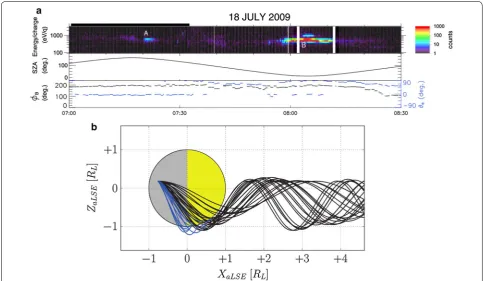
Regarding the nightside plasma population, recent observations from plasma analysers onboard Kaguya, Chang’E-1, Chandrayaan-1, and ARTEMIS, have shown the presence of protons in the near-lunar wake region (100–200 km above the surface) (Halekas et al. 2015). This region was thought to be devoid of any plasma population. Instead, protons were found to access the near-lunar wake by travelling parallel as well as perpen-dicular to the interplanetary magnetic field (IMF). The sources for the perpendicular entry are identified as (1) surface-scattered solar wind protons near the dayside
equator, accessing the near-lunar wake under the influ-ence of the convective electric field (Nishino et al. 2009), (2) the forward-scattered protons near the terminator (Wang et al. 2010), the increase in the Larmor radius of protons under the influence of wake boundary elec-tric field thereby accessing the near wake (Nishino et al. 2009), and (3) the protons from the tail of the solar wind velocity distribution that have gyro-radii larger than the radius of the Moon and can directly enter the lunar wake region (Dhanya et al. 2013) (Fig. 10). The parallel entry of the protons was observed by Chandrayaan-1 (Futaana et al. 2010) at a distance of 100 km from the lunar sur-face and by ARTEMIS at a distance of around 3.5 RL
from the Moon (Wiehle et al. 2011), where RL is the lunar radius (RL∼1738 km). The 1-D plasma expansion model (Gurevich et al. 1966; Samir et al. 1983) was able to explain the ARTEMIS observations, whereas it is not consistent with the Chandrayaan-1 observations.
In addition to protons, He++ have also been observed in lunar wake (Halekas et al. 2011). Furthermore, the electron flux enhancement has been reported in the lunar wake above the Crisium antipode magnetic anom-aly region (Nishino et al. 2015) and are characterised by low energy bi-directional field-aligned electron beams and a medium-energy population which are linked to the bouncing motion between the footprints of the crustal field. The theory behind the lunar wake refilling along the magnetic field (one-dimensional solution) has been discussed for background electron distributions ranging from Maxwellian to Kappa distributions (Halekas et al. 2014). Recent observations by ARTEMIS have shown magnetic field enhancements in the wake to more than twice that of ambient IMF during high plasma-beta con-ditions (Poppe et al. 2014b).
Recently, Kaguya observations on the lunar nightside when the Moon is in Earth’s plasmasheet have shown that the plasmasheet ions are accelerated by the spacecraft
potential which is negatively charged (the electrons are accelerated by the potential difference between the spacecraft and the lunar nightside surface) (Saito et al. 2014). Using this, the nightside surface potential was esti-mated in the range −100 to −500 V.
Discussion and conclusions
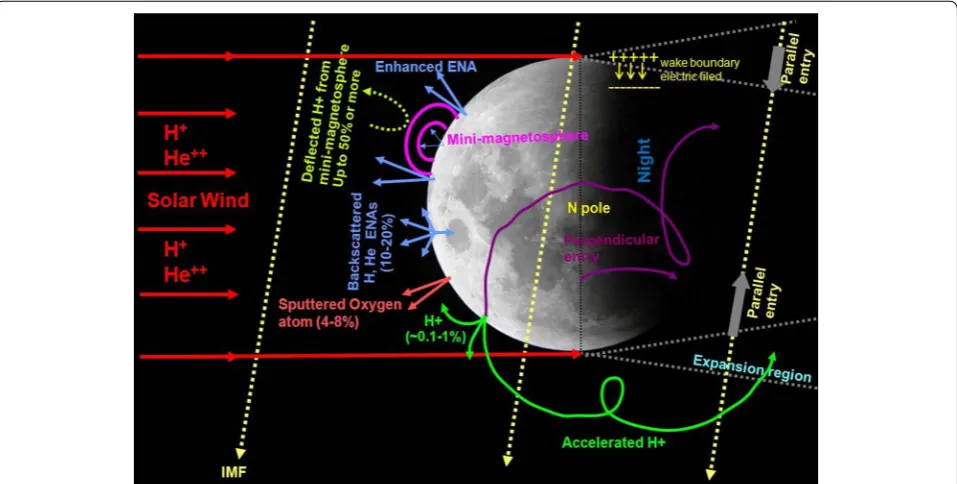
The latest understanding on the various processes initi-ated by the interaction of solar wind with the Moon is summarized in Fig. 11. Such processes include, but not limited to, backscattering of solar wind protons as hydro-gen ENAs, sputtering of the lunar surface, scattering of solar wind protons from the lunar surface as well as from magnetic anomalies, nightside ions, plasma dynamics in near-lunar wake.
The ENA backscattering as well as proton scattering from lunar surface indicates the presence of complex microphysics behind the plasma interaction with the regolith. The observation of neutralisation of solar wind protons with a porous regolith and backscattering with energies closer to that of solar wind calls for a need to understand the microphysics behind the processes that must have occurred on the lunar surface since its forma-tion. The larger sunward scattering of ENAs for larger Fig. 10 The observation of protons in lunar wake by SARA experiment on Chandrayaan-1, for one orbit on 18 July 2009 when the IMF was parallel to solar wind velocity. a The top panel shows the energy-time spectrograph of the observed protons where the population marked ‘A’ is the one observed in the lunar wake. Middle panel shows the solar zenith angle, and the bottom panel shows the IMF orientation during the observation. b
solar zenith angle suggests that the underlying processes are different compared to that observed in the labora-tory (Niehus et al. 1993). The ENA emission is not only a global phenomena on Moon, but also occurs under dif-ferent plasma regimes, such as the magnetosheath and the plasmasheet.
The surface of the Moon undergoes space weather-ing due to the continuous bombardment by high-energy solar wind plasma (Denevi et al. 2014 and references therein). The shielding of the surface from solar wind plasma by magnetic anomalies shows that the weather-ing is not uniform across the surface. The regions inside anomalies undergo less weathering and the region sur-rounding the local magnetic field received more solar wind flux. Thus the maturity of the soil is different at different locations on the Moon. This variable weath-ering is seen in the spectral features of the regions around the magnetic anomalies such as the high albedo regions known as ‘swirls’ (Blewett et al. 2011 and ref-erences therein). It has been found that most of the observed swirls have been associated with magnetic anomalies and are located inside the anomalies such as swirls of Reiner Gamma and the swirls in Mare Ingenii and Mare Marginis. The compositional analysis of sev-eral swirl regions by Blewett et al. (2011) showed the spectral characteristics of swirls to be similar to that of immature material and swirls were found to have slightly lower FeO values compared with their surroundings. The solar wind shielding by the magnetic anomalies were
identified as one of the potential sources of this compo-sitional difference.
The spectral analysis by the Moon Mineralogy Mapper of Chandrayaan-1 has found that the maturity of the swirl region is low compared to surrounding regions (Kramer et al. 2011) and also that the swirls are depleted in OH relative to their surrounding regions. The UV spectra of lunar swirls were found to be that of immature, crys-talline material as shown by the investigation by LROC (Denevi et al. 2014). Recently, the LRO data (Timothy et al. 2015) have supported the hypothesis that swirls are formed as a result of deflection of the solar wind by local magnetic fields. The comparison of high-albedo regions on Moon with the latest vector magnetic field map of the magnetic anomalies from Kaguya and Lunar Prospector observations (Tsunakawa et al. 2015) have suggested that 3-D structure of near-surface magnetic fields is important for the swirl formation at the magnetic anomaly. Thus, imaging of the lunar surface using ENAs has proved to be a powerful technique to detect local magnetic fields (magnetic anomaly regions) and mini-magnetospheres. This adds to the understanding of surface weathering.
solar wind protons into the surface using a Monte Carlo approach showed that implanted H+ is retained on the surfaces with activation energy >1 eV and the retained
H+ are likely to form OH. In recent laboratory simula-tions by Schaible et al. (2014), amorphous SiO2 and oli-vine samples were bombarded by proton beams of 2–10 keV under ultrahigh vacuum condition and it was found that about 90 % of the implanted H+ gets converted to hydroxyl species initially and the rate of conversion decreased exponentially with fluence. From this, it was estimated that on the lunar regolith, the solar wind-implanted H+ can account for the 17 % of the relative OH absorption which is consistent with observations. The backscattering of solar wind by ∼20 % reduces the frac-tion of hydrogen available for OH formafrac-tion and may affect the amount of OH. In addition, the shielding of the lunar surface by magnetic anomalies shows that the solar wind implantation will be less at regions protected by anomalies and hence, a more pronounced depletion of the OH content in the anomaly region (Kramer et al. 2011). Recent investigations using Monte Carlo model-ling have shown that the magnetic anomalies suppress the sputtered intensity thereby causing anisotropies in the lunar exosphere (Poppe et al. 2014a).
The different charged particle populations such as the surface-scattered solar wind protons on the dayside that are subsequently accelerated by the solar wind convec-tive electric field, the suspected exospheric ions, and the protons with different velocity distributions co-existing in the lunar wake, affect the lunar plasma environment. The protons on the nightside may alter the surface charg-ing and even cause sputtercharg-ing of the nightside lunar sur-face. The 3-D hybrid simulations (Fatemi et al. 2013) have shown the existence of three current systems in lunar wake in the transition regions between the plasma void, the rarefaction region, and the interplanetary plasma. These currents can induce the magnetic field and perturb the existing field lines and these currents were found to depend on the direction of the interplanetary magnetic field direction. Poppe et al. (2013) have modelled the possibility of a sputtering process initiated by the lunar exospheric ions, a process termed as self-sputtering. The model calculations suggested that the rate at which this processes sputter the particles may be equal or exceed that due to solar wind sputtering and micrometeoroid bombardment. Also, the rate is higher than that of sput-tering due to passage through the Earth’s plasma sheet.
Significant wave activities also have been initiated due to the different plasma population around Moon. A proton-governed region is formed on the night-side that subsequently creates an outward electric field, which accelerates the electrons inward (Nishino et al. 2010). The abundance of positive charge in the range
10−5
to 10−7 cm−3
can accelerate electrons up to 1 keV and broadband electrostatic noise due to the counter-streaming electron beams has been found as a result of this process. Electrostatic solitary waves and whistler waves have been observed around Moon (Halekas et al. 2006; Tsugawa et al. 2011, 2012, 2015; Nakagawa et al. 2011). Electrostatic solitary waves has been observed on the day-side lunar surface as well as at the boundary of the lunar wake from Kaguya (Hashimoto et al. 2010). At the wake boundary the waves were found to be gener-ated due to the electrons which are reflected and acceler-ated by an electric field at the boundary. On the day-side strong wave activities were produced by electrons which are mirror reflected at the magnetic anomalies and also weaker component due to electrons that are scattered from the lunar surface.
Whistler waves have been observed around Moon from Lunar Prospector in the frequency range 0.4–4 Hz (Hale-kas et al. 2006 and from Kaguya in the frequency range 0.1–10 Hz (Nakagawa et al. 2011; Tsugawa et al. 2011, 2012). From Lunar Prospector, the whistler waves were observed on the dayside, outside the lunar wake, and sug-gested a possible link of solar wind interaction with lunar magnetic anomalies as the source (Halekas et al. 2006). The analysis of the narrow-band whistler waves observed as magnetic fluctuation close to 1 Hz from Kaguya (Tsugawa et al. 2011) suggested the ion beams reflected by the lunar magnetic anomalies as a possible source of the waves. Nakagawa et al. (2011) reported the non-mon-ochromatic fluctuations of the magnetic field in the fre-quency range of 0.03–10 Hz around Moon from Kaguya. These fluctuations, which were supposed to be the whis-tler waves, were observed on the lunar dayside as well as near the terminator region and were not really linked to magnetic anomalies. The source of these waves was con-sidered as the solar wind protons that are scattered from lunar surface with wider range of velocity component parallel to the magnetic field. From Kaguya observations, Tsugawa et al. (2012) have reported the broadband whis-tler waves that are essentially produced by the interaction of solar wind lunar magnetic anomalies. The broadband waves and narrow band waves were observed in the same region. Their analysis suggested that broadband and nar-row band waves are different views of the same waves propagating in the solar wind frame. In addition, the har-monics of the whistler waves have also been observed around lunar magnetic anomalies near the terminator region of Moon from Kaguya (Tsugawa et al. 2015).
(Nakagawa et al. 2012). The possible source mechanisms of these waves were considered as the cyclotron reso-nance between the magnetohydrodynamic waves and the solar wind protons that are reflected from the Moon. The energy of the reflected protons can account for the energy of the ULF waves. Narrow band (0.04–0.17 Hz) ion-cyclotron waves have been reported to be present at the lunar surface when the Moon was in the terrestrial magnetotail, based on the observation of Apollo 15 and 16 Lunar Surface Magnetometers. The observed differ-ences in wave amplitude and phase at the Apollo 15 and 16 sites suggested that the wave signals were modified by the mini-magnetosphere above the Apollo 16 site. All these observations show that the electromagnetic envi-ronment around the Moon is dynamic.
The recent new findings have improved our under-standing of the evolution of the Moon which has been exposed to the space environment (solar wind plasma, solar radiation, meteors, cosmic rays etc.) over billions of years since its formation. This applies to any Moon-like planetary body in our solar system as well as to exoplan-ets and planetary systems in any galaxy in the universe. However, the underlying physical mechanism involved in the backscattering of larger fraction of the solar wind as ENAs remains poorly understood. The future areas of investigation would include the microphysics of solar wind–regolith interaction, which apart from throwing light on the solar wind scattering as neutrals and ions itself, will also help us to understand the role of surface properties in determining the ENA energy spectra and scattering function. Contribution of the sputtered ele-ments other than Oxygen, e.g., Ca, Si, Al, and Mg, to the lunar exosphere is not yet known, which calls for ENA sensors with much higher sensitivity in future missions. Another aspect which need attention is the interaction of solar wind with the magnetic anomalies on Moon—the fields generated due to these at different anomalies, the role of geometry of the anomalies in the interaction pro-cess, and a comprehensive knowledge on how they glob-ally affect the neutral and plasma environment including the lunar wake. In the lunar wake, a better understand-ing has to evolve on the effect of the different energetic particle population on the lunar wake dynamics, surface charging, possibility of nightside sputtering, and also on how the different proton entry mechanisms interact with each other. The knowledge on the variabilities of the neu-tral and plasma environment in lunar day and night, as well as under different solar wind conditions, is essential to characterise the environment around Moon and for any future human base on Moon.
Abbreviations
ENA: energetic neutral atom; IMF: interplanetary magnetic field.
Authors’ contributions
AB was the recipient of the “Distinguished Lecture” award, and presented this review at the AOGS meeting held in Sapporo, Japan, during 28 July–1 Aug, 2014. All the authors have contributed in drafting and revising the manuscript. All authors read and approved the final manuscript.
Author details
1 Space Physics Laboratory, Vikram Sarabhai Space Centre, Trivandrum 695022,
India. 2 Swedish Institute of Space Physics, Kiruna, Sweden. 3 Physikalisches Institut, University of Bern, Bern, Switzerland. 4 Division of Physical Sciences, American Museum of Natural History, New York, USA. 5 Space Sciences Labora-tory, University of California, Berkeley, CA, USA. 6 Institute of Space and Astro-nautical Science, Sagamihara, Japan.
Acknowledgements
The efforts at Space Physics Laboratory, Vikram Sarabhai Space Centre, were supported by the Indian Space Research Organisation (ISRO). The efforts at the Swedish Institute of Space Physics were supported in part by the European Space Agency (ESA) and the Swedish Research Links Programme funded by the Swedish International Development Cooperation Agency (SIDA). The efforts at the University of Bern were supported in part by ESA and by the Swiss National Science Foundation.
Compliance with ethical guidelines
Competing interests
The authors declare that they have no competing interests.
Received: 25 March 2015 Accepted: 3 August 2015
References
Allegrini F, Dayeh MA, Desai MI, Funsten HO, Fuselier SA, Janzen PH et al (2013) Lunar energetic neutral atom (ENA) spectra measured by the interstellar boundary explorer (IBEX). Planet Space Sci 85:232–242
Barabash S, Bhardwaj A, Wieser M, Sridharan R, Kurian T, Varier S et al (2009) Investigation of the solar wind-moon interaction onboard Chandrayaan-1 mission with the SARA experiment. Curr Sci 96(4):526–532
Benna M, Mahaffy PR, Halekas JS, Elphic RC, Delory GT (2015) Variability of helium, neon, and argon in the lunar exosphere as observed by the LADEE NMS instrument. Geophys Res Lett 42:3723–3729
Bhardwaj A, Barabash S, Futaana Y, Kazama Y, Asamura K, Sridharan R et al (2005) Low energy neutral atom imaging on the moon with the SARA instrument aboard Chandrayaan-1 mission. J Earth Syst Sci 114(6):749–760
Bhardwaj A, Wieser M, Dhanya MB, Barabash S, Futaana Y, Holmström M et al (2010) The Sub-keV Atom Reflecting Analyzer (SARA) experiment aboard Chandrayaan-1 mission: Instrument and observations. Adv Geosci 19:151–162
Blewett DT, Coman EI, Hawke BR, Gillis-Davis JJ, Purucker ME, Hughes CG (2011) Lunar swirls: examining crustal magnetic anomalies and space weathering trends. J Geophys Res 116:02002
Coleman PJ, Lichtenstein BR, Russell CT, Sharp LR, Schubert G (1972) Magnetic fields near the Moon. Geochem Cosmochem Acta 36:2271–2286 Collier MR, Snowden SL, Sarantos M, Benna M, Carter JA, Cravens TE et al
(2014) On lunar exospheric column densities and solar wind access beyond the terminator from ROSAT soft X-ray observations of solar wind charge exchange. J Geophys Res (Planets) 119:1459–1478
Crider DH, Vondrak RR (2002) Hydrogen migration to the lunar poles by solar wind bombardment of the moon. Adv Space Res 30(8):1869–1874 Deca J, Divin A, Lapenta G, Lembège B, Markidis S, Horányi M (2014)
Electro-magnetic particle-in-cell simulations of the solar wind interaction with lunar magnetic anomalies. Phys Rev Lett 151102:112
Dhanya MB, Bhardwaj A, Futaana Y, Fatemi S, Holmström M, Barabash S et al (2013) Proton entry into the near-lunar plasma wake for magnetic field aligned flow. Geophys Res Lett 40:2913–2917
Farrell WM, Hurley DM, Zimmerman MI (2015) Solar wind implantation into lunar regolith: hydrogen retention in a surface with defects. Icarus 255:116–126 Fatemi S, Holmström M, Futaana Y, Barabash S, Lue C (2013) The lunar wake
current systems. Geophys Res Lett 40:17–21
Feldman PD, Hurley DM, Retherford KD, Gladstone GR, Stern SA, Pryor W et al (2012) LAMP Team: temporal variability of lunar exospheric helium during January 2012 from LRO/LAMP. Icarus 221:854–858
Feldman WC, Lawrence DJ, Elphic RC, Barraclough BL, Maurice S, Genetay I et al (2000) Polar hydrogen deposits on the Moon. J Geophys Res 105:4175–4196
Funsten HO, Allegrini F, Bochsler PA, Fuselier SA, Gruntman M, Henderson K et al (2013) Reflection of solar wind hydrogen from the lunar surface. J Geophys Res (Planets) 118:292–305
Futaana Y, Barabash S, Wieser M, Holmström M, Bhardwaj A, Dhanya MB et al (2010) Protons in the near-lunar wake observed by the Sub-keV Atom Reflection Analyzer on board Chandrayaan-1. J Geophys Res 115:10248 Futaana Y, Barabash S, Wieser M, Holmström M, Lue C, Wurz P et al (2012)
Empirical energy spectra of neutralized solar wind protons from the lunar regolith. J Geophys Res 117:05005
Futaana Y, Barabash S, Wieser M, Lue C, Wurz P, Vorburger A et al (2013) Remote energetic neutral atom imaging of electric potential over a lunar magnetic anomaly. Geophys Res Lett 40:262–266
Giacalone J, Hood LL (2015) Hybrid simulation of the interaction of solar wind protons with a concentrated lunar magnetic anomaly. J Geophys Res 120:4081–4094
Gurevich AV, Paryiskaya LV, Pitaevsky LP (1966) Self-similar motion of rarefied plasma. Sov Phys JETP Engl Transl 22:449
Halekas JS, Bale SD, Mitchell DL, Lin RP (2005) Electrons and magnetic fields in the lunar plasma wake. J Geophys Res 110:07222
Halekas JS, Brain DA, Mitchell DL, Lin RP (2006) Whistler waves observed near lunar crustal magnetic sources. Geophys Res Lett 33:22104
Halekas JS, Mitchell DL, Lin RP, Frey S, Hood LL, Acuña MH et al (2001) Mapping of crustal magnetic anomalies on the lunar near side by the Lunar Pros-pector electron reflectometer. J Geophys Res 106:27841–27852 Halekas JS, Poppe AR, Delory GT, Sarantos M, Farrell WM, Angelopoulos V et al
(2012) Lunar pickup ions observed by ARTEMIS: spatial and temporal distribution and constraints on species and source locations. J Geophys Res 117:06006
Halekas JS, Poppe AR, Delory GT, Sarantos M, McFadden JP (2013) Using ARTEMIS pickup ion observations to place constraints on the lunar atmosphere. J Geophys Res Planets 118:81–88
Halekas JS, Poppe AR, McFadden JP (2014) The effects of solar wind velocity distributions on the refilling of the lunar wake: ARTEMIS observations and comparisons to one-dimensional theory. J Geophys Res Space Phys 119:5133–5149
Halekas JS, Poppe AR, McFadden JP, Angelopoulos V, Glassmeier K-H, Brain DA (2014) Evidence for small-scale collisionless shocks at the moon from artemis. Geophys Res Lett 41:7436–7443
Halekas JS, Saito Y, Delory GT, Farrell WM (2011) New views of the lunar plasma environment. Planet Space Sci 59:1681–1694
Halekas JS, Brain DA, Holmstrom M (2015) The moon’s plasma wake. In: AK, Jackman CM, Delamere PA (eds) Magnetotails in the solar system. Geo-physical Monograph 207, American GeoGeo-physical Union, Wiley, USA Harada Y, Futaana Y, Barabash S, Wieser M, Wurz P, Bhardwaj A et al (2014)
Back-scattered energetic neutral atoms from the Moon in the Earth’s plasma sheet observed by Chandarayaan-1/Sub-keV Atom Reflecting Analyzer instrument. J Geophys Res Space Phys 119:3573–3584
Hashimoto K, Hashitani M, Kasahara Y, Omura Y, Nishino MN, Saito Y et al (2010) Electrostatic solitary waves associated with magnetic anomalies and wake boundary of the Moon observed by KAGUYA. Geophys Res Lett 37:19204 Holmström M, Wieser M, Barabash S, Futaana Y, Bhardwaj A (2010) Dynamics of
solar wind protons reflected by the Moon. J Geophys Res 115:06206 Hood LL, Schubert G (1980) Lunar magnetic anomalies and surface optical
properties. Science 208:49–51
Hood LL, Zakharian A, Halekas J, Mitchell DL, Lin RP, Acuña MH et al (2001) Initial mapping and interpretation of lunar crustal magnetic anomalies using Lunar Prospector magnetometer data. J Geophys Res 106:27825–27840
Howes CT, Wang X, Deca J, Horányi M (2015) Laboratory investigation of lunar surface electric potentials in magnetic anomaly regions. Geophys Res Lett 42:4280–4287
Izawa MRM, Cloutis EA, Applin DM, Craig MA, Mann P, Cuddy M (2014) Labora-tory spectroscopic detection of hydration in pristine lunar regolith. Earth Planet Sci Lett 390:157–164
Jarvinen R, Alho M, Kallio E, Wurz P, Barabash S, Futaana Y (2014) On vertical electric fields at lunar magnetic anomalies. Geophys Res Lett 41:2243–2249
Kallio E, Järvinen R, Dyadechkin S, Wurz P, Barabash S, Alvarez F et al (2012) Kinetic simulations of finite gyroradius effects in the Lunar plasma envi-ronment on global, meso, and microscales. Planet Space Sci 74:146–155 Killen RM, Ip W-H (1999) The surface-bounded atmospheres of Mercury and
the Moon. Rev Geophys 37(3):361–406
Killen RM, Hurley DM, Farrell WM (2012) The effect on the lunar exosphere of a coronal mass ejection passage. J Geophys Res (Planets) 117(E10). doi:10.1 029/2011JE004011
Kramer GY, Besse S, Dhingra D, Nettles J, Klima R, Bethell IG et al (2011) M3 spectral analysis of lunar swirls and the link between optical maturation and surface hydroxyl formation at magnetic anomalies. J Geophys Res 116:00–18
Lin RP, Mitchell DL, Curtis DW, Anderson KA, Carlson CW, McFadden J et al (1998) Lunar surface magnetic fields and their interaction with the solar wind: results from Lunar Prospector. Science 281:1480–1484
Lue C, Futaana Y, Barabash S, Wieser M, Bhardwaj A, Wurz P (2014) Chan-drayaan-1 observations of backscattered solar wind protons from the lunar regolith: dependence on the solar wind speed. J Geophys Res Planets 119:968–975
Lue C, Futaana Y, Barabash S, Wieser M, Holmström M, Bhardwaj A et al (2011) Strong influence of lunar crustal fields on the solar wind flow. Geophys Res Lett 38:03202
Managadze GG, Cherepin VT, Shkuratov YG, Kolesnik VN, Chumikov AE (2011) Simulating OH/H2O formation by solar wind at the lunar surface. Icarus 215(1):449–451
McComas DJ, Allegrini F, Bochsler P, Bzowski M, Collier M, Fahr H et al (2009) IBEX-the interstellar boundary explorer. Space Sci Rev 146:11–33 McComas DJ, Allegrini F, Bochsler P, Frisch P, Funsten HO, Gruntman M et al
(2009) Lunar backscatter and neutralization of the solar wind: first obser-vations of neutral atoms from the Moon. Geophys Res Lett 36:12104 McCord TB, Taylor LA, Combe J-P, Kramer G, Pieters CM, Sunshine JM et al (2011)
Sources and physical processes responsible for OH/H2O in the lunar soil as revealed by the Moon Mineralogy Mapper (M3). J Geophys Res 116:00–05 Mierkiewicz EJ, Oliversen RJ, Roesler FL, Lupie OL (2014) High-resolution spec-troscopy of the lunar sodium exosphere. J Geophys Res (Space Physics) 119:4950–4956
Nakagawa T, Takahashi F, Tsunakawa H, Shibuya H, Shimizu H, Matsushima M (2011) Non-monochromatic whistler waves detected by Kaguya on the dayside surface of the moon. Earth Planets Space 63:37–46
Nakagawa T, Nakayama A, Takahashi F, Tsunakawa H, Shibuya H, Shimizu H et al (2012) Large-amplitude monochromatic ULF waves detected by Kaguya at the Moon. J Geophys Res 117:4101
Niehus H, Heiland W, Taglauer E (1993) Low-energy ion scattering at surfaces. Surf Sci Rep 17:213–303
Nishino MN, Fujimoto M, Maezawa K, Saito Y, Yokota S, Asamura K et al (2009) Solar-wind proton access deep into the near-Moon wake. Geophys Res Lett 36:16103
Nishino MN, Fujimoto M, Saito Y, Yokota S, Kasahara Y, Omura Y et al (2010) Effect of the solar wind proton entry into the deepest lunar wake. Geo-phys Res Lett 37:12106
Nishino MN, Maezawa K, Fujimoto M, Saito Y, Yokota S, Asamura K et al (2009) Pairwise energy gain-loss feature of solar wind protons in the near-Moon wake. Geophys Res Lett 36:12108
Nishino MN, Saito Y, Tsunakawa H, Takahashi F, Fujimoto M, Harada Y et al (2015) Electrons on closed field lines of lunar crustal fields in the solar wind wake. Icarus 250:238–248
Pieters CM, Goswami JN, Clark RN, Annadurai M, Boardman J, Buratti B et al (2009) Character and spatial distribution of OH/H2O on the surface of the Moon seen by M3 on Chandrayaan-1. Science 326:568–572
Poppe AR, Halekas JS, Sarantos M, Delory GT (2013) The self-sputtered contri-bution to the lunar exosphere. J Geophys Res (Planets) 118:1934–1944 Poppe AR, Sarantos M, Halekas JS, Delory GT, Saito Y, Nishino M (2014a)
Anisotropic solar wind sputtering of the lunar surface induced by crustal magnetic anomalies. Geophys Res Lett 41:4865–4872
Poppe AR, Fatemi S, Halekas JS, Holmström M, Delory GT (2014b) Artemis observations of extreme diamagnetic fields in the lunar wake. Geophys Res Lett 41:3766–3773
Richmond NC, Hood LL (2008) A preliminary global map of the vector lunar crustal magnetic field based on Lunar Prospector magnetometer data. J Geophys Res 113:E02010
Richmond NC, Hood LL, Halekas JS, Mitchell DL, Lin RP, Acuña M et al (2003) Correlation of a strong lunar magnetic anomaly with a high-albedo region of the Descartes mountains. Geophys Res Lett 30(7):1395 Saito Y, Nishino MN, Fujimoto M, Yamamoto T, Yokota S, Tsunakawa H et al
(2012) Simultaneous observation of the electron acceleration and ion deceleration over lunar magnetic anomalies. Earth Planets Space 64:83–92
Saito Y, Nishino MN, Yokota S, Tsunakawa H, Matsushima M, Takahashi F et al (2014) Night side lunar surface potential in the earth’s magnetosphere. Adv Space Res 54:1985–1992
Saito Y, Yokota S, Asamura K, Tanaka T, Nishino YMN, Terakawa Y et al (2010) In-flight performance and initial results of Plasma energy angle and compo-sition experiment (PACE) on SELENE (Kaguya). Space Sci Rev 154:265–303 Saito Y, Yokota S, Tanaka T, Asamura K, Nishino MN, Fujimoto M et al (2008)
Solar wind proton reflection at the lunar surface: low energy ion meas-urements by MAP-PACE onboard SELENE (KAGUYA). Geophys Res Lett 35:24205
Samir U Jr, Wright KH, Stone NH (1983) The expansion of a plasma into a vacuum: Basic phenomena and processes and applications to space plasma physics. Rev Geophys 21(7):1631–1646
Sarantos M, Hartle RE, Killen RM, Saito Y, Slavin JA, Glocer A (2012) Flux esti-mates of ions from the lunar exosphere. Geophys Res Lett 39:13101 Sarantos M, Killen RM, Glenar DA, Benna M, Stubbs TJ (2012) Metallic species,
oxygen and silicon in the lunar exosphere: Upper limits and prospects for LADEE measurements. J Geophys Res (Space Physics) 117:3103 Saul L, Wurz P, Vorburger A, Rodríguez M, Fuselier SA, McComas DJ (2013) Solar
wind reflection from the lunar surface: the view from far and near. Planet Space Sci 84:1–4
Schaible MJ, Baragiola RA (2014) Hydrogen implantation in silicates: the role of solar wind in SiOH bond formation on the surfaces of airless bodies in space. J Geophys Res planets 119:2017–2028
Schaufelberger A, Wurz P, Barabash S, Wieser M, Futaana Y, Holmström M et al (2011) Scattering function for energetic neutral hydrogen atoms off the lunar surface. Geophys Res Lett 38:22202
Sridharan R, Ahmed SM, Das TP, Sreelatha P, Pradeepkumar P, Naik N et al (2010) The sunlit lunar atmosphere: A comprehensive study by CHACE on the Moon Impact Probe of Chandrayaan-1. Planet Space Sci 58:1567– 1577 (Corrigendum Planet Space Sci 2015 doi:10.1016/j.pss.2014.12.021i) Stern SA (1999) The lunar atmosphere: History, status, current problems, and
context. Rev Geophys 37(4):453–492
Sunshine JM, Farnham TL, Feaga LM, Groussin O, Merlin F, Milliken RE et al (2009) Temporal and spatial variability of lunar hydration as observed by the deep impact spacecraft. Science 326(5952):565–568
Thampi SV, Sridharan R, Das TP, Ahmed SM, Kamalakar JA, Bhardwaj A (2015) The spatial distribution of molecular hydrogen in the lunar atmosphere-new results. Planet Space Sci 106:142–147
Timothy DG, Bandfield JL, Lucey PG, Hayne PO, Greenhagen BT, Arnold JA et al (2015) Formation of lunar swirls by magnetic field standoff of the solar wind. Nat Commun 6:6189
Tsugawa Y, Katoh Y, Terada N, Ono T, Tsunakawa H, Takahashi F et al (2012) Statistical study of broadband whistler-mode waves detected by Kaguya near the Moon. Geophys Res Lett 39:16101
Tsugawa Y, Katoh Y, Terada N, Tsunakawa H, Takahashi F, Shibuya H et al (2015) Harmonics of whistler-mode waves near the Moon. Earth Planets Space 67:36
Tsugawa Y, Terada N, Katoh Y, Ono T, Tsunakawa H, Takahashi F et al (2011) Statistical analysis of monochromatic whistler waves near the Moon detected by Kaguya. Ann Geophys 29:889–893
Tsunakawa H, Takahashi F, Shimizu H, Shibuya H, Matsushima M (2015) Surface vector mapping of magnetic anomalies over the moon using kaguya and lunar prospector observations. J Geophys Res 120:1160–1185
Vorburger A, Wurz P, Barabash S, Wieser M, Futaana Y, Holmström M et al (2012) Energetic neutral atom observations of magnetic anomalies on the lunar surface. J Geophys Res 117:07208
Vorburger A, Wurz P, Barabash S, Wieser M, Futaana Y, Holmström M et al (2014) First direct observation of sputtered lunar oxygen. J Geophys Res Space Phys 119:709–722
Vorburger A, Wurz P, Barabash S, Wieser M, Futaana Y, Lue C et al (2013) Energetic neutral atom imaging of the lunar surface. J Geophys Res 118:3937–3945
Vorburger A, Wurz P, Barabash S, Wieser M, Futaana Y, Bhardwaj A et al. (2015) Imaging the south pole-Aitken basin in backscattered neutral hydrogen atoms. Planet Space Sci (in press)
Wang X-D, Bian W, Wang J-S, Liu J-J, Zou Y-L, Zhang H-B et al (2010) Accelera-tion of scattered solar wind protons at the polar terminator of the Moon: results from Chang’E-1/SWIDs. Geophys Res Lett 37:07203
Wang X-D, Zong Q-G, Wang J-S, Cui J, Rème H, Dandouras I et al (2011) Detec-tion of m/q = 2 pickup ions in the plasma environment of the Moon: the trace of exospheric H2+. Geophys Res Lett 38:L14204
Wang J, Wu C, Qiu YL, Meng XM, Cai HB, Cao L et al (2015) An unprecedented constraint on water content in the sunlit lunar exosphere seen by Lunar-based Ultraviolet Telescope of Chang’e-3 mission. Planet Space Sci 109:123–128
Wiehle S, Plaschke F, Motschmann U, Glassmeier K-H, Auster HU, Angelopou-los V et al (2011) First lunar wake passage of ARTEMIS: discrimination of wake effects and solar wind fluctuations by 3D hybrid simulations. Planet Space Sci 59(8):661–671
Wieser M, Barabash S, Futaana Y, Holmström M, Bhardwaj A, Sridharan R et al (2010) First observation of a mini-magnetosphere above a lunar magnetic anomaly using energetic neutral atoms. Geophys Res Lett 37:015103
Wieser M, Barabash S, Futaana Y, Holmström M, Bhardwaj A, Sridharan R et al (2009) Extremely high reflection of solar wind protons as neutral hydrogen atoms from regolith in space. Planet Space Sci 57:2132–2134 (Erratum: 59, 798–799, 2011)
Wurz P, Rohner U, Whitby JA, Kolbb C, Lammer H, Dobnikar P et al (2007) The lunar exosphere: the sputtering contribution. Icarus 191:486–496 Yokota S, Saito Y, Asamura K, Tanaka T, Nishino MN, Tsunakawa H et al (2009)
First direct detection of ions originating from the Moon by MAP-PACE IMA onboard SELENE (KAGUYA). Geophys Res Lett 36:11201 Yokota S, Tanaka T, Saito Y, Asamura K, Nishino MN, Fujimoto M et al (2014)
Structure of the ionized lunar sodium and potassium exosphere: dawn– dusk asymmetry. J Geophys Res Planets 119:798–809