Time Course of Changes in Passive Avoidance and Y-Maze
Performance in Male Diabetic Rats
Mehrdad Roghani
*1, Mohammad Taghi Joghataie
2, Mohammad Reza Jalali
3and
Tourandokht Baluchnejadmojarad
41
Dept. of Physiology, School of Medicine, Shahed University; 2Dept. of Anatomy, School of Medicine, Iran University of Medical Sciences and University of Social Welfare and Rehabilitation (USWR); 3Dept. of Pathology, School of
Medicine, Shahed University; 4Dept. of Physiology, School of Medicine, Iran University of Medical Sciences, Tehran, Iran
Received 17 August 2005; revised 10 December 2005; accepted 10 December 2005
ABSTARCT
Diabetes mellitus is accompanied with disturbances in learning, memory, and cognitive skills in the human society and experimental animals. Therefore, this research study was conducted to evaluate time-dependent changes in passive avoidance and Y-maze performance in male diabetic rats. For this purpose, male Wistar rats were randomly divided into control and diabetic groups. For induction of diabetes, streptozotocin (STZ) was injected i.p. at a single dose of 60 mg/kg. For evaluation of learning
and memory, initial latency (IL) and step-through latency (STL) were determined at the end of 1st, 2nd,
and 3rdmonths using passive avoidance and Y-maze tasks. It was found out that mean IL exhibits a
significant increase only at the end of 2nd (p<0.05) and 3rd (p<0.01) months. In addition, STL
significantly reduced at the end of 2nd (p<0.05) and 3rd months (p<0.01). Regarding Y-maze task,
alternation score of the diabetic rats was lower than that of the control ones at the end of 1st(p<0.05),
2nd (p<0.01), and 3rd (p<0.01) months as compared to time-matched control group. To conclude, at
least one month is strictly required for development of behavioral disturbances in passive avoidance
and Y-maze tasks in STZ-diabetic rats. Iran. Biomed. J. 10 (2): 99-104, 2006
Keywords: Learning and memory, Cognition, Passive avoidance, Y-maze, Streptozotocin (STZ)
INTRODUCTION
iabetes mellitus (DM) is a common
metabolic disorder characterized by
hyperglycemia due to an absolute or relative insulin deficiency [1]. DM is known to be associated with neurological complications in both the peripheral nervous system (PNS) and the central nervous system (CNS) [2]. Regarding PNS, DM leads to a wide range of peripheral neuronal deficits including reduced motor nerve conduction velocity, impaired sciatic nerve regeneration, axonal shrinkage in association with reduced neurofilament delivery, and deficient anterograde axonal transport [3]. In rats with diabetes experimentally induced by streptozotocin (STZ), the nerve damage was similar to the nerve degeneration observed in human
diabetic neuropathy [4].In addition, different kinds
of neuropathies are one of the major complications
contribute to morbidity in patients with DM. Recently, pathological studies have suggested that diabetes is one of the risk factors for senile dementia of Alzheimer's type [5].
Although many studies about the relationship between diabetes and peripheral neuropathy have been done to date, however, the effects and consequences of diabetes on the brain itself have not been much studied and no marked structural abnormality has been found in the central nervous system of patients with diabetic neuropathy using routine histochemical staining methods [6]. Until now, very few etiological studies of relationship between diabetes and learning memory have been conducted. Manifestations of cerebral disorders in diabetic patients include alternations in neuro-transmission, electrophysiological abnormalities, structural changes and cognitive deficits [7]. In this regard, it has been reported that diabetic patients
D
have brain atrophy, two-fold increased risk of dementia, and impaired learning and memory. In addition, diabetic rats exhibit variant degrees of spatial learning impairments [8]. It is a well-known fact that cognitive deficit is associated with changes in the hippocampal synaptic plasticity including an impaired expression of long-term potentiation (LTP) and enhanced expression of long-term depression (LTD) [8, 9].
From a functional viewpoint, DM is reported to specifically impair the memory function in experimental animals with strong involvement of hippocampus and cerebral cortex. Interactions of glucose and cognitive function have been reported both in the presence of elevated arterial blood glucose levels and with decreased cerebral glucose metabolism. This finding may indicate disturbed acquisition and/or consolidation of memory [10]. Since previous studies have reported disturbed learning and memory and spatial memory impairment in one-month diabetic rats, and there is no general and consistent agreement on the pattern and time of development of these functional deficits in experimental animals [6, 8], this study was undertaken to evaluate time-dependent changes in passive avoidance and Y-maze performance in male diabetic rats. For this purpose, animal performance
in these tests was evaluated at the end of 1st, 2nd, and
3rdmonths after diabetes induction.
MATERIALS AND METHODS
Animals. Male Albino Wistar rats, (the Pasteur
institute of Iran, Tehran), weighing 290-320 g (10-12 weeks old), were housed in an air-conditioned
colony room on a light/dark cycle (20-22C and
30-40% humidity) and supplied with standard pelleted diet and tap water ad libitum. Procedures involving animals and their care were conducted in conformity with the NIH guidelines for the care and use of laboratory animals. The animals (n = 75) initially were randomly divided into 2 groups: control (n = 33) and diabetic (n = 42); each subdivided into 3 subgroups. Diabetes was induced by a single intraperitoneal injection of STZ (60 mg/kg) dissolved in cold 0.9% saline solution immediately before use. Diabetes was verified by a serum glucose level higher than 250 mg/dl [6] using glucose oxidation method (glucose oxidase kit, Zistchimie, Tehran). Behavioral tests including passive avoidance and Y-maze were performed at
the end of 1st, 2nd, and 3rd months in subdivided
groups.
Y-maze task. Short-term spatial memory
performance was assessed by recording
spontaneous alternation behavior in a single session in Y-maze [6]. The maze was made of black-painted Plexiglas. Each arm was 40 cm long, 30 cm high and 15 cm wide. The arm converged in an equilateral triangular central area that was 15 cm at its longest axis. The procedure was basically the same as that described previously as follows: each rat, naive to the maze, was placed at the end of one arm and allowed to move freely through the maze during an 8-min session. The series of arm entries was recorded visually. Arm entry was considered to be completed when the base of the animal’s tail had been completely placed in the arm. Alternation was defined as successive entries into the three arms on overlapping triplet sets. The alternation percentage was calculated as the ratio of actual to possible alternations (defined as the total number of arm entries minus two).
Single trial passive avoidance test. This test was
always conducted 2-3 days after Y-maze task. The apparatus (BPT Co., Tehran) consisted of an illuminated chamber connected to dark chamber by a guillotine door [11]. Electric shocks were delivered to the grid floor by an isolated stimulator. On the first and second days of testing, each rat was placed on the apparatus and left for 5 min to habituate to the apparatus. On the third day, an acquisition trial was performed. Rats were individually placed in the illuminated chamber. After a habituation period (2 min), the guillotine door was opened and after the rat entering the dark chamber, the door was closed and an inescapable scrambled electric shock (1 mA, 2 s once) was delivered. In this trial, the initial latency (IL) of entrance into the dark chamber was recorded and rats with IL greater than 60 s were excluded from the study. Twenty-four hours later, each rat was placed in the illuminated chamber for retention trial. The interval between the placement in the illuminated chamber and the entry into the dark chamber was measured as step-through latency (STL, up to a maximum of 600 s as cut-off).
Statistical analysis. All results were expressed as
mean S.E.M. For the behavioral tests including
passive avoidance test and Y-maze task, non-parametric Mann-Whitney U-test was used. Body weight and serum glucose levels were analyzed
using student’s t-test and repeated measure one-way
ANOVA. In all calculations, a difference at p<0.05
was regarded as significant.
150 200 250 300 350
Baseline 1st 2nd 3rd
Month
B
o
d
y
w
ei
g
h
t
(g
)
Control Diabetic
*
**
**
*
100 275 450
Baseline 1st 2nd 3rd Month
S
er
u
m
g
lu
co
se
l
ev
el
(
m
g
/d
l) Control
Diabetic *
* RESULTS
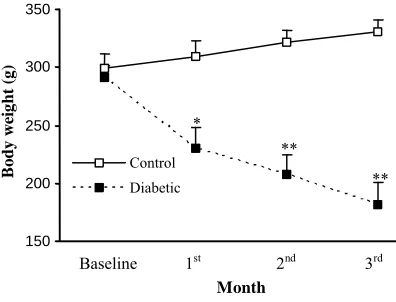
The body weight of the diabetic and normal rats was not different at the beginning of the study. After induction of diabetes, there was a marked significant reduction (as expected) in this parameter
in diabetic group after 1 (p<0.005), 2 and 3 months
(p<0.001) (Fig. 1). Regarding serum glucose level,
there was no significant difference between control and diabetic groups before the study. In addition, diabetic group showed a significant increase in serum glucose level at the end of months 1, 2, and 3
(p<0.001) (Fig. 2).
Fig. 1. Body weight of control and diabetic rats at different
months. *, p<0.005; **, p<0.001.
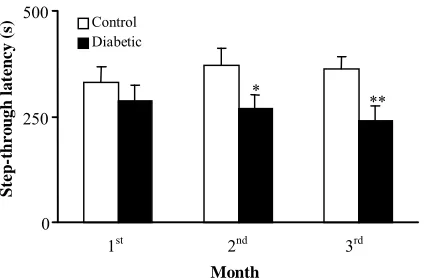
Effect of diabetes on acquisition and retention in passive avoidance test. Figures 3 and 4 show the
performance of control and diabetic rats in passive avoidance paradigm as indicated by initial and STL. The diabetic rats developed a significant impairment in acquisition and retention in passive avoidance test. In this respect, the mean IL which is indicative of acquisition in passive avoidance test showed a non-significant increase in diabetic group after diabetes of one-month duration. This parameter exhibited a significant increase after 2
(p<0.05) and 3 (p<0.01) months. Retention of
one-trial passive avoidance training was compared in diabetic and non-diabetic rats. Regarding STL which indicates retention, there was a significant
reduction in this parameter only after 2 (p<0.05)
and 3 months (p<0.01). Therefore, diabetes
markedly increased acquisition, and clearly decreased consolidation and recall of a passive avoidance response after 2 months.
Fig. 2. Serum glucose level of control and diabetic rats at
different months. *, p<0.001.
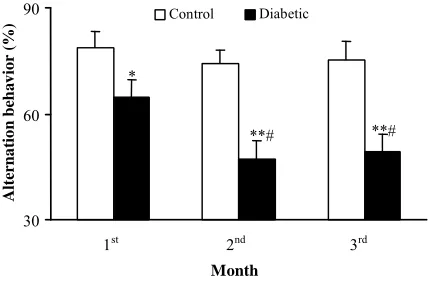
Alternation behavior in Y-maze. Figure 5 shows
the results for the Y-maze task, in which short-term spatial memory performance can be examined. There was no significant difference in the total number of times the animal entered an arm. However, the alternation score of the diabetic rats was lower than that of the control ones at the end of
1st(
p<0.05), 2nd (p<0.01), and 3rd (p<0.01) months
as compared to time-matched control group. Meanwhile, diabetic group at months 2 and 3 showed a significant reduction in alternation behavior as compared to diabetic group at the end
of one-month (p<0.05).
Fig. 3. Initial latency of control and diabetic rats at different months in single-trial passive avoidance test. *, p<0.05;
**, p<0.01.
DISCUSSION
The aim of this study was to determine time-dependent changes in passive avoidance and Y-maze performance in male diabetic rats. The results
0 40 80
1st 2nd 3rd
In
it
ia
l
la
te
n
cy
(
s)
Control Diabetic
Month
* **
0 250 500
1st 2nd 3rd
S
te
p
-t
h
ro
u
g
h
l
a
te
n
cy
(
s) Control Diabetic
Month
*
**
Fig. 4. Step-through latency of control and diabetic rats at different months in single-trial passive avoidance test. *, p<0.05; **, p<0.01.
clearly demonstrated that long-term diabetes is
accompanied with disturbances in animal
performance in passive avoidance and y-maze task. In this respect, diabetes duration should be more than 1 month to obtain a significant increase in IL and a significant decrease in STL in passive avoidance paradigm. In addition, alternation behavior as measured in Y-maze task significantly decreases, even following 1-month establishment of diabetes.
Previous studies have reported that DM is associated with neurological complications in both the PNS and CNS. Impairment of learning and memory is also recognized as a complication of diabetes [12]. Cognitive deficits in DM can result from metabolic impairment or cerebral vascular complications [1]. In animal models of DM, such as the STZ-diabetic rat, spatial learning impairments have also been reported. STZ-diabetic rats also display deficits in cognitive tasks, such as performance in the Morris water maze [4]. Although the pathogenesis of these deficits is multifactorial and controversial, there is strong evidence for the involvement of microvascular dysfunction and oxidative stress due to excess production of oxygen free radicals. In the latter case, since the mammalian hippocampus and cerebral cortex play a pivotal role in a diverse set of cognitive functions, such as novelty detection and memory, these areas are very vulnerable to oxidative damage in STZ-diabetic animals [13]. In agreement with this idea, it has been reported that lipid peroxidation enhances in both regions of the brain, which itself leads to a significant impairment in both motor and memory behavioral functions in diabetic animals [9]. On the other hand, previous studies in rats found that induction of diabetes
impairs LTP and enhances LTD induced by high frequency and low frequency stimulations, respectively. This could indicate that diabetes acts on synaptic plasticity through mechanisms involved in metaplasticity.
It is also known that LTP plays a crucial role in consolidation of memory. Persistent facilitation of LTD and inhibition of LTP may contribute to learning and memory impairments associated with DM [14]. Furthermore, STZ-induced diabetes in rats results in the altered function of N-methyl-D-Aspartate (NMDA) and Amino-hydroxy-propionic acid (AMPA) type glutamate receptors, which are implicated in learning and memory processes [6]. In this study, intensity of derangement in behavioral factors increased with time. In agreement with this finding, it has been found that the intensity of deficits of learning and memory may increase in the course of diabetes which is associated with intensification of pathological processes within the brain regions engaged in these processes [14]. Furthermore, locomotor and exploratory activity may have an influence on some behavioral tests including passive avoidance paradigm. In this regard, the number of entries, crossings and bar approaches was significantly lower in STZ-diabetic rats [11]. There are also some reports on the involvement of the cholinergic system abnormality in the impaired acquisition and/or retention of passive avoidance learning. In this respect, it has been postulated that the observed behavioral abnormalities consequent on an impairment of cerebral glucose metabolism may be suggestive of cholinergic dysfunction [15].
It has also been reported that the level of neurotrophic insulin-like growth factor (IGF) is reduced in diabetic patients and rodents. The latter data are consistent with a model in which brain IGF is essential for learning/memory processes, and a loss of IGF activity due to diabetes may contribute to cognitive disturbances [16]. Other findings postulate that STZ-induced diabetes impairs cognitive functions and causes an imbalance in the expression of neural cell adhesion molecules (NCAM) in those brain regions involved in learning and memory. Altered expression of NCAM in hippocampus may be an important cause of learning and memory deficits that occurs in DM [11]. From a biochemical viewpoint, cognitive impairment in DM has been associated with hippocampal apoptotic neuronal loss. In this respect, impaired insulinomimetic action by C-peptide plays a prominent role in cognitive dysfunction and hippocampal apoptosis in type 1 diabetes [17].
30 60 90
1st 2nd 3rd
A
lt
er
n
a
ti
o
n
b
eh
a
v
io
r
(%
) Control Diabetic
Month
**# *
**#
Fig. 5. Effect of diabetes of different durations (months) on alternation behavior in the Y-maze task.. *, p<0.05; **, p<0.01 (as compared to control); # , p<0.05 (as compared to one-month diabetics).
Furthermore, the expression of synaptophysin and neuropeptide Y in brain tissue of diabetic rats decreases [6, 18]. Finally, since neuronal nitric oxide synthase (nNOS) plays an important role in synaptic plasticity and learning and memory, decreased expression of nNOS mRNA and protein may contribute to deficits in hippocampal-dependent learning and memory in diabetic rats [13].
In the present study, the diabetic rats showed learning impairment in the Y-maze task, which is an indicator for the spontaneous alternation behavior. As shown in Figure 5, the score of alternation behavior of diabetic rats was significantly lower than that of the control. Other tasks to estimate the learning abilities of the diabetic rats have been previously attempted. Such tasks requested some kinds of motivations, e.g., food, water, or swimming [6]. Body weight, intake of food or water, and spontaneous motor activity of diabetic rats were significantly different from these of the control rats. The Y-maze task is a moderate task that does not require such motivations. Our finding that the alternation score of the diabetic rats was lower than that of control ones is an evidence of memory impairment in a diabetic animal model [19].
In conclusion, at least one month is strictly required for development of behavioral disturbances in passive avoidance and Y-maze tasks in STZ-diabetic rats. Further studies are warranted to investigate the detailed mechanisms that lead to these abnormalities.
ACKNOWLEDGEMENTS
This research study was supported by a grant from Research Council of University of Social Welfare and Rehabilitation (USWR, Tehran). The authors sincerely appreciate the sincere collaboration of Mrs. Sharayeli and Ms. Ansari (School of Medicine, Shahed University, Tehran).
REFERENCES
1. Feldman, E.L., Stevens, M.J. and Greene, D.A. (1997) Pathogenesis of diabetic neuropathy. Clin. Neurosci. 4: 365-370.
2. Greene, D.A., Stevens, M.J. and Feldman, E.L. (1999) Diabetic neuropathy: scope of the syndrome.
Am. J. Med. 30: 2S-8S.
3. Galer, B.S., Gianas, A. and Jensen, M.P. (2000) Painful diabetic polyneuropathy: epidemiology, pain description, and quality of life. Diabetes Res. Clin. Pract. 47: 123-128.
4. Ekstrom, P.A. and Tomlinson, D.R. (1990) Impaired nerve regeneration in streptozotocin-diabetic rats is improved by treatment with gangliosides. Exp. Neurol. 109: 200-203.
5. Heitner, J. and Dickson, D. (1997) Diabetics do not have increased Alzheimer type pathology compared with age-matched control subjects. A retrospective
postmortem immunocytochemical and
histofluorescent study. Neurology 49: 1306-1311.
6. Nitta, A., Murai, R., Suzuki, N., Ito, H., Nomoto, H., Katoh, G., Furukawa, Y. and Furukawa, S. (2002) Diabetic neuropathies in brain are induced by deficiency of BDNF. Neurotoxicol Teratol. 24: 695-701.
7. Biessels, G.J., Smale, S., Duis, S.E., Kamal, A. and Gispen, W.H.(2001) The effect of gamma-linolenic acid-alpha-lipoic acid on functional deficits in the peripheral and central nervous system of streptozotocin-diabetic rats. J. Neurol. Sci. 182: 99-106.
8. Popovic, M., Biessels, G.J., Isaacson, R.L. and Gispen, W.H. (2001) Learning and memory in streptozotocin-induced diabetic rats in a novel spatial/object discrimination task. Behav. Brain Res. 122: 201-207.
9. Parihar, M.S., Chaudhary, M., Shetty, R. and Hemnani, T. (2004) Susceptibility of hippocampus and cerebral cortex to oxidative damage in streptozotocin treated mice: prevention by extracts of Withania somnifera and Aloe vera. J. Clin. Neurosci. 11: 397-402.
10. Flood, J.F., Mooradian, A.D. and Morley, J.E. (1990) Characteristics of learning and memory in streptozocin-induced diabetic mice. Diabetes 39: 1391-1398.
11. Baydas, G., Nedzvetskii, V.S., Nerush, P.A., Kirichenko, S.V. and Yoldas, T. (2003) Altered expression of NCAM in hippocampus and cortex may underlie memory and learning deficits in rats with streptozotocin-induced diabetes mellitus. Life Sci. 73: 1907-1916.
12. Fernyhough, P., Diemel, L.T., Brewster, W.J. and Tomlinson, D.R. (1995) Altered neurotrophin mRNA levels in peripheral nerve and skeletal muscle of experimentally diabetic rats. J. Neurochem. 64: 1231-1237.
13. Reagan, L.P. and McEwen, B.S. (2002) Diabetes, but not stress, reduces neuronal nitric oxide synthase expression in rat hippocampus: implications for hippocampal synaptic plasticity. Neuroreport. 13:1801-1804.
14. Artola, A., Kamal, A., Ramakers, G.M., Biessels, G.J. and Gispen, W.H. (2005) Diabetes mellitus concomitantly facilitates the induction of long-term depression and inhibits that of long-term potentiation in hippocampus. Eur. J. Neurosci. 22: 169-178.
15. Jackson-Guilford, J., Leander, J.D. and Nisenbaum, L.K. (2000) The effect of streptozotocin-induced
diabetes on cell proliferation in the rat dentate gyrus.
Neurosci. Lett. 293: 91-94.
16. Lupien, S.B., Bluhm, E.J. and Ishii, D.N. (2003) Systemic insulin-like growth factor-I administration prevents cognitive impairment in diabetic rats, and brain IGF regulates learning/memory in normal adult rats. J. Neurosci. Res. 74: 512-523.
17. Sima, A.A. and Li, Z.G. (2005) The effect of C-peptide on cognitive dysfunction and hippocampal apoptosis in type 1 diabetic rats. Diabetes 54: 1497-1505.
18. Zhang, X.M., Han, S. and Zhou, L. (2004) The investigation of Syn and NPY expression in brain tissues of diabetic model rat induced by streptozotocin. Shi Yan Sheng Wu Xue Bao 37: 449-455.
19. Wioeniewski, K., Fedosiewicz-Wasiluk, M., Holy, Z.Z., Car, H. and Grzeda, E. (2003) Influence of NMDA, a potent agonist of glutamate receptors, on behavioral activity in 4-week streptozotocin-induced diabetic rats. Pol. J. Pharmacol. 55: 345-351.