www.astesj.com
Special issue on Advancement in Engineering Technology
A Joint Safety and Security Analysis of message protection
for CAN bus protocol
Luca Dariz*,1, Gianpiero Costantino2, Massimiliano Ruggeri1, Fabio Martinelli2
1CNR-IMAMOTER, Via Canal Bianco 28, Ferrara, Italy 2CNR-IIT, Via G. Moruzzi, 1, Pisa, Italy
A R T I C L E I N F O A B S T R A C T
Article history:
Received: 15 November, 2017 Accepted: 10 January, 2018 Online: 10 February, 2018 Keywords:
Automotive CAN bus
Security by design Security-properties Safety
One of the prominent challenges of the automotive-transportation sys-tem is represented by the integration of security and safety properties within protocols, applications and connectivity mechanisms. A joint safety/security design can sometimes expose to trade-offs, since their re-quirements may not match perfectly or even be incompatible. This pa-per analyses an example of security and safety design, by combining integrity with encryption considering the constraints of a typical CAN protocol and real-time traffic. The analysis is presented modelling diff er-ently attackers, packet fragmentation issues and the residual probability of error of the combined scheme.
1
Introduction
The common thought about cars is that they are me-chanical devices employed by passenger to move from a place to another. This is not true any more, or at least is not completely true since cars, or in general vehicles, in the last lustrum evolved to offer several services and connections that turn them into Cyber-Physical Systems (CPS) by the combination of sens-ing/actuation, processing, storing, and networking capabilities, as described by Fortino et al. [1]. Appli-cations, sensors, park and driving assistants are inte-grated into commercial vehicles and they are consid-ered standard features present in entry-level model of cars. Features, such as Internet connectivity, enlarge the attack surface of vehicles and, in particular, tra-ditional communication protocols developed to work on isolated environments could not maintain the same level of robustness when new variables are taken into account. This is especially true if one considers that connectivity itself can be provided in multiple hetero-geneous ways, which are not always predictable by the manufacturer anymore. For example, in [2], the au-thor proposed a connectivity solution based on smart-phones. On the other hand, practically all Electronic Control Units (ECUs) on a car are connected to one or more CAN busses, which is the traditional inter-face for intra-vehicle communications. The CAN bus use messages whose payload is at maximum 64bits
length, and depending on the payload set, it can en-able specific functionality of the vehicle, for instance enabling the accelerator of a car. The CAN bus pro-tocol was not designed to embed security properties such as: Authentication, Integrityand Confidentiality, and the security aspects are left to higher layers of the protocols-stack, for instance the application level. An example of attack on the CAN bus protocol is that per-formed on a Jeep Cherokee by Valasek and Miller in 2015 [3], where the authors showed how to hack and remotely control a Jeep Cherokee. This attack exploit a security flaw in theIn-vehicle Infotainment(IVI) sys-tem of the car to access the CAN bus network of the car. To fix this flaw, the Fiat Chrysler was forced to push a software update [4].
Security issues are a major challenge for connected vehicles, as reported in [5], and this is recognised also to have a relevant impact on vehicle’s safety [6]; it is clear that security and safety are fundamental in the design of an intelligent transportation system, es-pecially regarding the communication protocols and message protection schemes. It is important to note that the combination of safety and security issues is not exclusive of vehicular systems, but it affects the whole IoT world, especially systems which function-ality is considered critical (e.g. medical devices).
In this work, we propose a solution to turn the CAN bus protocol as aSecurity by Designprotocol by integrating authentication, integrity and
confidential-*Corresponding Author: Luca Dariz, CNR-IMAMOTER, Via Canal Bianco 28, Ferrara, Italy
ity properties. Our solution proposes the adoption of a Message Authentication Code (MAC), targeted for CAN bus messages, that is then encrypted with an ad-ditional key. The message created guarantees authen-tication and integrity through the MAC, and confiden-tiality with the additional encryption. Our defence strategy is studied to be applied against a model of attacker that runs both a Honest-But-Curious (HBC) or Fully Malicious attack strategy. Furthermore, our solution is evaluated from a safety point of view, in particular regarding the residual probability of error (Pre). This is necessary since the outcome of the secu-rity MAC i.e. accept or reject a particular message is a form of error detection which could reveal also trans-mission errors (e.g. caused by noise), and the message containing the MAC could bring safety-critical infor-mation. For example, this scheme could be applied to SAE J1939 Torque/Speed Control 1 message, which embeds a 4-bit checksum within the 8-byte CAN pay-load. The residual probability of error is first evalu-ated using an ideal block cipher model, then simula-tion results are presented for a specific implementa-tion choice. We show that averaging over the secret keys and over the possible messages, the value ofPre depends only on the length of the integrity tag used to decide whether the message is valid or not, and this isindependentfrom how the integrity tag is generated. On the other hand, we show how the worst case com-bination of key and message reduces massively the ability of this scheme to detect transmission errors, assuming a simplified channel model. The worst-case Pre is then simulated, with considerations on the dif-ficulty of finding the worst-case combination of key and message.
The main contributions of this paper is to analyse a message protection protocol from both a security and safety point of view, and highlight the trade-offs that result from the analysis. This paper is an extension of work originally presented inIEEE MT-ITS[7] and our contributions are summarized as follows:
• We improved the description of the analytical model for residual error probability by provid-ing more details on the error model, new expla-nation on the computation ofPreand analytical results;
• We expanded the security analysis and we better modelled the attacker;
• We improved the safety analysis giving more de-tails on the fragmentation and retransmission issues;
• We added more results and better described the analytical model depending on the statistical distribution of errors in the simple case of bi-nary symmetric channel;
• We redraw the plots with the simulation results, using colours, to be easier to understand. This paper is structured as follows: section 2 re-views the state of the art with regard to MAC algo-rithms and best practices, as well as error detection
mechanisms; section 3 presents the message protec-tion scheme discussed in this paper, discussing some design choices. In section 4, we introduce the attacker model and we make a security consideration on the MAC size. Section 5 exposes two aspects usually rele-vant for the safety of the system, that are packet frag-mentation and the probability of residual error Pre. Section 6 discusses other message protection schemes and their security and safety properties, compared to the scheme proposed here. Finally, section 7 con-cludes the paper with some motivation for future re-search directions.
2
Related Works
The following works refers to lightweight Message Authentication Code solutions for devices that have limited computational resources, like processors and memory. Chowdhury and Dasbit in [8] introduce
LMAC, a Lightweight Message Authentication Code (MAC) of 64bits dimension for Wireless Sensor Net-work that uses hash based symmetric key MAC. The authors show that LMAC is secure against passive and active attacks and it has a low overhead compared with other similar solutions. Another 64bits MAC, called Chaskey is presented by the authors of [9]. Chaskey uses 128bits key to generate a MAC which length is of 64bits or more. The authors say that Chaskey generates MAC that are suitable for 32bit Microcontroller and that it does not suffer of MAC truncation [10]. In [11] the authors show two ver-sions of lightweight MAC of 64 and 128bits called
TuLP-64andTuLP-128that are resources efficient and are though for body sensor networks. Then, in [12] the authors presented a lightweight MAC suitable for Smart Grid communications in which two devices reach mutual authentication by sharing a session key exchanged using Diffie-Hellman and a hash-based au-thentication code technique.
Regarding safety properties, such as the residual probability of error, Schiller and Mattes have analysed different ways of using nested CRC codes, for exam-ple in [13]. However, when it comes to cryptographic algorithms the kind of errors treated are related to se-curity properties and possible vulnerabilities, see for example the survey in [14]. To the best of our knowl-edge, an explicit model for the residual probability of error of a system using cryptographic algorithms has not been developed, although the statistical proper-ties of symmetric ciphers are sometimes studied in-depth, but always in the context of security, see for example [15].
3
Message protection scheme
is the authentication key. The combined µ||τ is then
encrypted to obtain the ciphertextc=EN C(k1, µ||τ),
wherek1 is theencryption key; the ciphertext is then
transmitted on the CAN bus. The receiver receivesc0, decrypts it and checks ifτ0 =H(k2, µ
0
), withµ0||τ0 =
DEC(k1, c 0
), to decide if the message is valid.
There can be some variations in this scheme; for example the integrity code can be appended to µto form the plaintext (also known as MAC-then-encrypt approach) withc=EN C(k1, µ||τ), or it can be excluded
from encryption (encrypt-then-MAC approach) with c =EN C(k1, µ)||τ. In both cases the MAC has to be
computed using the original message µ. Sometimes the MAC-then-encrypt approach is considered less secure, for example see [16], but in this paper the scheme has no padding and a fixed length of the mes-sage, so these considerations do not apply. Consid-ering the CAN bus, the first approach is more practi-cal since there exist encryption algorithms with 64-bit block size, equal to the maximum payload of a CAN message; in this case there is no need for additional data to perform the encryption, and the ciphertext is computed as c = EN C(k1, µ||τ). On the other hand,
if the plaintext is different from the block size (like in the encrypt-then-MAC approach), the cipher must be used in counter mode, or a stream cipher can be used. Either way, there needs to be additional infor-mation shared between the sender and the receiver, e.g. a nonce, to perform the encryption; in this case the ciphertext is computed asc=EN C(k1, I, µ)||τwith
I being the shared information.
Another variant is to avoid the use of two different shared keys and define the integrity code asτ=H(µ), whereH(·) is a hash function like SHA1 or an
error-detection code of the CRC family.
In this paper we consider only different possibil-ities for the integrity tag τ = H(µ), which can be a proper Message Authentication Code, a hash func-tion or a CRC; we do not consider then the encrypt-then-MAC approach, so we can define the plaintext m=µ||τ.
m
c=EN Ck(m)
ctx=encode(c)
m0
m0
=DECk(c0)
c0
=decode(crx)
Etx
Encryption layer
Channel coding
Transmission channel
Pok+Pre
Pch ok+Prech
Pe
Pch e
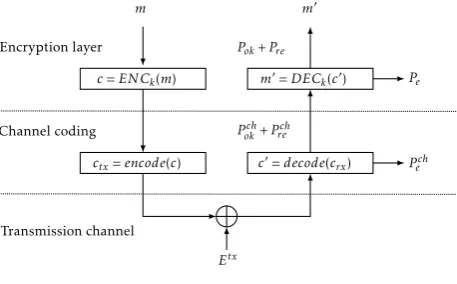
Figure 1: Message protection scheme.
4
Security considerations
When cars were not connected to the Internet, the attack surface was limited to local entry points that could make cars vulnerable to security attacks. Since connectivity has been embedded as feature inside cars, the attack surface is increased and it is not lim-ited to local attacks, but also remote ones make a ve-hicle more vulnerable. This provides a higher impact to the security and safety of cars’ passengers, and in addition, gives to attackers more and more kinds of attacks that they are able to exploit.
When, we talk about to local attacks, we refer to physical inputs to the vehicle that can be represented, for instance, by the auxiliary jack of the CD-Rom, USB ports, and the ODB2 connector. All these physical connectors require that an attacker has the opportu-nity to access the car and manipulate or alter the in-put to perform its attack. This, however, is possible but the impact is limited and less transparent to pas-senger. On the other side, remote attacks made on the wireless inputs enlarge the attack surface and may make attacks more relevant. Wireless inputs can be: the Bluetooth, Wi-Fi and cellular connections. In par-ticular, exploiting the cellular connection, it would be possible to remotely access the In-vehicle infotain-ment (IVI) system of a car, and from that reading and writing into the CAN bus [3]. In fact, the IVI system are consoles that often run an operating system such as Windows CE, Linux, and may even run Android. So, attackers may exploit known vulnerabilities of un-patched version of those operating systems to perform their attacks. On this scenario, the Key Reinstallation Attacks (KRACKs) [17] has demonstrated that a vul-nerability in the WPA2 protocol could allow “attack-ers to use this novel attack technique to read information that was previously assumed to be safely encrypted. This can be abused to steal sensitive information such as credit card numbers, passwords, chat messages, emails, photos, and so on1.”. Thus, using KRACKs and exploiting an unpatched version of the Wi-FI provided by the IVI, an attacker could jump in the car’s network getting sensitive information, and using that access as gate-way to force and get in the CAN bus network of the vehicle.
4.1
Attacker Model
In this paper, we analyse the CAN protocol from the security and safety point of views. In particular, this section aims at modelling attackers, defining which are the attacks that they may exploit.
In the modelling phase, we consider that attack-ers may have local or remote access to the vehicle to compromise the CAN bus by forging or altering mes-sages that may be considered valid by recipients. For instance, attackers may be able to exploit a weakness of the authentication module to remotely access the CAN bus network using a classic IP connection, and
once inside the vehicle, they forge valid message or even altering their contents.
To minimize the power of attackers, our defence strategy foresees that more attackers are not able to forge valid messages, keeping enabled confidentiality of proper messages generated. Also, we aim at iden-tifying messages that were altered, i.e., losing of in-tegrity. Thus, our defence strategy is based on three security properties that are:
Authentication: A recipient should be able to verify whether a message is sent by a legitimate sender;
Integrity: A recipient should be able to verify whether a message has been altered during its transmission;
Confidentiality: it guarantees that the content of a message is not revealed to an illegitimate entity, as it can happen with the Man-in-the-Middle (MITM) attack;
We apply our defence strategy against attackers who can play the following roles:
Honest-but-Curious (HBC): Also known as Passive Attack; an attacker may exploit the information legitimately gleaned by capturing messages ex-changed over the CAN bus network, but he/she will not perform any malicious activity to har-vest it.
Fully Malicious (FM): Also known as Active Attack; an attacker is able to forge or alter messages that are considered valid, after a verification step, by the recipient. So, the attacker strategy is to suc-ceed in at least one of the following attacks:
• Impersonationattack: the attacker is able to assume the identity of one of the legitimate parties;
• Guessingattack: the attacker is able to forge a valid MAC after a number of trials. • Replayattack: the attacker is able to re-use
valid messages with a malicious or fraudu-lent aim;
• Sniffingattack: the attacker is able to read the content of any messages exchanged through the CAN bus network:
In Table 1, we combine the defence strategy to each attack presented above aiming at blocking or mitigat-ing the correspondmitigat-ing attack.
4.2
Security considerations on encrypted
MAC and MAC size
We introduced the Message Authentication Code in the CAN-message payloads to provide by-design au-thenticationandintegrityproperties. At the same time, by encryptingµ||τ, we added theconfidentiality
prop-erty in messages to avoid that an attacker sniffs con-tent messages exchanged among ECUs. However,
even not considering encryption on messages, but even only the first two properties, an attacker is ca-pable to sniff messages, but she will not easily forge valid messages due to the MAC. With encryption, the attacker’s knowledge is still minor, and the probabil-ity to forge a valid message is linked to the guessing attackplus the encryption ofµ||τ.
Dworkin in [18] points out the importance of choosing a robust MAC to be resistant against the guessing attack. In particular, Dworkin explains that a sound MAC is provided with a size greater than 64bits, i.e.,τsize≥64-bits. However, due to the stan-dard CAN bus payload restriction, i.e., 64bit in total, it is very hard to keep that inequality true and we need a workaround to guarantee the security proper-ties with a specific level of risk. Thus, the workaround can be implemented through two different strategies: i) concatenating a MAC which size is at least 64-bit, or ii) limiting the number of repeated trials of an at-tacker before considering invalid the key that gener-ates the MAC. The first solution may cause the frag-mentation issue that we detail better in §5.1. In-stead, the second solution can be the best candidate for our workaround onτsize. To this purpose, in [18], Dworkin illustrates how to calculate the rightτsize de-pending on the following two bounds:
MaxInvalids: as the limit on the number of trials that an attacker can perform before the key is retired;
Risk: the highest acceptable probability for an inau-thentic message to be accepted as valid;
Then, due the above parameters, the τsize should satisfy the following inequality:
τsize≥lg(
MaxInvalids
Risk ). (1)
Our goal is to satisfy the inequality 1 with a value ofτsize that is greater than or equal to 16. From in-equality 1, the system can tolerate up to 30 (25) mes-sages before considering the key invalid, and the sys-tem can accept 2−11, i.e., Risk= 2048, chance of in-authentic messages. So, considering that the payload-size of a CAN-message is generically 48bits (µsize) and the maximum bandwidth of the communication chan-nel is 64bit (bandwidthmax), we obtain that µsize +
τsize ≤ bandwidthmax. The inequality 1 defines that
the lowest condition to have a µ||τ message for the
CAN bus protocol is to have MaxInvalids = 25 and Risk= 2048.
5
Safety considerations
5.1
Fragmentation
Attack Description Defence
Impersonation Generating messages being identified as legitimate party Authentication
Guessing Forging or altering messages that are valid by the recipient Confidentiality, Authentication, Integrity Replay Re-use messages that are considered valid by the recipient Authentication
Sniffing Read content of messages Confidentiality
Table 1: Summary of attack and defence strategies.
purposes) is not acceptable since it introduce unnec-essary latency in the complete reception of a message; this is mainly due to the low speed of CAN bus, which is typically 250 kB/s on vehicular networks, and can reach the maximum of 1 MB/s. Another reason is the increase of residual error rate in the communica-tion (see for example the appendix D.5.2 of ISO 15998 [19]); however, this increase could be tolerated more easily since, to a first approximation, thePreof a two-message scheme is roughly the double of thePre of a single message. With these limitations, common ap-plication requirements allow for a rather limited se-curity level achievable without changing the network communication protocol stack, and is fundamentally due, for a point-to-point communications, to the lim-ited payload length of a single CAN 2.0 bus message. The use of CAN-FD could relax these limitations, but even in this case the maximum payload length is 64 bytes.
5.2
Retransmissions
In order to tolerate packet loss, communication pro-tocols usually employ some form of re-transmission handling. Basically this means that if an error is de-tected on the packet, or if a timeout for packet re-ception expires, the transmitter sends again the same packet. Different variants of ARQ schemes (Auto-matic Repeat reQuest) exist, but the essential princi-ple is that a data packet is sent more than one time without modifications. While this feature is usually handled transparently at link or transport layer, it is a potential security vulnerability, since an attacker could either inject errors or transmit duplicated pack-ets to perform a replay attack (§4.1). Similar attacks are not hypothetical but have been demonstrated in reality, one of the most recent examples being the key reinstallation attack against WPA2 [17]. It is then desirable to handle retransmissions at the applica-tion level, if any, so sensitive security informaapplica-tion like nonces, which must be used exactly one time, are han-dled properly. It is also worth considering that frag-mentation makes retransmissions more complicated to handle efficiently, since here a small portion of a packet can be lost.
5.3
Probability of Residual Error
The analysis of the probability of residual errorPrein a communication protocol is usually a difficult task. In order to simplify the model, it is assumed that the channel coding is independent from the encryption scheme and it is possible to obtain a measure ofPrefor
channel coding, which correspond toPch
re with refer-ence to Figure 1. In this way, it is possible to focus only on the performance of the message protection scheme discussed in this paper. HerePreis obtained assuming Shannon’s ideal cipher model, which has been used in other works like [20], and the results are compared with simulations where real algorithms are used for encryption and integrity.
5.3.1 Error model
According to Shannon’s model, an ideal cipher is a random family of permutations, chosen indepen-dently for each possible key. More precisely, suppose
Kis the set of all keys andMis the set of all messages.
An ideal block cipher is a mapEN C :K × M → M
where, for each key k ∈ K, the encryption function
EN Ck(·) =EN C(k,·) is a random permutation on the message set M(independent of any other
permuta-tion). The same considerations apply to the decryp-tion funcdecryp-tionDECk(·) =DEC(k,·), which being the in-verse of a random permutation is itself a random per-mutation.
In this context, it is more useful to fix a specific pair (k, m) of key and message, and consider the ci-pher text message set as:
C0={c0:c0=c+e0, e0∈ E0} (2)
while the plain text message set is:
M0={m0:m0=m+e, e∈ E } (3)
where the setE0is the set of all possible undetected
er-ror vectors after channel decoding and before decryp-tion, andEis the set of all error vectors after
decryp-tion. The addition here correspond to a bitwise XOR. While the elements ofE0 correspond basically to
un-detected transmission errors, the elements ofEcan be
seen as undetected transmission errors transformed by the decryption function. For this reason, the distri-bution of the values inEdepends on the distribution
ofE0
, in a different way for each different pair (k, m), since the functionE(k,·) will correspond to a different
and independent permutation. The relation between
E0 andE is then of the formEN C :K × M × E0 → E
which can be rewritten as the mapEN C(k,m):E 0→ E
identified by a specific pair of values (k, m). The ex-plicit form can be derived from Figure 1 as
e=EN C(k,m)(e 0
) =DEC(k, c0) (4)
=DEC(k, c+e0) (5)
BeingEN C(k,·) andDEC(k,·) random permutations,
equation 6 represent a random map from E0 to E.
Each pair (k, m) correspond then to a different map EN C(k,m), independent from other maps. This means
that each error vector e0 on the transmission chan-nel correspond to a random error vector e after de-cryption. Assuming that the pair (k, m) is chosen uni-formly from the setK×M, the random error vectoreis
itself uniformly distributed. In practice, the relation betweeneande0is highly non-linear, since it strongly depends on the EN C and DEC functions, which in real block ciphers are usually highly non-linear func-tions themselves. This means that the approximation of uniform distribution ofe, for any givene0
and vary-ing (k, m), is accurate as long as these conditions ap-ply:
1. the real block cipher approximates a random permutation;
2. the messages inMare uniformly distributed;
3. the keys inKare uniformly distributed.
Condition 1 is itself an important security prop-erty, as shown for example in [21]. Condition 2 can be false depending on the context; for example, in a closed industrial control network the message set is usually limited; furthermore, messages in M can
include integrity checks (as in the scheme discussed here) which alter the distribution of the plaintext. Condition 3 is another important security property, although some block ciphers haveweak keys(e.g. DES and Blowfish). These conditions can be relaxed to having either the messages or the key uniformly dis-tributed, provided that condition 1 still apply.
5.3.2 Computation ofPre
In this section, we assume these conditions are sat-isfied. Given that, as shown in section 3, the origi-nal message ism=µ||τ, and the received message is
m0
=µ0||
τ0
, the probability of residual error can be de-fined as the joint probability
Pre=P(µ,µ0, τ0=H(µ0)) (7)
which correspond to the probability of having a cor-rect integrity tag (τ0=H(µ0)) but the decoded message is different from the original (µ,µ0) due to transmis-sion errors. Considering that EN C(k,m) is a random
map, each element ofC0can correspond to all the
pos-sible values ofM0. If the elements ofC0are uniformly
distributed (such as when considering a random mes-sage attack) the probability thatτ0 =H(µ0), averaged over all the possible (k, m), can be computed by count-ing as
Pavg(τ0=H(µ0)) = 2
µsize
2µsize+τsize = 1
2τsize (8) which is the probability of guessing a valid message. On the other hand, when transmission errors are con-sidered, only one of the elements ofC0 correspond to
the correct message, while all other elements have cu-mulative probabilityPrech. The residual probability of error in this case can be computed as
Preavg=Prech
2µsize−1
2µsize+τsize−1≈
Pch re
2τsize. (9) Both equations 8 and 9 are valid without making any assumption on the actual algorithmHused for com-putingτ.
This measure ofPreis, however, a measure for the average case, while from the safety point of view it is necessary to consider the worst case, that is:
Prewc= max k∈K
m∈M
Pre (10)
This again can be computed by counting, but this time the actual distribution ofE, given by transmission
er-rors, must be considered, specifically the one which maximise equation 10, which correspond to the worst-case pair (kwc, mwc). Using the ideal cipher model, the distribution inE can be obtained from a
permu-tation of the distribution in E0, so a simpler way to
computePwc
re is to take the 2µsize−1 error vectors ofE
0
with higher probabilityPe0and sum their probability.
Clearly, the upper bound for the variousEis
Prewc≤Pch
re (11)
where equality would mean that the encryption pro-cedure, even with an integrity check, is not effective at all in detecting transmission errors when (kwc, mwc) are used, because the relevant transmission errorse cause the plaintext to have an non-correctable error. More specifically, this correspond to the case where the 2µsize−1 most probable error vectors inE cover
practically the whole amount ofPrech. The fact that this is independent from the particular algorithmHis be-cause of the random map; in other words it is impos-sible to design an efficient integrity algorithm for this scheme as the distribution of e can not be known a priori.
This consideration exposes the trade-off between safety (as related to protection against random er-rors) and security (as related to protection against a malicious adversary). In the first case the statistical distribution of transmission errors is usually concen-trated on a restricted set of values, and error detec-tion codes are designed to detect the most probable errors, achieving a very high detection rate. On the other hand, if a malicious adversary is considered, all error patterns must be distributed ideally uniformly, otherwise an attacker may exploit its statistical char-acteristics.
5.3.3 Analytical results
To illustrate this problem, we consider a simplified model with a binomial distribution E0 ∼
of each error vector e0l with l bit set (note that must
be l > 0); this list is then sorted incrementally and
then the first values are taken, one error vector at a time, until exactly 2µsize−1 error vectors are chosen.
As shown in figure 2, where the worst-case residual probability of error is computed with the algorithm exposed above for different values ofp in a binomial distribution, the value ofPre rapidly increases as the distribution of errors is more concentrated. Hereτsize is fixed to 64 bytes; similar results are obtained for different values. In figure 3 instead, µsize is fixed to 256 bits and the worst-case Pre is plotted, and here the effect of the concentration of error distribution is also visible with effects similar to figure 2. This al-gorithm can be extended to the case where channel coding allows approximating the residual error distri-bution, for example if a CRC with a known minimum hamming distanceHCRC is used (some examples are available from the work of Koopman, see [22], for dif-ferent payload lengths). In this case, the error vectors
el withl < HCRCare not considered since they are
de-tected by channel coding. However if channel cod-ing include other information in the CRC (such as the length of the data payload) this approximation must be further refined.
10−20 10−15 10−10 10−5 10+0
0 200 400 600 800 1000
p= 0.5
p= 0.4
p=
0.3
p=
0.2
p= 0.1
p= 0.01
P
w
c
re
/P
ch re
µsize
Figure 2: Normalised worst-casePreobtained through computation, for different values ofp. τsizeis fixed to 64 bytes.
10−10 10−8 10−6 10−4 10−2 10+0
0 50 100 150 200 250
p
= 0. 5
p
= 0. 3
p
= 0. 2
p= 0.1
P
w
c
re
/P
ch re
τsize
Figure 3: Normalised worst-casePreobtained through computation, for different values ofp.µsizeis fixed to 256 bytes.
5.3.4 Simulation results
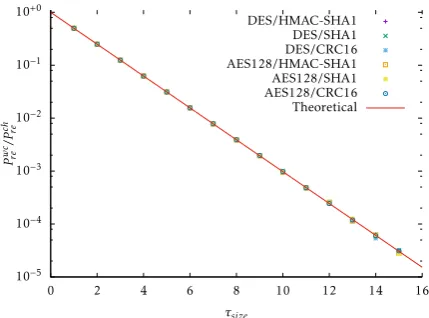
The simulations have been performed applying the encryption scheme to randomly selected (k, m) and us-ing different error vectors to obtain an approximation ofPre. For theEN C cipher, DES and AES have been used, while for H we used CRC, a truncated SHA1 hash function and a truncated HMAC scheme based on SHA1. The simulation have been implemented as a C++ program using the Nettle v2.7.1 cryptographic library. The simulations were run on a Intel i7 8-core laptop with 8 GB RAM; for each pair (k, m) a num-ber of error patterns e0 are generated, with the re-spective probability, and the normalised output Pre is computed as the ratio between the erroneous mes-sages that resulted inτ =H(µ) and the total number of erroneous messages. The plotted results represent a normalised Pre
Pch
re, where the value of 1 represent equal-ity in equation 11. The value of τsize varies from 0 to 16; greater values, which in theory correspond to a lowerPre, have not been simulated since they would have taken too much time to yield a result with rea-sonable precision; however the results are still mean-ingful with respect to the theoretical model. The com-plexity of the simulation has three factors:k,mande0. For example, using 1000 different keys, 1000 different messages and 10000 error patterns the total number of iterations is 1000·1000·10000 = 1010. However
each value of Pre is evaluated using 10000 samples, so lower values close to 10−4
will have a lower accu-racy. This explains the convenience to simulate with lowτsize.
10−5 10−4 10−3 10−2 10−1 10+0
0 2 4 6 8 10 12 14 16
P
w
c
re
/P
ch re
τsize
DES/HMAC-SHA1 DES/SHA1 DES/CRC16 AES128/HMAC-SHA1 AES128/SHA1 AES128/CRC16 Theoretical
Figure 4: Normalised average Pre obtained through simulation and from equation 9, for different values ofτsize.
av-eraged over the pairs (k, m).
In Figure 5 and 6 the normalised Prewc is plotted with varying τsize. The numerical values, displayed with a continuous line, are evaluated with the algo-rithm described in section 5.3.2, while the simulation results are taken as the highest value ofPreamong all tested (k, m). In this case the simulations do not match the theoretical model; the reason is that while the the-oretical model assumes that (kwc, mwc) is known, in practice this is not true, although for some ciphers it could be feasible to calculate it. In this case a great number of (k, m) combinations are randomly chosen and the worst case is considered. However, being un-able to scan all the (k, m) space, it is unlikely to find the worst case but only a ”bad“ pair (k, m) is found, for whichPrediffer significantly from the average case.
10−5 10−4 10−3 10−2 10−1 10+0
0 2 4 6 8 10 12 14 16
sim p=
0.3
sim p= 0 .1
cal c p=
0.3
calc p= 0.1
P
w
c
re
/P
ch re
τsize
Figure 5: Normalised worst-case Pre obtained with
E0 ∼B(n, k, p) through calculation and simulation
us-ing a DES/SHA1 scheme, with µsize+τsize = 64, for different values ofτsize.
10−3 10−2 10−1 10+0
0 2 4 6 8 10 12 14 16
sim p= 10−3
sim p= 10−4
calc p= 10−3and10−4
P
w
c
re
/P
ch re
τsize
Figure 6: Normalised worst-case Pre obtained with
E0 ∼B(n, k, p) through calculation and simulation
us-ing a DES/SHA1 scheme, with µsize+τsize = 64, for different values ofτsize.
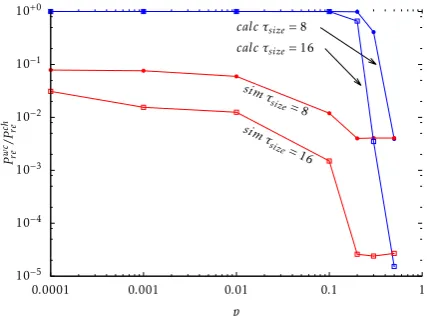
In Figure 7 and 8 the normalised Prewc is plotted with varyingp. For low values ofp, the value ofPrewc does not change a lot, since the most probable error
patterns are always the ones with 1 bit error. On the other hand, with higherpthe value ofPrewcapproaches Preavg, which is reached withp= 0.5, corresponding to a uniform distribution. The issue of finding the worst case (k, m) is then different depending on the bit er-ror probability ofB(n, k, p). For lowp, approximately under 0.1, it is easier to find a pair (k, m) with high Presince the most probable error patterns are the ones with only 1 bit error and are exactlyµsize+τsize. On the other hand, for higherp, the most probable error patterns are a much great number, because it is eas-ier to find more than one bit error. This explains the difficulty of finding the pair (kwc, mwc) to simulatePwc re accurately.
10−2 10−1 10+0
0.0001 0.001 0.01 0.1 1
simτ
size= 4
calc τsize= 4
P
w
c
re
/P
ch re
p
Figure 7: Normalised worst-case Pre obtained with
E0 ∼B(n, k, p) through calculation and simulation
us-ing a DES/SHA1 scheme, with µsize+τsize = 64, for different values ofp.
10−5 10−4 10−3 10−2 10−1 10+0
0.0001 0.001 0.01 0.1 1
simτ
size= 8
simτ
size= 16
calc τsize= 8
calc τsize= 16
P
w
c
re
/P
ch re
p
Figure 8: Normalised worst-case Pre obtained with
E0 ∼B(n, k, p) through calculation and simulation
us-ing a DES/SHA1 scheme, with µsize+τsize = 64, for different values ofp.
6
Discussion
Scheme Resists to Security properties Leaking out Safety properties
ENC + MAC Fully Malicious with chosen plaintext
Confidentiality Authentication
Integrity
- Strongly depends on (k, m)
ENC + CRC Fully Malicious with chosen plaintext
Confidentiality
Integrity - Strongly depends on (k, m)
plain + MAC Fully Malicious Authentication Integrity
Plaintext to FM
and HBC attackers Depends onH()
plain + CRC Honest-But-Curious - Plaintext to FM and HBC attackers
Good under common channel assumption [13]
plain - - Plaintext to FM
and HBC attackers
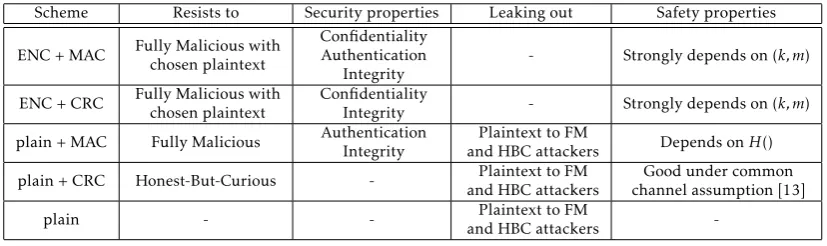
-Table 2: Summary of message protection schemes.
in this paper correspond to the ENC+MAC and ENC+CRC schemes, depending on the choice ofH(), to resist a fully malicious attacker with chosen plain-text. The main alternative scheme, which does not consider the Confidentiality property, is evaluated for reference, based on literature work. Here the trade-offappears clear comparing the ENC+CRC and plain+CRC scheme; while the first has better secu-rity properties, the latter has better safety properties under common channel models, because CRC codes are designed specifically for correcting transmission errors.
7
Conclusion
In this paper, we have presented an analysis showing that a security property, like encryption, directly in-fluences the probability of residual error, which is a safety property. On the other hand, the restricted size of the CAN bus payload forces the length of a MAC code to respect the fragmentation constraints which can be imposed by real-time requirements. With re-spect to similar schemes without encryption, by us-ing a second CRC in addition to that one at the physi-cal layer, the combinationENC+CRCperforms worse; this is due to the intrinsic properties of block ciphers, which transform the distribution of errors to uniform on average. Other message protection schemes could have a less drastic impact on the worst-case error de-tection capability, or even this error dede-tection capabil-ity could be embedded into the encryption algorithm itself, but then the risk is to offer the possibility for a side-channel attack.
Future works include the design and study of dif-ferent message protection schemes, to offer a better trade-offbetween safety and security, for example im-proving the performance of the integrity tag τ with respect to transmission errors. Additionally, an exper-imental testbed on a real CAN bus would be useful to assess the performance of the protocol.
Conflict of Interest The authors declare no conflict of interest.
Acknowledgement This work has been partially supported by the GAUSS (MIUR, PRIN 2015) and by
the H2020 EU funded NeCS (GA 675320).
References
[1] G. Fortino, A. Rovella, W. Russo, C. Savaglio, “On the Classification of Cyberphysical Smart Objects in the Internet of Things” inProceedings of the 5th International Workshop on Networks of Cooperating Objects for Smart Cities (UBICITEC 2014), Berlin, Germany, Apr 14, 2014, pp. 86-94.
[2] G. Aloi, G. Caliciuri, G. Fortino, R. Gravina, P. Pace, W. Russo, C. Savaglio, “Enabling IoT interoperability through opportunistic smartphone-based mobile gateways” inJournal of Network and Computer Applications, Volume 81, 2017, Pages 74-84. https://doi.org/10.1016/j.jnca.2016.10.013
[3] C. Valasek and C. Miller, “Remote Exploitation of an Unal-tered Passenger Vehicle” inDEFCON 23, 2015.
[4] A. Greenberg, “After jeep hack, chrysler recalls 1.4m vehicles for bug fix,” Online, Jul 2015. [Online]. Avail-able: https://www.wired.com/2015/07/jeep-hack-chrysler-recalls-1-4m-vehicles-bug-fix/
[5] B. McCluskey, “Connected cars: the security challenge for autonomous vehicles,” IET Engineering and Tech-nology Magazine, Feb 2017. [Online]. Available: https: //eandt.theiet.org/content/articles/2017/02/connected-cars-the-security-challenge-for-autonomous-vehicles/ [6] C. Kim, “Safety challenges for connected cars,” IEEE
Transportation Electrification Newsletter, Jun 2016. [Online]. Available: http://tec.ieee.org/newsletter/june-2016/safety-challenges-for-connected-cars
[7] L. Dariz, M. Selvatici, M. Ruggeri, G. Costantino, and F. Martinelli, “Trade-off analysis of safety and secu-rity in CAN bus communication,” in 5th IEEE In-ternational Conference on Models and Technologies for Intelligent Transportation Systems, MT-ITS 2017, Naples, Italy, June 26-28, 2017, pp. 226–231. [Online]. Available: https://doi.org/10.1109/MTITS.2017.8005670
[8] A. R. Chowdhury and S. DasBit, “Lmac: A lightweight mes-sage authentication code for wireless sensor network,” in2015 IEEE Global Communications Conference (GLOBECOM), Dec 2015, pp. 1–6. [Online]. Available: https://doi.org/10.1109/ GLOCOM.2015.7417118
[9] N. Mouha, B. Mennink, A. Van Herrewege, D. Watanabe, B. Preneel, and I. Verbauwhede,Chaskey: An Efficient MAC Algorithm for 32-bit Microcontrollers. Cham: Springer Inter-national Publishing, 2014, pp. 306–323. [Online]. Available: http://dx.doi.org/10.1007/978-3-319-13051-4 19
[10] N. Ferguson, “Authentication weaknesses in gcm,” Comments submitted to NIST Modes of Operation Process, May 2005. [11] Z. Gong, P. Hartel, S. Nikova, S.-H. Tang, and B. Zhu, “Tulp:
[12] M. M. Fouda, Z. M. Fadlullah, N. Kato, R. Lu, and X. S. Shen, “A lightweight message authentication scheme for smart grid communications,” IEEE Transactions on Smart Grid, vol. 2, no. 4, pp. 675–685, Dec 2011. [Online]. Available: http://dx.doi.org/10.1109/TSG.2011.2160661
[13] F. Schiller and T. Mattes, “Analysis of nested crc with addi-tional net data by means of stochastic automata for safety-critical communication,” in2008 IEEE International Workshop on Factory Communication Systems, May 2008, pp. 295–304. [Online]. Available: http://dx.doi.org/10.1109/WFCS.2008. 4638714
[14] A. Barenghi, L. Breveglieri, I. Koren, and D. Naccache, “Fault injection attacks on cryptographic devices: Theory, prac-tice, and countermeasures,”Proceedings of the IEEE, vol. 100, no. 11, pp. 3056–3076, Nov 2012. [Online]. Available: http: //dx.doi.org/10.1109/JPROC.2012.2188769
[15] A. Rimoldi, “On algebraic and statistical properties of aes-like ciphers,” Ph.D. dissertation, University of Trento, 2010. [Online]. Available: http://eprints-phd.biblio.unitn.it/151/ [16] S. Vaudenay, “Security flaws induced by cbc padding
- applications to ssl, ipsec, wtls ...” in Proceed-ings of the International Conference on the Theory and Applications of Cryptographic Techniques: Advances in Cryptology, ser. EUROCRYPT ’02. London, UK, UK: Springer-Verlag, 2002, pp. 534–546. [Online]. Available: http://dl.acm.org/citation.cfm?id=647087.715705
[17] M. Vanhoef and F. Piessens, “Key reinstallation attacks: Forcing nonce reuse in WPA2,” in Proceedings of the ACM SIGSAC Conference on Computer and Communications Security (CCS). ACM Press, Nov. 2017, pp. 1313–1328. [Online]. Available: http://dx.doi.org/10.1145/3133956.3134027
[18] M. Dworkin, “Recommendation for block cipher modes of op-eration: The cmac mode for authentication,” NIST Special Publication 800-38B, May 2005.
[19] ISO, “Earth-moving machinery - machine-control systems (mcs) using electronic components - performance criteria and tests for functional safety,” The International Organization for Standardization, Gen`eve, Switzerland, Tech. Rep. ISO 15998, 2008.
[20] C. Petit, F.-X. Standaert, O. Pereira, T. G. Malkin, and M. Yung, “A block cipher based pseudo random number generator secure against side-channel key recovery,” in Proceedings of the 2008 ACM Symposium on Information, Com-puter and Communications Security, ser. ASIACCS ’08. New York, NY, USA: ACM, 2008, pp. 56–65. [Online]. Available: http://doi.acm.org/10.1145/1368310.1368322
[21] L. Grassi, “New approaches for distinguishers and attacks on round-reduced aes,” Cryptology ePrint Archive, Report 2017/832, 2017, http://eprint.iacr.org/2017/832.