REVIEW
Zebrafish: a vertebrate tool for studying
basal body biogenesis, structure, and function
Ryan A. Marshall and Daniel P. S. Osborn
*Abstract
Understanding the role of basal bodies (BBs) during development and disease has been largely overshadowed by
research into the function of the cilium. Although these two organelles are closely associated, they have specific roles
to complete for successful cellular development. Appropriate development and function of the BB are
fundamen-tal for cilia function. Indeed, there are a growing number of human genetic diseases affecting ciliary development,
known collectively as the ciliopathies. Accumulating evidence suggests that BBs establish cell polarity, direct
ciliogen-esis, and provide docking sites for proteins required within the ciliary axoneme. Major contributions to our knowledge
of BB structure and function have been provided by studies in flagellated or ciliated unicellular eukaryotic organisms,
specifically
Tetrahymena
and
Chlamydomonas.
Reproducing these and other findings in vertebrates has required
animal in vivo models. Zebrafish have fast become one of the primary organisms of choice for modeling vertebrate
functional genetics. Rapid ex-utero development, proficient egg laying, ease of genetic manipulation, and
affordabil-ity make zebrafish an attractive vertebrate research tool. Furthermore, zebrafish share over 80 % of disease causing
genes with humans. In this article, we discuss the merits of using zebrafish to study BB functional genetics, review
current knowledge of zebrafish BB ultrastructure and mechanisms of function, and consider the outlook for future
zebrafish-based BB studies.
Keywords:
Zebrafish, Basal bodies, Crispr, Centriole duplication, Ultrastructure, Ciliopathies
© 2016 Marshall and Osborn. This article is distributed under the terms of the Creative Commons Attribution 4.0 International License (http://creativecommons.org/licenses/by/4.0/), which permits unrestricted use, distribution, and reproduction in any medium, provided you give appropriate credit to the original author(s) and the source, provide a link to the Creative Commons license, and indicate if changes were made. The Creative Commons Public Domain Dedication waiver (http://creativecommons. org/publicdomain/zero/1.0/) applies to the data made available in this article, unless otherwise stated.
Body of the primer
Zebrafish (Danio rerio):
what is the basic phylogeny of this
organism?
The zebrafish has been employed to study not only
ver-tebrate development, genetics, and disease but, due to
the comprehensive genomic annotation, has also helped
answer questions of evolutionary diversity and phylogeny
[1]. In short, zebrafish (
Danio rerio
), exhibit a toothless
jaw that classifies them under the Cyprinidae family, with
other members including carp, barbs, and minnows [2].
The Cyprinids themselves fall under the order of
Cyprini-formes
, a large and diverse grouping of ray-finned (class:
Actinopterygii
)
bony freshwater fishes [3]. The presence
of a swim bladder for buoyancy, moveable jaw, and
sym-metrical caudal fin classifies zebrafish under the
sub-division (or infraclass) of
Teleostei.
There are currently
approximately 26,840 species of Teleosts that represent
96 % of all living fish species spread across 40 orders, 448
families, and 4278 genera [4]. The successful
evolution-ary advance of Teleost fishes has been attributed to the
occurrence of a whole genome duplication (WGD) that
appeared early in the evolution of ray-finned fish, during
the divergence from the lobe-finned fish, some 320–400
million years ago [5, 6]. It is generally accepted that WGD
created new evolutionary opportunity by increasing
gene number without affecting gene dosage [6].
Conse-quently, WGD allowed for the introduction of new loci
with potentially advantageous functions, accounting for
genetic redundancy. Whilst WGD created an expansion
of genetic material and permitted leaps in evolutionary
advancement, it has complicated analyses of gene
func-tion and phylogeny, especially in the context of human
disease. Indeed, zebrafish possess at least one orthologue
of approximately 70 % of all human genes (roughly 40 %
of which have been duplicated) and 82 % of human
dis-ease causing genes [7]. However, idiosyncrasies taken
Open Access
*Correspondence: [email protected]
into account, zebrafish offer a tractable system for
study-ing gene function as indicated by the clear expansion in
zebrafish functional genetics, notably in recent years, into
the field of cilia and BB biology.
Basic basal body structure
Consisting of a barrel-shaped centriole tethered to the
cell membrane, the BB is fundamental in directing
cili-ogenesis, cell polarity, and providing a docking site for
essential intraflagellar transport (IFT) proteins, required
for appropriate ciliary function [8–10]. The centriole
structure is highly conserved across species and is
com-posed of nine triplet microtubules arranged in a
cylin-drical shape [11]. This structure forms the template that
nucleates the ciliary axoneme. Therefore, correct BB
construction dictates the development and function of
the cilium. Much of the pioneering work on BB
ultra-structure comes from detailed transmission electron
microscopy (TEM) from the unicellular flagellate
Chla-mydomonas
and the ciliated protozoa
Tetrahymena
[12,
13]. There is, however, very little high-resolution data
on the ultrastructure of the BB in zebrafish and
verte-brates as a whole. The majority of zebrafish TEM
stud-ies in the field of ciliogenesis have focused on axonemal
structure of the cilium, which conforms to the nine plus
two and nine plus zero doublets associated with motile
and primary cilia, respectively [14]. Therefore, it might
be speculated that BB structure also conforms to the nine
triplet microtubular arrangement. Indeed, this is what is
observed in BBs from modified primary cilia in the eye
and motile cilia located in the choroid plexus, required
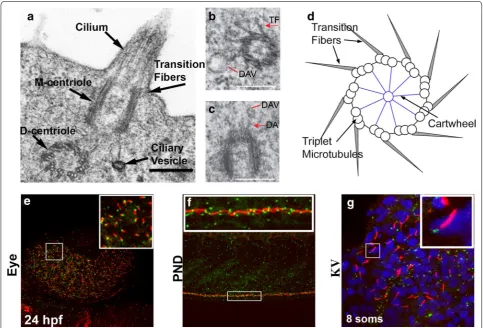
for cerebrospinal fluid movement, in the brain (Fig. 1a–d)
[15, 16]. Further conservation of structural function has
been suggested from closer inspection of the cartwheel
architecture, which forms the scaffold at the center of
the BB. Sas-6, which localizes to the cartwheel that is
required for early BB biogenesis in multiple model
sys-tems [17–20]. Interestingly, zebrafish Sas-6 protein
has been observed to self-assemble in vitro into
struc-tures reminiscent of the cartwheel structure, suggesting
Sas-6 itself is a major contributor to the core structural
organization at the center of zebrafish BBs [21]. However,
despite some compelling BB findings in zebrafish, further
studies focusing on BB ultrastructure need to be
con-ducted to elucidate BB structure variants between
organ-isms and within different tissue types.
Additional basal body structures or accessory structures
Electron microscopy has been fundamental to BB
dis-covery. Descriptive TEM observations of
Tetrahymena
BBs nearly 50 years ago identified structural off-shoots
that were speculated to be required for BB orientation
and function [13]. These structures include the rootlet,
basal foot, postciliary microtubules, transition fibers, and
kinetodesmal fibers. Whilst the functional roles of these
accessory structures remain largely unknown, there is
growing evidence that they play a role in BB orientation,
microtubular organization, ciliary structural support, and
anchoring [22–24]. Some of these structures have been
identified in zebrafish TEM, such as the rootlet, distal
appendages, transition fibers, and basal foot (Fig.
1a–
d) [16,
25]. However, the zebrafish model has yet to be
exploited to specifically focus on accessory structure
morphology and function.
Basal body origins and life cycle
BBs are closely related to centrosomes, they are
struc-turally similar and both act as microtubule organizing
centers. In fact, they are largely considered the same
entity that has simply taken on a different cellular role
post-mitotically, representing an efficient use of cellular
components. It has yet to be determined when exactly
in zebrafish development BBs become established.
However, cilia are first observed during late epiboly, at
the initiation of convergence and extension when
cel-lular movements form the embryonic germ layers [26].
Despite this, it is well documented that the reassignment
of occupation, from perinuclear centrosomal function
to the apical membrane for ciliogenesis, occurs across
species. Distinct cellular cues are likely to co-ordinate
this event; however, the mechanism of centriole
migra-tion and BB docking to the apical membrane is not fully
understood. Several studies in zebrafish have helped to
identify some novel players in this process, including
the Rac1 nucleotide exchange complex ELMO–DOCK1,
and the Hippo pathway [27,
28]. Functional knockdown
of
elmo1
,
dock1
, or
ezrin1
(components of the ELMO–
DOCK1 complex), using antisense morpholino
oligo-nucleotides, results in morphological defects consistent
with cilia loss [27]. Morphant embryos display detached
BBs at the apical membrane and impaired ciliary
axo-neme formation. Similarly, the Hippo pathway
transcrip-tional co-activator
yes
-
associated protein
(yap)
has been
shown to be required for appropriate BB arrangement
and apical membrane docking during zebrafish
ciliogen-esis [29]. Examination of the cross-talk and interactions
between the proteins proposed to orchestrate correct BB
migration and docking will help clarify this poorly
under-stood process.
that an alternative method for centriole amplification is
employed here. Indeed,
Deuterosome protein 1
(Deup1),
required for deuterosome-dependent (DD) centriole
biogenesis, is not present in zebrafish [31]. Interestingly,
cep63
required for mother centriole duplication (MCD)
is present in zebrafish [31].
Deup1
and
cep63
are known
to be paralogues with divergent roles in MCC promotion.
The presence of
cep63
but not
deup1
in zebrafish suggests
that
Deup1
arose from
cep63
and that zebrafish amplify
their centrioles via MCD, this is likely since zebrafish
MCC only contain a few cilia [31]. However, what
envi-ronmental cues instruct a cell to start amplifying
cen-trioles? Cells are singled out to become MCC through
inhibition of notch/delta signaling. Notch regulates
Mul-ticilin that promotes the production of centriolar
struc-tural proteins and
foxj1
, required for basal body docking,
cilia formation and motility [32,
33]. In zebrafish, the
foxj1a
(the homologue of the mammalian
Foxj1
) target
geminin coiled
-
coil domain containing (gmnc)
has been
identified to be required for MCC formation [32]. Fish
with disrupted
gmnc
fail to generate MCC, lack cells
con-taining multiple BBs and develop cystic kidneys, due to
the requirement for MCCs to propel filtrate along the
zebrafish pronephric tubule [32]. This suggests that
gmnc
is a critical regulator of centriole amplification. Thus, a
cascade of gene regulation is required to promote
cen-triole amplification and ultimately MCC commitment.
However, the regulated decision to activate this cascade,
independent of cell division, remains unclear.
Identification of basal body components
contaminants for proteomic analysis. In particular,
pro-teins that make up the amorphic pericentriolar
mate-rial (PCM) can often obscure centriole-specific proteins
[34], However, some clever approaches have been used to
piece together the ingredients that make up the BB.
Sev-eral studies have taken a comparative genomics approach
to identify genome differences between ciliated and
non-ciliated species [35, 36]. Whilst this predicts the required
ciliary components, it does not dissect out BB-specific
centriolar proteins. A much more direct approach has
been used in
Tetrahymena
and
Chlamydomonas
, where
minimal PCM has aided BB isolation allowing mass
spectroscopy to identify more specific BB proteome
candidates [34,
37]. This has been highly
informa-tive in identifying a “parts list” for basal body assembly.
Whilst similar experiments have not been conducted in
zebrafish, high conservation in centriole function and
therefore protein content should permit vertebrate
fol-low-up experiments. In recent years, the multinational
consortium known as SYSCILIA has compiled a “Gold
standard” (SCGS) list of ciliary components found in the
human genome [38]. For this article and to aid
research-ers wishing to study BB function in zebrafish, we have
extracted BB- and centrosome-specific genes from the
SCGS list and cross-referenced against genes with
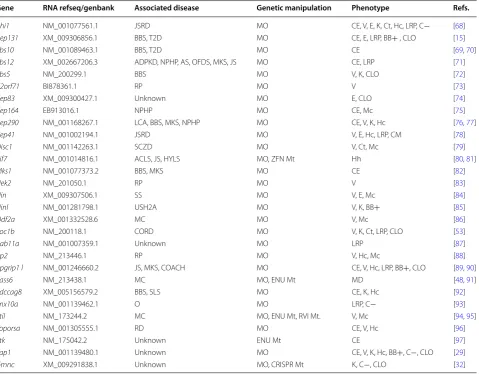
func-tional data in zebrafish (Table
1). Out of the 60 BB-/
centrosome-specific proteins extracted from the SCGS
list, 29 showed zebrafish functional follow-up studies,
with the majority limited to knockdown as opposed to
knockout approaches of gene silencing. It is clear from
our table that BB researchers are just beginning to
real-ize the power of zebrafish to study vertebrate function
of BB genes. With advanced genome editing techniques
now accessible in zebrafish, we expect some insightful BB
zebrafish papers to follow.
Notable basal body findings
Forward genetic mutagenic screens performed in the
1990’s, spearheaded zebrafish to the forefront of
ver-tebrate functional genetic research. Teams from
Bos-ton (USA) and Tubingen (Germany), lead by Wolfgang
Driever and Christiane Nusslein-Volhard, recovered
hun-dreds of
N
-ethyl-
N
-nitrosourea (ENU) directed
muta-tions that caused gross morphological abnormalities in
zebrafish development [39, 40]. At the time of screening,
the significance of cilia in human disease had not been
determined. Mutants identified through screening
pro-cesses were grouped together based on common
pheno-typic features. One group of mutants showed phenopheno-typic
similarities to the ift88 mouse, a gene that had been
shown in
chlamydomonas
to be required for ciliogenesis.
Now considered the archetypal zebrafish ciliopathy
phe-notype, mutant lines display randomized heart looping
and laterality defects, curved body axis,
hydrocepha-lus, pronephric and glomerular cysts, and defective eye
development [41]. Several of these mutations have been
mapped to key components in ciliary processes. Notably
affecting components of the IFT system. For example,
the zebrafish mutants oval (ift88), fleer (ift70), and elipsa
(traf3ip1), display loss of ciliary assembly [42–45].
How-ever, these mutants have intact BBs, suggesting that the
BB alone is not sufficient for ciliogenesis.
Early zebrafish ENU screens appeared to recover
mainly ciliary/axonemal gene mutations, rather than
those specific to basal body construction or function,
although a number of mutants still remain unmapped.
More BB/centriolar relevant mutants have been
dis-covered through genetic screens for maternal-effect
mutations [46, 47]. These experiments set out to
under-stand the maternal factors required for early embryonic
development and in doing so, identify genes involved
in the early cell cycle events that occur before zygotic
genes switch on. As previously mentioned, cilia do not
form in zebrafish until late gastrulation (approximately
9-h post-fertilization (hpf)), suggesting that any
cen-triolar mutations will be more akin to the centrosome
[26]. Interestingly, one of the mutants recovered, a
mis-sense mutant (Asn414Lys) known as cellular atoll (cea),
encodes the centriolar component Sass6 [48].
Geno-typically homozygote cea individuals develop to adults
and look phenotypically identical to wildtype, however
females produce clutches of eggs that due to defects in
centrosomal duplication arrest during early cell division.
Thus, Sass6 is a maternal effect gene required for
pre-gastrulation centrosomal duplication in zebrafish.
How-ever, the single amino acid change in cea appears not to
affect BB function, homozygotes are viable and develop
to adulthood. In other organisms, Sas-6 is localized to the
centriolar cartwheel and has been speculated to form the
cartwheel hub where loss leads to aberrant triplet
micro-tubule numbers [19, 20, 49]. Thus, Sas-6 localizes to the
cartwheel hub and is essential for centriole symmetry.
Indeed, x-ray crystallography of zebrafish
Sas-6 N-termi-nal has revealed that it assembles itself in vitro into
con-structs reminiscent of cartwheel hubs [21]. Further work
on zebrafish, with the development of conditional
muta-tions, will be critical in understanding the role of
verte-brate Sas-6 in BB function.
provide gene knockdown rather than knockout their use
maybe more favorable for understanding gene function
required for very early stages of development, such as
cel-lular division, when early lethality otherwise masks ENU
mutation recovery. Several zebrafish studies have utilized
MOs to study basal body protein function in vertebrates.
A notable case is that of Poc1, a core centriolar WD40
domain protein identified in both
Chlamydomonas
and
Tetrahymena
centriolar proteomic screens [34,
37,
52].
Interrogation of Poc1b function in
Tetrahymena
revealed
a structural role in BB stability [53]. Knockdown of the
zebrafish orthologue Poc1b using MOs results in
phe-notypic similarities to cilia deficient mutants, including
visual impairment. Cilia motility and length is hindered
in Poc1b morphant zebrafish embryos [53–55]. Recently,
mutations in POC1B have been identified in patients
dis-playing ciliopathy features [54,
56,
57]. Together, these
data show the power of multidisciplinary research that
can ultimately lead to the identification of novel disease
causing genes.
Table 1 Current zebrafish functional analysis, with zebrafish-specific references, of genes identified through the SCGS list
to be BB/centrosome affiliated
Note the addition of post-SCGS genes, yap and gmnc
JSRD joubert syndrome and related disorders, BBS bardet biedl syndrome, T2D type 2 diabetes, ADPKD autosomal dominant polycystic kidney disease, NPHP nephronophthisis, AS alström syndrome, OFDS orofaciodigital syndrome type 1, MKS meckels syndrome, RP retinitis pigmentosa, LCA leber’s congenital amaurosis, MC microcephaly, USH2A usher syndrome 2A, COACH cerebellar vermis oligophrenia ataxia coloboma hepatic fibrosis, SCZD schizophrenia, SLS senior-loken syndrome, O osteopetrosis, CORD cone-rod dystrophy, RD retinal degeneration, ZFN zinc finger nuclease, ENU N-ethyl-N-nitrosourea, RVI retroviral insertion, Mt mutant. Phenotype abbreviations: CE convergent extension defects, V visual impairment, E ear and otolith defects, K kidney defects including pronephric tubule dilation, Ct abnormal cartilage development, Hc hydrocephaly, Mc microcephaly, LRP left–right patterning defects, BB+ BBs observed intact, C− cilia absent, CM defective cilia motility, CLO cilia length and organization affected, Hh hedgehog signaling abrogated, MD mitotic division disrupted
Gene RNA refseq/genbank Associated disease Genetic manipulation Phenotype Refs.
Ahi1 NM_001077561.1 JSRD MO CE, V, E, K, Ct, Hc, LRP, C− [68]
Cep131 XM_009306856.1 BBS, T2D MO CE, E, LRP, BB+ , CLO [15]
Bbs10 NM_001089463.1 BBS, T2D MO CE [69, 70]
Bbs12 XM_002667206.3 ADPKD, NPHP, AS, OFDS, MKS, JS MO CE, LRP [71]
Bbs5 NM_200299.1 BBS MO V, K, CLO [72]
C2orf71 BI878361.1 RP MO V [73]
Cep83 XM_009300427.1 Unknown MO E, CLO [74]
Cep164 EB913016.1 NPHP MO CE, Mc [75]
Cep290 NM_001168267.1 LCA, BBS, MKS, NPHP MO CE, V, K, Hc [76, 77]
Cep41 NM_001002194.1 JSRD MO V, E, Hc, LRP, CM [78]
Disc1 NM_001142263.1 SCZD MO V, Ct, Mc [79]
Kif7 NM_001014816.1 ACLS, JS, HYLS MO, ZFN Mt Hh [80, 81]
Mks1 NM_001077373.2 BBS, MKS MO CE [82]
Nek2 NM_201050.1 RP MO V [83]
Nin XM_009307506.1 SS MO V, E, Mc [84]
Ninl NM_001281798.1 USH2A MO V, K, BB+ [85]
Odf2a XM_001332528.6 MC MO V, Mc [86]
Poc1b NM_200118.1 CORD MO V, K, Ct, LRP, CLO [53]
Rab11a NM_001007359.1 Unknown MO LRP [87]
Rp2 NM_213446.1 RP MO V, Hc, Mc [88]
Rpgrip1 l NM_001246660.2 JS, MKS, COACH MO CE, V, Hc, LRP, BB+, CLO [89, 90]
Sass6 NM_213438.1 MC MO, ENU Mt MD [48, 91]
Sdccag8 XM_005156579.2 BBS, SLS MO CE, K, Hc [92]
Snx10a NM_001139462.1 O MO LRP, C− [93]
Stil NM_173244.2 MC MO, ENU Mt, RVI Mt. V, Mc [94, 95]
Toporsa NM_001305555.1 RD MO CE, V, Hc [96]
Ttk NM_175042.2 Unknown ENU Mt CE [97]
Yap1 NM_001139480.1 Unknown MO CE, V, K, Hc, BB+, C−, CLO [29]
Strengths and future of basal body research in zebrafish
The many advantages of using zebrafish as a model
organ-ism has firmly established this small tropical aquarium
fish as a popular laboratory aid. Their rapid development,
production of large numbers of eggs, optical
transpar-ency and excellent value for money are very appealing
to vertebrate researchers. Additionally, BBs can be
eas-ily visualized alongside cilia in multiple zebrafish tissue
by using primary antibodies for γ-Tubulin (BB—GTU88
Sigma) and acetylated α-Tubulin (Cilia—T6793 Sigma) in
conjunction with isotype-specific secondary antibodies
(Fig. 1e–g) [58]. For many years, a major drawback when
modeling gene function in zebrafish was the difficulty
in performing targeted mutagenesis. As such, zebrafish
researchers have relied on MOs to knockdown
gene-specific translation, a relatively quick and inexpensive
technique [59]. However, problems associated with MO
off-target defects have meant that an arduous list of
con-trols need implementing in order to validate MO induced
phenotypic changes [60,
61]. In the last few years,
tech-niques to provide targeted mutagenesis in zebrafish have
rapidly evolved thanks to the use of genome editing tools
such as TALENS and CRISPR [62,
63]. Their
develop-ment has highlighted some of the inaccuracies in the
literature that have spread through MO use, where as
many as 80 % of MOs may actually fail to recapitulate
bona fide mutations in genes of interest [50]. CRISPR
and TALENS take advantage of the imperfect
endog-enous repair mechanism, non-homologous end
join-ing, which initiates after targeted double stranded DNA
breaks are induced by certain endonucleases (reviewed
in: [64, 65]). The development of tissue-specific promoter
driven endonuclease expression has enabled researchers
to create conditional mutants [66]. Minimal knowledge
of molecular biology is required to generate the reagents
required to direct the CRISPR Cas9 endonuclease to a
favorable region of the genome, making this available to
most laboratories and favorable over TALENS. In
addi-tion, there are comprehensive published protocols to
per-form, validate, and maintain CRISPR-induced mutagenic
lines [66,
67]. Therefore, generating CRISPR directed
mutant zebrafish lines is fast becoming an established
method in zebrafish laboratories. Yet, there is little
pub-lished work on BB-specific mutant zebrafish lines. Both
global and conditional CRISPR techniques will provide
BB researchers with invaluable tools to study candidate
gene function, especially when considering the
ubiqui-tous nature of BB gene expression. There is huge scope
for utilizing zebrafish in BB research and it will be
excit-ing to see how the systematic mutagenesis of the BB
pro-teome will identify novel roles both at the structural and
functional level.
Ethics statement
Animal
maintenance, husbandry, and procedures are
defined and controlled by the Animals (Scientific
Pro-cedures) Act 1986. All animal experimentation has been
carried out under licenses granted by the Home
Secre-tary (PPL No. 70/7892) in compliance with Biological
Services Management Group and the Biological Services
Ethical Committee, SGUL, London, UK.
Abbreviations
BB: basal bodies; WGD: whole genome duplication; IFT: intraflagellar transport; TEM: transmission electron microscopy; MCC: multiciliated cells; PCM: pericen-triolar material; SGSC: Syscilia’s Gold Standard; ENU: N-ethyl-N-nitrosourea; Hpf: hours post-fertilization; MO: antisense morpholino oligonucleotide; TALENs: transcription activator-like effector nucleases; CRISPR: clustered, regularly interspaced, short palindromic repeat; JSRD: joubert syndrome and related disorders; BBS: bardet biedl syndrome; T2D: type 2 diabetes; ADPKD: autoso-mal dominant polycystic kidney disease; NPHP: nephronophthisis; AS: Alström Syndrome; OFDS: Orofaciodigital syndrome type 1; MKS: Meckels syndrome; RP: Retinitis pigmentosa; LCA: Leber’s congenital amaurosis; MC: microcephaly; USH2A: Usher syndrome 2a; COACH: cerebellar vermis oligophrenia ataxia coloboma hepatic fibrosis; SCZD: schizophrenia; SLS: Senior-Loken syndrome; O: osteopetrosis; CORD: cone-rod dystrophy; RD: retinal degeneration.
Authors’ contributions
RM and DO planned, researched, and wrote the paper. Both authors read and approved the final manuscript.
Acknowledgements
RM is supported by the Imperial College London professional and personal development bursary. DO is supported by Fight for Sight UK Charity. We thank the hard work of those research groups cited in this article and apologize to those, which due to word limitations, were not mentioned.
Competing interests
The authors declare that they have no competing interests.
Received: 20 January 2016 Accepted: 1 March 2016
References
1. McCluskey BM, Postlethwait JH. Phylogeny of zebrafish, a “model species,” within Danio, a “model genus”. Mol Biol Evol. 2015;32(3):635–52. 2. Winfield IJ, Nelson JS. Cyprinid fishes: systematics, biology and
exploita-tion. London: Chapman and Hall; 1991.
3. Near TJ, Eytan RI, Dornburg A, Kuhn KL, Moore JA, Davis MP, Wainwright PC, Friedman M, Smith WL. Resolution of ray-finned fish phylogeny and timing of diversification. Proc Natl Acad Sci USA. 2012;109(34):13698–703. 4. Nelson JS. Fishes of the world. 4th ed. Hoboken: Wiley; 2006.
5. Ravi V, Venkatesh B. Rapidly evolving fish genomes and teleost diversity. Curr Opin Genet Dev. 2008;18(6):544–50.
6. Glasauer SM, Neuhauss SC. Whole-genome duplication in teleost fishes and its evolutionary consequences. Mol Genet Genomics. 2014;289(6):1045–60.
7. Howe K, Clark MD, Torroja CF, Torrance J, Berthelot C, Muffato M, Collins JE, Humphray S, McLaren K, Matthews L, et al. The zebrafish reference genome sequence and its relationship to the human genome. Nature. 2013;496(7446):498–503.
9. Li S, Fernandez JJ, Marshall WF, Agard DA. Three-dimensional structure of basal body triplet revealed by electron cryo-tomography. EMBO J. 2012;31(3):552–62.
10. Deane JA, Cole DG, Seeley ES, Diener DR, Rosenbaum JL. Localization of intraflagellar transport protein IFT52 identifies basal body transitional fibers as the docking site for IFT particles. Curr Biol. 2001;11(20):1586–90. 11. Hodges ME, Scheumann N, Wickstead B, Langdale JA, Gull K.
Reconstruct-ing the evolutionary history of the centriole from protein components. J Cell Sci. 2010;123(Pt 9):1407–13.
12. Geimer S, Melkonian M. The ultrastructure of the Chlamydomonas
reinhardtii basal apparatus: identification of an early marker of radial asymmetry inherent in the basal body. J Cell Sci. 2004;117(Pt 13):2663–74. 13. Allen RD. The morphogenesis of basal bodies and accessory structures
of the cortex of the ciliated protozoan Tetrahymena pyriformis. J Cell Biol. 1969;40(3):716–33.
14. Kramer-Zucker AG, Olale F, Haycraft CJ, Yoder BK, Schier AF, Drum-mond IA. Cilia-driven fluid flow in the zebrafish pronephros, brain and Kupffer’s vesicle is required for normal organogenesis. Development. 2005;132(8):1907–21.
15. Wilkinson CJ, Carl M, Harris WA. Cep70 and Cep131 contribute to cili-ogenesis in zebrafish embryos. BMC Cell Biol. 2009;10:17.
16. Lu Q, Insinna C, Ott C, Stauffer J, Pintado PA, Rahajeng J, Baxa U, Walia V, Cuenca A, Hwang YS, et al. Early steps in primary cilium assembly require EHD1/EHD3-dependent ciliary vesicle formation. Nat Cell Biol. 2015;17(3):228–40.
17. Culver BP, Meehl JB, Giddings TH Jr, Winey M. The two SAS-6 homologs in
Tetrahymena thermophila have distinct functions in basal body assembly. Mol Biol Cell. 2009;20(6):1865–77.
18. Leidel S, Delattre M, Cerutti L, Baumer K, Gonczy P. SAS-6 defines a protein family required for centrosome duplication in C. elegans and in human cells. Nat Cell Biol. 2005;7(2):115–25.
19. Nakazawa Y, Hiraki M, Kamiya R, Hirono M. SAS-6 is a cartwheel pro-tein that establishes the 9-fold symmetry of the centriole. Curr Biol. 2007;17(24):2169–74.
20. Rodrigues-Martins A, Bettencourt-Dias M, Riparbelli M, Ferreira C, Ferreira I, Callaini G, Glover DM. DSAS-6 organizes a tube-like centriole precursor, and its absence suggests modularity in centriole assembly. Curr Biol. 2007;17(17):1465–72.
21. van Breugel M, Hirono M, Andreeva A, Yanagisawa HA, Yamaguchi S, Nakazawa Y, Morgner N, Petrovich M, Ebong IO, Robinson CV, et al. Structures of SAS-6 suggest its organization in centrioles. Science. 2011;331(6021):1196–9.
22. Yang J, Gao J, Adamian M, Wen XH, Pawlyk B, Zhang L, Sanderson MJ, Zuo J, Makino CL, Li T. The ciliary rootlet maintains long-term stability of sensory cilia. Mol Cell Biol. 2005;25(10):4129–37.
23. Clare DK, Magescas J, Piolot T, Dumoux M, Vesque C, Pichard E, Dang T, Duvauchelle B, Poirier F, Delacour D. Basal foot MTOC organizes pillar MTs required for coordination of beating cilia. Nat Commun. 2014;5:4888. 24. Stinchcombe JC, Randzavola LO, Angus KL, Mantell JM, Verkade P, Griffiths
GM. Mother centriole distal appendages mediate centrosome docking at the immunological synapse and reveal mechanistic parallels with cili-ogenesis. Curr Biol: CB; 2015.
25. Hansen A, Zeiske E. The peripheral olfactory organ of the zebrafish, Danio rerio: an ultrastructural study. Chem Senses. 1998;23(1):39–48.
26. Borovina A, Superina S, Voskas D, Ciruna B. Vangl2 directs the posterior tilting and asymmetric localization of motile primary cilia. Nat Cell Biol. 2010;12(4):407–12.
27. Epting D, Slanchev K, Boehlke C, Hoff S, Loges NT, Yasunaga T, Indorf L, Nestel S, Lienkamp SS, Omran H, et al. The Rac1 regulator ELMO controls basal body migration and docking in multiciliated cells through interac-tion with Ezrin. Development. 2015;142(1):174–84.
28. Toret CP, Collins C, Nelson WJ. An Elmo-Dock complex locally controls Rho GTPases and actin remodeling during cadherin-mediated adhesion. J Cell Biol. 2014;207(5):577–87.
29. He L, Xu W, Jing Y, Wu M, Song S, Cao Y, Mei C. Yes-associated protein (Yap) is necessary for ciliogenesis and morphogenesis during pronephros development in zebrafish (Danio Rerio). Int J Biol Sci. 2015;11(8):935–47. 30. Dehring DA, Vladar EK, Werner ME, Mitchell JW, Hwang P,
Mitch-ell BJ. Deuterosome-mediated centriole biogenesis. Dev CMitch-ell. 2013;27(1):103–12.
31. Zhao H, Zhu L, Zhu Y, Cao J, Li S, Huang Q, Xu T, Huang X, Yan X, Zhu X. The Cep63 paralogue Deup1 enables massive de novo centriole biogen-esis for vertebrate multiciliogenbiogen-esis. Nat Cell Biol. 2013;15(12):1434–44. 32. Zhou F, Narasimhan V, Shboul M, Chong YL, Reversade B, Roy S. Gmnc is
a Master Regulator of the Multiciliated Cell Differentiation Program. Curr Biol. 2015;25(24):3267–73.
33. Ma L, Quigley I, Omran H, Kintner C. Multicilin drives centriole biogenesis via E2f proteins. Genes Dev. 2014;28(13):1461–71.
34. Keller LC, Romijn EP, Zamora I, Yates JR 3rd, Marshall WF. Proteomic analysis of isolated chlamydomonas centrioles reveals orthologs of ciliary-disease genes. Curr Biol. 2005;15(12):1090–8.
35. Avidor-Reiss T, Maer AM, Koundakjian E, Polyanovsky A, Keil T, Subrama-niam S, Zuker CS. Decoding cilia function: defining specialized genes required for compartmentalized cilia biogenesis. Cell. 2004;117(4):527–39. 36. Li JB, Gerdes JM, Haycraft CJ, Fan Y, Teslovich TM, May-Simera H, Li H,
Blacque OE, Li L, Leitch CC, et al. Comparative genomics identifies a flagellar and basal body proteome that includes the BBS5 human disease gene. Cell. 2004;117(4):541–52.
37. Kilburn CL, Pearson CG, Romijn EP, Meehl JB, Giddings TH Jr, Culver BP, Yates JR 3rd, Winey M. New Tetrahymena basal body protein components identify basal body domain structure. J Cell Biol. 2007;178(6):905–12. 38. van Dam TJ, Wheway G, Slaats GG, Huynen MA, Giles RH. The SYSCILIA
gold standard (SCGSv1) of known ciliary components and its applications within a systems biology consortium. Cilia. 2013;2(1):7.
39. Driever W, Solnica-Krezel L, Schier AF, Neuhauss SC, Malicki J, Stemple DL, Stainier DY, Zwartkruis F, Abdelilah S, Rangini Z, et al. A genetic screen for mutations affecting embryogenesis in zebrafish. Development. 1996;123:37–46.
40. Haffter P, Granato M, Brand M, Mullins MC, Hammerschmidt M, Kane DA, Odenthal J, van Eeden FJ, Jiang YJ, Heisenberg CP, et al. The identification of genes with unique and essential functions in the development of the zebrafish, Danio rerio. Development. 1996;123:1–36.
41. Drummond IA, Majumdar A, Hentschel H, Elger M, Solnica-Krezel L, Schier AF, Neuhauss SC, Stemple DL, Zwartkruis F, Rangini Z, et al. Early develop-ment of the zebrafish pronephros and analysis of mutations affecting pronephric function. Development. 1998;125(23):4655–67.
42. Omori Y, Zhao C, Saras A, Mukhopadhyay S, Kim W, Furukawa T, Sengupta P, Veraksa A, Malicki J. Elipsa is an early determinant of ciliogenesis that links the IFT particle to membrane-associated small GTPase Rab8. Nat Cell Biol. 2008;10(4):437–44.
43. Pathak N, Obara T, Mangos S, Liu Y, Drummond IA. The zebrafish fleer gene encodes an essential regulator of cilia tubulin polyglutamylation. Mol Biol Cell. 2007;18(11):4353–64.
44. Tsujikawa M, Malicki J. Genetics of photoreceptor development and func-tion in zebrafish. Int J Dev Biol. 2004;48(8–9):925–34.
45. Borovina A, Ciruna B. IFT88 plays a cilia- and PCP-independent role in controlling oriented cell divisions during vertebrate embryonic develop-ment. Cell Rep. 2013;5(1):37–43.
46. Dekens MP, Pelegri FJ, Maischein HM, Nusslein-Volhard C. The maternal-effect gene futile cycle is essential for pronuclear congression and mitotic spindle assembly in the zebrafish zygote. Development. 2003;130(17):3907–16.
47. Dosch R, Wagner DS, Mintzer KA, Runke G, Wiemelt AP, Mullins MC. Mater-nal control of vertebrate development before the midblastula transition: mutants from the zebrafish I. Dev Cell. 2004;6(6):771–80.
48. Yabe T, Ge X, Pelegri F. The zebrafish maternal-effect gene cellular atoll encodes the centriolar component sas-6 and defects in its paternal func-tion promote whole genome duplicafunc-tion. Dev Biol. 2007;312(1):44–60. 49. Strnad P, Gonczy P. Mechanisms of procentriole formation. Trends Cell
Biol. 2008;18(8):389–96.
50. Kok FO, Shin M, Ni CW, Gupta A, Grosse AS, van Impel A, Kirchmaier BC, Peterson-Maduro J, Kourkoulis G, Male I, et al. Reverse genetic screening reveals poor correlation between morpholino-induced and mutant phenotypes in zebrafish. Dev Cell. 2015;32(1):97–108.
51. Stainier DY, Kontarakis Z, Rossi A. Making sense of anti-sense data. Dev Cell. 2015;32(1):7–8.
53. Pearson CG, Osborn DP, Giddings TH Jr, Beales PL, Winey M. Basal body stability and ciliogenesis requires the conserved component Poc1. J Cell Biol. 2009;187(6):905–20.
54. Beck BB, Phillips JB, Bartram MP, Wegner J, Thoenes M, Pannes A, Samp-son J, Heller R, Gobel H, Koerber F, et al. Mutation of POC1B in a severe syndromic retinal ciliopathy. Hum Mutat. 2014;35(10):1153–62. 55. Zhang C, Zhang Q, Wang F, Liu Q. Knockdown of Poc1b causes abnormal
photoreceptor sensory cilium and vision impairment in zebrafish. Bio-chem Biophys Res Commun. 2015;465(4):651–7.
56. Durlu YK, Koroglu C, Tolun A. Novel recessive cone-rod dystrophy caused by POC1B mutation. JAMA Ophthalmol. 2014;132(10):1185–91. 57. Roosing S, Lamers IJ, de Vrieze E, van den Born LI, Lambertus S, Arts HH,
Peters TA, Hoyng CB, Kremer H, Hetterschijt L, Letteboer SJ. Disruption of the basal body protein POC1B results in autosomal-recessive cone-rod dystrophy. Am J Hum Genet. 2014;95(2):131–42.
58. Osborn DP, Roccasecca RM, McMurray F, Hernandez-Hernandez V, Mukherjee S, Barroso I, Stemple D, Cox R, Beales PL, Christou-Savina S. Loss of FTO antagonises Wnt signaling and leads to developmental defects associated with ciliopathies. PLoS One. 2014;9(2):e87662. 59. Nasevicius A, Ekker SC. Effective targeted gene ‘knockdown’ in zebrafish.
Nat Genet. 2000;26(2):216–20.
60. Eisen JS, Smith JC. Controlling morpholino experiments: don’t stop mak-ing antisense. Development. 2008;135(10):1735–43.
61. Heasman J. Morpholino oligos: making sense of antisense? Dev Biol. 2002;243(2):209–14.
62. Bedell VM, Wang Y, Campbell JM, Poshusta TL, Starker CG, Krug RG 2nd, Tan W, Penheiter SG, Ma AC, Leung AY, et al. In vivo genome editing using a high-efficiency TALEN system. Nature. 2012;491(7422):114–8.
63. Jao LE, Wente SR, Chen W. Efficient multiplex biallelic zebrafish genome editing using a CRISPR nuclease system. Proc Natl Acad Sci USA. 2013;110(34):13904–9.
64. Carlson DF, Fahrenkrug SC, Hackett PB. Targeting DNA With Fingers and TALENs. Mol Ther Nucleic Acids. 2012;1:e3.
65. Ran FA, Hsu PD, Wright J, Agarwala V, Scott DA, Zhang F. Genome engi-neering using the CRISPR-Cas9 system. Nat Protoc. 2013;8(11):2281–308. 66. Ablain J, Durand EM, Yang S, Zhou Y, Zon LI. A CRISPR/Cas9
vec-tor system for tissue-specific gene disruption in zebrafish. Dev Cell. 2015;32(6):756–64.
67. Talbot JC, Amacher SL. A streamlined CRISPR pipeline to reliably generate zebrafish frameshifting alleles. Zebrafish. 2014;11(6):583–5.
68. Simms R, Hynes A, Eley L, Inglis D, Chaudhry B, Dawe H, Sayer J. Modelling a ciliopathy: ahi1 knockdown in model systems reveals an essential role in brain, retinal, and renal development. Cell Mol Life Sci. 2012;69(6):993–1009.
69. Lim ET, Liu YP, Chan Y, Tiinamaija T, Karajamaki A, Madsen E, Go TDC, Altshuler DM, Raychaudhuri S, Groop L, et al. A novel test for recessive contributions to complex diseases implicates Bardet-Biedl syndrome gene BBS10 in idiopathic type 2 diabetes and obesity. Am J Hum Genet. 2014;95(5):509–20.
70. Stoetzel C, Laurier V, Davis EE, Muller J, Rix S, Badano JL, Leitch CC, Salem N, Chouery E, Corbani S, et al. BBS10 encodes a vertebrate-specific chap-eronin-like protein and is a major BBS locus. Nat Genet. 2006;38(5):521–4. 71. Stoetzel C, Muller J, Laurier V, Davis EE, Zaghloul NA, Vicaire S, Jacquelin
C, Plewniak F, Leitch CC, Sarda P, et al. Identification of a novel BBS gene (BBS12) highlights the major role of a vertebrate-specific branch of chaperonin-related proteins in Bardet-Biedl syndrome. Am J Hum Genet. 2007;80(1):1–11.
72. Al-Hamed MH, van Lennep C, Hynes AM, Chrystal P, Eley L, Al-Fadhly F, El Sayed R, Simms RJ, Meyer B, Sayer JA. Functional modelling of a novel mutation in BBS5. Cilia. 2014;3(1):3.
73. Nishimura DY, Baye LM, Perveen R, Searby CC, Avila-Fernandez A, Pereiro I, Ayuso C, Valverde D, Bishop PN, Manson FD, et al. Discovery and func-tional analysis of a retinitis pigmentosa gene, C2ORF71. Am J Hum Genet. 2010;86(5):686–95.
74. Joo K, Kim CG, Lee MS, Moon HY, Lee SH, Kim MJ, Kweon HS, Park WY, Kim CH, Gleeson JG, et al. CCDC41 is required for ciliary vesicle docking to the mother centriole. Proc Natl Acad Sci USA. 2013;110(15):5987–92. 75. Slaats GG, Ghosh AK, Falke LL, Le Corre S, Shaltiel IA, van de Hoek G,
Klasson TD, Stokman MF, Logister I, Verhaar MC, et al. Nephronophthisis-associated CEP164 regulates cell cycle progression, apoptosis and epithelial-to-mesenchymal transition. PLoS Genet. 2014;10(10):e1004594.
76. Baye LM, Patrinostro X, Swaminathan S, Beck JS, Zhang Y, Stone EM, Shef-field VC, Slusarski DC. The N-terminal region of centrosomal protein 290 (CEP290) restores vision in a zebrafish model of human blindness. Hum Mol Genet. 2011;20(8):1467–77.
77. Sayer JA, Otto EA, O’Toole JF, Nurnberg G, Kennedy MA, Becker C, Hen-nies HC, Helou J, Attanasio M, Fausett BV, et al. The centrosomal protein nephrocystin-6 is mutated in Joubert syndrome and activates transcrip-tion factor ATF4. Nat Genet. 2006;38(6):674–81.
78. Lee JE, Silhavy JL, Zaki MS, Schroth J, Bielas SL, Marsh SE, Olvera J, Brancati F, Iannicelli M, Ikegami K, et al. CEP41 is mutated in Joubert syndrome and is required for tubulin glutamylation at the cilium. Nat Genet. 2012;44(2):193–9.
79. Wood JD, Bonath F, Kumar S, Ross CA, Cunliffe VT. Disrupted-in-schizophrenia 1 and neuregulin 1 are required for the specification of oligodendrocytes and neurones in the zebrafish brain. Hum Mol Genet. 2009;18(3):391–404.
80. Maurya AK, Ben J, Zhao Z, Lee RT, Niah W, Ng AS, Iyu A, Yu W, Elworthy S, van Eeden FJ, et al. Positive and negative regulation of Gli activity by Kif7 in the zebrafish embryo. PLoS Genet. 2013;9(12):e1003955.
81. Tay SY, Ingham PW, Roy S. A homologue of the Drosophila kinesin-like protein Costal2 regulates Hedgehog signal transduction in the vertebrate embryo. Development. 2005;132(4):625–34.
82. Leitch CC, Zaghloul NA, Davis EE, Stoetzel C, Diaz-Font A, Rix S, Alfadhel M, Lewis RA, Eyaid W, Banin E, et al. Hypomorphic mutations in syndromic encephalocele genes are associated with Bardet-Biedl syndrome. Nat Genet. 2008;40(4):443–8.
83. Nishiguchi KM, Tearle RG, Liu YP, Oh EC, Miyake N, Benaglio P, Harper S, Koskiniemi-Kuendig H, Venturini G, Sharon D, et al. Whole genome sequencing in patients with retinitis pigmentosa reveals pathogenic DNA structural changes and NEK2 as a new disease gene. Proc Natl Acad Sci USA. 2013;110(40):16139–44.
84. Dauber A, Lafranchi SH, Maliga Z, Lui JC, Moon JE, McDeed C, Henke K, Zonana J, Kingman GA, Pers TH, et al. Novel microcephalic primordial dwarfism disorder associated with variants in the centrosomal protein ninein. J Clin Endocrinol Metab. 2012;97(11):E2140–51.
85. Dona M, Bachmann-Gagescu R, Texier Y, Toedt G, Hetterschijt L, Tonnaer EL, Peters TA, van Beersum SE, Bergboer JG, Horn N, et al. NINL and DZANK1 co-function in vesicle transport and are essential for photore-ceptor development in zebrafish. PLoS Genet. 2015;11(10):e1005574. 86. Novorol C, Burkhardt J, Wood KJ, Iqbal A, Roque C, Coutts N, Almeida AD, He J, Wilkinson CJ, Harris WA. Microcephaly models in the develop-ing zebrafish retinal neuroepithelium point to an underlydevelop-ing defect in metaphase progression. Open Biol. 2013;3(10):130065.
87. Westlake CJ, Baye LM, Nachury MV, Wright KJ, Ervin KE, Phu L, Chalouni C, Beck JS, Kirkpatrick DS, Slusarski DC, et al. Primary cilia membrane assembly is initiated by Rab11 and transport protein particle II (TRAPPII) complex-dependent trafficking of Rabin8 to the centrosome. Proc Natl Acad Sci USA. 2011;108(7):2759–64.
88. Shu X, Zeng Z, Gautier P, Lennon A, Gakovic M, Cheetham ME, Patton EE, Wright AF. Knockdown of the zebrafish ortholog of the retinitis pigmen-tosa 2 (RP2) gene results in retinal degeneration. Invest Ophthalmol Vis Sci. 2011;52(6):2960–6.
89. Mahuzier A, Gaude HM, Grampa V, Anselme I, Silbermann F, Leroux-Berger M, Delacour D, Ezan J, Montcouquiol M, Saunier S, et al. Dishev-elled stabilization by the ciliopathy protein Rpgrip1 l is essential for planar cell polarity. J Cell Biol. 2012;198(5):927–40.
90. Khanna H, Davis EE, Murga-Zamalloa CA, Estrada-Cuzcano A, Lopez I, den Hollander AI, Zonneveld MN, Othman MI, Waseem N, Chakarova CF, et al. A common allele in RPGRIP1L is a modifier of retinal degeneration in ciliopathies. Nat Genet. 2009;41(6):739–45.
91. Nair S, Lindeman RE, Pelegri F. In vitro oocyte culture-based manipulation of zebrafish maternal genes. Dev Dyn. 2013;242(1):44–52.
92. Otto EA, Hurd TW, Airik R, Chaki M, Zhou W, Stoetzel C, Patil SB, Levy S, Ghosh AK, Murga-Zamalloa CA, et al. Candidate exome capture identi-fies mutation of SDCCAG8 as the cause of a retinal-renal ciliopathy. Nat Genet. 2010;42(10):840–50.
93. Chen Y, Wu B, Xu L, Li H, Xia J, Yin W, Li Z, Shi D, Li S, Lin S, et al. A SNX10/V-ATPase pathway regulates ciliogenesis in vitro and in vivo. Cell Res. 2012;22(2):333–45.
• We accept pre-submission inquiries
• Our selector tool helps you to find the most relevant journal • We provide round the clock customer support
• Convenient online submission • Thorough peer review
• Inclusion in PubMed and all major indexing services • Maximum visibility for your research
Submit your manuscript at www.biomedcentral.com/submit
Submit your next manuscript to BioMed Central
and we will help you at every step:
zebrafish rapidly identifies genes essential for early vertebrate develop-ment. Nat Genet. 2002;31(2):135–40.
95. Pfaff KL, Straub CT, Chiang K, Bear DM, Zhou Y, Zon LI. The zebra fish cassiopeia mutant reveals that SIL is required for mitotic spindle organiza-tion. Mol Cell Biol. 2007;27(16):5887–97.
96. Chakarova CF, Khanna H, Shah AZ, Patil SB, Sedmak T, Murga-Zamalloa CA, Papaioannou MG, Nagel-Wolfrum K, Lopez I, Munro P, et al. TOPORS,
implicated in retinal degeneration, is a cilia-centrosomal protein. Hum Mol Genet. 2011;20(5):975–87.