Journal of Biological Sciences and Medicine
Available online at www.jbscim.com
ISSN: 2455-5266
27
Research Article
Open Access
Study of Titanium nanoparticles in biological system using
different techniques
Monex Kumar Gupta, Anand Kumar Vishwakrama, Garima Srivastava, Sujeet Pratap
Singh
1and Pavan Kumar
*GenTox Research and Development, Gomti Nagar, Lucknow- 226010, India
1
Amity University, Gomti Nagar Extension, Lucknow, Uttar Pradesh- 226010, India
*Corresponding Author: [email protected]
ARTICLE INFO ABSTRACT
Article History:
Received
18 August 2017
Accepted
20 September 2017
Available online
30 September 2017
Nanotechnology is a promising field of science and technology that deals with the effects of engineered or manufactured nanomaterial and their applications on living organisms. In addition to toxicity evaluation, these particles were characterized by different techniques like transmission electron microscopy (TEM) and nanoparticle tracking analysis (NTA). Titanium nanoparticle was within the small nanometer size range when dispersed in pure water. The particles were tended to agglomerate in media with higher ionic strength. The assessments of cytotoxicity showed that Ti nanoparticles caused a significant lessening in membrane integrity and cellular metabolic activity in a concentration dependent manner. The current study shows that size of Titanium nanoparticles and their ionic strength is adequate and also can be used at low concentrations to determine adverse effect in further studies.
Key words:
Titanium nanoparticle; Transmission Electron Microscope (TEM); Nanomaterial; Toxicity
Copyright: © 2017 Gupta et al. This is an open access article distributed under the terms of the Creative Commons Attribution License, which permits unrestricted use, distribution, and reproduction in any medium, provided the original author and source are credited.
Introduction
Nanotechnology is an emerging field in the area of interdisciplinary research, especially in biotechnology (Natarajan et al. 2010). Nanotechnology is one of the most active areas of research in current material science. Nanoscience and nanotechnology are the study that deals with the application of extremely small material and can be used other interdisciplinary fields, such as chemistry, biology, physics, materials science and engineering. Nanotechnology ("nanotech") is manipulation of matter on an atomic, molecular, and supramolecular scale. The earliest, widespread description of nanotechnology (Drexler and Eric 1986) referred to the particular technological goal of precisely manipulating atoms and molecules for
fabrication of macroscale products, also now referred to as molecular nanotechnology. Nanotechnology as defined by size is naturally very broad, including the fields of science as diverse as surface science, organic chemistry, molecular biology, semiconductor physics, energy storage (Hubler 2010; Shinn 2012) micro-fabrication (Lyon et al. 2013), molecular engineering etc. (Saini et al. 2010).
28
synthesis (Gopinath et al. 2012). Metal nanoparticles have potential applications in various areas, such as electronics, cosmetics, coatings, packaging and biotechnology. Various physical and chemical processes have been used in the synthesis of nanoparticles.
Nanoparticle nature of titanium dioxide has potential functions and features, such as stable properties, non-toxic, high activity of photocatalysis, low cost and good at resisting chemical attack. It is also an agreeable photocatalyst, disinfector and antiseptic in nature. Thus, the preparation and features of nanometer titanium dioxide powder has naturally been a research hotspot for a long time. Synthesis of nanoparticle of titanium oxide include some physical methods such as low-pressure gas evaporation, sputtering method, plasma method, high energy ball milling and chemical methods such as settling, hydrolysis, spraying method, oxidation-reduction method, laser synthesis, hydro-thermal method and sol-gel method. We use these different methods to prepare nano powder of titanium dioxide and analyze using XRD diffraction and Dissolved organic carbon (DOC) method.
The present study is thus aimed at characterization of nanomaterial using transmission electron microscopy, nanoparticle tracking analysis, and ion content method including metals, metal oxides, and carbon-based materials.
Materials and Methods
Synthesis of Nanoparticles
The titanium tetra chloride was used as a staring martial in this synthesis. 50 ml of titanium chloride was slowly added to the 200 ml distilled water in an ice cool bath. The beaker was taken from the ice bath to room temperature. The beaker was kept in magnetic stirrer to make a homogenous solution for 30 min. Bath temperature was raised to 1500c and kept in the same temperature till the process of Nano particle was completed. In another vessels 26 g of urea was dissolved in 250 ml of distilled
water. From the vessel 150 ml of urea solution was added to beaker under constant stirring, drop by drop touching the walls of the beaker. The solution turned in to white colloid without any precipitation. After the complete reaction, the solution was allowed to settle and the solution was washed with distilled water for 5 times.
Characterization of nanoparticles through transmission electron microscopy
Nano-TiO2 characterization was carried out by using transmission electron microscopy (TEM),
dynamic light scattering (DLS). TEM
methodologies were carried on a JEOL JEM-2011 instrument to determine size and morphology. DLS was performed on a Malvern Zetasizer Nano-ZS ZEN3600 instrument for the characterization of hydrodynamic size and zeta potential.
Nanoparticle Tracking Analysis
The nanoparticle size distributions of stock and working solutions were also analyzed using Nanoparticle. To obtain optimum imaging concentrations some samples were diluted in Milli-Q water: stock solution Ti of (using dilution factors sample to media 1:1000, 1:10 000), Ag in Leibowitz 15. A volume of 0.4 ml of each sample was measured 3 times with two cameras each, the high sensitivity camera Andor DL-658M-OEM and the lower sensitivity camera Marlin F-033B. All data were analyzed using the instrument software (NanoSight™) version 1.5.
Estimation of ion content
The ion content in the Ti nanoparticle solutions and the Ti exposure solution was determined by the ion selective electrode (ISE) ELIT 8211 crystal membrane for silver combined with a double junction potassium nitrate (ELIT 002) reference electrode in a dual electrode head (ELIT 201). A calibration curve between 0.00620 mg/L and 621 mg/L was made with Titanium tetrachloride. Measured values were read against a calibration curve.
29
Nanoparticle characterization through transmission electron microscopy (TEM)
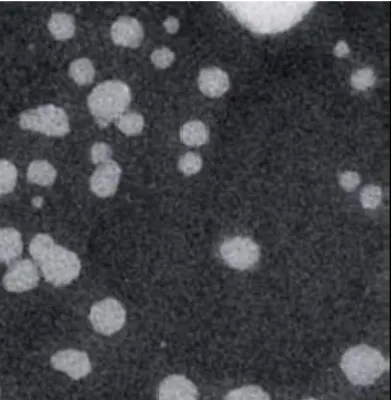
To better characterize the selected NPs, we used TEM to determine the size and the morphology of TiO2 NPs Fig.1. The average hydrodynamic diameter and zeta potential of the TiO2 NPs suspensions were determined by DLS. The nanoparticles of titanium in stock solution were mainly present as single particles with the largest fractions being between 1 and 3 nm respectively. The particle size distribution is accordingly shifted to somewhat larger sizes with the majority being between 4 nm and 7 nm in size. After the addition of DOC, most of the nanoparticles and agglomerates were found to be associated to DOC on the TEM images with an increase in particle size, with the largest particles present up to 80 nm in diameter. Ti particle appeared to be spherical in shape with some being more irregularly shaped. Ti nanoparticles in L15 containing DOC had a somewhat more oval appearance.
Nanoparticle Tracking Analysis
Sizes of titanium particle varied slightly due to the different size-range-capabilities of the standard and high using sensitivity cameras (Table 1). Titanium particles size mean values were about 61 nm in all liquids when determined using the lower sensitivity camera “Marlin”.
Determination of ion content
The ISE Titanium tetrachloride calibration curve was linear with values ranging from 441 mV at 640 mg/L Ti to 211 mV at the detection limit of 0.0060.5 mg/L of Ti. Titanium nanoparticle solution at a /=concentration of 120 mg/L showed a value of 192 mV, being below detection limit. The Zeta potential of titanium tetra chloride was – 1.69 mV for nano-TiO2 (21 nm) and –50.1 mV for nano-TiO2 (50 nm).
Fig 1. Size morphology of Titanium oxide nanomaterial
Table 1: Size distributions measured through nanoparticle tracking analyses (NTA) of Titanium
Concentration Lower sensitivity camera (nm High sensitivity camera (nm)
Silver (pure) 20.6±.31 30.1±.77
Silver (L-20) 21.3±.32 29.3±.75
30
Discussion
Due to the increasing use of nanoparticles, especially in consumer products, they are likely entering the environment. Their application in products like washing machines, personal care products, and cloth, are lead them to enter into sewage treatment plants, and following perhaps into the aquatic environment. Uptake of nanoparticles into aquatic organisms including fish, and the rising concerns about adverse effects was shown previously (Kashiwada 2006). In the aspect of synthesizing nanoparticles, different types of nanoparticles in the form of colloids, cluster powders could be synthesized by various techniques such as chemical method, physical method, biological method as well as hybrid technique (Umme et al. 2011). Similarly, this was also applied for the structure as well as morphology as according to Parthsarthi et al. (2009).
The nanoparticle particle size and shape as well as the aggregation behavior in different
exposure media were determined with
transmission electron microscope (TEM) and nanoparticle tracking analysis (NTA) (Murdock et al. 2008). The effect of DOC, being a ubiquitous component of natural fresh water systems, on particle characteristics and toxicity was also investigated. The present results indicated that the highest concentrations (1000 μg/ml) of the TiO2 NPs (80 nm) and all concentrations of TiO2 NPs (50 nm) have a genotoxic effect (Demir et al. 2014). Similarly, recent studies have shown that TiO2 NPs induce genotoxicity in various lines of cultured cells. For example, TiO2 (<20 nm) causes a significant dose-dependent increase in the induction of micronuclei and apoptosis in Syrian hamster embryo cells (Rahman et al. 2002).
The characterized titanium dioxide NPs (NPs) of sizes, shapes and phases of TiO2-NPs by scanning electron microscopy (SEM), X-ray diffraction (XRD) and dynamic light scattering (DLS) and have been induced an antioxidant gene expression in the tilapia, Oreochromis niloticus. The expression of the catalase (CAT),
glutathione-S-transferase (GST) and superoxide dismutase
(SOD) genes have been assessed by real-time polymerase chain reaction (RT-PCR) (Yeo et al. 2012). Powers et al. (2006) reviewed the different methods of nanomaterial characterization and proposed dynamic light scattering (DLS) as a useful technique to evaluate particle size, distribution, and the zeta potential of nanomaterials in solution. DLS has been used in recent and past studies, as early as 1975, as a simple method for analyzing suspension stability and measurement of particle size in solution (Berne and Pecora 1975; Simakov and Tsur 2006; Williams et al. 2006; Wu et al. 2005). Similar study has been performed in the present investigation. The International Agency for Research on Cancer (IARC) recently classified TiO2 as possibly carcinogenic to humans, based on sufficient evidence in experimental animals (Baan 2007). A number of studies have produced conflicting results related to the genotoxicity of TiO2 NPs in different test systems.
31
toxicity studies have demonstrated that inhalation of TiO2 NPs causes pulmonary inflammation in rats and mice (Bermudez et al. 2004) and TiO2 NPs induce DNA damage and genetic instability in mice (Trouiller et al. 2009). The present study was in agreement with Demir et al. (2014), that Titanium nanoparticle toxicity was mediated by Ti+, as Ti nanoparticles were interacting with cells and thereby releasing Ti+.
Conclusion
Transmission electron micro scope picture displayed that the actual grain was about 80 nm and was relatively well-distributed. TEM and NTA used for characterization of size changes of nanoparticles and their agglomeration state in exposure media and exposure media containing DOC, which had an elevated ionic strength compared to stock solutions.
Conflicts of interest
All contributing authors declare no conflicts of interest.
Acknowledgments
The authors are thankful to the director of the Gentox Research and Development (GRD), Lucknow, for providing support materials and the laboratory facility for conducting this study.
References
Ajitha B, Reddy AK, Reddy YS (2015) Biosynthesis of silver nanoparticles using Momordica charantia leaf broth: evaluation of their innate antimicrobial and catalytic activitiy. J Photochem Photobiol B: Biol 146:1–9
Baan RA (2007) Carcinogenic hazards from inhaled carbon black, titanium dioxide, and talc not containing asbestos or asbestiform fibers: recent evaluations by an IARC Monographs Working Group. Inhal Toxicol 19:213–228
Bermudez E, Mangum JB, Wong BA, Asgharian B, Hext PM, Warheit DB, Everitt JI (2004) Pulmonary responses of mice, rats, and
hamsters to subchronic inhalation of ultrafine titanium dioxide particles. Toxicol Sci 77:347–357
Berne BJ and Pecora R (1975) Dynamic Light Scattering. John Wiley, New York
Demir E, Kaya N, Kaya B (2014) Genotoxic effects of zinc oxide and titanium dioxide nanoparticles on root meristem cells of allium cepa by comet assay. Turk J Biol 38:31-39
Domingos RF, Baalousha MA, Ju-Nam Y (2008) Characterizing manufactured nanoparticles
in the environment: Multi method
determination of particle sizes. Environ. Sci Technol 43 (19):7277–7284
Drexler K Eric (1986) Engines of Creation: The Coming Era of Nanotechnology. Doubleday. ISBN 0-385-19973-2
Gontier E, Ynsa MD, Bíró T, Hunyadi J, Kiss B, Gáspár K, Pinheiro T, Silva JN, Filipe P, StachuraJ, Dabros W, Reinert T, Butz T, Moretto P, Surlève Bazeille, JE (2008) Is there penetration of titania nanoparticles in sunscreens through skin? A comparative electron and ion microscopy study. Nanotoxicol 22:18–231
Hubler A (2010) "Digital quantum batteries: Energy and information storage in nanovacuum tube arrays". Complexity. doi:10.1002/cplx.20306
Gopinath V, Mubarak Ali D, Priyadarshini S,
Priyadharsshini NM, Thajuddin N,
Velusamy P (2012) Biosynthesis of silver nanoparticles from Tribulus terrestris and its antimicrobial activity: a novel biological approach. Colloids and Surfaces, B: Biointerfaces 96:69-74
Kashiwada S (2006) Distribution of Nanoparticles in the See-through Medaka (Oryzias latipes). Environ Health Perspect 114(11):1697–1702 Lyon D (2013) Gap size dependence of the dielectric strength in nano vacuum gaps. IEEE. doi:10.1109/TDEI.2013.6571470
Murdock RC, Laura Braydich-Stolle AM,
32
Dispersion in Solution Prior to In
Vitro Exposure Using Dynamic Light
Scattering Technique. Toxicol Sci 101:239– 253
Natarajan K, Selvaraj S, Ramachandra MV (2010) Microbial production of silver nanoparticles. J Nanomat Biostruct 5:135-140
Parthsarthi A and Thilagavthi G (2009) Synthesis and characterization of titanium dioxide nano particles and their applications to textiles for microbe resistance. J Text Apparel Technol Management 6:2-2009 Park HG (2012) Gene expression in zebra fish
embryos following exposure to Cu-doped TiO2 and pure TiO2 nanometer-sized photocatalysts. Mol Cell Toxicol 8:127–137 Powers K, Brown S, Krishna V, Wasdo S, Moudgil B, and Roberts S (2006) Research strategies for safety evaluation of nanomaterials. Part VI. Characterization of nanoscale particles for toxicological evaluation. Toxicol Sci 90:296–303
Rahman Q, Lohani M, Dopp E (2002) Evidence that ultrafi ne titanium dioxide induces micronuclei and apoptosis in Syrian hamster embryo fibroblasts. Environ Health Perspect 110:797–800
Saini R, Saini S, Sharma S (2010)
"Nanotechnology: The Future Medicine". Journal of Cutaneous and Aesthetic Surgery. 3 (1):32–33
Simakov S and Tsur Y (2006) Surface stabilization of nano-sized titanium dioxide: improving the colloidal stability and the sintering morphology. J Nanopart Res 9:403–417 Trouiller B, Reliene R, Westbrook A, Solaimani P,
Schiesti RH (2009) Titanium dioxide nanoparticles induce DNA damage and genetic instability in vivo in mice. Cancer Res 69:8784–8789
Umme, T (2011) Synthesis and characterization of silver nanoparticles by chemical reduction method. Nano science, Engineering and Technology (ICONSET), International Conference
Williams D, Ehrman S, and Holoman T (2006) Evaluation of the microbial growth response
to inorganic nanoparticles. J.
Nanobiotechnol. doi: 10.1186/1477-3155-4-3
Wu Y, Yang W, Wang C, Hu J, Fu S (2005) Chitosan Nanoparticles as a novel delivery system for ammonium glycyrrhizinate. Int J Pharm 295:235–245