ISSN: 2320 –3242 (P), 2320 –3250 (online) Published on 11 December 2017
www.researchmathsci.org
DOI: http://dx.doi.org/10.22457/ijfma.v14n1a10
81
International Journal of
Equitable Regular Total Semi-µ Strong (Weak) Edge
Domination in Intuitionistic Fuzzy Graph
P.J.Jayalakshmi1, C.V.R. Harinarayanan2 and R.Muthuraj3
1
Department of Mathematics, Indraganesan College of Engineering and Technology, Trichy – 620 001, Tamilnadu, India.
E- mail: [email protected] 2
Department of Mathematics, Government Arts College, Paramakudi –637 001, Tamilnadu, India. E-mail:[email protected] 3
PG & Research Department of Mathematics, H.H. The Rajah’s College Pudukkottai – 622 001, Tamilnadu, India. E-mail: [email protected]
Received 5 November 2017; accepted 7 December 2017
Abstract. In this paper, the new kind of parameter Regular total semi - µ strong (weak) edge domination number in an intuitionistic fuzzy graph is defined and established the parametric conditions. Another new kind of parameter an equitable regular total semi - µ strong (weak) edge domination number is defined and established the parametric conditions. The properties of Regular total semi - µ strong (weak) edge domination number and an equitable regular total semi - µ strong (weak) edge domination number domination number are discussed.
Keywords: Dominating set, total semi - µ strong (weak) edge domination set, Regular total semi - µ strong (weak) edge domination set, equitable regular total semi - µ strong (weak) edge domination set, equitable regular total semi - µ strong (weak) edge domination number.
AMS Mathematics Subject Classification (2010): 03E72, 05C69, 05C72, 05C76
1. Introduction
82
intuitionistic fuzzy graph and some parametric conditions are established as a new concept.
2. Preliminaries
In this section, some basic definitions are discussed.
Definition 2.1. [7] Let G = (V, E) be an intuitionistic fuzzy graph (IFG) where
V={v1,v2,…,vn}. Then,
i. µ1 : V → [ 0 , 1 ] and γ1 : V → [ 0 , 1 ] respectively denote the degree of membership and non-membership of the element vi∈V and
1 ) ( ) (
0≤
µ
1 vi +γ
1 vi ≤ for every vi∈V.ii. E ⊂ V ×V where µ2:V × V → [0,1] and γ2:V × V → [0,1] are such that
)} ( ), ( max{ ) , ( )}, ( ), ( min{ ) ,
( 1 1 2 1 1
2 vi vj
µ
viµ
vjγ
vi vjγ
viγ
vjµ
≤ ≤ and1 ) , ( ) , (
0≤
µ
2 vi vj +γ
2 vi vj ≤ for every (vi,vj)∈E.Definition 2.2.[10] Let G = (V, E) be an IFG, Then the cardinality of G is defined to be
∑ + − + ∑ + − = ∈
∈ V V
j i 2 j i 2 V V i 1 i 1 i i 2 )) v , (v γ ) v , (v µ (1 2 )) (v γ ) (v µ (1 | G |
Definition 2.3. [10] The fuzzy vertex cardinality of G is defined by
p = ∑
+ − = ∈V V i 1 i 1 i 2 )) (v γ ) (v µ (1 | V
| for all vi ∈V
Definition 2.4. [10] The fuzzy edge cardinality of G is defined by
q = ∑
+ − = ∈V V j i 2 j i 2 i 2 )) v , (v γ ) v , (v µ (1 | E
| for all (vi, vj) ∈ E.
Definition 2.5. [8]
Let G = <V,E> be an IFG. Then the order of G is defined to be O(G) =
)) ( ), (
(Oµ G Oγ G where Oµ(G) = ∑
∈V
vi i
v )
(
1
µ
and Oγ(G) =∑
∈Vvi i
v )
(
1
γ
Definition 2.6. [8] The Size of G is defined to be S(G) = (Sµ(G),Sγ(G))where Sµ(G)
= ∑
≠j
i i j
v v , ) (
2
µ
and Sγ(G) = ∑≠j
i i j
v v, ) (
2
γ
Definition 2.7. [8] Let G = ((
µ
1,γ
1),(µ
2,γ
2))be an IFG. Theµ
-degree of a vertex vi isdµ(vi) =
∑
∈E
v vi j)
( j i 2 , ) v , (v
µ
. The ߛ-degree of a vertex vi is dγ(vi) =∑
∈E
v vi j)
Graph
83 The degree of a vertex is d(vi) = [
∑
∈E
v vi j)
(
j i 2
,
) v , (v
µ
,∑
∈E
v vi j)
(
j i 2
,
) v , (v
γ
] and µ2(vi,vj) = γ2(vi, vj) = 0 for vivj∉E.
The minimum degree of G is δ(G) = min{dµ(vi), dγ(vi)|vi∈V}. The maximum degree of G is ∆(G) = max {dµ(vi), dγ(vi)|vi∈V}
Definition 2.8. [8] The degree of a vertex v in an IFG G = (V, E) is defined to be sum of
the weights of the strong edges incident at v. It is denoted by W(G).
Definition 2.9. [11] A subset D of V is called a dominating set in an IFG G if for every
v ∈V ̶ D, there exists u∈D such that u,v∈E(G).
Definition 2.10. [11] A dominating set D of an IFG is said to be minimal dominating set if no proper subset of D is a dominating set.
Definition 2.11. [7] A strong (weak) dominating set Tµ of an intuitionistic fuzzy graph is said to be semi-µ strong (weak) dominating set if
µ
2(vi,vj)= min(
µ
1(vi),µ
1(vj))
forevery vi and vj.
Definition 2.12. [5] Let G be an intuitionistic fuzzy Graph. A semi - µ strong (weak)
dominating set Tµ of an IFG is said to be total semi - µ strong (weak) dominating set of
intuitionistic fuzzy graph G if dN(u)≥dN(v) for all u ∈ Tµ , v ∈V .
Definition 2.13. [5] A total semi - µ strong (weak) dominating set Tµ of an intuitionistic fuzzy graph G is called minimal total semi - µ strong (weak) dominating set of G if v∈ Tµ , Tµ - {v} is not a total semi - µ strong (weak) dominating set of G.
Definition 2.14. [5] The minimum fuzzy cardinality among all minimum total semi - µ
strong (weak) intuitionistic fuzzy dominating set in G is called total semi - µ strong
(weak) dominating number of G is denoted by γT (G)
µ .
Definition 2.15. The degree of effective edge of ei is the sum of the membership value of the effective edge incident on ei, denoted by dE(ei).
Definition 2.16. Let G be an intuitionistic fuzzy graph. The edge set Te is said to be a
total edge dominating set if for every edge in G dominates atleast one edge of Te.
Definition 2.17. Let G be an intuitionistic fuzzy graph. The edge set Te is said to be total
strong (weak) edge dominating set of G if
84
Definition 2.18. A total strong (weak) dominating set Te of an intuitionistic fuzzy graph G is called minimal total strong (weak) edge dominating set of G if v ∈Te, Te- {v} is not total strong (weak) edge dominating set of G.
Theorem 2.19. In an IFG, WTe(G)≤OTe(G)≤STe(G)
Proof: Let G be an intuitionistic fuzzy graph. Sum of fuzzy vertex cardinality of an
intuitionistic fuzzy graph but need not be a minimum of weighted total strong (weak) edge domination IFG of G. Therefore, WTe(G)≤OTe(G). STe(G)be a size of total strong (weak) edge dominating set but need not be a minimum of sum of fuzzy vertex cardinality of total strong (weak) edge dominating set, then OTe(G)≤STe(G).
Hence ,WTe(G)≤OTe(G)≤STe(G).
Theorem 2.20. In an IFG, WTe(G)≤
δ
Te(G)≤∆Te(G)Proof: Let G be an intuitionistic fuzzy graph.
δ
Te(G)is a minimum degree of totalstrong (weak) edge domination of IFG but need not be a minimum of weighted total strong (weak) edge domination in IFG, then WTe(G)≤δTe(G). ∆Te(G)is a maximum degree of total strong (weak) edge domination of IFG but need not minimum of minimum degree of total strong (weak) edge domination of IFG. Therefore, δTe(G)≤∆Te(G).
Hence ,WTe(G)≤δTe(G)≤∆Te(G).
3. Main results
Regular total semi - µ strong (weak) edge dominating set of an IFG
In this section, Regular total semi - µ strong (weak) edge dominating number of an intuitionistic fuzzy graph is introduced and its parametric conditions are established. Let us consider p ≤ q throughout the paper.
Definition 3.1. A total semi - µ strong (weak) edge dominating set eRTµof a graph G is a
regular total semi - µ strong (weak) edge dominating set if all the edges have same
degree.
Definition 3.2. A regular total semi - µ strong (weak) edge dominating set eRTµ of a
intuitionistic fuzzy graph G is called minimal regular total semi - µ strong (weak) edge
dominating set of G, if v ∈eRTµ, eRTµ - {v} is not a regular total semi - µ strong (weak) edge dominating set of G.
Definition 3.3. The minimum fuzzy cardinality among all minimal regular total semi - µ
strong (weak) edge dominating set is called regular total semi - µ strong (weak) edge
dominating set and its regular total semi - µ strong (weak) edge domination number is
Graph
85
Theorem 3.4. In an IFG, γeRTµ(G)≤ p≤q
Proof: Let G be an IFG. γeRTµbe a regular total semi - µ strong (weak) edge domination
number of an IFG. p be a sum of fuzzy vertex cardinality of an IFG G but need be a minimum of a regular total semi - µ strong (weak) edge domination number of an IFG.
µ eRT
γ be a regular total semi - µ strong (weak) edge domination number of an IFG is less
than or equal to sum of fuzzy vertex cardinality of an IFG. That is, γeRT (G)≤ p
µ . q
be a sum of fuzzy edge cardinality of a regular total semi - µ strong (weak) edge domination of an IFG but need not be a minimum of sum of fuzzy vertex cardinality of a regular total semi - µ strong (weak) edge domination of an IFG of G. Then, sum of fuzzy vertex cardinality is less than or equal to sum of edge cardinality of a regular total semi - µ strong (weak) edge domination of an IFG G. That is, p≤ q.
Hence, γeRTµ(G)≤ p≤q.
Theorem 3.5. In an IFG of G, WeRTµ(G)≤OeRTµ(G)≤SeRTµ(G)
Proof: Let G be an IFG. γeRTµbe a regular total semi - µ strong (weak) edge domination
number of an IFG.
) (G
OeRTµ be an order of a regular total semi - µ strong (weak) edge domination
of an IFG of G but need not be a minimum of a weighted regular total semi - µ strong (weak) edge domination of an IFG. Then, weighted regular total semi - µ strong (weak) edge domination of an IFG of G is less than or equal to order of an IFG. That is,
) ( )
(G O G
WeRTµ ≤ eRTµ . SeRTµ(G)be a size of a regular total semi - µ strong (weak) edge
domination of an IFG but need not be a minimum of an order of an edge IFG of G. Then, an order of a regular total semi - µ strong (weak) edge domination of an IFG is less than or equal to size of an edge IFG. That is, OeRTµ(G)≤SeRTµ(G).
Hence, WeRTµ(G)≤OeRTµ(G)≤SeRTµ(G)
Theorem 3.6. For an IFG,
2 )
(G p q
eRT
− ≥ µ
γ
Proof: Let G be an IFG. γeRTµbe a regular total semi - µ strong (weak) edge domination
number of an IFG. Let p be a sum of fuzzy vertex cardinality of an IFG G. Let q be a sum of fuzzy edge cardinality of an IFG G.
2
q p−
be a fuzzy vertices but need not be a maximum of a regular total semi - µ
86
strong (weak) edge domination number of an IFG of G is greater than or equal to
2
q p−
fuzzy vertices. Hence,
2 )
(G p q
eRT
− ≥ µ
γ
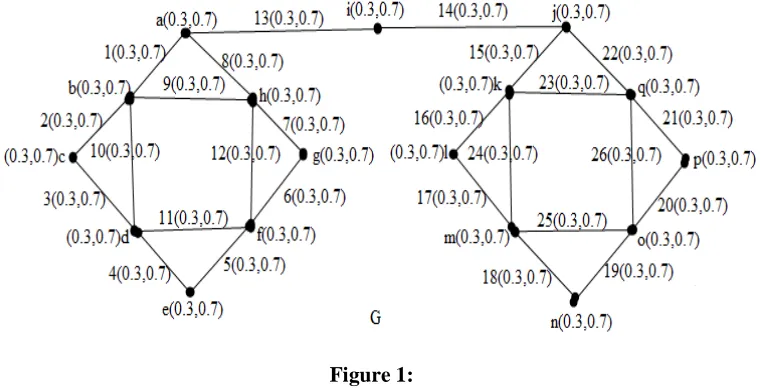
Example 3.7. Let G be an intuitionistic fuzzy graph. Let
T
eR
γ be a regular total strong (weak) edge domination number of G.
Figure 1:
RTe = {1,3,5,7,15,17,19,21}, E – RTe = {2,4,6,8,9,10,11,12,13,14,16,18,20,22}, p = 4.2, q = 5.2, γ (G) 1.8
T
eR = ∆eN(G)=1.8, δeN(G)=1.6, |p–q| = |-1| = 1,
2.6, (G)
δ
p , 4 . 2 (G)
∆
p− eN = − eN = q−∆eN(G) =3.4, q−δeN(G)=3.6.
4. Equitable regular total semi - µ strong (weak) edge domination in an IFG
In this section, Equitable regular total semi - µ strong (weak) edge dominating number of an intuitionistic fuzzy graph is introduced and its parametric conditions are established. Let us consider p ≤ q throughout the paper.
Definition 4.1. A regular total semi - µ strong (weak) edge dominating set eERTµof an intuitionistic fuzzy graph G is an equitable regular total semi - µ strong (weak) edge
dominating set if
i. u,v∈ E(G) and
ii. | deg(u) – deg(v) | ≤ 1 for all u ∈ ERTµ , v ∈ V-ERTµ
Definition 4.2. An equitable regular total semi - µ strong (weak) edge dominating set
µ
Graph
87
µ strong (weak) edge dominating set of G, if v ∈eERTµ , eERTµ - {v} is not an equitable regular total semi - µ strong (weak) edge dominating set of G.
Definition 4.3. The minimum fuzzy cardinality among all minimal equitable regular total
semi - µ strong (weak) edge dominating set is called equitable regular total semi - µ
strong (weak) edge dominating set and its equitable regular total semi - µ strong
(weak) edge domination number is denoted by γeERTµ(G).
Theorem 4.4. For an intuitionistic fuzzy graph, (G)
δ
q (G)
∆
p (G)
γeERT e(µ) e(µ)
µ ≤ − ≤ −
Proof: Let G be an intuitionistic fuzzy graph. Let γeERT (G)
µ be an equitable regular total semi - µ strong (weak) edge domination number of G.
p - ∆e(µ) be a fuzzy vertices but need not be a minimum of an equitable regular
total semi - µ strong (weak) edge domination number of G. Then, an equitable regular total semi - µ strong (weak) edge domination number of G is less than or equal to p -
) e(
∆ µ . That is, γeERT (G) p ∆e(µ)(G)
µ ≤ − . q-
δ
e(µ) be a fuzzy vertices but need not be a minimum of p-∆e(µ) fuzzy vertices. p- ∆e(µ) fuzzy vertices is less than or equal toq-) e(µ
δ
.Therefore, p−∆e(µ)(G)≤ q−δe(µ)(G).
Hence, γeRT (G) p ∆e(µ)(G) p δe(µ)(G)
µ ≤ − ≤ − .
Theorem 4.5. For an intuitionistic fuzzy graph, (G)
δ
q (G)
∆
p (G)
γeERTµ ≤ − e(γ) ≤ − e(γ)
Proof: Let G be an intuitionistic fuzzy graph. Let γeRT (G)
µ be a regular total strong (weak) edge domination number of G.
q - ∆e(γ)be a fuzzy edges but need not be a minimum of regular total strong
(weak) edge domination number of G. Then, a regular total strong (weak) edge domination number of G is less than or equal to q - ∆e(γ). That is,
(G)
∆
q (G)
γeRT e(γ)
µ ≤ − . q - δe(γ)be a fuzzy vertices but need not be a minimum of q - ∆e(γ)fuzzy vertices. q - ∆e(γ)fuzzy vertices is less than or equal to q - δe(γ)
Therefore,q − ∆e(γ)(G)≤ q − δe(γ)(G).
Hence, γeERTµ(G)≤p−∆e(γ)(G)≤q−δe(γ)(G).
Theorem 4.6. For an intuitionistic fuzzy graph,
1 (G)
∆
(G)
∆
p (G)
γ
) e(
) e(
eERT +
− ≥
µ γ
88
Proof: Let G be an intuitionistic fuzzy graph. Let γeERTµ be an equitable regular total
strong (weak) edge domination number of G.
1 (G) ∆ (G) ∆ p ) e( ) e( + − µ γ
be a fuzzy vertices but need
not be a maximum of an equitable regular total strong (weak) edge domination number of
G. Hence,
1 (G) ∆ (G) ∆ p (G) γ ) e( ) e( eERT + − ≥ µ γ µ .
Theorem 4.7. Let G be an IFG. In an IFG,
2 ) ( ) ( ) ( 2 ) ( ) ( ( ) ( ) ( ) )
( O G G
G G
G
O e e
eERT e
eµ µ γ γ
µ
γ
≤ −∆≤ ∆
−
Proof: Let G be an IFG.
γ
eERTµ(G) be an equitable regular total semi - µ strong (weak)edge domination of an IFG. eERT (G)
µ
γ
be an equitable regular total semi - µ strong(weak) edge domination of an IFG but need not be a minimum of a
2 ) ( ) ( ( ) )
( G G
Oeµ −∆eµ
fuzzy cardinality of IFG.
2 ) ( ) ( ( ) )
( G G
Oeµ −∆eµ
fuzzy cardinality is less than or equal to
an equitable regular total semi - µ strong (weak) edge domination of an IFG. That is,
) ( 2 ) ( ) ( ( ) ) ( G G G O eERT e e µ
γ
µ µ −∆ ≤ . 2 ) ( ) ( ( ) )( G G
Oeγ −∆eγ
be a fuzzy vertices but need
not be a minimum of an equitable regular total semi - µ strong (weak) edge domination of an IFG. Then, an equitable regular total semi - µ strong (weak) edge domination of an
IFG is less than or equal to a
2 ) ( ) ( ( ) )
( G G
Oeγ −∆eγ
fuzzy vertices. That is,
2 ) ( ) ( )
(G Oe( ) G e( ) G
eERT γ γ µ
γ
≤ −∆ . Hence, 2 ) ( ) ( ) ( 2 ) ( ) ( ( ) ( ) ( ) )( O G G
G G
G
O e e
eERT e
eµ µ γ γ
µ
γ
≤ −∆ ≤ ∆ − .Example 4.8. Let G be an IFG. All the edges have (0.3,0.5) membership values.
ERTµ={1,2,3,4,5,6,32,34,36,38,40,42}, V - ERTµ =
{7,8,9,10,11,12,13,14,15,16,17,18,19,20,21,22,23,24,25,26,27,28,29,30,31,33,35,37,39,4 1},
γ
eERTµ(G)=4.8, p = 9.6, q = 16.8, O(G) = (2.4,7.2), S(G) = (2.4,7.2), W(G) =(3.6,6),p−∆e(γ)(G) =8.1,q− δe(γ)(G)=15.3
8.7 (G) δ p , 7 . 8 (G) ∆
Graph
89
Figure 2: 5. Conclusion
In this paper, an equitable regular total semi - µ strong (weak) edge domination number is defined and established the parametric conditions. The properties of Regular total semi - µ strong (weak) edge domination number and an equitable regular total semi - µ strong (weak) edge domination number domination number are discussed.
Acknowledgement. The authors of highly grateful to the referees for their valuable comments and suggestions for improving this paper.
REFERENCES
1. S.Arumugam and C.Natarajan, Strong (weak) domination in fuzzy graphs, Intern.
Journal of Computational and Mathematical Science,107(16) (2014) 16-18.
2. K.M.Dharmalingam and M.Rani, Equitable domination in fuzzy graphs, Intern.
Journal of Pure and Applied Mathematics, 94(5) (2014) 661-667.
3. K.M.Dharmalingam and M.Rani, Total equitable domination in fuzzy graphs,
Bulletin of the International Mathematical Virtual Institute, provide journal details
4. P.J. Jayalakshmi and C.V.R.Harinarayanan, Total strong (weak) domination in fuzzy graph, Advances in Theoretical and Applied Mathematics, 11(3) (2016) 203-212. 5. P.J. Jayalakshmi, C.V.R. Harinarayanan and R.Muthuraj, Total semi-µ strong (weak)
90
6. V. R. Kulli and D.K. Patwari, On the total edge domination number of a graph, In A. M. Mathi, editor, Proc. Of the Symp. On Graph Theory and Combinatorics, Kochi, Centre Math. Sci., Trivandrum, 21 (1991) 75-81.
7. M.G. Karunambigai and R. Bhuvaneswari, Degrees in intuitionistic fuzzy graphs,
Annals of Fuzzy Mathematics and Informatics, 10 (2016) 1 10.
8. A. NagoorGani and M. Basheer Ahamed, Order and size in fuzzy graph, Bulletin of
Pure and Applied Sciences, 22 (2003) 145-148.
9. A. NagoorGani and K. Prasanna Devi, Edge domination and independence in fuzzy graphs, Advances in Fuzzy Sets and Systems, 15 (2013) 73- 84.
10. A. NagoorGani and S. Shajitha Begum, Degree, order and size in intuitionistic fuzzy graphs, International Journal of Algorithm, Computing and Mathematics, 3 (2010) 11-16.