(IJAER) 2011, Vol. No. 1, Issue No. V, May ISSN: 2231-5152
MITIGATING CO-ATACKING MULTIPLE BLACK HOLE ATTACK USING DRI AND RELIABILITY TABLE IN
WIRELESS AD HOC NETWORKS
Vinit, Research Scholar, Manav Bharti University Solan (H.P).
ABSTRACT
Mobile ad hoc networks (MANETs) are extensively used in military and civilian applications. The dynamic topology of MANETs allows nodes to join and leave the network at any point of time. This generic characteristic of MANET has rendered it vulnerable to security attacks. In this paper, we address the problem of coordinated attack by multiple black holes acting in-group. We present a technique to identify multiple black holes cooperating with each other and a solution to discover a safe route avoiding cooperative multiple black hole attack.
Keywords: Ad hoc networks, Black hole, Security, Routing, Reliability Measurement Ttable, AODV
INTRODUCTION
Ad hoc networks have a large number of potential applications. Military uses such as Connecting soldiers or other military units to each other on the battlefield or creating sensory arrays with thousands of sensors are two typical examples. Ad hoc networks provide a possibility of creating a network in situations where creating the infrastructure would be impossible or prohibitively expensive. Unlike a network with fixed infrastructure, mobile nodes in ad hoc networks do not communicate via access points (fixed structures). Each mobile node acts as a host when requesting/providing information from/to other nodes in the network, and acts as router when discovering and maintaining routes for other nodes in the network. There are currently three main routing protocols for ad hoc networks [1], Destination- Sequenced Distance Vector routing (DSDV) [12], Dynamic Source Routing (DSR) [9], and AODV
(IJAER) 2011, Vol. No. 1, Issue No. V, May ISSN: 2231-5152 entries for every possible destination node, and the number of hops to reach them. The routing table is periodically updated for every change in the network to Maintain consistency. This involves frequent route update broadcasts. DSDV is inefficient because as the network grows the overhead grows as O(n2) [1]. DSR is an on-demand routing protocol and it maintains a route cache, which leads to memory overhead. DSR has a higher overhead as each packet carries the complete route, and does not support multicast.
AODV is a source initiated on-demand routing protocol. Every mobile node maintains a routing table that maintains the next hop node information for a route to the destination node. When a source node wishes to route a packet to a destination node, it uses the specified route if a fresh enough route to the destination node is available in its routing
table. If not, it starts a route discovery process, by broadcasting the Route Request (RREQ) message to its neighbors, which is further propagated until it reaches an intermediate node with a fresh enough route to the destination node specified in the RREQ, or the destination node itself. Each intermediate node receiving the RREQ, makes an entry in its routing table for the node that forwarded the RREQ message, and the source node. The destination node or the intermediate node with a fresh enough route to the destination node, unicasts the Route Response (RREP) message to the neighboring node from which it received the RREQ. An intermediate node makes an entry for the neighboring node from which it received the RREP, then forwards the RREP in the reverse direction. Upon receiving the RREP, the source node updates its routing table with an entry for the destination node, and the node from which it received the RREP. The source node starts routing the data packet to the destination node through the neighboring node that first responded with an RREP. Some researchers discuss the vulnerabilities in Ad hoc routing protocols and the attacks that can be mounted. The AODV protocol is vulnerable to the well-known black hole attack.
A black hole is a node that always responds positively with a RREP message to every RREQ, even though it does not really have a valid route to the destination node. Since a black hole does not have to check its routing table, it is the first to respond to the RREQ in most cases. When the data packets routed by the source node reach the black hole node, it drops the packets rather than forwarding them to the destination node. Deng, Li, and Agrawal [3] assume the
(IJAER) 2011, Vol. No. 1, Issue No. V, May ISSN: 2231-5152 The rest of the paper is organized as follows. In Section 2, we introduce the cooperative Black hole attack. Next, in Section 3, we present a new methodology to prevent a cooperative black hole attack with the reliability measurement. Finally, in Section 4, we conclude and discuss future work.
MULTIPLE BLACK HOLE ATTACK PROBLEM
Black Hole
A black hole has two properties. First, the node exploits the ad hoc routing protocol, such
as AODV, to advertise itself as having a valid route to a destination node, even though the route is spurious, with the intention of intercepting packets. Second, the node consumes the intercepted packets. We define the following conventions for protocol representation.
(IJAER) 2011, Vol. No. 1, Issue No. V, May ISSN: 2231-5152 RREQ/RREP
MULTIPLE BLACK HOLE ATTACK
According to the original AODV protocol, when source node S wants to communicate with the destination node D, the
source node S broadcasts the route request (RREQ) packet. The neighboring active nodes update their routing table with an entry for the source node S, and check if it is the destination node or has a fresh enough route to the destination node. If not, the intermediate node updates the RREQ (increasing the hop count) and floods the network with the RREQ to the destination node D until it reaches node D or any other intermediate node which has a fresh enough route
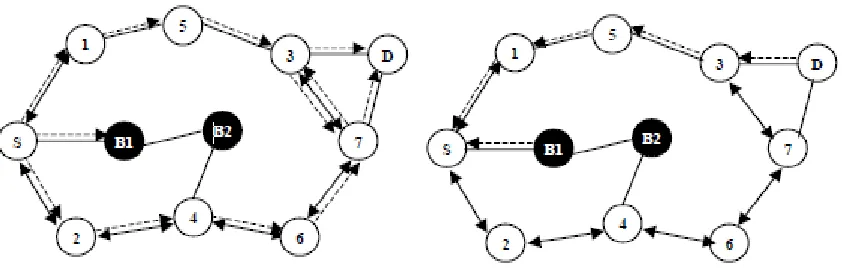
to D, as depicted by example in Figure 1. The destination node D or the intermediate node with a fresh enough route to D, initiates a route response (RREP) in the reverse direction, as depicted in Figure 3. Node S starts sending data packets to the neighboring node, which responded first, and discards the other responses. This works fine when the network has no malicious nodes.
Figure 1: Network flooding of RREQ Figure 2: Propagation of RREP messages
Researchers have proposed solutions to identify and eliminate a single black hole node [3]. However, the case of multiple black hole nodes acting in coordination has not been addressed. For example, when multiple black hole nodes are acting in coordination with each other, the first black hole node B1 refers to one of its teammates B2 as the next hop, as depicted in Figure 2. According to [3], the source node S sends a “Further Request (FRq)” to B2 through a
(IJAER) 2011, Vol. No. 1, Issue No. V, May ISSN: 2231-5152 solution proposed in [3], node S starts passing the data packets assuming that the route S-B1-B2 is secure. However, in reality, the packets are consumed by node B1 and the security of the network is compromised.
SOLUTION
In this section, we propose a methodology for identifying multiple black hole nodes Cooperating as a group with slightly modified AODV protocol by introducing Data Routing Information (DRI) Table and Cross Checking.
3.1 Data Routing Information Table
Figure 3: Solution to avoid multiple black hole Figure 4: Solution to identify multiple black hole Attack. nodes in one-time check
(IJAER) 2011, Vol. No. 1, Issue No. V, May ISSN: 2231-5152
Node Address Packet drops Packet forwards Misbehave
Table1.1. Node reliability table.
Node Address: Address of next hop node.
Packet Drops: Counter for counting the dropped packet.
Packet Forwards: Counter for counting the forwarded packet.
Misbehave: It has two values 0 and 1, 0 for well behaving node, 1 for misbehaving node.
CROSS CHECKING
Figure 3: Solution to avoid cooperative black hole attack Figure 4: Solution to identify multiple black hole
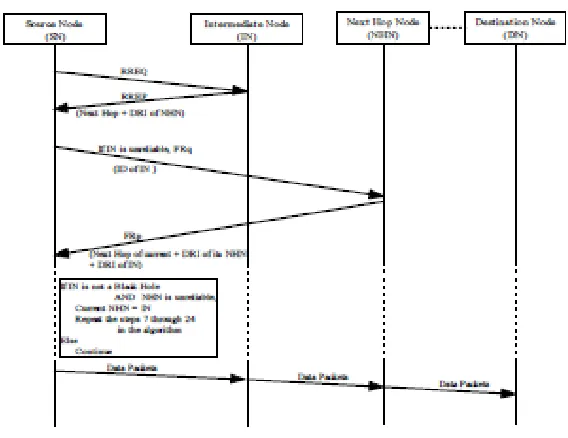
nodes in one-time check In our techniques we rely on reliable nodes (nodes through which the source node has routed data) to transfer data packets. The modified AODV protocol, and the algorithm for our proposed methodology are illustrated in Figure 5. In the protocol, the source node (SN) broadcasts a RREQ message to discover a secure route to the destination node. The Intermediate Node (IN) generating the RREP has to provide its Next Hop Node (NHN), and
its DRI entry for the NHN. Upon receiving RREP message from IN, the source node will check its own DRI table to see whether IN is a reliable node. If source node has used IN before to route data, then IN is a reliable node grater then the thrshould1 and thrshould2 according to reliability algorithm and source node starts routing data through IN. Otherwise, IN is unreliable and the source node sends FRq message to NHN to check the identity of the IN, and asks NHN: 1) if IN has routed data packets through NHN, 2) who is the current NHN’s next hop to destination, and 3) has the current NHN routed data through its own next hop.
(IJAER) 2011, Vol. No. 1, Issue No. V, May ISSN: 2231-5152 node, the route is secure, and source node will update its DRI entry for IN with 01, and starts routing data via IN. If IN is a black-hole, the source node identifies all the nodes along the reverse path from IN to the node that generated the RREP as black hole nodes. Source node ignores any other RREP from the black holes and broadcasts the list of cooperative black holes. If NHN is an unreliable node, source node treats current NHN as IN and sends FRq to the updated IN’s next hop node and goes on in a loop from steps 7 through 24 in the algorithm. Here we cannot measure
the reliability at different threshold so that after this we measure the reliability with the help of reliability table at each
node.
Pseudo code of prevent multiple black hole attack in MANETs
Notations :
SN: Source Node IN: Intermediate Node DN: Destination Node NHN: Next Hop Node FRq: Further Request FRp: Further Reply
Reliable Node: The node through which the SN has routed data DRI: Data Routing Information
ID: Identity of the node 1 SN broadcasts RREQ 2 SN receives RREP
3 IF (RREP is from DN or a reliable node>th1or th2) { 4 Route data packets (Secure Route)
5 } 6 ELSE { 7 Do {
8 Send FRq and ID of IN to NHN
9 Receive FRp, NHN of current NHN, DRI entry for 10 NHN's next hop, DRI entry for current IN
11 IF (NHN is a reliable node>th1or th2) { 12 Check IN for black hole using DRI entry 13 IF (IN is not a black hole)
(IJAER) 2011, Vol. No. 1, Issue No. V, May ISSN: 2231-5152 15 ELSE {
16 Insecure Route 17 IN is a black hole
18 All the nodes along the reverse path from IN to the node 19 that generated RREP are black holes
20 } 21 } 22 ELSE
23 Current IN = NHN
24 } While (IN is NOT a reliable node) 25 }
Pseudo code of reliability table mechanism
1.Data packet forwarded or sent.
2.Copy and keep the data packet in DRI table until it is expired or forwarded 3.If (data packet forwarded)
{Increment the corresponding forwarded packet in the node-reliability table and remove the data packet from DRI table}
4.If (data packet expires in the DRI table)
{Increment the corresponding dropped packet in the node-reliability table and remove the data packet from DRI table
If (dropped packet >threshold(th1)) then
{
If (dropped packet /forwarded packet)> threshold(th2))
{
Node is misbehaving
Promiscuous node locally tells all the node of its wireless range that particular node is misbehaving node.
Discard RREP message coming from the misbehaving node
(IJAER) 2011, Vol. No. 1, Issue No. V, May ISSN: 2231-5152
}
}
}
Figure 5: Modified AODV protocol and algorithm to prevent cooperative black hole attack
As an example, let’s consider the network in Figure 4. When node B1 responds to source node S with RREP message,
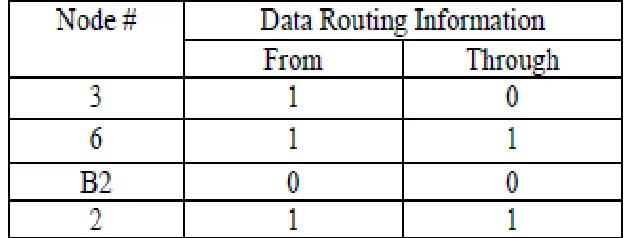
it provides its next hop node B2 and DRI for the next hop (i.e. if B1 has routed data packets through B2). Here the black hole node lies about using the path by replying with the DRI value equal to 0 1. Upon receiving RREP message from B1, the source node S will check its own DRI table to see whether B1 is a reliable node. Since S has never sent any data through B1 before, B1 is not a reliable node to S. Then S sends FRq to B2 via alternative path S-2-4-B2 and asks if B2 has routed any data from B1, who is B2’s next hop, and if B2 has routed data packets through B2’s next hop. Since B2 is collaborating with B1, it replies positively to all the three requests and gives node 6 (randomly) as its next hop.
(IJAER) 2011, Vol. No. 1, Issue No. V, May ISSN: 2231-5152 value corresponding to B2 is equal to 0 0 as shown in Figure 4. Based on this information, node S can infer that B2 is a black hole node. If node B1 was supposed to `have routed data packets through node B2, it should have validated the node before sending it. Now, since node B2 is invalidated through node 6, node B1 must cooperate with node B2. Hence both nodes B1 and B2 are marked as black hole nodes and this information is propagated through the network leading to their listing as black holes, and revocation of their certificates. Further, S discards any further responses
from B1 or B2 and looks for a valid alternative route to D. The process of cross checking the intermediate nodes is a one time procedure which we believe is affordable to secure a network from multiple black hole nodes. The cost of cross checking the nodes can be minimized by letting nodes sharing their trusted nodes list (DPI table) with each other.
Simulation approach:-
Average received Throughput: - It is the total number of received packet per unit time. In another term, throughput is the packet size (in term of bits) that is going to be transmitted divided by the time that is used to transmit these bits.
Average sending Throughput: - It is the total number of sending packet per unit time. In another term, throughput is the packet size (in term of bits) that is going to be transmitted divided by the time that is used to transmit these bits.
Total throughput = (Average received throughput / Average sending throughput)*100%
End-to-end delay: - This is defined as the delay between the time at which the data packet was originated at the source and the time it reaches the destination.
Delay = Receiving time - Sending time
(IJAER) 2011, Vol. No. 1, Issue No. V, May ISSN: 2231-5152
Packet loss =((Total No. of packet sent -Total No. of packet received ) / ( Total No.of packet sent ) )*100%
1) First, results are calculated for throughput vs. number of black hole node,
Figure 6: Throughput vs. Black hole nodes for 50 nodes
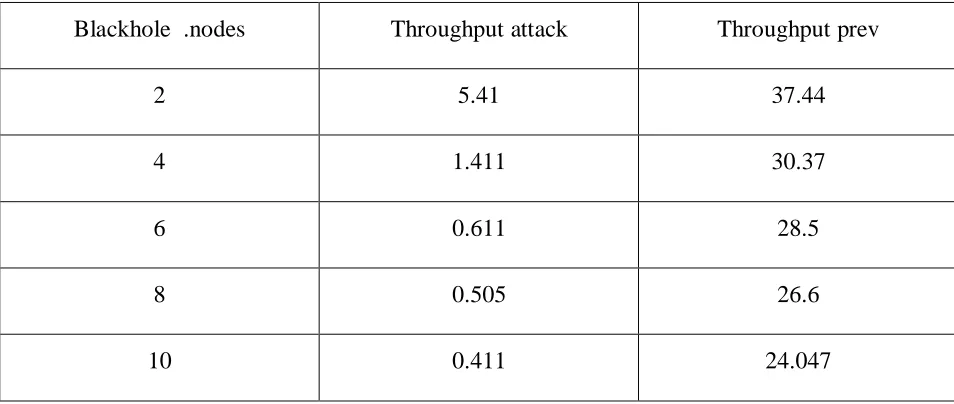
The results are shown in table 9 increases in the value of throughput when the modified AODV based on DRI mechanism is active in the presence of 2,4,6,8,10 black hole nodes.
Table 5.2: Percentage increase in Throughput in the presence of 2,4,6,8,10 Black hole nodes
Blackhole .nodes Throughput attack Throughput prev
2 5.41 37.44
4 1.411 30.37
6 0.611 28.5
8 0.505 26.6
10 0.411 24.047
Throughput vs Black hole nodes
0 10 20 30 40
0 5 10 15
Black hole nodes
Th
ro
ug
hp
ut(%
)
(IJAER) 2011, Vol. No. 1, Issue No. V, May ISSN: 2231-5152
2) Second, results are calculated for packet loss vs. number of black hole node, these line charts are shown below:-
Figure 7: packet loss vs. Black hole nodes for 50 nodes
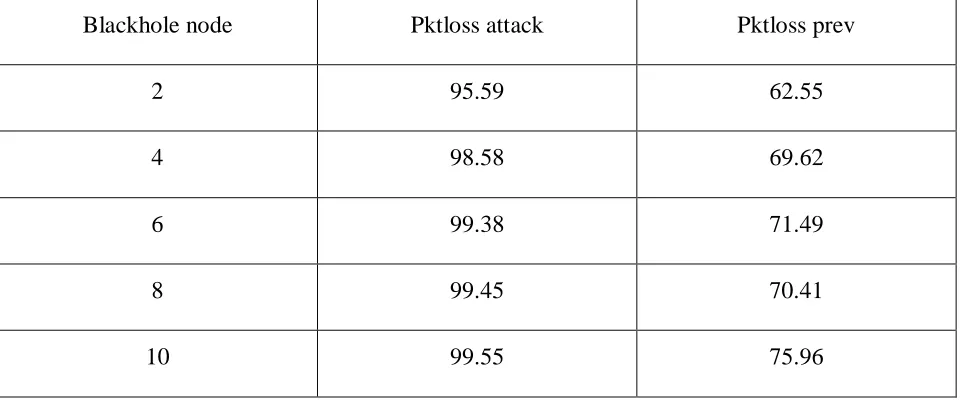
The results are shown in table 10 decrease the value of packet loss when the modified AODV based on DRI mechanism is active in the presence of 2,4,6,8,10 black hole nodes.
Table 5.3: Percentage decrease the packet loss in the presence of 2,4,6,8,10 Black hole nodes
Blackhole node Pktloss attack Pktloss prev
2 95.59 62.55
4 98.58 69.62
6 99.38 71.49
8 99.45 70.41
10 99.55 75.96
Packetloss vs Black hole nodes
0 50 100 150
0 5 10 15
Black hole nodes
Pa
c
k
e
tl
o
s
s
(%
)
Packetlos s attack with DRI inactive m ode
(IJAER) 2011, Vol. No. 1, Issue No. V, May ISSN: 2231-5152
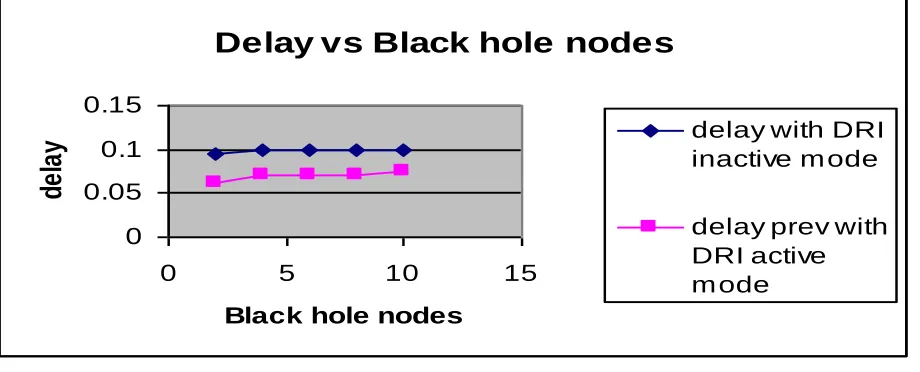
3) Results are calculated for delay vs. number of black hole node, these line charts are shown below:-
Figure 5.3: delay vs. Black hole nodes for 50 nodes
The results are shown in table 11 decrease the value of dealy when the modified AODV based on DRI mechanism is active in the presence of 2,4,6,8,10 black hole nodes.
Table 5.4: Percentage decrease the dealy in the presence of 2,4,6,8,10 Black hole nodes
Blackhole node Delay attack Delay prev
2 0.0956 0.0626
4 0.0986 0.0696
6 0.0994 0.0715
8 0.0995 0.0704
10 0.0996 0.076
Delay vs Black hole nodes
0 0.05 0.1 0.15
0 5 10 15
Black hole nodes
de
la
y
delay with DRIinactive m ode(IJAER) 2011, Vol. No. 1, Issue No. V, May ISSN: 2231-5152
Analysis:- The experimental results show that when we using same simulation parameter with reliability measurement and modified AODV were tested on above-mentioned networks having the black hole nodes are increased such as 2,4,6,8,10 in the network then in the presence of DRI active mode throughput increases up to 24% to 32% and packet loss decrease 40% to 30% and delay decrease 0.04 ms to 0.03 ms, compare with the DRI inactive mode.
CONCLUSIONS AND FUTURE WORK
In this paper we have studied the routing security issues of MANETs, described the Cooperative black hole attack that can be mounted against a MANET and proposed a feasible solution for it in the AODV protocol. The proposed solution can be applied to 1.) Identify multiple black hole nodes cooperating with each other in a MANET; and 2.)
Discover secure paths from source to destination by avoiding multiple black hole nodes acting in cooperation and its implementation. As future work, we intend to study the impact of GRAY hole nodes (nodes which switch from good nodes to black hole nodes) and techniques for their identification.
REFERENCES
[1] Elizabeth M. Royer, and Chai-Keong Toh, “A Review of Current Routing Protocols for AdHoc Mobile Wireless Networks,” IEEE Personal Communications, pp. 46-55, April 1999.
[2] Charles E. Perkins, and Elizabeth M. Royer, “Ad-hoc On-Demand Distance Vector (AODV) Routing,” Internet
Draft, November 2002.
[3] Hongmei Deng, Wei Li, and Dharma P. Agrawal, “Routing Security in Wireless Ad Hoc Network,” IEEE
Communications Magzine, vol. 40, no. 10, October 2002.
[4] S. Marti et al., “Mitigating Routing Misbehavior in Mobile Ad Hoc Networks,” 6th Int’l.Conference Mobile Comp.
Net., pp. 255-265, August 2000.
[5] Lidong Zhou, Zygmunt J.Hass, ``Securing Ad Hoc Networks'', IEEE Special Issue on Network Security, vol-13, pp 24-30 Nov-Dec 1999
[6] Srdjan Capkuny, Levente Butty´an, and Jean-Pierre Hubaux, “Self-Organized Public-Key Management for Mobile Ad Hoc Networks,” Technical Report at EPFL,
(IJAER) 2011, Vol. No. 1, Issue No. V, May ISSN: 2231-5152 [7] Lidong Zhou, and Zygmunt J. Haas, “Securing Ad Hoc Networks,” IEEE Network Magazine,vol. 13, no.6,
November/December 1999.
[8] Janne Lundberg, “Routing Security in Ad Hoc Networks,” netsec-lundberg.pdf/routing-security-in-ad.pdf [9] David B. Johnson, and David A. Maltz, “Dynamic Source Routing in Ad Hoc Wireless Networks,” Mobile
Computing, edited by Tomasz Imielinski and Hank Korth, Chapter 5, pages 153-181, Kluwer Academic Publishers,
1996.
[10] Y. Zhang, W. Lee, “Intrusion Detection in Wireless Ad Hoc Networks,” 6th Int’l. Conference Mobile Comp. Net.,
Mobicom 2000, pp. 275-283, August 2000.
[11] Haiyun Luo, Petros Zerfos, Jiejun Kong, Songwu Lu and Lixia Zhang, “Self-securing Ad Hoc Wireless Networks,” http://www.cs.ucla.edu/~jkong/publications/ISCC02.pdf.
[12] C. E. Perkins and P. Bhagwat, “Highly Dynamic Destination-Sequenced Distance-Vector Routing (DSDV) for Mobile Computers,” Computer Communications Review, pp. 234-244, October 1994.
[13] Sanjay Ramaswamy, Huirong Fu, Manohar Sreekantaradhya, John Dixon, and Kendall Nygard, ``Prevention of Cooperative Black Hole Attack in Wireless Ad Hoc Networks'', 2003 International Conference on Wireless Networks (ICWN'03), Las Vegas, Nevada, USA.
[14] L.Venkatraman and D.P. Agrawal, ``Strategies for Enhancing Routing Security in Protocols for Mobile Ad Hoc Networks'', IEEE Network Magazine, vol. 13, no-6, Nov 1999
[15] The Network Simulator - ns-2 http://www/isi.edu/nsnam/ns.
[16] Kevin Fall and Kannan Varahan, editors. ''NS Notes and Documentation'', the VINT Project, UC Berkeley, LBL, USC/ISI, and Xerox PARC, November 1997.
[17] K.Gorantala, ``Routing Protocol in Mobile Ad-hoc Networks,'' Technical report Department of Computer Science from UMEA University, June-2006.
[18] X. Hong, Kaixin Xu, and Mario Gerla, ``Scalable routing protocols for mobile ad hoc networks'', IEEE Network Magazine, pp11-21, July-Aug2002
[19] V.D.Park and M.S.Corson, ``A Highly Adaptive Distributed Routing Algorithm for Mobile Wireless Networks,'' Proc. INFOCOM, Apr-1997.
[20] L.Buttyan and J.P.Hubaux, ``Enforcing service availability in mobile ad hoc networks'', in Proceedings of MobiHOC, USA, Aug 2000.
[21] S.Buchegger and J.Y.L.Boudec, ``Performance analysis of CONFIDANT protocol: Cooperation of nodes'', In Proceedings of IEEE Workshop on Mobie adhoc network, Lausanne, June 2002
(IJAER) 2011, Vol. No. 1, Issue No. V, May ISSN: 2231-5152 [23] B.Awebuch, D.Holmer and H.Rubens, ``An on-demand secure routing protocol resilient to Byzantine failure'', in Procedding of Security Workshop on MobiCom, 2002
[24] R. Ramanujan, S.Kudige, T.Nguyen and F. Adlestein, ``Intrusion-resistant ad hoc wireless networks'', in Proceedings of MilCom, October 2002
[25] Bing Wu, Jianmin Chen, Jie Wu, Mihaela Cardei , ``Survey on Attacks and Countermeasures in Mobile Ad Hoc
Networks'' in florida atlantic university, pp 1-38, jan 2006
______________________