_____________________________________________________________________________________________________ *Corresponding author: E-mail: [email protected];
(Past name: British Journal of Pharmaceutical Research, PastISSN: 2231-2919, NLM ID: 101631759)
Development and Validation of Ultra High
Performance Liquid Chromatographic (UHPLC)
Method for the Determination of Roxithromycin in
the Broiler Plasma
R. D. Singh
1*, S. K. Mody
1, H. B. Patel
1, V. N. Sarvaiya
1, B. R. Patel
1and S. B. Gondaliya
21Department of Pharmacology and Toxicology, College of Veterinary Science & A.H., SDAU,
Sardarkrushinagar, Gujarat – 385506, India. 2
Central Instrumentation Laboratory, SDAU, Sardarkrushinagar, Gujarat – 385506, India.
Authors’ contributions
This work was carried out in collaboration among all authors. Author RDS designed the study and prepared the primary draft. Authors SKM and HBP managed the analyses of the study. Author VNS managed the literature searches. All authors were participated in the execution of laboratory study. All authors read and approved the final manuscript.
Article Information
DOI: 10.9734/JPRI/2019/v31i630318 Editor(s): (1) Dr. Jongwha Chang, University of Texas, College of Pharmacy, USA. Reviewers: (1) Hideharu Shintani, Chuo University, Japan. (2)Syed Umer Jan, University Of Balochistan, Pakistan. Complete Peer review History:https://sdiarticle4.com/review-history/52726
Received 11 September 2019 Accepted 15 November 2019 Published 21 November 2019
ABSTRACT
Aims: The present study was designed to develop and validate the UHPLC method for quantitative determination of roxithromycin, a macrolide antimicrobial drug, in broiler plasma for the application of pharmacokinetic studies.
Methodology: UHPLC apparatus comprised of ultraviolet (UV) detector was used in the present study. Chromatographic separation was performed by using reverse phase C18 column. Mobile phase was combination of buffer and 55 acetonitrile in the ratio of 55: 45. Buffer part used was 0.1% trifluoroacetic acid (v/v) having pH of 2.1. Erythromycin was used as an internal standard. Isocratic elution mode was employed with flow rate of 1 ml/min and effluents were monitored at wavelength of 220 nm. Liquid-liquid extraction using ice-cold acetonitrile was performed to extract
roxithromycin from plasma samples. The data integration was performed using Chromeleon™ version 6.8 software.
Results: The linear calibration curve with a mean correlation
observed for concentrations ranging from 0.20 to 12.80 µg/ml. At any concentration, accuracy was not found to be less than 90%. The mean extraction recovery (n=5) for concentrations of 0.40 µg/ml was 81.36%. The calculated intraday and interday C.V. % was not more than 7.70% and 9.42%, respectively, at any concentration studied. The specificity of the analysis was reflected by the narrow range of retention time ranging between 6.983 to 7.178 minutes. LOD and LOQ of the method under investigation were calculated as 0.131 and 0.398 µg/ml, respectively
Conclusion: A reliable, reproducible, accurate, precise, specific and sensitive method for analysis of roxithromycin in broiler plasma was developed and validated for applica
pharmacokinetic study of the roxithromycin.
Keywords: UHPLC; roxithromycin; method validation; broiler plasma.
1. INTRODUCTION
Roxithromycin is a semi-synthetic, long orally administered antibacterial drug of macrolide class [1]. One of the biggest advantages of roxithromycin is its power of intracellular concentration. The pharmacokinetic profile of roxithromycin is characterized by high plasma, tissue and body fluid concent
a long half-life permitting an extended dosage interval [2]. Macrolide antibiotics and their semi synthetic derivatives like roxithromycin are most commonly used in poultry to treat avian mycoplasmosis and are considered to be bacteriostatic at low therapeutic concentrations, but can be slowly bactericidal at higher concentrations [3]. Roxithromycin is widely used as antimicrobial drug for treating many bacterial infections especially Mycoplasma spp. in broiler chickens. In Asian countries, its use is more in poultry industry for the treatment of Chronic Respiratory Disease (CRD) caused by avian pathogen Mycoplasma gallisepticum
chemical structure of roxithromycin is presented as Fig. 1.
Simple HPLC - UV (using ultra-violet detector) methods are reported for the roxithromycin detection from tablets or pharmaceutical formulations and used for stability studies [ but these methods do not portray analysis from biological matrices like plasma. The quantification of roxithromycin from p needs additional compatible extraction protocol from plasma. A number of advanced methods are reported for analysis of roxithromycin in biological matrices like rat plasma [7], rat lung tissues [8], human serum [9], human urine [10] and human plasma [11,12]. But all these methods involved advanced and costly detection
roxithromycin from plasma samples. The data integration was performed using Chromeleon™
The linear calibration curve with a mean correlation coefficient (R2) value of 0.9999 was observed for concentrations ranging from 0.20 to 12.80 µg/ml. At any concentration, accuracy was not found to be less than 90%. The mean extraction recovery (n=5) for concentrations of 0.40 µg/ml ted intraday and interday C.V. % was not more than 7.70% and 9.42%, respectively, at any concentration studied. The specificity of the analysis was reflected by the narrow range of retention time ranging between 6.983 to 7.178 minutes. LOD and LOQ of the
ethod under investigation were calculated as 0.131 and 0.398 µg/ml, respectively.
A reliable, reproducible, accurate, precise, specific and sensitive method for analysis of roxithromycin in broiler plasma was developed and validated for applica
pharmacokinetic study of the roxithromycin.
method validation; broiler plasma.
synthetic, long-acting, administered antibacterial drug of macrolide class [1]. One of the biggest advantages of roxithromycin is its power of intracellular concentration. The pharmacokinetic profile of roxithromycin is characterized by high plasma, tissue and body fluid concentrations and life permitting an extended dosage interval [2]. Macrolide antibiotics and their semi-synthetic derivatives like roxithromycin are most commonly used in poultry to treat avian mycoplasmosis and are considered to be low therapeutic concentrations, but can be slowly bactericidal at higher concentrations [3]. Roxithromycin is widely used as antimicrobial drug for treating many bacterial spp. in broiler use is more in poultry industry for the treatment of Chronic Respiratory Disease (CRD) caused by avian Mycoplasma gallisepticum [4]. The chemical structure of roxithromycin is presented
violet detector) methods are reported for the roxithromycin detection from tablets or pharmaceutical formulations and used for stability studies [5,6] but these methods do not portray analysis from biological matrices like plasma. The quantification of roxithromycin from plasma needs additional compatible extraction protocol from plasma. A number of advanced methods are reported for analysis of roxithromycin in biological matrices like rat plasma [7], rat lung tissues [8], human serum [9], human urine [10] 12]. But all these methods involved advanced and costly detection
techniques using electrochemical, amperometric, photo-diode array and fluorescence (with derivitazation) detectors. One report of roxithromycin detection using HPLC
was reported, that too for human plasma [13]. For broiler plasma, no HPLC -
reported, however costly advanced LC technique is reported for detection of roxithromycin from broiler tissues implicated mainly for residue studies [14]. Thus, the present study was undertaken to develop and validate a simple UHPLC-UV method for determination of roxithromycin in broiler chicken’s plasma for studying pharmacokinetic studies.
Fig. 1. Chemical structure of roxithromycin (9E-[O-{(2-methoxyethoxy)-methyl}oxim
erythromycin)
2. MATERIALS AND METHODS
2.1 Drugs and Chemicals
Certified E.P. (European Pharmacopoeia) grade of roxithromycin and erythromycin (for internal roxithromycin from plasma samples. The data integration was performed using Chromeleon™
) value of 0.9999 was observed for concentrations ranging from 0.20 to 12.80 µg/ml. At any concentration, accuracy was not found to be less than 90%. The mean extraction recovery (n=5) for concentrations of 0.40 µg/ml ted intraday and interday C.V. % was not more than 7.70% and 9.42%, respectively, at any concentration studied. The specificity of the analysis was reflected by the narrow range of retention time ranging between 6.983 to 7.178 minutes. LOD and LOQ of the
A reliable, reproducible, accurate, precise, specific and sensitive method for analysis of roxithromycin in broiler plasma was developed and validated for application in the
techniques using electrochemical, amperometric, diode array and fluorescence (with derivitazation) detectors. One report of roxithromycin detection using HPLC - UV method ted, that too for human plasma [13]. UV method is reported, however costly advanced LC-MS technique is reported for detection of roxithromycin from broiler tissues implicated mainly for residue studies [14]. Thus, the present study was undertaken to develop and validate a UV method for determination of roxithromycin in broiler chicken’s plasma for
Fig. 1. Chemical structure of roxithromycin
methyl}oxime]-HODS
standard) pure drug powders were procured from Sigma-Aldrich Chemicals Pvt. Ltd., Bengaluru, India. Water, acetonitrile, trifluoroacetic acid, sodium hydroxide and other reagents of HPLC grade were procured from S. D. Fine-Chem Limited, Mumbai, India. Triethylamine of HPLC grade was procured from Merck, Mumbai, India.
2.2 Broiler Plasma
The blank drug free plasma from broiler chickens was supplied by the Department of Livestock Production and Management, College of Veterinary Science and Animal Husbandry, SDAU, Sardarkrushinagar, Gujarat, India.
2.3 Instruments
Ultra high performance liquid chromatography (UHPLC) apparatus (Dionex ultimate 3000®, Thermo Fisher, Germany) comprised of ultraviolet (UV) detector and gradient solvent delivery pump was used in the present study. Chromatographic separation was performed by using reverse phase C18 column (ODS, 25 cm x 4.6 mm ID, 4.5 µ; Purospher® Star RP-18, Merck-Millipore, Mumbai, India) at ambient temperature (~28°C). The data integration was performed by software ‘Chromeleon™ version 6.8’ Chromatography Data System.
2.4 Drug Extraction from Plasma Standards
Drug-free broiler plasma was used for making different roxithromycin concentrations of 0.20, 0.40, 0.80, 1.60, 3.20, 6.40, and 12.80 mg/ml. After drug extraction, each of these standards was run in quintuple (n=5) to get area response in UHPLC. Liquid-liquid extraction using ice-cold acetonitrile was performed to extract roxithromycin from plasma samples. Exactly 400 µL of plasma sample was taken into 2 ml Eppendorf® micro-centrifuge tube, and then 40
µL 1 M NaOH was added to it and vortexed for about 10 seconds. After this alkalinization, 1200 µL ice-cold acetonitrile was added in same tube and vortex mixed for 3 minutes at 2400 RPM. Then the mixture was centrifuged at 5000 RPM for 10 minutes at 4°C. Upper organic phase was collected and dried under nitrogen (N2) evaporator (AT-EV-50, Athena Technology, Mumbai, India). Exactly, 20 µL of internal standard (200 mg/ml erythromycin dissolved in diluent) was mixed with 80 µL diluent (made up of equal parts of ice-cold acetonitrile and HPLC grade water) for reconstitution of each extracted and evaporated sample. Thus, dried residues were reconstituted with total 100 µL diluent. The prepared sample was finally centrifuged (5000 RPM, 5 minutes, 4°C) and 20 µL of the upper clear portion was manually injected into UHPLC.
2.5 Optimized Chromatographic Con-ditions
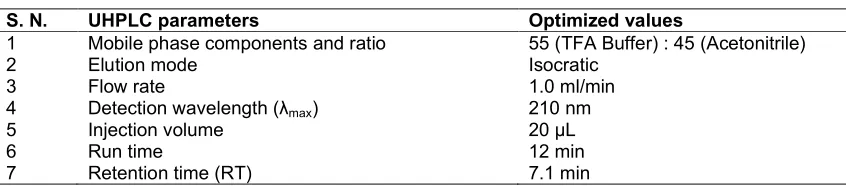
The optimized chromatographic parameters for UHPLC analysis of roxithromycin concentrations in broiler plasma sample are given in Table 1. Mobile phase comprises of 55 parts of buffer with 45 parts of acetonitrile. Buffer part was prepared by mixing trifluoroacetic acid (TFA) with HPLC grade water to yield strength of 0.1% TFA buffer (v/v) having pH of 2.1. It was filtered by filter paper (0.45 µm pore size) by using a vacuum pump and degassed using ultrasonic sonicator before use. During sample run, intermittent washings of microsyringe were done with washing solution (80 Acetonitrile: 20 HPLC grade water) to avoid carry over effect.
The representative chromatograms are shown in Fig. 2.
UV detector responses were generated as chromatograms using ‘Chromeleon™ version 6.8’ software at the data collection rate of 2.5 Hz and a time constant of 0.6 second.
Table 1. Optimized chromatographic parameters for UHPLC analysis of roxithromycin
S. N. UHPLC parameters Optimized values
1 Mobile phase components and ratio 55 (TFA Buffer) : 45 (Acetonitrile)
2 Elution mode Isocratic
3 Flow rate 1.0 ml/min
4 Detection wavelength (λmax) 210 nm
5 Injection volume 20 µL
6 Run time 12 min
Fig. 2. Chromatograms of (A) blank plasma, (B) plasma spiked with roxithromycin (5 µg/ml)
2.6 Method Validation
For validation of the present developed
method for analysis of roxithromycin, major parameters like linearity, recovery, accuracy and precision (intraday and inter-day) were calculated as per standard guidelines [15,
detection (LOD) and Limit of quantification (LOQ) were calculated using the standard deviation of responses (Std. Dev.) and the slope value of the calibration curve [17]. Formulae used were LOD = 3.3 x (Std. Dev. / Slope) and, LOQ = 10 x (Std. Dev. / Slope).
2.7 Statistical Analysis
All values are expressed as the mean ± standard deviation. Precision C.V. (Co
variance) was calculated as % = (Standard Deviation / Mean of observed concentration) X 100.
3. RESULTS AND DISCUSSION
3.1 Optimization of Chromatographic Parameters
The ultimate goal of optimization of any HPLC method is to achieve good resolution peaks with acceptable retention times but without peak tailing, absence of the interfering background peaks, and high and stable sensitivity [1 easier to achieve absence of interfering background peaks when analysis is to be done in simple matrices. However, for the present study, involving the analysis in complex biological matrix like plasma, minimizing the interfering peaks was focused. Many buffers have been used in past for reverse phased chromatographic estimation of roxithromycin mainly phosphate and acetate buffers [7,11,13,19], but in present study, trifluoroacetic acid (TFA) buffer gives good chromatographic results in terms of satisfactory
Fig. 2. Chromatograms of (A) blank plasma, (B) plasma spiked with roxithromycin (5 µg/ml)
For validation of the present developed UHPLC method for analysis of roxithromycin, major parameters like linearity, recovery, accuracy and day) were calculated 15,16]. Limit of detection (LOD) and Limit of quantification (LOQ) lated using the standard deviation of responses (Std. Dev.) and the slope value of the calibration curve [17]. Formulae used were LOD LOQ = 10 x (Std.
the mean ± standard deviation. Precision C.V. (Co-efficient of variance) was calculated as % = (Standard observed concentration) X
SSION
Chromatographic
optimization of any HPLC method is to achieve good resolution peaks with acceptable retention times but without peak tailing, absence of the interfering background peaks, and high and stable sensitivity [18]. It is easier to achieve absence of interfering background peaks when analysis is to be done in simple matrices. However, for the present study, involving the analysis in complex biological matrix like plasma, minimizing the interfering peaks was focused. Many buffers have been phased chromatographic estimation of roxithromycin mainly phosphate ], but in present study, trifluoroacetic acid (TFA) buffer gives good chromatographic results in terms of satisfactory
separation of peaks in plasma samples. added advantage for having longer working life of silica columns. The precaution was taken to prepare fresh 0.1% TFA (v/v) each day prior to analysis due to its volatile nature. Initially, gradient method was followed started with 95% buffer and 5% acetonitrile scheme stage wise finally changed to 5% buffer and 95% acetonitrile at 10 minutes but was finally avoided due lack of reproducibility in the terms of retention time. Finally, isocratic method with 55% TFA buffer and 45% acetonitrile was found suitable and was adopted. HPLC grade Acetonitrile (ACN) was used as organic modifier part in mobile phase as it was reported to having good solute retention capacity for roxithromycin [1 Moreover, ACN is good choice when detection is to be done at lower wavelengths of 200
as it has lower UV cut-off value of 190 nm. Generally, macrolides are known to show higher absorbance at lower wavelengths and produce weak chromatographic signals. Roxithromycin exhibits weak absorbance at higher wavelength (235 nm) [13]. UV-detection of roxithromycin has been performed at lambda max (λ
between 200 to 220 nm [5,6,10,13]. The three wavelengths i.e. 205, 210 and 215 were tried in the present study and larger peak areas were obtained at λmax of 210 nm; hence this wavelength was selected for chromatographic detection of roxithromycin.
3.2 Method Validation
3.2.1 Linearity
The linearity was tested from the calibration curve prepared from spiked plasma samples for concentrations in the range from 0.
µg/ml. For linearity, seven concentrations
0.4, 0.8, 1.6, 3.2, 6.4 and 12.8 µg/ml were used in quintuplet (n = 5) and their mean values were used to construct the curve. The resultant mean
Fig. 2. Chromatograms of (A) blank plasma, (B) plasma spiked with roxithromycin (5 µg/ml)
separation of peaks in plasma samples. It has added advantage for having longer working life of silica columns. The precaution was taken to prepare fresh 0.1% TFA (v/v) each day prior to analysis due to its volatile nature. Initially, gradient method was followed started with 95% acetonitrile scheme stage wise finally changed to 5% buffer and 95% acetonitrile at 10 minutes but was finally avoided due lack of reproducibility in the terms of retention time. Finally, isocratic method with 55% TFA buffer d suitable and was adopted. HPLC grade Acetonitrile (ACN) was used as organic modifier part in mobile phase as it was reported to having good solute retention capacity for roxithromycin [18]. Moreover, ACN is good choice when detection is lower wavelengths of 200-220 nm off value of 190 nm. Generally, macrolides are known to show higher absorbance at lower wavelengths and produce weak chromatographic signals. Roxithromycin exhibits weak absorbance at higher wavelengths detection of roxithromycin has been performed at lambda max (λmax) value 13]. The three 205, 210 and 215 were tried in the present study and larger peak areas were nm; hence this wavelength was selected for chromatographic
linear regression equation of calibration curve for roxithromycin was of y= 0.2342x + 0.0031 with r2 = 0.9999. For the individual set of values, the goodness-of-fit (r2) was found at least 0.9987 among all five curves, indicating functional linear relationship between the concentration of analyte and area under the peak.
3.2.2 Recovery
Blood plasma is a complex mixture of biologically active compounds including proteins that can bond to the target analyte or interfere with their detection. Various liquid – liquid extraction (LLE) protocols with alkalization had been used to extract roxithromycin from biological matrices using solvents like tert-butyl methyl ether [7], Diethyl ether with isopentane [11], hexane plus isoamyl alcohol [13], dichloromethane [10] and Acetonitrile [9,12]. In present study, extraction was tried with dichloromethane and acetonitrile and more recovery was observed with acetonitrile. Acetonitrile is one of the most efficient organic solvent which also removes protein from plasma. Ice cold acetonitrile was used to get better protein precipitation. The effect of acetonitrile volume on the extraction was examined at in the range of 800 to 1400 µL (2 to 3.5 times of plasma volume) and 1200 µL was found to be optimal volume as the peak area of analyte was not increased beyond this volume of extracting solvent. The presence of basic nitrogen(s) in macrolide molecules reflects the basic character of these lipophilic compounds; pKa of roxithromycin is equal to 8.8 [12]. Therefore, extraction of roxithromycin from plasma needs a high pH condition (alkalization)
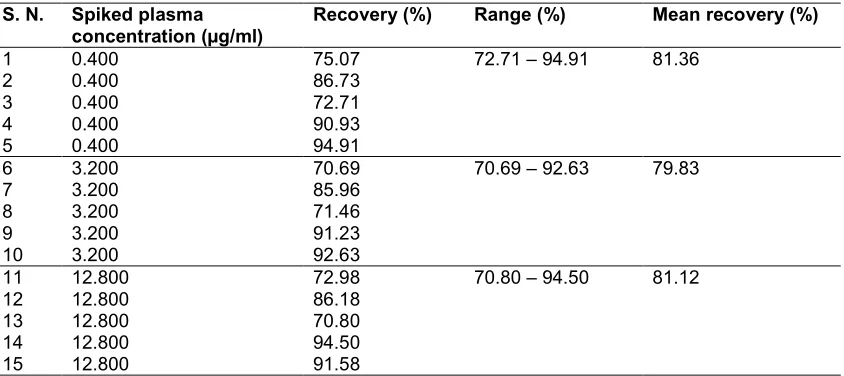
which is obtained by using 1M NaOH in the present study. Same alkalizing agent was also employed in other study to get good recovery percent of roxithromycin from plasma [7]. The extraction recovery of roxithromycin was measured by comparison of the areas of roxithromycin after injection of the extracted spiked samples (n=5) with those obtained after injection of the standard solution containing equivalent concentrations of the drug. The extraction recovery was studied at three different concentrations of 0.40 µg/ml (low near to LOQ), 3.20 µg/ml (medium) and 12.80 µg/ml (high concentration) as per validation requirements. The respective mean recoveries were obtained in similar figures as 81.36, 79.83 and 81.12% (Table 2). A higher recovery rate of roxithromycin (112%) from rat plasma was reported for amperometric detection, using tert-butyl methyl ether as extraction solvent [7] whereas extraction with hexane: isoamylalcohol (98:2) exhibited 90±3% recovery of roxithromycin in human plasma [13].
3.2.3 Accuracy
Accuracy (in per cent) was estimated by deviation of observed concentration in plasma sample with spiked known drug concentration in the plasma sample. Accuracy was studied at three different concentrations in triplicates. At any concentration, accuracy was not found to be less than 90.20% or in other terms, inaccuracy was not more than 9.8% (Table 3). In another report [13] too, the inaccuracy did not exceed 9% at all levels studied, which is quite acceptable.
Table 2. Mean extraction recoveries for roxithromycin from spiked plasma (n=5)
S. N. Spiked plasma concentration (µg/ml)
Recovery (%) Range (%) Mean recovery (%)
1 0.400 75.07 72.71 – 94.91 81.36
2 0.400 86.73
3 0.400 72.71
4 0.400 90.93
5 0.400 94.91
6 3.200 70.69 70.69 – 92.63 79.83
7 3.200 85.96
8 3.200 71.46
9 3.200 91.23
10 3.200 92.63
11 12.800 72.98 70.80 – 94.50 81.12
12 12.800 86.18
13 12.800 70.80
14 12.800 94.50
Table 3. Accuracy of the developed method for analysis of roxithromycin from broiler plasma (n=3)
S. N. Spiked plasma concentration (µg/ml) Observed concentration (µg/ml) Accuracy (%)
1 0.400 0.421 97.90
2 0.400 0.446 95.40
3 0.400 0.471 92.90
4 3.200 3.127 92.70
5 3.200 3.298 90.20
6 3.200 3.116 91.60
7 12.800 12.764 96.40
8 12.800 12.889 91.10
9 12.800 12.825 97.50
3.2.4 Precision
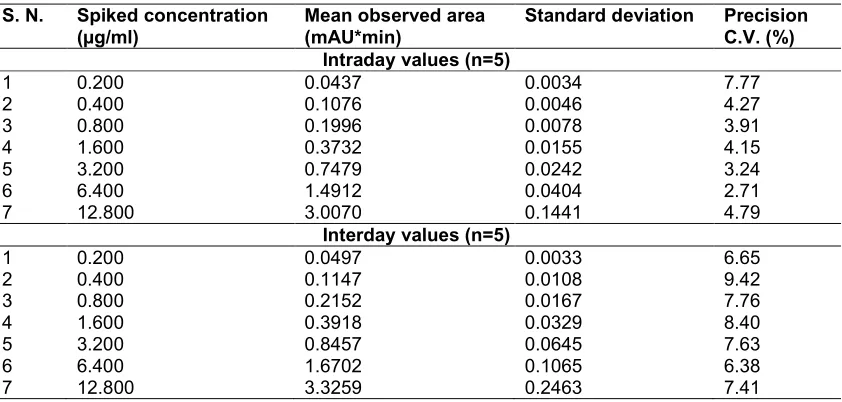
Intraday and inter-day precisions (n=5) were expressed in the terms of C.V. % (Co-efficient of variance). The highest intraday and interday C.V. % calculated was 7.70% (at 0.20 µg/ml) and 9.42% (at 0.40 µg/ml), respectively (Table 4). Thus, it was acceptable since CV% was within the acceptable 20% limit at the lower limit of quantification (0.400 µg/ml) and within 15% for other concentrations studied.
3.2.5 Specificity
This parameter is concerned with the extent to which other substances interfere with the identification and, where appropriate, quantification, of the analyte(s) of interest. The retention times of roxithromycin were specifically ranged, without any interference peaks, from 6.983 to 7.178 (~ 7.1 ± 0.1) minutes with a mean of 7.081 minutes.
3.2.6 Sensitivity
Limit of detection (LOD) and Limit of quantification (LOQ) were calculated using the standard deviation of responses and the slope value of the calibration curve. LOD and LOQ of the developed analytical method for roxithromycin were calculated as 0.131 and 0.398 µg/ml, respectively. The target quantification limit of roxithromycin in plasma for pharmacokinetic study should be above its MIC (minimum inhibitory concentration), that is 0.5 µg/ml against most of common susceptible pathogens. The MIC cut-off point for roxithromycin separating sensitive from resistant human pathogens was suggested to be 0.5 µg/ml [20] whereas, MIC breakpoints for roxithromycin against avian pathogen Mycoplasma gallisepticum were suggested as ≤ 1–4 (Sensitive), ≤ 4 (Intermediate) and > 4 (Resistant) µg/ml [21].
Table 4. Intraday and inter-day precision of roxithromycin in broiler plasma (n=5) by UHPLC - UV detection
S. N. Spiked concentration (µg/ml)
Mean observed area (mAU*min)
Standard deviation Precision C.V. (%) Intraday values (n=5)
1 0.200 0.0437 0.0034 7.77
2 0.400 0.1076 0.0046 4.27
3 0.800 0.1996 0.0078 3.91
4 1.600 0.3732 0.0155 4.15
5 3.200 0.7479 0.0242 3.24
6 6.400 1.4912 0.0404 2.71
7 12.800 3.0070 0.1441 4.79
Interday values (n=5)
1 0.200 0.0497 0.0033 6.65
2 0.400 0.1147 0.0108 9.42
3 0.800 0.2152 0.0167 7.76
4 1.600 0.3918 0.0329 8.40
5 3.200 0.8457 0.0645 7.63
6 6.400 1.6702 0.1065 6.38
3.2.7 Internal standard
Internal standard calibration involves the comparison of the instrument responses from the target compound in the sample to the responses of reference standard added to the sample or sample extract before injection [22]. The difference between retention times of the target compound and the internal standard may be used to know the relative retention time which can be further used to compensate for small retention time shifts. Roxithromycin and erythromycin were used as internal standard for quantification of each other [11,19]. Clarithromycin is also used as an internal standard in one study when pure erythromycin was not available [13]. In present analytical method for roxithromycin, erythromycin (200 µg/ml concentration in diluent) was found appropriate as an internal standard, producing consistent peak area and providing wide separations between peaks of target analyte and internal standard. Retention time of erythromycin
was 4.0 ± 0.1 minutes in the present method.
4. CONCLUSION
The developed UHPLC method for determination of roxithromycin in broiler plasma was found to be reliable, reproducible, accurate, precise, specific and sensitive method, and serves the purpose for the application in the pharmacokinetic study with limit of quantification equal to 0.398 µg/ml which is lower than the target MIC value of roxithromycin against susceptible bacterial pathogens in broiler chickens which ranges from 0.500 to 1.000 µg/ml.
CONSENT
It is not applicable.
ETHICAL APPROVAL
It is not applicable.
ACKNOWLEDGEMENTS
Authors are thankful to Central Instrumentation Laboratory (CIL) and Department of Livestock Production and Management (LPM), SDAU, Sardarkrushinagar, Gujarat, India, respectively for providing Nitrogen evaporator and broiler bird’s plasma used in the present study.
COMPETING INTERESTS
Authors have declared that no competing interests exist.
REFERENCES
1. Gaynor M, Mankin AS. Macrolide antibiotics: Binding site, mechanism of action, resistance. Curr Top Med Chem. 2003;3(9):949-960.
2. Markham A, Faulds D. Roxithromycin. Drugs. 1994;48(2):297-326.
3. Landoni MF, Albarellos G. The use of antimicrobial agents in broiler chickens. Vet J. 2015;205(1):21-27.
4. Na Lampang K, Chongsuvivatwong V, Kitikoon V. Pattern and determinant of antibiotics used on broiler farms in Songkhla province, Southern Thailand. Trop Anim Health Prod. 2007;39(5):355-361.
Available:https://doi.org/10.1007/s11250-007-9023-3
5. de Oliveira V, Bergold AM, Schapoval EE. High-performance liquid chromatographic determination of roxithromycin in tablets. Anal Lett. 1996;29(13):2377-2382.
6. Wahba ME. Liquid chromatographic determination of roxithromycin: Application to stability studies. J Chromatogr Sc. 2012;51(1):44-52.
7. Taninaka C, Ohtani H, Hanada E, Kotaki H, Sato H, Iga T. Determination of erythromycin, clarithromycin, roxithromycin and azithromycin in plasma by high-performance liquid chromatography with amperometric detection. J Chromatogr B Biomed Sci Appl. 2000;738(2):405- 411.
8. Wang P, Qi M, Jin X. Determination of roxithromycin in rat lung tissue by liquid chromatography–mass spectrometry. J Pharm Biomed Anal. 2005;39(3-4):618-623.
9. Torano JS, Guchelaar HJ. Quantitative determination of the macrolide antibiotics erythromycin, roxithromycin, azithromycin and clarithromycin in human serum by high-performance liquid chromatography using pre-column derivatization with 9-fluorenylmethyloxycarbonyl chloride and fluorescence detection. J Chromatogr B Biomed Sci Appl. 1998;720(1-2):89-97. 10. Djordjevic S, Drljevic K, Jovanovic B,
with photo diode array detection. Med Data. 2011;3(4):345-348.
11. Grgurinovich N, Matthews A. Analysis of erythromycin and roxithromycin in plasma or serum by high-performance liquid chromatography using electrochemical detection. J Chromatogr B Biomed Sci Appl. 1988;433:298-304.
12. Glowka FK, Karazniewicz-Lada M. Determination of roxithromycin in human plasma by HPLC with fluorescence and UV absorbance detection: Application to a pharmacokinetic study. J Chromatogr B. 2007;852(1-2):669-673.
13. Macek J, Ptacek P, Klima J. Determination of roxithromycin in human plasma by high-performance liquid chromatography with spectrophotometric detection. J Chromatogr B Biomed Sci Appl. 1999;723(1-2):233-238.
14. Lim JH, Park BK, Yun HI. Determination of roxithromycin by liquid chromatography/ mass spectrometry after multiple-dose oral administration in broilers. J Vet Sci. 2003;4(1):35-40.
15. FDA Center for Drug Evaluation and Research. Reviewer guidance: Validation of chromatographic methods. Division of Communications Management, FDA, Rockville, Maryland, USA; 1994.
16. Harris DC. Quality assurance and calibration methods. In: Harris DC, Lucy CA, Editors. Quantitative Chemical Analysis, 9th Ed. New York: W.H. Freeman and Company. 2016;95-112.
17. International Conference on
Harmonisation. Harmonised Tripartite Guideline Q2(R1). Validation of analytical procedures: Text and methodology. International Conference on Harmonisation (ICH) of Technical Requirements for Registration of Pharmaceuticals for Human Use; 2005.
Available:https://www.ich.org/ (Accessed on 11th October 2019)
18. Pappa-Louisi A, Agrafiotou P. Reversed-phase liquid chromatographic behavior of the macrolide antibiotics clarithromycin and roxithromycin. Chromatographia. 2002; 55(9-10):541-7.
19. Croteau D, Vallee F, Bergeron MG, LeBel M. High-performance liquid chromato-graphic assay of erythromycin and its esters using electrochemical detection. J Chromatogr B Biomed Sci Appl. 1987;419: 205-12.
20. Young RA, Gonzalez JP, Sorkin EM. Roxithromycin: A review of its antibacterial activity, pharmacokinetic properties and clinical efficacy. Drugs. 1989;37(1):8-41.
21. Hannan PC. Guidelines and
recommendations for antimicrobial minimum inhibitory concentration (MIC) testing against veterinary mycoplasma species. Vet Res. 2000;31(4):373-95. 22. United States Environmental Protection
Agency. Method 8000C: Determinative chromatographic separations. SW846, 8000C, Section 11.4.3, Revision 3, 2003. US-EPA, USA; 2003.
© 2019 Singh et al.; This is an Open Access article distributed under the terms of the Creative Commons Attribution License
(http://creativecommons.org/licenses/by/4.0), which permits unrestricted use, distribution, and reproduction in any medium,
provided the original work is properly cited.
Peer-review history: