World Maritime University
The Maritime Commons: Digital Repository of the World
Maritime University
World Maritime University Dissertations
Dissertations
2000
Towards a shipping policy for Guyana
Earnestine Gracelyn Mars
World Maritime University
Follow this and additional works at:
http://commons.wmu.se/all_dissertations
Part of the
Public Affairs, Public Policy and Public Administration Commons
This Dissertation is brought to you courtesy of Maritime Commons. Open Access items may be downloaded for non-commercial, fair use academic purposes. No items may be hosted on another server or web site without express written permission from the World Maritime University. For more information, please [email protected].
Recommended Citation
WORLD MARITIME UNIVERSITY
Malmö, Sweden
TOWARDS A SHIPPING POLICY FOR GUYANA
By
EARNESTINE GRACELYN MARS
The Cooperative Republic of Guyana
A dissertation submitted to the World Maritime University in partial
fulfillment of the requirements for the award of the degree of
MASTER OF SCIENCE
in
SHIPPING MANAGEMENT
DECLARATION
I certify that all the material in this dissertation that is not my own work has been identified, and that no material is included for which a degree has previously been conferred on me.
The contents of this dissertation reflect my own personal views, and are not necessarily endorsed by the University.
………. (Signature) ………. (Date)
Supervised by: Hodgson, Dick Associate Professor World Maritime University Malmo, Sweden
Assessor: Donner, Patrick
Associate Professor, Shipping Management World Maritime University
Malmo, Sweden
Co-assessor: Per Jessing Secretary General Swedish Shipping Forum Visiting Professor
*****************************************************************************
THIS STUDY IS DEDICATED
TO
MY DAUGHTER
WRENESA NEGILANNA ROMIA
ACKNOWLEDGEMENTS
The author wishes to express her very sincere thanks and appreciation to the many persons who have contributed in different ways to the success of this paper. Although it is not possible to mention each name, she would like to expressively thank the following individuals and organisations:
The Carl Duisberg Gesellschaft e.V. of Germany for sponsoring the two years of study at the World Maritime University.
The Government of the Republic of Guyana and the management of the Transport and Harbour Department for his nomination to pursue the course of study.
Messrs. Ivor English, General Manager, Transport and Harbour Department and Mrs. Brenda Taharally, Confidential Secretary, Transport and Harbour Department for responding to various questions and for supplying valuable information relative to shipping development in Guyana.
To Professor J. R. F. Hodgson for the invaluable assistance given in terms of supervising and guiding the author at every stage of this project.
The faculty and staff of the World Maritime University both Visiting and Resident Professors for the high quality of lectures and general knowledge which they imparted.
ABSTRACT
Title of Dissertation: Towards a Shipping Policy forGuyana
Degree: Msc
This study examines the historical and contemporary operating environments of Guyana’s shipping industry. These conditions have been the driving force which has influenced the writer’s ideas, and led to the formulation of broad policy principles to guide the formation of a strategic national shipping policy, which are likely to yield positive results if adopted.
A general introduction of the existing policies, which have guided maritime
development, sets the scene for the description, examination, analysis and evaluation of the ensuing problems.
It will come as no surprise that the existing policies, which were introduced by the British to foster their mercantile interest, need significant modifications in keeping with the rapid changes that have taken place in the global shipping industry.
It is therefore, vitally necessary for administrative policies to be carefully enacted and the shipping objectives modified to enhance economic, safety, and environmental development in the country.
and at the same time meet the demands of the regional and international shipping environment.
Most Caribbean countries have adopted maritime conventions and instruments in their national law, thereby reflecting global maritime standards. Failure of Guyana to adopt a similar course may lead to its eventual marginalisation in relation to regional
approaches in particular, and the international maritime community in general.
These pressing issues have motivated the writer to undertake this project, which aims at the development of appropriate policy principles after carefully examining and evaluating the past and present operating environments of shipping in Guyana.
TABLE OF CONTENTS
Declaration ii
Acknowledgement iii
Abstract v
Table of Contents vii
List of Tables xi
List of Abbreviation xii
CHAPTER 1 Introduction 1
1.1 Background to the study 1 1.2 Objectives of the study 4 1.3 Methodology 5 1.4 Constraints 6
CHAPTER 2 Current Structure and Operating Environment of Guyana
Shipping Industry 7
2.9 Flag State Control (FSC) 27 2.10 Port State Control (PSC) 28 2.11 Aids to Navigation (ATN) 29
2.12 Pilotage 30
2.13 Information Technology (IT) 31 2.14 Rates and Tariffs 33 2.15 Pollution Prevention and Environment Protection 34 2.16 Policy, Legislation and its Administration 35
CHAPTER 3 Evaluation and Analysis of the Current Structure and
Operating Environment of the Guyana Shipping Industry 37
3.1 Government and Policy 37 3.2 Policy Analysis 37 3.3 Maritime Policy 42 3.4 National Shipping Policy 43 3.5 Economic Evaluation and Analysis of Coastal Shipping 44 3.5.1 Intermodal/Multimodal Transport Policy 49 3.5.2 Limitation of Liability and Insurance Policy 51 3.5.3 Ports and Ports Services to Shipping 54 3.5.4 Tax Policy and Tax Administration 56 3.6 Evaluation and Analysis for Improving Safety within the Local
Shipping Industry 59 3.6.1 Safety of Ships 60 3.6.2 Standards of Training and Certification 60 3.6.3 Maritime Investigations 61 3.6.4 Piracy and Armed Robbery 62 3.6.5 Safety Services 63 3.7 Maritime Pollution and Environment Protection 64
CHAPTER 4 Examination of Options Available for the Creation of a
Cohesive Shipping Policy 66
4.1.3 Maritime Subsidies Policy 68 4.1.4 Intermodal Transportation Policy 70 4.1.5 Port State Control Policy 72 4.1.6 Cost Recovery Policy 73 4.2 Safety and Environmental Options 74
4.2.1 Role and Function of Maritime Safety
Administration 75 4.2.2 Information Technology (IT) 76
CHAPTER 5 Proposed Framework to Guide the Formation of a National
Shipping Policy 78
5.1 A Mission Statement 79 5.2 Policy Principles 80 5.3 Strategic Directions 81 5.3.1 Building the Foundation for Development 81 5.3.2 Developing Human Resources 83 5.3.3 Developing Transportation Infrastructure 83 5.3.4 Improving Safety 85 5.3.5 Cooperating with Regional Partners 86 5.4 Specific Policy Initiatives 86 5.4.1 Institutional Reforms 88 5.4.2 Human Resource Development 88 5.4.3 Regional Cooperation 89 5.4.4 Marine Sector 89
5.4.4.1 The Creation of a National Port Authority 90 5.4.4.2 The Creation of a Maritime
Administration 91 5.4.4.3 The Commercialisation of T&HD Ferry Operations 91 5.5 Implementation Approach 93
References 101
Appendices
LIST OF TABLES
Table I T&HD Services and Net Effect 105
Table II Cargo, Passenger and Vehicles Transported 106
Table III Imports by End Use 23
Table IV Exports of Major Commodities 24
Table V Hellenic Table 107
LIST OF ABBREVIATIONS
ATM Aids to Navigation
BIMCO Baltic and International Maritime Council
BOG Bank of Guyana
CARICOM Caribbean Community
CBCSL Courtney Benn Contracting Services
Limited
CIF Cost Insurance and Freight
CNN Cable News Network
CNS/ATM Communications, Navigation, Surveillance
Air Traffic Management
COLREG Convention on the International
Regulations for Preventing Collisions at Sea
EDI Electronic Data Interchange
EEC European Economic Commission
ETB External Trade Bureau
FFs Freight Forwarders
FOB Free on Board
FSC Flag State Control
GATT General Agreement on Tariffs and Trade
GNIC Guyana National Industrial Company
GOG Government of Guyana
GT Gross Tonnage
HELMEPA Hellenic Marine Environment of Pollution of the Sea by Oil
H&M Hull and Machinery
ILO International Labour Organisation
IMO International Maritime Organisation
IRD Inland and Revenue Department
ISM International Safety Management
IT Information Technology
LL International Convention on Load Lines
MARPOL International Convention for the
Prevention of Pollution from Ships
MNCs Multinational Companies
MOU Memorandum of Understanding
MSC Maritime Safety Committee
MTOs Multimodal Transport Operators
MTS Multimodal Transport Service
NTT National Task Team
NVOCC Non Vessel Operating Common Carrier
OILPOL International Convention for the
Prevention of Pollution of the Sea by Oil
P&I Protection and Indemnity
PSC Port State Control
SAR Search and Rescue
SOLAS International Convention for the Safety of
Life at Sea
STCW 95 International Convention on Standards of
Training, Certification and Watch-keeping for Seafarers
SUA International Convention for the
Safety of Maritime Navigation
TEU Twenty-foot Equivalent Unit
T&HD Transport and Harbours Department
TT Through Transport
UK United Kingdom
UNCITRAL United Nations Commission on
International Trade Law
UNCTAD United Nations Conference on Trade and
Development
UNCTC United Nations Centre on Transnational
Corporation
UNDP United Nations Development Programme
USA United States of America
US$ United States Dollar
VIP Vision, Intelligence and Passion
VTM Vessel Traffic Management
VTS Vessel Traffic Service
WIPO World Intellectual Property Organisation
WMU World Maritime University
CHAPTER 1
1. INTRODUCTION
This chapter introduces the background to Guyana’s shipping industry, the objectives of this research, the methodology used in the development of this research, and the constraints encountered during the process.
1.1 BACKGROUND TO THE STUDY
The development of shipping in particular and maritime transport infrastructure, in general, from a Guyanese perspective, must essentially be ascertained relative to the total socio-economic political system in Guyana from the colonial era to the post-republican period. It is understandable therefore; that maritime policy or shipping policy has been somewhat constrained, in a domain of competing and conflicting priorities.
It is however, not the purpose of this research to examine in minute detail every facet, which promoted or constricted the development of a coherent shipping policy in Guyana. But rather to highlight those significant elements, which can give focus to the study and enhance the quality of the final output.
Of course, some ideas and arguments are presented on policies appropriate for
Guyanese history and economic development policies have been rooted in the
institutions of the plantation economy which formed the basis for a relationship that was dynamic but yet conflictive, restrictive, and in some instances, exploitative. In this regard, shipping policy formulation was oriented towards the promotion of bulk shipping since the major focus was on the trans-shipment of primary products from Guyana to its colonial master.
Indeed, one of the major legacies of the colonial era has been the entrenchment of the 1894 British Merchant Shipping Act. This Act has guided maritime policy for over one century in Guyana and the rest of the English speaking Caribbean. It must therefore be clearly established that this type of policy was in no way unique to Guyana for
ostensibly Britain promoted a similar system of administration in all of her dependent territories.
Since 1970, when Guyana became a Republic, the economic policy adopted has been one of a planned market economy. There was a heavy state involvement in the
productive forces. It is therefore understandable that all maritime and shipping related activities would fall in this same mould. There was the establishment of the External Trade Bureau (ETB), which regulated trading, and shipping activities for imports were restricted since the intention was to restrict the importation of certain commodities. This restrictive approach generally led to the emergence of the “underground economy”, which was characterised by smuggling, the evasion of customs duties, and illegal shipping.
flag. For any serious arguments to be purported in this regard in the future would necessitate the promotion of a national fleet, which was constrained by the dictates of Guyana’s National Registry which historically had eroded.
Over the last five decades there were many studies undertaken in Guyana, which reflected the need for serious modifications, in a general sense, to be made to the existing system of transport administration in Guyana. In recognition of this, a primary concern should be the careful implementation of a needs assessment strategy, which would form the basis of any new development thrust.
Although it should be recognised that transport policy should be viewed in a wholistic sense, since it is an integral part of overall economic policy, any study undertaken should first focus upon a specific issue or sector in the transportation network, be it road, rail, air or water. It is the writer’s view that since it is a well established fact that transport is perceived as the catalyst for economic development, the inter-relationship between the various modes should not be ignored whenever a serious analysis is made of any particular sector. This is precisely why this study refers to the other modes, and attempts to justify the importance of an overall transport policy for the country.
The only serious attempt that was made to address the issue of a transport plan for Guyana was undertaken in 1975 by the Central Transport Planning Unit with the assistance of the Israel Institute of Transportation Planning and Research. Although that report identified the need for change in the maritime, aviation and road
transportation systems, there was little done in terms of implementation, for essentially, it did not transcend the stage of being a mere draft document.
It is indeed ironical that despite Guyana becoming a member of the International Maritime Organisation (IMO) in 1987, it failed to significantly amend the 1894 British Merchant Shipping Act so as to accommodate the implementation of international maritime conventions, codes and customary practices. This seems to suggest that because of the lack of a powerful and influential faction of persons in the private and public sectors in the business of transportation, the transport policy of Guyana is still in its infancy.
Since 1995 there has been a progressive move by the government to draw from the collective wisdom of the principal actors in the business of transport in order to formulate a national transportation policy. This process continues to move at a very slow pace since it lacks the full cooperation of all parties involved. However, such an approach should not be single-minded, but viewed as part of a total national strategy aimed at economic development.
Based on the foregoing, it is easy to conclude that very little has been done in terms of fostering a new and strategic policy framework for shipping administration and the development of a legal regime that is consistent with developments in the international maritime community.
1.2 OBJECTIVES OF THE STUDY
This research intends to examine the current structure and operating environment of Guyana’s shipping industry, with particular reference to:
• Economic factors
• Safety and environmental protection factors
It also intends to identify and analyse the shortcomings of the shipping industry in an attempt to evaluate the best option available in creating an efficient and coherent shipping industry and to propose some broad principles that should guide the formation of a strategic national shipping policy.
1.3 METHODOLOGY
The methodology applied is of significance to this research for it influenced the quality of the research and determined the extent to which the intended objectives were realised. The methodology took the following form:
• The collection of primary data based on contacts and interviews with several persons within the local transport industry that enabled the writer to collect and analyse information on the current situation.
• The method of participatory observation was fully utilised during the writer’s exercises and field study. Visiting experts and Chief Executive Officers of shipping companies were interviewed so as to obtain first hand information on shipping and its related issues. Information from lecture notes, handouts, seminars, lecturers and professors of the World Maritime University (WMU) was fully utilised.
• Secondary data were collected from books, journals, magazines, periodicals, articles, and the Internet with a view to summarising and analysing relevant information on various issues and concepts.
1.4 CONSTRAINTS
CHAPTER 2
2. CURRENT STRUCTURE AND OPERATING ENVIRONMENT OF THE GUYANA SHIPPING INDUSTRY
In this Chapter, the writer describes the present trends and developments in international shipping that are pertinent to policy issues, and the current structure and operating environment of Guyana’s shipping industry. The description of Guyana’s shipping environment is approached from an economic, safety and environmental protection perspective, followed by a brief explanation of its current policy, legislation and administrative framework. Careful consideration of the present system is given to the following areas:
-ECONOMIC FACTORS:
• domestic shipping and its operating environment, • inland water transport,
• support services, • freight forwarding,
• import and export of Guyana’s waterborne trade,
SAFETY FACTORS:
• safety in the design and construction of ships, • human resource development,
• information technology, • rates and tariffs, and
ENVIRONMENTAL FACTORS:
• pollution prevention and environment protection
MANAGEMENT FACTORS:
• Policy, legislation and its administration.
The writer’s description does not cover in detail all underlying factors, rather only those factors that are of significance in the current shipping environment.
2.1. INTERNATIONAL SHIPPING
For Guyana to sustain a sufficient level of shipping services at a tenable cost depends on a host of factors, including the supply of shipping services available at any given time and the extent to which competitive factors prevail in the respective trades. There are a number of current trends and developments that have emerged and have significantly upset international shipping. Given the paucity of time and other inherent limitations, it is not the writer’s intention to describe in minute detail all contemporary present day trends but rather to highlight those significant elements that have serious implications for Guyana’s shipping policy.
These trends and developments are explained in the following order: • Globalisation and liberalisation
• Mergers, alliances and acquisitions • Logistic management
• Technology
• Crew training and certification • Multi-modal Transport
2.1.1. GLOBALISATION AND LIBERALISATION
The globalisation of production and the liberalisation of trade have become engines of growth and mechanisms for integrating countries into the global economy. The establishment of institutions like the General Agreement on Tariffs and Trade (GATT) and the World Trade Organisation (WTO) has reduced trade barriers between nations. Consequently there has been a fragmentation of production processes across international borders as a result of the proliferation of business entities. Multinational companies (MNCs) have mushroomed and in some instances there has been a major increase in economic activities in areas which were hitherto stagnant. According to a joint report by International Labour Organisation (ILO), and United Nations Centre on Transnational Corporation (UNCTC) (1988), ‘many markets have become increasingly transnational and interdependent, and account for about 20% of world manufacturing output’. While the shipping industry has been responsible for aligning different stages of production, the MNCs have gained huge bargaining power and today regard ocean transport as no more than one of many links in an often complex international distribution chain. MNCs, therefore, seek out total transportation providers who are willing to meet stringent deadlines and not affect their just-in-time production system. This trend has significantly affected the shipping industry in the following ways:
• The increasing role of MNCs: - MNCs today are looking for global transportation providers rather than just shipping services. Given their large business contribution to the industry, shipping companies have had to establish offices across the globe and shift personnel in order to fit the global vision of the parent companies.
• Reduced freight rates: - According to WTO statistics, unit cost of sea freight has declined by 70 % in real terms in the last 10 to 15 years. Shipping companies have to be innovative in an effort to offer efficient services at lower costs by achieving economies of scale through mega carriers and by acquisition, mergers and alliances.
• Shipping companies’ strategies: - The shipping function is increasingly shifting from a physical shipment of goods to a value added process through new services and economic values at each step of the logistic chain. Shipping transport and communication networks are adjusting in order to benefit from the great opportunities that are evolving with logistics and multi-modal development.
Coupled with globalisation, most developing countries, especially in Asia and Latin America, are gradually favouring liberalisation of shipping, privatisation or commercialisation of State-owned enterprises, or encouragement of private sector involvement and greater competition among shipping enterprises, national and foreign (United Nations Conference on Trade and Development (UNCTAD), 1992). These changes in policy have liberalised the economies and given greater freedom of choice to shippers with respect to the utilisation of shipping companies and vessels as well as lower freight or charter rates.
promotes induced growth in the level of container traffic. These phenomena have impacted upon port throughput and service capacity, and on the number and size of ships needed to handle world container trade.
2.1.2. ACQUISITION, MERGERS AND ALLIANCES
In the increasingly competitive environment, network economy companies are seeking economies of scale and scope with the desire to satisfy market requirements, through better asset utilisation, wider service coverage, higher frequency of sailing and improved market capabilities. In view of the above, most prominent shipping companies are focusing on differentiating their services and products, and expanding by merging, take-overs, acquisitions and alliances. Presently, it is not uncommon to hear of significant cross-border and multinational deals in an attempt to provide shipping services on a broader geographical basis in order to meet trade requirements.
2.1.3. LOGISTIC MANAGEMENT
Professor Ma (1999) pointed out that logistic management is an optimization process involving the location, movement and storage of resources from the point of origin, through various economic activities, to the final consumer. This concept facilitates the trends mentioned herein, creating greater demands on international shipping services, including their performance, reliability, flexibility and quality. Thus, shipping companies, especially, in liner operations, have to arrange shipping schedules according to market requirements.
2.1.4. INFORMATION AND COMMUNICATION TECHNOLOGY
The advances in IT and communication that have brought significant developments to international shipping include the use of electronic data interchange (EDI) and the Internet. The use of electronic commerce to facilitate international transactions has benefited the shipping industry, especially, in the area of electronic bills of lading. EDI offers faster means of communication that saves time and costs, increases the level of security against fraud associated with the use of paper documents and reduces documentation errors. There are legal and technical issues regarding the use of electronic documents, which include the lack of legal recognition, writing and signature requirements and the need for document of title and negotiability. However, these issues are today solved with the use of digital signatures, private key encryption and the accommodation of the E-commerce Modal Law of the United Nations Commission on International Trade Law (UNCITRAL) into domestic and international legislation (UNCTAD 1998).
Further, according to A. Asay (2000), there was the launching of a new international shipping service in September 1999, the bolero.net. This service is designed to meet internationally accepted standards and proffers an open commercial model, a distinctive legal framework and a complete security system that facilitates international electronic transmission of documents and data between the various elements of trade, and produces similar results to those of paper transaction.
2.1.5. TECHNOLOGY
International shipping has undergone significant technological changes that have not been confined to the shipping industry but extended to its supporting transport modes and transfer points such as ports and inland terminals. Developments in shipping technology are prevalent in all shipping markets, albeit to varying degrees. In the dry and liquid bulk trades the trend has focused on economies of scale through larger sized and specialised transport units. However, the liner shipping market has progressed beyond this factor by involving changes in transport concepts towards those of multimodalism and transport logistics. This is necessary for meeting its growing demand on the international market.
The basic technological innovation that has dramatically changed international shipping is containerisation. Since its introduction vessel sizes have increased to a capacity of about 8,000 twenty foot equivalent (TEU), reflecting the desire of operators to reduce costs through economies of scale at the expense of operating flexibility, with competitive sailing speed being a critical factor. Information systems, shipboard automation, navigational equipment and aids, and satellite communication continue to be progressive factors in international shipping.
The reduction in crew size, aided by technology, has kept pace with the elimination or simplification of shipboard tasks without reducing ship safety. Today, typical crew sizes of a modern container ship range from about 15 to 18. Although, further large-scale reductions in crew size might be technically possible, it appears doubtful whether it will actually happen. According to Goss (1988, p.13), the path that may be followed lies in the qualitative upgrading of crew enabling the concept of quality assurance to be applied at sea. Moreover, reduction in crew numbers carries with it a connotation of a higher level of crew competence, including the ability of the crew to exchange responsibilities. This aspect is discussed in the following section.
2.1.6. CREW TRAINING AND CERTIFICATION
Today the focus of the international shipping industry is centered on the implementation and enforcement of the International Convention on Standards of Training, Certification and Watch-keeping for Seafarers (STCW 95) by IMO member states. This is a critical aspect of international shipping, for failure by states which are party to the convention to fulfill the necessary requirements, especially those that provide seafarers to the industry, may result in a shortage of seafarers.
IMO through the sub-committee on flag state implementation, in accordance with resolution A.847 (20), has prepared guidelines to assist flag states in the implementation of its instruments (IMO 1998). In collaboration with this, Article XI of STCW 95 has provisions for parties that request technical assistance for training, establishment of training institutions, supply of necessary equipment and facilities, development of programs, and measures to enhance seafarers qualifications (IMO 1996).
as a “white list”, of those nations that fully comply with STCW 95 requirements and are qualified to provide the world with seafarers.
Many States, for example Indonesia and the Philippines, are still in the process of meeting these mandatory requirements and are seeking IMO’s approval in extending the transition period so that they may be included in the first round of the white list (Lloyd’s List, 2000, April 12).
The Philippines, which is the single largest supplier of seafarers in the world as it relates to international commercial fleets, is battling with the important single issue as to which agency is ultimately responsible for ensuring STCW 95 compliance. According to A. Almazan (2000, March 30), this was pointed out by IMO secretary general, William O’Neil, in his response to deficiencies in the report submitted; ‘the panel is concerned that there still does not appear to be a single entity that has full responsibility for administering the STCW convention’.
Crew training and certification is an international issue for everyone in the business of shipping, for seafarers must have the necessary skill, competence and ability in order for them to operate safely in the maritime industry. This aspect is coupled with the International Safety Management (ISM) Code of safe practices and procedures, where the focus is on inculcating in crews, the necessary awareness and attitudes of a safety culture.
2.1.7. MULTI-MODAL/INTERMODAL TRANSPORT
movement of goods, which uses successively several modes of transport that may be under the control of a multi-modal operator.
No matter which terminology is used, as a result of globalisation of production and liberalisation of trade and technological developments, international shipping provides multi-modal/inter-modal transport service. This type of service, which is dominant with global shipping lines of the containerised trade, facilitates the movement of goods under the continuous supervision and responsibility of a single operator. Thus, unlike traditional transport, it primarily takes account of the needs of the cargo, rather than the transport mode, by ensuring an integrated transport process between the consignor and consignee.
International shipping no longer constitutes an isolated process of moving goods from point to point but has become an integrated part of total production and marketing processes in the context of marketing-logistic concepts. The general point of departure was the realisation that port-to-port container transport had become a commodity service, with resulting pressure on freight rates forcing liner companies to cut costs to an absolute minimum. Strategic responses by shipping lines to this challenge have ranged from the maintenance of a port-to-port approach aiming at attaining large transport volumes on a low-price basis to an outright direct involvement in land transport operations with an aim to provide quality logistic service.
the improvement of potential revenues, is achieved, according to UNCTAD (1992), through:
• Improved control over container movements • Control over inland transport links
• Realisation of economies of scale in inland transport
• Concentration of cargo movement through a limited number of ports • Offer of complex distribution services
• Increased flexibility in the establishment of tariffs
Based on the foregoing, it can be seen that the international shipping industry is dynamic, therefore, a full understanding of the underlying factors is significant for Guyana’s policy on shipping.
2.2. COASTAL SHIPPING AND ITS OPERATING ENVIRONMENT
Historically, the bulk of the domestic cargoes were transported by private operators and persons operating unscheduled water services that catered for their own particular needs. However, with the establishment of the Transport and Harbour Department (T&HD) in the year 1931, the water transport system became better organised. The intention was that it would be recognised as the principal agency for the operation of the ferry and coastal shipping services (Government of Guyana (GOG), 1931).
certificate of registration is based on the discretion exercised by the authority, the contractual relationship between the government and foreign companies, and on the implied policy of cabotage.
Presently, the Customs and Excise department, under the purview of the Controller of Customs, carries out the registration of local vessels. This responsibility is not assigned to the General Manager of T&HD, the designated agency. However, based on information received, this arrangement witnessed the decline of the National Registry, for ship owners were forced to pay a substantial amount for registration.
Generally, companies registered in Guyana pay a percentage of the profit earned as taxation, upon submission of audited financial returns to the Inland Revenue Department (IRD), in accordance to the GOG (1939). However, T&HD is exempted from taxation since it is a government department and its services are for public convenience. This privilege is not offered to private operators but in most cases, because the operators are not registered companies, and because the antiquated taxation system lacks coordination between tax policy and tax administration, they may be able to evade taxation.
Apart from being exempted from taxation, T&HD is heavily subsidised by the Government of Guyana. Significant financial assistance is provided towards various capital works such as the acquisition of new vessels and/or rehabilitation or reconstruction of existing ones, and for maintaining terminals and wharves in facilitating operational services. The privately owned operators are in no official way being subsidised. Bank loans to individuals for developing the local shipping industry are neither supported nor encouraged by the government.
integrated inter-modal network. However, the traditional usage of supportive water transport infrastructure, and the customs of operators and shippers, exclusively relies on segmented transportation service. Containers are extensively and consistently used in the import and export of cargoes but because the potential efficiencies in their use are not recognised, and due to a lack of efficient intermodal infrastructure, they are presently loaded and unloaded at the ports.
There is considerable traffic on the three main rivers of Guyana and along the coast. In fact in many areas the rivers are the principal means of transport. The extent of the total public and private local fleet is still being assessed, but nine vessels are operated by T&HD in providing coastal and ferry services. It should be noted that although these vessels are in excess of thirty years old, they are well maintained in accordance with local maritime standards.
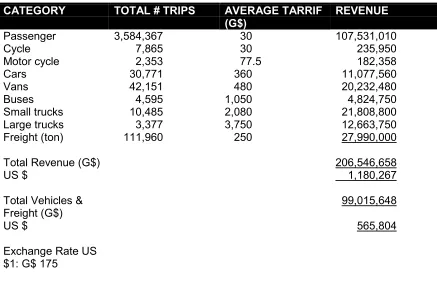
T&HD offers several coastal and ferry services across the rivers of Guyana. Of all the services offered by T&HD, as shown in the Appendix I, Table I, only two consistently show profits; the Rogisnol/New Amsterdam and the Parika/Adventure. For the remainder, in particular the Berbice River and the North West services, the government has provided a cross-subsidy, funded out of the profits realised by the Harbours, since T&HD also has the responsibility for the superintendence of ports and harbours. The importance of one of the main services is reflected in the statistical figures of value/volume of passenger, vehicular and cargo transported in Appendix I, Table II.
2.3. INLAND WATER TRANSPORT
Inland water transport is also performed by river barges engaged primarily in the carriage of dry bulk commodities. Inland barge transportation is important for bauxite, sugar, rice, logs and aggregates. In the case of sugar, for example, ninety eight percent of the sugar for exportation, is delivered by barges to the port of Georgetown. Drainage canals are also used for collecting sugar on the estates. In addition to the transport of these commodities by barges, small vessels of 300 to 500 tons are used, especially for the transport of rice, sugar and fertilisers.
The riverain waterways are navigable up stream by vessels of shallow draft of 7 or 8 ft. This restriction is understandable for most of the rivers carry large volumes of silt which are deposited at certain points in the rivers and along the coast to form shoals, sand-banks, islands and bars. Coastal deposits in Guyana’s rivers originate from deposits of the large rivers in the neighbouring countries. These deposits present substantial obstacles to shipping because considerable extra distances must be travelled, and time and money expended, in navigating around them.
2.4. SUPPORT SERVICES
The ship repair activities are carried out on a relatively competitive basis, consequently, there is the possibility for quality control.
Guyana is very much dependent upon the ports to facilitate its international and domestic trade. The port of Georgetown is the only port in Guyana with general cargo berths and facilities capable of accommodating ocean-going ships. The majority of imports and exports for Guyana pass through this port. The imports, even when destined for another region of the country, arrive there in large consignments and are then transported as smaller units by road or coastal vessels. Exports in the same way are transshipped from other regions to Georgetown.
At Port Georgetown the quays are owned and operated independently by both private and public entities whose operations are independent of each other. In general, development of berths is carried out individually, in pursuit of commercial and other objectives without consideration for others, since no constructional standards are set by the Port’s Administration. However, the distance that wharves can be projected into the river is restricted by the Port Administration, while the Municipality approves all other construction.
2.5. FREIGHT FORWARDERS (FFs)
There are several private agencies that perform the task of arranging transportation with ships, operators, and agents of shippers and airlines for internal and international voyages. They may be called “custom house agents”, “clearing agents”, “custom brokers”, “travel agents” or “shipping and forwarding agents” depending on the activities performed. FFs, according to Ma (1999), are considered as an intermediary operator acting as: “an informative, providing necessary information on the market to the clients: an intermediary in facilitating transport arrangement who is supportive in the provision of logistic services”. Thus the FF acts as an organiser of the logistic chain between the shipper or receiver, the carrier and the operators (Francou, 2000). The scope of the services may comprise part or all of the elements of the logistic chain.
With the recent developments in international trade, the trend towards “door-to-door service” and the corresponding development of the interior regions of Guyana, logistic operations have become important and more complex, and as such require competent, reliable and financially strong operators. The basic requirements for the operation of FF, as pointed out by UNCTAD (1995), are competence, commitment, geographical coverage, financial capability, equipment and know-how. However, the FFs that operate in Guyana do not exhibit these basic requirements and further, they lack the “necessary organisational setup, experts in planning and marketing and trained staff”, as highlighted by UNCTAD (1995).
2.6. GUYANA’S WATERBORNE TRADE
waterborne trade is here to stay because of the established fact that sea (river) transport is the cheapest and most cost-effective form of bulk transport. This mode is significant to Guyana, since it is the only means of transportation in some interior regions because infrastructure development in other modes of transport has not occurred.
2.6.1. IMPORTS
The economic policy adopted by Guyana in 1970 was one of a planned economy where the state had a heavy involvement in the productive sector. This gave rise to the establishment of the ETB, which regulated trading and shipping activities, for imports were restricted since the intention was to restrict the importation of certain commodities. However, with a change in economic policy to a free market economy, the benefits of trade as advocated by theorists; Adam Smith and David Ricardo, on absolute and comparative advantages began to gain momentum.
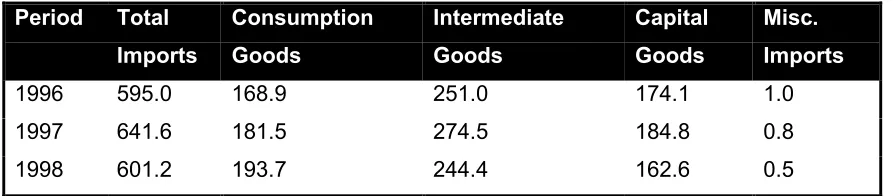
Currently, Guyana is heavily dependent on imported commodities, which include fuel, lubricants, fertilisers, vehicles, machinery, industrial goods, processed food, wheat, beverages and detergents. The total value of imports for 1998 was US$601.2 million dollars. Imports, by end use, for the period 1996-1998 are shown in Table III below.
Table III
Imports by End Use (Summary) (c.i.f.) (US$ Million)
Period Total Imports
Consumption Goods
Intermediate Goods
Capital Goods
Misc. Imports
1996 595.0 168.9 251.0 174.1 1.0
1997 641.6 181.5 274.5 184.8 0.8
1998 601.2 193.7 244.4 162.6 0.5
2.6.2. EXPORTS
It is difficult for any country to market its products in a world where competition, price, quality and delivery time are of immense importance. However, Guyana, being a member of the Caribbean Community (CARICOM), which aims at promoting free trade among the countries of the region, has a tradition of trade and commercial contacts with the CARICOM region. The exports to this region, which include rice, timber, textiles, agricultural products, molasses, rum, gold, pharmaceutical and light machinery, amount to about 25 percent of Guyana’s total trade. Other products such as bauxite and sugar are exported to United States of America (USA), North Europe, Japan, the Far East, Great Britain and the European Economic Community (EEC). The total value of exports for 1998 was US$547 million. The export figures of the major commodities for the period 1996 –1998 are shown in the Table IV below.
Table IV
Exports of Major Commodities (f.o.b.) (US$ Million)
Periods Total Sugar Rice Bauxite Gold Timber Other
1996 588 151 94 87 104 51 101
1997 594 133 88 89 140 41 103
1998 547 129 73 79 124 31 111
Source: Bank of Guyana and Bureau of Statistics, 1998
2.7. SAFETY OF SHIPS DESIGN AND CONSTRUCTION
produced on the basis of considerable research and development and the regulations of IMO on ship structure have not been implemented in the national laws of Guyana. With the increase in speedboats being used in supplementing T&HD services, a need for appropriate rules and regulations governing the quality, design and construction of these vessels becomes more relevant to the process of ensuring safety.
At present Guyana has only delegated authority to classification societies to survey ships and issue certificates in respect of the Load Line (LL) Convention. There are surveyors and inspectors appointed by the Government to carry out surveys and inspections of vessels, however, their functions are based on the old British Merchant Shipping Act of 1894. Therefore certain modifications would be required in the future to bring them into line with modern approaches and internationally prescribed standards.
2.8. HUMAN RESOURCE DEVELOPMENT
The performance of the Guyana shipping industry is dependent on suitable individuals that can be made responsible for establishing policy, planning, enforcing laws and regulations, investing in and operating the various elements of the transport system. However, at present there is no consistent human resource development program in respect of training of seafarers and personnel for the maritime industry.
pave the way for improved training of our seafarers locally which would undoubtedly enable them to function on foreign going vessels.
T&HD undertakes in-house training for pilots, engineers, marine officers and clerical staff, including managers, based on it’s own rules and guidelines. There is an apprenticeship scheme for trainees in the field of electrical, machining, carpentry, welding and mechanical at the Central Workshop branch, in an attempt to procure future employees on the various activities.
Over the years management has sponsored employees on programs at universities and colleges. Of these sponsorships seven have graduated from the WMU and two are due to graduate at the end of 2000. Others have graduated from other universities and colleges in areas of management, accountancy, economics and technology. These training and education opportunities are intended to equip the employees with the knowledge and competence they need to perform their duties.
Generally, there is a need for specified standards for training and certification of seafarers, surveyors, port state control officers, inspectors, registrars of ships and other personnel in an effort to enhance overall safety of shipping and the protection of the marine environment. Further, there is need for training institutions that are prescribed by law in order to deliver the desired training in keeping with internationally acceptable standards.
2.9. FLAG STATE CONTROL (FSC)
Guyana became a member of IMO in 1987, and its obligations under the organisation prescribed that the State adopt international maritime conventions, codes and customary practices as part of its responsibility to act as an efficient and competent Flag State to all ships under its flag. Ensuring that its ships meet the standards of the conventions, including those with respect to safe manning, is part of its continuing duties.
This responsibility of the State or the prescribed administration is increasingly important since the rivers of Guyana are filled with ever expanding movements of domestic cargo, vehicles and passengers. Moreover, ships that fly its flag on international voyages must operate in accordance with international laws and regulations.
Flag State control is a concept that not only focuses on the implementation of the relevant conventions in national legislation but on the supervision of ships under its flag. This involves the issuing of certificates, following up on deficiencies and pollution reports, making offences punishable, ensuring that personnel are properly trained, investigating incidents and accidents, notifying IMO on detention of ships and providing reports on investigation.
This concept is also of importance under ILO conventions, where the Flag State has similar obligations, including measures for shipboard conditions and living arrangements, compliance of the ship with labour conventions, laws and regulations, and collective agreements, and adequate procedures for seafarers’ engagements and investigation of complaints.
legislate or regulate the industry while taking into consideration the relevant international conventions, codes and recommendations. Second, it needs the necessary administrations to implement and enforce the laws, and third, it needs competent human resources to carry out the necessary activities in the relevant cases. Suggested ways of resolving these issues are discussed in the Chapters that follow.
2.10. PORT STATE CONTROL (PSC)
Every member State of IMO, apart from fulfilling its responsibility as a flag State, must participate in port state control activities in a complimentary effort to ensure safety at sea and pollution prevention. Acting in the capacity of a port State, a party must ensure that foreign ships visiting its ports are safe to proceed to sea and are not likely to cause any danger to passengers, crew or the environment.
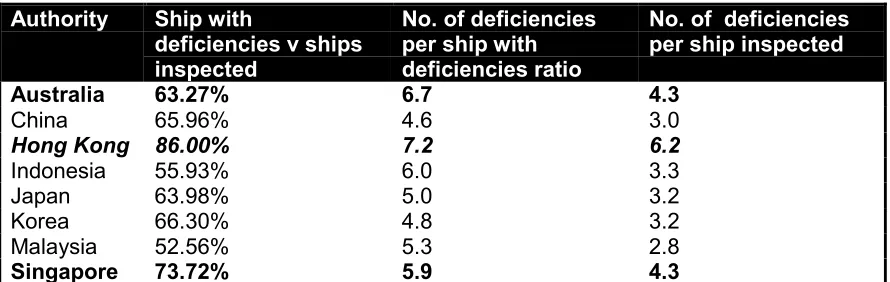
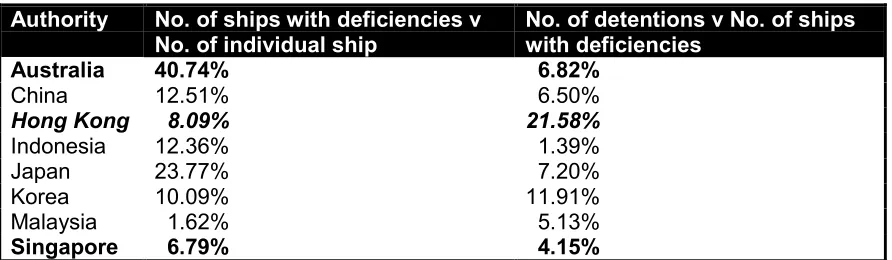
A State can effectively perform the duties of Port State control only if its national laws and regulations are adequate and in accordance with international standards. In 1997 there were 1638 foreign ship visits to Guyana’s ports. These visits were made by 332 ships under various flags of which 236 were general cargo ships, 78 were bulk carriers and 18 were tankers. The bulk carriers and tankers were all over 500 gross tonnage (GT) while of the general cargo ships, 201 were over 500 GT, 13 were under 150 GT and 22 were between 150 and 500 GT.
Guyana, because of the deficiencies mentioned under FSC, has not been equipped to fulfil its responsibility in respect to safety and environmental protection. A continuity of this practice will facilitate the existence and operation of substandard ships that will create an unsafe and unhealthy marine environment.
-• verify that ships’ certificates are valid
• check crew on board for valid certificates in respect to STCW
• check for clear grounds for non-compliance to international conventions
• detain any ship that is not seaworthy in respect to the ship, crew and pollution risks • check control of discharges in respect to MARPOL
The international environment is promoting the concept of regional cooperation on PSC that is based on agreement between states in a form of a Memorandum of Understanding (MOU). So far there are about ten such MOUs, which include those to be completed in the year 2000. The Caribbean MOU, which was established in 1996, is to facilitate this regional cooperation on PSC matters. Guyana is not a Party to the Caribbean MOU. Admission is pending because of its inability to undertake fully the obligations of PSC activities. Presently, this issue is under substantial consideration and attention by the relevant authorities and interested parties.
2.11. AIDS TO NAVIGATION (ATN)
According to a Canadian Coast Guard Aids to Navigation Technical Publication, aids to navigation are:
“Devices or systems, external to the vessel, which are provided to help a mariner determine his position and course, to warn him of danger or obstructions or to advise him of the location of the best or preferred route [through channels and waterways]”.
The ability of a mariner to determine the preferred route through channels and waterways is facilitated by the accuracy and reliability of the aids system.
Beacons are navigational marks constructed of wood, metal, concrete, masonry or glass-reinforced plastic, or a combination of these materials, erected on, or in the vicinity of, dangerous hazards, or onshore, as aids to navigation.
At present, Guyana uses the International Association of Lighthouse Authorities Harmonized Buoyage “System B” but, prior to its adoption, no scientific or technical study was undertaken to determine its suitability to the local conditions. The buoys that are used frequently become inoperable and out of commission in a very short period of time. Further, buoys are vandalised, and those that are unlit are constantly damaged, shifted or completely displaced by trawlers and coastal craft navigating at night or under conditions of restricted visibility.
The beacons are believed to be more reliable than the buoys as aids to navigation although their lights are from time to time out of commission. Whenever this occurs the channel is closed to nocturnal navigation and in the day they are used as “day-beacons”.
Both types of ATNs have problems for there are no strict maintenance and replacement systems.
2.12. PILOTAGE
Demerara River as far as the Bauxite mining town of Linden, which is 65 miles from the capital.
The importance of pilotage is not fully appreciated for it suffers from problems attributed to improper organisation and management by the ports. Further, the pilots under T&HD are traditional public servants; therefore, they are constrained by public service regulations. However, with regard to river Pilotage that is carried out by GNIC, this is more of a private arrangement, although recognition is also given to the existing Pilotage regulations. The inadequacy and unreliability of pilot launches has historically affected the pilot service. However, during the last three years there have been two nationally approved well-maintained pilot launches which have significantly improved the service.
One of today’s key shipping philosophies is to reduce transit time. This implies that the right equipment and resources must be available to supply navigational services to ships and to the handling of the cargo so as to ensure a short turnaround time. Therefore, inadequate pilotage services in Guyana could lead to an increase in the prices of commodities since shipping companies’ costs would escalate due to the payment of demurrage for the increased lay-time of the chartered vessels.
2.13. INFORMATION TECHNOLOGY (IT)
of commercial and administrative transactions using an agreed standard to secure the data pertaining to that transaction (UNCTAD, 1995).
The shipping industry is seen by many as tending to traditionally adhere to old customs and trade practices. As a result of a constant increase in trade and the need to have short turnaround and dwell time, the timely arrival of information is vital to trade. Frequently goods arrive at the intended destination long before the supporting information that is needed by the various operators to perform their functions. To remove this delay in information production and transfer, there is a need to use modern information technology.
The concept of EDI, which is developing around the world, has created systems for the linkage of branches of the same companies, counterparts in the same industry and small groups of operational partners. These participants are constantly adapting to meet not only the changing needs associated in particular with the speed of modern transport and express freight deliveries but with the convenience attainable through the use of containers, and to take the advantages offered by IT to improve information processing, documentation and transmission.
Today information flows are based on paper documentation, documents produced by computer but sent manually, or sent from computer to computer with minimal human intervention. Where is Guyana in this process?
1995). Further, its customs and legal systems are not prepared to accept the benefits offered by IT, especially, in the field of shipping.
The writer therefore wishes to state that any attempt to guide the formation of a strategic national shipping policy for Guyana cannot be made without giving special consideration to IT. An acceptance of this process by government would undoubtedly yield positive results for Guyana in the future.
2.14. RATES AND TARIFFS
T&HD is the principal agency mandated by law to manage and provide coastal and ferry services along the rivers of Guyana. All rates and tariffs set for the operation of the domestic transportation services are regulated and approved by the Ministry of Transport. The rates and tariffs set are claimed to be sufficient to cover all costs including depreciation and interest even though their establishment was not as a result of a detailed analysis and scientific assessment of all the factors involved. In the majority of cases the commuters do not pay the full fares because of the government’s subsidies program. This is typically the case on the Berbice River service and the North West District ferry service in the outlying areas of the country where a lot of primary agricultural production occurs.
With respect to the supplemented service provided by private speed boat operators, T&HD manages, controls, determines and approves the fares for this operation. However, the department needs to be more vigilant and proactive in regulating, while commuters need to be aware of their role with regard to operators adhering to the published fares.
discriminations by carriers. This is of great importance in respect to the various forms of cooperation and the organisational framework of the liner shipping industry. Thus, the government needs to implement policies, whether they are at national, regional or international levels, so that potential abuses, to which the system might lend itself, are avoided.
2.15. POLLUTION PREVENTION AND ENVIRONMENT PROTECTION
Oil pollution of the sea, especially around ports and harbours, has been recognised since the 1900s. However, the first attempt to minimise pollution by oil from ships came in the form of bans on illegal discharges of oil. After the adoption of unilateral national rules on the prevention of marine pollution by the United Kingdom (UK) and the United States in 1922 and 1924 and the adoption of the International Convention for the Prevention of Pollution of the Sea by Oil (OILPOL) in 1954, IMO adopted a completely new convention addressing marine pollution. The International Convention for the Prevention of Pollution from ships (MARPOL) was created with the objective of preventing the pollution of the marine environment from the discharge of harmful substances. It addressed not only pollution by oil but also pollution by chemicals, sewage, garbage and air while requiring Contracting Parties to promote the provision of reception facilities.
Hellenic Marine Environment Protection Association (HELMEPA) in Appendix 2, Table V.
Regulations and rules on oil spill prevention, preparedness, and response, and the provision of reception facilities continue to be critical issues for Guyana. In accordance with the Environment Protection Act, the overall responsibility for pollution of the environment lies with the Environment Protection Agency but the work of this agency does not focus on the prevention of pollution from ships. T&HD, that manages and controls ships’ operations in and around the shores of Guyana, is not directly involved in the work of the Agency.
Under the present national legislation of Guyana there are no rules or regulations governing pollution from ships and no organisation has been given the responsibility for administering such activities. Guyana has acceded to a number of international instruments relating to the prevention of pollution from ships and the combating of, and compensation for, such pollution. However, these instruments should be implemented and enforced under its national laws. Although Guyana participated in the entire series of workshops under the programme entitled the Wider Caribbean Initiative on Ship Generated Waste, the decisions taken have not yet been translated into tangible terms throughout the region generally, and in Guyana, in particular.
2.16. POLICY, LEGISLATION AND ITS ADMINISTRATION
equipped to foster and promote a healthy, workable and safe shipping environment. This has led to the belief by many that there is a need for the coherent development of a shipping policy to be administered by a single agency designated by law to implement and enforce the shipping laws of the State, as well as, other major international maritime laws and regulations.
With the enactment of a new and modern shipping Act, the Guyana Shipping Act 1998, it is expected that efforts from the public and private sectors, including the Government, to ensure its full implementation will continue apace. To enable the Shipping Act to have full effect a number of regulations are essential in order to amplify its provisions. These regulations will provide the details and specifics required for effective implementation of the Act while taking cognisance of the international requirements, and the express standards that Government determines as necessary for the country.
The Act also provides for standards that will ensure increased safety for passengers, crew and cargo, which will undoubtedly benefit the country in terms of saving lives and property and ensuring the economic and reliable transport of goods. However, there are no provisions with respect to the economic management of shipping, including the prospects for business opportunities and the promotion of private operators in local shipping activities. Nor are there provisions directed at environmental management issues in line with IMO’s objective of cleaner seas through prevention of pollution and environmental protection.
CHAPTER 3
3. EVALUATION AND ANALYSIS OF THE CURRENT STRUCTURE AND OPERATING ENVIRONMENT OF GUYANA SHIPPING INDUSTRY
In an attempt to establish conceptual clarity and to guide the process of the research, the writer considers it prudent to review the work of previous writers on the subjects of “Government and Policy”, “Policy Analysis” in general, “Maritime Policy” and “National Shipping Policy” in its strictest sense. Preceding this, will be an analysis and evaluation of the current structure and operating environment of the Guyana shipping industry from an economic, safety and environmental perspective while taking in consideration pertinent information gathered from the various policy issues examined earlier.
3.1. GOVERNMENT AND POLICY
Further, J. J. Richardson and G. Jordan (1979) argued that in contemporary times State action and the policy process can only be understood by reference to group theory. They further contended that policy and decision-making in a democratic political system is influenced by a multiplicity of participants. Pressure group participation is issue specific and as a result, influence in the policy process is dynamic and changes overtime. This means that a single group, such as the economic elite, does not dominate all major aspects of the policy process. This theory rests on the notion of power which, B. M. Gross (1968) argued, is exercised in order to achieve specific purposes that may take many forms including persuasion, bargaining or threat. Lindblom (1968) describes the process as a ‘play of power’ which proceeds by interaction and a series of negotiating steps between groups using a variety of resources and techniques to reach a solution.
A system of public (government) institutions is an asset to a nation if it is used for the making of policy, and is as important to national development as economic resources. The problem, however, is that it is far from clear how systems of government are to be built up so as to function properly from administrative or management perspectives. The concept of a public sector includes what kinds of activities public institutions carry out and how decisions are made and implemented by these institutions. Thus, on the one hand, there is the theory of the public sector as a branch of government involved in allocation, redistribution and regulation, and on the other hand, there is the dynamic policy perspective of a public sector involved in the making and implementation of policies.
3.2. POLICY ANALYSIS
most important choices made in an organisation or an institution. Perhaps such a general definition of the concept of a policy was never strictly adhered to, as the connection between policy and the public sector has remained a very close one.
Laswell’s perspective on policy analysis is not simply the understanding of policies as important public choices but also the need to locate data and provide interpretations of the policy problems, which according to him, are often the fundamental, and neglected problems. The writer, in an attempt to examine the policy problems existing within the local shipping system, has located a wide base of data, which are used to evaluate and interpret the underlying policy problems.
In policy examination there is tension between objectivity and subjectivity, and between neutrality and relevance. But any approach to policy examination and formulation has further implications, for it includes, in addition to knowledge about the policy-making process itself, the assembly and evaluation of knowledge about the policy problems (Lasswell, 1951, p. 14).
C. Ham and M. Hill (1984, p. 4) differentiate between ‘analysis of policy’ and ‘analysis for policy’. They advocated that this distinction is important in drawing attention to policy examination as an academic activity, for it is concerned primarily with the advancement of understanding of policy formulation as an applied activity and its contribution to the solution of the existing policy problems.
Two of Dror’s main components in policy making are economic rationality and the use of qualitative knowledge. Economic rationality is considered in Chapter Four under the section examining economic options.
Since there is little quantitative information available for policy-making purposes, the writer will only use qualitative data and “extra-rational” mechanisms, such as intuition, non-routine behavior and guesstimate. This policy analysis needs to be based on a set of principles, which are expected to guide the overall process. But according to Dror (1974, p. 198), such principles are not enough, as there must also be an ‘optimal policy-making structure’ which in this case, is the Maritime Administration, as discussed in Chapter Five.
Dror, (1974, pp. 197-213), also identified certain characteristics of an optimal policy-making structure, which the writer wishes to endorse as being useful in policy examination and formulation. They are of a formal kind and include:
1. Participation by many and diverse groups
2. A minimum amount of formalisation of the policy process in assigning various policy tasks to different groups
3. Redundancy between groups and tasks as well as isolation of some groups from the others
4. Integration of groups and periodical reexamination and reform of the structure
This idea of having an actual policy-making structure, according to Dror (1974, p. 261), is to establish and reinforce this special organisation for policy examination and formulation that is charged with taking a fresh look at basic policy issues.
concerned with the more effective manipulation of the real world, which should be accomplished with a full understanding of the underlying phenomena.
Quade further outlined a model of policy analysis that involves both intellectual cogitation and social interaction with policy-makers. He pointed out that there are three stages associated with policy analysis. First, discovering the best and feasible alternative. Second, acceptance of the findings, which are incorporated into a policy or decision. Third, implementing the policy or decision (Quade, 1976, p. 254).
According to Wildavsky (1979, p. 17), policy analysis is an activity that solves tensions between resources and objectives, planning and politics. He observed that the specific policy challenge is to resolve these tensions.
As policy in real life involves ends and means, so policy analysis must be a set of theories about the relationship between ends and means. Policy analysis implies rationality, which means searching for ends as well as responsibility, and the proper resources needed in achieving suitable objectives. Since policy analysis deals with contested and value-ingrained materials, it must be practical, evaluative and reconstructive, and based on solid theoretical foundations.
3.3. MARITIME POLICY
Maritime policy from the standpoint of a purely national or regional approach should undoubtedly incorporate a number of key areas. These areas include ports, shipping, maritime education and training, and maritime legislation among other areas. It is therefore important to refer to these areas since there is a direct relationship between shipping and these maritime related issues.
According to Professor Ma (1999), maritime policy can be understood as an integral part of the overall economic policy of a country since it embraces regulatory, financial and fiscal measures to be employed by the authorities in relation to the country’s maritime transport sector. He further points out that maritime policy defines the State’s attitude towards the maritime industry.
Professor Ma’s interpretation is relevant; consequently, it is used as a guide to this research. Essentially, the development of any society, must of a necessity, take into account the total transport sector, in general, and maritime transport, in particular, as an element of the total development strategy.