in the population sciences published by the Max Planck Institute for Demographic Research Konrad-Zuse Str. 1, D-18057 Rostock · GERMANY www.demographic-research.org
DEMOGRAPHIC RESEARCH
VOLUME 20, ARTICLE 10, PAGES 195-208
PUBLISHED 24 FEBRUARY 2009
http://www.demographic-research.org/Volumes/Vol20/10/ DOI: 10.4054/DemRes.2009.20.10
Research Article
Active-duty military service in the United States:
Cohabiting unions and the transition to
marriage
Megan Lemmon
Mira Whyman
Jay Teachman
© 2009 Lemmon, Whyman & Teachman.
This open-access work is published under the terms of the Creative Commons Attribution NonCommercial License 2.0 Germany, which permits use, reproduction & distribution in any medium for non-commercial purposes, provided the original author(s) and source are given credit.
1 Introduction 196
2 Previous research 196
3 Theoretical framework 197
4 Data and methods 199
5 Descriptive statistics 201
6 Multivariate results 203
7 Conclusion and discussion 205
Active-duty military service in the United States:
Cohabiting unions and the transition to marriage
Megan Lemmon 1
Mira Whyman 2
Jay Teachman 3
Abstract
A small but growing body of research has begun to identify the consequences of military service during the all-voluntary era. Previous literature has emphasized the role played by the economic prospects of men in stimulating marriage, among both singles and cohabiters. Military service and marriage are related through pay rates, stability of employment and additional benefits awarded to married couples. In this article, we examine the relationship between military service and the likelihood that cohabiting unions will be converted into marriages. Our paper extends previous research by making a distinction between the effects of active-duty verses reserve-duty service on the transition to marriage using data from the 1979 National Longitudinal Survey of Youth (NLSY). Our findings indicate that there is a positive relationship between active-duty service and cohabitors transitioning to marriage.
1 Department of Sociology, Western Washington University, Bellingham, WA 98225, USA.
E-mail: [email protected].
2 Department of Sociology, Western Washington University, Bellingham, WA 98225, USA.
E-mail: [email protected].
3 Department of Sociology, Western Washington University, Bellingham, WA 98225, USA.
1. Introduction
A small but growing body of research has begun to identify the consequences of military service during the all-voluntary era, including socioeconomic attainment (Angrist 1990; Teachman 2003), marriage (Lundquist 2004, Teachman 2007), and divorce (Lundquist 2006). In this article, we extend this research by examining the relationship between military service and the likelihood that cohabiting unions will be converted into marriages. Using data taken from the 1979 National Longitudinal Study of Youth (NLSY79), we show that active-duty military service is positively associated with the likelihood that a cohabiting union will end in marriage. This finding holds in the face of numerous controls for important covariates known to be associated with marriage, as well as important controls for selectivity into military service.
2. Previous research
Over the last several decades, premarital cohabitation has become increasingly common. Currently, almost 50 percent of couples cohabit before marriage and during the 1980s (our time period of study) cohabitation rates fluctuated between 30-40 % depending upon age (Bumpass and Lu 2000, Thorton 1988). This prevalence has prompted many researchers to seek factors related to the transition to marriage among cohabitors. For the most part, this body of literature suggests that better socioeconomic attainment (education, occupation, or earnings) for cohabiting men spurs marriage (Brown 2000, Lichter, Qian, and Mellott 2006, Oppenheimer 2003, Sanchez, Manning and Smock 1998, Smock and Manning 1997, Smock et al 2005), while the socioeconomic attainments of cohabiting women are not related to marriage (Brown 2000, Sanchez, Manning, and Smock 1998, Smock and Manning 1997).
socioeconomic attainment, military service may influence the decisions men make about marriage and cohabitation.
Just as military service inherently affects marriage, it is also related to outcomes such as divorce. Men serving in all branches of the military face higher risks of divorce than their civilian counterparts because they tend to marry at a younger age and are exposed to job related stresses such as relocations, long separations from their spouse during deployment, long work hours, and high mental/physical risks (Adler-Baeder, Pittman, and Taylor 2005). Consequently, previous research shows that these risks result in higher divorce rates among military men than civilians (Adler-Baeder, Pittman, and Taylor 2005, Lundquist 2007). In fact, between the ages of 20-34 the divorce rate for men in the military is over twice what it is for civilian men, however this gap narrows considerably after age 35 (Adler-Baeder, Pittman, and Taylor 2005).
3. Theoretical framework
Military service can be linked to marriage via pay rates and stability of employment. A large body of literature has emphasized the importance of the man’s economic resources in stimulating marriage, both among singles and cohabitors (Oppenheimer, Kalmijn, and Lim 1997, Sweeney 2002). Similarly, many of the studies cited previously in this paper note the importance of the man’s socioeconomic attainment for encouraging marriage among cohabitors. Both sociologists (Parsons 1949) and economists (Becker 1981) have provided theoretical grounding for this finding, focusing on the traditional expectation for the man to be the household breadwinner.
Starting with the AVF (1973), military pay rates rose rapidly in order to meet enlistment quotas. As a consequence, during the AVF era, recruits have enjoyed relatively high pay compared to their civilian counterparts (Daula, Smith, and Nord 1990, Gilroy, Phillips, and Blair 1990). Incomes earned by recruits are higher than would otherwise be available to them at a similar point in their life course (Phillips et al. 1992). The military also provides stable employment, providing a degree of economic certainty that is difficult to match in the civilian labor market.
who are cohabiting. Married men are also able to make use of family support services that are not available to cohabiting men. These services include assistance with spousal employment, child care, help with financial planning, and pay supplements when deployed with dependents. In addition, although the military is not unique in offering medical benefits to spouses and children, these benefits accrue to all dependents of active-duty service members without cost, irrespective of their rank or time in service. Again, medical benefits are not available to the cohabiting partners of service members. Thus, the package of benefits that is available to married service members is substantially greater than that available to service members who are cohabiting. The combination of good pay, economic stability, and benefits tied to marital status leads us to predict that active-duty service in the AVF is positively related to the transition to marriage among cohabitors by providing incentives to marry.
Another issue to consider in the relationship between military service and union transitions is that men who enter the military are a select subset of the male population (Teachman, Call, and Segal 1993). Enlistees are tested and screened to meet physical, mental, educational, and moral standards for enlistment. Men with health limitations, who do not meet relatively stringent standards for scores on the ASVAB (the basic entrance examination used by the military), who have little education, or who have a felony conviction are not eligible for enlistment. And, as another element of screening, all AFV enlistees have elected to enter into a long-term (usually three years) enforceable contract. Hence, enlistees have demonstrated their ability to commit to something and may be less hesitant to make the type of long-term commitment necessary for marriage (Teachman 2007). Recruits are thus selected according to health, mental ability, education, known moral conduct, and a willingness to commit to a long-term contract; all of which makes them more attractive in the marriage market. Indeed, at every age, it has been demonstrated that young men serving in the military are more likely than their civilian counterparts to be married (Teachman 2007). Ceteris Paribas, one would therefore expect that men who elect to enter the military are more likely to choose a transition to marriage over a continuing cohabitation.
make them more suitable for the commitment required by marriage. However, reserves and veterans did not receive the exclusive benefits only available to active duty personnel that encourage the transition to marriage.
4. Data and methods
Starting in 1979, the NLSY-79 interviewed 12,686 men and women between the ages of 14-21. The men in our sample were interviewed a maximum of 21 times over a period spanning 25 years (1979-2004; interviews were annual through 1994, biennial thereafter). The NLSY-79 is a household survey, and all eligible members of a sampled household are interviewed. Consequently, approximately one third of the households used in this analysis contained at least two brothers. As described later, we correct for the potential correlation between brothers using a GEE (Generalized Estimating Equation) procedure.
We examined men who formed first cohabiting unions between the ages of 17 and 34 between the years of 1979 and 2004. We selected this sample because 17 is the minimum age at which men can enter the military and men older than 33 cannot enter the military. Furthermore, we exclude men older than 34 because they are selective of early birth cohorts subject to higher period marriage rates and lower period cohabitation rates. We also excluded a small number of men who formed a cohabiting union prior to the beginning of the survey or before age 17. Women are excluded from the analysis because too few female respondents in the NLSY-79 entered the military to provide stable estimates of the effects of military service on their first cohabiting union.
We created a database measured by years in which men were interviewed and in a first cohabiting union. Men enter our sample in the year that they initiate their first cohabiting union and cumulatively contribute additional “person years” for each year of the survey that they continue this cohabiting union. Therefore, person year 1 for any respondent corresponds to the first year of their first cohabiting union. Men who permanently leave the NLSY-79, either because they cannot be tracked or because of changes in the sampling frame, contribute person years until they exit the survey. In several cases, respondents were not interviewed in a particular year but were interviewed in a subsequent year, leaving a gap in the data. Where possible, we used retrospective information collected by the NLSY-79 to complete information for the missing person years.
censored in 1985 when the over sample was dropped. We also exclude the small number of men (particularly black men) who became officers because there were too few of them to make accurate comparisons. Thus, the results presented in this paper pertain to the effects of enlisted military service during the late 1970s and the 1980s.
As a result of the sampling frame, we necessarily place two additional restrictions on the data. First, we exclude men who entered the military after 1984 because they are inevitably much older than the average military recruit, particularly active-duty recruits. Second, we censor men who were on active-duty after 1989 because at that time they were much older than the average active-duty service member. In addition, men serving after 1989 would have been at risk of serving in the Persian Gulf War, further biasing any effect of active-duty service. As a consequence, the sample focuses on men in cohabiting unions between the ages of 17 and 34 and who potentially entered the military between 1975 (the year the oldest NLSY-79 respondents turned 17) and 1984. These men served in the military between 1975 and 1989, with a few reserves serving past 1989. The final sample that we analyze includes 5,335 person years, indicating years in a first cohabiting union, from 1,579 individuals. We analyze these data using a discrete-time event history model.
The dependent variable is a nominal measure indicating whether a man in a cohabiting union experienced a transition to marriage (1 = yes, 0 = no) in a given year. Our database indicates that 25 % of the civilians in our sample had cohabited at some point in their lives, compared to 8.3 % of those currently serving on active duty, 6.7 % of those currently serving on reserve duty, 29 % of veterans of active duty and 31.6 % of veterans of reserve duty. Men who marry or end their cohabiting union are dropped from subsequent intervals. A limitation of the NLSY-79 data is that the exact beginning and ending dates of cohabiting unions are unavailable. The only information available is whether a specific partner is in the household at successive waves of the survey. Thus, the NLSY-79 data will tend to underestimate short term cohabiting unions, although the short term cohabiting unions in the database are representative of all short term cohabiting unions under the assumption that such unions are formed and end randomly over a calendar year. In order to account for sibling clustering, we estimated a set of binary logistic regression models using PROC GENMOD in SAS 9.1, which allows a GEE estimator.
as a series of dummy variables: income less than $5,000, $5,000 - $9,999, $10,000 - $14,999, $15,000 - $19,999. The omitted category is income greater than $20,000. Labor force attachment in the past year, which when combined with income implicitly controls for wage rates, is coded as a series of dummy variables tapping weeks worked in the past year: no work activity, worked 1 – 25 weeks, worked 26 – 47 weeks. The omitted category is worked 48 or more weeks. To specify entrenchment in the labor market, we include measures of cumulative labor market experience and tenure in current job (both measured in weeks). Completed education as of the prior year is coded as a series of dummy variables: less than high school, some college, and college or more. The omitted category is high school education.
We further account for differences in social background that may have an effect on the transition to marriage. Race and ethnicity are measured as a series of dummy variables: Black and Hispanic with White being the omitted category. Religion in which the respondent was raised is measured as a series of dummy variables: Catholic, none and other with Protestant being the omitted category. We also include controls for whether the respondent was raised in a rural area (0 = no, 1 = yes), the number of siblings he has, and his mother’s education (measured in years). To measure strong competing roles that may interfere with forming a union, we include a dummy variable indicating whether the respondent was enrolled in school (0 = no, 1 = yes). To measure other commitments that might tie a man to a union we include a continuous, time varying measure of the number of children present in the cohabiting union. Finally, in order to control for changes in the likelihood of making a transition out of cohabitation associated with duration alone, we include a control for time cohabited (in years) and its square.
5. Descriptive statistics
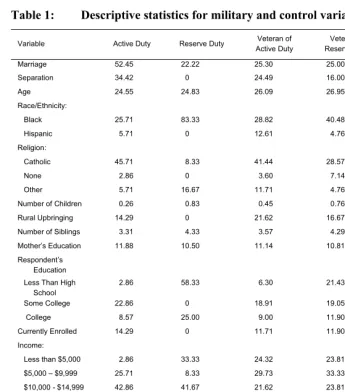
Table 1: Descriptive statistics for military and control variables
Variable Active Duty Reserve Duty Veteran of Active Duty
Veteran of
Reserve Duty Civilian
Marriage 52.45 22.22 25.30 25.00 24.31
Separation 34.42 0 24.49 16.00 22.96
Age 24.55 24.83 26.09 26.95 26.37
Race/Ethnicity:
Black 25.71 83.33 28.82 40.48 27.30
Hispanic 5.71 0 12.61 4.76 16.46
Religion:
Catholic 45.71 8.33 41.44 28.57 36.40
None 2.86 0 3.60 7.14 8.28
Other 5.71 16.67 11.71 4.76 9.92
Number of Children 0.26 0.83 0.45 0.76 0.51
Rural Upbringing 14.29 0 21.62 16.67 18.61
Number of Siblings 3.31 4.33 3.57 4.29 3.85
Mother’s Education 11.88 10.50 11.14 10.81 10.98
Respondent’s Education Less Than High
School
2.86 58.33 6.30 21.43 23.52
Some College 22.86 0 18.91 19.05 19.02
College 8.57 25.00 9.00 11.90 15.03
Currently Enrolled 14.29 0 11.71 11.90 7.46
Income:
Less than $5,000 2.86 33.33 24.32 23.81 19.22
$5,000 – $9,999 25.71 8.33 29.73 33.33 30.67
$10,000 - $14,999 42.86 41.67 21.62 23.81 24.34
$15,000 - $19,999 22.86 8.33 11.71 16.67 14.01
Labor Market Experience
76.89 225.67 184.53 267.67 304.49
Job Tenure 21.34 151.50 86.14 136.29 158.31
Weeks Employed:
None 5.71 0 2.70 4.76 3.17
1 – 25 5.71 16.67 9.99 7.14 7.16
26 - 47 2.86 25.00 30.63 33.33 19.02
6. Multivariate results
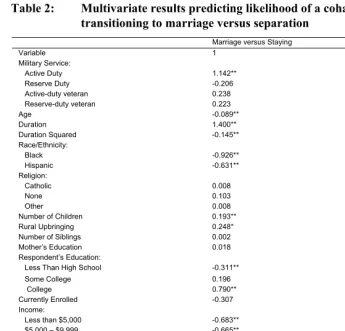
Results from estimating the multinomial logistic regression models are shown in Table 2. Two models are shown. Model 1 shows estimates of the relationship between the covariates and the likelihood of marriage versus remaining in a cohabiting union. Model 2 shows estimates of the relationship between the covariates and the likelihood of separating versus remaining in a cohabiting union. Our hypothesis relates to the likelihood of marriage, but we present both models for the sake of comparison. Our results (not shown) also indicate that the relationship between active-duty military service and transition to marriage is not moderated by race.
The results from Model 1 are consistent with our hypothesis. That is, men in cohabiting unions serving on active duty are more likely to transition to marriage than other men. The relationship is substantial with men serving on active duty being more than 3 times (eβ= 3.13) more likely to marry at any point in time. This result remains
constant despite strong controls for the socioeconomic position of young men, including income and stability of employment. The results also suggest that the findings cannot be attributed to selectivity. None of the other indicators of military service provide evidence for a statistically significant relationship with the likelihood of marrying. Moreover, the differences between the coefficient for active duty military service and those for other measures of military service are all statistically significant using constrained chi-squared tests (active duty vs. reserve duty = 10.30, p < .002; active duty vs. active duty veteran= 12.70, p < .001; active duty vs. reserve duty veteran = 6.55, p < .02).
Among the other predictors of marriage among cohabiting men we find that older men, Blacks, Hispanics, men with less education, men earning less, and men working less than full time are less likely to experience a transition to marriage. Men in cohabiting relationships with children, who have a rural upbringing, and who have more labor market experience are more likely to experience a transition to marriage.
Table 2: Multivariate results predicting likelihood of a cohabiting couple transitioning to marriage versus separation
Marriage versus Staying Separation versus Staying
Variable 1 2
Military Service:
Active Duty 1.142** 0.452
Reserve Duty -0.206 -0.506
Active-duty veteran 0.238 0.367**
Reserve-duty veteran 0.223 -0.346
Age -0.089** -0.062**
Duration 1.400** 1.614**
Duration Squared -0.145** -0.137**
Race/Ethnicity:
Black -0.926** 0.429**
Hispanic -0.631** 0.283
Religion:
Catholic 0.008 -0.356
None 0.103 -0.523**
Other 0.008 0.089
Number of Children 0.193** -2.922**
Rural Upbringing 0.248* 0.087
Number of Siblings 0.002 -0.008
Mother’s Education 0.018 -0.001
Respondent’s Education:
Less Than High School -0.311** -0.063
Some College 0.196 0.132
College 0.790** 0.168
Currently Enrolled -0.307 -0.041
Income:
Less than $5,000 -0.683** 0.249
$5,000 – $9,999 -0.665** 0.039
$10,000 - $14,999 -0.395** 0.074
$15,000 - $19,999 -0.165 0.147
Labor Market Experience 0.001** 0.001
Job Tenure -0.001 -0.001
Weeks Employed:
None -0.471 0.471*
1 – 25 -0.504** 0.490**
26 - 47 -0.405** 0.196
Log-likelihood -1559.31 -1333.91
7. Conclusion and discussion
The results are consistent with our hypothesis. Active-duty military service during the 1980s was strongly and positively related to the likelihood that a cohabiting union would become a marriage. This relationship cannot be explained by a set of controls for covariates shown in prior research to be related to the likelihood of marriage among cohabiting individuals, nor can the relationship between military service and marriage be explained by selectivity. There appears to be a direct relationship between active duty service and marriage among cohabiting men.
Although active-duty service members earn more than their civilian counterparts, this is not likely the source of the active-duty effect. The model estimated includes controls for income earned. Nor is the effect likely due to stability of employment, because the model controls for cumulative labor market experience and recent unemployment. We suspect that the effect of active-duty service is tied to the benefits that accrue to active-duty service members when they marry; however, the NLSY-79 data do not allow us to control for these benefits specifically. These benefits include housing allowances, medical coverage, additional pay when deployed, and assistance with childcare and spouse employment. Other benefits include use of post exchanges and other facilities by dependents and assistance in relocating their families when being transferred between posts. None of these benefits are available to active-duty cohabiting couples.4
What the results imply is the effectiveness of family-friendly policies on stimulating marriage. The policies implemented by the military result in the ability of service members to remain on active-duty while taking care of a family. Although it is unlikely that these policies can be translated to a broader audience, they do show that cohabiting couples are responsive to incentives linked to marital status.
4 One reviewer has correctly noted that we cannot exclude an alternative hypothesis. Specifically, that
References
Adler-Baeder, F., Pittman, J., and Taylor L. (2005). Marital transitions in military families: Their prevalence and their relevance for adaptation to the military. Military Family Research Institute, Purdue University.
Angrist, J. (1990). Lifetime earnings and the Vietnam era draft lottery: Evidence from Social Security Administrative records. American Economic Review 80:313-336. Becker, G. (1981). A treatise on the family. Cambridge: Harvard University Press. Brown, S. (2000). Union transitions among cohabitors: The significance of relationship
assessments and expectations. Journal of Marriage and Family 62: 833-846. doi:10.1111/j.1741-3737.2000.00833.x.
Bumpass, L., and Lu, H. (2000). Trends in cohabitation and implications for children’s family contexts. Population Studies 54: 29-41. doi:10.1080/713779060.
Daula, T., Smith, D., and Nord, R. (1990). Inequality in the military: Fact or fiction? American Sociological Review 55: 714-718.doi:10.2307/2095866.
Gilroy, C., Phillips, R., and Blair, J. (1990). The All-Volunteer Army: Fifteen years later. Armed Forces and Society 16: 329-350. doi:10.1177/0095327X9001600302
Lichter, D., Qian, Z., and Mellott, L. (2006). Marriage or dissolution? Union transitions among poor cohabiting women. Demography 43: 223-240. doi:10.1353/dem.2006.0016.
Lundquist, J. (2004). When race makes no difference: Marriage and the military. Social Forces 83: 731-757. doi:10.1353/sof.2005.0017.
Lundquist, J. (2006). The Black-White gap in marital dissolution among young adults: What can a counterfactual scenario tell us? Social Problems 3: 421-441. doi:10.1525/sp.2006.53.3.421.
Lundquist, J. (2007). A comparison of civilian and enlisted divorce rates during the early All Volunteer Force Era. Journal of Political and Military Sociology 35: 199-217.
Office of the Undersecretary of Defense (2005). Population Representation in the Military Services [electronic resource]. http://www.dod.mil/prhome/ poprep2002/index.htm, accessed December 19, 2005.
Oppenheimer, V. (2003). Cohabitation and marriage during young men’s career development process. Demography 40: 127-149.
Oppenheimer, V., Kalmijn, M., and Lim, N. (1997). Men’s career development and marriage timing during a period of rising inequality. Demography 34: 311-330. doi:10.2307/3038286.
Parsons, T. (1949). The social structure of the family. In: Ashen, R. (ed.). The Family: Its Functions and Destiny. New York: Harper and Brothers: pp. 173-203. Pettit, B. and Western, B. (2004). Mass imprisonment and the life course: Race and
class inequality in U.S. incarceration. American Sociological Review 69: 151-169.
Phillips, R., Andrisani, P., Daymont, T., and Gilroy, C. (1992). The economic returns to military service: Race-ethnic differences. Social Science Quarterly 73: 340-359. Sanchez, L., Manning, W., and Smock, P. (1998). Sex-specialized or collaborative mate
selection? Union transitions among cohabitors. Social Science Research 27: 280-304. doi:10.1006/ssre.1998.0627.
Smock, P. and Manning, W. (1997). Cohabiting partners’ economic circumstances and marriage. Demography 34: 331-341. doi:10.2307/3038287.
Smock, P., Manning, W., and Porter, M. (2005). Everything’s there except money: How money shapes decisions to marry among cohabitors. Journal of Marriage and Family 67: 680-696. doi:10.1111/j.1741-3737.2005.00162.x.
Sweeney, M. (2002). Two decades of family change: The shifting economic foundations of marriage. American Sociological Review 67: 132-147. doi:10.2307/3088937.
Teachman, J. (2003). Military service during the Vietnam era: Were there consequences for subsequent civilian earnings. Social Forces 83: 709-73. doi:10.1353/sof.2005.0021.
Teachman, J. (2007). Race, military service, and marital timing: Evidence from the NLSY-79. Demography 44: 389–404. doi:10.1353/dem.2007.0018.