ARTICLE OPEN ACCESS
Somatic expansion of the
C9orf72
hexanucleotide
repeat does not occur in ALS spinal cord tissues
Jay P. Ross, BSc, Claire S. Leblond, PhD, H´el`ene Catoire, PhD, Kathryn Volkening, PhD,Michael Strong, MD, FRCPC, FANN, FCAHS, Lorne Zinman, MD, MSc, FRCPC, Janice Robertson, PhD, Patrick A. Dion, PhD, and Guy A. Rouleau, MD PhD, FRCPC
Neurol Genet2019;5:e317. doi:10.1212/NXG.0000000000000317
Correspondence
Dr. Rouleau [email protected]
Abstract
ObjectiveTo test for somaticC9orf72hexanucleotide repeat expansion (HRE) and hexanucleotide repeat length instability in the spinal cord of amyotrophic lateral sclerosis (ALS) cases.
Methods
Whole and partial spinal cords of 19 ALS cases were dissected into transversal sections (5 mm thick). The presence ofC9orf72HRE was tested in each independent section using Repeat-Primed PCR and amplicon-size genotyping. Index measures for the testing of mosaicism were obtained through serial dilutions of genomic DNA from an individual carrying a germline
C9orf72HRE in the genomic DNA of an individual without aC9orf72HRE.
Results
None of the sections examined supported the presence of a subpopulation of cells with aC9orf72HRE. Moreover, theC9orf72hexanucleotide repeat lengths measured were identical across all the spinal cord sections of each individual patient.
Conclusions
We did not observe somatic instability of theC9orf72HRE in disease relevant tissues of ALS cases.
From the Department of Human Genetics (J.P.R., G.A.R.), McGill University, Montr´eal, Quebec, Canada; Montreal Neurological Institute and Hospital (J.P.R., H.C., P.A.D., G.A.R.), McGill University, Montr´eal, Quebec, Canada; Pasteur Institute (C.S.L.), University Paris Diderot, Sorbonne Paris Cit´e, Paris, France; Department of Neurology and Neurosurgery (H.C., P.A.D., G.A.R.), McGill University, Montr´eal, Quebec, Canada; Department of Clinical Neurological Sciences and Robarts Research Institute (K.V., M.S.A.N.N.), Schulich School of Medicine and Dentistry, Western University, London, Ontario, Canada; Sunnybrook Health Sciences Centre (L.Z.); and Tanz Centre for Research in Neurodegenerative Diseases (J.R.), University of Toronto, Toronto, Ontario, Canada.
Funding information and disclosures are provided at the end of the article. Full disclosure form information provided by the authors is available with the full text of this article at Neurology.org/NG.
The Article Processing Charge was funded by the authors.
Amyotrophic lateral sclerosis (ALS) is a neurodegenerative disease characterized by rapid and progressive loss of motor neurons.1 Although germline mutations in several genes have been identified, the C9orf72 hexanucleotide repeat expansion (HRE) is currently one of the most prevalent and penetrant cause of ALS.1 In the general population,
C9orf72contains less than 30 GGGGCC repeats in thefirst intron, whereas in ALS cases the number of repeats ranges between hundreds to thousands.1Because it is difficult to precisely size the repeat length above 30,2many aspects of
C9orf72-related ALS have not been thoroughly investigated.
Somatic mutations have been hypothesized as a possible cause of ALS in cases who do not have germline mutations in genes known to be associated with the disease.3Repeat
sequences are particularly of interest for somatic mutation analysis because their emergent secondary structures can lead to expansion or contraction of repeat lengths.4 It is also notable that theC9orf72HRE can lead to cell-to-cell transmission of dipeptide repeat proteins,5and as such, it is conceivable that a small population ofC9orf72HRE cells nested in the nervous system could potentiate ALS.
Recently, somatic recombination ofAPPhas been demon-strated to occur in Alzheimer’s disease neurons.6Because somatic expansion of C9orf72 hexanucleotide repeats is a potential mechanism for ALS pathogenesis and because routine blood DNA testing would not identify such somatic events,2 we tested DNA extracted from finely sectioned spinal cords of 19 patients with ALS for low levels of the
C9orf72HRE.
TableDescription of the ALS patient cohort
Individual No. sections Age Sex Site of onset Germline mutations
ALS01 108 50 M Left hand None
ALS02 75 69 F Right hand None
ALS03 96 62 F Bulbar None
ALS04 70 79 M Right leg None
ALS05 118 78 M Bulbar NEK1p.P318L
ALS06 78 58 F Right hand None
ALS07 78 Left foot None
ALS08 88 Left hand None
ALS09 82 Right foot None
ALS10 22 66 M None
ALS11 28 62 M None
ALS12 30 61 M TBK1p.L306I,CCNFp.E396D,SPG11p.R1992Q
ALS13 17 57 M None
ALS14 38 66 F None
ALS15 11 78 F Bulbar None
ALS16 21 62 M None
ALS17 31 71 M None
ALS18 22 69 F None
ALS19 31 67 F SPASTp.R221C
Abbreviation: ALS = amyotrophic lateral sclerosis.
Site of onset refers to the initial location of ALS symptoms, Sections refer to the number of;5 mm spinal cord samples generated from each spinal cord. A total of 1,053 unique sections were tested.
Glossary
Methods
SamplesThe spinal cords from 19 ALS cases were included in this study. DNA obtained from prior blood samplings of these cases established them all to be negative for the C9orf72 HRE. Samples were collected from 3 institutions: the Montreal Neurological Institute and Hospital in Montr´eal, Qu´ebec; the Sunnybrook Health Sciences Centre in Toronto, Ontario; and the ALS Clinic at the London Health Science Centre in London, Ontario. Average patient age at donation was 65.9 years, with a male-to-female ratio of 1.29. A targeted sequencing approach7 was used to test for rare (minor allele frequency < 0.001) protein-altering germline mutations in genes known to be ALS risk fac-tors. Information regarding the ALS cases is listed in table.
Standard protocol approvals, registrations, and patient consents
All participants signed an informed consent form that was approved by the ethical review boards of institutions that contributed the material.
Tissue sectioning and DNA extraction
Spinal cords were manually portioned into transverse sections of approximately 5 mm thickness. Sections were then separated along the coronal plane into dorsal and ventral halves, with only the ventral areas being used in the present study. Each ventral portion was separated into left and right ventral horns. Geno-mic DNA was extracted using standard salting-out methods from approximately half of both the left and right ventral portions of every section available from each spinal cord.
C9orf72HRE reactions
C9orf72 HRE genotyping8 was performed on blood DNA samples (or sampling of the cervical area of the cerebellum if
blood was not available) to accurately size germline hex-anucleotide repeat alleles. Repeat-primed PCR (RPPCR)9was performed on all sampled sections of each patient to assess for theC9orf72HRE and to estimate the lengths ofC9orf72alleles in each section. GeneMapper v4.0 (Applied Biosystems) was used to visualize and estimate reaction fragment sizes. Lengths of C9orf72 hexanucleotide repeat amplicons were measured using GeneMapper compared to the GeneScan-500 LIZ Size Standard (Applied Biosystems). Peaks from the RPPCR
pro-files were chosen based on the genotyping method results to representC9orf72alleles, which were plotted to assess variation within normal-lengthC9orf72hexanucleotide repeat lengths.
HRE mosaicism index measures
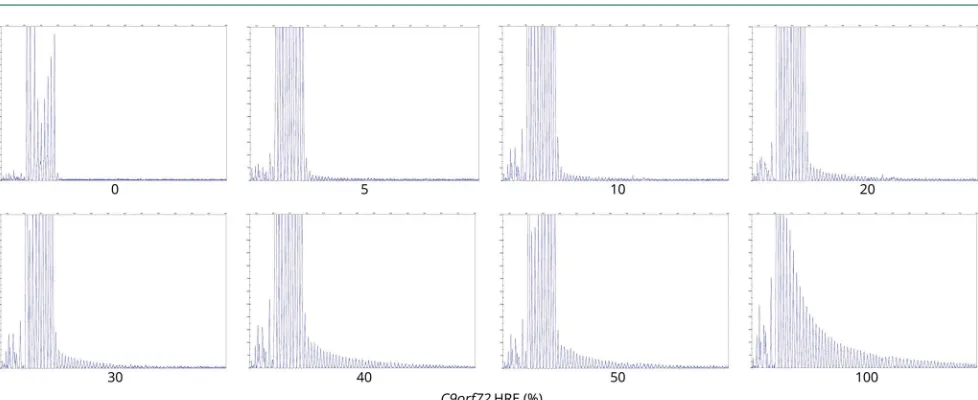
Genomic DNA from a patient previously established as aC9orf72HRE carrier was diluted in genomic DNA from an ALS patient without the HRE to generate a percentage of HRE within a sample (0%, 5%, 10%, 20%, 30%, 40%, 50%, and 100%). These dilutions were index measures for the testing of C9orf72 HRE mosaicism within a section; their RPPCR profiles enabled us to assess the sensitivity of the method for each HRE dilution. RPPCR fragment length profiles were visually compared between every spinal cord section and the mosaicism index measures.
Data availability statement
The authors confirm that the data necessary for confirming the conclusions of this study are available within the article and its supplementary material. Raw data is available upon request.
Results
Mosaicism detection
Varying proportions of theC9orf72HRE diluted in wild-type DNA displayed unique profiles on RPPCR fragment sizing Figure 1C9orf72HRE mosaicism RPPCR profiles
(figure 1). We were able to detect as low as 5% mosaicism based on the profiles generated by our assay.
Spinal sample testing
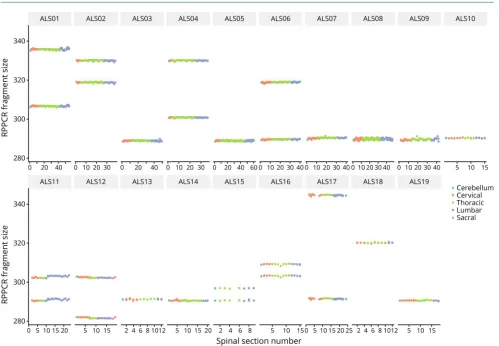
A total of 1,053 individual sections were tested by RPPCR in the spinal cords of patients with ALS. No section showed evidence ofC9orf72HRE at or above a 5% mosaicism level in any of the spinal cords tested. All sections from the same spinal cord showed the same profile of RPPCR fragments, and RPPCR peaks (chosen by the amplicon genotyping method sizing) showed that repeat sizing did not signifi -cantly change across a spinal cord (figure 2).
Discussion
Because of the high penetrance of theC9orf72HRE and the accumulation of repeat RNA fragments and dipeptide proteins,1,9its pathologic mechanism must have a strong (albeit time-dependent) effect. Therefore, there must be a threshold or concentration at which the products and effects ofC9orf72HRE are toxic to cells and tissues. It is possible that low levels of
C9orf72HRE not detectable by germline testing could be
suf-ficient to cause disease through accumulation of products.
Our study did notfind evidence forC9orf72 HRE somatic expansion in the spinal cords of patients with ALS. This does not preclude the possibility that very low levels of expansion may exist in patients with ALS. However, as we were able to detect the levels of mosaicism at or above 5%, lower-frequency somatic mutations would have had to occur late in neural tissue development.
The lengths of C9orf72 hexanucleotide repeats across all sections of the same spinal cord were identical. This result confirms that C9orf72 hexanucleotide repeats are stable when in the normal range10and that if instability does occur, it is restricted to expanded alleles.2InC9orf72 expression vectors, the number of hexanucleotide repeats has been reported to contract or expand above a critical number of repeats.4Changes in C9orf72hexanucleotide repeat length might occur more readily in artificial systems, and in human neural cells there may be a mechanism to prevent frequent alterations. Very largeC9orf72HRE can exhibit a range of repeat lengths across tissues of an individual10; however, these pathogenic expansions likely occur in most or all cells of an individual and the exact number of repeats triggering the disease remains to be established.
Figure 2RPPCR fragment sizes in the spinal cord sections of patients with ALS
Our study is limited by sample size, as it is difficult to acquire large numbers of spinal cords from patients with ALS. Based on our results, if somatic expansion occurs at the level de-tectable by our assays, it is likely that it does not account for a large proportion of ALS cases, not occurring in large clusters of neuronal cells. However, as we sampled exclusively from the ventral spinal cord, our assay did not test for somatic events in dorsal neurons or glial cells, which could be sources of pathogenic protein seeding.
Study of theC9orf72HRE remains difficult because of the technological limitations of sequencing GC-rich and re-petitive regions of the genome. Techniques such as single cell and long-read sequencing may allow detection of very low-level somatic events and precise measurement of the
C9orf72HRE length.
Acknowledgment
The authors thank the participants for their contribution to the study. The authors would like to thank Cynthia Bourassa, Fulya Akçimen, Boris Chaumette, Calwing Liao, and Qin He for their assistance in reviewing the manuscript and scientific content. Thanks are also due to Vessela Zaharieva and Cathy Mirarchi for their assistance in clinical coordination. The authors thank the Douglas Bell Canada Brain Bank (McGill University), Sunny-brook Health Sciences Centre (University of Toronto), and the Schulich School of Medicine and Dentistry of Western University for providing the material and relevant clinical information.
Study funding
Amyotrophic Lateral Sclerosis Society of Canada.
Disclosure
J.P. Ross has received a doctoral student fellowship from the ALS Society of Canada and a Canadian Institutes of Health Research Frederick Banting & Charles Best Canada Grad-uate Scholarship (FRN 159279). C.S. Leblond, H. Catoire, K. Volkening, M. Strong, L. Zinman, J. Robertson, and P.A. Dion reports no disclosures. G. A Rouleau has received support from the Canadian Institute of Health Research (CIHR). Full disclosure form information provided by the authors is available with the full text of this article at Neurology.org/NG.
Publication history
Received byNeurology: Genetics October 26, 2018. Accepted infinal form February 19, 2019.
References
1. Taylor JP, Brown RH Jr, Cleveland DW. Decoding ALS: from genes to mechanism. Nature 2016;539:197–206.
2. Pamphlett R, Cheong PL, Trent RJ, Yu B. Can ALS-associated C9orf72 repeat expansions be diagnosed on a blood DNA test alone? PLoS One 2013;8: e70007.
3. Leija-Salazar M, Piette C, Proukakis C. Review: somatic mutations in neuro-degeneration. Neuropathol Appl Neurobiol 2018;44:267–285.
4. Thys RG, Wang YH. DNA replication dynamics of the GGGGCC repeat of the C9orf72 gene. J Biol Chem 2015;290:28953–28962.
5. Westergard T, Jensen BK, Wen X, et al. Cell-to-Cell transmission of dipeptide repeat proteins linked to C9orf72-ALS/FTD. Cell Rep 2016;17:645–652.
AppendixAuthor contributions
Name Location Role Contribution
Jay P. Ross, BSc McGill University, Montr´eal, QC, Canada
Author Design and concept of study;
experimental procedures; analysis and interpretation of the data; and drafting the manuscript for intellectual content
Appendix (continued)
Name Location Role Contribution
Claire S. Leblond, PhD
Pasteur Institute, University Paris Diderot, Sorbonne Paris Cit´e, Paris, France
Author Design and concept of study;
experimental procedures; analysis and interpretation of the data; and drafting the manuscript for intellectual content
H´el`ene Catoire, PhD
McGill University, Montr´eal, QC, Canada Author Experimental procedures; and drafting the manuscript for intellectual content Kathryn Volkening, PhD
Schulich School of Medicine and Dentistry, Western University, London, Ontario, Canada. Author Experimental procedures; and drafting the manuscript for intellectual content Michael Strong, MD, FRCPC, FANN, FCAHS
Schulich School of Medicine and Dentistry, Western University, London, Ontario, Canada. Author Clinical assessment of patients; experimental procedures; and drafting the manuscript for intellectual content Lorne Zinman, MD, MSc, FRCPC Sunnybrook Health Sciences Centre, Toronto, ON, Canada
Author Clinical assessment of patients; and drafting the manuscript for intellectual content Janice Robertson,PhD University of Toronto, Toronto, ON, Canada
Author Drafting the manuscript for intellectual content
Patrick A. Dion, PhD
McGill University, Montr´eal, QC, Canada
Author Design and concept of study;
interpretation of the data; and drafting or revising the manuscript for intellectual content Guy A. Rouleau, MD PhD, FRCPC McGill University, Montr´eal, QC, Canada
Author Design and concept of study;
6. Lee MH, Siddoway B, Kaeser GE, et al. Somatic APP gene recombination in Alz-heimer’s disease and normal neurons. Nature 2018;563:639–645.
7. O’Roak BJ, Vives L, Fu W, et al. Multiplex targeted sequencing identifies recurrently mutated genes in autism spectrum disorders. Science 2012;338:1619–1622. 8. Renton AE, Majounie E, Waite A, et al. A hexanucleotide repeat expansion in C9ORF72
is the cause of chromosome 9p21-linked ALS-FTD. Neuron 2011;72:257–268.
9. DeJesus-Hernandez M, Mackenzie IR, Boeve BF, et al. Expanded GGGGCC hex-anucleotide repeat in noncoding region of C9ORF72 causes chromosome 9p-linked FTD and ALS. Neuron 2011;72:245–256.
DOI 10.1212/NXG.0000000000000317
2019;5;
Neurol Genet
Jay P. Ross, Claire S. Leblond, Hélène Catoire, et al.
cord tissues
hexanucleotide repeat does not occur in ALS spinal
C9orf72
Somatic expansion of the
This information is current as of March 20, 2019
Services
Updated Information &
http://ng.neurology.org/content/5/2/e317.full.html including high resolution figures, can be found at:
References
http://ng.neurology.org/content/5/2/e317.full.html##ref-list-1 This article cites 10 articles, 2 of which you can access for free at:
Subspecialty Collections
http://ng.neurology.org//cgi/collection/amyotrophic_lateral_sclerosis_
Amyotrophic lateral sclerosis
http://ng.neurology.org//cgi/collection/all_spinal_cord
All Spinal Cord
http://ng.neurology.org//cgi/collection/all_genetics
All Genetics
following collection(s):
This article, along with others on similar topics, appears in the
Permissions & Licensing
http://ng.neurology.org/misc/about.xhtml#permissions its entirety can be found online at:
Information about reproducing this article in parts (figures,tables) or in
Reprints
http://ng.neurology.org/misc/addir.xhtml#reprintsus Information about ordering reprints can be found online:
reserved. Online ISSN: 2376-7839.
Published by Wolters Kluwer Health, Inc. on behalf of the American Academy of Neurology.. All rights an open-access, online-only, continuous publication journal. Copyright Copyright © 2019 The Author(s).
is an official journal of the American Academy of Neurology. Published since April 2015, it is